Hotels are moving to the WhatsApp Business API to automate guest messaging, cut OTA commissions, and scale marketing without adding front desk staff.




Your guests are already on WhatsApp. They book a room and message you to ask about early check-in. They land at the airport and ask about parking. They want extra towels at 11pm. For most hotels, WhatsApp is already the busiest guest channel, often without anyone planning it that way.
Here is the problem. Most hotels run all of this on the free WhatsApp Business app, on one phone, managed by one or two people. It works until it does not. The moment you want to send a booking offer to 2,000 past guests, send a pre-arrival message for every reservation automatically, or let three staff members answer guests at once, the free app hits a wall.
That wall is why hotels are switching to the WhatsApp Business API. It is the same WhatsApp your guests use, connected to your booking system, built to send approved marketing messages at scale and automate guest communication without a person tapping send. This guide explains what the API actually changes for a hotel, where it saves you money, and what switching involves.
The WhatsApp Business API is a version of WhatsApp built for businesses that need to message guests at scale and automate those messages. Unlike the free app you install from the app store, the API has no chat screen of its own. You connect it to a platform that adds a dashboard, automation, and team access on top of it.
Three things separate the API from the free app.
You do not buy the API directly from WhatsApp in most cases. You access it through an approved provider that handles the technical side, gives you a dashboard, and connects it to your other tools. This guide focuses on why hotels move to it and what they get back.
The free WhatsApp Business app is built for a small shop with one person replying to messages. A hotel sending marketing to thousands of guests and running guest communication around the clock outgrows it fast.
Picture a Friday evening. Your reservations manager has the hotel phone. A guest messages asking to move their booking, two more ask about late check-in, and you want to send a weekend offer to last month's guests. One person, one phone, three urgent things at once. The offer never goes out, because there was no spare minute to send it. That is the ceiling most hotels run into. Here is exactly where it breaks.
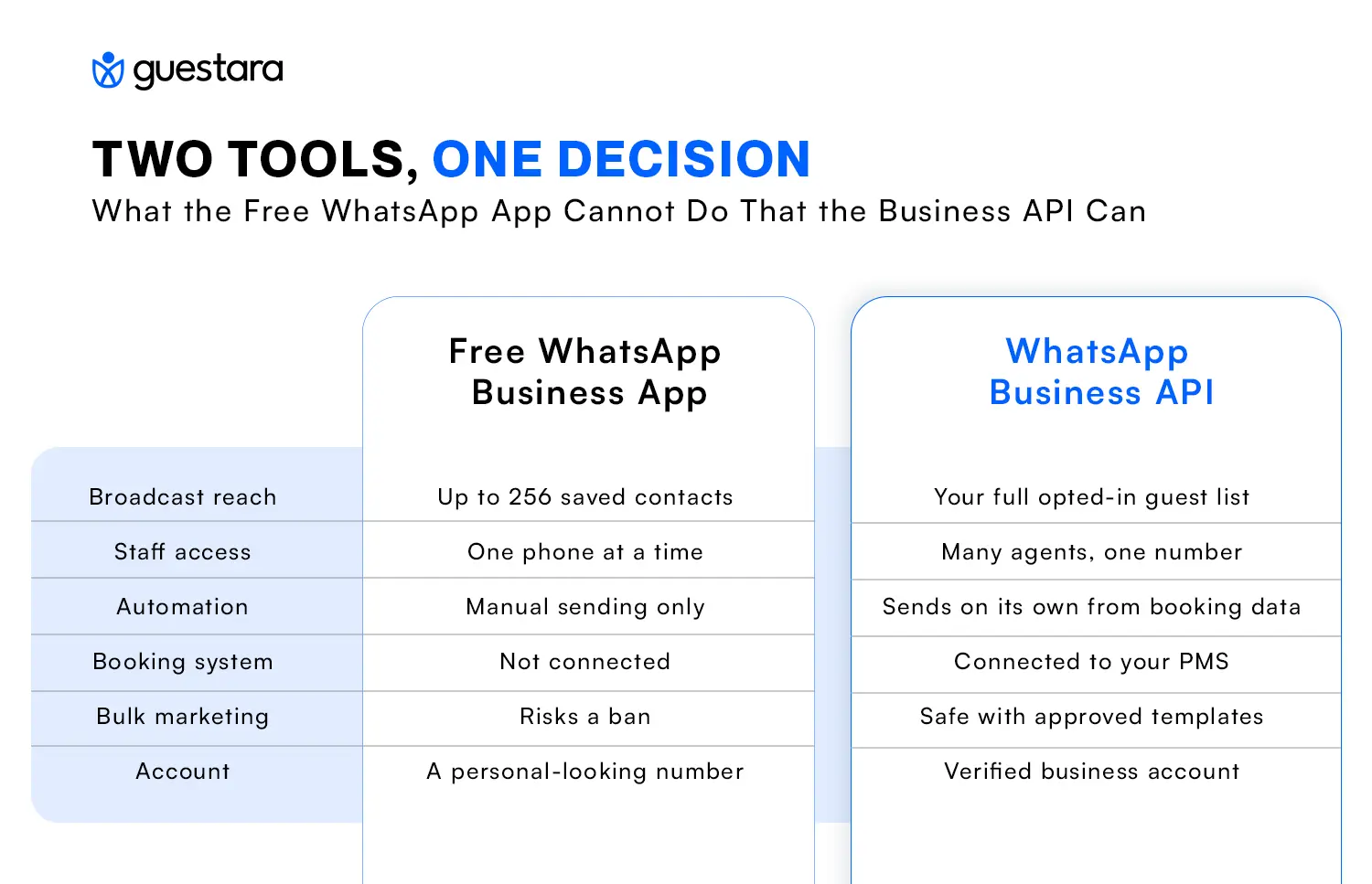
The free app limits broadcast lists to 256 recipients. Worse, your message only reaches people who have already saved your hotel's number in their phone. Most guests never do. So a broadcast to your guest list reaches a fraction of it, and the rest never see the offer.
The free app is built around one primary phone. When two front desk staff and a reservations agent all need to answer guests at once, they end up passing one phone around or logging each other out. Guests wait. Messages get missed. The busier you get, the worse it feels for the guest.
The free app offers a few canned tools like away messages and quick replies. It cannot send a check-in link 24 hours before arrival to every guest on its own. It cannot fire a review request the moment a guest checks out. Every message that matters still needs a human to remember it and send it by hand.
This is the one that catches hotels off guard. Sending bulk promotional messages from the free app, or worse from a personal number, looks like spam to WhatsApp. Numbers get flagged and banned. You can lose your main guest channel overnight, with no appeal and no way to warn the guests who relied on it.
When a hotel moves to the WhatsApp Business API, the change is not cosmetic. You go from a single shared phone to a real guest communication system. Here is what you actually get.
The API runs on a verified WhatsApp Business account. Guests see your hotel name, and often a verification badge, instead of an unsaved number. That small trust signal lifts reply rates, because guests know the message is really from you and not a scam. A name they recognise gets opened. A random number gets ignored.
You can send approved message templates to your entire opted-in guest list, not just the 256 contacts who saved your number. A seasonal offer, a flash discount on direct bookings, a festival package, all of it goes out in one campaign to everyone who agreed to hear from you. Our guide to WhatsApp broadcast campaigns walks through how to build and send these step by step.
Your whole team answers guests from the same number through one dashboard. The front desk, reservations, and the night shift all see the same conversations. Nothing gets dropped because one person was on leave with the phone in their pocket.
This is the real unlock. Connected to your PMS, the API knows who is arriving tomorrow, who just checked out, and who booked direct last year. That data is what turns WhatsApp from a chat app into a marketing engine. The next sections show what that looks like in practice.
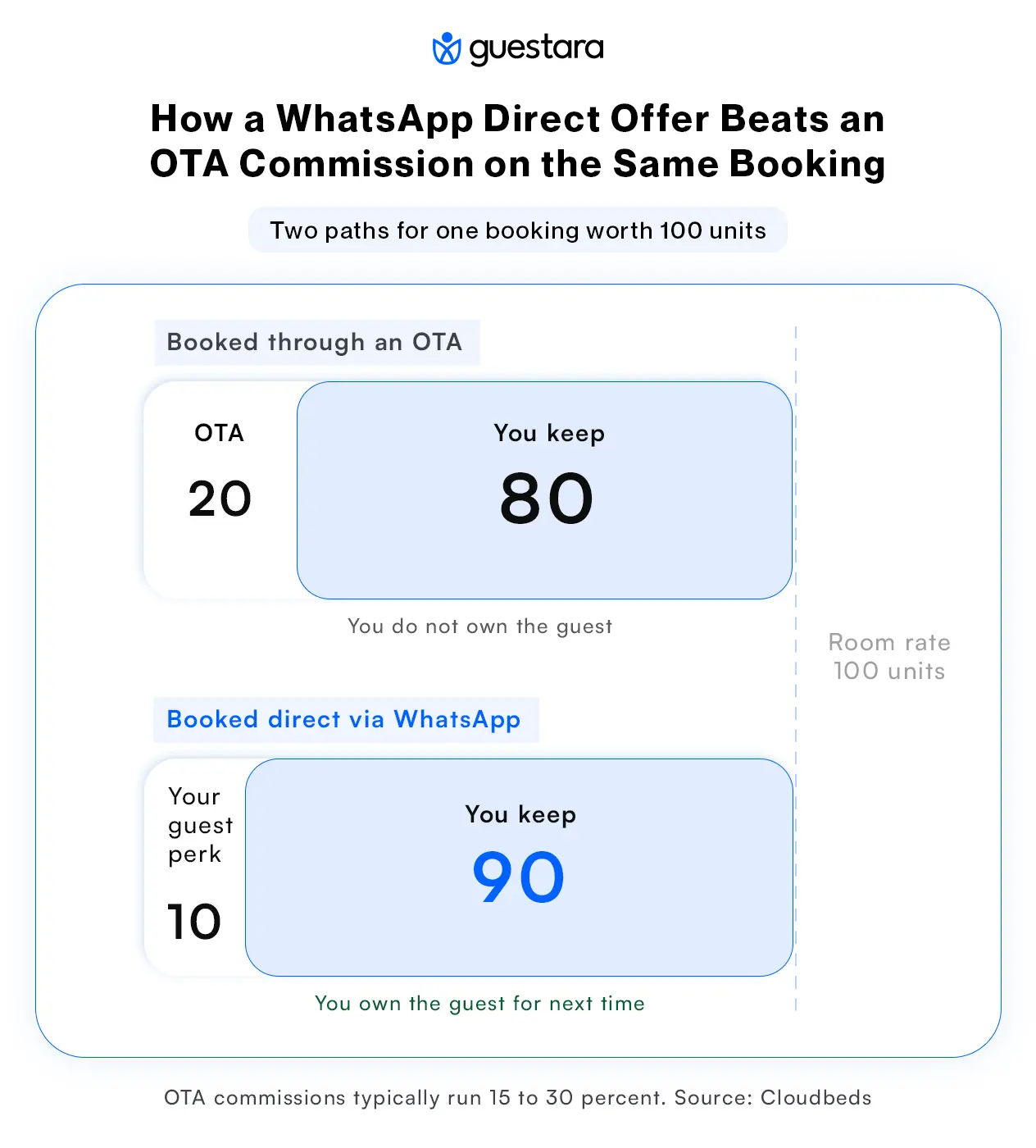
Every booking that comes through an online travel agency costs you a commission, usually 15 to 30 percent of the room rate according to Cloudbeds. The WhatsApp Business API helps you win more direct bookings, which means more of that revenue stays with you instead of the platform.
Here is how it works in practice. A guest who booked through an OTA for their last stay is sitting in your guest list. Before their next trip, you send that past guest a direct-booking offer on WhatsApp with a small perk for booking with you instead of the OTA. They book direct. You keep the full rate.
Now the math, in plain terms. Say a guest's stay is worth a base value of 100 units. Book it through an OTA at a 20 percent commission and you lose 20 units to the platform. Win that same booking direct through a WhatsApp offer that gives the guest a 10 percent perk, and you give up only 10 units while keeping the guest relationship. You come out ahead on the booking, and you own that guest for next time.
Multiply that across a season. If WhatsApp shifts even one in ten OTA bookings to direct, the commission you keep adds up to real money, not a rounding error. For the full method to calculate what your WhatsApp marketing actually returns, see our guide to measuring WhatsApp marketing ROI, and for winning back guests who almost booked and dropped off, see our retargeting guide.
The biggest reason hotels switch to the WhatsApp Business API is automation. Once it is connected to your booking data, your guest messages send themselves, triggered by what each guest does, with no one at a keyboard.
A single setup can cover the whole stay.
You build this once. It then runs for every guest, every booking, without adding a single person to your team. This is what the free app cannot do at any scale.
Picture the difference over a single day. Without the API, someone has to remember to send each check-in link, copy each guest's details, and chase each review by hand. The moment the front desk gets busy, those messages stop. With the API connected to your booking data, the same day runs itself. Every arriving guest gets their check-in link on time. Every departing guest gets a review request while the stay is fresh. Your team spends the day with the guests in front of them, not typing the same messages over and over to the ones who already left. For the full walkthrough of how to set these automated campaigns up against guest data, see our guide to automating hotel WhatsApp campaigns. The technical detail of how the API itself differs from the free app lives in our WhatsApp Business versus Business API guide.
Guestara's Guest Journey tool is built exactly for this. You set the triggers and timing once, and it handles pre-arrival, check-in, upsell, and review messages across WhatsApp for every reservation. To send the right message to the right guest rather than the same blast to everyone, pair it with proper guest segmentation.
The API does not just send messages. It drives revenue and reputation, because it puts offers and review requests in front of guests at the exact moment they are most likely to act.
When an upsell offer fires automatically at the right moment, like a room upgrade the day before arrival or a late checkout on the morning of departure, guests buy. Hotels using automated WhatsApp upsells through Guestara see up to 200 percent more upsell revenue. The offer reaches every guest at the right time, instead of depending on a front desk pitch that may never happen on a busy morning.
A review request sent on WhatsApp right after checkout gets opened and acted on far more than an email sent days later. With Guestara, the guest taps one of three buttons. Good, Average, or Bad. Happy guests go straight to Google or your OTA to post publicly. Unhappy guests trigger a private alert to your team instead, so you fix the issue before it becomes a one-star review. Hotels see up to 300 percent more positive reviews this way. The reason WhatsApp beats email for this is simple reach, which we break down in our WhatsApp open rates versus email and SMS comparison.
Switching to the WhatsApp Business API is simpler than most hotels expect. You do not need a developer or an IT team. A provider handles the technical setup, and onboarding usually takes about a week.
You connect a phone number to the API through your provider. This number becomes your official business account. The provider walks you through the verification step, so you are not left reading WhatsApp's documentation on your own.
Any business-initiated marketing message on WhatsApp uses a template that WhatsApp must approve first. Generic guides will tell you this takes anywhere from two to ten days. Through Guestara, template approval usually takes one to two hours, so you are not sitting idle for days waiting to launch a campaign you already wrote. For the official rules on templates and what WhatsApp charges to send them, see Meta's WhatsApp pricing documentation.
The value comes from your booking data, so the API connects to your PMS. Guestara works with major systems including Cloudbeds, Hotelogix, Ezee Absolute, Apaleo, Beds24, SiteMinder, Little Hotelier, and Oracle. Once connected, your guest data feeds your automated messages, and the whole journey runs off real reservations rather than a spreadsheet you update by hand.
Once these three steps are done, your automated journeys and campaigns are live. Most hotels send their first automated guest messages within a week of starting.
Yes, even a small hotel benefits from the WhatsApp Business API, as long as guest messaging is a real part of how you operate. The question is not size. It is volume and repetition.
If you are manually sending check-in details, chasing reviews, and answering the same questions every day, the API pays for itself by giving you those hours back. A 20-room boutique property running automated pre-arrival, upsell, and review messages often earns more revenue per guest than a larger hotel still doing it all by hand.
Take a simple case. A small property sends every arriving guest one automated offer for early check-in or a room upgrade. Even if only a handful of guests say yes each week, that is revenue the front desk never had the time to ask for. Run it every week of the year and it quietly adds up, with no extra staff and no extra effort after the first setup. The same goes for reviews. One automated request after every checkout, sent the same way each time, steadily lifts your rating while you do nothing.
The hotels that should wait are the ones with very low message volume and no plan to market on WhatsApp at all. For everyone else already living in WhatsApp with their guests, the free app is usually the thing holding them back, not a budget they cannot justify.
Moving to the WhatsApp Business API is less about technology and more about deciding to stop doing guest messaging by hand. The hotels switching now are not chasing a trend. They are tired of missed messages, manual review chasing, and watching OTA commissions eat their margin month after month.
Want to run guest marketing on WhatsApp without adding front desk staff? This is where a platform like Guestara helps. It connects the WhatsApp Business API to your booking system, automates your guest messages across the whole stay, and gets you live in about a week. You keep the guest experience personal while the repetitive work runs on its own.


Hotels are moving to the WhatsApp Business API to automate guest messaging, cut OTA commissions, and scale marketing without adding front desk staff.
Your guests are already on WhatsApp. They book a room and message you to ask about early check-in. They land at the airport and ask about parking. They want extra towels at 11pm. For most hotels, WhatsApp is already the busiest guest channel, often without anyone planning it that way.
Here is the problem. Most hotels run all of this on the free WhatsApp Business app, on one phone, managed by one or two people. It works until it does not. The moment you want to send a booking offer to 2,000 past guests, send a pre-arrival message for every reservation automatically, or let three staff members answer guests at once, the free app hits a wall.
That wall is why hotels are switching to the WhatsApp Business API. It is the same WhatsApp your guests use, connected to your booking system, built to send approved marketing messages at scale and automate guest communication without a person tapping send. This guide explains what the API actually changes for a hotel, where it saves you money, and what switching involves.
The WhatsApp Business API is a version of WhatsApp built for businesses that need to message guests at scale and automate those messages. Unlike the free app you install from the app store, the API has no chat screen of its own. You connect it to a platform that adds a dashboard, automation, and team access on top of it.
Three things separate the API from the free app.
You do not buy the API directly from WhatsApp in most cases. You access it through an approved provider that handles the technical side, gives you a dashboard, and connects it to your other tools. This guide focuses on why hotels move to it and what they get back.
The free WhatsApp Business app is built for a small shop with one person replying to messages. A hotel sending marketing to thousands of guests and running guest communication around the clock outgrows it fast.
Picture a Friday evening. Your reservations manager has the hotel phone. A guest messages asking to move their booking, two more ask about late check-in, and you want to send a weekend offer to last month's guests. One person, one phone, three urgent things at once. The offer never goes out, because there was no spare minute to send it. That is the ceiling most hotels run into. Here is exactly where it breaks.
The free app limits broadcast lists to 256 recipients. Worse, your message only reaches people who have already saved your hotel's number in their phone. Most guests never do. So a broadcast to your guest list reaches a fraction of it, and the rest never see the offer.
The free app is built around one primary phone. When two front desk staff and a reservations agent all need to answer guests at once, they end up passing one phone around or logging each other out. Guests wait. Messages get missed. The busier you get, the worse it feels for the guest.
The free app offers a few canned tools like away messages and quick replies. It cannot send a check-in link 24 hours before arrival to every guest on its own. It cannot fire a review request the moment a guest checks out. Every message that matters still needs a human to remember it and send it by hand.
This is the one that catches hotels off guard. Sending bulk promotional messages from the free app, or worse from a personal number, looks like spam to WhatsApp. Numbers get flagged and banned. You can lose your main guest channel overnight, with no appeal and no way to warn the guests who relied on it.
When a hotel moves to the WhatsApp Business API, the change is not cosmetic. You go from a single shared phone to a real guest communication system. Here is what you actually get.
The API runs on a verified WhatsApp Business account. Guests see your hotel name, and often a verification badge, instead of an unsaved number. That small trust signal lifts reply rates, because guests know the message is really from you and not a scam. A name they recognise gets opened. A random number gets ignored.
You can send approved message templates to your entire opted-in guest list, not just the 256 contacts who saved your number. A seasonal offer, a flash discount on direct bookings, a festival package, all of it goes out in one campaign to everyone who agreed to hear from you. Our guide to WhatsApp broadcast campaigns walks through how to build and send these step by step.
Your whole team answers guests from the same number through one dashboard. The front desk, reservations, and the night shift all see the same conversations. Nothing gets dropped because one person was on leave with the phone in their pocket.
This is the real unlock. Connected to your PMS, the API knows who is arriving tomorrow, who just checked out, and who booked direct last year. That data is what turns WhatsApp from a chat app into a marketing engine. The next sections show what that looks like in practice.
Every booking that comes through an online travel agency costs you a commission, usually 15 to 30 percent of the room rate according to Cloudbeds. The WhatsApp Business API helps you win more direct bookings, which means more of that revenue stays with you instead of the platform.
Here is how it works in practice. A guest who booked through an OTA for their last stay is sitting in your guest list. Before their next trip, you send that past guest a direct-booking offer on WhatsApp with a small perk for booking with you instead of the OTA. They book direct. You keep the full rate.
Now the math, in plain terms. Say a guest's stay is worth a base value of 100 units. Book it through an OTA at a 20 percent commission and you lose 20 units to the platform. Win that same booking direct through a WhatsApp offer that gives the guest a 10 percent perk, and you give up only 10 units while keeping the guest relationship. You come out ahead on the booking, and you own that guest for next time.
Multiply that across a season. If WhatsApp shifts even one in ten OTA bookings to direct, the commission you keep adds up to real money, not a rounding error. For the full method to calculate what your WhatsApp marketing actually returns, see our guide to measuring WhatsApp marketing ROI, and for winning back guests who almost booked and dropped off, see our retargeting guide.
The biggest reason hotels switch to the WhatsApp Business API is automation. Once it is connected to your booking data, your guest messages send themselves, triggered by what each guest does, with no one at a keyboard.
A single setup can cover the whole stay.
You build this once. It then runs for every guest, every booking, without adding a single person to your team. This is what the free app cannot do at any scale.
Picture the difference over a single day. Without the API, someone has to remember to send each check-in link, copy each guest's details, and chase each review by hand. The moment the front desk gets busy, those messages stop. With the API connected to your booking data, the same day runs itself. Every arriving guest gets their check-in link on time. Every departing guest gets a review request while the stay is fresh. Your team spends the day with the guests in front of them, not typing the same messages over and over to the ones who already left. For the full walkthrough of how to set these automated campaigns up against guest data, see our guide to automating hotel WhatsApp campaigns. The technical detail of how the API itself differs from the free app lives in our WhatsApp Business versus Business API guide.
Guestara's Guest Journey tool is built exactly for this. You set the triggers and timing once, and it handles pre-arrival, check-in, upsell, and review messages across WhatsApp for every reservation. To send the right message to the right guest rather than the same blast to everyone, pair it with proper guest segmentation.
The API does not just send messages. It drives revenue and reputation, because it puts offers and review requests in front of guests at the exact moment they are most likely to act.
When an upsell offer fires automatically at the right moment, like a room upgrade the day before arrival or a late checkout on the morning of departure, guests buy. Hotels using automated WhatsApp upsells through Guestara see up to 200 percent more upsell revenue. The offer reaches every guest at the right time, instead of depending on a front desk pitch that may never happen on a busy morning.
A review request sent on WhatsApp right after checkout gets opened and acted on far more than an email sent days later. With Guestara, the guest taps one of three buttons. Good, Average, or Bad. Happy guests go straight to Google or your OTA to post publicly. Unhappy guests trigger a private alert to your team instead, so you fix the issue before it becomes a one-star review. Hotels see up to 300 percent more positive reviews this way. The reason WhatsApp beats email for this is simple reach, which we break down in our WhatsApp open rates versus email and SMS comparison.
Switching to the WhatsApp Business API is simpler than most hotels expect. You do not need a developer or an IT team. A provider handles the technical setup, and onboarding usually takes about a week.
You connect a phone number to the API through your provider. This number becomes your official business account. The provider walks you through the verification step, so you are not left reading WhatsApp's documentation on your own.
Any business-initiated marketing message on WhatsApp uses a template that WhatsApp must approve first. Generic guides will tell you this takes anywhere from two to ten days. Through Guestara, template approval usually takes one to two hours, so you are not sitting idle for days waiting to launch a campaign you already wrote. For the official rules on templates and what WhatsApp charges to send them, see Meta's WhatsApp pricing documentation.
The value comes from your booking data, so the API connects to your PMS. Guestara works with major systems including Cloudbeds, Hotelogix, Ezee Absolute, Apaleo, Beds24, SiteMinder, Little Hotelier, and Oracle. Once connected, your guest data feeds your automated messages, and the whole journey runs off real reservations rather than a spreadsheet you update by hand.
Once these three steps are done, your automated journeys and campaigns are live. Most hotels send their first automated guest messages within a week of starting.
Yes, even a small hotel benefits from the WhatsApp Business API, as long as guest messaging is a real part of how you operate. The question is not size. It is volume and repetition.
If you are manually sending check-in details, chasing reviews, and answering the same questions every day, the API pays for itself by giving you those hours back. A 20-room boutique property running automated pre-arrival, upsell, and review messages often earns more revenue per guest than a larger hotel still doing it all by hand.
Take a simple case. A small property sends every arriving guest one automated offer for early check-in or a room upgrade. Even if only a handful of guests say yes each week, that is revenue the front desk never had the time to ask for. Run it every week of the year and it quietly adds up, with no extra staff and no extra effort after the first setup. The same goes for reviews. One automated request after every checkout, sent the same way each time, steadily lifts your rating while you do nothing.
The hotels that should wait are the ones with very low message volume and no plan to market on WhatsApp at all. For everyone else already living in WhatsApp with their guests, the free app is usually the thing holding them back, not a budget they cannot justify.
Moving to the WhatsApp Business API is less about technology and more about deciding to stop doing guest messaging by hand. The hotels switching now are not chasing a trend. They are tired of missed messages, manual review chasing, and watching OTA commissions eat their margin month after month.
Want to run guest marketing on WhatsApp without adding front desk staff? This is where a platform like Guestara helps. It connects the WhatsApp Business API to your booking system, automates your guest messages across the whole stay, and gets you live in about a week. You keep the guest experience personal while the repetitive work runs on its own.
The WhatsApp Business app is a free app for small businesses, built around one phone with basic tools like quick replies and broadcast lists capped at 256 contacts. The WhatsApp Business API is built for scale and automation. It lets many staff answer from one number, send approved marketing messages to large opted-in audiences, and connect to your booking system so messages send automatically. The app is run by hand. The API runs on its own.
The WhatsApp Business API has no fixed subscription fee from WhatsApp itself, but it is not entirely free. WhatsApp charges a small fee for the messages you send to guests, and the provider you use to access the API charges for their platform and tools. For most hotels the cost is small next to the OTA commissions saved and the staff hours freed up by automation.
Yes, you can send marketing messages on the WhatsApp Business API, as long as the guest has opted in to hear from you and the message uses a template that WhatsApp has approved. This is what makes the API safe for hotel marketing, unlike the free app where bulk promotion can get your number banned. Approved templates can include seasonal offers, direct-booking discounts, and package promotions sent to your whole opted-in guest list.
No, you do not need a developer to set up the WhatsApp Business API. You access it through a provider that handles the technical setup, number verification, and connection to your booking system for you. Most hotels are up and running within about a week, without writing any code or hiring IT staff.
Yes, the WhatsApp Business API can connect to your hotel PMS through a platform built for hotels. Guestara connects with major systems including Cloudbeds, Hotelogix, Ezee Absolute, Apaleo, Beds24, SiteMinder, Little Hotelier, and Oracle. Once connected, your guest messages send automatically based on real booking data, like a check-in link before arrival or a review request after checkout.
We work closely with the industry leaders to offer seamless solutions




We’re here to help your whole team stay ahead of the curve as you grow.

Get up and running quickly with a personalized onboarding plan

Connect with real people who really get it, 24/7

Checkout our vast library of free resources, templates and more
There's only so much we can say — so let us show you! Schedule a demo today and reach your business goals.


.png)