Learn what AI-powered WhatsApp campaigns for hotels really do, from conversation-based auto-tagging to faster template creation, and where AI still falls short.




Most WhatsApp platforms now call themselves AI-powered. Very few explain what the AI actually does. This guide does exactly that.
AI-powered WhatsApp campaigns for hotels are campaigns where AI handles three specific jobs. It tags guests into segments based on how they interact with your chatbot. It drafts template messages from simple prompts. And it answers routine guest replies around the clock, escalating to your team when needed. Everything else behind a modern WhatsApp campaign, the triggers, the scheduling, the audience filters, is rules-based automation. It works brilliantly. It is just not AI.
Knowing the difference matters. You have probably sat through a demo where every second feature had the word smart in front of it. When you know which parts are genuinely AI and which parts are filters with a nicer name, you ask better questions, buy the right tool, and set expectations your team can actually meet.
An AI-powered WhatsApp campaign is a broadcast or automated message flow where artificial intelligence performs at least one real task that a rules engine cannot. In hotel WhatsApp marketing today, that means three tasks: building segments from guest conversations, generating message templates, and handling two-way replies automatically.
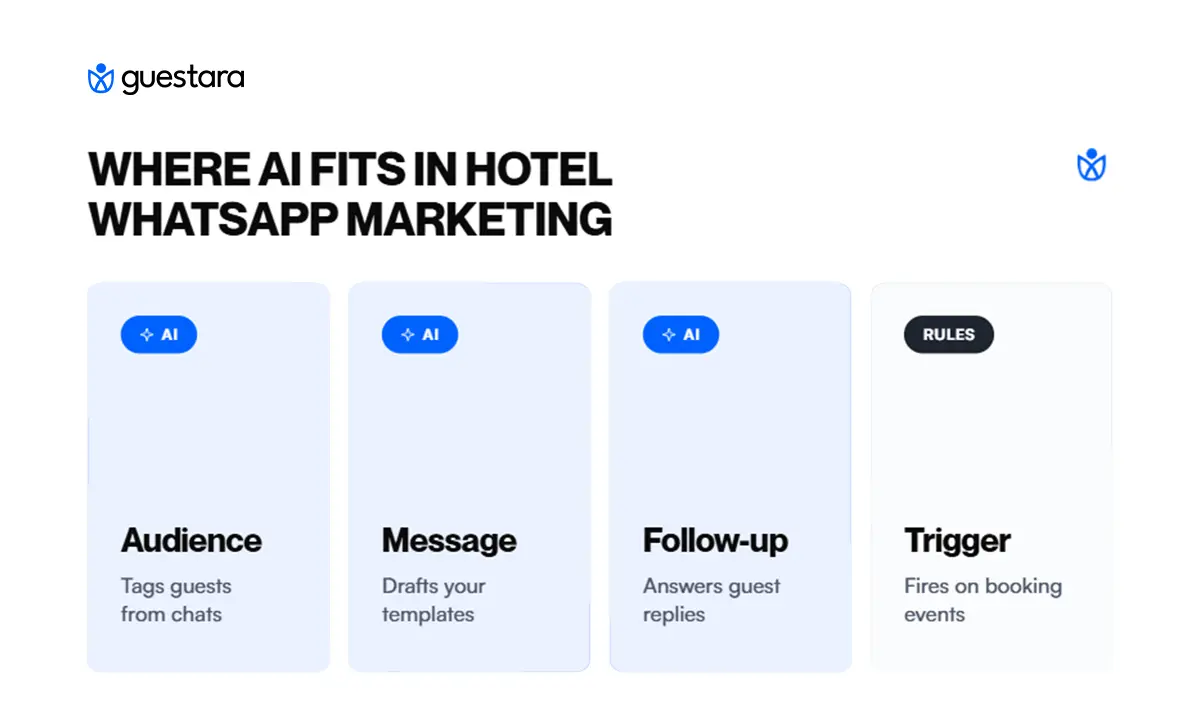
To see where AI fits, break any WhatsApp campaign into its four moving parts.
Here is the honest map. AI genuinely helps with the audience, because chatbot conversations can tag guests into segments without anyone touching a spreadsheet. AI genuinely helps with the message, because it can draft template copy from a short prompt. AI genuinely helps with the follow-up, because a chatbot can answer replies instantly at 2am.
The trigger is different. Triggers in hotel WhatsApp marketing are rules tied to booking events. Booking confirmed, three days before arrival, day of checkout. No AI decides those moments, and it does not need to. Your property management system already knows exactly where each guest sits in their journey, which is more reliable than any prediction.
So a truthful definition looks like this. AI-powered WhatsApp campaigns for hotels combine rules-based triggers built on booking data with AI that segments guests through conversation, drafts the copy, and manages replies. That combination is real, available now, and worth using. Anything promising more than that deserves a hard second look, and later in this guide you will see exactly which claims to question.
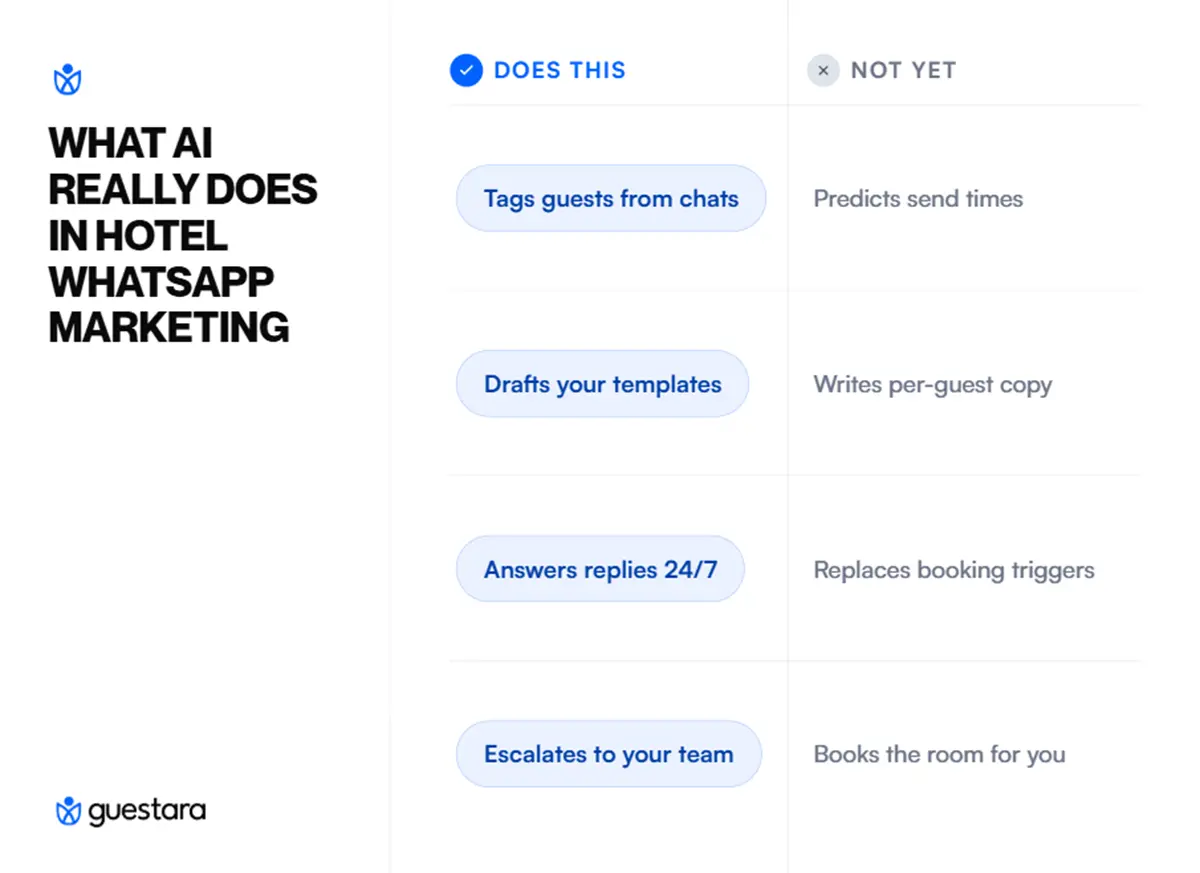
AI earns its place in three parts of hotel WhatsApp marketing today. Each one removes a manual job your team is currently doing by hand, or not doing at all.
When a guest interacts with your WhatsApp chatbot, the bot can apply tags and update guest attributes based on the answers they choose. A guest who taps an option about spa offers gets tagged with that interest. A guest who asks about airport pickup gets tagged as an arrival-service prospect.
No staff member reads the chat and updates a list. The segment builds itself while the conversation happens. Over weeks, your audience quietly sorts itself into groups defined by what guests actually said they wanted, which is stronger targeting data than anything a booking form captures.
WhatsApp marketing runs on pre-approved template messages. Writing them used to mean staring at a blank box, guessing at character limits, and hoping the tone landed. AI template generation changes that. You describe the campaign in a sentence, and the system drafts template copy you can edit and submit.
The draft is a starting point, not a finished product. You still sharpen the offer, fix the voice, and make it sound like your property. But starting from a working draft instead of a blank screen cuts template creation from an afternoon to minutes.
Every broadcast triggers replies. Questions about the offer, the dates, the cancellation terms. A chatbot trained on your property information answers those instantly, at any hour, and passes anything complex to a human. Guests get answers in seconds. Your front desk stops drowning in repeat questions every time a campaign goes out.
One thing worth naming plainly. When platforms advertise smart segmentation, they usually mean attribute filters, the ability to combine conditions like room type, booking source, and last activity with AND and OR logic. Those filters are essential, and you should demand them. They are just not artificial intelligence, and a vendor who blurs that line in a demo is telling you something about how they communicate.

Conversation-based tagging turns your chatbot into a segmentation engine. Every guest interaction becomes a data point that files the guest into the right audience for future campaigns, without manual list work.
There is a reason this matters more on WhatsApp than anywhere else. Meta commissioned Kantar to survey over 11,000 consumers across 22 markets, and 73.3 percent said they prefer messaging when communicating with a business. The same research found 72.4 percent are more likely to buy from brands that offer messaging. Your guests are already talking to you in this channel. Auto-tagging simply makes sure nothing they tell you gets lost.
The mechanism is simple. You build a chatbot flow with choice buttons or open questions. Each answer path carries an instruction: apply this tag, or update this attribute. When a guest picks an answer, the tag lands on their profile instantly.
From that moment, the guest belongs to a live segment you can broadcast to. The tag persists across campaigns, so a guest who showed interest in spa offers in March is still in your spa segment when the monsoon package launches in July.
Say your pre-arrival message asks guests what would make their stay better, with three buttons: spa and wellness, dining experiences, or local activities.
Out of 100 guests who respond, imagine 38 tap spa, 41 tap dining, and 21 tap activities. Your chatbot has just built three segments while your team slept. Two weeks later, you launch a couples spa package. Instead of broadcasting to your full list, you send it to the 38 spa-tagged guests.
The difference shows up immediately in your numbers. A tightly matched offer to a self-declared interest group consistently earns higher read and reply rates than the same offer sprayed across everyone, and it protects your sender quality rating because fewer guests ignore or block you. If you want the full framework for designing segments beyond conversation tags, our guide on how to segment hotel guests on WhatsApp covers the complete approach.
Tagging works after the stay too, and this is where repeat business hides. Add one question to your post-checkout flow: what did you enjoy most, with buttons for rooms, dining, and service.
Every guest who taps dining is now flagged as someone your restaurant impressed. Six weeks later, your chef launches a weekend tasting menu. You do not blast the full past-guest list. You message the dining-tagged guests, referencing the experience they told you they loved.
That message reads like a personal invitation, not a promotion, because it is built on something the guest actually said. Past guests who felt heard book again at a rate no cold campaign matches. And the tag cost your team nothing to collect, because the chatbot filed it the moment the guest answered.
Conversation tags become far more powerful when you combine them with booking attributes through simple filter logic. Spa tag AND arrival within 14 days gives you a pre-arrival upsell audience. Dining tag AND past guest gives you a comeback campaign for food lovers.
The tags capture intent. The booking data captures timing and context. Filters combine them into audiences that feel almost handpicked, with zero hand-picking. This layering works best when your campaigns already run on automated journeys tied to guest data, which we break down in our post on automating WhatsApp campaigns with guest data.
AI removes the two slowest steps in getting a WhatsApp campaign out the door: writing the template and waiting for approval.
Template writing has quiet failure modes. Copy that reads like spam gets rejected by Meta. Copy that reads too formal gets ignored by guests. Placeholders formatted wrong break personalization.
AI-assisted template generation starts you past those traps. You describe what you need, for example a friendly pre-arrival message offering early check-in for a beach resort, and the system produces structured template copy with placeholders in the right format. You edit for voice, add your offer details, and submit.
The practical gain is speed and consistency. A revenue manager who needs five seasonal templates no longer blocks an afternoon for it. And because drafts follow template formatting rules from the start, fewer submissions bounce back.
Every marketing template needs Meta approval before it can send. Generic WhatsApp guides quote approval windows of 2 to 10 days, which is long enough to kill a flash offer or a last-minute occupancy push.
Through Guestara, template approval typically completes in 1 to 2 hours. That gap changes what campaigns are possible. A rainy weekend forecast on Thursday can become a spa-and-stay offer broadcasting by Thursday evening, not a missed opportunity approved the following week.
Fast approval plus AI drafting means the whole cycle, from campaign idea to approved template, fits inside a single morning. For the full sending process once your template clears, our step-by-step WhatsApp broadcast guide for hotels walks through every screen.
Two capabilities that vendors imply, and buyers assume, do not actually exist in hotel WhatsApp marketing today. Knowing them protects you from paying for promises, and each one has a working alternative that performs well right now.
No hotel WhatsApp platform today uses AI to predict the best send time for each individual guest. What platforms offer is scheduling, the ability to plan broadcasts in advance across time zones. Scheduling is useful. It is not prediction.
Here is why that gap barely matters for hotels. Email marketers need send-time prediction because they are guessing when someone might check a cluttered inbox. Hotels do not have to guess. Your booking data tells you the moments that matter: the day the booking lands, the week before arrival, the morning of checkout. A message triggered by a real booking event will beat a message sent at an AI-predicted clock time, because relevance beats timing every time.
The working alternative: anchor every campaign to a booking event trigger, then use scheduling to respect quiet hours. That combination gets you most of what send-time AI would theoretically offer, using tools that exist today.
No platform in this category writes a unique message for each individual guest. What exists is merge-field personalization, inserting the guest name, booking dates, or room type into one template, plus AI that helps draft the template itself. The template is still one message going to many people.
The expectation gap is real, because guests genuinely want personal treatment. McKinsey research found that 71 percent of consumers expect personalized interactions from companies, and 76 percent get frustrated when they do not receive them. AI-generated copy at the individual level is also showing early promise outside hospitality. In a McKinsey-documented telecom case, customers receiving gen AI-enhanced personalized campaign messages engaged and took action 10 percent more often than customers who did not. That is a telecom result, not a hotel one, but it signals where messaging is heading.
Until it arrives in this category, the working alternative is segment tightness. A message to 38 spa-tagged guests that opens with their name and references their arrival date feels personal, because the segment did the personalizing. Ten sharp segments with matched offers will outperform one clever template sent to everyone, and no AI is required to build them.
Treat both of these gaps as a buying filter. Vendors rarely lie outright, but demos are built to let assumptions do the work. Five questions cut through it.
A vendor with real capability answers these in the product, not in a follow-up email. A vendor who reaches for the roadmap slide has answered too, just not the way they intended. Either way, you walk out of the demo knowing exactly what you are buying, which is the entire point of understanding where AI genuinely works.
The fastest way to understand AI-powered WhatsApp campaigns for hotels is to run one. This walkthrough uses only capabilities that exist today, and you can complete the setup in an afternoon.
Every guest you message must have opted in to receive WhatsApp communication from your property. This is not optional. Meta enforces it through your quality rating, and one broadcast to a cold list can restrict your sending limits for weeks.
The cleanest opt-in moments are booking confirmation, your pre-arrival email, and check-in. A single line and a checkbox is enough. If your list predates your opt-in process, run a permission campaign first and message only the guests who confirm. Slower, but your sender reputation is the asset every campaign in this guide depends on.
Choose a single moment where guests already message you or can be invited to. The pre-arrival window works best, because response rates peak when a stay is imminent. Your entry message might ask one question with three tappable interest options.
Keep it to one question. Every extra step cuts completion.
Create the chatbot flow so each answer applies a tag or updates an attribute on the guest profile. Three interest buttons means three tags. Add one fallback path that hands unclear replies to a team member, so no guest hits a dead end.
This step is where the AI layer starts working for you. From now on, every guest who responds is segmenting themselves.
Once tags accumulate, pick your first offer and match it to one tag group. Use AI template generation to draft the message, then edit it until it sounds like your property. Include the guest name placeholder and one clear call to action, either a reply button or a direct booking link.
Submit for approval. With approval running in 1 to 2 hours through Guestara, your template is typically ready the same morning you write it.
Filter your audience to the single tag you are targeting, add any booking-data condition that sharpens it, such as upcoming arrivals only, and send or schedule the broadcast. Resist the urge to widen the audience to boost reach. The entire point of this campaign is relevance, and your quality rating depends on it.
After 48 hours, your campaign data splits guests into behavior groups: read but did not reply, replied with interest, clicked but did not book. Each group deserves a different follow-up, and reply-based retargeting lets you send it. A gentle nudge to readers, a booking link to interested repliers, an assist message to clickers who stalled.
This follow-up layer is where campaigns quietly double their results. Our full guide on WhatsApp retargeting for hotels covers the sequences that recover drop-offs.
Measure AI the same way you would measure a new staff member: compare results with and without it. The cleanest test is a holdout comparison between your AI-built segment and your general list.
Run it like this. Send the same offer to two audiences in the same week. Audience one is your conversation-tagged segment. Audience two is a slice of your general list with no tag filter. Then compare four numbers: read rate, reply rate, click rate, and completed bookings.
A worked example with percentages. Suppose the tagged segment reads at 85 percent, replies at 22 percent, and converts 6 percent to bookings, while the general slice reads at 70 percent, replies at 8 percent, and converts 2 percent. The tagged audience is producing three times the conversion rate. That multiple, not any single campaign's revenue, is the number that proves the AI tagging layer is earning its keep.
Track the comparison over three or four campaigns before drawing conclusions, because single sends swing on offer quality and timing. And watch one guardrail metric alongside the wins: your block and opt-out rate. Tight segments should push it down. If it rises, your tagging logic needs fixing, not your offers.
For the complete measurement framework, including how to attribute bookings to campaigns correctly, see our guide on measuring hotel WhatsApp marketing ROI.
AI in hotel WhatsApp marketing is real, useful, and narrower than the marketing around it suggests. It builds segments from conversations, drafts your templates, and answers guest replies at any hour. It does not predict send times and it does not write individual messages per guest, no matter what a demo implies.
The hotels winning with WhatsApp right now are not waiting for those future capabilities. They are combining the AI that exists with disciplined rules-based automation: booking-event triggers, tight segments, fast template approval, and reply-based follow-ups. That stack is available today and it compounds with every guest conversation.
Want to see what that looks like on your own guest list? Guestara gives hotels conversation-based tagging, AI-assisted template drafting, and template approval in 1 to 2 hours, built specifically for how hotels run campaigns. And if you are earlier in the journey, start with our complete guide to hotel WhatsApp marketing.


Learn what AI-powered WhatsApp campaigns for hotels really do, from conversation-based auto-tagging to faster template creation, and where AI still falls short.
Most WhatsApp platforms now call themselves AI-powered. Very few explain what the AI actually does. This guide does exactly that.
AI-powered WhatsApp campaigns for hotels are campaigns where AI handles three specific jobs. It tags guests into segments based on how they interact with your chatbot. It drafts template messages from simple prompts. And it answers routine guest replies around the clock, escalating to your team when needed. Everything else behind a modern WhatsApp campaign, the triggers, the scheduling, the audience filters, is rules-based automation. It works brilliantly. It is just not AI.
Knowing the difference matters. You have probably sat through a demo where every second feature had the word smart in front of it. When you know which parts are genuinely AI and which parts are filters with a nicer name, you ask better questions, buy the right tool, and set expectations your team can actually meet.
An AI-powered WhatsApp campaign is a broadcast or automated message flow where artificial intelligence performs at least one real task that a rules engine cannot. In hotel WhatsApp marketing today, that means three tasks: building segments from guest conversations, generating message templates, and handling two-way replies automatically.
To see where AI fits, break any WhatsApp campaign into its four moving parts.
Here is the honest map. AI genuinely helps with the audience, because chatbot conversations can tag guests into segments without anyone touching a spreadsheet. AI genuinely helps with the message, because it can draft template copy from a short prompt. AI genuinely helps with the follow-up, because a chatbot can answer replies instantly at 2am.
The trigger is different. Triggers in hotel WhatsApp marketing are rules tied to booking events. Booking confirmed, three days before arrival, day of checkout. No AI decides those moments, and it does not need to. Your property management system already knows exactly where each guest sits in their journey, which is more reliable than any prediction.
So a truthful definition looks like this. AI-powered WhatsApp campaigns for hotels combine rules-based triggers built on booking data with AI that segments guests through conversation, drafts the copy, and manages replies. That combination is real, available now, and worth using. Anything promising more than that deserves a hard second look, and later in this guide you will see exactly which claims to question.
AI earns its place in three parts of hotel WhatsApp marketing today. Each one removes a manual job your team is currently doing by hand, or not doing at all.
When a guest interacts with your WhatsApp chatbot, the bot can apply tags and update guest attributes based on the answers they choose. A guest who taps an option about spa offers gets tagged with that interest. A guest who asks about airport pickup gets tagged as an arrival-service prospect.
No staff member reads the chat and updates a list. The segment builds itself while the conversation happens. Over weeks, your audience quietly sorts itself into groups defined by what guests actually said they wanted, which is stronger targeting data than anything a booking form captures.
WhatsApp marketing runs on pre-approved template messages. Writing them used to mean staring at a blank box, guessing at character limits, and hoping the tone landed. AI template generation changes that. You describe the campaign in a sentence, and the system drafts template copy you can edit and submit.
The draft is a starting point, not a finished product. You still sharpen the offer, fix the voice, and make it sound like your property. But starting from a working draft instead of a blank screen cuts template creation from an afternoon to minutes.
Every broadcast triggers replies. Questions about the offer, the dates, the cancellation terms. A chatbot trained on your property information answers those instantly, at any hour, and passes anything complex to a human. Guests get answers in seconds. Your front desk stops drowning in repeat questions every time a campaign goes out.
One thing worth naming plainly. When platforms advertise smart segmentation, they usually mean attribute filters, the ability to combine conditions like room type, booking source, and last activity with AND and OR logic. Those filters are essential, and you should demand them. They are just not artificial intelligence, and a vendor who blurs that line in a demo is telling you something about how they communicate.
Conversation-based tagging turns your chatbot into a segmentation engine. Every guest interaction becomes a data point that files the guest into the right audience for future campaigns, without manual list work.
There is a reason this matters more on WhatsApp than anywhere else. Meta commissioned Kantar to survey over 11,000 consumers across 22 markets, and 73.3 percent said they prefer messaging when communicating with a business. The same research found 72.4 percent are more likely to buy from brands that offer messaging. Your guests are already talking to you in this channel. Auto-tagging simply makes sure nothing they tell you gets lost.
The mechanism is simple. You build a chatbot flow with choice buttons or open questions. Each answer path carries an instruction: apply this tag, or update this attribute. When a guest picks an answer, the tag lands on their profile instantly.
From that moment, the guest belongs to a live segment you can broadcast to. The tag persists across campaigns, so a guest who showed interest in spa offers in March is still in your spa segment when the monsoon package launches in July.
Say your pre-arrival message asks guests what would make their stay better, with three buttons: spa and wellness, dining experiences, or local activities.
Out of 100 guests who respond, imagine 38 tap spa, 41 tap dining, and 21 tap activities. Your chatbot has just built three segments while your team slept. Two weeks later, you launch a couples spa package. Instead of broadcasting to your full list, you send it to the 38 spa-tagged guests.
The difference shows up immediately in your numbers. A tightly matched offer to a self-declared interest group consistently earns higher read and reply rates than the same offer sprayed across everyone, and it protects your sender quality rating because fewer guests ignore or block you. If you want the full framework for designing segments beyond conversation tags, our guide on how to segment hotel guests on WhatsApp covers the complete approach.
Tagging works after the stay too, and this is where repeat business hides. Add one question to your post-checkout flow: what did you enjoy most, with buttons for rooms, dining, and service.
Every guest who taps dining is now flagged as someone your restaurant impressed. Six weeks later, your chef launches a weekend tasting menu. You do not blast the full past-guest list. You message the dining-tagged guests, referencing the experience they told you they loved.
That message reads like a personal invitation, not a promotion, because it is built on something the guest actually said. Past guests who felt heard book again at a rate no cold campaign matches. And the tag cost your team nothing to collect, because the chatbot filed it the moment the guest answered.
Conversation tags become far more powerful when you combine them with booking attributes through simple filter logic. Spa tag AND arrival within 14 days gives you a pre-arrival upsell audience. Dining tag AND past guest gives you a comeback campaign for food lovers.
The tags capture intent. The booking data captures timing and context. Filters combine them into audiences that feel almost handpicked, with zero hand-picking. This layering works best when your campaigns already run on automated journeys tied to guest data, which we break down in our post on automating WhatsApp campaigns with guest data.
AI removes the two slowest steps in getting a WhatsApp campaign out the door: writing the template and waiting for approval.
Template writing has quiet failure modes. Copy that reads like spam gets rejected by Meta. Copy that reads too formal gets ignored by guests. Placeholders formatted wrong break personalization.
AI-assisted template generation starts you past those traps. You describe what you need, for example a friendly pre-arrival message offering early check-in for a beach resort, and the system produces structured template copy with placeholders in the right format. You edit for voice, add your offer details, and submit.
The practical gain is speed and consistency. A revenue manager who needs five seasonal templates no longer blocks an afternoon for it. And because drafts follow template formatting rules from the start, fewer submissions bounce back.
Every marketing template needs Meta approval before it can send. Generic WhatsApp guides quote approval windows of 2 to 10 days, which is long enough to kill a flash offer or a last-minute occupancy push.
Through Guestara, template approval typically completes in 1 to 2 hours. That gap changes what campaigns are possible. A rainy weekend forecast on Thursday can become a spa-and-stay offer broadcasting by Thursday evening, not a missed opportunity approved the following week.
Fast approval plus AI drafting means the whole cycle, from campaign idea to approved template, fits inside a single morning. For the full sending process once your template clears, our step-by-step WhatsApp broadcast guide for hotels walks through every screen.
Two capabilities that vendors imply, and buyers assume, do not actually exist in hotel WhatsApp marketing today. Knowing them protects you from paying for promises, and each one has a working alternative that performs well right now.
No hotel WhatsApp platform today uses AI to predict the best send time for each individual guest. What platforms offer is scheduling, the ability to plan broadcasts in advance across time zones. Scheduling is useful. It is not prediction.
Here is why that gap barely matters for hotels. Email marketers need send-time prediction because they are guessing when someone might check a cluttered inbox. Hotels do not have to guess. Your booking data tells you the moments that matter: the day the booking lands, the week before arrival, the morning of checkout. A message triggered by a real booking event will beat a message sent at an AI-predicted clock time, because relevance beats timing every time.
The working alternative: anchor every campaign to a booking event trigger, then use scheduling to respect quiet hours. That combination gets you most of what send-time AI would theoretically offer, using tools that exist today.
No platform in this category writes a unique message for each individual guest. What exists is merge-field personalization, inserting the guest name, booking dates, or room type into one template, plus AI that helps draft the template itself. The template is still one message going to many people.
The expectation gap is real, because guests genuinely want personal treatment. McKinsey research found that 71 percent of consumers expect personalized interactions from companies, and 76 percent get frustrated when they do not receive them. AI-generated copy at the individual level is also showing early promise outside hospitality. In a McKinsey-documented telecom case, customers receiving gen AI-enhanced personalized campaign messages engaged and took action 10 percent more often than customers who did not. That is a telecom result, not a hotel one, but it signals where messaging is heading.
Until it arrives in this category, the working alternative is segment tightness. A message to 38 spa-tagged guests that opens with their name and references their arrival date feels personal, because the segment did the personalizing. Ten sharp segments with matched offers will outperform one clever template sent to everyone, and no AI is required to build them.
Treat both of these gaps as a buying filter. Vendors rarely lie outright, but demos are built to let assumptions do the work. Five questions cut through it.
A vendor with real capability answers these in the product, not in a follow-up email. A vendor who reaches for the roadmap slide has answered too, just not the way they intended. Either way, you walk out of the demo knowing exactly what you are buying, which is the entire point of understanding where AI genuinely works.
The fastest way to understand AI-powered WhatsApp campaigns for hotels is to run one. This walkthrough uses only capabilities that exist today, and you can complete the setup in an afternoon.
Every guest you message must have opted in to receive WhatsApp communication from your property. This is not optional. Meta enforces it through your quality rating, and one broadcast to a cold list can restrict your sending limits for weeks.
The cleanest opt-in moments are booking confirmation, your pre-arrival email, and check-in. A single line and a checkbox is enough. If your list predates your opt-in process, run a permission campaign first and message only the guests who confirm. Slower, but your sender reputation is the asset every campaign in this guide depends on.
Choose a single moment where guests already message you or can be invited to. The pre-arrival window works best, because response rates peak when a stay is imminent. Your entry message might ask one question with three tappable interest options.
Keep it to one question. Every extra step cuts completion.
Create the chatbot flow so each answer applies a tag or updates an attribute on the guest profile. Three interest buttons means three tags. Add one fallback path that hands unclear replies to a team member, so no guest hits a dead end.
This step is where the AI layer starts working for you. From now on, every guest who responds is segmenting themselves.
Once tags accumulate, pick your first offer and match it to one tag group. Use AI template generation to draft the message, then edit it until it sounds like your property. Include the guest name placeholder and one clear call to action, either a reply button or a direct booking link.
Submit for approval. With approval running in 1 to 2 hours through Guestara, your template is typically ready the same morning you write it.
Filter your audience to the single tag you are targeting, add any booking-data condition that sharpens it, such as upcoming arrivals only, and send or schedule the broadcast. Resist the urge to widen the audience to boost reach. The entire point of this campaign is relevance, and your quality rating depends on it.
After 48 hours, your campaign data splits guests into behavior groups: read but did not reply, replied with interest, clicked but did not book. Each group deserves a different follow-up, and reply-based retargeting lets you send it. A gentle nudge to readers, a booking link to interested repliers, an assist message to clickers who stalled.
This follow-up layer is where campaigns quietly double their results. Our full guide on WhatsApp retargeting for hotels covers the sequences that recover drop-offs.
Measure AI the same way you would measure a new staff member: compare results with and without it. The cleanest test is a holdout comparison between your AI-built segment and your general list.
Run it like this. Send the same offer to two audiences in the same week. Audience one is your conversation-tagged segment. Audience two is a slice of your general list with no tag filter. Then compare four numbers: read rate, reply rate, click rate, and completed bookings.
A worked example with percentages. Suppose the tagged segment reads at 85 percent, replies at 22 percent, and converts 6 percent to bookings, while the general slice reads at 70 percent, replies at 8 percent, and converts 2 percent. The tagged audience is producing three times the conversion rate. That multiple, not any single campaign's revenue, is the number that proves the AI tagging layer is earning its keep.
Track the comparison over three or four campaigns before drawing conclusions, because single sends swing on offer quality and timing. And watch one guardrail metric alongside the wins: your block and opt-out rate. Tight segments should push it down. If it rises, your tagging logic needs fixing, not your offers.
For the complete measurement framework, including how to attribute bookings to campaigns correctly, see our guide on measuring hotel WhatsApp marketing ROI.
AI in hotel WhatsApp marketing is real, useful, and narrower than the marketing around it suggests. It builds segments from conversations, drafts your templates, and answers guest replies at any hour. It does not predict send times and it does not write individual messages per guest, no matter what a demo implies.
The hotels winning with WhatsApp right now are not waiting for those future capabilities. They are combining the AI that exists with disciplined rules-based automation: booking-event triggers, tight segments, fast template approval, and reply-based follow-ups. That stack is available today and it compounds with every guest conversation.
Want to see what that looks like on your own guest list? Guestara gives hotels conversation-based tagging, AI-assisted template drafting, and template approval in 1 to 2 hours, built specifically for how hotels run campaigns. And if you are earlier in the journey, start with our complete guide to hotel WhatsApp marketing.
An AI-powered WhatsApp campaign for hotels is a broadcast or automated message flow where AI performs at least one task a rules engine cannot. In practice, AI handles three jobs today: tagging guests into segments based on their chatbot conversations, drafting template message copy from prompts, and answering routine guest replies automatically with escalation to staff. Campaign triggers and scheduling remain rules-based, tied to booking events like confirmation, pre-arrival, and checkout.
AI can draft WhatsApp template messages from a short prompt, giving hotels a structured starting point they edit and submit for Meta approval. What AI cannot do yet in this category is generate a unique message for each individual guest. Personalization at the guest level still works through merge fields, such as the guest name and booking dates, inserted into one approved template sent to a segment.
Partly, and the honest answer matters. AI-driven chatbots can apply tags and update guest attributes automatically based on how guests respond in conversation flows, which builds segments without manual list work. The rest of segmentation runs on rules: filters that combine tags with booking attributes like arrival date, room type, and booking source using AND and OR logic. The combination of conversation tags plus booking-data filters produces the strongest hotel segments available today.
No. Individual send-time prediction does not exist in hotel WhatsApp marketing platforms today. What platforms offer is scheduling, which lets you plan broadcasts in advance across time zones. For hotels this gap rarely hurts, because booking events are better timing signals than predictions. A message triggered by booking confirmation or sent 24 hours before arrival lands at a naturally relevant moment for every guest.
Run a holdout comparison. Send the same offer in the same week to an AI-tagged segment and to an unfiltered slice of your list, then compare read rate, reply rate, click rate, and completed bookings across three or four campaigns. If the tagged segment consistently converts at a multiple of the general list, the AI tagging layer is adding value. Also monitor block and opt-out rates, which should fall as segments tighten.
We work closely with the industry leaders to offer seamless solutions




We’re here to help your whole team stay ahead of the curve as you grow.

Get up and running quickly with a personalized onboarding plan

Connect with real people who really get it, 24/7

Checkout our vast library of free resources, templates and more
There's only so much we can say — so let us show you! Schedule a demo today and reach your business goals.


.png)