Hotel WhatsApp marketing runs best on autopilot. Learn how to automate WhatsApp campaigns using guest data so the right message fires at the right moment.




It is 4pm on a Friday. Three guests are checking in, two are asking about late checkout on WhatsApp, and the phone is ringing.
Somewhere in that rush, a check-in link does not get sent. A pre-arrival upsell that would have earned a room upgrade never goes out. A review request to a happy guest who left this morning slips through.
None of it was forgotten on purpose. The front desk simply ran out of hands.
Automating hotel WhatsApp campaigns means connecting your guest data to triggers, so each message fires on its own when something happens. A booking is confirmed. A stay date arrives. A guest checks out. The message sends automatically, with no one pressing send.
This guide shows you which guest data triggers which message, how to automate the full booking lifecycle, a real example from start to finish, and the few moments you should never hand to a machine.
WhatsApp campaign automation is a system that sends messages on its own when guest data hits a defined trigger, instead of a staff member sending each one by hand. The trigger is an event or a data point. The message is written once. After that, it runs for every guest who meets the condition.
A manual campaign needs a person to decide who to message and when, then press send. An automated campaign needs neither. You set the rule once. The booking system does the rest.
Think of it as the difference between remembering to send a check-in link to every arriving guest and a rule that says: when a guest is arriving tomorrow, send the check-in link. The first depends on a busy person. The second depends on nothing.
This is the backbone of modern hotel WhatsApp marketing. The hotels that scale their guest communication are not sending more messages by hand. They are sending fewer by hand and letting data send the rest.
You automate because messages that fire on a guest's real behavior outperform messages sent on your schedule, and because a busy front desk cannot send them consistently anyway.
Manual sending fails in two predictable ways. It is slow, so messages arrive late or not at all. And it is inconsistent, so some guests get the pre-arrival offer and some do not, with no pattern except how busy the desk was that day.
On a quiet Tuesday, your team might send every check-in link and every upsell on time. On a full Friday, half of them never go out. The guests on the busy days are not worth less, but they get a worse experience, and you lose the revenue those messages would have earned.
A machine does not have busy days. It sends the same message at the same trigger whether one guest is arriving or fifty.
Automation flips the logic. Instead of you choosing a time to send, the guest's own behavior chooses it. They book, and a confirmation fires. Their arrival nears, and a check-in link fires. They check out, and a review request fires.
That timing is why automated messages convert better. They arrive at a moment that already matters to the guest, not a moment that happened to suit your calendar.
The performance gap is large and well documented in marketing data. Automated, behavior-triggered messages consistently beat batch sends on opens and conversions, because they reach people when attention is highest. On WhatsApp, where messages get read within minutes, that timing advantage is sharper than on any other channel.
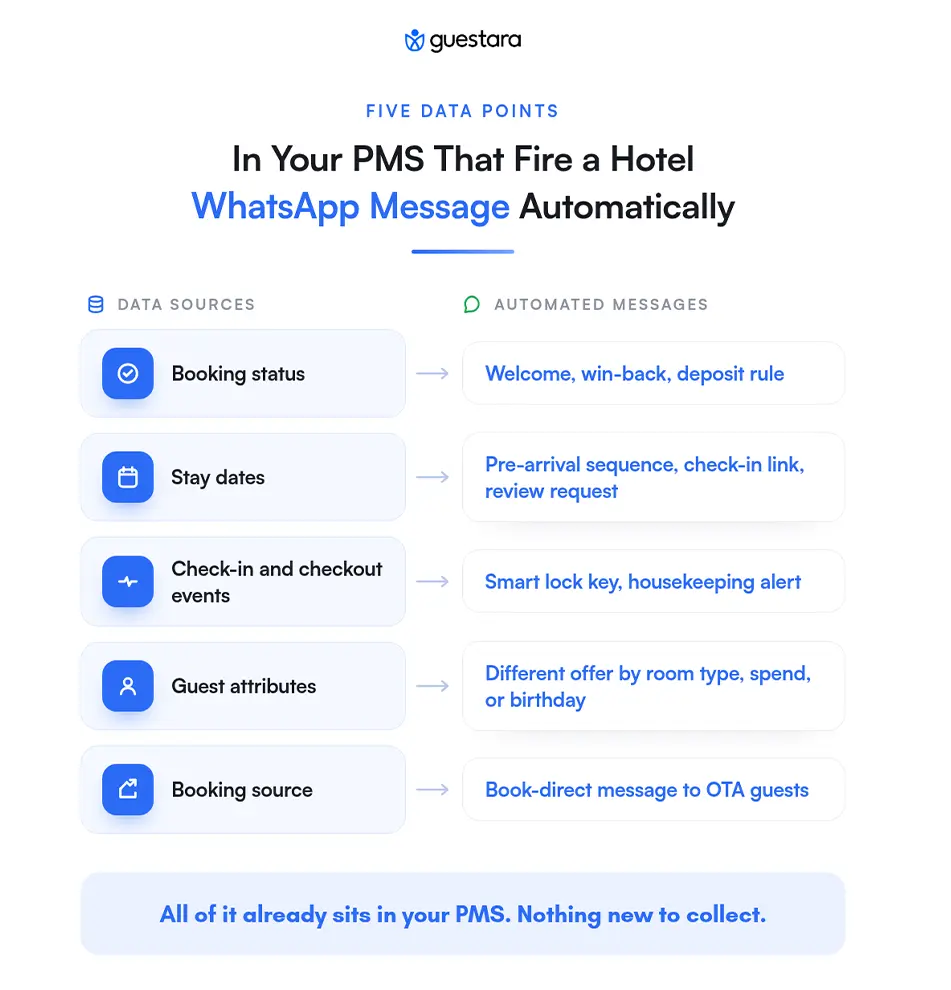
The data that triggers a WhatsApp message already sits in your PMS. You do not need to collect anything new. You need to connect what you already hold to a rule that fires a message.
Five data points do most of the work, and it helps to see what each one actually triggers.
Each of these is a switch. When the data changes, the message fires. The skill is not collecting data. It is deciding which change is worth a message.
The proof that this works sits in the numbers. Brevo's 2026 benchmark data shows automation emails reaching far higher open rates than standard campaigns, because they land when the recipient is already paying attention. The same logic drives every trigger above.
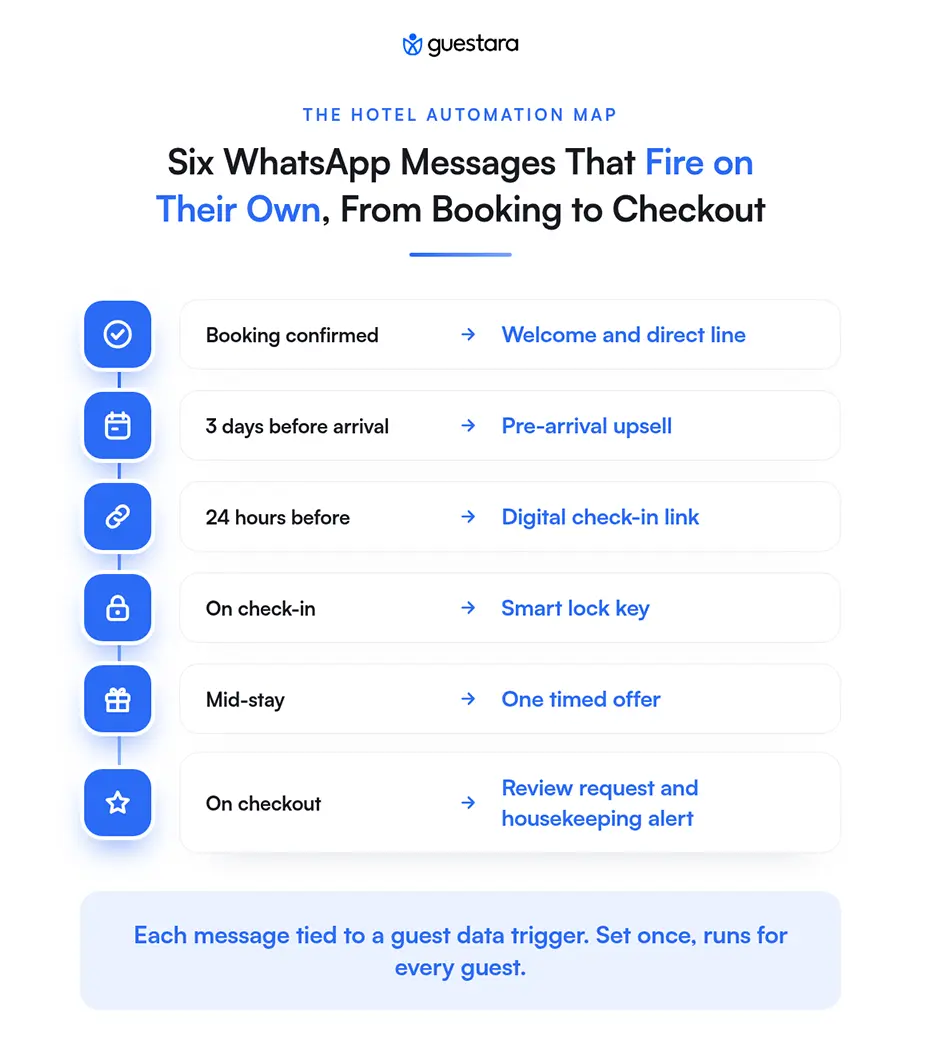
A complete automation covers the guest from the moment they book to the days after they leave, with each message tied to a data trigger. Set it once, and it runs for every guest without a single manual send. Here is the lifecycle, stage by stage.
The confirmed booking is your first chance to open a direct line. A warm confirmation message does more than repeat the reservation details. It moves the guest onto WhatsApp, where every later message will land.
This matters most for an OTA guest you are meeting for the first time. The booking gave you a name and a stay. The confirmation message starts the relationship that an OTA usually keeps for itself.
A few days out, the guest is in planning mode. This is the window for a relevant upsell. A room upgrade, an early check-in, a dinner reservation, an airport transfer.
The offer feels like part of the trip because the guest is already thinking about the trip. Sent here, it reads as helpful. Sent at the desk after a long flight, the same offer reads as a sales pitch.
The day before arrival, the check-in link fires. The guest completes check-in from their phone, scans their ID, and fills nothing in by hand.
By the time they reach your property, the paperwork is done. The queue at the desk shrinks, and the first thing the guest feels is speed instead of a form.
When check-in completes, the smart lock key can fire automatically if your property uses one. The guest walks straight to the room. No second stop, no waiting for a keycard.
This is automation removing a step entirely, not just a message. The data event, check-in complete, does the work a staff member used to do by hand.
During the stay, one well-timed message can add real revenue. A spa slot in the afternoon. A dinner booking for the evening. A late checkout offered the morning before departure.
The rule here is restraint. One relevant mid-stay offer lands. Five messages during a two-night stay drive the guest to opt out. Pick the single moment that fits and let the rest go.
Checkout fires two things at once. The review request goes to the guest while the experience is still fresh in their mind, which is when they are most likely to leave one. And housekeeping is notified the room is free, so turnaround starts immediately.
A review request sent two days later competes with everything that has happened since. Sent within hours of checkout, it catches the guest while the stay still feels real.
The efficiency of running all of this automatically is the point. Omnisend's 2025 data found that automated messages drove a large share of total sales from a tiny share of total volume, which is exactly what an understaffed hotel needs.
One trigger deserves its own treatment rather than a line here. Recovering guests who started a booking and dropped off, or who went quiet after an inquiry, is its own discipline with its own timing. That is covered in the WhatsApp retargeting guide.
The pre-arrival window is the single highest-value moment to automate, because the guest is committed, engaged, and has time to spend before they arrive.
A guest who has booked but not yet arrived is picturing the stay. They are thinking about dinner, about the view, about making the trip special. An upgrade or an add-on in this moment feels like part of the excitement, not an interruption.
That mindset is what makes the pre-arrival offer convert. The guest is not being sold to. They are being helped to plan something they are already looking forward to.
Compare that to the desk. A guest who just landed after a delayed flight, standing in a queue, has no appetite for a suite upgrade conversation. The same offer that wins two days out falls flat on arrival.
The front desk also cannot reach every guest before they arrive. It can only talk to the ones already standing in front of it. Automation reaches all of them, at the right moment, for every booking.
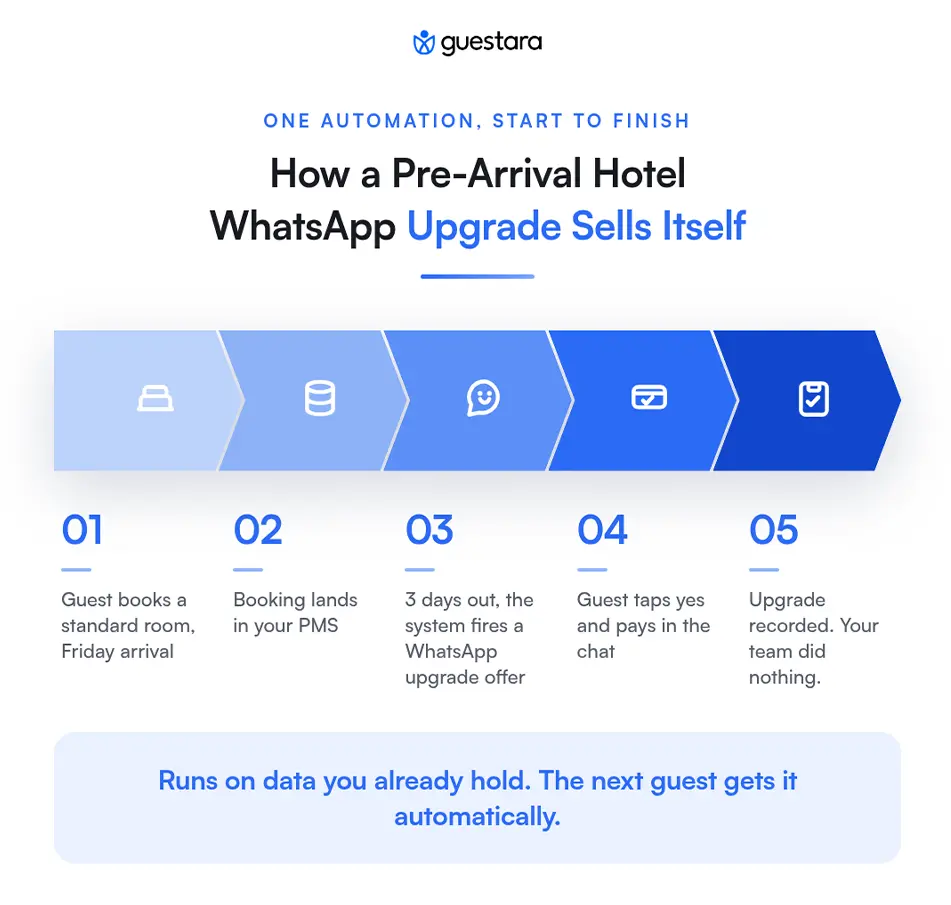
Here is one automation, built once and running on its own.
A guest books a standard room for a Friday arrival. The booking lands in your PMS. Three days before Friday, the system checks the stay date and fires a WhatsApp message: a friendly note offering an upgrade to a room with a view for a set add-on price, with one tap to confirm.
The guest taps yes and pays in the chat. The upgrade is recorded against the booking. Your team did nothing. The next guest arriving in three days gets the same message, with their name and their dates, automatically.
That single automation runs on data you already hold, the booking and the arrival date. For many hotels, this one journey covers the cost of the whole system, because it captures upgrade revenue that a busy desk would have missed.
Some moments need a human, and automating them does more harm than good. The rule is simple. Automate the routine and the timed. Keep a person on the emotional and the unexpected.
Never automate a response to a complaint. A guest who messages with a problem needs a real person who can read the situation and fix it.
An automated reply here reads as a brush-off. It can take a recoverable issue, a noisy room, a missed booking detail, and turn it into a public one-star review. The cost of getting this wrong is far higher than the time a human reply takes.
Never automate past the opt-in. Every contact on WhatsApp needs to have agreed to hear from you, and a booking alone is not consent.
Automation that messages guests who never opted in puts your sending number at risk. Once a number is flagged for sending to people who did not ask, every future campaign suffers, including the ones to guests who did opt in.
Watch your frequency. Automation makes it easy to send too much without noticing, because no one is pressing send to feel the volume.
A guest who gets a confirmation, a pre-arrival note, an upsell, a mid-stay offer, and three more messages will opt out. Cap the volume per guest and let only the most relevant messages through. A short, useful sequence keeps the list healthy. A constant stream empties it.
You do not build the whole lifecycle on day one. You start with one trigger that earns its keep, prove it works, then add the next.
Pick the automation with the clearest payoff. For most hotels, that is the pre-arrival upsell or the check-in link, because both run on data you already have and both show results fast.
Write the message once. Keep it short, name the guest, make one offer, and give one link. Resist the urge to pack three offers into the first message.
Every automated WhatsApp message uses a Meta pre-approved template. You cannot send improvised marketing copy at scale, so the template has to be approved before the automation can run.
Submit the template before you build the journey, not after. Hotels that build the campaign first often discover at the last minute that the template is not approved and miss the window entirely.
Before you turn the automation on for real guests, send it to yourself on two phones. Check that the guest name fills in correctly. Click every link. Confirm any image or PDF loads.
A broken link in a manual send reaches one guest. A broken link in an automation reaches every guest who hits that trigger, silently, until someone notices. Five minutes of testing prevents weeks of quiet failure.
Automating hotel WhatsApp campaigns comes down to one thing: connecting your booking data to a tool that can act on it without manual work. That is exactly what a guest journey platform does.
With Guestara, your guest data flows in from your PMS, and you build trigger-based journeys across WhatsApp, email, and SMS. A booking confirmation, a pre-arrival message, a check-in link 24 hours before arrival, a smart lock key on check-in, a mid-stay upsell, a post-checkout review request. You set the triggers and the timing once, and the journey runs for every guest after that.
It connects with major PMS systems including Cloudbeds, Hotelogix, Ezee Absolute, Apaleo, Beds24, SiteMinder, Little Hotelier, and Oracle, so the data that fires your messages is the data you already trust. Automated upsell offers that fire at the right moment can drive up to 200% more upsells, because they reach the guest when buying intent is highest.
One practical detail matters here. Through Guestara, Meta template approval takes one to two hours, not the two to ten days generic guides quote. So when you decide to launch a new automated journey, you are not waiting days to turn it on.
Two things sit just outside this guide. Sending a one-off campaign to a filtered list by hand is broadcasting, covered in the broadcast campaigns guide. And deciding which guests belong in which automated journey is segmentation, covered in the guest segmentation guide. Automation is what fires once those two are in place. For the full picture, start with the complete guide.
Want your WhatsApp messages to run on their own while your team handles the guests in front of them? This is where platforms like Guestara connect your guest data to WhatsApp and let the right message fire at the right moment, for every guest, automatically. See how it works with a quick demo.


Hotel WhatsApp marketing runs best on autopilot. Learn how to automate WhatsApp campaigns using guest data so the right message fires at the right moment.
It is 4pm on a Friday. Three guests are checking in, two are asking about late checkout on WhatsApp, and the phone is ringing.
Somewhere in that rush, a check-in link does not get sent. A pre-arrival upsell that would have earned a room upgrade never goes out. A review request to a happy guest who left this morning slips through.
None of it was forgotten on purpose. The front desk simply ran out of hands.
Automating hotel WhatsApp campaigns means connecting your guest data to triggers, so each message fires on its own when something happens. A booking is confirmed. A stay date arrives. A guest checks out. The message sends automatically, with no one pressing send.
This guide shows you which guest data triggers which message, how to automate the full booking lifecycle, a real example from start to finish, and the few moments you should never hand to a machine.
WhatsApp campaign automation is a system that sends messages on its own when guest data hits a defined trigger, instead of a staff member sending each one by hand. The trigger is an event or a data point. The message is written once. After that, it runs for every guest who meets the condition.
A manual campaign needs a person to decide who to message and when, then press send. An automated campaign needs neither. You set the rule once. The booking system does the rest.
Think of it as the difference between remembering to send a check-in link to every arriving guest and a rule that says: when a guest is arriving tomorrow, send the check-in link. The first depends on a busy person. The second depends on nothing.
This is the backbone of modern hotel WhatsApp marketing. The hotels that scale their guest communication are not sending more messages by hand. They are sending fewer by hand and letting data send the rest.
You automate because messages that fire on a guest's real behavior outperform messages sent on your schedule, and because a busy front desk cannot send them consistently anyway.
Manual sending fails in two predictable ways. It is slow, so messages arrive late or not at all. And it is inconsistent, so some guests get the pre-arrival offer and some do not, with no pattern except how busy the desk was that day.
On a quiet Tuesday, your team might send every check-in link and every upsell on time. On a full Friday, half of them never go out. The guests on the busy days are not worth less, but they get a worse experience, and you lose the revenue those messages would have earned.
A machine does not have busy days. It sends the same message at the same trigger whether one guest is arriving or fifty.
Automation flips the logic. Instead of you choosing a time to send, the guest's own behavior chooses it. They book, and a confirmation fires. Their arrival nears, and a check-in link fires. They check out, and a review request fires.
That timing is why automated messages convert better. They arrive at a moment that already matters to the guest, not a moment that happened to suit your calendar.
The performance gap is large and well documented in marketing data. Automated, behavior-triggered messages consistently beat batch sends on opens and conversions, because they reach people when attention is highest. On WhatsApp, where messages get read within minutes, that timing advantage is sharper than on any other channel.
The data that triggers a WhatsApp message already sits in your PMS. You do not need to collect anything new. You need to connect what you already hold to a rule that fires a message.
Five data points do most of the work, and it helps to see what each one actually triggers.
Each of these is a switch. When the data changes, the message fires. The skill is not collecting data. It is deciding which change is worth a message.
The proof that this works sits in the numbers. Brevo's 2026 benchmark data shows automation emails reaching far higher open rates than standard campaigns, because they land when the recipient is already paying attention. The same logic drives every trigger above.
A complete automation covers the guest from the moment they book to the days after they leave, with each message tied to a data trigger. Set it once, and it runs for every guest without a single manual send. Here is the lifecycle, stage by stage.
The confirmed booking is your first chance to open a direct line. A warm confirmation message does more than repeat the reservation details. It moves the guest onto WhatsApp, where every later message will land.
This matters most for an OTA guest you are meeting for the first time. The booking gave you a name and a stay. The confirmation message starts the relationship that an OTA usually keeps for itself.
A few days out, the guest is in planning mode. This is the window for a relevant upsell. A room upgrade, an early check-in, a dinner reservation, an airport transfer.
The offer feels like part of the trip because the guest is already thinking about the trip. Sent here, it reads as helpful. Sent at the desk after a long flight, the same offer reads as a sales pitch.
The day before arrival, the check-in link fires. The guest completes check-in from their phone, scans their ID, and fills nothing in by hand.
By the time they reach your property, the paperwork is done. The queue at the desk shrinks, and the first thing the guest feels is speed instead of a form.
When check-in completes, the smart lock key can fire automatically if your property uses one. The guest walks straight to the room. No second stop, no waiting for a keycard.
This is automation removing a step entirely, not just a message. The data event, check-in complete, does the work a staff member used to do by hand.
During the stay, one well-timed message can add real revenue. A spa slot in the afternoon. A dinner booking for the evening. A late checkout offered the morning before departure.
The rule here is restraint. One relevant mid-stay offer lands. Five messages during a two-night stay drive the guest to opt out. Pick the single moment that fits and let the rest go.
Checkout fires two things at once. The review request goes to the guest while the experience is still fresh in their mind, which is when they are most likely to leave one. And housekeeping is notified the room is free, so turnaround starts immediately.
A review request sent two days later competes with everything that has happened since. Sent within hours of checkout, it catches the guest while the stay still feels real.
The efficiency of running all of this automatically is the point. Omnisend's 2025 data found that automated messages drove a large share of total sales from a tiny share of total volume, which is exactly what an understaffed hotel needs.
One trigger deserves its own treatment rather than a line here. Recovering guests who started a booking and dropped off, or who went quiet after an inquiry, is its own discipline with its own timing. That is covered in the WhatsApp retargeting guide.
The pre-arrival window is the single highest-value moment to automate, because the guest is committed, engaged, and has time to spend before they arrive.
A guest who has booked but not yet arrived is picturing the stay. They are thinking about dinner, about the view, about making the trip special. An upgrade or an add-on in this moment feels like part of the excitement, not an interruption.
That mindset is what makes the pre-arrival offer convert. The guest is not being sold to. They are being helped to plan something they are already looking forward to.
Compare that to the desk. A guest who just landed after a delayed flight, standing in a queue, has no appetite for a suite upgrade conversation. The same offer that wins two days out falls flat on arrival.
The front desk also cannot reach every guest before they arrive. It can only talk to the ones already standing in front of it. Automation reaches all of them, at the right moment, for every booking.
Here is one automation, built once and running on its own.
A guest books a standard room for a Friday arrival. The booking lands in your PMS. Three days before Friday, the system checks the stay date and fires a WhatsApp message: a friendly note offering an upgrade to a room with a view for a set add-on price, with one tap to confirm.
The guest taps yes and pays in the chat. The upgrade is recorded against the booking. Your team did nothing. The next guest arriving in three days gets the same message, with their name and their dates, automatically.
That single automation runs on data you already hold, the booking and the arrival date. For many hotels, this one journey covers the cost of the whole system, because it captures upgrade revenue that a busy desk would have missed.
Some moments need a human, and automating them does more harm than good. The rule is simple. Automate the routine and the timed. Keep a person on the emotional and the unexpected.
Never automate a response to a complaint. A guest who messages with a problem needs a real person who can read the situation and fix it.
An automated reply here reads as a brush-off. It can take a recoverable issue, a noisy room, a missed booking detail, and turn it into a public one-star review. The cost of getting this wrong is far higher than the time a human reply takes.
Never automate past the opt-in. Every contact on WhatsApp needs to have agreed to hear from you, and a booking alone is not consent.
Automation that messages guests who never opted in puts your sending number at risk. Once a number is flagged for sending to people who did not ask, every future campaign suffers, including the ones to guests who did opt in.
Watch your frequency. Automation makes it easy to send too much without noticing, because no one is pressing send to feel the volume.
A guest who gets a confirmation, a pre-arrival note, an upsell, a mid-stay offer, and three more messages will opt out. Cap the volume per guest and let only the most relevant messages through. A short, useful sequence keeps the list healthy. A constant stream empties it.
You do not build the whole lifecycle on day one. You start with one trigger that earns its keep, prove it works, then add the next.
Pick the automation with the clearest payoff. For most hotels, that is the pre-arrival upsell or the check-in link, because both run on data you already have and both show results fast.
Write the message once. Keep it short, name the guest, make one offer, and give one link. Resist the urge to pack three offers into the first message.
Every automated WhatsApp message uses a Meta pre-approved template. You cannot send improvised marketing copy at scale, so the template has to be approved before the automation can run.
Submit the template before you build the journey, not after. Hotels that build the campaign first often discover at the last minute that the template is not approved and miss the window entirely.
Before you turn the automation on for real guests, send it to yourself on two phones. Check that the guest name fills in correctly. Click every link. Confirm any image or PDF loads.
A broken link in a manual send reaches one guest. A broken link in an automation reaches every guest who hits that trigger, silently, until someone notices. Five minutes of testing prevents weeks of quiet failure.
Automating hotel WhatsApp campaigns comes down to one thing: connecting your booking data to a tool that can act on it without manual work. That is exactly what a guest journey platform does.
With Guestara, your guest data flows in from your PMS, and you build trigger-based journeys across WhatsApp, email, and SMS. A booking confirmation, a pre-arrival message, a check-in link 24 hours before arrival, a smart lock key on check-in, a mid-stay upsell, a post-checkout review request. You set the triggers and the timing once, and the journey runs for every guest after that.
It connects with major PMS systems including Cloudbeds, Hotelogix, Ezee Absolute, Apaleo, Beds24, SiteMinder, Little Hotelier, and Oracle, so the data that fires your messages is the data you already trust. Automated upsell offers that fire at the right moment can drive up to 200% more upsells, because they reach the guest when buying intent is highest.
One practical detail matters here. Through Guestara, Meta template approval takes one to two hours, not the two to ten days generic guides quote. So when you decide to launch a new automated journey, you are not waiting days to turn it on.
Two things sit just outside this guide. Sending a one-off campaign to a filtered list by hand is broadcasting, covered in the broadcast campaigns guide. And deciding which guests belong in which automated journey is segmentation, covered in the guest segmentation guide. Automation is what fires once those two are in place. For the full picture, start with the complete guide.
Want your WhatsApp messages to run on their own while your team handles the guests in front of them? This is where platforms like Guestara connect your guest data to WhatsApp and let the right message fire at the right moment, for every guest, automatically. See how it works with a quick demo.
Automating WhatsApp campaigns means setting up rules that send messages on their own when guest data hits a trigger, instead of a staff member sending each message by hand. A confirmed booking, an upcoming arrival date, or a completed checkout can each fire a specific message automatically. You write the message and set the trigger once, and the system runs it for every guest who meets the condition. This lets a hotel message every guest consistently without adding work for the front desk.
Hotels use data that already sits in their PMS, so nothing new needs to be collected. The most common triggers are booking status, stay dates, check-in and checkout events, guest attributes like room type or birthday month, and booking source. When one of these changes, it fires the matching message, such as a check-in link 24 hours before arrival or a review request on checkout.
Yes. Messages triggered by a guest's real behavior consistently outperform messages sent on a fixed schedule, because they arrive at a moment that already matters to the guest. Marketing data across platforms shows automated, behavior-triggered messages beating batch sends on both opens and conversions. On WhatsApp, where messages are read within minutes, that timing advantage is even stronger than on email.
Hotels should never automate responses to complaints or sensitive guest issues, which need a real person who can read the situation and resolve it. They should also never message guests who have not opted in, since a booking alone is not consent and messaging without it risks the hotel's WhatsApp sending number. Frequency needs a cap too, because over-sending automated messages drives opt-outs.
No. Automation reduces the work rather than adding to it, which is why it suits independent and small hotels. Once the triggers and messages are set up, the campaigns run on their own for every future guest with no manual sending. A platform that connects to your PMS handles the data and the timing, so a small team can run the same automated guest journey as a large one.
We work closely with the industry leaders to offer seamless solutions




We’re here to help your whole team stay ahead of the curve as you grow.

Get up and running quickly with a personalized onboarding plan

Connect with real people who really get it, 24/7

Checkout our vast library of free resources, templates and more
There's only so much we can say — so let us show you! Schedule a demo today and reach your business goals.


.png)