84% of hotel bookings are abandoned. Learn how hotel WhatsApp retargeting turns booking drop-offs, cold inquiries, and campaign non-responders into confirmed reservations.




A guest finds your hotel. Checks availability. Starts filling in the booking form. Then stops.
You never find out why. They never come back. The room stays empty.
This is not an edge case. 84% of online hotel bookings are abandoned before completion. For a mid-sized hotel receiving several thousand booking attempts a month, that number represents a very large pile of revenue that came close enough to land and then disappeared.
Most hotels treat abandonment as a loss. The smarter framing is that it is a warm lead. A guest who started a booking is not a stranger who glanced at your website. They already chose you. They just did not finish. WhatsApp retargeting is how you go back and close that conversation.
.webp)
Retargeting in hotel WhatsApp marketing is the practice of sending a follow-up message to a guest who showed intent but did not convert — and doing it through the channel most likely to reach them.
There are three distinct drop-off points where retargeting applies, and each one calls for a different kind of message.
Guests who started a reservation on your website or booking engine and did not complete it. These are the highest-intent drop-offs. They had a date in mind, checked availability, and went to the point of entering details. Something stopped them: price uncertainty, a distraction, a question they could not answer, friction in the checkout process.
Guests who messaged your hotel on WhatsApp asking about availability, rates, or a specific package, received a reply, and then went quiet. They were interested enough to reach out directly. Something in the response, or the time it took to arrive, caused them to disengage.
Guests who received a WhatsApp broadcast campaign, saw it (or did not open it), and took no action. They are on your opted-in list. They have stayed before. They just did not respond to the first message.
Each of these represents a different temperature of lead and requires a different retargeting approach. Treating all three the same way is why most retargeting efforts underperform.
The standard retargeting channel for hotels is email. Send an abandoned booking reminder at 30 minutes, another at 24 hours, another at 72 hours. It is a well-documented approach with reasonable benchmarks.
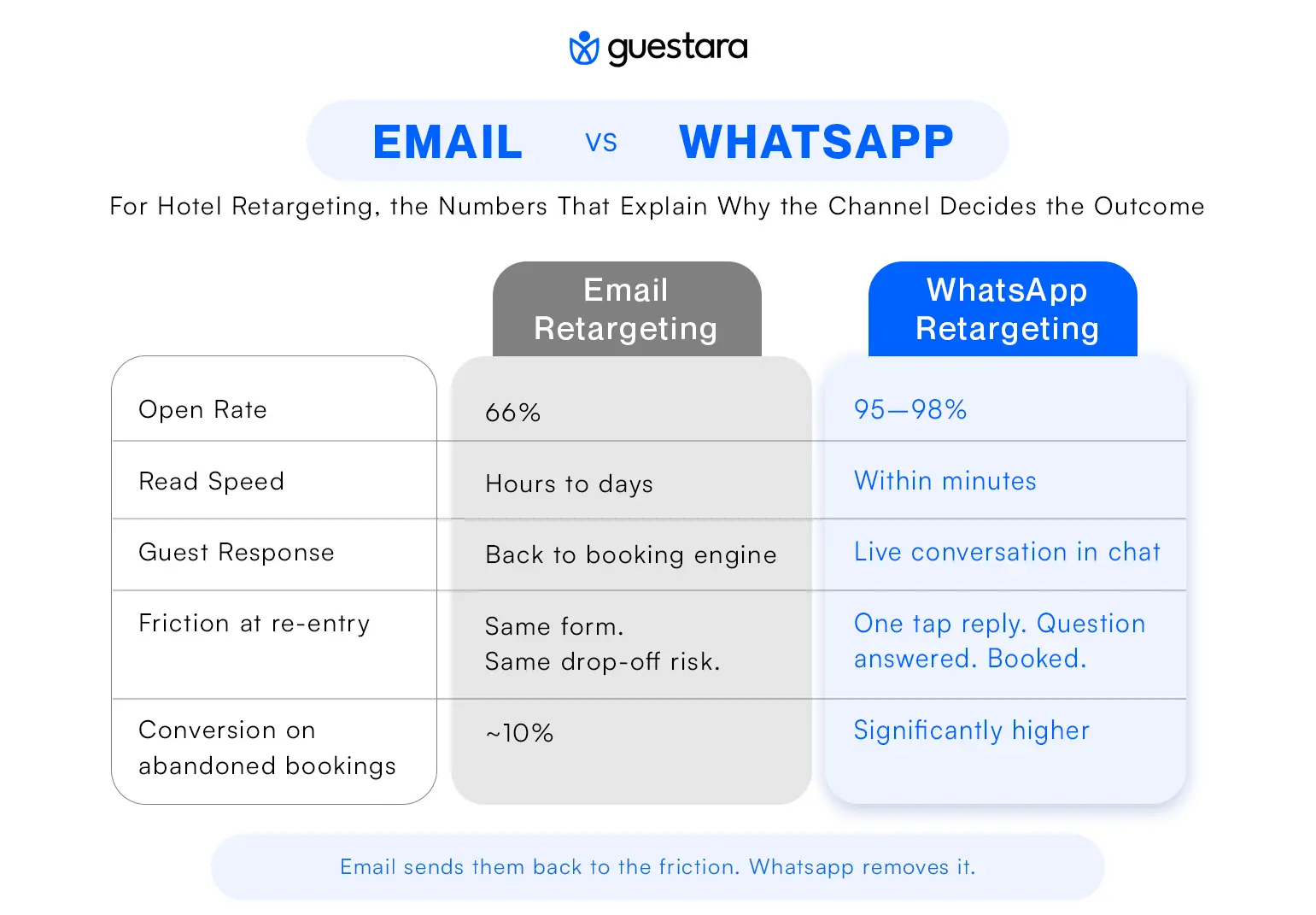
Email cart abandonment campaigns for hotels average 66% open rates and 10% conversion according to Revinate's 2025 Hospitality Benchmark Report. That 10% is not a bad number on its own. It means for every 100 guests who abandoned a booking and received an email follow-up, 10 came back and completed it.
Now consider what happens when that same message goes on WhatsApp instead of email. WhatsApp open rates run 95–98% within 24 hours. The message lands in a chat the guest checks constantly, not in a promotions folder they clear once a week. It reads like a personal message, not an automated marketing sequence.
The open rate advantage alone fundamentally changes the math. A message that 95 out of 100 guests open converts at a higher absolute rate than one that 66 out of 100 open, even if the conversion percentage from open to booking is identical.
Beyond open rates, WhatsApp retargeting has a structural advantage email does not: it opens a real conversation. A guest who clicks reply on a WhatsApp message connects directly with your team. A question about the rate, a request to modify the dates, a query about what is included in the package — all of these can be answered in the same thread, in real time, by a real person or an AI chatbot, without the guest needing to navigate back to a booking engine.
That conversation-to-booking path is shorter and more natural on WhatsApp than anywhere else.
52% of travelers abandon bookings because of a bad digital experience — not because they changed their mind about the hotel. Price uncertainty, a question they could not answer, a form that felt too long, or simply getting distracted mid-process. The intent was there. The friction won.
A WhatsApp retargeting message to a booking abandoner does one thing: removes the friction that caused them to stop.
The message arrives within 30 to 60 minutes of the drop-off, while the trip is still in their mind. It acknowledges what they were looking at — specific dates, specific room type if that data is captured — and it gives them a direct path back to complete the booking.
What this message needs:
What this message must not do:
The channel match matters as much as the message. An email abandonment reminder sits in an inbox with forty other unread messages. A WhatsApp message arrives in the same place the guest chats with their family about which hotel to book. The proximity to the actual decision is completely different.
A guest messaged your hotel directly. That is a significant signal. They bypassed the OTA search results, found your WhatsApp number or link, and chose to reach out personally.
They asked about a weekend in October. Wanted to know if a specific room was available. Asked about the pet policy or whether the pool was heated. Your team replied. Then nothing.
This drop-off is different from a booking abandoner because the conversation already started. Retargeting here is not recovering a checkout — it is re-opening a dialogue.
The window for this retargeting message is short. 24 to 48 hours after the last message in the thread. Beyond that, the guest has likely made a decision elsewhere.
The message does not pretend the conversation did not happen. It references it directly.
"Hi Anita, you were asking about the 14th and 15th of October. We still have the room available. Did you have any other questions, or would you like me to hold a tentative booking for you?"
That is the entire message. No promotional language. No offer padding. Just a direct follow-up to a real conversation that went quiet.
If the inquiry came with a clear intent signal — a guest asking about a specific date, a specific package, or whether a rate could be matched — the retargeting message can include a specific nudge: a direct booking link, a confirmation that the room is still available at the same rate, or a time-limited hold offer.
The tone is service, not sales. The guest reached out first. The retargeting message respects that by picking the conversation back up rather than treating them as a marketing target.
This is the retargeting type built directly into Guestara's broadcast campaign flow.
When a broadcast campaign sends to 500 past guests, some open it and book. Some open it and do not act. Some do not open it at all. The non-responders — both unread and read-but-no-action — are a retargeting audience.
Inside Guestara, after a campaign sends, the analytics view shows delivery, read, and reply data for every contact. You can filter that data to build a retargeting segment: contacts who received the original broadcast but did not reply or click.
This segment is warmer than a cold list. They are opted-in past guests. They received the first message. The retargeting message is a second touch with a different angle or a slight adjustment to the offer.
If the first message did not produce a reply, a longer version of the same message will not either. Cut it down to the essential point.
If the original was a seasonal package, the retargeting message might lead with the expiry: "The Diwali offer closes on Friday. Two rooms still available at the past-guest rate." Same campaign, different hook — scarcity rather than appeal.
Send the retargeting message 48 to 72 hours after the original, not immediately. The goal is a second chance at the right moment, not a follow-up that arrives before the guest has had time to consider the first message.
A contact who received the original broadcast and the retargeting message and still did not respond is not a target for a third send in the same campaign cycle. Respect the signal. Move them to a different segment for a future campaign with a genuinely different offer.
.webp)
Retargeting on WhatsApp works within the same compliance framework as any other broadcast. Every retargeting message must use a Meta pre-approved template. Every contact must be opted in. Every message must include opt-out instructions.
There is one additional consideration specific to retargeting: the 24-hour messaging window.
When a guest sends your hotel a message on WhatsApp, a 24-hour customer service window opens. Within that window, your team can reply in free-form text without using a template. This is relevant for inquiry drop-off retargeting specifically. If the guest messaged you 18 hours ago and you are following up on the same thread, you can reply in natural conversational language.
Once that window closes — after 24 hours with no message from the guest — any outbound message from the hotel must use an approved template. This is the point where the retargeting message becomes a formal template send rather than a conversational follow-up.
Hotels that miss this distinction sometimes send free-form retargeting messages outside the window, which violates WhatsApp's policy and risks the account's quality rating. The practical rule: if the guest has not messaged within 24 hours, use a template. Always.
A mountain resort property has 3,200 past guests in their Guestara contact database. In September they send a broadcast campaign to 800 guests who stayed in the last 18 months, offering a Diwali long weekend package at a past-guest rate.
Of those 800, 620 read the message. 140 reply or click through. 80 complete a booking.
The retargeting opportunity is the remaining 680 who received the campaign but did not convert: 180 who did not open it and 500 who opened it but did not act.
The resort builds a retargeting segment in Guestara using the read status and reply status filters from the campaign analytics. They select a pre-approved template that leads with the scarcity angle — limited rooms remaining, offer closes Friday — and schedule it for Tuesday morning, 48 hours after the original send.
Of the 680 in the retargeting segment, 390 open the follow-up. 65 reply or click. 35 complete a booking.
Those 35 bookings came from a list that had already been sent one message and not responded. Without the retargeting send, every one of those would have been a missed conversion. With it, the campaign's total output went from 80 to 115 direct bookings — a 43% increase from a single follow-up send.
The cost of that follow-up: the same fraction of a rupee per message as the original campaign.
The retargeting flow in Guestara builds on the same campaign builder used for any broadcast.
After a campaign sends and analytics data populates — typically within 24 to 48 hours of sending — click into the campaign from the dashboard. The analytics view shows delivered, read, replied, and clicked data for every contact in the send.
To build a retargeting segment:
For inquiry drop-off retargeting, the flow is simpler. The conversation already exists in the Unified Inbox. A team member or the AI chatbot sends a follow-up message directly in the open thread within 24 hours of the last message. If outside the 24-hour window, select the appropriate retargeting template and send from within the conversation.
The complete guide to running WhatsApp broadcast campaigns covers the full campaign builder flow including audience filters and scheduling, which forms the foundation for every retargeting send.
Every guest who abandoned a booking, went quiet after an inquiry, or did not respond to your last campaign is a warm lead with a shorter path to conversion than anyone you are trying to reach through paid acquisition.
Guestara's hotel WhatsApp marketing platform gives hotels the audience filters, campaign analytics, and retargeting tools to go back and close those conversations — automatically, at scale, without adding headcount.
Book a demo to see how retargeting works inside the platform for a property like yours.


84% of hotel bookings are abandoned. Learn how hotel WhatsApp retargeting turns booking drop-offs, cold inquiries, and campaign non-responders into confirmed reservations.
A guest finds your hotel. Checks availability. Starts filling in the booking form. Then stops.
You never find out why. They never come back. The room stays empty.
This is not an edge case. 84% of online hotel bookings are abandoned before completion. For a mid-sized hotel receiving several thousand booking attempts a month, that number represents a very large pile of revenue that came close enough to land and then disappeared.
Most hotels treat abandonment as a loss. The smarter framing is that it is a warm lead. A guest who started a booking is not a stranger who glanced at your website. They already chose you. They just did not finish. WhatsApp retargeting is how you go back and close that conversation.
Retargeting in hotel WhatsApp marketing is the practice of sending a follow-up message to a guest who showed intent but did not convert — and doing it through the channel most likely to reach them.
There are three distinct drop-off points where retargeting applies, and each one calls for a different kind of message.
Guests who started a reservation on your website or booking engine and did not complete it. These are the highest-intent drop-offs. They had a date in mind, checked availability, and went to the point of entering details. Something stopped them: price uncertainty, a distraction, a question they could not answer, friction in the checkout process.
Guests who messaged your hotel on WhatsApp asking about availability, rates, or a specific package, received a reply, and then went quiet. They were interested enough to reach out directly. Something in the response, or the time it took to arrive, caused them to disengage.
Guests who received a WhatsApp broadcast campaign, saw it (or did not open it), and took no action. They are on your opted-in list. They have stayed before. They just did not respond to the first message.
Each of these represents a different temperature of lead and requires a different retargeting approach. Treating all three the same way is why most retargeting efforts underperform.
The standard retargeting channel for hotels is email. Send an abandoned booking reminder at 30 minutes, another at 24 hours, another at 72 hours. It is a well-documented approach with reasonable benchmarks.
Email cart abandonment campaigns for hotels average 66% open rates and 10% conversion according to Revinate's 2025 Hospitality Benchmark Report. That 10% is not a bad number on its own. It means for every 100 guests who abandoned a booking and received an email follow-up, 10 came back and completed it.
Now consider what happens when that same message goes on WhatsApp instead of email. WhatsApp open rates run 95–98% within 24 hours. The message lands in a chat the guest checks constantly, not in a promotions folder they clear once a week. It reads like a personal message, not an automated marketing sequence.
The open rate advantage alone fundamentally changes the math. A message that 95 out of 100 guests open converts at a higher absolute rate than one that 66 out of 100 open, even if the conversion percentage from open to booking is identical.
Beyond open rates, WhatsApp retargeting has a structural advantage email does not: it opens a real conversation. A guest who clicks reply on a WhatsApp message connects directly with your team. A question about the rate, a request to modify the dates, a query about what is included in the package — all of these can be answered in the same thread, in real time, by a real person or an AI chatbot, without the guest needing to navigate back to a booking engine.
That conversation-to-booking path is shorter and more natural on WhatsApp than anywhere else.
52% of travelers abandon bookings because of a bad digital experience — not because they changed their mind about the hotel. Price uncertainty, a question they could not answer, a form that felt too long, or simply getting distracted mid-process. The intent was there. The friction won.
A WhatsApp retargeting message to a booking abandoner does one thing: removes the friction that caused them to stop.
The message arrives within 30 to 60 minutes of the drop-off, while the trip is still in their mind. It acknowledges what they were looking at — specific dates, specific room type if that data is captured — and it gives them a direct path back to complete the booking.
What this message needs:
What this message must not do:
The channel match matters as much as the message. An email abandonment reminder sits in an inbox with forty other unread messages. A WhatsApp message arrives in the same place the guest chats with their family about which hotel to book. The proximity to the actual decision is completely different.
A guest messaged your hotel directly. That is a significant signal. They bypassed the OTA search results, found your WhatsApp number or link, and chose to reach out personally.
They asked about a weekend in October. Wanted to know if a specific room was available. Asked about the pet policy or whether the pool was heated. Your team replied. Then nothing.
This drop-off is different from a booking abandoner because the conversation already started. Retargeting here is not recovering a checkout — it is re-opening a dialogue.
The window for this retargeting message is short. 24 to 48 hours after the last message in the thread. Beyond that, the guest has likely made a decision elsewhere.
The message does not pretend the conversation did not happen. It references it directly.
"Hi Anita, you were asking about the 14th and 15th of October. We still have the room available. Did you have any other questions, or would you like me to hold a tentative booking for you?"
That is the entire message. No promotional language. No offer padding. Just a direct follow-up to a real conversation that went quiet.
If the inquiry came with a clear intent signal — a guest asking about a specific date, a specific package, or whether a rate could be matched — the retargeting message can include a specific nudge: a direct booking link, a confirmation that the room is still available at the same rate, or a time-limited hold offer.
The tone is service, not sales. The guest reached out first. The retargeting message respects that by picking the conversation back up rather than treating them as a marketing target.
This is the retargeting type built directly into Guestara's broadcast campaign flow.
When a broadcast campaign sends to 500 past guests, some open it and book. Some open it and do not act. Some do not open it at all. The non-responders — both unread and read-but-no-action — are a retargeting audience.
Inside Guestara, after a campaign sends, the analytics view shows delivery, read, and reply data for every contact. You can filter that data to build a retargeting segment: contacts who received the original broadcast but did not reply or click.
This segment is warmer than a cold list. They are opted-in past guests. They received the first message. The retargeting message is a second touch with a different angle or a slight adjustment to the offer.
If the first message did not produce a reply, a longer version of the same message will not either. Cut it down to the essential point.
If the original was a seasonal package, the retargeting message might lead with the expiry: "The Diwali offer closes on Friday. Two rooms still available at the past-guest rate." Same campaign, different hook — scarcity rather than appeal.
Send the retargeting message 48 to 72 hours after the original, not immediately. The goal is a second chance at the right moment, not a follow-up that arrives before the guest has had time to consider the first message.
A contact who received the original broadcast and the retargeting message and still did not respond is not a target for a third send in the same campaign cycle. Respect the signal. Move them to a different segment for a future campaign with a genuinely different offer.
Retargeting on WhatsApp works within the same compliance framework as any other broadcast. Every retargeting message must use a Meta pre-approved template. Every contact must be opted in. Every message must include opt-out instructions.
There is one additional consideration specific to retargeting: the 24-hour messaging window.
When a guest sends your hotel a message on WhatsApp, a 24-hour customer service window opens. Within that window, your team can reply in free-form text without using a template. This is relevant for inquiry drop-off retargeting specifically. If the guest messaged you 18 hours ago and you are following up on the same thread, you can reply in natural conversational language.
Once that window closes — after 24 hours with no message from the guest — any outbound message from the hotel must use an approved template. This is the point where the retargeting message becomes a formal template send rather than a conversational follow-up.
Hotels that miss this distinction sometimes send free-form retargeting messages outside the window, which violates WhatsApp's policy and risks the account's quality rating. The practical rule: if the guest has not messaged within 24 hours, use a template. Always.
A mountain resort property has 3,200 past guests in their Guestara contact database. In September they send a broadcast campaign to 800 guests who stayed in the last 18 months, offering a Diwali long weekend package at a past-guest rate.
Of those 800, 620 read the message. 140 reply or click through. 80 complete a booking.
The retargeting opportunity is the remaining 680 who received the campaign but did not convert: 180 who did not open it and 500 who opened it but did not act.
The resort builds a retargeting segment in Guestara using the read status and reply status filters from the campaign analytics. They select a pre-approved template that leads with the scarcity angle — limited rooms remaining, offer closes Friday — and schedule it for Tuesday morning, 48 hours after the original send.
Of the 680 in the retargeting segment, 390 open the follow-up. 65 reply or click. 35 complete a booking.
Those 35 bookings came from a list that had already been sent one message and not responded. Without the retargeting send, every one of those would have been a missed conversion. With it, the campaign's total output went from 80 to 115 direct bookings — a 43% increase from a single follow-up send.
The cost of that follow-up: the same fraction of a rupee per message as the original campaign.
The retargeting flow in Guestara builds on the same campaign builder used for any broadcast.
After a campaign sends and analytics data populates — typically within 24 to 48 hours of sending — click into the campaign from the dashboard. The analytics view shows delivered, read, replied, and clicked data for every contact in the send.
To build a retargeting segment:
For inquiry drop-off retargeting, the flow is simpler. The conversation already exists in the Unified Inbox. A team member or the AI chatbot sends a follow-up message directly in the open thread within 24 hours of the last message. If outside the 24-hour window, select the appropriate retargeting template and send from within the conversation.
The complete guide to running WhatsApp broadcast campaigns covers the full campaign builder flow including audience filters and scheduling, which forms the foundation for every retargeting send.
Every guest who abandoned a booking, went quiet after an inquiry, or did not respond to your last campaign is a warm lead with a shorter path to conversion than anyone you are trying to reach through paid acquisition.
Guestara's hotel WhatsApp marketing platform gives hotels the audience filters, campaign analytics, and retargeting tools to go back and close those conversations — automatically, at scale, without adding headcount.
Book a demo to see how retargeting works inside the platform for a property like yours.
Hotel WhatsApp retargeting is the practice of sending a follow-up message on WhatsApp to guests who showed booking intent but did not convert. This includes guests who abandoned a booking on the hotel's website, guests who inquired via WhatsApp and then went quiet, and guests who received a broadcast campaign but did not respond. Because WhatsApp messages are read by 95–98% of opted-in recipients within 24 hours, retargeting on WhatsApp reaches more of these warm leads than email-based retargeting, and opens a direct conversation path that allows the hotel to address objections and close the booking in real time.
For booking abandoners, the retargeting message should go out within 30 to 60 minutes of the drop-off, while the trip is still in the guest's mind and before they have completed a booking elsewhere. For inquiry drop-offs, 12 to 24 hours after the last message in the thread is the right window — prompt enough to show attentiveness without feeling intrusive. For campaign non-responders, 48 to 72 hours after the original broadcast gives the guest time to engage with the first message before the retargeting message arrives.
Yes. Inside Guestara, campaign analytics show read status for every contact in a broadcast send. Hotels can filter for contacts who received the campaign but did not open it, build a retargeting segment from that filtered list, and send a follow-up message with a different subject angle or scarcity hook. The retargeting message must use a Meta pre-approved template and the contact must remain opted in. Contacts who have opted out cannot be included in any retargeting send regardless of their previous engagement history.
When a guest sends a message to a hotel's WhatsApp number, a 24-hour customer service window opens during which the hotel can reply in free-form conversational text without using a pre-approved template. Once that window closes — after 24 hours with no inbound message from the guest — any outbound message from the hotel must use an approved template. For inquiry drop-off retargeting specifically, this means a follow-up within 24 hours of the guest's last message can be written naturally in conversation, while a follow-up beyond 24 hours requires a template send. Hotels that miss this boundary and send free-form messages outside the window risk their WhatsApp account quality rating.
Email retargeting for hotels averages 66% open rates and 10% conversion on abandoned booking campaigns according to Revinate's 2025 Hospitality Benchmark Report. WhatsApp retargeting operates at 95–98% open rates within 24 hours and opens a real two-way conversation rather than a one-way email sequence. The structural difference is that a guest who replies to a WhatsApp retargeting message connects directly with the hotel team in a live chat, where questions can be answered and the booking can be closed in the same thread. Email retargeting sends the guest back to a booking engine where the same friction that caused the original abandonment still exists.
We work closely with the industry leaders to offer seamless solutions




We’re here to help your whole team stay ahead of the curve as you grow.

Get up and running quickly with a personalized onboarding plan

Connect with real people who really get it, 24/7

Checkout our vast library of free resources, templates and more
There's only so much we can say — so let us show you! Schedule a demo today and reach your business goals.


.png)