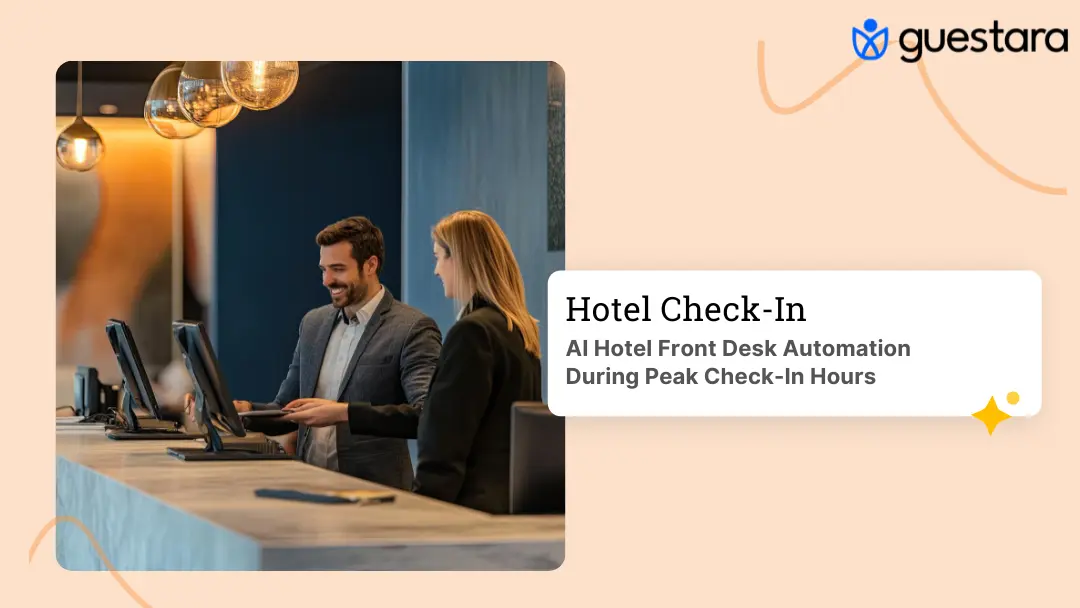
AI automates hotel front desk operations during peak check-in hours. Fewer queues, faster arrivals, no extra headcount. Here is exactly how it works.




It is 3pm on a Friday. Your occupancy is 90%. Checkout was at 11am. Check-in opens at 2pm.
In that one-hour window, your front desk team is managing everything at once.
The queue of arriving guests. The phone ringing with room-ready requests. The WhatsApp message from a guest asking for the WiFi password that just came in. The maintenance request that someone logged in a group chat and nobody has actioned yet. The couple at the counter who want to know if they can have a late checkout tomorrow. The solo traveller who needs an extra pillow sent up.
None of these are emergencies. All of them need someone to handle them right now.
This is the peak-hour problem at hotel front desks. And it is not a staffing problem. You cannot solve it by adding headcount, because the bottleneck is not the number of people. It is the number of tasks landing on those people at exactly the same moment.
AI does not add more staff. It removes the tasks that should never have reached the desk in the first place.
This post covers exactly how AI automates hotel front desk operations during peak check-in hours: what it handles, what it routes, what it escalates, and what your team is left free to do.
The front desk bottleneck during peak check-in is a compounding problem, not a simple volume problem.
It starts with a concentration of arrivals. Most hotels see the bulk of their check-ins land in a two-hour window, typically between 2pm and 4pm. At a 100-room property running 75% occupancy, that is 75 guests arriving in 120 minutes. At six minutes per traditional check-in, the maths does not work even with two staff members on the desk.
But the check-in queue is not the only thing running at that moment.
In-house guests from the night before are calling the desk with requests. Housekeeping is updating room statuses and flagging exceptions. Maintenance issues logged during the day are waiting for someone to action them. Incoming messages from OTA channels, WhatsApp, and email are landing in different places and nobody has a complete picture.
When departments operate from different versions of room status, decision-making slows dramatically. Staff spend valuable time confirming information rather than acting on it. During peak periods, even small delays quickly escalate. One unavailable room delays another arrival. That arrival creates a longer queue. Longer queues generate more guest complaints.
The AHLA 2025 State of the Industry Report identifies a quick and easy check-in and checkout process as one of the key drivers hotels must prioritize to ensure positive guest experiences. That standard is very hard to meet when the desk is managing six different types of tasks simultaneously.
The solution is not to make staff faster at handling all of those tasks. It is to stop all of them arriving at the desk at the same time.
.webp)
The tasks that pile up at the front desk during peak check-in fall into three categories: guest queries, task routing, and check-in processing. AI handles all three differently, and it is worth being specific about what that means in practice.
During a peak arrival window, a significant proportion of front desk interactions are questions that have the same answer every time.
What is the WiFi password? What time is breakfast? Is the pool open? What time is checkout tomorrow? Can I get an extra towel?
These are not hospitality moments. They are information lookups. And every time a staff member stops to answer one of these during a peak check-in window, a guest in the queue waits longer.
Guestara's AI chatbot handles these queries automatically, 24 hours a day, trained on the hotel's own property data. The WiFi password the chatbot gives is your WiFi password. The breakfast times are your breakfast times. The pool hours are accurate to your property, not a generic response.
The Hotel Tech Report 2025 State of Guest Technology found that 58% of hotel guests believe AI can improve their stay. The queries they want handled faster are exactly the routine ones that should never have been reaching a staff member at the desk during check-in in the first place.
When a guest asks for the WiFi password via WhatsApp at 3pm on a Friday, the AI answers instantly. The desk never sees the message.
The second category of tasks that breaks peak-hour operations is not the queries. It is the requests that need a physical response.
A guest reports a broken air conditioning unit. Someone needs extra pillows sent to room 204. A checkout room has not been cleaned and a new guest is waiting. A room that was flagged ready by housekeeping has a maintenance issue.
In a traditional hotel operation, these requests arrive by phone, WhatsApp, in person at the desk, or via OTA messaging. Staff manually note each one, figure out who needs to handle it, and pass it on, usually through a group chat or by calling the relevant department.
That manual routing process is slow. It creates gaps. And during a peak window, it means tasks sit waiting while staff are focused on the check-in queue.
Guestara's Task Board routes these requests automatically using Access Control Logic. A maintenance request goes directly to the maintenance team. An F&B order goes to the kitchen. A housekeeping request goes to housekeeping. No manual routing. No group chat. No staff member acting as a relay.
Every task lands with the right team the moment it is logged, with a full audit trail so nothing gets missed.
The third category is the check-in queue itself. This is where AI makes the biggest single difference to peak-hour operations.
When hotel self check-in is running via a pre-arrival link, most guests arriving during a peak window have already completed registration before they walked through the door. They scanned their ID on their phone the night before. The form filled itself. Staff approved it in the dashboard that morning.
Those guests do not join the queue. They collect their digital key on their phone, or pick up a pre-prepared key card in under 30 seconds, and go to their room.
The guests who do reach the desk are the ones who need a brief interaction or chose not to complete mobile check-in. For those guests, the tablet at the front desk runs the same AI ID scanning flow: 30 seconds, form fills itself, staff approve.
The queue shrinks not because staff are faster. It shrinks because most guests never join it.
The reason AI peak-hour automation works is not because any single tool solves the problem. It is because three modules work together simultaneously.
Running just digital check-in without AI chatbot support means the desk is still fielding routine queries during check-in processing. Running just an AI chatbot without task routing means service requests still need manual coordination. Running task routing without digital check-in means the queue is still long.
The combination is:
1. Hotel self check-in (Digital Check-In module) Removes most guests from the arrival queue before they arrive. The desk processes completions, not a queue.
2. AI Chatbot Intercepts routine guest queries before they reach the desk. Staff only see escalations requests that genuinely need human judgement or a physical response.
3. Task Board with ACL routing Every service and maintenance request routes to the right team automatically the moment it is logged. No staff member is the relay.
Together, these three modules mean your front desk team during a 3pm peak window is doing one thing: handling the exceptions and the genuinely human moments. Not the WiFi password. Not the pillow request to room 204. Not the room-ready status check. Those are handled.

A common concern when hotels evaluate AI automation is whether the AI knows what it cannot handle. This is the right question to ask.
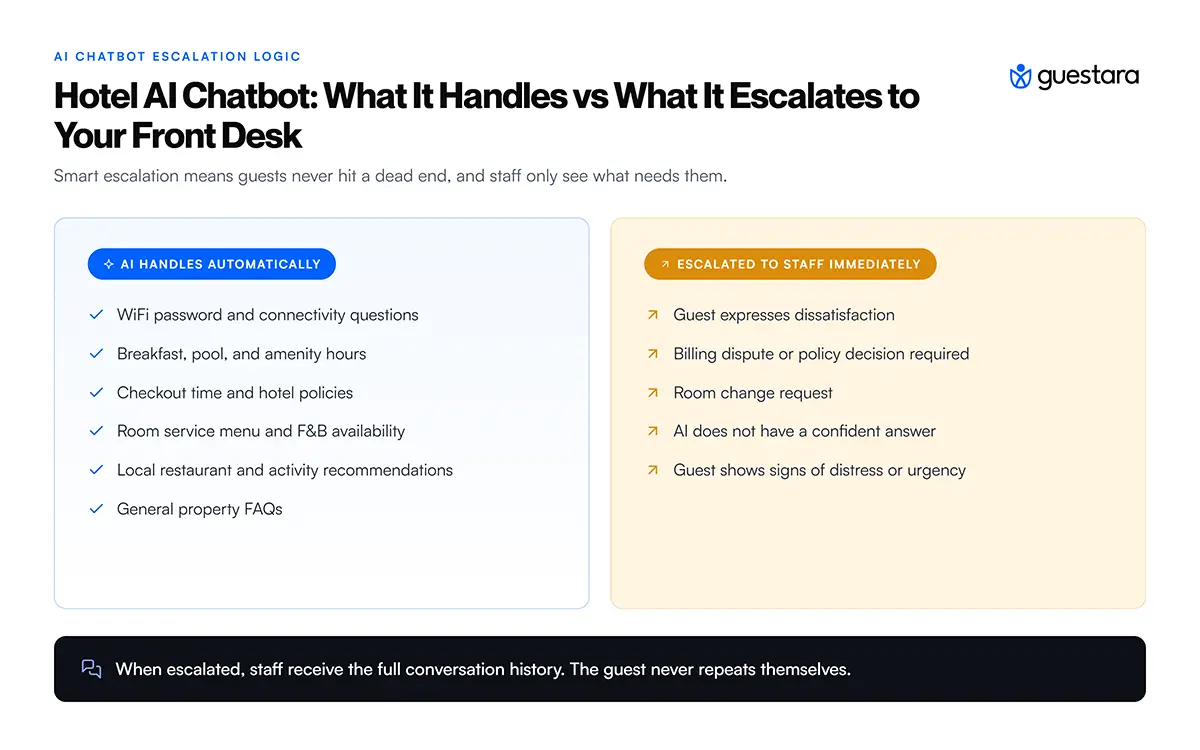
Guestara's AI chatbot is designed with a clear escalation logic. When a guest query falls outside the scope of what the AI can resolve accurately, or when a guest signals distress or urgency, the conversation is immediately handed to a staff member. The staff member receives the full conversation context, so they can respond without asking the guest to repeat anything.
What the AI handles without escalation:
What the AI escalates immediately:
The logic is smart escalation, not blanket automation. The AI handles what it can. Everything else goes to a human with full context and no delay.
For properties managing digital check-in exceptions — guests who arrive without ID, split payment requests, room changes at the desk — the front desk SOP for handling those exceptions is covered in our post on hotel front desk SOPs for digital check-in exceptions.
This is the question that matters most for hotel GMs evaluating AI automation. If AI is handling routine queries, routing tasks, and processing most check-ins, what is the front desk team actually doing?
The answer is everything that cannot be automated.
The guest who arrives looking exhausted and needs someone to notice. The family travelling with a toddler who has been in the car for four hours and needs a room on the ground floor right now. The business traveller who has a dinner tonight and wants a restaurant recommendation that is not on TripAdvisor. The returning guest who stayed six months ago and whose name the front desk agent remembers.
These are not tasks. They are moments. And they require the kind of attention that is impossible to give when a staff member is simultaneously typing a passport number, answering a WhatsApp message, and trying to remember whether the maintenance request for room 312 got forwarded to the right person.
When everyone arrives at once, your reception desk becomes a clearinghouse for everything. Staff are not just handing out room keys. They are explaining WiFi passwords, writing down breakfast timings, logging requests for extra pillows, and answering calls from rooms that checked in ten minutes ago. This operational pile-up creates major front desk bottlenecks.
AI removes the pile-up. What is left is the work that justifies a trained hospitality professional standing at that desk.
For independent hotels where one or two staff members are covering the peak window, this shift is the difference between a chaotic arrival experience and a controlled one. Staff are not less important when AI is running. They are more able to do what they are actually there to do.
For a detailed look at how to structure the front desk during peak windows once self check-in is live, see the hotel self check-in peak-hour playbook.
Peak-hour automation does not only apply to the 2pm to 4pm check-in window. The same logic applies at night.
Late arrivals, particularly guests arriving after 10pm, present a different but equally real operational problem. Staff coverage is reduced. The AI chatbot should have sent the guest their check-in link. Their digital key should be waiting. But sometimes the link was not completed, or the guest has a question before they can get to the room.
At traditional hotels, a late arrival means a phone call to the desk, a staff member pulled away from whatever they are doing, and a manual check-in process that takes the same five to eight minutes it takes at 3pm.
With AI running, the late-arriving guest who did not complete mobile check-in gets a nudge via WhatsApp before arrival. The AI chatbot handles any pre-arrival questions automatically. If the guest does arrive at the desk, the tablet runs the same 30-second scan. If the key needs to be sent again, the staff member approves from the dashboard in seconds.
Night audit is also cleaner. Because registration data is captured digitally and verified at the point of scan, there is no manual reconciliation of paper forms. The data is already in the system, accurate, and exportable.
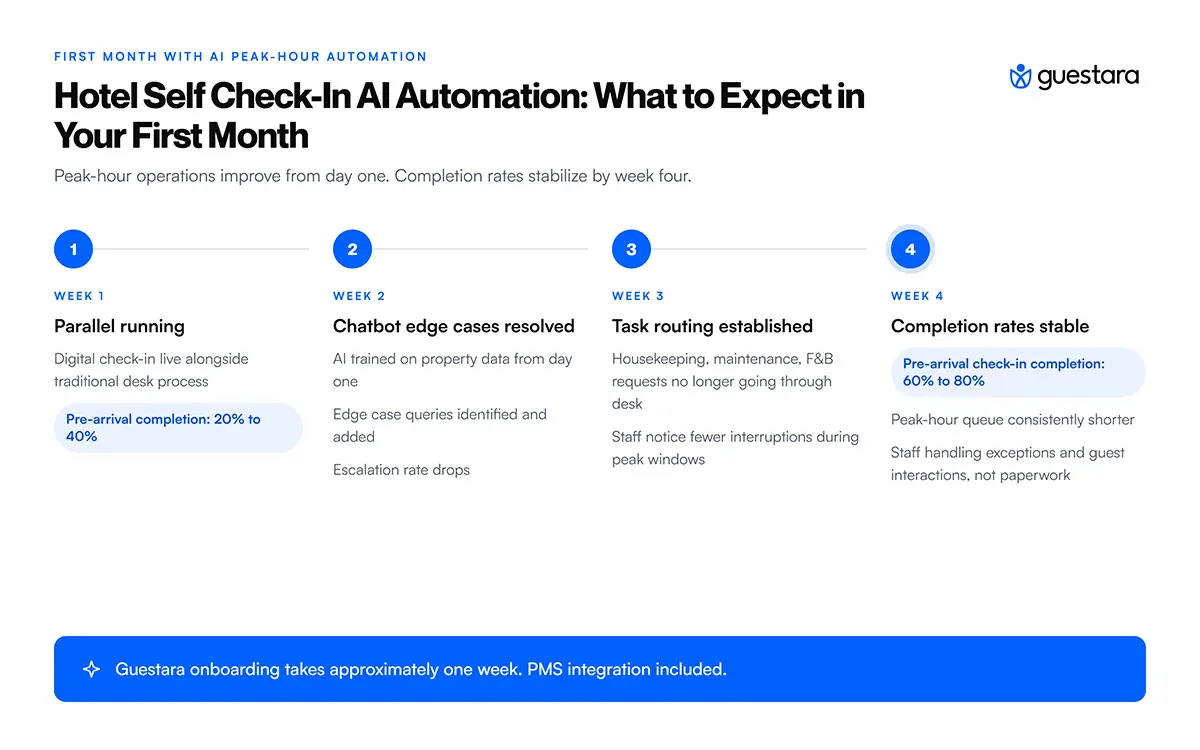
Hotels that implement Guestara's combined digital check-in, AI chatbot, and task routing flow typically see the peak-hour shift happen quickly. Here is what the first month looks like in practice.
Most properties run the new digital check-in flow alongside the traditional desk process during the first week. Pre-arrival completion rates start low — typically 20% to 40% of guests and climb as the messaging cadence is dialled in.
The AI chatbot is live and trained on the property's specific data by day one, but the first two weeks reveal the queries that fall outside initial training. The hotel team adds answers to edge cases. Escalation rate drops.
Task routing via ACL is running automatically. Housekeeping, maintenance, and F&B requests are no longer going through the desk. Staff notice the reduction in interruptions during peak windows.
With the right pre-arrival message timing and a well-written check-in link, most properties reach 60% to 80% pre-arrival completion by the end of the first month. The peak-hour queue is consistently shorter. Staff have time to manage exceptions and genuine guest interactions rather than administrative tasks.
Guestara's onboarding takes approximately one week. The platform integrates with major PMS systems including Cloudbeds, Hotelogix, Ezee Absolute, Apaleo, Beds24, SiteMinder,Oracle more.
Guestara's hospitality AI platform and contactless check-in and checkout module work together to automate the three peak-hour problem areas covered in this post.
Hotel self check-in: Pre-arrival link via WhatsApp, email, or SMS. AI ID scan, form fills in under 30 seconds. Staff approve in dashboard. Digital key delivered to guest's phone via 50+ smart lock integrations. Tablet fallback for on-arrival guests.
AI Chatbot: Trained on your property data. Handles routine guest queries automatically 24/7. Smart escalation to staff with full conversation context when human judgement is needed. Proactively surfaces upsell opportunities based on conversation context.
Task Board with ACL routing: Every service, maintenance, and F&B request routed to the right department automatically the moment it is logged. Full audit trail. No WhatsApp group chaos. No tasks missed because they went to the wrong person.
If you want to see how the three-module combination works on your specific property type and PMS, the Guestara team can walk you through a configuration.


AI automates hotel front desk operations during peak check-in hours. Fewer queues, faster arrivals, no extra headcount. Here is exactly how it works.
It is 3pm on a Friday. Your occupancy is 90%. Checkout was at 11am. Check-in opens at 2pm.
In that one-hour window, your front desk team is managing everything at once.
The queue of arriving guests. The phone ringing with room-ready requests. The WhatsApp message from a guest asking for the WiFi password that just came in. The maintenance request that someone logged in a group chat and nobody has actioned yet. The couple at the counter who want to know if they can have a late checkout tomorrow. The solo traveller who needs an extra pillow sent up.
None of these are emergencies. All of them need someone to handle them right now.
This is the peak-hour problem at hotel front desks. And it is not a staffing problem. You cannot solve it by adding headcount, because the bottleneck is not the number of people. It is the number of tasks landing on those people at exactly the same moment.
AI does not add more staff. It removes the tasks that should never have reached the desk in the first place.
This post covers exactly how AI automates hotel front desk operations during peak check-in hours: what it handles, what it routes, what it escalates, and what your team is left free to do.
The front desk bottleneck during peak check-in is a compounding problem, not a simple volume problem.
It starts with a concentration of arrivals. Most hotels see the bulk of their check-ins land in a two-hour window, typically between 2pm and 4pm. At a 100-room property running 75% occupancy, that is 75 guests arriving in 120 minutes. At six minutes per traditional check-in, the maths does not work even with two staff members on the desk.
But the check-in queue is not the only thing running at that moment.
In-house guests from the night before are calling the desk with requests. Housekeeping is updating room statuses and flagging exceptions. Maintenance issues logged during the day are waiting for someone to action them. Incoming messages from OTA channels, WhatsApp, and email are landing in different places and nobody has a complete picture.
When departments operate from different versions of room status, decision-making slows dramatically. Staff spend valuable time confirming information rather than acting on it. During peak periods, even small delays quickly escalate. One unavailable room delays another arrival. That arrival creates a longer queue. Longer queues generate more guest complaints.
The AHLA 2025 State of the Industry Report identifies a quick and easy check-in and checkout process as one of the key drivers hotels must prioritize to ensure positive guest experiences. That standard is very hard to meet when the desk is managing six different types of tasks simultaneously.
The solution is not to make staff faster at handling all of those tasks. It is to stop all of them arriving at the desk at the same time.
The tasks that pile up at the front desk during peak check-in fall into three categories: guest queries, task routing, and check-in processing. AI handles all three differently, and it is worth being specific about what that means in practice.
During a peak arrival window, a significant proportion of front desk interactions are questions that have the same answer every time.
What is the WiFi password? What time is breakfast? Is the pool open? What time is checkout tomorrow? Can I get an extra towel?
These are not hospitality moments. They are information lookups. And every time a staff member stops to answer one of these during a peak check-in window, a guest in the queue waits longer.
Guestara's AI chatbot handles these queries automatically, 24 hours a day, trained on the hotel's own property data. The WiFi password the chatbot gives is your WiFi password. The breakfast times are your breakfast times. The pool hours are accurate to your property, not a generic response.
The Hotel Tech Report 2025 State of Guest Technology found that 58% of hotel guests believe AI can improve their stay. The queries they want handled faster are exactly the routine ones that should never have been reaching a staff member at the desk during check-in in the first place.
When a guest asks for the WiFi password via WhatsApp at 3pm on a Friday, the AI answers instantly. The desk never sees the message.
The second category of tasks that breaks peak-hour operations is not the queries. It is the requests that need a physical response.
A guest reports a broken air conditioning unit. Someone needs extra pillows sent to room 204. A checkout room has not been cleaned and a new guest is waiting. A room that was flagged ready by housekeeping has a maintenance issue.
In a traditional hotel operation, these requests arrive by phone, WhatsApp, in person at the desk, or via OTA messaging. Staff manually note each one, figure out who needs to handle it, and pass it on, usually through a group chat or by calling the relevant department.
That manual routing process is slow. It creates gaps. And during a peak window, it means tasks sit waiting while staff are focused on the check-in queue.
Guestara's Task Board routes these requests automatically using Access Control Logic. A maintenance request goes directly to the maintenance team. An F&B order goes to the kitchen. A housekeeping request goes to housekeeping. No manual routing. No group chat. No staff member acting as a relay.
Every task lands with the right team the moment it is logged, with a full audit trail so nothing gets missed.
The third category is the check-in queue itself. This is where AI makes the biggest single difference to peak-hour operations.
When hotel self check-in is running via a pre-arrival link, most guests arriving during a peak window have already completed registration before they walked through the door. They scanned their ID on their phone the night before. The form filled itself. Staff approved it in the dashboard that morning.
Those guests do not join the queue. They collect their digital key on their phone, or pick up a pre-prepared key card in under 30 seconds, and go to their room.
The guests who do reach the desk are the ones who need a brief interaction or chose not to complete mobile check-in. For those guests, the tablet at the front desk runs the same AI ID scanning flow: 30 seconds, form fills itself, staff approve.
The queue shrinks not because staff are faster. It shrinks because most guests never join it.
The reason AI peak-hour automation works is not because any single tool solves the problem. It is because three modules work together simultaneously.
Running just digital check-in without AI chatbot support means the desk is still fielding routine queries during check-in processing. Running just an AI chatbot without task routing means service requests still need manual coordination. Running task routing without digital check-in means the queue is still long.
The combination is:
1. Hotel self check-in (Digital Check-In module) Removes most guests from the arrival queue before they arrive. The desk processes completions, not a queue.
2. AI Chatbot Intercepts routine guest queries before they reach the desk. Staff only see escalations requests that genuinely need human judgement or a physical response.
3. Task Board with ACL routing Every service and maintenance request routes to the right team automatically the moment it is logged. No staff member is the relay.
Together, these three modules mean your front desk team during a 3pm peak window is doing one thing: handling the exceptions and the genuinely human moments. Not the WiFi password. Not the pillow request to room 204. Not the room-ready status check. Those are handled.
A common concern when hotels evaluate AI automation is whether the AI knows what it cannot handle. This is the right question to ask.
Guestara's AI chatbot is designed with a clear escalation logic. When a guest query falls outside the scope of what the AI can resolve accurately, or when a guest signals distress or urgency, the conversation is immediately handed to a staff member. The staff member receives the full conversation context, so they can respond without asking the guest to repeat anything.
What the AI handles without escalation:
What the AI escalates immediately:
The logic is smart escalation, not blanket automation. The AI handles what it can. Everything else goes to a human with full context and no delay.
For properties managing digital check-in exceptions — guests who arrive without ID, split payment requests, room changes at the desk — the front desk SOP for handling those exceptions is covered in our post on hotel front desk SOPs for digital check-in exceptions.
This is the question that matters most for hotel GMs evaluating AI automation. If AI is handling routine queries, routing tasks, and processing most check-ins, what is the front desk team actually doing?
The answer is everything that cannot be automated.
The guest who arrives looking exhausted and needs someone to notice. The family travelling with a toddler who has been in the car for four hours and needs a room on the ground floor right now. The business traveller who has a dinner tonight and wants a restaurant recommendation that is not on TripAdvisor. The returning guest who stayed six months ago and whose name the front desk agent remembers.
These are not tasks. They are moments. And they require the kind of attention that is impossible to give when a staff member is simultaneously typing a passport number, answering a WhatsApp message, and trying to remember whether the maintenance request for room 312 got forwarded to the right person.
When everyone arrives at once, your reception desk becomes a clearinghouse for everything. Staff are not just handing out room keys. They are explaining WiFi passwords, writing down breakfast timings, logging requests for extra pillows, and answering calls from rooms that checked in ten minutes ago. This operational pile-up creates major front desk bottlenecks.
AI removes the pile-up. What is left is the work that justifies a trained hospitality professional standing at that desk.
For independent hotels where one or two staff members are covering the peak window, this shift is the difference between a chaotic arrival experience and a controlled one. Staff are not less important when AI is running. They are more able to do what they are actually there to do.
For a detailed look at how to structure the front desk during peak windows once self check-in is live, see the hotel self check-in peak-hour playbook.
Peak-hour automation does not only apply to the 2pm to 4pm check-in window. The same logic applies at night.
Late arrivals, particularly guests arriving after 10pm, present a different but equally real operational problem. Staff coverage is reduced. The AI chatbot should have sent the guest their check-in link. Their digital key should be waiting. But sometimes the link was not completed, or the guest has a question before they can get to the room.
At traditional hotels, a late arrival means a phone call to the desk, a staff member pulled away from whatever they are doing, and a manual check-in process that takes the same five to eight minutes it takes at 3pm.
With AI running, the late-arriving guest who did not complete mobile check-in gets a nudge via WhatsApp before arrival. The AI chatbot handles any pre-arrival questions automatically. If the guest does arrive at the desk, the tablet runs the same 30-second scan. If the key needs to be sent again, the staff member approves from the dashboard in seconds.
Night audit is also cleaner. Because registration data is captured digitally and verified at the point of scan, there is no manual reconciliation of paper forms. The data is already in the system, accurate, and exportable.
Hotels that implement Guestara's combined digital check-in, AI chatbot, and task routing flow typically see the peak-hour shift happen quickly. Here is what the first month looks like in practice.
Most properties run the new digital check-in flow alongside the traditional desk process during the first week. Pre-arrival completion rates start low — typically 20% to 40% of guests and climb as the messaging cadence is dialled in.
The AI chatbot is live and trained on the property's specific data by day one, but the first two weeks reveal the queries that fall outside initial training. The hotel team adds answers to edge cases. Escalation rate drops.
Task routing via ACL is running automatically. Housekeeping, maintenance, and F&B requests are no longer going through the desk. Staff notice the reduction in interruptions during peak windows.
With the right pre-arrival message timing and a well-written check-in link, most properties reach 60% to 80% pre-arrival completion by the end of the first month. The peak-hour queue is consistently shorter. Staff have time to manage exceptions and genuine guest interactions rather than administrative tasks.
Guestara's onboarding takes approximately one week. The platform integrates with major PMS systems including Cloudbeds, Hotelogix, Ezee Absolute, Apaleo, Beds24, SiteMinder,Oracle more.
Guestara's hospitality AI platform and contactless check-in and checkout module work together to automate the three peak-hour problem areas covered in this post.
Hotel self check-in: Pre-arrival link via WhatsApp, email, or SMS. AI ID scan, form fills in under 30 seconds. Staff approve in dashboard. Digital key delivered to guest's phone via 50+ smart lock integrations. Tablet fallback for on-arrival guests.
AI Chatbot: Trained on your property data. Handles routine guest queries automatically 24/7. Smart escalation to staff with full conversation context when human judgement is needed. Proactively surfaces upsell opportunities based on conversation context.
Task Board with ACL routing: Every service, maintenance, and F&B request routed to the right department automatically the moment it is logged. Full audit trail. No WhatsApp group chaos. No tasks missed because they went to the wrong person.
If you want to see how the three-module combination works on your specific property type and PMS, the Guestara team can walk you through a configuration.
AI helps hotel front desks during peak hours by removing the three categories of tasks that cause bottlenecks: routine guest queries, service request routing, and check-in processing. An AI chatbot trained on the hotel's property data answers WiFi, breakfast, and general FAQ queries automatically, so staff never see those messages during a busy window. Task routing via an automated board sends maintenance, housekeeping, and F&B requests to the right department without any staff member acting as a relay. And hotel self check-in via a pre-arrival link means most guests arriving during peak hours have already completed registration, so they never join the check-in queue. Staff are left to handle exceptions and genuine guest interactions.
Guestara's AI chatbot handles routine queries automatically: WiFi passwords, breakfast times, pool hours, checkout time, room service availability, local recommendations, and general property FAQs. It escalates immediately when a guest expresses dissatisfaction, when a request requires a policy decision such as a billing dispute or room change, when the AI does not have a confident answer, or when the guest shows signs of urgency or distress. When a conversation is escalated, the staff member receives the full conversation history so they can respond without asking the guest to repeat anything.
Yes, and independent hotels typically see the biggest operational impact from AI peak-hour automation. Smaller properties often run one or two staff members during peak check-in windows. When those staff members are handling registration, routing requests, and answering queries simultaneously, the experience suffers for everyone. AI removes the tasks that should not be reaching the desk in the first place, which means a one or two-person team can manage a 60-room property at peak occupancy without the chaos that previously required additional headcount.
Most properties reach a stable pre-arrival check-in completion rate of 60% to 80% within the first four weeks of running Guestara's digital check-in flow. Week one typically sees completion at 20% to 40% as guests are first introduced to the flow. Completion rates climb as the pre-arrival message timing is optimised and any friction in the check-in link is removed. The tablet fallback at the front desk handles on-arrival guests throughout the ramp-up period, so peak-hour operations improve from day one even while completion rates are still climbing.
Minimal hardware is required. The hotel self check-in flow is web-based and runs on the guest's own phone — no kiosk hardware is needed for pre-arrival check-in. A tablet at the front desk handles on-arrival guests who did not complete mobile check-in. If the property already has smart locks installed, Guestara connects to them for digital key delivery without new hardware. Properties without smart locks can use the existing key card system — the AI-powered check-in still removes data entry and speeds up the approval process, even if the key is physical.
We work closely with the industry leaders to offer seamless solutions




We’re here to help your whole team stay ahead of the curve as you grow.

Get up and running quickly with a personalized onboarding plan

Connect with real people who really get it, 24/7

Checkout our vast library of free resources, templates and more
There's only so much we can say — so let us show you! Schedule a demo today and reach your business goals.


.png)