Wallet room keys let guests unlock rooms with an iPhone or Android phone. Here is what independent hotels need to run them, and what to buy now.




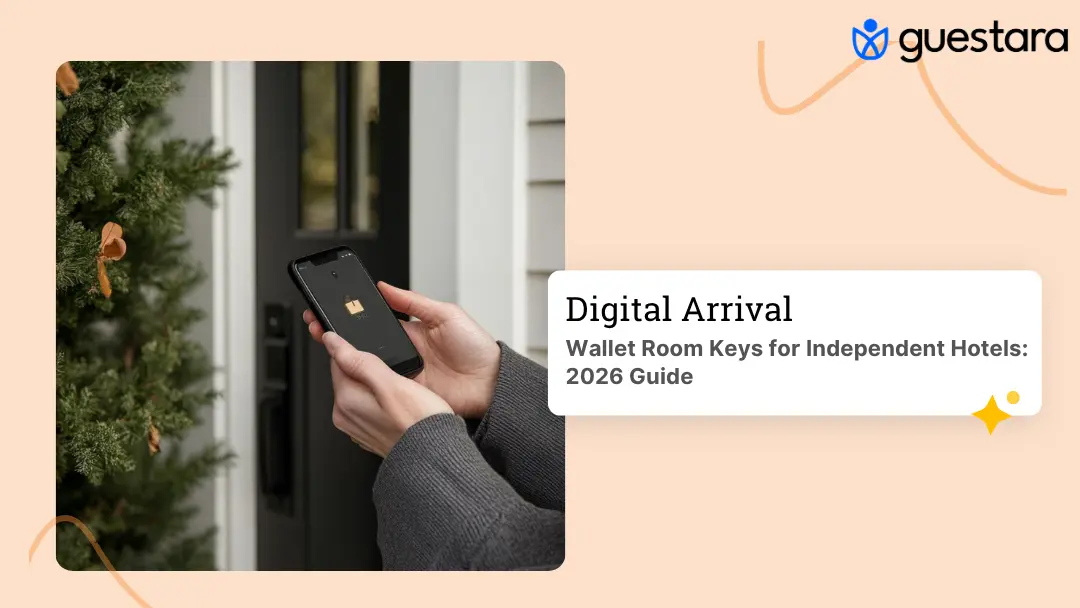
Independent hotels can now issue room keys straight into Apple Wallet and Google Wallet without building an app. That became true in June 2026, when Salto Space Hospitality added support for Room Keys in Apple Wallet, provisioned remotely through a credential manager partner instead of through software the hotel had to own.
For the four years before that, wallet room keys were a brand feature. Hyatt launched first in December 2021 across six US properties. Everyone who followed had an app and an engineering team behind it. If you ran 40 rooms in a converted townhouse, the technology existed and you could not have it.
Meanwhile your arrival still runs on plastic. Somebody encodes a card. Somebody explains it. It demagnetises in a pocket next to a phone, the guest comes back, and somebody encodes another one. Multiply that by every arrival, every day, with no end date.
This guide covers what a wallet room key actually is, whether your property qualifies, what has to be connected behind it, what it costs, and what changes at your front desk on day one.
A wallet room key is a hotel room access credential stored natively inside Apple Wallet or Google Wallet on a guest's phone or smartwatch, used by holding the device near the door reader. There is no hotel app to open, no Bluetooth to pair and no screen to unlock.
Most operators treat a mobile key and a wallet room key as the same product. They are not, and they behave differently at the door.
An app-based mobile key lives inside software the guest has to install, sign into and open. A wallet room key lives in the operating system, in the same place as their boarding pass and their bank card.
On iPhone, Express Mode turns on automatically, so the guest never unlocks the phone or opens anything. Apple's Power Reserve keeps the key working for up to five hours after the device needs charging.
.webp)
Wallet room keys run on hardware most of your guests already carry:
The device floor matters more than it looks. An arrival list of 60 people will contain a handful of phones that fall below it, and those guests are your exception queue.
If you are earlier in this decision and still weighing keyless access as a category, our complete guide to hotel digital keys and mobile access covers the ground underneath this post.
Hotel guests add a wallet room key through an add-to-wallet button rather than a download, and it reaches them by one of three routes. The route your property picks decides your adoption rate more than any other single choice.
The third route matters most to independent properties, because it takes the download out of the guest's path entirely.
The two ecosystems ask for different things on both sides of the transaction.
.webp)
Timing decides adoption, and most properties get it wrong by sending too early.
A check-in link sent three days out gets buried. A link that lands while the guest is in a taxi from the airport gets used, because the guest is thinking about arriving at that exact moment.
Guestara's Guest Journey runs that sequence automatically. Trigger-based messages fire against PMS booking data across WhatsApp, email and SMS, so the check-in link goes out 24 hours before arrival and the room key follows the moment check-in completes. The full pre-arrival to post-stay flow sits inside the guest engagement platform.
Yes. Independent hotels can offer Apple Wallet room keys without building their own app, and this became true recently rather than gradually. The barrier was never the size of the property.
The blocker sat in the middle of the add-to-wallet flow. Apple and Google both route the credential through a service provider's app, which for years meant a hotel needed its own branded app.
Only chains had one worth building. Hyatt went first in December 2021. Google Wallet launched hotel key support in June 2024 at the Clarion Hotel Post in Gothenburg. Club Quarters followed in January 2025. Every early adopter was a brand or a group.
Lock platforms started acting as the credential manager themselves, which removed the app the hotel had to own.
Salto announced in June 2026 that its Salto Space Hospitality platform now supports Room Keys in Apple Wallet, with keys provisioned remotely through a credential manager partner. Room keys can be deployed on a standalone property or across a multi-property estate.
That moves the qualifying question entirely. It is no longer "does your brand have an app." It is "does your access platform support wallet credentials, and can it provision them remotely."
A 40-room boutique property on the right lock platform can now offer the same arrival experience as a flagship resort. The gap between what a brand can do at the door and what an independent can do at the door has closed further in the last two years than in the previous ten.
Support is decided per platform and per lock generation, not per manufacturer. This is where properties get caught out.
A hotel running readers from a supported manufacturer can still fall outside wallet key support because the installed hardware is two generations behind the current catalogue. Check your actual model numbers against your access platform's live support list before you promise anything to guests or to an owner.
Hotels need four connected layers before a guest can tap a phone on a guest room door, and a wallet room key project fails at whichever layer got skipped. Most failures are not technical.
.webp)
Google's hotel key documentation sets out the reader and service provider prerequisites on the Android side, and it is worth reading before any vendor conversation.
A room key cannot issue without a room number, and that is a workflow problem rather than a software one.
If your team assigns rooms manually at the desk when the guest walks in, no wallet room key can pre-issue. The credential has nothing to point at. Guests arrive, tap nothing, and queue anyway.
Wallet room keys expose weak room assignment discipline in a way plastic never did. Fix the assignment workflow first, or you will pay for a keyless system that only ever activates at the front desk.
Guestara is the guest experience layer, not the credential issuer. That distinction is worth being precise about.
Guestara's Digital Check-In verifies the guest and completes registration. Guestara integrates with 50+ smart lock systems and major PMS platforms including Cloudbeds, Apaleo, SiteMinder, Hotelogix and Oracle, and digital room keys are sent automatically the moment check-in completes.
The wallet credential itself is issued by your access platform. Guestara is what gets the guest to the point of having one, and what handles every guest who cannot use one. For the PMS side of the build, our smart lock integration guide walks through the connection in detail.
The right credential for a hotel is set by door count, reader hardware and whether the desk is staffed overnight. It is not set by which technology launched most recently.
.webp)
The cost sits in two places, and only one of them is recurring.
Plastic keycards are a recurring line that never ends. You buy stock, you replace cards guests demagnetise, and you pay staff time at the desk on every reissue. Wallet room keys move that recurring cost into software.
The capital cost sits in the readers. If your doors already carry NFC-capable readers, adding wallet room keys is largely a software and integration project. If they do not, you are looking at a hardware refresh, and the honest answer is that the maths only works if those locks were near end of life anyway.
You do not choose between plastic and phone. You choose which one is the default and which one is the exception.
Every property runs both for the foreseeable future. Deciding that explicitly, and staffing for it, is what separates a keyless rollout that works from one that creates a new queue. If you are still selecting the lock hardware underneath this, our guide on how to choose, integrate and automate hotel smart locks covers the criteria.
[[cta:cta-5 | eyebrow=Smart Locks | heading=Send room keys the moment check-in is *complete* | btn=Explore Hotel Smart Locks | link=https://www.guestara.com/hotel-smart-locks ]]
No. Hotels should not pause a lock purchase for Aliro, but should write it into procurement questions before signing anything.
The Connectivity Standards Alliance released the Aliro 1.0 specification on 26 February 2026. It is a single interoperability standard for mobile access credentials.
What it brings:
Today, wallet room key support is decided vendor by vendor. You pick a lock platform and you inherit whatever wallet support that platform has built. Aliro is designed to make the credential portable across vendors, so a guest's phone works at the door regardless of whose hardware is on it.
That is a real change and still not a reason to delay. Certification and commercialisation take time to reach installed hardware, and the locks you buy this year will be on your doors in a decade. Your guests are carrying wallet-capable phones right now.
Three questions, and get the answers in the contract rather than the sales deck:
A wallet room key gives a hotel more control than a plastic keycard, not less. The credential sits in the secure element of a device belonging to one identified person, rather than on a card that works for anyone holding it.
The operational advantages are the security case, and they are all things a plastic card cannot do:
Apple's guidance on room keys in Wallet sets out the guest-side behaviour, including automatic deactivation at the end of a stay.
A credential handed to an unverified booking is a security hole no matter how strong the cryptography is. The gate that matters most sits before the key is ever issued.
Guestara's Digital Check-In closes that gate. The guest scans a government ID, AI reads it, and the registration form auto-fills in about 30 seconds. The key is issued against a verified guest profile rather than a name typed into a booking field.
Olive Hotels by Embassy reached 99.8% verified guest profiles using Guestara.
Many jurisdictions require guest registration details to be captured and filed with local authorities, and several have moved that filing onto digital portals.
Capturing ID data at digital check-in makes that filing faster. It does not make it optional. Write down your retention policy for scanned ID data before you switch any of this on, including how long images are held and who can access them.
Wallet room keys move a hotel front desk from issuing credentials to handling exceptions. That is a bigger change to staffing than it sounds, because the work does not disappear. It changes shape.
Today every arrival runs the same script. Greet, find the booking, take the ID, encode a card, hand it over, explain the lift. After wallet room keys, most arrivals walk past the desk with a live key already on their phone.
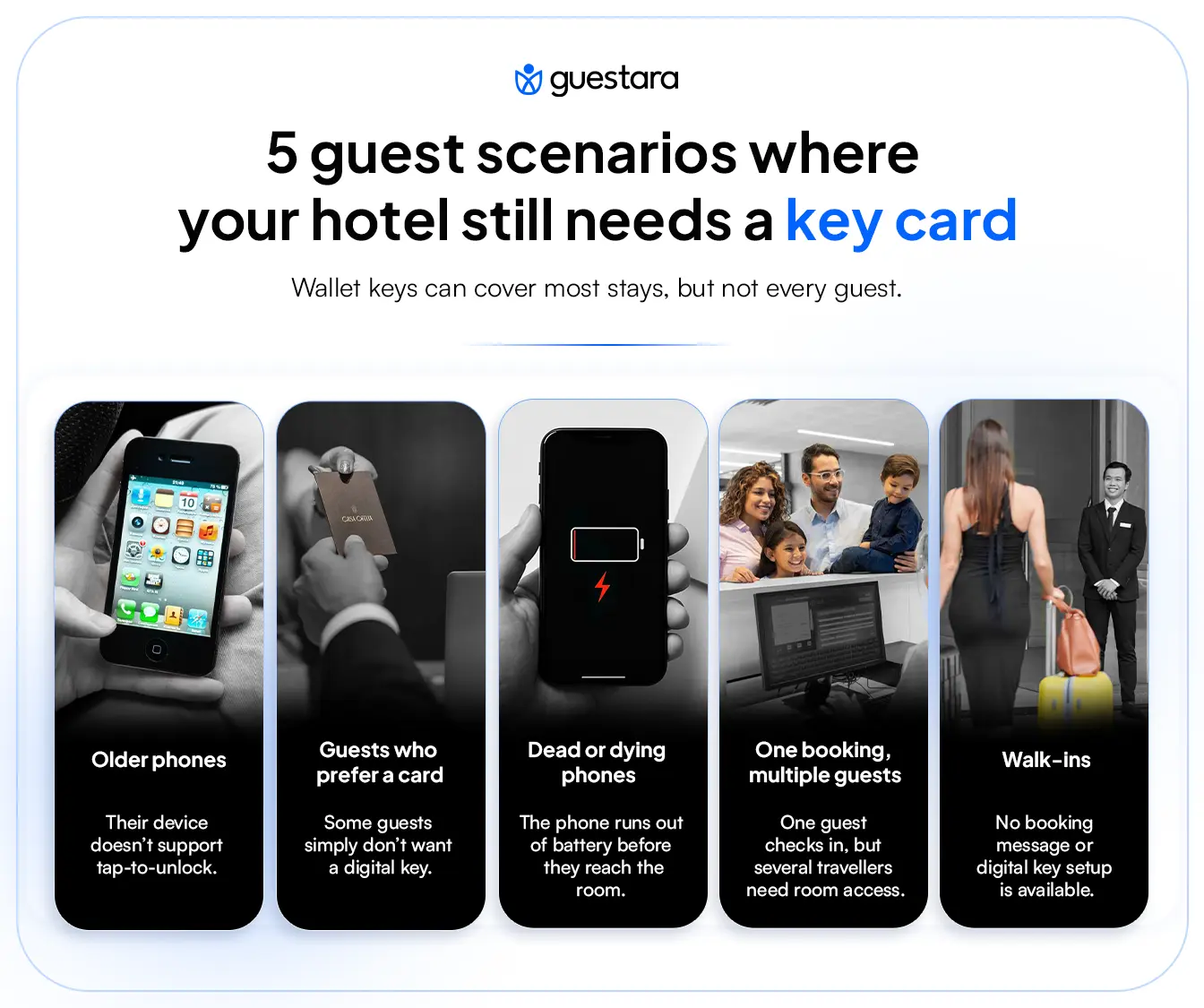
Plan for this group deliberately, because it never reaches zero:
Never run wallet room keys as your only credential. Keep an encoder behind the desk and keep card stock. A property that removes the fallback builds a queue out of the exact guests least able to fix the problem themselves. Google's hotel key help page is worth keeping handy for guests who need the Android side explained.
Train this once and it holds:
For properties adding a self-service layer for walk-ins and stragglers, a front desk kiosk or tablet registration station catches them without pulling a staff member off the floor.
A wallet room key nobody adds is a keycard with extra steps. Three things move the number.
The pre-arrival sequence, the timing of the message, and the count of taps between the message and the key. Reduce the taps first, because that is the cheapest fix.
Olive Hotels by Embassy saw a 248% lift in guest engagement using Guestara.
Exceptions still need routing. Guestara's Task Board sends a lock issue to maintenance and a room change to the front desk automatically, so a failed tap at 11pm becomes a tracked task instead of a message lost in a staff WhatsApp group. The wider arrival and departure flow sits in contactless check-in and checkout.
[[cta:cta-6 | eyebrow=Digital Arrival | heading=Give every guest a *verified* arrival, not a queue | btn=Book a demo | link=https://www.guestara.com/get-demo ]]


Wallet room keys let guests unlock rooms with an iPhone or Android phone. Here is what independent hotels need to run them, and what to buy now.
Independent hotels can now issue room keys straight into Apple Wallet and Google Wallet without building an app. That became true in June 2026, when Salto Space Hospitality added support for Room Keys in Apple Wallet, provisioned remotely through a credential manager partner instead of through software the hotel had to own.
For the four years before that, wallet room keys were a brand feature. Hyatt launched first in December 2021 across six US properties. Everyone who followed had an app and an engineering team behind it. If you ran 40 rooms in a converted townhouse, the technology existed and you could not have it.
Meanwhile your arrival still runs on plastic. Somebody encodes a card. Somebody explains it. It demagnetises in a pocket next to a phone, the guest comes back, and somebody encodes another one. Multiply that by every arrival, every day, with no end date.
This guide covers what a wallet room key actually is, whether your property qualifies, what has to be connected behind it, what it costs, and what changes at your front desk on day one.
A wallet room key is a hotel room access credential stored natively inside Apple Wallet or Google Wallet on a guest's phone or smartwatch, used by holding the device near the door reader. There is no hotel app to open, no Bluetooth to pair and no screen to unlock.
Most operators treat a mobile key and a wallet room key as the same product. They are not, and they behave differently at the door.
An app-based mobile key lives inside software the guest has to install, sign into and open. A wallet room key lives in the operating system, in the same place as their boarding pass and their bank card.
On iPhone, Express Mode turns on automatically, so the guest never unlocks the phone or opens anything. Apple's Power Reserve keeps the key working for up to five hours after the device needs charging.
Wallet room keys run on hardware most of your guests already carry:
The device floor matters more than it looks. An arrival list of 60 people will contain a handful of phones that fall below it, and those guests are your exception queue.
If you are earlier in this decision and still weighing keyless access as a category, our complete guide to hotel digital keys and mobile access covers the ground underneath this post.
Hotel guests add a wallet room key through an add-to-wallet button rather than a download, and it reaches them by one of three routes. The route your property picks decides your adoption rate more than any other single choice.
The third route matters most to independent properties, because it takes the download out of the guest's path entirely.
The two ecosystems ask for different things on both sides of the transaction.
Timing decides adoption, and most properties get it wrong by sending too early.
A check-in link sent three days out gets buried. A link that lands while the guest is in a taxi from the airport gets used, because the guest is thinking about arriving at that exact moment.
Guestara's Guest Journey runs that sequence automatically. Trigger-based messages fire against PMS booking data across WhatsApp, email and SMS, so the check-in link goes out 24 hours before arrival and the room key follows the moment check-in completes. The full pre-arrival to post-stay flow sits inside the guest engagement platform.
Yes. Independent hotels can offer Apple Wallet room keys without building their own app, and this became true recently rather than gradually. The barrier was never the size of the property.
The blocker sat in the middle of the add-to-wallet flow. Apple and Google both route the credential through a service provider's app, which for years meant a hotel needed its own branded app.
Only chains had one worth building. Hyatt went first in December 2021. Google Wallet launched hotel key support in June 2024 at the Clarion Hotel Post in Gothenburg. Club Quarters followed in January 2025. Every early adopter was a brand or a group.
Lock platforms started acting as the credential manager themselves, which removed the app the hotel had to own.
Salto announced in June 2026 that its Salto Space Hospitality platform now supports Room Keys in Apple Wallet, with keys provisioned remotely through a credential manager partner. Room keys can be deployed on a standalone property or across a multi-property estate.
That moves the qualifying question entirely. It is no longer "does your brand have an app." It is "does your access platform support wallet credentials, and can it provision them remotely."
A 40-room boutique property on the right lock platform can now offer the same arrival experience as a flagship resort. The gap between what a brand can do at the door and what an independent can do at the door has closed further in the last two years than in the previous ten.
Support is decided per platform and per lock generation, not per manufacturer. This is where properties get caught out.
A hotel running readers from a supported manufacturer can still fall outside wallet key support because the installed hardware is two generations behind the current catalogue. Check your actual model numbers against your access platform's live support list before you promise anything to guests or to an owner.
Hotels need four connected layers before a guest can tap a phone on a guest room door, and a wallet room key project fails at whichever layer got skipped. Most failures are not technical.
Google's hotel key documentation sets out the reader and service provider prerequisites on the Android side, and it is worth reading before any vendor conversation.
A room key cannot issue without a room number, and that is a workflow problem rather than a software one.
If your team assigns rooms manually at the desk when the guest walks in, no wallet room key can pre-issue. The credential has nothing to point at. Guests arrive, tap nothing, and queue anyway.
Wallet room keys expose weak room assignment discipline in a way plastic never did. Fix the assignment workflow first, or you will pay for a keyless system that only ever activates at the front desk.
Guestara is the guest experience layer, not the credential issuer. That distinction is worth being precise about.
Guestara's Digital Check-In verifies the guest and completes registration. Guestara integrates with 50+ smart lock systems and major PMS platforms including Cloudbeds, Apaleo, SiteMinder, Hotelogix and Oracle, and digital room keys are sent automatically the moment check-in completes.
The wallet credential itself is issued by your access platform. Guestara is what gets the guest to the point of having one, and what handles every guest who cannot use one. For the PMS side of the build, our smart lock integration guide walks through the connection in detail.
The right credential for a hotel is set by door count, reader hardware and whether the desk is staffed overnight. It is not set by which technology launched most recently.
The cost sits in two places, and only one of them is recurring.
Plastic keycards are a recurring line that never ends. You buy stock, you replace cards guests demagnetise, and you pay staff time at the desk on every reissue. Wallet room keys move that recurring cost into software.
The capital cost sits in the readers. If your doors already carry NFC-capable readers, adding wallet room keys is largely a software and integration project. If they do not, you are looking at a hardware refresh, and the honest answer is that the maths only works if those locks were near end of life anyway.
You do not choose between plastic and phone. You choose which one is the default and which one is the exception.
Every property runs both for the foreseeable future. Deciding that explicitly, and staffing for it, is what separates a keyless rollout that works from one that creates a new queue. If you are still selecting the lock hardware underneath this, our guide on how to choose, integrate and automate hotel smart locks covers the criteria.
[[cta:cta-5 | eyebrow=Smart Locks | heading=Send room keys the moment check-in is *complete* | btn=Explore Hotel Smart Locks | link=https://www.guestara.com/hotel-smart-locks ]]
No. Hotels should not pause a lock purchase for Aliro, but should write it into procurement questions before signing anything.
The Connectivity Standards Alliance released the Aliro 1.0 specification on 26 February 2026. It is a single interoperability standard for mobile access credentials.
What it brings:
Today, wallet room key support is decided vendor by vendor. You pick a lock platform and you inherit whatever wallet support that platform has built. Aliro is designed to make the credential portable across vendors, so a guest's phone works at the door regardless of whose hardware is on it.
That is a real change and still not a reason to delay. Certification and commercialisation take time to reach installed hardware, and the locks you buy this year will be on your doors in a decade. Your guests are carrying wallet-capable phones right now.
Three questions, and get the answers in the contract rather than the sales deck:
A wallet room key gives a hotel more control than a plastic keycard, not less. The credential sits in the secure element of a device belonging to one identified person, rather than on a card that works for anyone holding it.
The operational advantages are the security case, and they are all things a plastic card cannot do:
Apple's guidance on room keys in Wallet sets out the guest-side behaviour, including automatic deactivation at the end of a stay.
A credential handed to an unverified booking is a security hole no matter how strong the cryptography is. The gate that matters most sits before the key is ever issued.
Guestara's Digital Check-In closes that gate. The guest scans a government ID, AI reads it, and the registration form auto-fills in about 30 seconds. The key is issued against a verified guest profile rather than a name typed into a booking field.
Olive Hotels by Embassy reached 99.8% verified guest profiles using Guestara.
Many jurisdictions require guest registration details to be captured and filed with local authorities, and several have moved that filing onto digital portals.
Capturing ID data at digital check-in makes that filing faster. It does not make it optional. Write down your retention policy for scanned ID data before you switch any of this on, including how long images are held and who can access them.
Wallet room keys move a hotel front desk from issuing credentials to handling exceptions. That is a bigger change to staffing than it sounds, because the work does not disappear. It changes shape.
Today every arrival runs the same script. Greet, find the booking, take the ID, encode a card, hand it over, explain the lift. After wallet room keys, most arrivals walk past the desk with a live key already on their phone.
Plan for this group deliberately, because it never reaches zero:
Never run wallet room keys as your only credential. Keep an encoder behind the desk and keep card stock. A property that removes the fallback builds a queue out of the exact guests least able to fix the problem themselves. Google's hotel key help page is worth keeping handy for guests who need the Android side explained.
Train this once and it holds:
For properties adding a self-service layer for walk-ins and stragglers, a front desk kiosk or tablet registration station catches them without pulling a staff member off the floor.
A wallet room key nobody adds is a keycard with extra steps. Three things move the number.
The pre-arrival sequence, the timing of the message, and the count of taps between the message and the key. Reduce the taps first, because that is the cheapest fix.
Olive Hotels by Embassy saw a 248% lift in guest engagement using Guestara.
Exceptions still need routing. Guestara's Task Board sends a lock issue to maintenance and a room change to the front desk automatically, so a failed tap at 11pm becomes a tracked task instead of a message lost in a staff WhatsApp group. The wider arrival and departure flow sits in contactless check-in and checkout.
[[cta:cta-6 | eyebrow=Digital Arrival | heading=Give every guest a *verified* arrival, not a queue | btn=Book a demo | link=https://www.guestara.com/get-demo ]]
Guests do not need to download the hotel's own app, but a service provider app currently sits in the standard add-to-wallet flow for both Apple and Google. In practice, most independent properties route around this by sending a check-in link before arrival, so the guest completes check-in in a browser and receives the key without installing anything. Confirm with your access platform which route it supports before you promise guests an app-free arrival.
On iPhone, Apple's Power Reserve keeps a room key in Apple Wallet working for up to five hours after the device needs charging. On Android, a completely drained battery generally means the key cannot be used, and the guest needs a physical key from reception. This is one of the main reasons every property that runs wallet room keys also keeps an encoder and card stock behind the desk.
That depends on whether your readers are NFC-capable and whether your access platform supports wallet credential provisioning. Support is decided per platform and per hardware generation, so a property can be running the right manufacturer and still fall outside support because the readers are two generations old. Check your installed hardware model numbers against your access platform's current support list rather than assuming the brand covers you.
A wallet room key is more controllable than a plastic keycard in this situation. The credential is stored in the device's secure element and can be revoked remotely and instantly, which is not possible with a card that has already left the building. The stronger safeguard is upstream, because a key issued against a verified identity is auditable in a way that an anonymously encoded card is not.
Wallet room keys work for short-term rentals where the units carry compatible NFC readers, but distributed portfolios rarely have uniform hardware across every property. Most STR operators get further with a web-based key or a keypad code delivered by message, since neither depends on the lock hardware being identical from unit to unit. Where a portfolio is standardising locks anyway, specifying wallet-capable readers at that point is the cheaper moment to do it.
We work closely with the industry leaders to offer seamless solutions




We’re here to help your whole team stay ahead of the curve as you grow.

Get up and running quickly with a personalized onboarding plan

Connect with real people who really get it, 24/7

Checkout our vast library of free resources, templates and more
There's only so much we can say — so let us show you! Schedule a demo today and reach your business goals.


.png)