Learn how hotel digital keys work, including BLE, NFC, and PIN access, costs, security, and benefits for hotels.




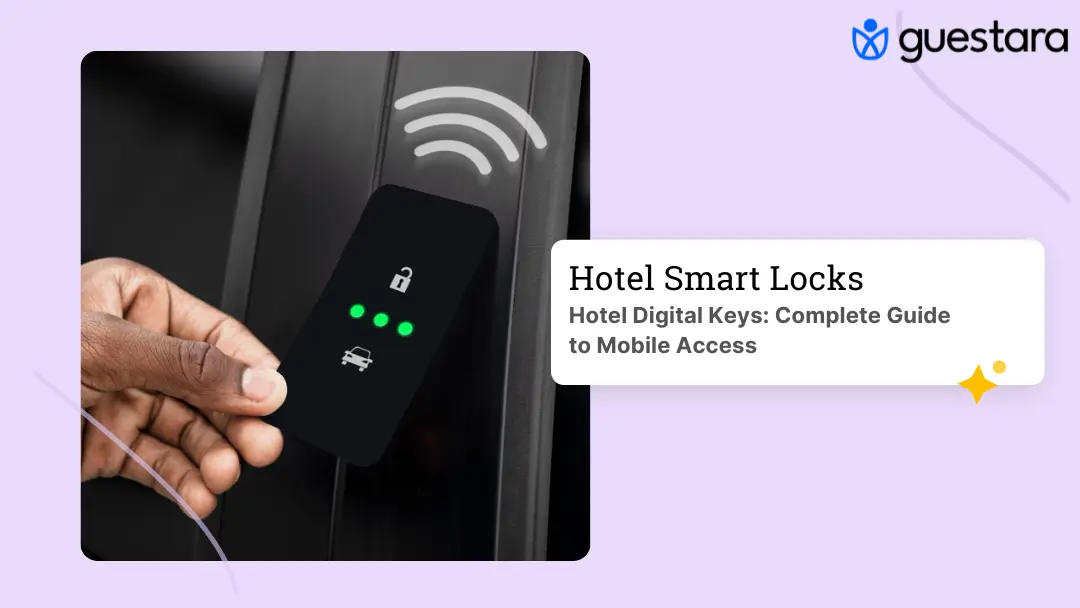
A hotel digital key is a room key stored on a guest's phone. It opens the door using Bluetooth, NFC, a PIN code, or a QR code, and it replaces the plastic key card at checkout.
It is 11pm on a Friday. A guest lands after a delayed flight, drags a suitcase past a dark lobby, and finds a note taped to the door telling them to ring the night bell twice. Fifteen minutes later, a half asleep staff member hands over a key card that works on the second try.
That scene plays out at independent hotels every week, and it is completely avoidable. A digital key sent straight to the guest's phone means the door opens the moment they arrive, whether the front desk is staffed or not.
Digital keys are one piece of a larger shift toward self check-in technology, where ID verification, room assignment, and door access all happen on the guest's own phone instead of at a counter. This guide covers what a hotel digital key actually is, the four ways guests open a door with a phone, what the technology costs to install, how secure it really is, and how to decide if your property is ready for it.
A hotel digital key is a digital credential, usually stored on a guest's smartphone, that replaces a physical key card or metal key for opening a hotel room door.
Guests receive the key on their phone before or during arrival. They unlock the door by holding the phone near the lock, tapping a button in an app, scanning a QR code, or entering a PIN, depending on which technology the property has installed.
Unlike a key card, a digital room key cannot be left behind at the pool or demagnetized by a hotel room safe. It also cannot be duplicated without access to the guest's phone, and it deactivates automatically the moment checkout is complete.
Hotel groups including Marriott, IHG, and Hilton, along with independent boutique properties, now offer some form of digital key. The technology has moved from a luxury extra to a standard guest expectation, especially among younger travelers who already unlock their car, their office, and their front door with a phone.
The shift is not limited to large chains. Independent hotels and boutique properties are adopting digital keys at the same time they roll out mobile check-in, since the two work best as one connected process rather than two separate projects. A guest who checks in on their phone expects the room key to arrive on that same phone, not at a counter three floors down.
A hotel digital key works by linking a guest's reservation to a unique digital credential that a smart lock recognizes, sent to the guest's phone before they need it.
Here is the typical flow.
None of this requires a staff member to physically hand anything over. Guestara's Digital Check-In module runs this entire sequence in the background. Once a guest scans their ID, the platform completes check-in through an AI ID scan that takes 30 seconds and pushes a digital key to more than 50 supported smart lock brands, so the room is ready before the guest steps out of the elevator.
The delivery channel matters as much as the technology behind the lock. A key sent by email gets buried under boarding passes and dinner reservations. A key sent by WhatsApp or SMS lands in a channel the guest already checks every few minutes during travel. Guestara's Guest Journey module ties the digital key to the same automated sequence that sends the pre-arrival message and the check-in link, so the guest never has to hunt for it in an inbox.
Delivery failures happen, and a good system plans for them. If a lock does not respond, if a guest's phone loses signal at the exact moment they reach the door, or if the PMS has not synced the room assignment yet, the front desk needs a fallback path that does not involve calling IT support at midnight. That usually means a PIN code generated from the same reservation, available at the keypad as a backup the moment the digital key fails to connect.
Hotels use four main types of digital keys, and most properties end up supporting more than one to cover every guest and every phone.
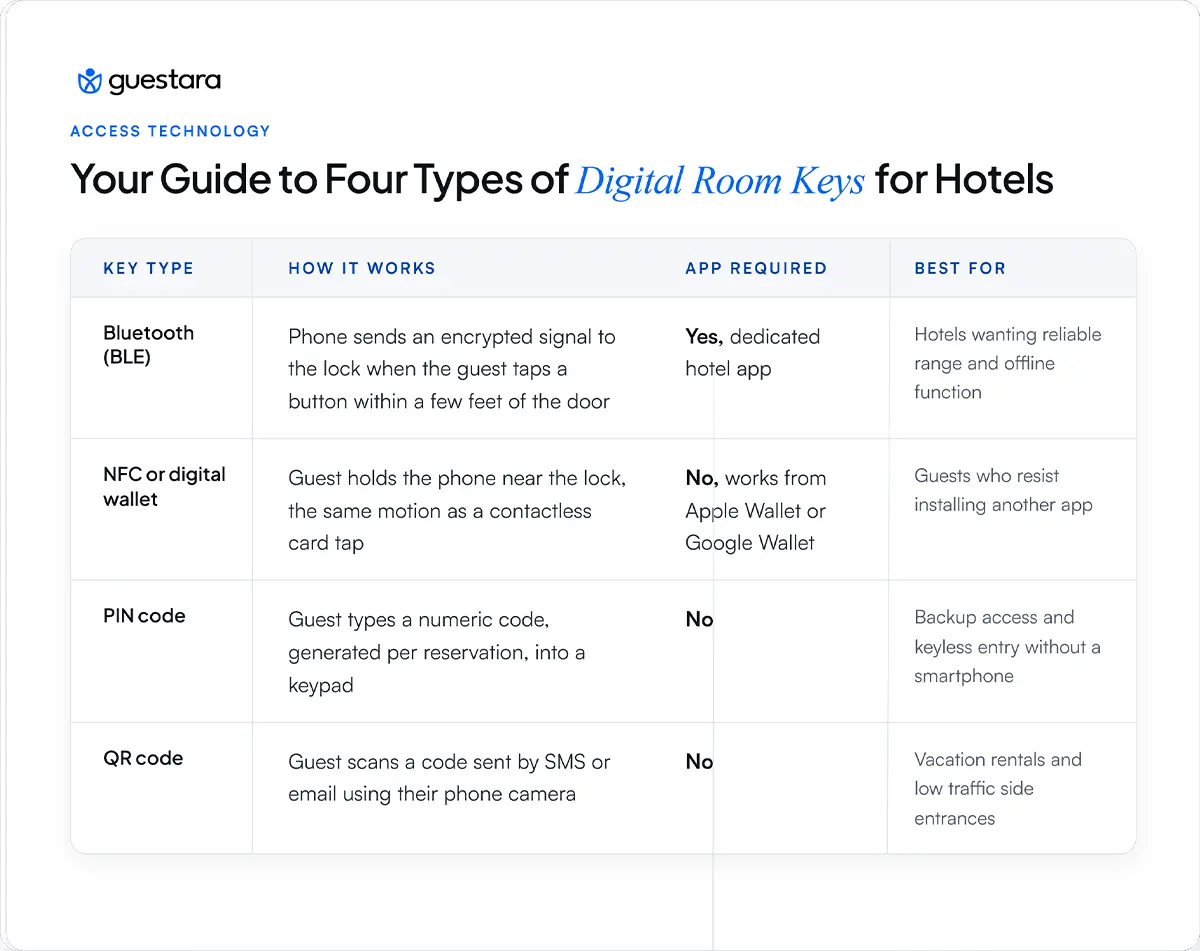
Bluetooth keys hold the longest range and keep working even with a weak signal, which matters at properties with thick walls or basement level rooms. NFC and wallet based keys remove the biggest point of friction: nobody wants to install an app for a two night stay. PIN codes remain the simplest fallback when a guest's phone battery dies or they are not comfortable with a mobile key at all. QR codes cost the least to deploy since they need no new hardware on the guest's side, only a camera, which is why smaller vacation rental operators lean on them first.
Most properties do not pick one type and stop there. A mid-size hotel commonly runs NFC or wallet keys as the default for guests who want zero setup, keeps a BLE app option for guests who book longer stays and will use the key more than once, and leaves a keypad PIN on every door as the fallback that never fails because a phone died or a signal dropped.
No, guests do not always need to download an app. NFC based digital keys work directly from a phone's built in wallet, the same one that already stores boarding passes and transit cards.
Bluetooth based keys are the exception. Because BLE keys need a dedicated application to broadcast the signal to the lock, guests must install the hotel's app or a shared digital key app before arrival.
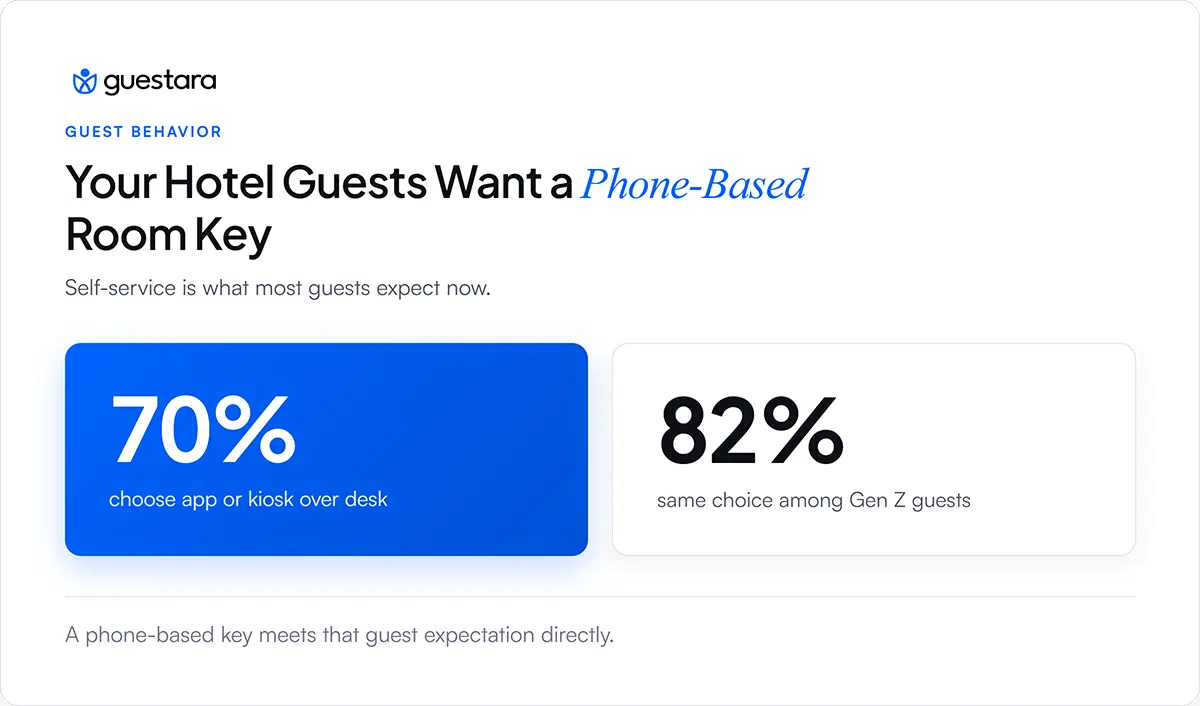
This distinction matters more than it looks. Mews and Talker Research surveyed 2,000 American travelers in April and May 2025 and found that 70% are likely to check into a hotel using an app or kiosk instead of the front desk, rising to 82% among Gen Z travelers. Guests are ready for self-service. What they resist is a mandatory download for a single stay.
Properties that offer an app-free option, through NFC or wallet based keys, remove that resistance entirely. Guests add the key to a wallet they already use daily, and the room unlocks the same way a transit card does. Properties that also offer a self-service kiosk or tablet at the front desk give the remaining guests, the ones without a compatible phone or a comfort level with mobile keys, a fast fallback that still avoids a manual queue.
The same appetite for self-service shows up beyond the room key. Hotel Tech Report's 2026 State of Hotel Guest Tech Report, based on a global survey of 402 recent hotel guests, found that 43% of luxury travelers expect not to wait in line at any point during their stay, and nearly half of all guests already prefer to check out using their smartphone. A digital key that skips the app download fits directly into that expectation, since it removes the one extra step that would otherwise slow a guest down at the door.
A digital key removes the physical card entirely, while a traditional key card still requires a piece of plastic encoded at the front desk.
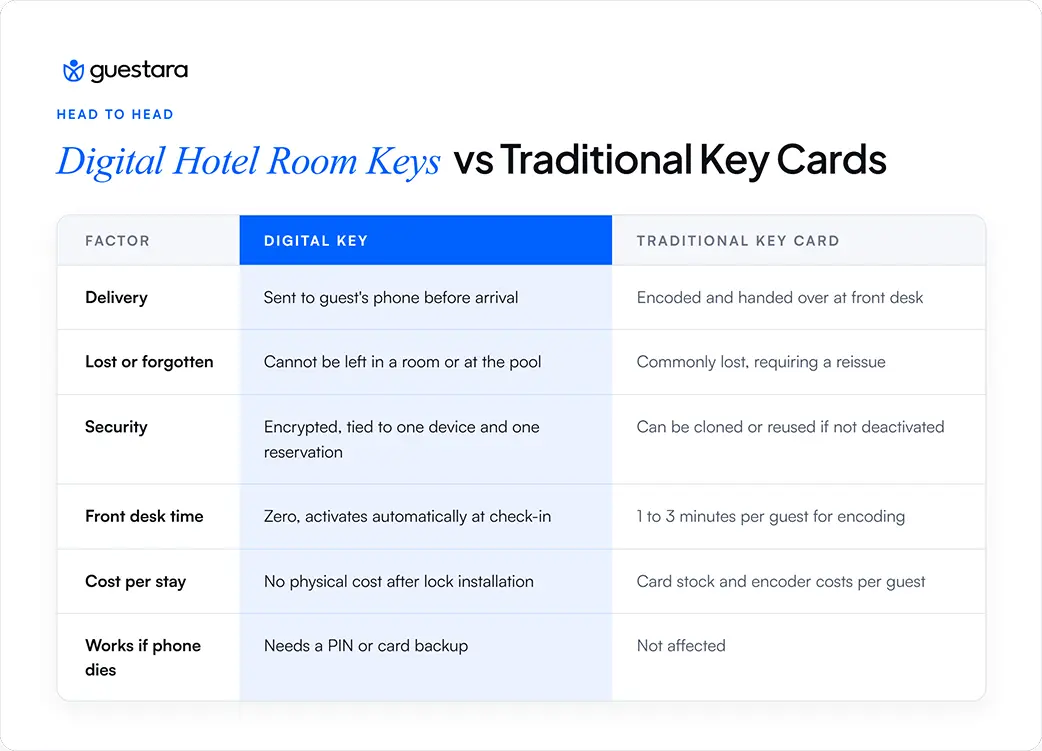
The biggest operational shift is at the front desk. A staff member no longer encodes a card for every arrival, which matters most during a Friday afternoon rush when three guests are checking in at once and two more are asking about late checkout. Freeing up that time is not just about speed. It means the one staff member on the floor can handle the guest with the billing question instead of standing at the encoder for someone who already finished check-in on their phone.
Digital keys do not remove the need for a card based backup entirely. Guests without a smartphone, guests whose battery dies, and older travelers who prefer a physical card should always have that fallback available.
Smart lock hardware costs $150 to $500 per door, with installation adding another $100 to $300 depending on whether the door needs rewiring or a full frame replacement.
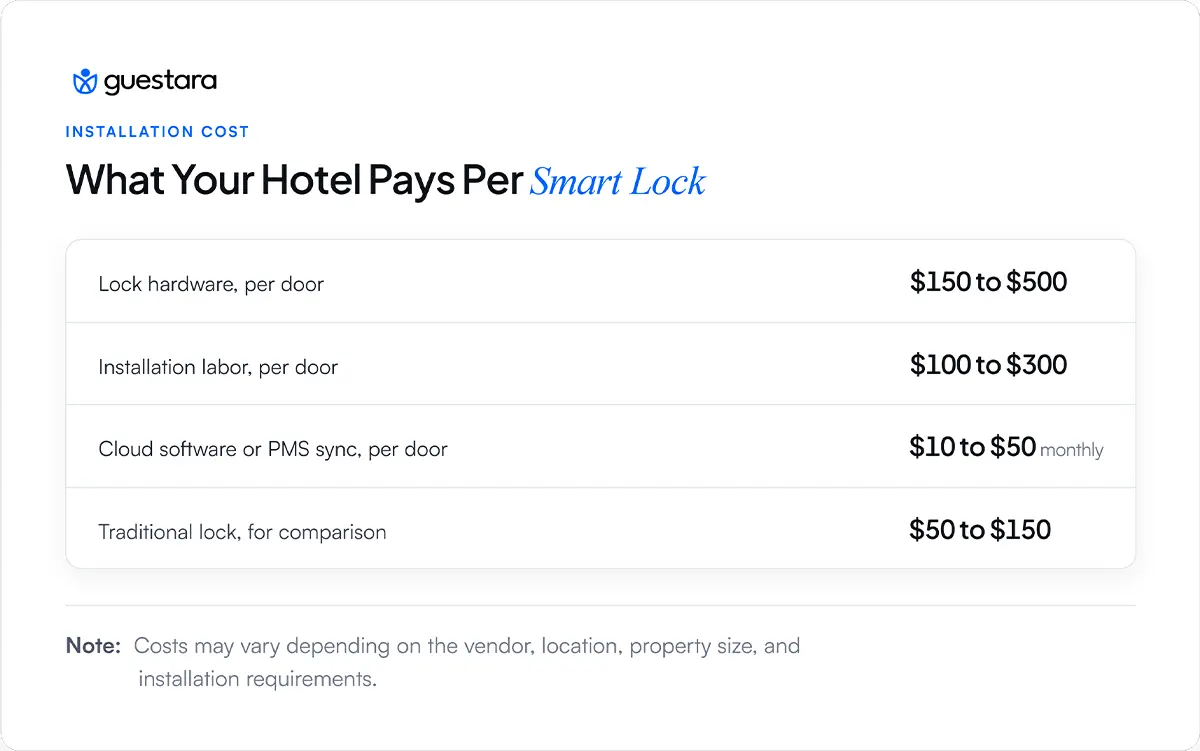
A 40 room boutique property replacing every lock should budget for hardware and installation together, roughly $250 to $800 per door before any monthly software fee. Most hotels do not replace every lock at once. A common approach is to start with high traffic doors, guest rooms and side entrances, and expand once the system proves itself.
The math works in the hotel's favor over time. A lost key card costs $5 to $20 to reissue, and a lock that jams from a demagnetized card can pull a housekeeper or engineer off other work for 15 minutes or more. Digital keys remove both costs entirely, and the smart lock market as a whole is projected to grow at close to 20% a year through 2030 as more properties make the switch.
Most properties see the return on investment within the first one to two years, once card reissue costs, lock maintenance calls, and the staff minutes spent on manual key encoding are added up across a full year of arrivals. A 60 room hotel encoding cards for even half its guests during a busy season easily spends more staff time on that single task than the monthly software fee for a digital key platform.
Yes, hotel digital keys are more secure than traditional key cards, because each key is encrypted, tied to a single reservation, and revoked automatically at checkout.
A magstripe key card can be cloned with inexpensive equipment and often stays active after a guest checks out if staff forget to deactivate it. A digital key cannot be duplicated without access to the guest's actual phone and the encrypted credential stored on it, and the system revokes it the moment checkout completes in the property management system.
Digital key systems also create an audit trail. Every unlock event, every failed attempt, and every access revocation gets logged, which matters for incident investigation and for properties handling an insurance claim after a security dispute.
The security gap between key types is closing but has not disappeared. A lock that has not received a firmware update in years, or a hotel running an outdated app, introduces the same vulnerabilities any connected device carries. Choosing a system with wide PMS integration and regular lock firmware support closes most of that gap. Guestara's platform integrates with more than 50 smart lock systems, which lets a property choose hardware with a strong security track record instead of settling for whatever locks a single vendor happens to sell.
Multi-property operators face an added layer here. A hotel group running five properties on five different lock systems cannot audit access consistently, since each system logs and reports differently. Centralizing digital key issuance and revocation through one platform, tied to one PMS, gives a security team a single audit trail to check instead of five.
The right digital key system depends on three things: the smart locks already installed, the property management system in use, and how comfortable your guests are with self-service technology.
Start with compatibility. A digital key platform is only as useful as the locks it can talk to. Properties locked into a single lock vendor often find their options limited when they want to add mobile access later, which is why checking PMS and lock integration lists before buying matters more than comparing app interfaces. A closer look at how to choose, integrate, and automate hotel smart locks is worth a dedicated read before making a hardware decision.
Consider your guest mix next. A business hotel near an airport, full of guests checking in late and checking out before sunrise, benefits most from NFC or wallet based keys that need zero app download. A resort with a longer average stay can justify a dedicated app, since guests will use it more than once during the trip.
Vacation rentals and small independent properties without 24 hour staff should prioritize systems with QR or PIN fallback, since there is no front desk to catch a guest whose phone will not connect. Hotel groups and short term rental managers running several properties should weigh centralized management just as heavily as guest experience, since generating and revoking codes across a portfolio by hand does not scale past a handful of units.
Guestara's Digital Check-In and Smart Locks modules work together out of the box. Registration completes in 30 seconds through an AI ID scan, and the digital key sends automatically through any of more than 50 supported lock brands, with no separate app required for guests using NFC or wallet based access. Onboarding typically takes about one week, including PMS and lock integration.


Learn how hotel digital keys work, including BLE, NFC, and PIN access, costs, security, and benefits for hotels.
A hotel digital key is a room key stored on a guest's phone. It opens the door using Bluetooth, NFC, a PIN code, or a QR code, and it replaces the plastic key card at checkout.
It is 11pm on a Friday. A guest lands after a delayed flight, drags a suitcase past a dark lobby, and finds a note taped to the door telling them to ring the night bell twice. Fifteen minutes later, a half asleep staff member hands over a key card that works on the second try.
That scene plays out at independent hotels every week, and it is completely avoidable. A digital key sent straight to the guest's phone means the door opens the moment they arrive, whether the front desk is staffed or not.
Digital keys are one piece of a larger shift toward self check-in technology, where ID verification, room assignment, and door access all happen on the guest's own phone instead of at a counter. This guide covers what a hotel digital key actually is, the four ways guests open a door with a phone, what the technology costs to install, how secure it really is, and how to decide if your property is ready for it.
A hotel digital key is a digital credential, usually stored on a guest's smartphone, that replaces a physical key card or metal key for opening a hotel room door.
Guests receive the key on their phone before or during arrival. They unlock the door by holding the phone near the lock, tapping a button in an app, scanning a QR code, or entering a PIN, depending on which technology the property has installed.
Unlike a key card, a digital room key cannot be left behind at the pool or demagnetized by a hotel room safe. It also cannot be duplicated without access to the guest's phone, and it deactivates automatically the moment checkout is complete.
Hotel groups including Marriott, IHG, and Hilton, along with independent boutique properties, now offer some form of digital key. The technology has moved from a luxury extra to a standard guest expectation, especially among younger travelers who already unlock their car, their office, and their front door with a phone.
The shift is not limited to large chains. Independent hotels and boutique properties are adopting digital keys at the same time they roll out mobile check-in, since the two work best as one connected process rather than two separate projects. A guest who checks in on their phone expects the room key to arrive on that same phone, not at a counter three floors down.
A hotel digital key works by linking a guest's reservation to a unique digital credential that a smart lock recognizes, sent to the guest's phone before they need it.
Here is the typical flow.
None of this requires a staff member to physically hand anything over. Guestara's Digital Check-In module runs this entire sequence in the background. Once a guest scans their ID, the platform completes check-in through an AI ID scan that takes 30 seconds and pushes a digital key to more than 50 supported smart lock brands, so the room is ready before the guest steps out of the elevator.
The delivery channel matters as much as the technology behind the lock. A key sent by email gets buried under boarding passes and dinner reservations. A key sent by WhatsApp or SMS lands in a channel the guest already checks every few minutes during travel. Guestara's Guest Journey module ties the digital key to the same automated sequence that sends the pre-arrival message and the check-in link, so the guest never has to hunt for it in an inbox.
Delivery failures happen, and a good system plans for them. If a lock does not respond, if a guest's phone loses signal at the exact moment they reach the door, or if the PMS has not synced the room assignment yet, the front desk needs a fallback path that does not involve calling IT support at midnight. That usually means a PIN code generated from the same reservation, available at the keypad as a backup the moment the digital key fails to connect.
Hotels use four main types of digital keys, and most properties end up supporting more than one to cover every guest and every phone.
Bluetooth keys hold the longest range and keep working even with a weak signal, which matters at properties with thick walls or basement level rooms. NFC and wallet based keys remove the biggest point of friction: nobody wants to install an app for a two night stay. PIN codes remain the simplest fallback when a guest's phone battery dies or they are not comfortable with a mobile key at all. QR codes cost the least to deploy since they need no new hardware on the guest's side, only a camera, which is why smaller vacation rental operators lean on them first.
Most properties do not pick one type and stop there. A mid-size hotel commonly runs NFC or wallet keys as the default for guests who want zero setup, keeps a BLE app option for guests who book longer stays and will use the key more than once, and leaves a keypad PIN on every door as the fallback that never fails because a phone died or a signal dropped.
No, guests do not always need to download an app. NFC based digital keys work directly from a phone's built in wallet, the same one that already stores boarding passes and transit cards.
Bluetooth based keys are the exception. Because BLE keys need a dedicated application to broadcast the signal to the lock, guests must install the hotel's app or a shared digital key app before arrival.
This distinction matters more than it looks. Mews and Talker Research surveyed 2,000 American travelers in April and May 2025 and found that 70% are likely to check into a hotel using an app or kiosk instead of the front desk, rising to 82% among Gen Z travelers. Guests are ready for self-service. What they resist is a mandatory download for a single stay.
Properties that offer an app-free option, through NFC or wallet based keys, remove that resistance entirely. Guests add the key to a wallet they already use daily, and the room unlocks the same way a transit card does. Properties that also offer a self-service kiosk or tablet at the front desk give the remaining guests, the ones without a compatible phone or a comfort level with mobile keys, a fast fallback that still avoids a manual queue.
The same appetite for self-service shows up beyond the room key. Hotel Tech Report's 2026 State of Hotel Guest Tech Report, based on a global survey of 402 recent hotel guests, found that 43% of luxury travelers expect not to wait in line at any point during their stay, and nearly half of all guests already prefer to check out using their smartphone. A digital key that skips the app download fits directly into that expectation, since it removes the one extra step that would otherwise slow a guest down at the door.
A digital key removes the physical card entirely, while a traditional key card still requires a piece of plastic encoded at the front desk.
The biggest operational shift is at the front desk. A staff member no longer encodes a card for every arrival, which matters most during a Friday afternoon rush when three guests are checking in at once and two more are asking about late checkout. Freeing up that time is not just about speed. It means the one staff member on the floor can handle the guest with the billing question instead of standing at the encoder for someone who already finished check-in on their phone.
Digital keys do not remove the need for a card based backup entirely. Guests without a smartphone, guests whose battery dies, and older travelers who prefer a physical card should always have that fallback available.
Smart lock hardware costs $150 to $500 per door, with installation adding another $100 to $300 depending on whether the door needs rewiring or a full frame replacement.
A 40 room boutique property replacing every lock should budget for hardware and installation together, roughly $250 to $800 per door before any monthly software fee. Most hotels do not replace every lock at once. A common approach is to start with high traffic doors, guest rooms and side entrances, and expand once the system proves itself.
The math works in the hotel's favor over time. A lost key card costs $5 to $20 to reissue, and a lock that jams from a demagnetized card can pull a housekeeper or engineer off other work for 15 minutes or more. Digital keys remove both costs entirely, and the smart lock market as a whole is projected to grow at close to 20% a year through 2030 as more properties make the switch.
Most properties see the return on investment within the first one to two years, once card reissue costs, lock maintenance calls, and the staff minutes spent on manual key encoding are added up across a full year of arrivals. A 60 room hotel encoding cards for even half its guests during a busy season easily spends more staff time on that single task than the monthly software fee for a digital key platform.
Yes, hotel digital keys are more secure than traditional key cards, because each key is encrypted, tied to a single reservation, and revoked automatically at checkout.
A magstripe key card can be cloned with inexpensive equipment and often stays active after a guest checks out if staff forget to deactivate it. A digital key cannot be duplicated without access to the guest's actual phone and the encrypted credential stored on it, and the system revokes it the moment checkout completes in the property management system.
Digital key systems also create an audit trail. Every unlock event, every failed attempt, and every access revocation gets logged, which matters for incident investigation and for properties handling an insurance claim after a security dispute.
The security gap between key types is closing but has not disappeared. A lock that has not received a firmware update in years, or a hotel running an outdated app, introduces the same vulnerabilities any connected device carries. Choosing a system with wide PMS integration and regular lock firmware support closes most of that gap. Guestara's platform integrates with more than 50 smart lock systems, which lets a property choose hardware with a strong security track record instead of settling for whatever locks a single vendor happens to sell.
Multi-property operators face an added layer here. A hotel group running five properties on five different lock systems cannot audit access consistently, since each system logs and reports differently. Centralizing digital key issuance and revocation through one platform, tied to one PMS, gives a security team a single audit trail to check instead of five.
The right digital key system depends on three things: the smart locks already installed, the property management system in use, and how comfortable your guests are with self-service technology.
Start with compatibility. A digital key platform is only as useful as the locks it can talk to. Properties locked into a single lock vendor often find their options limited when they want to add mobile access later, which is why checking PMS and lock integration lists before buying matters more than comparing app interfaces. A closer look at how to choose, integrate, and automate hotel smart locks is worth a dedicated read before making a hardware decision.
Consider your guest mix next. A business hotel near an airport, full of guests checking in late and checking out before sunrise, benefits most from NFC or wallet based keys that need zero app download. A resort with a longer average stay can justify a dedicated app, since guests will use it more than once during the trip.
Vacation rentals and small independent properties without 24 hour staff should prioritize systems with QR or PIN fallback, since there is no front desk to catch a guest whose phone will not connect. Hotel groups and short term rental managers running several properties should weigh centralized management just as heavily as guest experience, since generating and revoking codes across a portfolio by hand does not scale past a handful of units.
Guestara's Digital Check-In and Smart Locks modules work together out of the box. Registration completes in 30 seconds through an AI ID scan, and the digital key sends automatically through any of more than 50 supported lock brands, with no separate app required for guests using NFC or wallet based access. Onboarding typically takes about one week, including PMS and lock integration.
A hotel digital key and a mobile key refer to the same thing: a room credential stored on a guest's smartphone instead of a physical card. Some properties use the term digital key for wallet based access delivered through Apple Wallet or Google Wallet, and mobile key for access delivered through a dedicated hotel app. Both work the same way at the door, using Bluetooth or NFC to communicate with the lock. The terms are used interchangeably in most hotel marketing, so guests should look at whether an app download is mentioned rather than relying on the label alone.
Yes, many hotel digital key systems support adding a room key directly to Apple Wallet or Google Wallet using NFC technology. This removes the need to download a separate hotel app, since the phone unlocks the door the same way it taps to pay for a coffee. Not every property offers wallet based keys yet, so guests should confirm this option with the hotel before assuming it is available. The check-in confirmation message usually includes a direct link to add the key to a wallet app, so guests do not need to search for it manually.
If a guest's phone battery dies, most hotels keep a backup access method available, usually a PIN code entered at the door or a physical key card issued at the front desk. Properties without 24 hour staff, such as many vacation rentals, typically rely on a PIN code system for exactly this reason. Guests should ask about backup access when a property advertises phone only entry. Traveling with a portable charger removes most of this risk, but it is still worth confirming the property has a fallback before arrival, especially for a late night check-in.
Hotel digital keys use encrypted credentials tied to a specific reservation and a specific device, which makes them harder to intercept or duplicate than a standard magstripe key card. The main risk comes from outdated lock firmware or an unsupported app, not the digital key concept itself. Properties that keep lock firmware updated and use a platform with strong PMS integration reduce this risk significantly. Every digital key also expires automatically at checkout, unlike a key card that can stay active for weeks if staff forget to deactivate it.
Yes, digital keys are common at vacation rentals and short term rental properties, often more common than at traditional hotels, since many operate without staff on site. A guest typically receives a PIN code or a digital key link by text message before arrival, unlocks the door independently, and the code expires automatically after checkout. This self-service model is close to the entire operating model of most vacation rental businesses. Operators managing several units at once also rely on this system to confirm a guest actually checked in, since a used access code doubles as an arrival record.
We work closely with the industry leaders to offer seamless solutions




We’re here to help your whole team stay ahead of the curve as you grow.

Get up and running quickly with a personalized onboarding plan

Connect with real people who really get it, 24/7

Checkout our vast library of free resources, templates and more
There's only so much we can say — so let us show you! Schedule a demo today and reach your business goals.


.png)