Managing hotel self check-in and traditional desk during peak hours? This playbook shows you how to handle hybrid check-in without guest frustration or staff burnout.




Your hotel digital check-in is live. Completion rates are climbing. Everything looks great.
Then Friday at 3 PM hits.
Twelve guests are in your lobby. Half completed hotel mobile check-in and want their keys. The other half didn't and need full processing. Two kiosks are occupied. Your front desk has one agent on duty.
Everyone is waiting. Everyone is frustrated.
This is the hybrid check-in challenge that most hotels face but few prepare for.
Most hotels implement hotel self check-in systems thinking it will eliminate front desk congestion.
It doesn't.
What it does is create two separate queues that compete for the same staff attention.
You have guests who completed hotel pre-arrival check-in. They expect instant service. Just hand me the key and let me go to my room.
Then you have guests who didn't complete hotel online check-in. They need full processing. ID collection. Payment authorization. Registration card signatures.
Both groups arrive at the same time. Both expect fast service.
Your front desk agent can't serve both simultaneously.
The problem isn't hotel digital check-in. The problem is thinking hotel self check-in replaces your front desk instead of changing how it operates.
Here's what actually happens during peak hours at most properties:
A guest who completed hotel contactless check-in stands at the desk for eight minutes while the agent processes someone who didn't. They're annoyed because they did everything the hotel asked and they're still waiting.
Meanwhile, the guest being processed feels rushed because the agent is trying to move quickly to clear the digital check-in queue behind them.
Nobody wins.
Peak hours expose every weakness in your hotel check-in workflow. If you haven't designed your operation for hybrid traffic, 3 PM to 6 PM becomes a daily crisis.
Peak check-in hours vary by property type, but most hotels see the same patterns.
Urban business hotels:
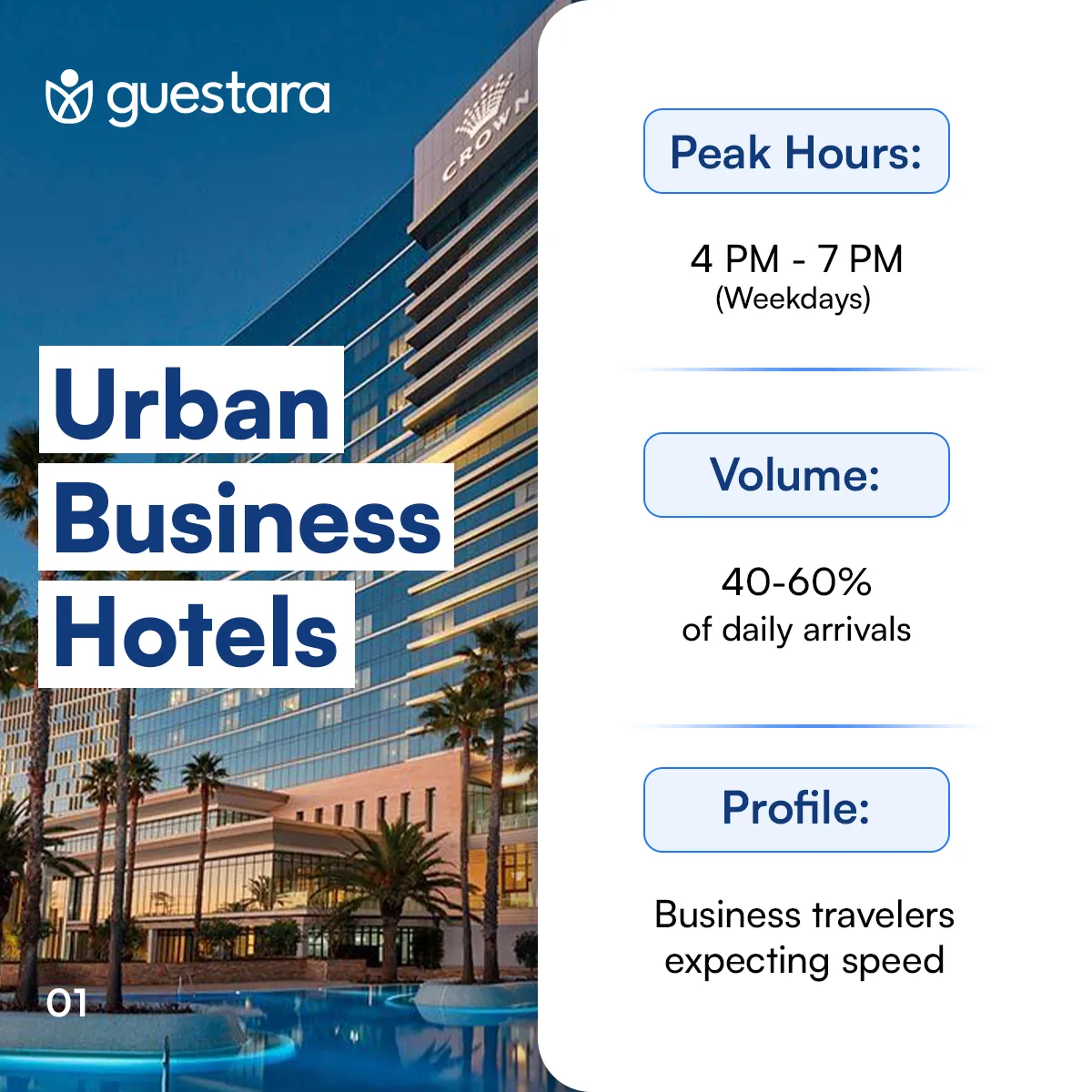
Peak time: 4 PM to 7 PM on weekdays
Volume: 40 to 60 percent of daily arrivals in a three-hour window
Guest type: Business travelers expecting speed, often with status or loyalty expectations
Resort properties:
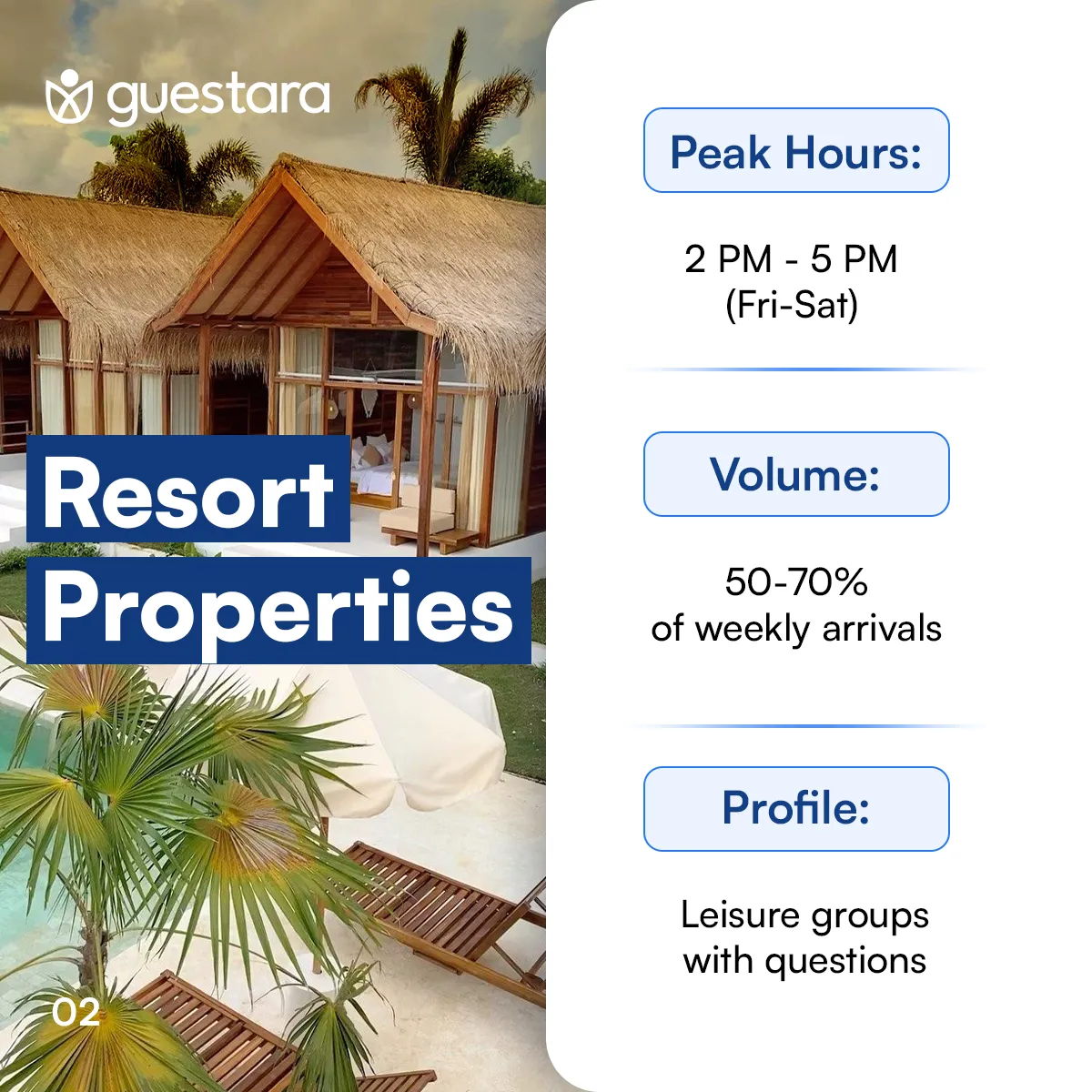
Peak time: 2 PM to 5 PM on Fridays and Saturdays
Volume: 50 to 70 percent of weekly arrivals on weekend days
Guest type: Leisure travelers, often in groups, with luggage and questions about amenities
Airport hotels:
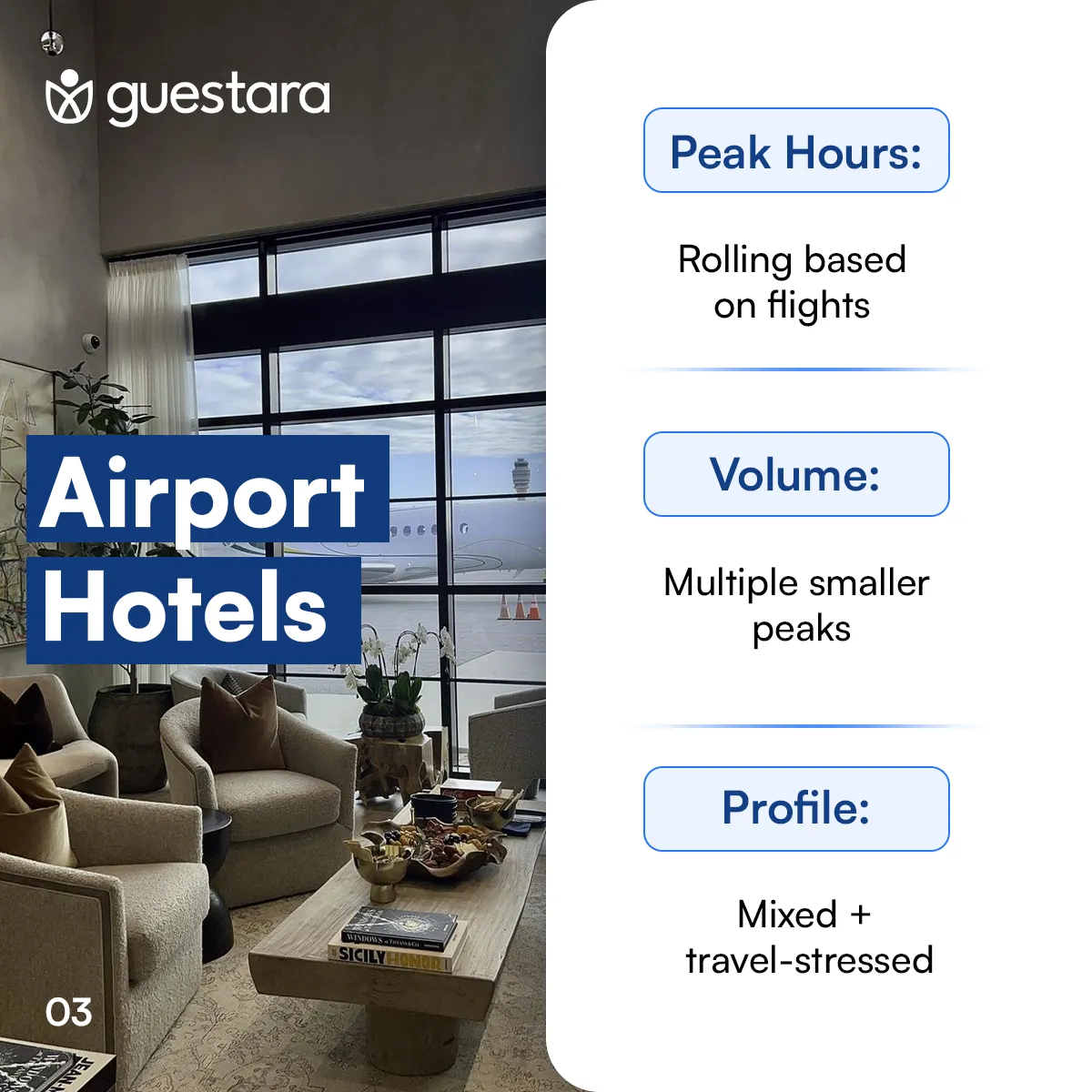
Peak time: Rolling throughout the day based on flight schedules
Volume: Multiple smaller peaks rather than one major surge
Guest type: Mix of business and leisure, often stressed from travel delays
The challenge is the same across all property types: your digital check-in completion rate doesn't change, but arrival volume concentrates into narrow windows.
If you have 70 percent guest completion rates on pre-arrival check-in during normal hours, you still have 70 percent during peak hours.
That means if 50 guests arrive between 3 PM and 4 PM, 35 completed mobile check-in and 15 need manual processing.
Your front desk needs to handle both groups efficiently or everything backs up.
Most check-in chaos happens because guests don't know where to go.
They completed WhatsApp hotel check-in. They walk into your lobby. They see a front desk with a line.
Do they wait in line? Do they go directly to their room? Do they need to stop somewhere first?
Without clear signage and flow design, they default to standing in line at the desk.
Your lobby layout should make the choice obvious.
Place it in a high-visibility location. Not tucked in a corner. Not hidden behind a pillar.
Add clear signage above it: "Completed online check-in? Get your key here."
Put floor markers directing traffic from the entrance to the kiosk.
Staff the kiosk area during peak hours. Not to operate it, but to answer questions and redirect guests who should be at the desk instead.
Create two distinct desk positions. One for express check-in (guests who completed hotel pre-arrival check-in). One for full check-in.
Mark them clearly. Use different colored signs. Different desk podiums if possible.
The express position should be closer to the elevator. This sends a visual message: you did the work online, now you get faster access.
Use queue management signage: "Completed check-in online? Please identify yourself to staff for express processing."
Train your staff to actively scan the lobby and pull digital check-in guests forward when they arrive.
Your lobby should answer these questions without anyone asking:
Most hotels answer none of these questions visually. They rely on guests to figure it out or ask.
That creates hesitation. Hesitation creates queues. Queues create frustration.
You can't just add more bodies at the front desk and expect better results.
You need to position staff based on what your hybrid check-in flow actually requires.
One staff member dedicated to guests who completed online check-in.
Their only job: verify identity, issue keys, answer quick questions.
Average time per guest: 90 seconds to 2 minutes.
This position handles 20 to 30 guests per hour during peak times.
One staff member handling guests who need complete processing.
They collect IDs. Process payments. Explain hotel policies. Answer detailed questions.
Average time per guest: 5 to 8 minutes.
This position handles 8 to 12 guests per hour.
One staff member who doesn't stand behind a desk.
They greet arriving guests. Direct them to the correct position. Handle quick questions without making people wait in line.
They spot problems before they escalate. Guest needs a room change? The lobby coordinator can start that process before they reach the desk.
They also monitor the hotel kiosk if you have one and help guests who get stuck.
One staff member who can flex between express and full check-in based on who's waiting.
They prioritize digital check-in guests when possible but can process full check-ins when needed.
One staff member handling everything that doesn't require the desk system.
They verify pre-arrival check-in completion on their tablet. They issue keys from a mobile device if your system allows it. They answer questions about the property.
Most importantly, they manage the queue so the desk agent can focus on processing.
Having all staff behind the desk during peak hours.
This creates a wall of people that intimidates guests and makes your lobby feel crowded.
It also means nobody is managing flow. Nobody is intercepting simple questions. Nobody is identifying VIP arrivals who should skip the line.
Having one person try to do everything.
This is the default at many properties. One agent handles digital check-in, full check-in, questions, phone calls, and problems simultaneously.
They can't give quality service to anyone because they're constantly interrupted.
Guests who complete hotel self check-in processes before arrival expect speed.
They did the work you asked them to do. Now they want the benefit.
If they wait the same amount of time as guests who didn't complete hotel pre-arrival check-in, they'll stop doing it.
Your fast track process should be genuinely fast. Under three minutes from lobby entrance to elevator.
Not much.
They already uploaded their ID. They already added payment. They already agreed to your terms.
Your staff needs to:
That's it.
No reprinting registration cards they already signed digitally. No re-explaining policies they already accepted online. No asking for information you already collected.
Your staff should follow this exact flow for hotel pre-arrival check-in guests:
Agent: "Hi, welcome to [Hotel Name]. Did you complete check-in online?"
Guest: "Yes."
Agent: "Perfect. Can I have your name and ID please?"
Agent: "Great, Mr. Smith, you're in Room 304. Here are your keys. Elevators are to your left. Breakfast is 6 to 10 AM in the lobby. Any questions about the property?"
Guest responds or declines.
Agent: "Enjoy your stay."
This speed matters more than you think. Research shows that 73 percent of travelers prefer hotels with self-service technology, and they expect it to be genuinely faster than traditional check-in.
Agents who feel obligated to explain everything even when the guest already knows.
Agents who reprint registration cards just because that's the normal process.
Agents who ask questions the system already answered: "How many nights are you staying?" "What rate did you book?" "Did you want breakfast?"
All of that information is in your PMS. The guest confirmed it during mobile check-in. Don't make them repeat it.
Always.
If you see someone waiting in a full check-in queue who completed online check-in, pull them forward.
This reinforces that completing pre-arrival check-in has actual benefits.
It also keeps your full check-in line moving because you're removing people who don't need to be there.
Train your staff to actively ask people in line: "Did anyone complete check-in online before arriving?"
You can't force guests to use digital check-in.
Some won't want to. Some won't be able to. Some will ignore your pre-arrival messaging entirely.
During peak hours, these guests take the most time. But they still deserve good service.
When a guest who didn't complete online check-in arrives during peak time, your staff should acknowledge the wait upfront.
"I'll be happy to help you check in. The process takes about five minutes. I see we have a few guests ahead of you. I'll have you checked in as quickly as possible."
This manages expectations. It also subtly reinforces that online check-in would have been faster.
Don't apologize for the wait if they chose not to use your self-check-in systems. Just acknowledge it and move forward.
Wait times directly impact satisfaction. Cornell University research shows that guest satisfaction drops by 50 percent when check-in wait times exceed five minutes. This is why managing both queues efficiently during peak hours isn't optional.
Fast check-in doesn't mean bad service.
It means eliminating unnecessary steps and keeping the conversation focused.
Don't ask questions you don't need answered:
Bad: "What brings you to town?"
Better: "Can I see your ID and a credit card please?"
Don't over-explain:
Bad: "So the rate includes breakfast which is served from 6 to 10 in the morning in our restaurant which is on the ground floor through those doors over there, and you'll also have access to our pool which is on the second floor and opens at 6 AM and closes at 10 PM, and wifi is complimentary throughout the property and the network name is..."
Better: "Your rate includes breakfast from 6 to 10 AM. Here's a property info card with wifi details and amenities. Any specific questions?"
Don't create extra work:
If your PMS can email the registration card, don't print it unless the guest requests paper.
If payment authorization can be done digitally, don't make them sign a physical slip.
If your key system allows it, encode keys before the guest arrives during peak hours.
Not every manual check-in takes the same amount of time.
Solo business traveler with one night, one card, no questions: 4 minutes.
Family of five with split payments, room requests, and questions about parking: 12 minutes.
Your lobby coordinator or roaming staff should identify high-complexity check-ins and warn the desk agent.
This allows the agent to suggest those guests step aside briefly while simpler check-ins are processed.
"Mr. Johnson, I see you have a few specific requests. Let me get these two quick check-ins handled and then I'll give you my full attention so we can make sure everything is set up exactly how you need it."
Most guests appreciate this because they'd rather have dedicated attention than feel rushed.
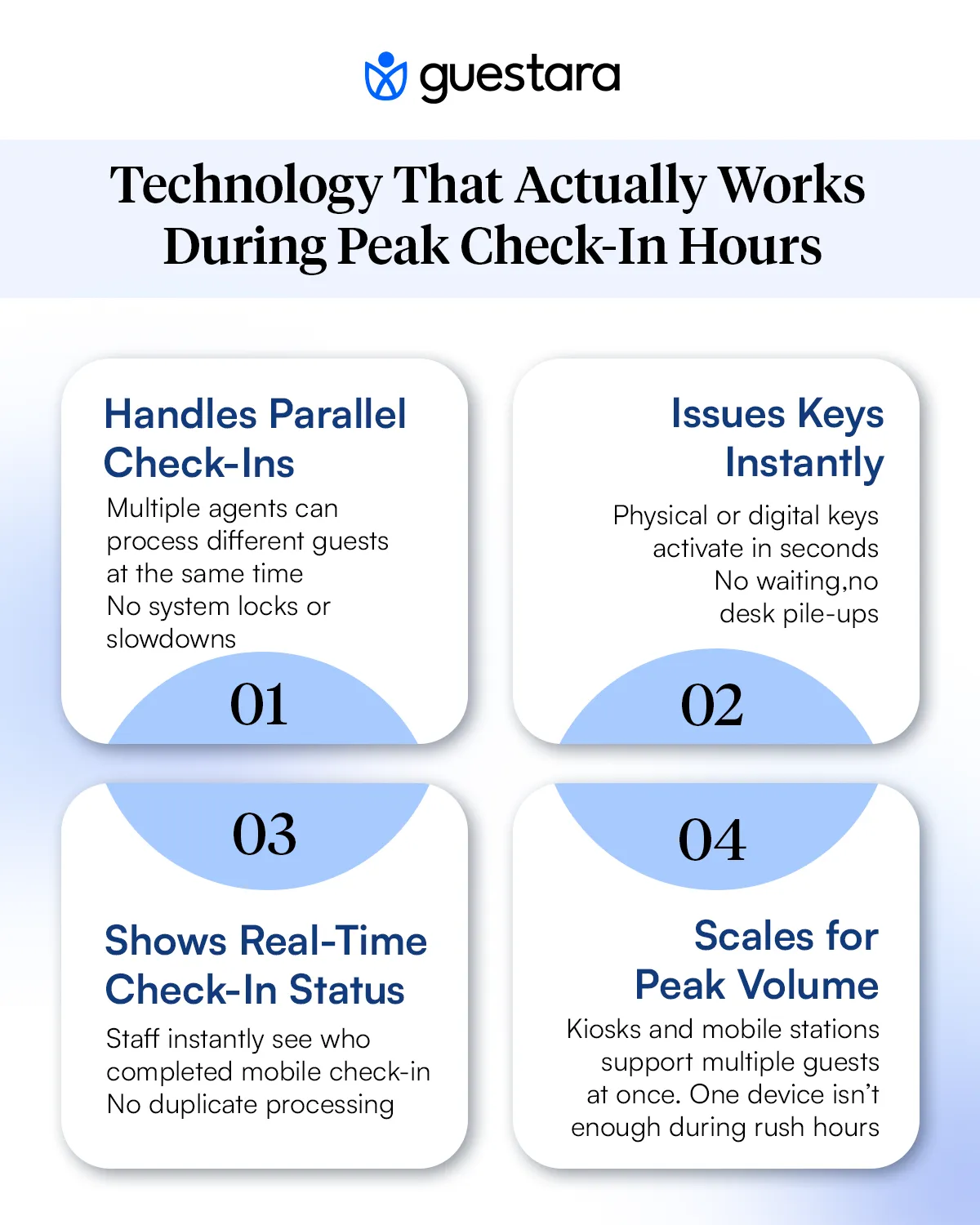
Technology should make peak hours easier, not create new bottlenecks.
Most hotels buy hotel contactless check-in systems without thinking about how they'll perform under high volume.
Implementing hotel contactless check-in requires more than just buying software. Your entire technology stack needs to handle peak demand.
When implemented correctly, hotel contactless check-in systems can reduce check-in time from 8-12 minutes to just 3 minutes a 75 percent improvement. But that speed only happens if your infrastructure can support it.
If your system locks a reservation when one agent opens it, you have a problem during peak hours.
Your express check-in agent needs to issue keys while your full check-in agent processes a different guest's payment in the same group booking.
If they can't work simultaneously, you've created an artificial bottleneck.
Test this before peak hours: can three agents access three different reservations at the same time without the system slowing down?
If not, you need to fix that or redesign your workflow to avoid conflicts.
If keys take 30 seconds to encode, that adds up.
During a peak hour, your express agent processes 20 guests. That's 10 minutes just waiting for keys to encode.
Modern systems encode keys in under five seconds. If yours doesn't, that needs to be a priority upgrade.
Better yet: issue digital keys that activate instantly through your hotel mobile check-in app.
Guests who completed WhatsApp hotel check-in can receive their key code directly on their phone. They never need to stop at the desk.
Your staff needs to know the moment a guest completes hotel mobile check-in while standing in your lobby.
If there's a lag between completion and notification, your desk agent might start processing them manually when they've actually already finished online.
This creates duplicate work and confuses the guest.
Your system should send instant alerts: push notifications to staff tablets, visible flags in your PMS, or desktop notifications.
One kiosk creates a queue during peak hours.
If you have 35 guests who completed hotel pre-arrival check-in arriving between 3 and 4 PM, and each needs 90 seconds at the kiosk, you need multiple units.
One kiosk means a 52-minute wait for the last guest in line.
Two kiosks cut that to 26 minutes.
Three kiosks bring it down to 17 minutes.
Run the math based on your actual peak volume and guest completion rates.
Poor staff training.
Unclear lobby flow.
Inconsistent communication with guests about pre-arrival check-in.
No amount of technology fixes those problems.
Peak hour management starts 48 hours before the guest walks into your lobby.
Your pre-arrival messaging needs to do more than ask guests to complete hotel online check-in.
It needs to explain what happens when they arrive based on whether they complete it or not.
Subject: Check in before you arrive - save time at [Hotel Name]
Body:
"Your reservation is confirmed for [date]. You can complete hotel check-in online now and skip the desk when you arrive.
Tap here to check in: [link]
This takes 2 minutes and lets you go straight to your room when you arrive.
Check-in is available at our front desk from [time] to [time]. Our busiest arrival times are [peak hours]. Completing hotel online check-in helps you avoid the wait."
Subject: Don't forget to check in online - we're expecting you today
Body:
"We're looking forward to seeing you today at [Hotel Name].
If you haven't checked in online yet, you can do it right now: [link]
Already checked in online? When you arrive, head straight to [kiosk location / express desk] to pick up your keys. No waiting in line.
Didn't check in online? No problem. Our front desk will help you. During busy times (3 PM to 6 PM), full check-in takes about 5 minutes.
See you soon!"
It sets clear expectations.
Guests know that completing hotel mobile check-in has a tangible benefit: skipping the line.
They also know that not completing it doesn't mean they can't check in, but it might take longer during peak hours.
This creates gentle pressure without making them feel forced.
Want to improve your messaging strategy further? Learn more about proven strategies to boost hotel mobile check-in adoption through better communication timing and content.
Vague messages: "Check in online for a faster experience."
Faster than what? How much faster?
Messages that oversell hotel digital check-in: "Skip the front desk entirely!"
Then they arrive and still need to stop at the desk for keys. Now they're annoyed.
Messages that only focus on the hotel's benefit: "Help us serve you better by checking in online."
Guests don't care about helping you. They care about what's in it for them.
Even with perfect preparation, you'll have days when arrivals exceed your staffing plan.
A conference lets out early. A flight gets rerouted and dumps 30 extra guests on you. A weather event makes everyone arrive at once.
You need protocols for handling unexpected surges.
If your lobby wait time exceeds 10 minutes at any point, activate surge protocols immediately.
Don't wait to see if it gets worse. It will.
Identify two staff members who can be pulled to the front desk during emergencies.
Usually this is your front office manager and one other trained agent.
They don't need to be scheduled for front desk during normal operations, but they need to be on property during peak hours and able to step in.
Your lobby coordinator or managers should be able to issue keys from tablets without accessing the full desk system.
This creates additional express check-in points anywhere in your lobby.
Pull a table into your lobby. Set up a tablet. Put a sign on it: "Completed online check-in? Get your key here."
You've just created a temporary express station that takes pressure off your main desk.
When volume is unmanageable, offer guests an alternative:
"I can check you in right now, which will take about 10 minutes in line. Or I can take your name and phone number, prioritize your room assignment, and text you in 20 minutes when you can come back and get your key immediately. You're welcome to enjoy our [lobby/pool/restaurant] while you wait."
Many guests prefer this over standing in line.
It also gives you time to process the immediate backlog before they return.
Don't start cutting corners on security.
Don't skip ID verification. Don't bypass payment authorization. Don't eliminate required signatures.
You're busy, but you're not so busy that you can ignore basic procedures.
Even during peak hour chaos, your team needs clear protocols for handling common exceptions like missing IDs, split payments, or room changes. Learn more about managing digital check-in exceptions during high-volume periods.
Don't make guests feel like they're inconveniencing you.
They don't care that you're short-staffed or having an unusually busy day. They care about their check-in experience.
Stay calm. Stay professional. Process them as efficiently as possible without making them feel rushed.
Most front desk training focuses on how to check someone in.
That's not enough for hybrid operations.
Your team needs to know how to manage two different check-in flows simultaneously, make split-second decisions about who to serve next, and communicate clearly with guests about their options.
Set up these situations during training:
You're in the middle of processing a guest who didn't complete online check-in. Another guest approaches who did complete mobile check-in and just needs keys.
What do you do?
Correct answer: Acknowledge the express guest, tell them you'll be right with them, finish the current transaction quickly, then serve the express guest.
Don't stop mid-transaction. It confuses the current guest and makes them feel less important.
You have three guests waiting in express check-in and three in full check-in. Who do you serve first?
Correct answer: Alternate. Process one express, one full, one express, one full.
This keeps both queues moving and prevents either group from feeling ignored.
They finished pre-arrival check-in but now need a different room type. This requires full processing.
What do you do?
Correct answer: Be honest. "I'm happy to help with that room change. Since we need to adjust your reservation, this will take about five minutes, similar to a full check-in. Would you like me to handle it now or would you prefer I help the guests behind you first?"
Let them decide.
During team meetings, ask these questions:
Your team should have consistent, practiced answers.
Track these metrics per agent:
If one agent consistently takes longer, they need additional training or they're doing steps that aren't necessary.
If one agent moves too fast and generates complaints, they're cutting corners or being rude.
The goal is efficient service, not speed at the expense of quality.
Most hotels track the wrong metrics for hybrid check-in.
They measure total check-ins per day. They measure pre-arrival check-in completion rates. They measure average wait time.
Those numbers tell you what happened. They don't tell you what to fix.
What percentage of your daily arrivals happen during your peak window?
If it's over 60 percent, you have a concentration problem that needs to be addressed with better arrival time management.
Should be under 2 minutes. If it's not, find out why.
Are agents asking unnecessary questions? Is your key system slow? Are guests confused about where to go?
Should be under 6 minutes. If it's not, identify the bottleneck.
Usually it's payment processing, ID scanning, or agents over-explaining policies.
Break down your completion rates by hour of arrival.
You might have 75 percent completion overall, but only 60 percent during peak hours.
That tells you that your peak arrivals are less engaged with pre-arrival messaging. You need different communication timing or messaging for that segment.
How many staff members are working the front desk during peak times compared to slow times?
If you have the same staffing regardless of volume, you're either overstaffed during slow periods or understaffed during peak.
Average wait for express check-in guests should be under 3 minutes.
Average wait for full check-in guests should be under 8 minutes.
If either exceeds that, your lobby flow isn't working.
Review it weekly with your front desk team.
Look for patterns. Tuesdays always worse than other days? Your pre-arrival messaging timing might be off for mid-week business arrivals.
Thursday and Friday peak hours brutal? That's your weekend leisure arrivals. You need different staffing on those days.
Use the data to make staffing decisions, adjust messaging schedules, and identify training needs.
Don't just collect it. Act on it.
The goal isn't to eliminate your front desk.
The goal is to make check-in fast and easy regardless of which method the guest chooses.
When hotel self check-in works well, guests don't notice it's hybrid. They just notice it's fast.
Your hotel digital check-in guests get in and out quickly. Your manual check-in guests get efficient, personal service. Nobody feels like they're being punished for their choice.
Peak hours test whether you've actually built a system or just installed technology.
Technology is the easy part. The hard part is workflow design, staff training, communication strategy, and real-time operational adjustments.
Most hotels skip the hard part and wonder why peak hours are still chaotic despite spending money on hotel contactless check-in systems.


Managing hotel self check-in and traditional desk during peak hours? This playbook shows you how to handle hybrid check-in without guest frustration or staff burnout.
Your hotel digital check-in is live. Completion rates are climbing. Everything looks great.
Then Friday at 3 PM hits.
Twelve guests are in your lobby. Half completed hotel mobile check-in and want their keys. The other half didn't and need full processing. Two kiosks are occupied. Your front desk has one agent on duty.
Everyone is waiting. Everyone is frustrated.
This is the hybrid check-in challenge that most hotels face but few prepare for.
Most hotels implement hotel self check-in systems thinking it will eliminate front desk congestion.
It doesn't.
What it does is create two separate queues that compete for the same staff attention.
You have guests who completed hotel pre-arrival check-in. They expect instant service. Just hand me the key and let me go to my room.
Then you have guests who didn't complete hotel online check-in. They need full processing. ID collection. Payment authorization. Registration card signatures.
Both groups arrive at the same time. Both expect fast service.
Your front desk agent can't serve both simultaneously.
The problem isn't hotel digital check-in. The problem is thinking hotel self check-in replaces your front desk instead of changing how it operates.
Here's what actually happens during peak hours at most properties:
A guest who completed hotel contactless check-in stands at the desk for eight minutes while the agent processes someone who didn't. They're annoyed because they did everything the hotel asked and they're still waiting.
Meanwhile, the guest being processed feels rushed because the agent is trying to move quickly to clear the digital check-in queue behind them.
Nobody wins.
Peak hours expose every weakness in your hotel check-in workflow. If you haven't designed your operation for hybrid traffic, 3 PM to 6 PM becomes a daily crisis.
Peak check-in hours vary by property type, but most hotels see the same patterns.
Urban business hotels:
Peak time: 4 PM to 7 PM on weekdays
Volume: 40 to 60 percent of daily arrivals in a three-hour window
Guest type: Business travelers expecting speed, often with status or loyalty expectations
Resort properties:
Peak time: 2 PM to 5 PM on Fridays and Saturdays
Volume: 50 to 70 percent of weekly arrivals on weekend days
Guest type: Leisure travelers, often in groups, with luggage and questions about amenities
Airport hotels:
Peak time: Rolling throughout the day based on flight schedules
Volume: Multiple smaller peaks rather than one major surge
Guest type: Mix of business and leisure, often stressed from travel delays
The challenge is the same across all property types: your digital check-in completion rate doesn't change, but arrival volume concentrates into narrow windows.
If you have 70 percent guest completion rates on pre-arrival check-in during normal hours, you still have 70 percent during peak hours.
That means if 50 guests arrive between 3 PM and 4 PM, 35 completed mobile check-in and 15 need manual processing.
Your front desk needs to handle both groups efficiently or everything backs up.
Most check-in chaos happens because guests don't know where to go.
They completed WhatsApp hotel check-in. They walk into your lobby. They see a front desk with a line.
Do they wait in line? Do they go directly to their room? Do they need to stop somewhere first?
Without clear signage and flow design, they default to standing in line at the desk.
Your lobby layout should make the choice obvious.
Place it in a high-visibility location. Not tucked in a corner. Not hidden behind a pillar.
Add clear signage above it: "Completed online check-in? Get your key here."
Put floor markers directing traffic from the entrance to the kiosk.
Staff the kiosk area during peak hours. Not to operate it, but to answer questions and redirect guests who should be at the desk instead.
Create two distinct desk positions. One for express check-in (guests who completed hotel pre-arrival check-in). One for full check-in.
Mark them clearly. Use different colored signs. Different desk podiums if possible.
The express position should be closer to the elevator. This sends a visual message: you did the work online, now you get faster access.
Use queue management signage: "Completed check-in online? Please identify yourself to staff for express processing."
Train your staff to actively scan the lobby and pull digital check-in guests forward when they arrive.
Your lobby should answer these questions without anyone asking:
Most hotels answer none of these questions visually. They rely on guests to figure it out or ask.
That creates hesitation. Hesitation creates queues. Queues create frustration.
You can't just add more bodies at the front desk and expect better results.
You need to position staff based on what your hybrid check-in flow actually requires.
One staff member dedicated to guests who completed online check-in.
Their only job: verify identity, issue keys, answer quick questions.
Average time per guest: 90 seconds to 2 minutes.
This position handles 20 to 30 guests per hour during peak times.
One staff member handling guests who need complete processing.
They collect IDs. Process payments. Explain hotel policies. Answer detailed questions.
Average time per guest: 5 to 8 minutes.
This position handles 8 to 12 guests per hour.
One staff member who doesn't stand behind a desk.
They greet arriving guests. Direct them to the correct position. Handle quick questions without making people wait in line.
They spot problems before they escalate. Guest needs a room change? The lobby coordinator can start that process before they reach the desk.
They also monitor the hotel kiosk if you have one and help guests who get stuck.
One staff member who can flex between express and full check-in based on who's waiting.
They prioritize digital check-in guests when possible but can process full check-ins when needed.
One staff member handling everything that doesn't require the desk system.
They verify pre-arrival check-in completion on their tablet. They issue keys from a mobile device if your system allows it. They answer questions about the property.
Most importantly, they manage the queue so the desk agent can focus on processing.
Having all staff behind the desk during peak hours.
This creates a wall of people that intimidates guests and makes your lobby feel crowded.
It also means nobody is managing flow. Nobody is intercepting simple questions. Nobody is identifying VIP arrivals who should skip the line.
Having one person try to do everything.
This is the default at many properties. One agent handles digital check-in, full check-in, questions, phone calls, and problems simultaneously.
They can't give quality service to anyone because they're constantly interrupted.
Guests who complete hotel self check-in processes before arrival expect speed.
They did the work you asked them to do. Now they want the benefit.
If they wait the same amount of time as guests who didn't complete hotel pre-arrival check-in, they'll stop doing it.
Your fast track process should be genuinely fast. Under three minutes from lobby entrance to elevator.
Not much.
They already uploaded their ID. They already added payment. They already agreed to your terms.
Your staff needs to:
That's it.
No reprinting registration cards they already signed digitally. No re-explaining policies they already accepted online. No asking for information you already collected.
Your staff should follow this exact flow for hotel pre-arrival check-in guests:
Agent: "Hi, welcome to [Hotel Name]. Did you complete check-in online?"
Guest: "Yes."
Agent: "Perfect. Can I have your name and ID please?"
Agent: "Great, Mr. Smith, you're in Room 304. Here are your keys. Elevators are to your left. Breakfast is 6 to 10 AM in the lobby. Any questions about the property?"
Guest responds or declines.
Agent: "Enjoy your stay."
This speed matters more than you think. Research shows that 73 percent of travelers prefer hotels with self-service technology, and they expect it to be genuinely faster than traditional check-in.
Agents who feel obligated to explain everything even when the guest already knows.
Agents who reprint registration cards just because that's the normal process.
Agents who ask questions the system already answered: "How many nights are you staying?" "What rate did you book?" "Did you want breakfast?"
All of that information is in your PMS. The guest confirmed it during mobile check-in. Don't make them repeat it.
Always.
If you see someone waiting in a full check-in queue who completed online check-in, pull them forward.
This reinforces that completing pre-arrival check-in has actual benefits.
It also keeps your full check-in line moving because you're removing people who don't need to be there.
Train your staff to actively ask people in line: "Did anyone complete check-in online before arriving?"
You can't force guests to use digital check-in.
Some won't want to. Some won't be able to. Some will ignore your pre-arrival messaging entirely.
During peak hours, these guests take the most time. But they still deserve good service.
When a guest who didn't complete online check-in arrives during peak time, your staff should acknowledge the wait upfront.
"I'll be happy to help you check in. The process takes about five minutes. I see we have a few guests ahead of you. I'll have you checked in as quickly as possible."
This manages expectations. It also subtly reinforces that online check-in would have been faster.
Don't apologize for the wait if they chose not to use your self-check-in systems. Just acknowledge it and move forward.
Wait times directly impact satisfaction. Cornell University research shows that guest satisfaction drops by 50 percent when check-in wait times exceed five minutes. This is why managing both queues efficiently during peak hours isn't optional.
Fast check-in doesn't mean bad service.
It means eliminating unnecessary steps and keeping the conversation focused.
Don't ask questions you don't need answered:
Bad: "What brings you to town?"
Better: "Can I see your ID and a credit card please?"
Don't over-explain:
Bad: "So the rate includes breakfast which is served from 6 to 10 in the morning in our restaurant which is on the ground floor through those doors over there, and you'll also have access to our pool which is on the second floor and opens at 6 AM and closes at 10 PM, and wifi is complimentary throughout the property and the network name is..."
Better: "Your rate includes breakfast from 6 to 10 AM. Here's a property info card with wifi details and amenities. Any specific questions?"
Don't create extra work:
If your PMS can email the registration card, don't print it unless the guest requests paper.
If payment authorization can be done digitally, don't make them sign a physical slip.
If your key system allows it, encode keys before the guest arrives during peak hours.
Not every manual check-in takes the same amount of time.
Solo business traveler with one night, one card, no questions: 4 minutes.
Family of five with split payments, room requests, and questions about parking: 12 minutes.
Your lobby coordinator or roaming staff should identify high-complexity check-ins and warn the desk agent.
This allows the agent to suggest those guests step aside briefly while simpler check-ins are processed.
"Mr. Johnson, I see you have a few specific requests. Let me get these two quick check-ins handled and then I'll give you my full attention so we can make sure everything is set up exactly how you need it."
Most guests appreciate this because they'd rather have dedicated attention than feel rushed.
Technology should make peak hours easier, not create new bottlenecks.
Most hotels buy hotel contactless check-in systems without thinking about how they'll perform under high volume.
Implementing hotel contactless check-in requires more than just buying software. Your entire technology stack needs to handle peak demand.
When implemented correctly, hotel contactless check-in systems can reduce check-in time from 8-12 minutes to just 3 minutes a 75 percent improvement. But that speed only happens if your infrastructure can support it.
If your system locks a reservation when one agent opens it, you have a problem during peak hours.
Your express check-in agent needs to issue keys while your full check-in agent processes a different guest's payment in the same group booking.
If they can't work simultaneously, you've created an artificial bottleneck.
Test this before peak hours: can three agents access three different reservations at the same time without the system slowing down?
If not, you need to fix that or redesign your workflow to avoid conflicts.
If keys take 30 seconds to encode, that adds up.
During a peak hour, your express agent processes 20 guests. That's 10 minutes just waiting for keys to encode.
Modern systems encode keys in under five seconds. If yours doesn't, that needs to be a priority upgrade.
Better yet: issue digital keys that activate instantly through your hotel mobile check-in app.
Guests who completed WhatsApp hotel check-in can receive their key code directly on their phone. They never need to stop at the desk.
Your staff needs to know the moment a guest completes hotel mobile check-in while standing in your lobby.
If there's a lag between completion and notification, your desk agent might start processing them manually when they've actually already finished online.
This creates duplicate work and confuses the guest.
Your system should send instant alerts: push notifications to staff tablets, visible flags in your PMS, or desktop notifications.
One kiosk creates a queue during peak hours.
If you have 35 guests who completed hotel pre-arrival check-in arriving between 3 and 4 PM, and each needs 90 seconds at the kiosk, you need multiple units.
One kiosk means a 52-minute wait for the last guest in line.
Two kiosks cut that to 26 minutes.
Three kiosks bring it down to 17 minutes.
Run the math based on your actual peak volume and guest completion rates.
Poor staff training.
Unclear lobby flow.
Inconsistent communication with guests about pre-arrival check-in.
No amount of technology fixes those problems.
Peak hour management starts 48 hours before the guest walks into your lobby.
Your pre-arrival messaging needs to do more than ask guests to complete hotel online check-in.
It needs to explain what happens when they arrive based on whether they complete it or not.
Subject: Check in before you arrive - save time at [Hotel Name]
Body:
"Your reservation is confirmed for [date]. You can complete hotel check-in online now and skip the desk when you arrive.
Tap here to check in: [link]
This takes 2 minutes and lets you go straight to your room when you arrive.
Check-in is available at our front desk from [time] to [time]. Our busiest arrival times are [peak hours]. Completing hotel online check-in helps you avoid the wait."
Subject: Don't forget to check in online - we're expecting you today
Body:
"We're looking forward to seeing you today at [Hotel Name].
If you haven't checked in online yet, you can do it right now: [link]
Already checked in online? When you arrive, head straight to [kiosk location / express desk] to pick up your keys. No waiting in line.
Didn't check in online? No problem. Our front desk will help you. During busy times (3 PM to 6 PM), full check-in takes about 5 minutes.
See you soon!"
It sets clear expectations.
Guests know that completing hotel mobile check-in has a tangible benefit: skipping the line.
They also know that not completing it doesn't mean they can't check in, but it might take longer during peak hours.
This creates gentle pressure without making them feel forced.
Want to improve your messaging strategy further? Learn more about proven strategies to boost hotel mobile check-in adoption through better communication timing and content.
Vague messages: "Check in online for a faster experience."
Faster than what? How much faster?
Messages that oversell hotel digital check-in: "Skip the front desk entirely!"
Then they arrive and still need to stop at the desk for keys. Now they're annoyed.
Messages that only focus on the hotel's benefit: "Help us serve you better by checking in online."
Guests don't care about helping you. They care about what's in it for them.
Even with perfect preparation, you'll have days when arrivals exceed your staffing plan.
A conference lets out early. A flight gets rerouted and dumps 30 extra guests on you. A weather event makes everyone arrive at once.
You need protocols for handling unexpected surges.
If your lobby wait time exceeds 10 minutes at any point, activate surge protocols immediately.
Don't wait to see if it gets worse. It will.
Identify two staff members who can be pulled to the front desk during emergencies.
Usually this is your front office manager and one other trained agent.
They don't need to be scheduled for front desk during normal operations, but they need to be on property during peak hours and able to step in.
Your lobby coordinator or managers should be able to issue keys from tablets without accessing the full desk system.
This creates additional express check-in points anywhere in your lobby.
Pull a table into your lobby. Set up a tablet. Put a sign on it: "Completed online check-in? Get your key here."
You've just created a temporary express station that takes pressure off your main desk.
When volume is unmanageable, offer guests an alternative:
"I can check you in right now, which will take about 10 minutes in line. Or I can take your name and phone number, prioritize your room assignment, and text you in 20 minutes when you can come back and get your key immediately. You're welcome to enjoy our [lobby/pool/restaurant] while you wait."
Many guests prefer this over standing in line.
It also gives you time to process the immediate backlog before they return.
Don't start cutting corners on security.
Don't skip ID verification. Don't bypass payment authorization. Don't eliminate required signatures.
You're busy, but you're not so busy that you can ignore basic procedures.
Even during peak hour chaos, your team needs clear protocols for handling common exceptions like missing IDs, split payments, or room changes. Learn more about managing digital check-in exceptions during high-volume periods.
Don't make guests feel like they're inconveniencing you.
They don't care that you're short-staffed or having an unusually busy day. They care about their check-in experience.
Stay calm. Stay professional. Process them as efficiently as possible without making them feel rushed.
Most front desk training focuses on how to check someone in.
That's not enough for hybrid operations.
Your team needs to know how to manage two different check-in flows simultaneously, make split-second decisions about who to serve next, and communicate clearly with guests about their options.
Set up these situations during training:
You're in the middle of processing a guest who didn't complete online check-in. Another guest approaches who did complete mobile check-in and just needs keys.
What do you do?
Correct answer: Acknowledge the express guest, tell them you'll be right with them, finish the current transaction quickly, then serve the express guest.
Don't stop mid-transaction. It confuses the current guest and makes them feel less important.
You have three guests waiting in express check-in and three in full check-in. Who do you serve first?
Correct answer: Alternate. Process one express, one full, one express, one full.
This keeps both queues moving and prevents either group from feeling ignored.
They finished pre-arrival check-in but now need a different room type. This requires full processing.
What do you do?
Correct answer: Be honest. "I'm happy to help with that room change. Since we need to adjust your reservation, this will take about five minutes, similar to a full check-in. Would you like me to handle it now or would you prefer I help the guests behind you first?"
Let them decide.
During team meetings, ask these questions:
Your team should have consistent, practiced answers.
Track these metrics per agent:
If one agent consistently takes longer, they need additional training or they're doing steps that aren't necessary.
If one agent moves too fast and generates complaints, they're cutting corners or being rude.
The goal is efficient service, not speed at the expense of quality.
Most hotels track the wrong metrics for hybrid check-in.
They measure total check-ins per day. They measure pre-arrival check-in completion rates. They measure average wait time.
Those numbers tell you what happened. They don't tell you what to fix.
What percentage of your daily arrivals happen during your peak window?
If it's over 60 percent, you have a concentration problem that needs to be addressed with better arrival time management.
Should be under 2 minutes. If it's not, find out why.
Are agents asking unnecessary questions? Is your key system slow? Are guests confused about where to go?
Should be under 6 minutes. If it's not, identify the bottleneck.
Usually it's payment processing, ID scanning, or agents over-explaining policies.
Break down your completion rates by hour of arrival.
You might have 75 percent completion overall, but only 60 percent during peak hours.
That tells you that your peak arrivals are less engaged with pre-arrival messaging. You need different communication timing or messaging for that segment.
How many staff members are working the front desk during peak times compared to slow times?
If you have the same staffing regardless of volume, you're either overstaffed during slow periods or understaffed during peak.
Average wait for express check-in guests should be under 3 minutes.
Average wait for full check-in guests should be under 8 minutes.
If either exceeds that, your lobby flow isn't working.
Review it weekly with your front desk team.
Look for patterns. Tuesdays always worse than other days? Your pre-arrival messaging timing might be off for mid-week business arrivals.
Thursday and Friday peak hours brutal? That's your weekend leisure arrivals. You need different staffing on those days.
Use the data to make staffing decisions, adjust messaging schedules, and identify training needs.
Don't just collect it. Act on it.
The goal isn't to eliminate your front desk.
The goal is to make check-in fast and easy regardless of which method the guest chooses.
When hotel self check-in works well, guests don't notice it's hybrid. They just notice it's fast.
Your hotel digital check-in guests get in and out quickly. Your manual check-in guests get efficient, personal service. Nobody feels like they're being punished for their choice.
Peak hours test whether you've actually built a system or just installed technology.
Technology is the easy part. The hard part is workflow design, staff training, communication strategy, and real-time operational adjustments.
Most hotels skip the hard part and wonder why peak hours are still chaotic despite spending money on hotel contactless check-in systems.
It depends on your arrival volume, but a general rule: one express check-in position for every 25 expected arrivals per hour, one full check-in position for every 10 expected arrivals per hour, and one lobby coordinator regardless of size. For a 150-room property expecting 50 arrivals during peak hour with 70 percent hotel pre-arrival check-in completion, you need two express positions, two full positions, and one coordinator.
No. Requiring it creates guest frustration and generates negative reviews. Some guests can't complete hotel mobile check-in due to technical limitations, privacy concerns, or preference for human interaction. Make hotel online check-in easy and beneficial, but always offer full service at your front desk.
This means your system isn't truly contactless. Hotel digital check-in should either allow guests to go directly to their room with mobile keys, or pickup should be from a hotel self check-in kiosk, not the staffed desk. If they're stopping at the desk anyway, you've created a false promise. Either implement true contactless entry or adjust your messaging to set accurate expectations.
VIP arrivals should never wait in any queue. Your lobby coordinator should identify them immediately when they enter and bring them directly to a staff member for personal service. If you're too busy to give VIPs personal attention during peak hours, you have a fundamental staffing problem that technology can't fix.
Clear, benefit-focused messaging sent 48 hours and again on arrival day. Emphasize time savings and make the difference visible in your lobby during peak hours. Guests need to see other guests getting faster service with hotel self check-in to believe it matters. If your express lane looks the same as your full check-in, there's no visible incentive.
We work closely with the industry leaders to offer seamless solutions




We’re here to help your whole team stay ahead of the curve as you grow.

Get up and running quickly with a personalized onboarding plan

Connect with real people who really get it, 24/7

Checkout our vast library of free resources, templates and more
There's only so much we can say — so let us show you! Schedule a demo today and reach your business goals.


.png)