Hotel self check-in has changed. AI ID scanning cuts the entire arrival process to 30 seconds. Here is how it works and what it means for your property.




A guest lands after a four-hour flight. They want one thing: to be in their room.
What they get instead is a queue. A pen. A clipboard. A staff member who apologises while typing the same information the guest already provided when they booked.
That gap, between what guests expect and what most hotels still deliver at the front desk, is costing properties more than they realise. It shows up in reviews. It shapes how guests feel about the entire stay before they have even seen the room.
Hotel self check-in is not a new idea. But the version most hotels have seen, a basic digital form on a tablet, is not what we are talking about here. The version that is reshaping arrivals in 2026 uses AI to scan a guest's ID, auto-fill every field from that scan, and complete the entire check-in in under 30 seconds.
This post walks through exactly how that works, why it matters now more than ever, and what hotel operators need to know before choosing a system.
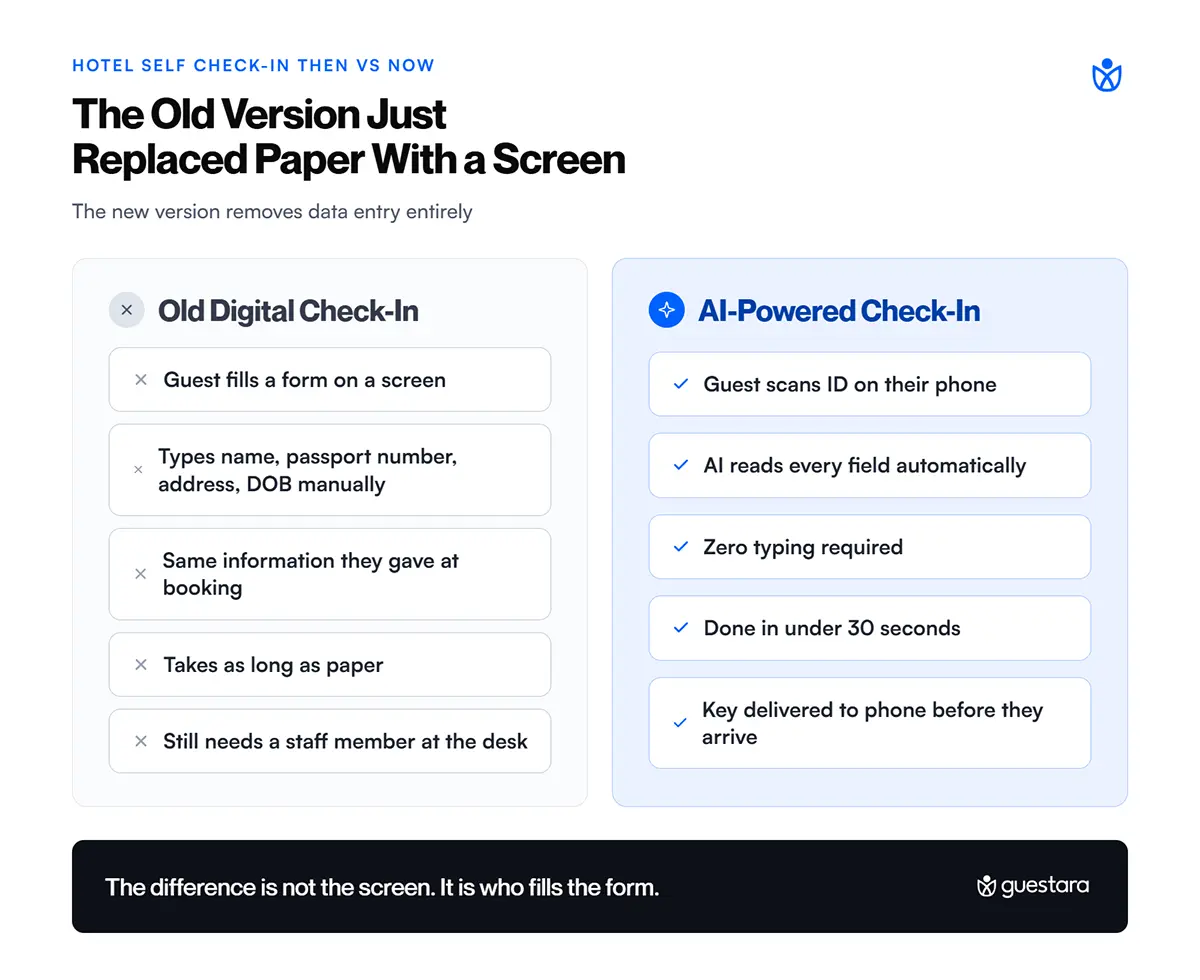
Hotel self check-in has existed in various forms for over a decade. Airlines figured it out long ago. But the early hotel versions had a fundamental problem: they replaced paper with digital paper.
The guest still had to type their name, their passport number, their address, their date of birth. They just did it on a screen instead of a form. That is not a faster experience. It is the same experience with a different surface.
What changed is AI-powered ID scanning.
When a guest scans their passport, national ID, or driving licence, the AI reads the document in real time and pulls every relevant field automatically. Name, date of birth, nationality, document number, expiry date. All extracted and written into the registration form without the guest touching a keyboard.
The 30-second check-in is not a marketing claim. It is what happens when you remove manual data entry from the process entirely.
A 2025 survey commissioned by Mews, covering 2,000 American travelers, found that 70% of guests would prefer to check themselves into a hotel using an app or self-service kiosk rather than a traditional front desk. Among Gen Z travelers, that number rises to 82%.
This is not a niche preference among tech-savvy travellers. It is the mainstream expectation.
The same data shows that 82% of hotel loyalty members report frustrations with existing systems, specifically calling out long check-in times and service models that do not meet current needs. These are your repeat guests. Your most valuable segment. And they are the ones most likely to be dissatisfied with a slow, manual arrival process.
The Hotel Tech Report 2026 State of Guest Technology, drawn from a global survey of 402 recent hotel guests, found that 43% of luxury guests expect not to wait in line at all. If your property competes in that segment, a traditional front desk queue is not just an inconvenience. It is a direct threat to review scores and repeat bookings.
The problem is not that hotels have ignored the issue. Most hotel operators know their check-in process is not ideal. The problem is that earlier versions of hotel self check-in did not actually solve it. They moved the friction without removing it.
AI ID scanning removes it.
Here is the actual flow a guest goes through with a properly built hotel self check-in system.
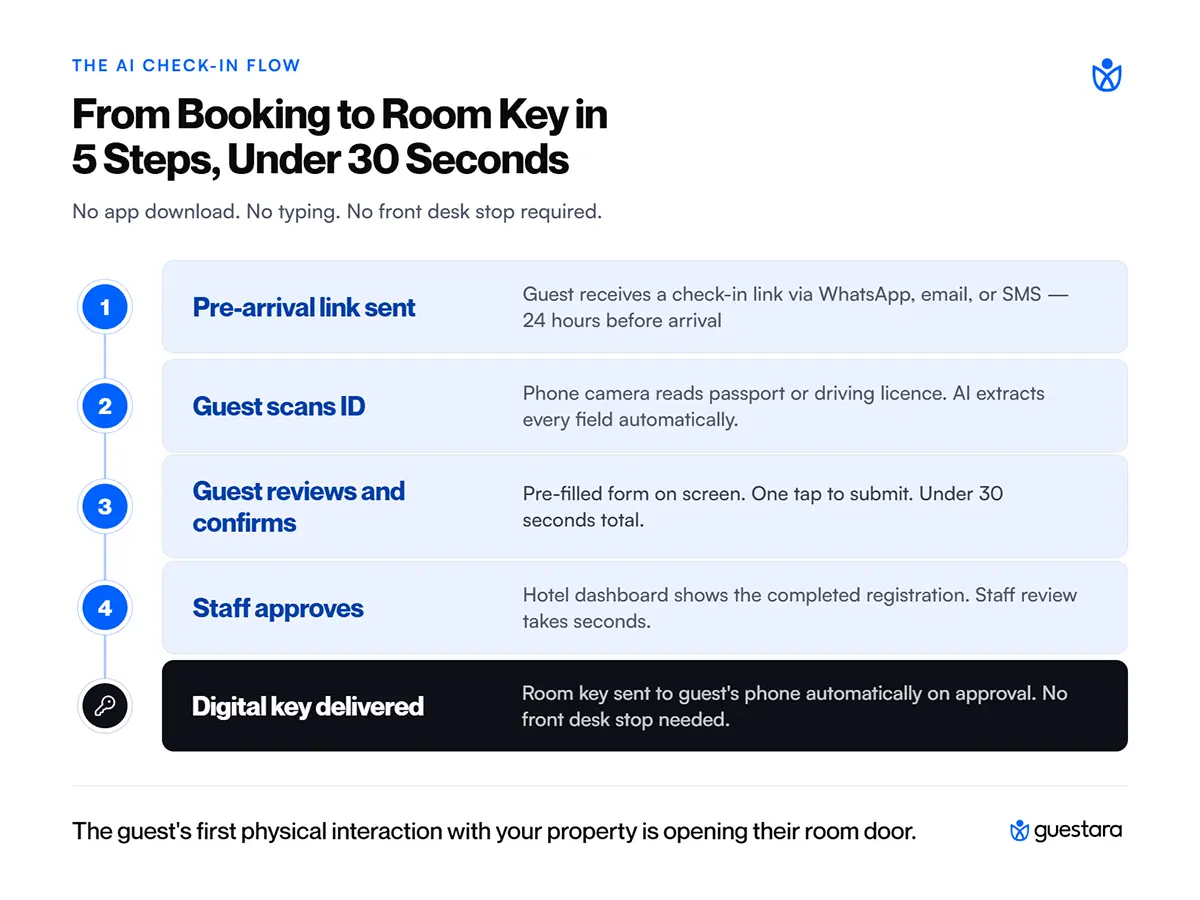
Twenty-four hours before arrival, the guest receives a check-in link via WhatsApp, email, or SMS. No app download required. It opens in a browser on their phone. The timing and sequencing of these pre-arrival messages has a direct impact on how many guests complete check-in before they arrive — the approach is covered in detail in how pre-arrival messages boost check-in completion rates.
The guest taps to scan their ID. They hold their passport or driving licence up to the phone camera. The AI reads the document and auto-fills every field on the registration form from the scan data.
The guest does not type a single character.
The guest glances at the pre-filled form to confirm everything looks right. One tap to submit.
Total time: under 30 seconds for most guests.
The registration lands in the hotel's dashboard. A staff member reviews and approves it, which takes seconds since all the data is already there and verified.
Once approved, the system automatically sends the guest a digital key to their phone. The guest goes directly to their room on arrival. No stop at the front desk required.
This is what a complete hotel self check-in flow looks like when AI is doing the data work. The guest experience is fast. The staff experience is simpler. And the property gets fully accurate registration data every time.
A common concern when hotel GMs first look at AI-powered self check-in is what it means for their team. The honest answer is that it depends on how you redeploy the time it frees up.
Manual check-in is not the highest-value use of a trained hospitality professional. Typing passport numbers, re-reading form fields, asking guests to repeat their surname so it is spelled correctly. These tasks exist because someone has to do them. But they add nothing to the guest experience.
When those tasks are handled automatically, your front desk team is free to do something they cannot be automated out of: genuine hospitality. Recommending the restaurant down the street that is not on TripAdvisor yet. Noticing the guest looks exhausted and offering to have a cold drink sent to the room. Recognising a returning guest by name.
That is what the time freed by hotel self check-in is worth.
Suba Hotels implemented Guestara's digital check-in flow across their properties. During peak arrival windows that previously required a full front desk team, they were able to operate with a single staff member managing the process. Not because the experience suffered. Because most guests had already completed check-in before they walked through the door.
The front desk did not disappear. It changed its job. For a practical look at managing peak arrival windows with a leaner team, the hotel self check-in peak-hour playbook covers the specific staffing and task-routing approach in detail.
There is one step in traditional hotel check-in that even a completed digital registration still cannot solve: handing over a physical key.
If a guest completes their pre-arrival check-in at home, arrives at the hotel, and still has to stop at the front desk to collect a key card, the queue has not been eliminated. It has just moved to a different point in the process.
Smart lock integration closes that gap entirely.
Once a hotel staff member approves a guest's digital registration in the platform, the system sends a digital room key directly to the guest's phone. The guest walks from the car park to their room without stopping anywhere. The front desk interaction is zero.
Guestara connects with over 50 smart lock providers. For most hotels that already have smart locks installed, this is not a new hardware investment. It is connecting the system that manages check-in to the system that controls the doors, so approval and key delivery happen in the same automated step. You can see which lock systems Guestara works with on the hotel smart locks page.
This is what a fully completed hotel self check-in looks like: the guest's first interaction with any physical element of the property is opening their room door.
For more on how digital check-in reduces wait times at the front desk, see our guide to reducing hotel check-in wait times.
Not every guest will use the pre-arrival link. Some will miss the message. Others will mean to do it later and forget. International guests may have connectivity issues. These are facts of hotel operations.
A well-built hotel self check-in system accounts for this without penalising the property.
The fallback is a tablet at the front desk. The guest walks up, the staff member hands them the tablet, and they scan their ID right there. The AI does the same read in the same 30 seconds. The form fills itself. The staff member approves on the spot. Guestara's hotel self-service kiosk covers exactly this on-arrival flow.
The guest who skips pre-arrival check-in does not create a queue problem. They check in in 30 seconds at the desk instead of 30 seconds on their phone the night before.
What you are removing is the guest who shows up, hands over their passport, waits while a staff member types seven lines of information, waits again while the key card is encoded, and then finally gets told what floor their room is on.
Every guest either checks in before they arrive, or checks in instantly when they do. There is no longer a third category.
Hotel operators evaluating self check-in tools sometimes assume that removing a human from the ID verification step reduces security. The opposite is true.
Manual ID checks at the front desk depend entirely on a staff member being trained, alert, and consistent. A busy Friday evening with a full check-in queue is not the optimal condition for accurate document verification.
AI ID scanning does not get tired. It does not make exceptions because a guest seems impatient. It checks every document against the same criteria every time.
Modern AI ID scanning systems validate document authenticity in real time, not just reading the printed data but assessing whether the document itself is genuine.
AI-powered scanning adds a verification layer that a human reviewer cannot replicate at the desk, while making the process faster for the guest at the same time. It is not a trade-off between security and speed. It is an improvement to both simultaneously.
For hotels with local registration compliance requirements, guest data captured via AI scan can be exported directly as a PDF for authority submission. The digital process does not remove the compliance step. It automates it.
The market for hotel self check-in tools has grown significantly. Not all systems deliver the same result. Here is what actually matters for an independent hotel or boutique property.
The difference between a fast check-in and a frustrating one is whether the guest has to type their details. If the system is just a digital version of a paper form, you have not solved the problem. Look for AI-powered document scanning that reads the ID and fills the form automatically.
Any check-in flow that requires a guest to download an app will lose a significant portion of guests before they start. The link should open in a browser. Nothing to install.
A one-way sync that only reads data from your PMS is not enough. The system needs to write completed registrations back to your PMS automatically, so staff are not manually updating records after every check-in. This is how you actually eliminate double handling.
If the check-in system cannot connect to your room access system to send digital keys on approval, you still have a front desk queue. Confirm the system supports your lock brand or the brands you are considering before committing.
No pre-arrival check-in system will achieve 100% completion before arrival. The platform should include a tablet-based check-in option that uses the same AI scanning flow, so staff have a consistent, fast process for every guest regardless of when they check in.
Depending on your market, local regulations may require guest registration data in a specific format. Confirm the system can export in a compliant format before assuming it covers your requirements.
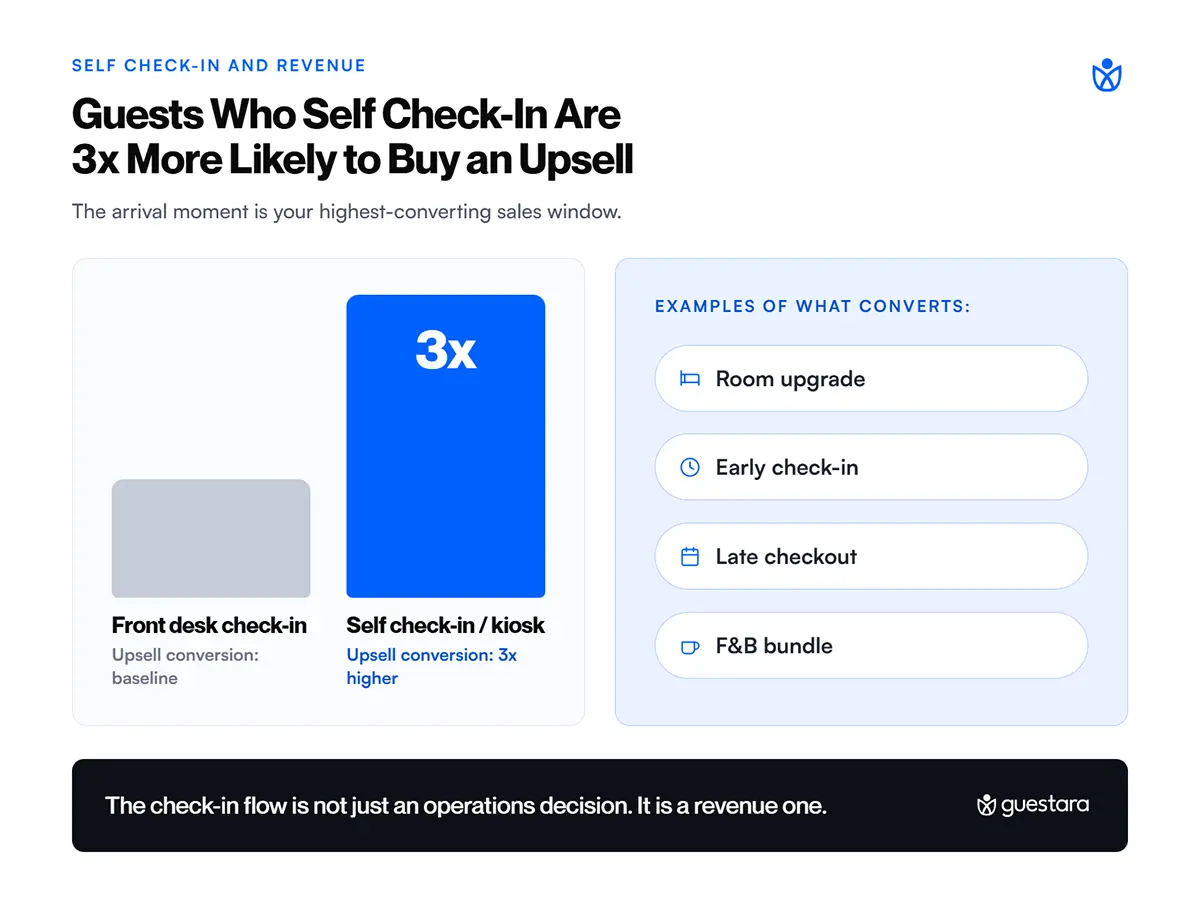
How Hotel Self Check-In Connects to Revenue
Most conversations about hotel self check-in focus on the front desk. The efficiency gains, the staffing implications, the guest experience improvement at arrival. All of that is real. But the revenue connection is underappreciated.
Mews data from their kiosk deployments found that guests who check in via a self-service channel are three times more likely to purchase an upsell compared to guests who check in at the front desk.
The reason is timing and framing. A guest who has just completed a self check-in flow is in an active, decision-making mindset. They are on their phone. They are already in the middle of their arrival experience. A well-placed offer for a room upgrade, an early check-in they need, or a dinner reservation that saves them a search later lands in exactly the right moment.
When the check-in flow connects to an upsell module, offers can be presented automatically at the point the guest completes their registration. Not a generic email three days before arrival. Not a printed flyer at the front desk. A specific, timed offer at the exact moment the guest is most likely to say yes.
This is how hotel self check-in pays for itself beyond the front desk efficiency gain. It is not just a cost reduction. It is an additional revenue channel built into the arrival experience itself.
For hotels already using Guestara, the check-in flow connects directly to the Engage module, which handles automated upsell offers timed to arrival, mid-stay, and checkout moments. The offers are customisable by property and can be adjusted based on booking type, room category, or stay length. The full check-in and checkout product suite is covered on the contactless check-in and checkout page.
To understand how the broader guest journey connects to review generation and reputation management, see our post on intercepting bad hotel reviews at check-in.
Guestara's digital check-in module handles the full pre-arrival and on-arrival check-in process for independent hotels, boutique properties, resorts, and vacation rentals.
The flow covers:
Onboarding takes approximately one week. Guestara integrates with major PMS systems including Cloudbeds, Hotelogix, Ezee Absolute, Apaleo, Beds24, SiteMinder, Little Hotelier, and Oracle.
If you want to see how hotel self check-in works on your specific setup, the team at Guestara can walk you through the configuration for your property type and PMS.


Hotel self check-in has changed. AI ID scanning cuts the entire arrival process to 30 seconds. Here is how it works and what it means for your property.
A guest lands after a four-hour flight. They want one thing: to be in their room.
What they get instead is a queue. A pen. A clipboard. A staff member who apologises while typing the same information the guest already provided when they booked.
That gap, between what guests expect and what most hotels still deliver at the front desk, is costing properties more than they realise. It shows up in reviews. It shapes how guests feel about the entire stay before they have even seen the room.
Hotel self check-in is not a new idea. But the version most hotels have seen, a basic digital form on a tablet, is not what we are talking about here. The version that is reshaping arrivals in 2026 uses AI to scan a guest's ID, auto-fill every field from that scan, and complete the entire check-in in under 30 seconds.
This post walks through exactly how that works, why it matters now more than ever, and what hotel operators need to know before choosing a system.
Hotel self check-in has existed in various forms for over a decade. Airlines figured it out long ago. But the early hotel versions had a fundamental problem: they replaced paper with digital paper.
The guest still had to type their name, their passport number, their address, their date of birth. They just did it on a screen instead of a form. That is not a faster experience. It is the same experience with a different surface.
What changed is AI-powered ID scanning.
When a guest scans their passport, national ID, or driving licence, the AI reads the document in real time and pulls every relevant field automatically. Name, date of birth, nationality, document number, expiry date. All extracted and written into the registration form without the guest touching a keyboard.
The 30-second check-in is not a marketing claim. It is what happens when you remove manual data entry from the process entirely.
A 2025 survey commissioned by Mews, covering 2,000 American travelers, found that 70% of guests would prefer to check themselves into a hotel using an app or self-service kiosk rather than a traditional front desk. Among Gen Z travelers, that number rises to 82%.
This is not a niche preference among tech-savvy travellers. It is the mainstream expectation.
The same data shows that 82% of hotel loyalty members report frustrations with existing systems, specifically calling out long check-in times and service models that do not meet current needs. These are your repeat guests. Your most valuable segment. And they are the ones most likely to be dissatisfied with a slow, manual arrival process.
The Hotel Tech Report 2026 State of Guest Technology, drawn from a global survey of 402 recent hotel guests, found that 43% of luxury guests expect not to wait in line at all. If your property competes in that segment, a traditional front desk queue is not just an inconvenience. It is a direct threat to review scores and repeat bookings.
The problem is not that hotels have ignored the issue. Most hotel operators know their check-in process is not ideal. The problem is that earlier versions of hotel self check-in did not actually solve it. They moved the friction without removing it.
AI ID scanning removes it.
Here is the actual flow a guest goes through with a properly built hotel self check-in system.
Twenty-four hours before arrival, the guest receives a check-in link via WhatsApp, email, or SMS. No app download required. It opens in a browser on their phone. The timing and sequencing of these pre-arrival messages has a direct impact on how many guests complete check-in before they arrive — the approach is covered in detail in how pre-arrival messages boost check-in completion rates.
The guest taps to scan their ID. They hold their passport or driving licence up to the phone camera. The AI reads the document and auto-fills every field on the registration form from the scan data.
The guest does not type a single character.
The guest glances at the pre-filled form to confirm everything looks right. One tap to submit.
Total time: under 30 seconds for most guests.
The registration lands in the hotel's dashboard. A staff member reviews and approves it, which takes seconds since all the data is already there and verified.
Once approved, the system automatically sends the guest a digital key to their phone. The guest goes directly to their room on arrival. No stop at the front desk required.
This is what a complete hotel self check-in flow looks like when AI is doing the data work. The guest experience is fast. The staff experience is simpler. And the property gets fully accurate registration data every time.
A common concern when hotel GMs first look at AI-powered self check-in is what it means for their team. The honest answer is that it depends on how you redeploy the time it frees up.
Manual check-in is not the highest-value use of a trained hospitality professional. Typing passport numbers, re-reading form fields, asking guests to repeat their surname so it is spelled correctly. These tasks exist because someone has to do them. But they add nothing to the guest experience.
When those tasks are handled automatically, your front desk team is free to do something they cannot be automated out of: genuine hospitality. Recommending the restaurant down the street that is not on TripAdvisor yet. Noticing the guest looks exhausted and offering to have a cold drink sent to the room. Recognising a returning guest by name.
That is what the time freed by hotel self check-in is worth.
Suba Hotels implemented Guestara's digital check-in flow across their properties. During peak arrival windows that previously required a full front desk team, they were able to operate with a single staff member managing the process. Not because the experience suffered. Because most guests had already completed check-in before they walked through the door.
The front desk did not disappear. It changed its job. For a practical look at managing peak arrival windows with a leaner team, the hotel self check-in peak-hour playbook covers the specific staffing and task-routing approach in detail.
There is one step in traditional hotel check-in that even a completed digital registration still cannot solve: handing over a physical key.
If a guest completes their pre-arrival check-in at home, arrives at the hotel, and still has to stop at the front desk to collect a key card, the queue has not been eliminated. It has just moved to a different point in the process.
Smart lock integration closes that gap entirely.
Once a hotel staff member approves a guest's digital registration in the platform, the system sends a digital room key directly to the guest's phone. The guest walks from the car park to their room without stopping anywhere. The front desk interaction is zero.
Guestara connects with over 50 smart lock providers. For most hotels that already have smart locks installed, this is not a new hardware investment. It is connecting the system that manages check-in to the system that controls the doors, so approval and key delivery happen in the same automated step. You can see which lock systems Guestara works with on the hotel smart locks page.
This is what a fully completed hotel self check-in looks like: the guest's first interaction with any physical element of the property is opening their room door.
For more on how digital check-in reduces wait times at the front desk, see our guide to reducing hotel check-in wait times.
Not every guest will use the pre-arrival link. Some will miss the message. Others will mean to do it later and forget. International guests may have connectivity issues. These are facts of hotel operations.
A well-built hotel self check-in system accounts for this without penalising the property.
The fallback is a tablet at the front desk. The guest walks up, the staff member hands them the tablet, and they scan their ID right there. The AI does the same read in the same 30 seconds. The form fills itself. The staff member approves on the spot. Guestara's hotel self-service kiosk covers exactly this on-arrival flow.
The guest who skips pre-arrival check-in does not create a queue problem. They check in in 30 seconds at the desk instead of 30 seconds on their phone the night before.
What you are removing is the guest who shows up, hands over their passport, waits while a staff member types seven lines of information, waits again while the key card is encoded, and then finally gets told what floor their room is on.
Every guest either checks in before they arrive, or checks in instantly when they do. There is no longer a third category.
Hotel operators evaluating self check-in tools sometimes assume that removing a human from the ID verification step reduces security. The opposite is true.
Manual ID checks at the front desk depend entirely on a staff member being trained, alert, and consistent. A busy Friday evening with a full check-in queue is not the optimal condition for accurate document verification.
AI ID scanning does not get tired. It does not make exceptions because a guest seems impatient. It checks every document against the same criteria every time.
Modern AI ID scanning systems validate document authenticity in real time, not just reading the printed data but assessing whether the document itself is genuine.
AI-powered scanning adds a verification layer that a human reviewer cannot replicate at the desk, while making the process faster for the guest at the same time. It is not a trade-off between security and speed. It is an improvement to both simultaneously.
For hotels with local registration compliance requirements, guest data captured via AI scan can be exported directly as a PDF for authority submission. The digital process does not remove the compliance step. It automates it.
The market for hotel self check-in tools has grown significantly. Not all systems deliver the same result. Here is what actually matters for an independent hotel or boutique property.
The difference between a fast check-in and a frustrating one is whether the guest has to type their details. If the system is just a digital version of a paper form, you have not solved the problem. Look for AI-powered document scanning that reads the ID and fills the form automatically.
Any check-in flow that requires a guest to download an app will lose a significant portion of guests before they start. The link should open in a browser. Nothing to install.
A one-way sync that only reads data from your PMS is not enough. The system needs to write completed registrations back to your PMS automatically, so staff are not manually updating records after every check-in. This is how you actually eliminate double handling.
If the check-in system cannot connect to your room access system to send digital keys on approval, you still have a front desk queue. Confirm the system supports your lock brand or the brands you are considering before committing.
No pre-arrival check-in system will achieve 100% completion before arrival. The platform should include a tablet-based check-in option that uses the same AI scanning flow, so staff have a consistent, fast process for every guest regardless of when they check in.
Depending on your market, local regulations may require guest registration data in a specific format. Confirm the system can export in a compliant format before assuming it covers your requirements.
How Hotel Self Check-In Connects to Revenue
Most conversations about hotel self check-in focus on the front desk. The efficiency gains, the staffing implications, the guest experience improvement at arrival. All of that is real. But the revenue connection is underappreciated.
Mews data from their kiosk deployments found that guests who check in via a self-service channel are three times more likely to purchase an upsell compared to guests who check in at the front desk.
The reason is timing and framing. A guest who has just completed a self check-in flow is in an active, decision-making mindset. They are on their phone. They are already in the middle of their arrival experience. A well-placed offer for a room upgrade, an early check-in they need, or a dinner reservation that saves them a search later lands in exactly the right moment.
When the check-in flow connects to an upsell module, offers can be presented automatically at the point the guest completes their registration. Not a generic email three days before arrival. Not a printed flyer at the front desk. A specific, timed offer at the exact moment the guest is most likely to say yes.
This is how hotel self check-in pays for itself beyond the front desk efficiency gain. It is not just a cost reduction. It is an additional revenue channel built into the arrival experience itself.
For hotels already using Guestara, the check-in flow connects directly to the Engage module, which handles automated upsell offers timed to arrival, mid-stay, and checkout moments. The offers are customisable by property and can be adjusted based on booking type, room category, or stay length. The full check-in and checkout product suite is covered on the contactless check-in and checkout page.
To understand how the broader guest journey connects to review generation and reputation management, see our post on intercepting bad hotel reviews at check-in.
Guestara's digital check-in module handles the full pre-arrival and on-arrival check-in process for independent hotels, boutique properties, resorts, and vacation rentals.
The flow covers:
Onboarding takes approximately one week. Guestara integrates with major PMS systems including Cloudbeds, Hotelogix, Ezee Absolute, Apaleo, Beds24, SiteMinder, Little Hotelier, and Oracle.
If you want to see how hotel self check-in works on your specific setup, the team at Guestara can walk you through the configuration for your property type and PMS.
Hotel self check-in lets guests complete the registration process on their own phone before or during arrival, without going to the front desk. In a modern AI-powered system, the guest receives a check-in link via WhatsApp, email, or SMS, scans their ID using their phone camera, and the AI reads the document and fills the registration form automatically. The entire process takes under 30 seconds. Staff review and approve the completed registration in a dashboard, then the system sends a digital room key to the guest's phone. The guest can go directly to their room without stopping at the front desk.
The slow part of traditional hotel check-in is manual data entry. A staff member has to read a guest's ID and type each piece of information into the system, which takes several minutes per guest and introduces errors. AI ID scanning removes that step entirely. The guest holds their passport or ID card up to their phone camera, and the AI reads and extracts every field, name, date of birth, document number, nationality, expiry date, automatically populating the form with no typing required. When there is no manual data entry, check-in drops to under 30 seconds.
AI ID scanning is more consistent than manual verification, not less. A trained staff member verifying documents at a busy front desk during peak check-in is subject to fatigue, time pressure, and inconsistency. AI reads every document against the same criteria every time, without exception. Modern systems also assess document authenticity in real time, going beyond reading the printed data to checking whether the document itself is genuine. For compliance purposes, the registration data captured through AI scanning can be exported in formats suitable for local regulatory reporting.
A well-built system includes a tablet at the front desk as a fallback. The guest walks up, scans their ID on the tablet, the AI fills the form in the same 30 seconds, and a staff member approves on the spot. The pre-arrival and on-arrival flows use the same AI scanning technology, so the experience is consistent regardless of when the guest checks in. This means the hotel is never in a position where some guests get a fast process and others face a slow one.
Yes, when the check-in platform is connected to a compatible smart lock system. When a staff member approves a guest's digital registration, the platform sends a digital room key directly to the guest's phone. The guest goes from arriving at the property to opening their room door without any front desk interaction. Guestara connects with over 50 smart lock providers, so most hotels with existing smart lock installations can add this capability without new hardware.
We work closely with the industry leaders to offer seamless solutions




We’re here to help your whole team stay ahead of the curve as you grow.

Get up and running quickly with a personalized onboarding plan

Connect with real people who really get it, 24/7

Checkout our vast library of free resources, templates and more
There's only so much we can say — so let us show you! Schedule a demo today and reach your business goals.


.png)