Learn how hotel self check-in eliminates front desk queues. Real stats, step-by-step flow, smart lock delivery, and buying criteria for independent hotels.





Suba Hotels reduced their front desk team to a single staff member after automating guest check-in — a process that previously required a full team during peak arrivals.
That is not a workflow tweak. That is a structural change in how the front desk operates.
The traditional fix for check-in bottlenecks has always been the same: hire more people, open more counters, train faster. But that approach treats the symptom. The real problem is not how many people stand behind the desk. It is that check-in still happens at the desk at all.
This blog explains how independent hotels with small teams are eliminating the queue — by moving hotel self check-in before the guest walks through the door.
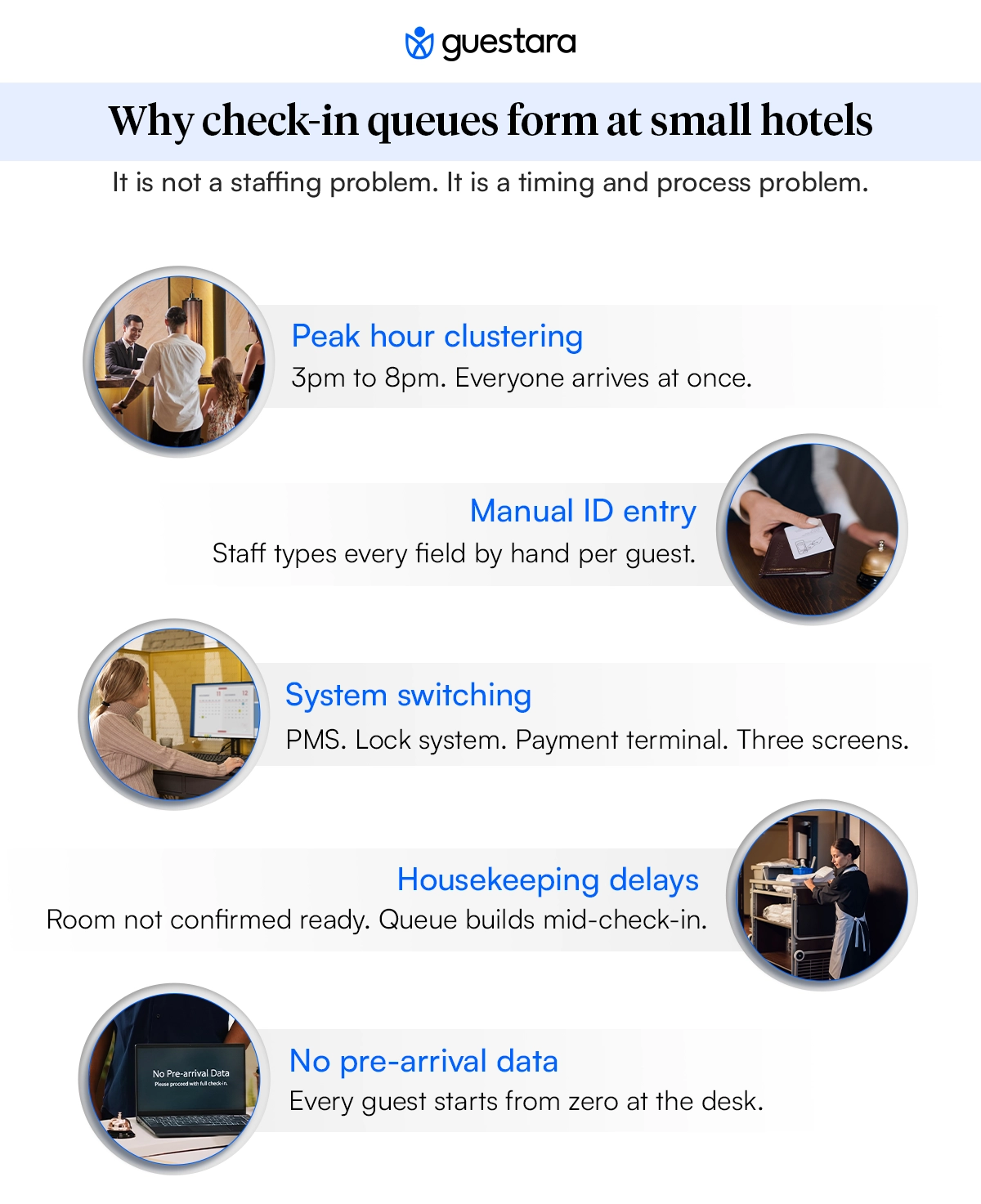
Check-in queues at small hotels are not caused by slow staff. They form because manual processes were never designed to handle simultaneous arrivals.
Research from Cornell University's Center for Hospitality Research found that for US guests, a wait of more than five minutes at check-in causes a 47% drop in guest satisfaction — before the guest has even seen their room.
The mechanics behind that drop are predictable:
Traditional check-in takes 8 to 12 minutes per guest. That is not a staff problem. That is a process problem.
According to the American Hotel and Lodging Association's 2025 State of the Industry Report, hotel staffing levels still have not recovered to pre-pandemic levels. Independent properties are managing peak arrivals with fewer people than they had five years ago.
Hiring more staff is not the fix. Removing the manual process is.
.webp)
Hotel self check-in before arrival is the single most direct way to cut front desk wait times. Cornell's research shows that crossing the five-minute wait threshold causes a 47% satisfaction drop — pre-arrival check-in removes the wait entirely before the guest walks in.
Hotel Tech Report's 2025 State of Guest Technology Report found that 43% of guests now expect to arrive without waiting in a line at all. That is not a premium expectation. It is a baseline.
Here is how the pre-arrival flow works step by step:
Hospitality Technology's 2024 Customer Engagement Study found that 64% of guests prefer to check in via their mobile device — not a dedicated app, but their phone browser. The WhatsApp link approach works because it meets guests where they already are.
Hotels using mobile check-in report front desk processing time dropping from 8 to 12 minutes per guest to under 3 minutes for verification-only interactions. That frees up significant staff capacity during peak windows without adding a single person to payroll.
For properties with local legal reporting requirements, guest registration data exports directly as a PDF for authority submission. The digital process does not remove compliance. It automates it.
Not every guest will complete hotel self check-in before they arrive. This is the most common objection operators raise — and it has a direct answer.
Most hotels see 60 to 80% completion rates on pre-arrival check-in. That means 20 to 40% of arrivals still need handling at the desk. A tablet at the front desk covers this gap.
Here is how the tablet fallback works:
The tablet does not replace the pre-arrival flow. It is the safety net for the guests who did not use it.
The result: no guest at your property ever fills out a paper form again, regardless of whether they completed check-in in advance or not. For a full breakdown of how to handle every exception — missing IDs, split payments, early arrivals, room changes — see Guestara's front desk SOP guide for digital check-in exceptions.
Even when hotel self check-in is completed before arrival, one friction point can remain: the guest still has to collect a physical key card at the front desk.
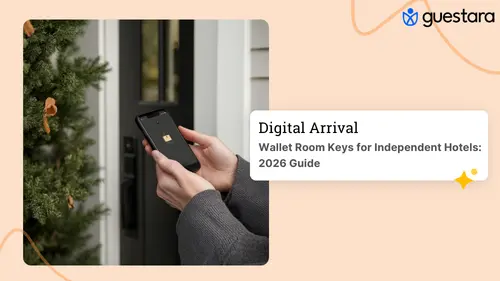
Smart lock connection removes it entirely. Here is the sequence once a guest completes digital check-in:
Guestara connects with 50+ smart lock providers. For hotel GMs who already have smart locks installed, this is a connection to existing hardware — not a new capital investment.
When the full flow runs correctly — pre-arrival registration, remote approval, digital key delivery — the front desk interaction for that guest is zero. The entire check-in experience happens before they walk through the hotel entrance.
Hotels that have implemented this full flow report front desk complaints dropping significantly and guest satisfaction scores rising — data from properties using mobile check-in shows satisfaction rates 23% higher compared to those using traditional check-in only.
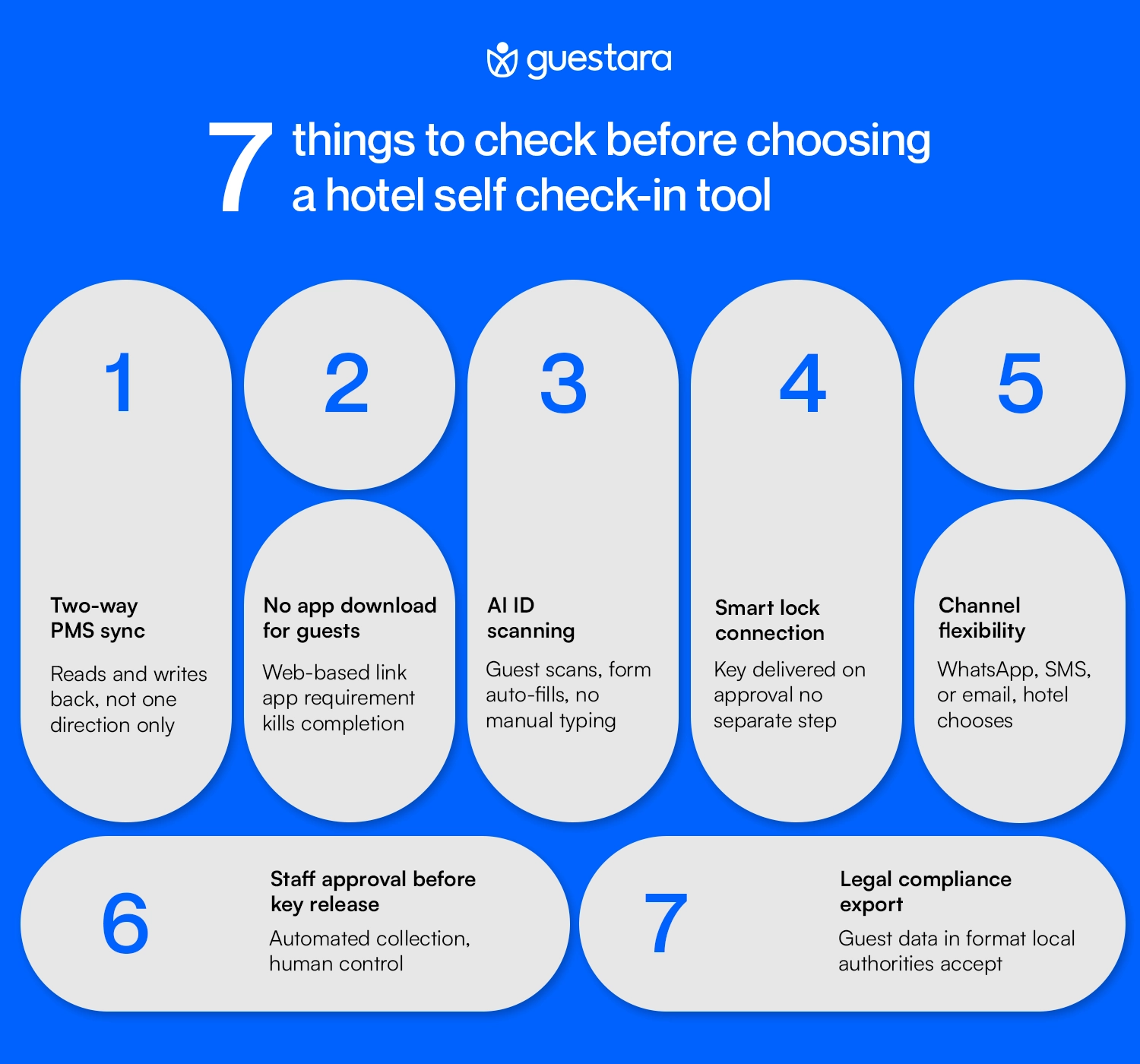
This question comes up every time a hotel GM evaluates options. The market includes Canary Technologies, Duve, Chekin, and others — each with a different focus. Here is what actually matters for an independent property with a small team.
Two-way PMS sync A one-way connection that only reads data is not enough. The system must write back — updating reservation records, flagging completed check-ins, syncing room status. Without it, staff still update the PMS manually after every digital check-in.
Web-based guest flow — no app download required Any requirement to download an app causes a meaningful share of guests to abandon the process. 64% of guests prefer mobile check-in via their phone browser — not an app. Web-based delivery via WhatsApp or SMS link is the only approach that produces consistent completion rates.
AI ID scanning The difference between a digital form and a genuinely fast check-in is whether the guest types their own details or not. AI ID scanning removes that step entirely. Guest scans their document, the form fills itself in approximately 30 seconds. Without it, you have replaced paper with a slower digital version of the same process.
Smart lock compatibility Key delivery should be automated from the check-in approval step. If your property has smart locks — or plans to — the platform must connect directly to your lock hardware, not require a separate manual action from staff.
Channel flexibility Business travellers respond to email. Leisure guests respond to WhatsApp. The platform should let the hotel configure delivery channel per property or guest segment — not force a single method.
Staff approval workflow Fully automated check-in with no staff review creates compliance risk. The right model is automated data collection with a staff approval step before the key releases. Fast for the guest, controlled for the hotel.
Legal compliance export For markets with mandatory guest registration or police reporting requirements, the system must export data in a format local authorities accept. Verify this before selecting any tool.
An Oracle Hospitality study of over 600 hotel executives found that 96% are already investing in contactless technology, and 62% believe fully contactless check-in will become the industry standard within three years. For independent hotels evaluating this now, the question is not whether to move in this direction — it is which tool fits the property's size and existing systems.
If you want to see how Guestara's hotel self check-in flow works for a property your size, book a demo and the team will walk you through setup specific to your PMS and smart lock system.


Learn how hotel self check-in eliminates front desk queues. Real stats, step-by-step flow, smart lock delivery, and buying criteria for independent hotels.
Suba Hotels reduced their front desk team to a single staff member after automating guest check-in — a process that previously required a full team during peak arrivals.
That is not a workflow tweak. That is a structural change in how the front desk operates.
The traditional fix for check-in bottlenecks has always been the same: hire more people, open more counters, train faster. But that approach treats the symptom. The real problem is not how many people stand behind the desk. It is that check-in still happens at the desk at all.
This blog explains how independent hotels with small teams are eliminating the queue — by moving hotel self check-in before the guest walks through the door.
Check-in queues at small hotels are not caused by slow staff. They form because manual processes were never designed to handle simultaneous arrivals.
Research from Cornell University's Center for Hospitality Research found that for US guests, a wait of more than five minutes at check-in causes a 47% drop in guest satisfaction — before the guest has even seen their room.
The mechanics behind that drop are predictable:
Traditional check-in takes 8 to 12 minutes per guest. That is not a staff problem. That is a process problem.
According to the American Hotel and Lodging Association's 2025 State of the Industry Report, hotel staffing levels still have not recovered to pre-pandemic levels. Independent properties are managing peak arrivals with fewer people than they had five years ago.
Hiring more staff is not the fix. Removing the manual process is.
Hotel self check-in before arrival is the single most direct way to cut front desk wait times. Cornell's research shows that crossing the five-minute wait threshold causes a 47% satisfaction drop — pre-arrival check-in removes the wait entirely before the guest walks in.
Hotel Tech Report's 2025 State of Guest Technology Report found that 43% of guests now expect to arrive without waiting in a line at all. That is not a premium expectation. It is a baseline.
Here is how the pre-arrival flow works step by step:
Hospitality Technology's 2024 Customer Engagement Study found that 64% of guests prefer to check in via their mobile device — not a dedicated app, but their phone browser. The WhatsApp link approach works because it meets guests where they already are.
Hotels using mobile check-in report front desk processing time dropping from 8 to 12 minutes per guest to under 3 minutes for verification-only interactions. That frees up significant staff capacity during peak windows without adding a single person to payroll.
For properties with local legal reporting requirements, guest registration data exports directly as a PDF for authority submission. The digital process does not remove compliance. It automates it.
Not every guest will complete hotel self check-in before they arrive. This is the most common objection operators raise — and it has a direct answer.
Most hotels see 60 to 80% completion rates on pre-arrival check-in. That means 20 to 40% of arrivals still need handling at the desk. A tablet at the front desk covers this gap.
Here is how the tablet fallback works:
The tablet does not replace the pre-arrival flow. It is the safety net for the guests who did not use it.
The result: no guest at your property ever fills out a paper form again, regardless of whether they completed check-in in advance or not. For a full breakdown of how to handle every exception — missing IDs, split payments, early arrivals, room changes — see Guestara's front desk SOP guide for digital check-in exceptions.
Even when hotel self check-in is completed before arrival, one friction point can remain: the guest still has to collect a physical key card at the front desk.
Smart lock connection removes it entirely. Here is the sequence once a guest completes digital check-in:
Guestara connects with 50+ smart lock providers. For hotel GMs who already have smart locks installed, this is a connection to existing hardware — not a new capital investment.
When the full flow runs correctly — pre-arrival registration, remote approval, digital key delivery — the front desk interaction for that guest is zero. The entire check-in experience happens before they walk through the hotel entrance.
Hotels that have implemented this full flow report front desk complaints dropping significantly and guest satisfaction scores rising — data from properties using mobile check-in shows satisfaction rates 23% higher compared to those using traditional check-in only.
This question comes up every time a hotel GM evaluates options. The market includes Canary Technologies, Duve, Chekin, and others — each with a different focus. Here is what actually matters for an independent property with a small team.
Two-way PMS sync A one-way connection that only reads data is not enough. The system must write back — updating reservation records, flagging completed check-ins, syncing room status. Without it, staff still update the PMS manually after every digital check-in.
Web-based guest flow — no app download required Any requirement to download an app causes a meaningful share of guests to abandon the process. 64% of guests prefer mobile check-in via their phone browser — not an app. Web-based delivery via WhatsApp or SMS link is the only approach that produces consistent completion rates.
AI ID scanning The difference between a digital form and a genuinely fast check-in is whether the guest types their own details or not. AI ID scanning removes that step entirely. Guest scans their document, the form fills itself in approximately 30 seconds. Without it, you have replaced paper with a slower digital version of the same process.
Smart lock compatibility Key delivery should be automated from the check-in approval step. If your property has smart locks — or plans to — the platform must connect directly to your lock hardware, not require a separate manual action from staff.
Channel flexibility Business travellers respond to email. Leisure guests respond to WhatsApp. The platform should let the hotel configure delivery channel per property or guest segment — not force a single method.
Staff approval workflow Fully automated check-in with no staff review creates compliance risk. The right model is automated data collection with a staff approval step before the key releases. Fast for the guest, controlled for the hotel.
Legal compliance export For markets with mandatory guest registration or police reporting requirements, the system must export data in a format local authorities accept. Verify this before selecting any tool.
An Oracle Hospitality study of over 600 hotel executives found that 96% are already investing in contactless technology, and 62% believe fully contactless check-in will become the industry standard within three years. For independent hotels evaluating this now, the question is not whether to move in this direction — it is which tool fits the property's size and existing systems.
If you want to see how Guestara's hotel self check-in flow works for a property your size, book a demo and the team will walk you through setup specific to your PMS and smart lock system.
The most effective method is hotel self check-in before the guest arrives. Hotels send a web-based check-in link via WhatsApp, SMS, or email 24 hours before arrival. Guests scan their ID, an AI system auto-fills the registration form in approximately 30 seconds, and the hotel approves it remotely. By the time the guest walks in, check-in is already done — no queue, no additional front desk staff required. Traditional check-in takes 8 to 12 minutes per guest; the digital flow reduces that to under 3 minutes for staff verification only.
No. The most effective hotel self check-in systems are fully web-based. The guest receives a link via WhatsApp or SMS, taps it, and completes check-in in their phone browser. No app download, no account creation, no friction. This matters because guests who are asked to download an app frequently skip the process entirely — which is why browser-based delivery is the only approach that produces consistent completion rates across all guest demographics.
Most hotels see 60 to 80% pre-arrival completion rates, which means 20 to 40% of guests still arrive without completing it. A tablet at the front desk handles every walk-in guest who skipped pre-arrival check-in. The guest scans their ID at the tablet, AI fills the registration form in the same 30 seconds, and staff approve on the spot. No paper forms, no manual typing, no queue. For full exception handling — missing IDs, split payments, room changes
Yes — this is where the system becomes fully contactless. Once staff approve a guest's digital registration, the platform sends a digital room key directly to the guest's phone via the smart lock connection. The guest goes straight from the car park to their room. Guestara connects with 50+ smart lock providers, so compatibility with existing hardware is usually straightforward and does not require new capital investment in lock hardware.
For most independent hotels, full setup takes approximately one week. This includes PMS connection, configuring the automated pre-arrival message flow, setting the check-in link delivery timing, and connecting any smart lock system on the property. The hotel defines its own rules — which channel to use, when the message fires, what the form collects — and the system runs automatically from that point. For a detailed implementation timeline.
We work closely with the industry leaders to offer seamless solutions




We’re here to help your whole team stay ahead of the curve as you grow.

Get up and running quickly with a personalized onboarding plan

Connect with real people who really get it, 24/7

Checkout our vast library of free resources, templates and more
There's only so much we can say — so let us show you! Schedule a demo today and reach your business goals.


.png)