AI is changing how hotels design the guest journey. See five shifts reshaping the hotel guest experience journey in 2026, and where the human touch still wins.




Every hotel already has a guest journey. It runs from the first booking email to the review request after checkout, and most of it was designed years ago by someone drawing boxes on a whiteboard. Pre-stay. In-stay. Post-stay. A neat line with a few messages hanging off it.
That map has not changed much in a decade. What has changed is the guest walking through it. They book on their phone at midnight. They message you on WhatsApp instead of calling. They expect the front desk to already know their late arrival before they mention it.
The way you design the hotel guest experience journey is now falling behind the way guests actually move through it. That gap is exactly what AI is closing. Not by adding one more chatbot to the corner of your website, but by changing the shape of the journey itself.
Here are the five shifts that matter most in 2026, what each one looks like on a real property, and the one place where the smart move is to keep AI out.
Designing the guest journey with AI means building a stay that adjusts to each guest automatically, instead of sending the same fixed sequence of messages to everyone. The journey stops being a static map and starts behaving like a living flow that reads booking data, timing, and guest behavior, then decides what happens next.
This is a design change, not a tools change. You are not bolting AI onto a journey you already run. You are rethinking the journey around what AI now makes possible: one continuous flow instead of three separate stages, a path built per guest instead of one path for all, and messages that fire on their own instead of waiting for a staff member to remember.
The five shifts below each reshape one part of that design. Read them as a set. Together they describe where the hotel guest experience journey is heading, and none of them requires a big property or a big team to start.
One honest note before the list. AI is reshaping most of the journey, but not all of it. The last section covers the moments where hotels should slow down and keep a person in the loop. That balance is the difference between a journey that feels smart and one that feels cold.
The first shift is structural. AI is collapsing the old pre-stay, in-stay, and post-stay boxes into a single continuous journey where each moment feeds the next.
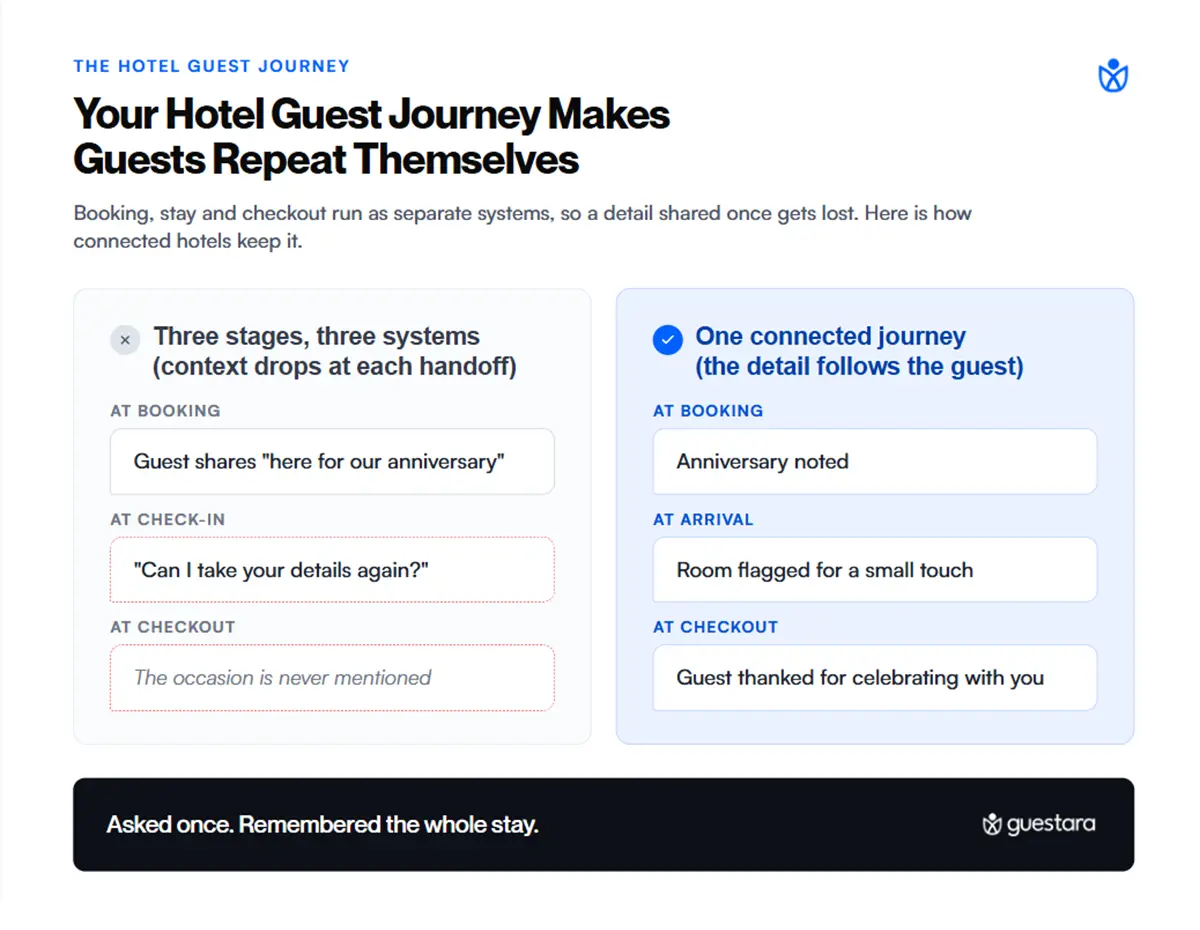
The old design treats the stay as three jobs owned by three teams. Marketing runs pre-stay. The front desk owns in-stay. Someone in reputation chases the review afterward. Each handoff drops context. The guest who asked about a crib during booking has to ask again at check-in, because that conversation lived in a different system.
AI removes the handoffs. When your booking data, messages, and stay history sit in one connected flow, the crib request from week one is already known at arrival. McKinsey and Skift describe this same move across the wider industry, noting that AI is shifting travel from steps applied to a journey toward the entire journey being reengineered end to end. The journey stops being a relay race and becomes one conversation.
Picture a guest named Ana who books a two-night stay for an anniversary. In a stage-based journey, the booking system knows the occasion, but nobody downstream does. In a continuous journey, that single detail travels the whole way. The pre-arrival message references the occasion. The room gets flagged for a small touch. The checkout message thanks her for choosing you for it. Same data point, used at three moments, with zero re-entry.
None of that needs new information. It needs the journey to be designed as one flow instead of three, so the data collected at the start is still available at the end.
This is the core job of the Guestara Guest Journey module. You set trigger-based message flows tied to your PMS booking data, running across WhatsApp, email, and SMS from a single sequence. Booking confirmed, pre-arrival note, check-in link before arrival, mid-stay offer, post-checkout review request. Set once, it runs for every guest as one connected journey. For a wider view of how the stages link together, our guide on mapping the hotel guest journey walks through the full pre-stay to post-stay flow.
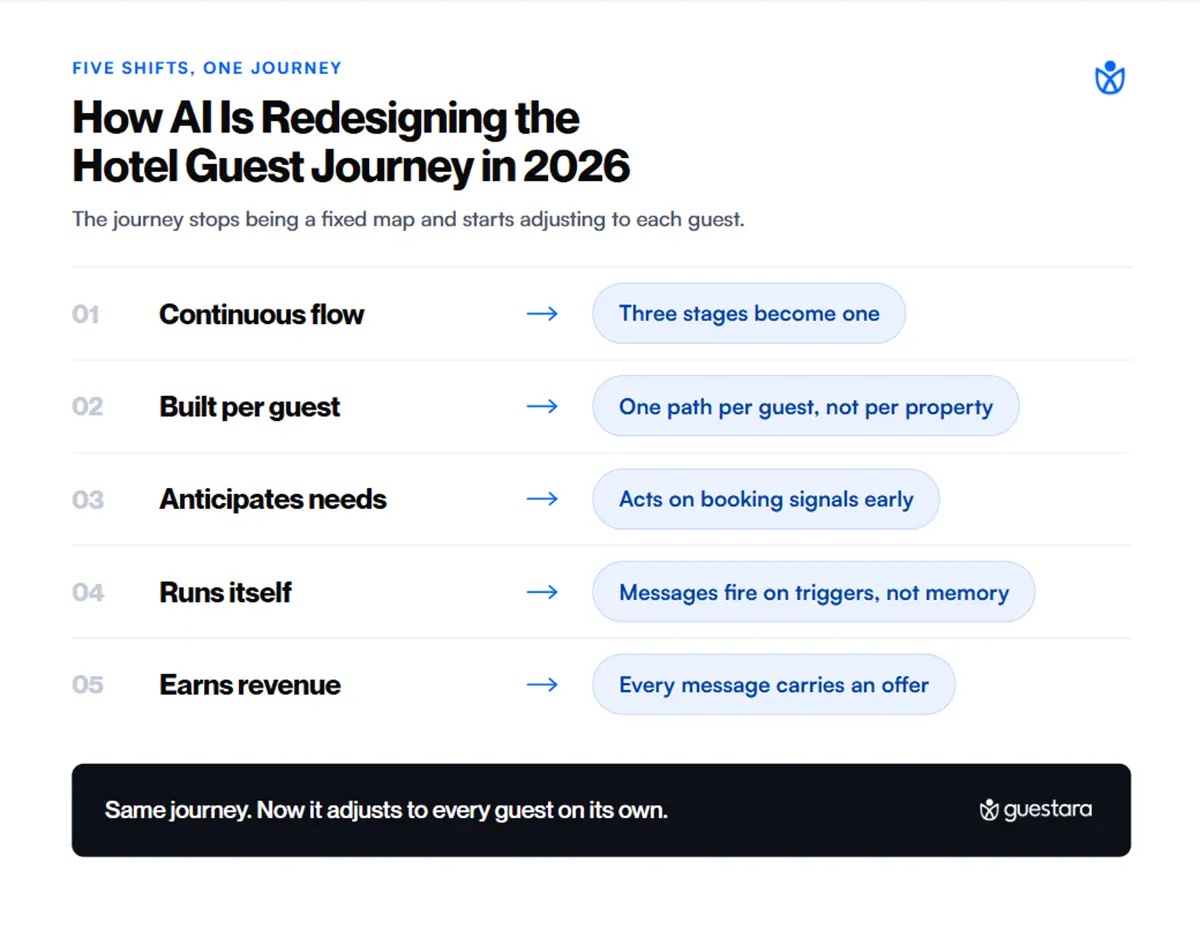
The second shift is personalization by design. AI lets you run a different journey for each guest without writing a different journey for each guest.
A traditional journey is one size. Every guest gets the same three emails at the same three times, whether they are a solo business traveler in for one night or a family in for a week. The content is generic because it has to serve everyone.
An AI-shaped journey is built per guest. It reads the booking source, the trip purpose, the length of stay, and the guest history, then adjusts the timing and the message. The business traveler gets a fast, low-noise path focused on a quick check-in and a quiet room. The family gets early check-in options, a local activities note, and a late checkout offer. Same platform, two journeys, no extra manual work. Guests notice the fit. Revfine reports that 58% of guests believe AI improves their booking and stay experience, and a journey that matches their trip is a large part of why.
Take two bookings arriving the same weekend.
The first is a corporate guest, direct booking, one night, arriving late. The right journey is short. A pre-arrival check-in link so they skip the desk. A quiet room noted. A simple checkout. No spa offers at 11pm.
The second is a couple, weekend break, booked through an OTA, arriving Friday afternoon. The right journey is richer. A warm pre-arrival note. A dinner reservation prompt. A room upgrade offer while excitement is high. A late checkout offer on Sunday morning.
In a fixed journey, both guests get the same messages and both feel slightly off. In a per-guest journey, each one feels like the hotel built the stay around them. The design does the work that a large concierge team used to do by hand.
Per-guest design only works if your guest data is connected. The booking source, the trip type, and the stay history have to reach the journey that sends the messages. This is why the shift is a design decision before it is a technology decision. Hotels that keep this data in disconnected systems cannot personalize at scale, no matter which tool they buy. Our deeper look at how AI improves the hotel guest experience covers how connected guest data turns into tailored service.
The third shift moves the journey from reactive to anticipatory. Instead of waiting for the guest to ask, the design tries to answer before the question arrives.
Most journeys are reactive by default. The guest asks for a late checkout, so you offer one. The guest complains about a cold room, so you fix it. The design only moves when the guest pushes it.
Anticipatory design flips the order. It uses the signals already in the booking to prepare for likely needs. A guest flying in on a late international flight probably wants a smooth arrival and a simple check-in, so the journey sends the digital check-in link earlier and offers a late checkout without being asked. A returning guest who ordered breakfast in the room last time gets the in-room dining menu surfaced on day two. The need is met before it is spoken.
Pre-arrival is the strongest window for this. The guest is excited, planning, and open. A journey designed to anticipate uses the days before arrival to do quiet work. It confirms arrival time and offers early check-in if the room is likely ready. It shares the parking and directions before the guest has to search for them. It reads a long stay and suggests a mid-stay housekeeping preference. Each of these answers a question the guest was about to ask.
The result feels like attentiveness, because it is. The guest experiences a hotel that seems one step ahead. The property experiences fewer inbound questions and a calmer front desk.
Here is the part most vendors skip. Anticipatory does not mean the software reads minds. It means the journey acts on clear, real signals like flight timing, trip length, and past behavior. It is prediction based on data you already hold, not magic. Where the signal is weak or the stakes are high, the design should ask rather than assume. A journey that guesses wrong feels worse than one that simply asks a good question. Anticipation is a design goal to reach with care, not a switch to flip. For the wider view of rising guest expectations, see our piece on how AI is raising the bar on the hotel guest experience.
The fourth shift is about who pushes the button. AI moves the journey from staff-triggered to self-running, so the right message goes out even when nobody remembers to send it.
In most hotels, the journey runs on human memory. Someone has to remember to send the pre-arrival note, chase the review, and follow up with the guest who never replied. On a busy weekend, those steps are the first to slip. The journey exists on paper but breaks in practice.
A self-running journey removes the dependency on memory. Each step fires on its own trigger. Booking confirmed sends the welcome. Twenty-four hours before arrival sends the check-in link. Checkout complete sends the review request. The front desk does not touch any of it. The journey runs the same on a quiet Tuesday and a full Saturday.
Think about the review request. Most hotels agree it matters, and most hotels forget to send it when the property is full. That is the exact moment it matters most, because a full property means more guests and more potential reviews walking out the door unasked.
A self-running journey sends that request automatically, timed to the checkout, when guest satisfaction is at its peak. No one has to notice. The Guestara Review Collection flow follows this pattern, sending a simple review link at the right moment, which is how properties reach up to 300% more positive reviews. The step that used to depend on a busy person now depends on a trigger. For the full picture of automating these flows, our guide on guest journey automation breaks down each trigger in detail.
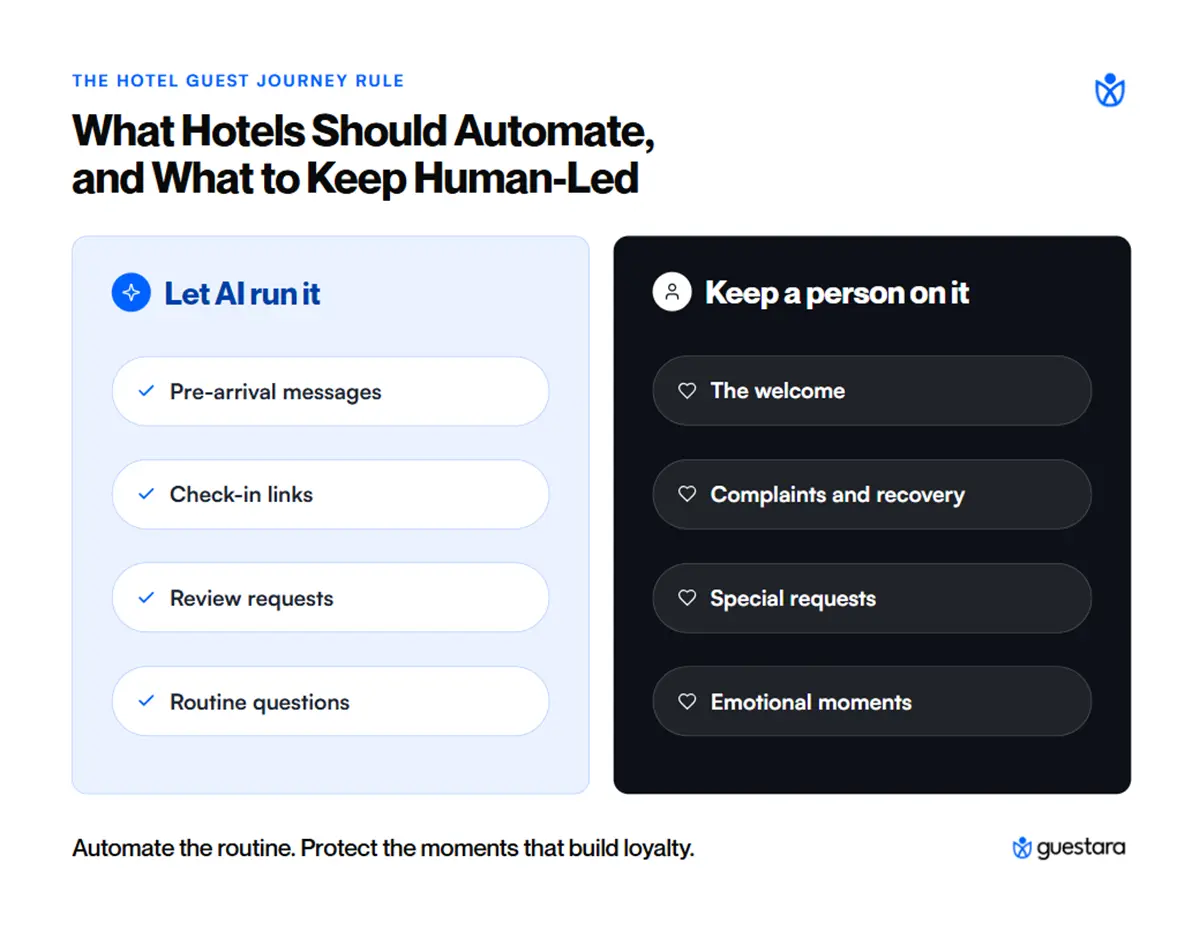
Self-running does not mean hands-off everywhere. The safest design keeps automation on the routine steps and a person on the judgment calls. McKinsey and Skift found that only 2% of travelers will currently let AI act with full autonomy on their behalf, which is a clear signal to build in oversight rather than remove it. In practice this means the journey handles the standard messages on its own, while anything unusual, a complaint, a special request, a complex change, routes to a real team member fast. An AI chatbot can handle the routine questions around the clock and escalate the rest, so guests never hit a dead end and staff only touch what needs a human.
The fifth shift changes the purpose of the touchpoints themselves. AI turns each step of the journey from a flat notification into a designed revenue moment.
Traditional journey touchpoints are informational. The confirmation confirms. The pre-arrival note reminds. The checkout message says goodbye. Each one does its small job and earns nothing.
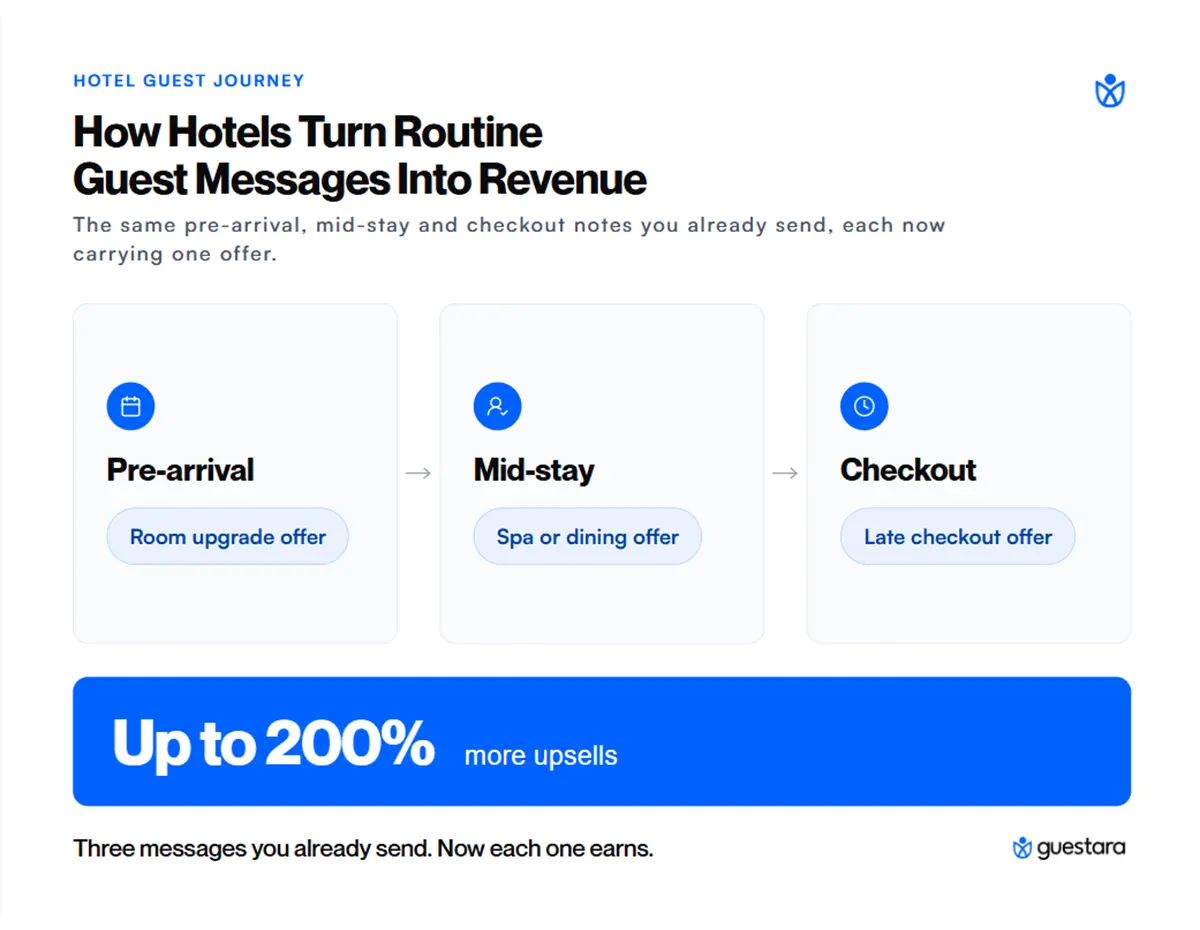
An AI-shaped journey treats those same moments as revenue moments by design. The pre-arrival note also offers a room upgrade. The mid-stay message also surfaces the spa. The checkout also offers a late departure. The information is still there, but each touchpoint now carries an offer matched to the guest and the moment. This is why revenue is rising up the priority list. In the Mews Hotelier Survey 2026, 52% of the most AI-proficient properties named revenue growth as the main outcome they want from AI, ahead of pure efficiency.
Follow the money through one designed journey.
At pre-arrival, the guest gets an upgrade offer while anticipation is high. A share of guests say yes, and the upgrade is pure margin.
Mid-stay, a well-timed message offers a spa slot or a dinner booking. Some guests take it. The offer felt like a helpful nudge, not a sales pitch, because it arrived at the right time.
At checkout, the journey offers a late departure. Guests who are not rushing pay for the extra hours. The room still turns over the same day, just later.
None of these moments is new. The pre-arrival note, the mid-stay message, and the checkout already exist in your journey. The shift is designing each one to carry an offer. Properties that do this well see up to 200% more upsells, because the offers ride on messages the guest already opens.
Revenue moments compound. A journey with three designed offer points beats a journey with none, on every single guest, every single stay, with no extra headcount. That is why revenue has moved to the front of the AI conversation for hotels. The Guestara Upsell module powers this by letting guests browse and order from a branded menu, with offers set to fire at peak buying moments through the journey flow. To see the tools behind it, our hotel upsell software overview shows how the offers connect to the journey, and Smart Checkout captures the late-departure moment at the end.
AI should not reshape the moments that carry the most emotion. The welcome, the apology, the recovery after something goes wrong. These are where guests judge whether a hotel actually cares, and they are where the human touch still wins.
The data backs this up. In the Mews Hotelier Survey 2026, even as 98% of hoteliers reported using AI across operations, 59% said the front desk welcome and check-in should stay human-led. That view was strongest among the properties using AI the most, which tells you something. The more these operators worked with AI, the clearer they became about where it does not belong.
The design rule that follows is simple. Automate the routine and the repetitive. Keep a person on the emotional and the exceptional. A late arrival gets a smooth automated check-in, but a guest arriving upset after a delayed flight gets a real person. A standard question gets an instant AI answer, but a complaint gets escalated to someone who can own it. The journey should make room for the human moments, not fill them with automation. Our look at the role of guest communication in the journey covers where a human voice matters most.
There is also a trust limit on personalization. Guests like a journey that fits them, but they get uneasy when it feels like surveillance. The line sits at usefulness. Using a stated preference to prepare the room reads as care. Referencing something the guest never told you reads as creepy. Good design stays on the useful side, uses data the guest would expect you to hold, and is transparent about it. Cross that line and personalization backfires, no matter how clever the AI.
You do not need to redesign the whole journey at once. The properties that move fastest pick one shift, prove it, then add the next.
Start with the self-running review request, because it is the easiest win and the fastest to measure. Turn on an automated review link timed to checkout and watch the volume of reviews rise. That single step pays for attention and builds internal confidence.
Next, add one designed revenue moment. A pre-arrival upgrade offer is the strongest place to begin, because the guest is already excited. Measure the take rate for one month.
Then connect your guest data so the journey can start adjusting per guest. Once trip type and stay history reach your messages, the personalization from Way 2 becomes possible without extra manual effort.
Only after those are running should you push toward anticipatory design and deeper automation. Each step rests on the one before it. A hotel that skips straight to advanced personalization without connected data ends up with a journey that guesses badly.
Keep the scorecard short. Track review volume and score, upsell take rate and revenue per stay, check-in completion before arrival, and the share of guest messages handled without staff. If those four move, the redesign is working. If they do not, you have a data or timing problem to fix before adding more automation. For the broader set of journey metrics, our guide on critical guest journey mistakes that cost revenue shows the gaps to watch for.
The hotels that will lead the hotel guest experience journey in 2026 are not the ones with the most AI. They are the ones who redesigned the journey around it, kept the human moments human, and let the machine handle the rest.


AI is changing how hotels design the guest journey. See five shifts reshaping the hotel guest experience journey in 2026, and where the human touch still wins.
Every hotel already has a guest journey. It runs from the first booking email to the review request after checkout, and most of it was designed years ago by someone drawing boxes on a whiteboard. Pre-stay. In-stay. Post-stay. A neat line with a few messages hanging off it.
That map has not changed much in a decade. What has changed is the guest walking through it. They book on their phone at midnight. They message you on WhatsApp instead of calling. They expect the front desk to already know their late arrival before they mention it.
The way you design the hotel guest experience journey is now falling behind the way guests actually move through it. That gap is exactly what AI is closing. Not by adding one more chatbot to the corner of your website, but by changing the shape of the journey itself.
Here are the five shifts that matter most in 2026, what each one looks like on a real property, and the one place where the smart move is to keep AI out.
Designing the guest journey with AI means building a stay that adjusts to each guest automatically, instead of sending the same fixed sequence of messages to everyone. The journey stops being a static map and starts behaving like a living flow that reads booking data, timing, and guest behavior, then decides what happens next.
This is a design change, not a tools change. You are not bolting AI onto a journey you already run. You are rethinking the journey around what AI now makes possible: one continuous flow instead of three separate stages, a path built per guest instead of one path for all, and messages that fire on their own instead of waiting for a staff member to remember.
The five shifts below each reshape one part of that design. Read them as a set. Together they describe where the hotel guest experience journey is heading, and none of them requires a big property or a big team to start.
One honest note before the list. AI is reshaping most of the journey, but not all of it. The last section covers the moments where hotels should slow down and keep a person in the loop. That balance is the difference between a journey that feels smart and one that feels cold.
The first shift is structural. AI is collapsing the old pre-stay, in-stay, and post-stay boxes into a single continuous journey where each moment feeds the next.
The old design treats the stay as three jobs owned by three teams. Marketing runs pre-stay. The front desk owns in-stay. Someone in reputation chases the review afterward. Each handoff drops context. The guest who asked about a crib during booking has to ask again at check-in, because that conversation lived in a different system.
AI removes the handoffs. When your booking data, messages, and stay history sit in one connected flow, the crib request from week one is already known at arrival. McKinsey and Skift describe this same move across the wider industry, noting that AI is shifting travel from steps applied to a journey toward the entire journey being reengineered end to end. The journey stops being a relay race and becomes one conversation.
Picture a guest named Ana who books a two-night stay for an anniversary. In a stage-based journey, the booking system knows the occasion, but nobody downstream does. In a continuous journey, that single detail travels the whole way. The pre-arrival message references the occasion. The room gets flagged for a small touch. The checkout message thanks her for choosing you for it. Same data point, used at three moments, with zero re-entry.
None of that needs new information. It needs the journey to be designed as one flow instead of three, so the data collected at the start is still available at the end.
This is the core job of the Guestara Guest Journey module. You set trigger-based message flows tied to your PMS booking data, running across WhatsApp, email, and SMS from a single sequence. Booking confirmed, pre-arrival note, check-in link before arrival, mid-stay offer, post-checkout review request. Set once, it runs for every guest as one connected journey. For a wider view of how the stages link together, our guide on mapping the hotel guest journey walks through the full pre-stay to post-stay flow.
The second shift is personalization by design. AI lets you run a different journey for each guest without writing a different journey for each guest.
A traditional journey is one size. Every guest gets the same three emails at the same three times, whether they are a solo business traveler in for one night or a family in for a week. The content is generic because it has to serve everyone.
An AI-shaped journey is built per guest. It reads the booking source, the trip purpose, the length of stay, and the guest history, then adjusts the timing and the message. The business traveler gets a fast, low-noise path focused on a quick check-in and a quiet room. The family gets early check-in options, a local activities note, and a late checkout offer. Same platform, two journeys, no extra manual work. Guests notice the fit. Revfine reports that 58% of guests believe AI improves their booking and stay experience, and a journey that matches their trip is a large part of why.
Take two bookings arriving the same weekend.
The first is a corporate guest, direct booking, one night, arriving late. The right journey is short. A pre-arrival check-in link so they skip the desk. A quiet room noted. A simple checkout. No spa offers at 11pm.
The second is a couple, weekend break, booked through an OTA, arriving Friday afternoon. The right journey is richer. A warm pre-arrival note. A dinner reservation prompt. A room upgrade offer while excitement is high. A late checkout offer on Sunday morning.
In a fixed journey, both guests get the same messages and both feel slightly off. In a per-guest journey, each one feels like the hotel built the stay around them. The design does the work that a large concierge team used to do by hand.
Per-guest design only works if your guest data is connected. The booking source, the trip type, and the stay history have to reach the journey that sends the messages. This is why the shift is a design decision before it is a technology decision. Hotels that keep this data in disconnected systems cannot personalize at scale, no matter which tool they buy. Our deeper look at how AI improves the hotel guest experience covers how connected guest data turns into tailored service.
The third shift moves the journey from reactive to anticipatory. Instead of waiting for the guest to ask, the design tries to answer before the question arrives.
Most journeys are reactive by default. The guest asks for a late checkout, so you offer one. The guest complains about a cold room, so you fix it. The design only moves when the guest pushes it.
Anticipatory design flips the order. It uses the signals already in the booking to prepare for likely needs. A guest flying in on a late international flight probably wants a smooth arrival and a simple check-in, so the journey sends the digital check-in link earlier and offers a late checkout without being asked. A returning guest who ordered breakfast in the room last time gets the in-room dining menu surfaced on day two. The need is met before it is spoken.
Pre-arrival is the strongest window for this. The guest is excited, planning, and open. A journey designed to anticipate uses the days before arrival to do quiet work. It confirms arrival time and offers early check-in if the room is likely ready. It shares the parking and directions before the guest has to search for them. It reads a long stay and suggests a mid-stay housekeeping preference. Each of these answers a question the guest was about to ask.
The result feels like attentiveness, because it is. The guest experiences a hotel that seems one step ahead. The property experiences fewer inbound questions and a calmer front desk.
Here is the part most vendors skip. Anticipatory does not mean the software reads minds. It means the journey acts on clear, real signals like flight timing, trip length, and past behavior. It is prediction based on data you already hold, not magic. Where the signal is weak or the stakes are high, the design should ask rather than assume. A journey that guesses wrong feels worse than one that simply asks a good question. Anticipation is a design goal to reach with care, not a switch to flip. For the wider view of rising guest expectations, see our piece on how AI is raising the bar on the hotel guest experience.
The fourth shift is about who pushes the button. AI moves the journey from staff-triggered to self-running, so the right message goes out even when nobody remembers to send it.
In most hotels, the journey runs on human memory. Someone has to remember to send the pre-arrival note, chase the review, and follow up with the guest who never replied. On a busy weekend, those steps are the first to slip. The journey exists on paper but breaks in practice.
A self-running journey removes the dependency on memory. Each step fires on its own trigger. Booking confirmed sends the welcome. Twenty-four hours before arrival sends the check-in link. Checkout complete sends the review request. The front desk does not touch any of it. The journey runs the same on a quiet Tuesday and a full Saturday.
Think about the review request. Most hotels agree it matters, and most hotels forget to send it when the property is full. That is the exact moment it matters most, because a full property means more guests and more potential reviews walking out the door unasked.
A self-running journey sends that request automatically, timed to the checkout, when guest satisfaction is at its peak. No one has to notice. The Guestara Review Collection flow follows this pattern, sending a simple review link at the right moment, which is how properties reach up to 300% more positive reviews. The step that used to depend on a busy person now depends on a trigger. For the full picture of automating these flows, our guide on guest journey automation breaks down each trigger in detail.
Self-running does not mean hands-off everywhere. The safest design keeps automation on the routine steps and a person on the judgment calls. McKinsey and Skift found that only 2% of travelers will currently let AI act with full autonomy on their behalf, which is a clear signal to build in oversight rather than remove it. In practice this means the journey handles the standard messages on its own, while anything unusual, a complaint, a special request, a complex change, routes to a real team member fast. An AI chatbot can handle the routine questions around the clock and escalate the rest, so guests never hit a dead end and staff only touch what needs a human.
The fifth shift changes the purpose of the touchpoints themselves. AI turns each step of the journey from a flat notification into a designed revenue moment.
Traditional journey touchpoints are informational. The confirmation confirms. The pre-arrival note reminds. The checkout message says goodbye. Each one does its small job and earns nothing.
An AI-shaped journey treats those same moments as revenue moments by design. The pre-arrival note also offers a room upgrade. The mid-stay message also surfaces the spa. The checkout also offers a late departure. The information is still there, but each touchpoint now carries an offer matched to the guest and the moment. This is why revenue is rising up the priority list. In the Mews Hotelier Survey 2026, 52% of the most AI-proficient properties named revenue growth as the main outcome they want from AI, ahead of pure efficiency.
Follow the money through one designed journey.
At pre-arrival, the guest gets an upgrade offer while anticipation is high. A share of guests say yes, and the upgrade is pure margin.
Mid-stay, a well-timed message offers a spa slot or a dinner booking. Some guests take it. The offer felt like a helpful nudge, not a sales pitch, because it arrived at the right time.
At checkout, the journey offers a late departure. Guests who are not rushing pay for the extra hours. The room still turns over the same day, just later.
None of these moments is new. The pre-arrival note, the mid-stay message, and the checkout already exist in your journey. The shift is designing each one to carry an offer. Properties that do this well see up to 200% more upsells, because the offers ride on messages the guest already opens.
Revenue moments compound. A journey with three designed offer points beats a journey with none, on every single guest, every single stay, with no extra headcount. That is why revenue has moved to the front of the AI conversation for hotels. The Guestara Upsell module powers this by letting guests browse and order from a branded menu, with offers set to fire at peak buying moments through the journey flow. To see the tools behind it, our hotel upsell software overview shows how the offers connect to the journey, and Smart Checkout captures the late-departure moment at the end.
AI should not reshape the moments that carry the most emotion. The welcome, the apology, the recovery after something goes wrong. These are where guests judge whether a hotel actually cares, and they are where the human touch still wins.
The data backs this up. In the Mews Hotelier Survey 2026, even as 98% of hoteliers reported using AI across operations, 59% said the front desk welcome and check-in should stay human-led. That view was strongest among the properties using AI the most, which tells you something. The more these operators worked with AI, the clearer they became about where it does not belong.
The design rule that follows is simple. Automate the routine and the repetitive. Keep a person on the emotional and the exceptional. A late arrival gets a smooth automated check-in, but a guest arriving upset after a delayed flight gets a real person. A standard question gets an instant AI answer, but a complaint gets escalated to someone who can own it. The journey should make room for the human moments, not fill them with automation. Our look at the role of guest communication in the journey covers where a human voice matters most.
There is also a trust limit on personalization. Guests like a journey that fits them, but they get uneasy when it feels like surveillance. The line sits at usefulness. Using a stated preference to prepare the room reads as care. Referencing something the guest never told you reads as creepy. Good design stays on the useful side, uses data the guest would expect you to hold, and is transparent about it. Cross that line and personalization backfires, no matter how clever the AI.
You do not need to redesign the whole journey at once. The properties that move fastest pick one shift, prove it, then add the next.
Start with the self-running review request, because it is the easiest win and the fastest to measure. Turn on an automated review link timed to checkout and watch the volume of reviews rise. That single step pays for attention and builds internal confidence.
Next, add one designed revenue moment. A pre-arrival upgrade offer is the strongest place to begin, because the guest is already excited. Measure the take rate for one month.
Then connect your guest data so the journey can start adjusting per guest. Once trip type and stay history reach your messages, the personalization from Way 2 becomes possible without extra manual effort.
Only after those are running should you push toward anticipatory design and deeper automation. Each step rests on the one before it. A hotel that skips straight to advanced personalization without connected data ends up with a journey that guesses badly.
Keep the scorecard short. Track review volume and score, upsell take rate and revenue per stay, check-in completion before arrival, and the share of guest messages handled without staff. If those four move, the redesign is working. If they do not, you have a data or timing problem to fix before adding more automation. For the broader set of journey metrics, our guide on critical guest journey mistakes that cost revenue shows the gaps to watch for.
The hotels that will lead the hotel guest experience journey in 2026 are not the ones with the most AI. They are the ones who redesigned the journey around it, kept the human moments human, and let the machine handle the rest.
The hotel guest experience journey is the full path a guest travels with your property, from the first booking touchpoint through pre-arrival, check-in, the stay, checkout, and post-stay follow-up. Each stage is a chance to shape how the guest feels and how much they spend. Designing it well means every touchpoint connects to the next, so the guest has one smooth experience rather than a series of disconnected messages from different departments.
AI is changing the hotel guest journey by making it continuous, personal, anticipatory, self-running, and revenue-focused by design. Instead of one fixed sequence sent to every guest, the journey now reads booking data and behavior to adjust timing and content per guest, fires messages automatically on triggers, and turns routine touchpoints into offer moments. The Mews Hotelier Survey 2026 found 98% of hoteliers already using AI across operations, so this shift is now mainstream rather than experimental.
No. Hotels should automate the routine and repetitive steps, like pre-arrival messages, check-in links, and review requests, while keeping a person on the emotional and exceptional moments. Research from Mews shows 59% of hoteliers believe the front desk welcome and check-in should stay human-led, and only 2% of travelers in McKinsey and Skift research will let AI act with full autonomy. The best journey design mixes automation for scale with human judgment for the moments that build loyalty.
Yes. Small and independent hotels often gain the most, because they lack the large teams that big chains use to personalize by hand. An automated, data-triggered journey lets a small property run a tailored stay for every guest without adding staff. The barrier is not size, it is connected guest data. Once booking source, trip type, and stay history reach the messaging flow, a ten-room property can deliver a journey that feels as considered as a major brand.
The first step is to turn on one self-running message, usually the automated review request timed to checkout, because it is simple to set up and easy to measure. Once that proves out, add a single revenue moment such as a pre-arrival upgrade offer, then connect your guest data so the journey can start adjusting per guest. Building one shift at a time avoids the common mistake of chasing advanced personalization before the underlying data is ready.
We work closely with the industry leaders to offer seamless solutions




We’re here to help your whole team stay ahead of the curve as you grow.

Get up and running quickly with a personalized onboarding plan

Connect with real people who really get it, 24/7

Checkout our vast library of free resources, templates and more
There's only so much we can say — so let us show you! Schedule a demo today and reach your business goals.


.png)