Agentic AI in the hotel guest journey means AI that acts, not just answers. See what it means for independent hotels in 2026, and where humans still win.




You run a small property. Some days you are the general manager, the revenue manager, and the person covering the front desk when someone calls in sick. It is a good business to run. It is also a lot of hats for one team.
Here is the quiet truth about your operation. You already hold almost everything you need to give every guest a great stay. The returning guest's floor preference. The couple's anniversary. The flight landing at 11pm. It is all sitting in your systems right now.
The problem is that none of it moves on its own. A staff member has to notice it and act. On a full weekend, with a small team, that is the exact step that slips.
Agentic AI is the shift that closes that gap. It is not a smarter chatbot. It is not one more automation rule. It is a system that can read what you already know and take action toward a goal, without someone on your team remembering to do it.
This post explains what agentic AI in the hotel guest journey actually means, what it can and cannot do in 2026, and how an independent hotel can start using it without a big team or a big budget.
Agentic AI in the hotel guest journey is AI that can take actions and make decisions toward a goal, not just answer questions or send pre-set messages. Given a target like "resolve this guest request" or "prepare this arrival," it works out the steps, checks your systems, and acts, adjusting as the situation changes.
That is the whole idea in one line. The word that matters is agentic, which means the AI has agency. It does things. To see why that is new, it helps to place it next to the two tools hotels already know.
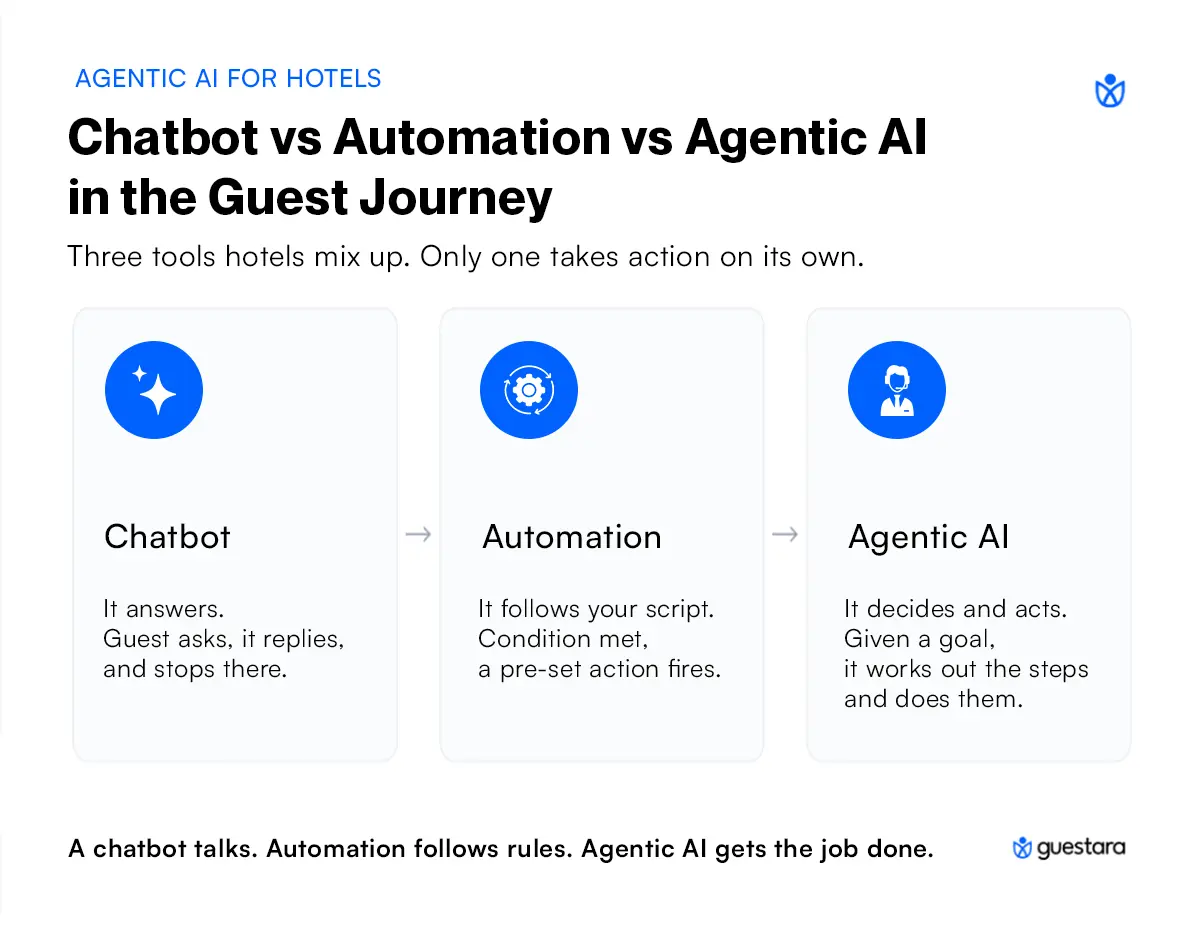
A chatbot answers. A guest asks for the pool hours or the WiFi password, and the bot replies with the right information. It is reactive and it stops at the answer. Useful, but it does not do anything beyond talk.
Agentic AI goes past the answer to the action. A guest asks for a late checkout. A chatbot tells them to call the front desk. An agentic system checks whether the room is needed, confirms the guest's booking, approves the late checkout, and updates housekeeping, all inside the same conversation.
This is the distinction that trips most hoteliers up, so it is worth slowing down. Automation fires a pre-set action when a condition is met. You write the rule once. Booking confirmed, so send the welcome message. Twenty-four hours before arrival, so send the check-in link. It runs the script you wrote, exactly as you wrote it, every time.
Agentic AI is different because it decides the steps itself. You give it a goal, not a script. It reasons through what to do, pulls the data it needs, and takes the action that fits this specific guest and this specific moment. Automation follows your instructions. An agent works toward your outcome.
Gartner describes agentic AI as systems that move beyond generating text to acting autonomously to complete tasks, navigating systems and resolving multi-step problems on behalf of the user. Mews, in its 2026 vision for AI in hospitality, frames the same shift as the move from assistive to autonomous intelligence, where connected systems reason, plan, and act to reach a business outcome rather than waiting for a prompt.
For a hotel, the short version is this. A chatbot talks. Automation follows rules. Agentic AI takes ownership of a goal and gets it done.
Agentic AI matters more for independent hotels because small properties feel the labor gap most, and autonomous action is the one thing that adds capacity without adding headcount. A large chain can throw staff at a problem. An owner-operated property cannot, so a system that handles the routine on its own is worth far more per room.
The enterprise conversation around agentic AI is loud right now, and it is aimed at big groups with big tech teams. The independent hotel angle is barely covered. That gap is the point, because the pressure is heaviest exactly where the coverage is thinnest.
The numbers explain the urgency. In early 2026, more than half of hotels still reported being understaffed, according to the American Hotel and Lodging Association, with housekeeping and front desk the hardest roles to fill. When you are short two people on a Saturday, the pre-arrival prep, the upsell follow-up, and the review request are the first tasks to fall off the list.
An agent does not call in sick and does not get pulled onto three other jobs at once. For a property that runs lean by necessity, that reliability is the whole value.
Most independent hotels have spent years stacking tools. A property management system here. A booking engine there. A messaging app on someone's phone. The result records information well and acts on it almost never.
A guest books their fourth stay. Your system knows their room preference and their loyalty status. Then they arrive to a standard room and a front desk with no briefing, because the one person who was meant to read the note had twelve other things to do. Agentic AI is the layer that finally acts on the data you were already collecting.
It sounds backwards, but the smallest teams get the biggest lift. With limited staff wearing several hats, an agent can take on booking enquiries, request handling, and late-night coverage, work that would otherwise mean another hire or another late night for the owner. The less staff you have to spare, the more each automated action is worth. The same staffing pressure the AHLA tracks across the industry is exactly why a lean property has the most to gain. This is why the independent segment, not the enterprise one, may feel the change first in daily operations. For the wider picture of how AI is reshaping each stage, our guide to the AI hotel guest journey breaks it down touchpoint by touchpoint.
Agentic AI can already handle multi-step tasks at several points in the guest journey, from preparing an arrival to resolving a request to closing out a checkout. The pattern is always the same. It reads live data, decides what the guest needs, and takes the action, looping in a human only when the situation calls for judgment.
Here is where it fits, stage by stage, described as what the technology can do rather than magic.
Pre-arrival is the strongest window. An agent reads the booking, sees a late international flight, and prepares a smooth arrival without being told to. It sends the digital check-in link earlier, flags the room as ready for a late night, and surfaces an upgrade offer timed to when the guest is most excited. The prep that used to depend on someone remembering now happens on its own.
In-stay is where the difference from a simple chatbot shows. A guest messages that the room is missing towels. A chatbot logs it. An agent reads the request, creates the task, routes it to housekeeping for that floor, and confirms back to the guest, all without a staff member acting as the middle step. The request does not sit unread in an inbox until someone spots it.
Checkout is full of small decisions that agents handle well. A guest asks to stay two more hours. The agent checks whether the room is booked next, approves the late checkout, takes the payment, and notifies housekeeping of the new turnaround time. After the stay, it sends the review request at the right moment and, on a poor rating, alerts your team to recover the guest instead of letting the complaint go public.
It is worth being honest about what is available to an independent hotel right now versus what is still emerging. Fully autonomous agents that run your whole property are early. What you can put in place today is the foundation they depend on. A platform like Guestara gives you automated, data-triggered guest journeys through its Engage module, a 24/7 AI chatbot trained on your own property data that answers routine questions and hands anything complex to a real person, and a task board that routes each request to the right department on its own. That connected-data, automation, and escalation layer is the groundwork every agentic system is built on, and it is working in hotels now. To see how the automated journey piece works, our guide on guest journey automation covers the triggers in detail.
The real change from automation to agentic AI is that the system stops following your script and starts making the call. Automation does exactly what you told it, in the order you told it. An agent is handed a goal and figures out the order itself, which means it can handle situations you never wrote a rule for.
This distinction decides whether the technology is worth it for your property, so it is worth a clear example.
Say you build an automation rule. If a guest asks for an early check-in, send them a message with the standard check-in time and a link to request it. That rule fires every time, word for word. If the guest replies with a follow-up question, the rule has nothing to say, because you did not write that part. Automation is powerful and reliable, but it only covers the paths you mapped in advance.
Now give an agent the goal instead. Handle early check-in requests well. A guest asks at 6am if they can get in early. The agent checks whether a clean room is available now, sees that one is, offers it, takes any fee, and tells housekeeping the room is going out early. A second guest asks the same thing, but no room is ready. The agent offers luggage storage and a text the moment a room opens up. Same goal, two different guests, two different actions, none of which you scripted.
Picture both systems facing the same message: "Any chance of a late checkout tomorrow? We have a 4pm flight." Automation replies with your standard late-checkout policy and a link. The agent checks tomorrow's arrivals for that room, sees it is free until evening, approves a 2pm checkout, charges the set fee, and updates housekeeping's schedule, then confirms the exact time to the guest. One answers. One resolves. That is the line between automation and agentic AI. Our post on the AI hotel guest experience shows more of where this connected approach pays off.
Agentic AI cannot be trusted with full autonomy over high-stakes or emotional moments yet, and pretending otherwise is how hotels get burned. The technology is real and useful, but it has clear limits in 2026, and good design respects them.
This section is the one most vendors skip. It is also the one that keeps your property out of trouble.
Guests are not ready to hand over control, and the projects that ignore this fail. Only 2% of travelers will currently let AI book a trip with full autonomy, according to research from McKinsey and Skift. And Gartner, the same firm forecasting that agentic AI will resolve 80% of common service issues by 2029, has also warned that more than 40% of agentic AI projects will be abandoned by 2027, mostly from rushed rollouts, unclear value, and weak controls. The direction is real. The straight-line hype is not.
Some moments should never run on autopilot. The welcome for a guest arriving upset after a delayed flight. The response to a complaint. The recovery when something goes wrong. These are where guests decide whether your property actually cares, and they need a person. The safe design keeps agents on the routine and the repetitive, and keeps humans on the emotional and the exceptional. An agent should know when to stop and escalate, not push forward on a guess. Even Mews, which is betting heavily on agentic AI, frames the path as gradual and keeps hoteliers deciding what to automate and to what extent.
An agent is only as good as the data it acts on. If your room status is wrong, it will approve a late checkout on a room that is already booked. If the guest profile is stale, it will act on the wrong preference. Before any agent can be trusted to take action, your core data has to be clean and connected. This is why the unglamorous work of connecting your systems comes before the clever part, not after. For the mistakes that break a journey before AI can even help, see our post on critical guest journey mistakes.
An independent hotel should start with agentic AI by getting its data connected, turning on automation first, and adding autonomous action gradually with a human in the loop. You do not buy an agent and flip a switch. You build the foundation, prove each layer, then let the system take on more.
The properties that get this right move in a clear order. The ones that fail try to skip to the end.
Start by connecting your core systems so guest data, room status, and booking details live in one place an agent could read. This is the least exciting step and the most important one. An agent acting on scattered or stale data will make confident mistakes. Clean, connected data is the price of entry, so pay it before anything else.
Next, switch on rule-based automation for the routine journey messages. Pre-arrival notes, check-in links, and review requests timed to checkout. This alone removes a large share of the manual work and lets your team feel the benefit with almost no risk. Once that runs cleanly, layer in the smarter, decision-making tasks one at a time, starting with low-stakes ones like request routing and late-checkout approvals.
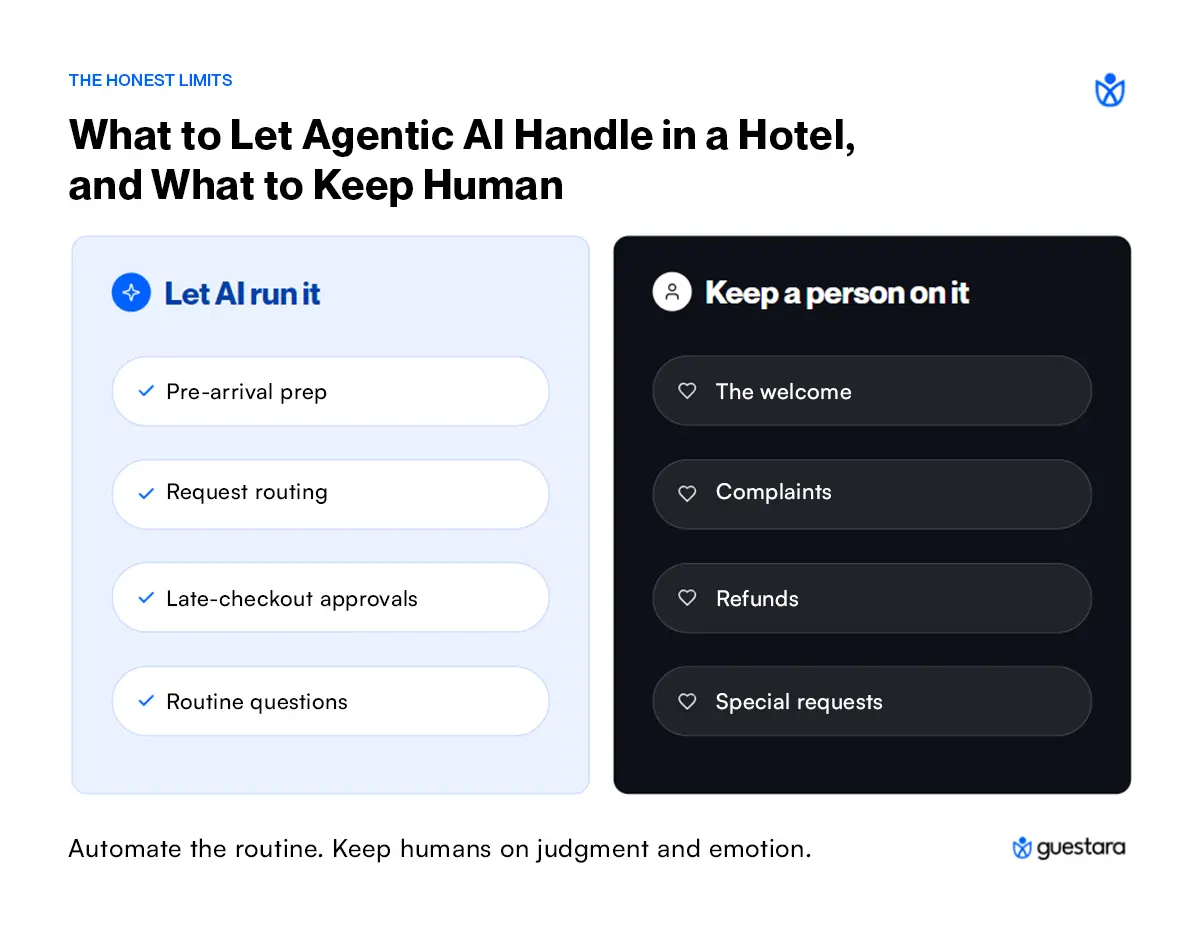
Build the handoff in from the start. Decide which actions an agent can take on its own and which ones must pause for a person. A late checkout on an empty room, fine to automate. A refund, a complaint, or a special request, route to a human. This is not a limitation to remove later. It is the design that makes guests trust the system and keeps your brand safe. Think of the agent as capacity for your team, not a replacement for it. Our guide on how guest journey automation supports satisfaction shows where the human handoff belongs.
The hotels that will win the next few years are not the ones with the boldest AI claims. They are the ones that connected their data, automated the routine, added autonomy carefully, and kept the human moments human.


Agentic AI in the hotel guest journey means AI that acts, not just answers. See what it means for independent hotels in 2026, and where humans still win.
You run a small property. Some days you are the general manager, the revenue manager, and the person covering the front desk when someone calls in sick. It is a good business to run. It is also a lot of hats for one team.
Here is the quiet truth about your operation. You already hold almost everything you need to give every guest a great stay. The returning guest's floor preference. The couple's anniversary. The flight landing at 11pm. It is all sitting in your systems right now.
The problem is that none of it moves on its own. A staff member has to notice it and act. On a full weekend, with a small team, that is the exact step that slips.
Agentic AI is the shift that closes that gap. It is not a smarter chatbot. It is not one more automation rule. It is a system that can read what you already know and take action toward a goal, without someone on your team remembering to do it.
This post explains what agentic AI in the hotel guest journey actually means, what it can and cannot do in 2026, and how an independent hotel can start using it without a big team or a big budget.
Agentic AI in the hotel guest journey is AI that can take actions and make decisions toward a goal, not just answer questions or send pre-set messages. Given a target like "resolve this guest request" or "prepare this arrival," it works out the steps, checks your systems, and acts, adjusting as the situation changes.
That is the whole idea in one line. The word that matters is agentic, which means the AI has agency. It does things. To see why that is new, it helps to place it next to the two tools hotels already know.
A chatbot answers. A guest asks for the pool hours or the WiFi password, and the bot replies with the right information. It is reactive and it stops at the answer. Useful, but it does not do anything beyond talk.
Agentic AI goes past the answer to the action. A guest asks for a late checkout. A chatbot tells them to call the front desk. An agentic system checks whether the room is needed, confirms the guest's booking, approves the late checkout, and updates housekeeping, all inside the same conversation.
This is the distinction that trips most hoteliers up, so it is worth slowing down. Automation fires a pre-set action when a condition is met. You write the rule once. Booking confirmed, so send the welcome message. Twenty-four hours before arrival, so send the check-in link. It runs the script you wrote, exactly as you wrote it, every time.
Agentic AI is different because it decides the steps itself. You give it a goal, not a script. It reasons through what to do, pulls the data it needs, and takes the action that fits this specific guest and this specific moment. Automation follows your instructions. An agent works toward your outcome.
Gartner describes agentic AI as systems that move beyond generating text to acting autonomously to complete tasks, navigating systems and resolving multi-step problems on behalf of the user. Mews, in its 2026 vision for AI in hospitality, frames the same shift as the move from assistive to autonomous intelligence, where connected systems reason, plan, and act to reach a business outcome rather than waiting for a prompt.
For a hotel, the short version is this. A chatbot talks. Automation follows rules. Agentic AI takes ownership of a goal and gets it done.
Agentic AI matters more for independent hotels because small properties feel the labor gap most, and autonomous action is the one thing that adds capacity without adding headcount. A large chain can throw staff at a problem. An owner-operated property cannot, so a system that handles the routine on its own is worth far more per room.
The enterprise conversation around agentic AI is loud right now, and it is aimed at big groups with big tech teams. The independent hotel angle is barely covered. That gap is the point, because the pressure is heaviest exactly where the coverage is thinnest.
The numbers explain the urgency. In early 2026, more than half of hotels still reported being understaffed, according to the American Hotel and Lodging Association, with housekeeping and front desk the hardest roles to fill. When you are short two people on a Saturday, the pre-arrival prep, the upsell follow-up, and the review request are the first tasks to fall off the list.
An agent does not call in sick and does not get pulled onto three other jobs at once. For a property that runs lean by necessity, that reliability is the whole value.
Most independent hotels have spent years stacking tools. A property management system here. A booking engine there. A messaging app on someone's phone. The result records information well and acts on it almost never.
A guest books their fourth stay. Your system knows their room preference and their loyalty status. Then they arrive to a standard room and a front desk with no briefing, because the one person who was meant to read the note had twelve other things to do. Agentic AI is the layer that finally acts on the data you were already collecting.
It sounds backwards, but the smallest teams get the biggest lift. With limited staff wearing several hats, an agent can take on booking enquiries, request handling, and late-night coverage, work that would otherwise mean another hire or another late night for the owner. The less staff you have to spare, the more each automated action is worth. The same staffing pressure the AHLA tracks across the industry is exactly why a lean property has the most to gain. This is why the independent segment, not the enterprise one, may feel the change first in daily operations. For the wider picture of how AI is reshaping each stage, our guide to the AI hotel guest journey breaks it down touchpoint by touchpoint.
Agentic AI can already handle multi-step tasks at several points in the guest journey, from preparing an arrival to resolving a request to closing out a checkout. The pattern is always the same. It reads live data, decides what the guest needs, and takes the action, looping in a human only when the situation calls for judgment.
Here is where it fits, stage by stage, described as what the technology can do rather than magic.
Pre-arrival is the strongest window. An agent reads the booking, sees a late international flight, and prepares a smooth arrival without being told to. It sends the digital check-in link earlier, flags the room as ready for a late night, and surfaces an upgrade offer timed to when the guest is most excited. The prep that used to depend on someone remembering now happens on its own.
In-stay is where the difference from a simple chatbot shows. A guest messages that the room is missing towels. A chatbot logs it. An agent reads the request, creates the task, routes it to housekeeping for that floor, and confirms back to the guest, all without a staff member acting as the middle step. The request does not sit unread in an inbox until someone spots it.
Checkout is full of small decisions that agents handle well. A guest asks to stay two more hours. The agent checks whether the room is booked next, approves the late checkout, takes the payment, and notifies housekeeping of the new turnaround time. After the stay, it sends the review request at the right moment and, on a poor rating, alerts your team to recover the guest instead of letting the complaint go public.
It is worth being honest about what is available to an independent hotel right now versus what is still emerging. Fully autonomous agents that run your whole property are early. What you can put in place today is the foundation they depend on. A platform like Guestara gives you automated, data-triggered guest journeys through its Engage module, a 24/7 AI chatbot trained on your own property data that answers routine questions and hands anything complex to a real person, and a task board that routes each request to the right department on its own. That connected-data, automation, and escalation layer is the groundwork every agentic system is built on, and it is working in hotels now. To see how the automated journey piece works, our guide on guest journey automation covers the triggers in detail.
The real change from automation to agentic AI is that the system stops following your script and starts making the call. Automation does exactly what you told it, in the order you told it. An agent is handed a goal and figures out the order itself, which means it can handle situations you never wrote a rule for.
This distinction decides whether the technology is worth it for your property, so it is worth a clear example.
Say you build an automation rule. If a guest asks for an early check-in, send them a message with the standard check-in time and a link to request it. That rule fires every time, word for word. If the guest replies with a follow-up question, the rule has nothing to say, because you did not write that part. Automation is powerful and reliable, but it only covers the paths you mapped in advance.
Now give an agent the goal instead. Handle early check-in requests well. A guest asks at 6am if they can get in early. The agent checks whether a clean room is available now, sees that one is, offers it, takes any fee, and tells housekeeping the room is going out early. A second guest asks the same thing, but no room is ready. The agent offers luggage storage and a text the moment a room opens up. Same goal, two different guests, two different actions, none of which you scripted.
Picture both systems facing the same message: "Any chance of a late checkout tomorrow? We have a 4pm flight." Automation replies with your standard late-checkout policy and a link. The agent checks tomorrow's arrivals for that room, sees it is free until evening, approves a 2pm checkout, charges the set fee, and updates housekeeping's schedule, then confirms the exact time to the guest. One answers. One resolves. That is the line between automation and agentic AI. Our post on the AI hotel guest experience shows more of where this connected approach pays off.
Agentic AI cannot be trusted with full autonomy over high-stakes or emotional moments yet, and pretending otherwise is how hotels get burned. The technology is real and useful, but it has clear limits in 2026, and good design respects them.
This section is the one most vendors skip. It is also the one that keeps your property out of trouble.
Guests are not ready to hand over control, and the projects that ignore this fail. Only 2% of travelers will currently let AI book a trip with full autonomy, according to research from McKinsey and Skift. And Gartner, the same firm forecasting that agentic AI will resolve 80% of common service issues by 2029, has also warned that more than 40% of agentic AI projects will be abandoned by 2027, mostly from rushed rollouts, unclear value, and weak controls. The direction is real. The straight-line hype is not.
Some moments should never run on autopilot. The welcome for a guest arriving upset after a delayed flight. The response to a complaint. The recovery when something goes wrong. These are where guests decide whether your property actually cares, and they need a person. The safe design keeps agents on the routine and the repetitive, and keeps humans on the emotional and the exceptional. An agent should know when to stop and escalate, not push forward on a guess. Even Mews, which is betting heavily on agentic AI, frames the path as gradual and keeps hoteliers deciding what to automate and to what extent.
An agent is only as good as the data it acts on. If your room status is wrong, it will approve a late checkout on a room that is already booked. If the guest profile is stale, it will act on the wrong preference. Before any agent can be trusted to take action, your core data has to be clean and connected. This is why the unglamorous work of connecting your systems comes before the clever part, not after. For the mistakes that break a journey before AI can even help, see our post on critical guest journey mistakes.
An independent hotel should start with agentic AI by getting its data connected, turning on automation first, and adding autonomous action gradually with a human in the loop. You do not buy an agent and flip a switch. You build the foundation, prove each layer, then let the system take on more.
The properties that get this right move in a clear order. The ones that fail try to skip to the end.
Start by connecting your core systems so guest data, room status, and booking details live in one place an agent could read. This is the least exciting step and the most important one. An agent acting on scattered or stale data will make confident mistakes. Clean, connected data is the price of entry, so pay it before anything else.
Next, switch on rule-based automation for the routine journey messages. Pre-arrival notes, check-in links, and review requests timed to checkout. This alone removes a large share of the manual work and lets your team feel the benefit with almost no risk. Once that runs cleanly, layer in the smarter, decision-making tasks one at a time, starting with low-stakes ones like request routing and late-checkout approvals.
Build the handoff in from the start. Decide which actions an agent can take on its own and which ones must pause for a person. A late checkout on an empty room, fine to automate. A refund, a complaint, or a special request, route to a human. This is not a limitation to remove later. It is the design that makes guests trust the system and keeps your brand safe. Think of the agent as capacity for your team, not a replacement for it. Our guide on how guest journey automation supports satisfaction shows where the human handoff belongs.
The hotels that will win the next few years are not the ones with the boldest AI claims. They are the ones that connected their data, automated the routine, added autonomy carefully, and kept the human moments human.
Agentic AI in a hotel is AI that takes actions and makes decisions toward a goal, rather than only answering questions like a chatbot or firing pre-set rules like automation. Given a target such as resolving a guest request or preparing an arrival, it reads your live data, works out the steps, and acts, looping in staff for anything that needs human judgment. The key difference is agency: it does things across your systems, not just talk.
Automation follows a script you wrote in advance, firing a fixed action when a condition is met, such as sending a check-in link 24 hours before arrival. Agentic AI is handed a goal instead of a script and decides the steps itself, so it can handle situations you never wrote a rule for. Automation does exactly what you told it. An agent works toward the outcome you want and adapts to each guest and moment.
Yes, and small properties often gain the most. With limited staff wearing several hats, an agent adds capacity for tasks like request handling, pre-arrival prep, and late-night coverage without another hire. The barrier is not property size, it is connected data. Once your guest, room, and booking information live in one place an agent can read, a small hotel can deliver a level of responsiveness that used to require a much larger team.
Agentic AI should not be trusted with full autonomy over emotional or high-stakes moments, such as the welcome, complaint recovery, refunds, or special requests. Only 2% of travelers will currently let AI act with full autonomy, and even Gartner, which forecasts heavy agentic adoption, expects more than 40% of agentic AI projects to be canceled by 2027 from rushed, poorly governed rollouts. The safe approach keeps agents on routine tasks and keeps humans on judgment calls, with clean data underneath.
Start by connecting your core systems so guest data, room status, and bookings live in one place. Then turn on rule-based automation for routine journey messages like pre-arrival notes and review requests. Once that runs cleanly, add decision-making tasks one at a time, beginning with low-stakes ones such as request routing and late-checkout approvals, and always keep a human in the loop for anything sensitive. Build the foundation first, prove each layer, then let the system take on more.
We work closely with the industry leaders to offer seamless solutions




We’re here to help your whole team stay ahead of the curve as you grow.

Get up and running quickly with a personalized onboarding plan

Connect with real people who really get it, 24/7

Checkout our vast library of free resources, templates and more
There's only so much we can say — so let us show you! Schedule a demo today and reach your business goals.


.png)