A hotel receipt guide for hoteliers: what to include, how it differs from a tax invoice, receipt formats, and how to issue tax-compliant digital receipts.





A hotel receipt is the document you hand a guest after payment, confirming what they paid and what they paid for. It looks like the least important page in the whole stay. It is often the most important.
Think about who actually needs it. The guest checking out at 6am who needs it for an expense claim. The corporate booker whose finance team rejects the stay because the document was not a proper tax invoice. The guest who files a chargeback three weeks later, where your receipt is the one piece of evidence that wins or loses the dispute.
A weak receipt costs you money and goodwill in all three cases. A strong one protects your revenue and sends the guest away impressed.
This guide covers what belongs on a hotel receipt, how it differs from an invoice and a folio, how to make it tax-compliant and dispute-proof, and how to issue it without your team retyping a thing.
A hotel receipt is a document issued after payment that confirms a guest has paid and records exactly what they paid for. It is proof of a completed transaction, which makes it different from a bill that only asks for payment. Every charge from the stay, room, taxes, and extras, appears on it as a settled total.
The receipt does three jobs at once. For the hotel, it is the financial record that supports audits and tax filing. For a business traveler, it is the document their employer needs to reimburse them. For any guest, it is the proof that resolves a later question about a charge.
Because it carries all of that weight, a hotel receipt has to be clear, itemized, and traceable to one specific stay. A vague or inconsistent receipt creates disputes instead of closing them.
A receipt, an invoice, and a folio are three different documents with three different jobs, and using the wrong one causes real problems at checkout and at tax time. The folio is the running account of everything a guest owes during the stay. The invoice is the itemized request for payment, and in tax terms it is the document that carries the tax detail. The receipt is the proof that payment was made.
The distinction matters most for business guests and for tax. A guest paying out of pocket often just needs the receipt. A guest whose company reimburses them needs the invoice, because that is the document their finance team files. In many markets the invoice is also the legal tax document, which a plain receipt is not.
Guestara's Payments module keeps the folio, the invoice, and the receipt tied to one booking, so the right document is ready at the right moment without your team rebuilding it by hand.
.webp)
A hotel receipt should include every detail needed to identify the stay, itemize the charges, and confirm payment, on a single clear page. Leaving out a field is what turns a routine receipt into a support ticket or a lost chargeback. The following elements belong on every hotel receipt.
Two of these save you the most trouble. Itemized taxes and fees are what a guest's finance team needs to reimburse them, and a per-night, per-item breakdown is what heads off disputes before they start. On payment method, show only the card type and last four digits. A full card number on a receipt is a security and compliance risk, and you can read why in our guide to hotel payment options.
Guestara's Payments module and Guestara's Smart Checkout generate an itemized folio automatically, so every charge lands on the receipt against the right booking. You can see the full flow on the Guestara hotel payments platform.
Key takeaways
.webp)
A hotel receipt becomes tax-compliant when it carries the exact tax fields your jurisdiction requires, and in many markets that means issuing a formal tax invoice, not just a payment receipt. This is where hotels serving business and international guests get caught out, because the guest's finance team is checking for fields a simple receipt does not have.
India is the clearest example. A valid GST tax invoice is governed by Rule 46 of the CGST Rules, which sets 16 mandatory fields. The document has to be headed "Tax Invoice," not "Receipt" or "Bill," and it must carry the hotel's GSTIN, a unique serial number of up to 16 characters, the place of supply, the accommodation SAC code 9963, and the tax split into CGST and SGST or into IGST. The GST rate itself depends on the room tariff slab, so it varies and should be shown per the current slab rather than assumed.
For a business guest, one field decides everything. The invoice must carry the company's name and GSTIN, or the company can lose its input tax credit on the stay. An incorrect tax invoice also carries a penalty of up to 25,000 rupees under the CGST Act, so this is not a formatting nicety.
The same principle holds beyond India. A GCC property issues a VAT invoice with its TRN and the VAT broken out. A US property itemizes sales and occupancy tax. The rule is constant: match the document to what the guest's tax authority and finance team require. Guestara's Payments module generates tax-structured folios so the right fields are present by default rather than added by hand.
A clear, itemized hotel receipt is often the single piece of evidence that wins a payment dispute, so it should be built to be read by a card issuer, not just by the guest. When a guest disputes a charge weeks after checkout, the card network asks the hotel to prove the charge was valid. The receipt, and the folio behind it, is that proof.
To win a dispute, a receipt needs specific things. It needs a per-night and per-item breakdown so every amount is accounted for. It needs the stay dates and guest details that tie the charge to a real booking. It needs the payment method and a receipt number, and ideally a signed folio, so the record is verifiable. Without these, an invalid claim can succeed simply because the hotel could not evidence the charge.
This is the same defense that runs through the whole payments cluster. For the full playbook on cutting disputes, see our guide to hotel payment processing best practices.
Guestara's Payments module ties every receipt to its booking and keeps the itemized record, while card authorization keeps the card descriptor consistent with the charge. That combination is what turns a receipt into evidence a hotel can actually use.
Hotel receipts come in several formats, and digital receipts win on cost, speed, storage, and searchability while paper trails behind on every measure. The right choice depends on your property's setup, but the direction of guest preference is settled. Around 89 percent of consumers now want a digital receipt option, according to Green America's Skip the Slip research.
The practical answer for most hotels is a digital receipt generated by the system and delivered to the guest's phone or inbox. It removes handwriting errors, gives the guest a copy they can store or forward to their employer, and leaves you a searchable record for audits and disputes.
The efficient way to issue hotel receipts is to generate them from the PMS at checkout and deliver them digitally, with a copy stored automatically for audit and dispute defense. Manual receipts, retyped or varied by shift, are where errors, mismatched folios, and lost records come from. Automation removes every one of those steps.
The flow is simple once it is set up:
The timing matches guest behavior. Nearly half of hotel guests now prefer to check out using their phone, according to the 2025 State of Hotel Guest Technology Report. Guestara's Smart Checkout lets the guest settle and sign the eFolio from their phone with no download, and Guestara's Unified Inbox delivers the receipt over WhatsApp the moment payment clears. The room releases for housekeeping at the same time, so the receipt and the turnaround happen together.
Key takeaways
[[cta:cta-7 | eyebrow=Smart Checkout | heading=end every guest a receipt the moment they tap to pay. | btn=Explore Smart Checkout | link=https://www.guestara.com/contactless-checkin-checkout ]]
Below is a standard hotel receipt format any property can adapt. It captures every element from earlier in one clean layout, and it works as a starting point whether you issue receipts digitally or on paper.
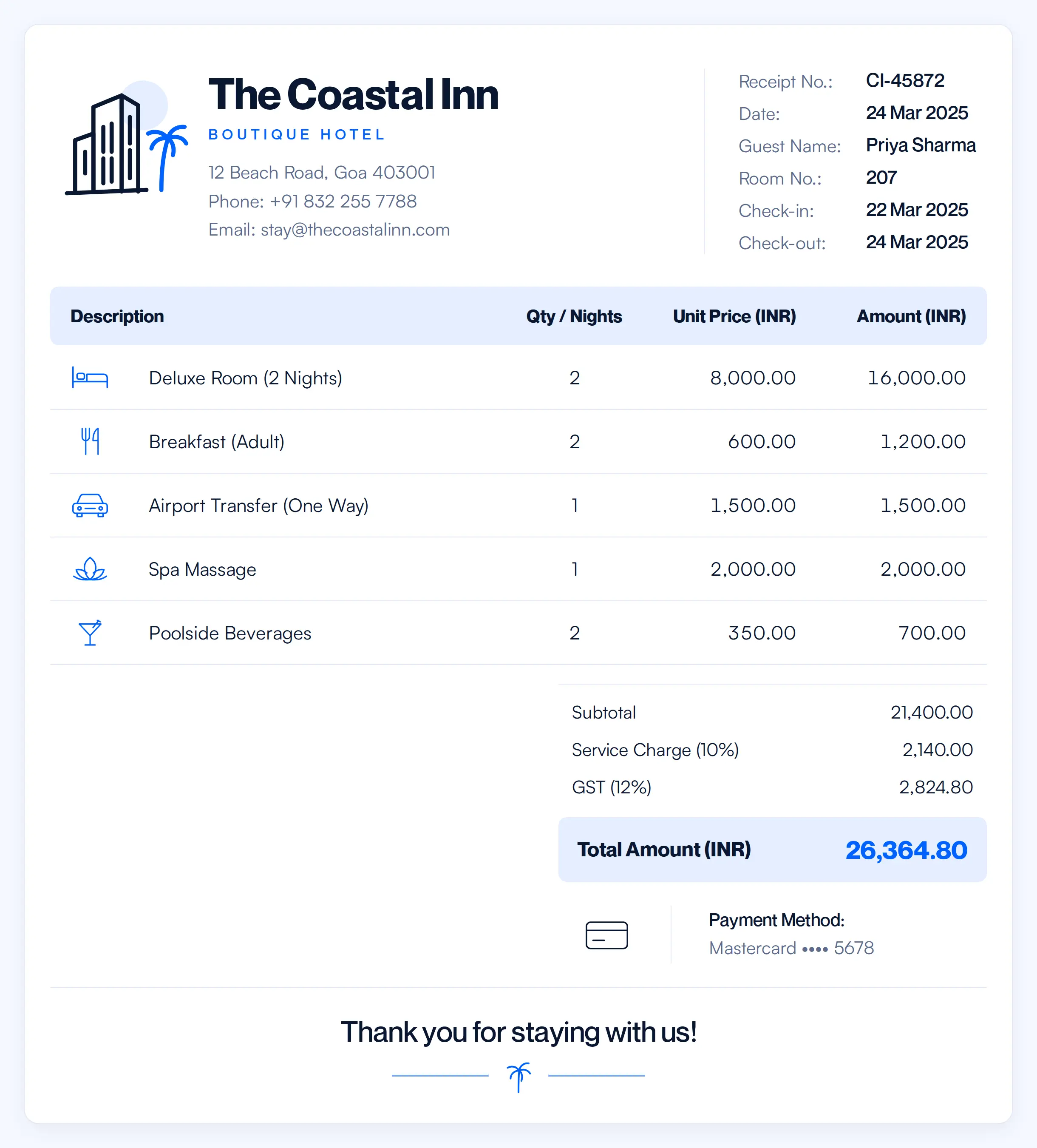
For a tax invoice, add the fields from the tax-compliance section above. In India that means heading the document "Tax Invoice" and adding your GSTIN, the guest's GSTIN for a business stay, the place of supply, SAC 9963, and the tax split into CGST and SGST or IGST. In a VAT market, add your TRN and the VAT breakdown.
[[cta:cta-5 | eyebrow=HOTEL PAYMENTS | heading=Turn every checkout into a clean, dispute-proof record.| btn= Explore Guestara Payments | link=https://www.guestara.com/hotel-payments ]]


A hotel receipt guide for hoteliers: what to include, how it differs from a tax invoice, receipt formats, and how to issue tax-compliant digital receipts.
A hotel receipt is the document you hand a guest after payment, confirming what they paid and what they paid for. It looks like the least important page in the whole stay. It is often the most important.
Think about who actually needs it. The guest checking out at 6am who needs it for an expense claim. The corporate booker whose finance team rejects the stay because the document was not a proper tax invoice. The guest who files a chargeback three weeks later, where your receipt is the one piece of evidence that wins or loses the dispute.
A weak receipt costs you money and goodwill in all three cases. A strong one protects your revenue and sends the guest away impressed.
This guide covers what belongs on a hotel receipt, how it differs from an invoice and a folio, how to make it tax-compliant and dispute-proof, and how to issue it without your team retyping a thing.
A hotel receipt is a document issued after payment that confirms a guest has paid and records exactly what they paid for. It is proof of a completed transaction, which makes it different from a bill that only asks for payment. Every charge from the stay, room, taxes, and extras, appears on it as a settled total.
The receipt does three jobs at once. For the hotel, it is the financial record that supports audits and tax filing. For a business traveler, it is the document their employer needs to reimburse them. For any guest, it is the proof that resolves a later question about a charge.
Because it carries all of that weight, a hotel receipt has to be clear, itemized, and traceable to one specific stay. A vague or inconsistent receipt creates disputes instead of closing them.
A receipt, an invoice, and a folio are three different documents with three different jobs, and using the wrong one causes real problems at checkout and at tax time. The folio is the running account of everything a guest owes during the stay. The invoice is the itemized request for payment, and in tax terms it is the document that carries the tax detail. The receipt is the proof that payment was made.
The distinction matters most for business guests and for tax. A guest paying out of pocket often just needs the receipt. A guest whose company reimburses them needs the invoice, because that is the document their finance team files. In many markets the invoice is also the legal tax document, which a plain receipt is not.
Guestara's Payments module keeps the folio, the invoice, and the receipt tied to one booking, so the right document is ready at the right moment without your team rebuilding it by hand.
A hotel receipt should include every detail needed to identify the stay, itemize the charges, and confirm payment, on a single clear page. Leaving out a field is what turns a routine receipt into a support ticket or a lost chargeback. The following elements belong on every hotel receipt.
Two of these save you the most trouble. Itemized taxes and fees are what a guest's finance team needs to reimburse them, and a per-night, per-item breakdown is what heads off disputes before they start. On payment method, show only the card type and last four digits. A full card number on a receipt is a security and compliance risk, and you can read why in our guide to hotel payment options.
Guestara's Payments module and Guestara's Smart Checkout generate an itemized folio automatically, so every charge lands on the receipt against the right booking. You can see the full flow on the Guestara hotel payments platform.
Key takeaways
A hotel receipt becomes tax-compliant when it carries the exact tax fields your jurisdiction requires, and in many markets that means issuing a formal tax invoice, not just a payment receipt. This is where hotels serving business and international guests get caught out, because the guest's finance team is checking for fields a simple receipt does not have.
India is the clearest example. A valid GST tax invoice is governed by Rule 46 of the CGST Rules, which sets 16 mandatory fields. The document has to be headed "Tax Invoice," not "Receipt" or "Bill," and it must carry the hotel's GSTIN, a unique serial number of up to 16 characters, the place of supply, the accommodation SAC code 9963, and the tax split into CGST and SGST or into IGST. The GST rate itself depends on the room tariff slab, so it varies and should be shown per the current slab rather than assumed.
For a business guest, one field decides everything. The invoice must carry the company's name and GSTIN, or the company can lose its input tax credit on the stay. An incorrect tax invoice also carries a penalty of up to 25,000 rupees under the CGST Act, so this is not a formatting nicety.
The same principle holds beyond India. A GCC property issues a VAT invoice with its TRN and the VAT broken out. A US property itemizes sales and occupancy tax. The rule is constant: match the document to what the guest's tax authority and finance team require. Guestara's Payments module generates tax-structured folios so the right fields are present by default rather than added by hand.
A clear, itemized hotel receipt is often the single piece of evidence that wins a payment dispute, so it should be built to be read by a card issuer, not just by the guest. When a guest disputes a charge weeks after checkout, the card network asks the hotel to prove the charge was valid. The receipt, and the folio behind it, is that proof.
To win a dispute, a receipt needs specific things. It needs a per-night and per-item breakdown so every amount is accounted for. It needs the stay dates and guest details that tie the charge to a real booking. It needs the payment method and a receipt number, and ideally a signed folio, so the record is verifiable. Without these, an invalid claim can succeed simply because the hotel could not evidence the charge.
This is the same defense that runs through the whole payments cluster. For the full playbook on cutting disputes, see our guide to hotel payment processing best practices.
Guestara's Payments module ties every receipt to its booking and keeps the itemized record, while card authorization keeps the card descriptor consistent with the charge. That combination is what turns a receipt into evidence a hotel can actually use.
Hotel receipts come in several formats, and digital receipts win on cost, speed, storage, and searchability while paper trails behind on every measure. The right choice depends on your property's setup, but the direction of guest preference is settled. Around 89 percent of consumers now want a digital receipt option, according to Green America's Skip the Slip research.
The practical answer for most hotels is a digital receipt generated by the system and delivered to the guest's phone or inbox. It removes handwriting errors, gives the guest a copy they can store or forward to their employer, and leaves you a searchable record for audits and disputes.
The efficient way to issue hotel receipts is to generate them from the PMS at checkout and deliver them digitally, with a copy stored automatically for audit and dispute defense. Manual receipts, retyped or varied by shift, are where errors, mismatched folios, and lost records come from. Automation removes every one of those steps.
The flow is simple once it is set up:
The timing matches guest behavior. Nearly half of hotel guests now prefer to check out using their phone, according to the 2025 State of Hotel Guest Technology Report. Guestara's Smart Checkout lets the guest settle and sign the eFolio from their phone with no download, and Guestara's Unified Inbox delivers the receipt over WhatsApp the moment payment clears. The room releases for housekeeping at the same time, so the receipt and the turnaround happen together.
Key takeaways
[[cta:cta-7 | eyebrow=Smart Checkout | heading=end every guest a receipt the moment they tap to pay. | btn=Explore Smart Checkout | link=https://www.guestara.com/contactless-checkin-checkout ]]
Below is a standard hotel receipt format any property can adapt. It captures every element from earlier in one clean layout, and it works as a starting point whether you issue receipts digitally or on paper.
For a tax invoice, add the fields from the tax-compliance section above. In India that means heading the document "Tax Invoice" and adding your GSTIN, the guest's GSTIN for a business stay, the place of supply, SAC 9963, and the tax split into CGST and SGST or IGST. In a VAT market, add your TRN and the VAT breakdown.
[[cta:cta-5 | eyebrow=HOTEL PAYMENTS | heading=Turn every checkout into a clean, dispute-proof record.| btn= Explore Guestara Payments | link=https://www.guestara.com/hotel-payments ]]
A hotel invoice is an itemized request for payment that also carries the tax detail, while a hotel receipt is proof that the payment was made. A guest paying out of pocket often needs only the receipt, but a guest whose employer reimburses them usually needs the invoice, because that is the document their finance team files. In many markets the invoice is also the legal tax document, which a plain receipt is not.
In India, a business guest needs a GST tax invoice, which must show the tax, not just a simple receipt. Under Rule 46 of the CGST Rules the document has to be headed "Tax Invoice" and carry the hotel's GSTIN, the accommodation SAC code 9963, and the tax split into CGST and SGST or IGST. For a company stay it must also show the guest company's GSTIN, or the company can lose its input tax credit on the booking.
A receipt for business travel needs everything a corporate finance team requires to reimburse the employee and claim any tax credit. That means the hotel name and tax registration, the guest and company details, the stay dates, itemized charges, taxes broken out separately, the payment method, and a unique receipt or invoice number. In tax markets like India or the GCC, it should be a proper tax invoice carrying the GSTIN or TRN rather than a plain payment receipt.
Yes, and in many markets WhatsApp is the channel guests most expect. A connected system generates the receipt at checkout and sends it to the guest's WhatsApp or email the moment payment clears, giving them a digital copy they can store or forward. Guestara's Unified Inbox delivers receipts over WhatsApp automatically, which is why nearly 90 percent of consumers preferring a digital receipt is easy to satisfy.
Hotels prevent chargebacks by issuing clear, itemized receipts that a card issuer can use as evidence a charge was valid. The receipt should show a per-night and per-item breakdown, the stay and guest details, the payment method, and a receipt number, ideally with a signed folio behind it. When a guest disputes a charge weeks later, that verifiable record is what lets the hotel contest an invalid claim and win.
We work closely with the industry leaders to offer seamless solutions




We’re here to help your whole team stay ahead of the curve as you grow.

Get up and running quickly with a personalized onboarding plan

Connect with real people who really get it, 24/7

Checkout our vast library of free resources, templates and more
There's only so much we can say — so let us show you! Schedule a demo today and reach your business goals.



.png)