Master hotel upselling strategies for December peak season. Increase ancillary revenue 25-50% with pre-arrival, check-in & in-stay tactics.




.webp)
Here's what happens in December that doesn't happen any other month.
Your rooms fill up. Occupancy hits 80-90%+. But more importantly your guests arrive with completely different mindsets than the rest of the year.
They're not cutting costs. They've budgeted for experiences. They're traveling to escape work stress, reconnect with family, celebrate milestones, or ring in a new year. Their wallets are open. Their defenses are down. Their hearts are focused on making memories.
This is the one month where guests actually want to upgrade. Want to add experiences. Want to spend more because the occasion justifies it.
But here's the brutal reality: most hoteliers focus so hard on filling rooms that they completely miss the bigger revenue opportunity sitting right in front of them.
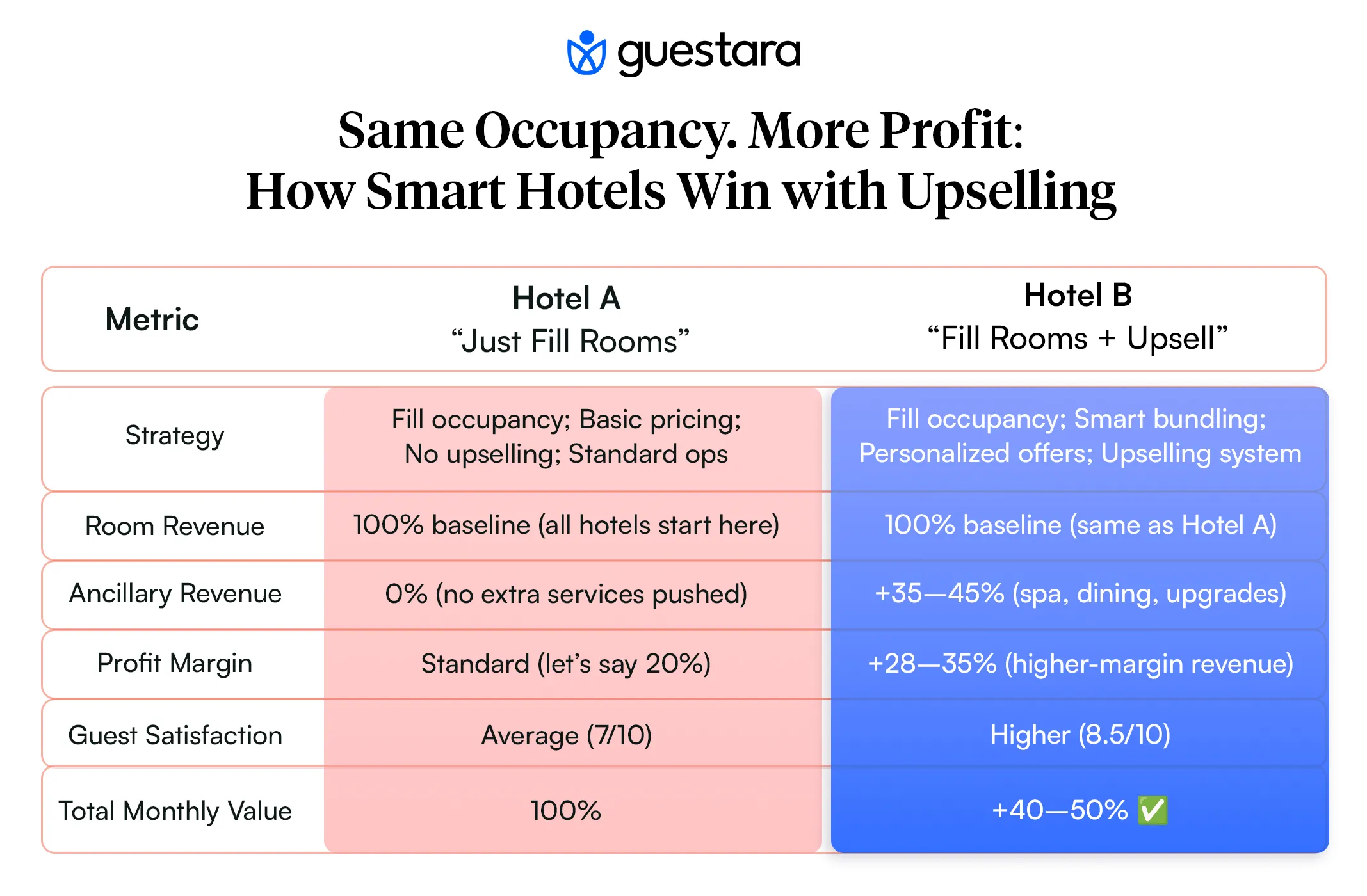
A typical 100-room hotel at full December occupancy makes roughly $150,000 in room revenue. Standard. But hotels with real upselling strategies make an extra $50,000 to $75,000 in ancillary revenue from those same guests. That's 33-50% additional profit from guests who booked anyway.
The difference isn't luck. It's strategy.
This guide shows you the exact system. Real tactics. Real results. No pressure sales. Just the straightforward approach that turns December from "our busiest month" into "our most profitable month."
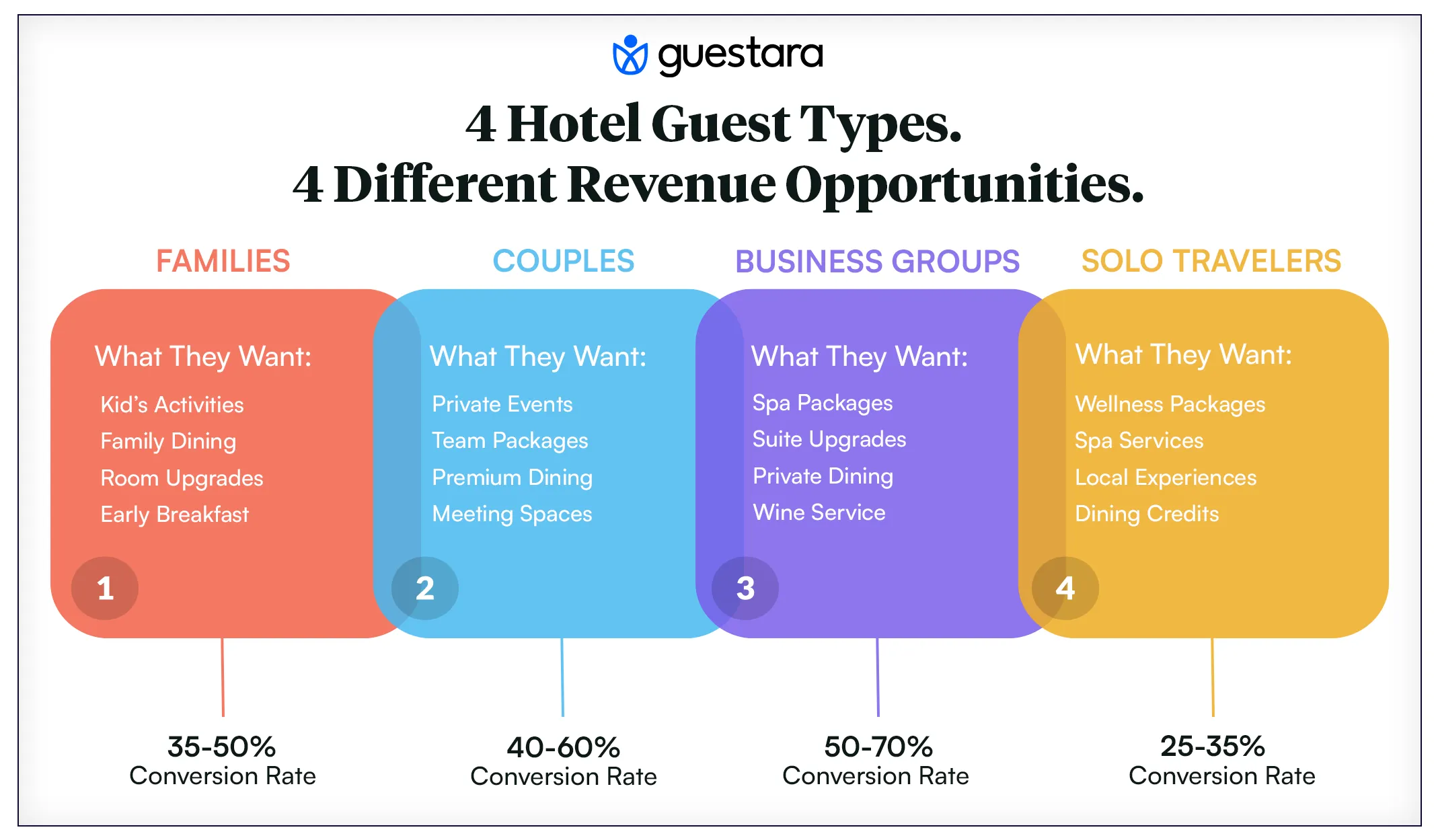
December guests aren't like May guests.
A family just survived months of packed schedules, kids in school, work deadlines, holiday prep. Then mid-December hits and suddenly they get permission to escape. They book a hotel not just for the room, but for the permission to relax.
A couple decides they're not staying with family. They're going somewhere romantic to reconnect without distractions. They're mentally preparing to spend money on this experience.
A corporate group books for their Christmas party. They've budgeted $100+ per person. These aren't price-conscious guests. They're here to make it memorable.
This mindset shift is everything. December guests don't see your hotel as a commodity. They see it as part of their experience. And they're willing to pay for anything that enhances it.
The key insight: December guests have already made the decision to spend. Your job isn't to convince them to spend more. Your job is to show them what's available.
Start now: Pull your December booking data from last year. What percent were families? Couples? Groups? What did each group purchase? This data becomes your roadmap.
Picture this: It's December 23rd. Your property is fully booked. Every night through January 2nd is at capacity.
Next door, a hotel with the same occupancy is doing something different. Pre-arrival emails positioned special packages. At check-in, the front desk naturally mentioned late checkout. During stay, SMS highlighted experiences. At checkout, guests booked future New Year's Eve packages.
Same occupancy. Same hotel. But one walks away with an extra $75,000.
Here's the math: When you're at full occupancy, every additional dollar per guest is almost pure profit. Fixed costs are covered. Staff is there. Utilities are on.
A 100-room hotel at full occupancy in December:
The hotels winning in December maximize every touchpoint: pre-arrival, check-in, during stay, checkout.
This isn't being pushy. It's being prepared. December guests want these extras. A family wants to know about kids' activities. A couple wants to book a romantic dinner. You're simply showing them what's available.
Pre-arrival is when guests are most open to buying.
Think about booking timing. They're excited. Visualizing the trip. Researching activities. In planning mode. Credit card already out.
This is when to reach them. Not arrival day when they're tired. Not during stay when they're busy. But right now, while excited.
The data is clear: Guests who receive personalized pre-arrival offers are 4x more likely to purchase add-ons than guests who don't.
Don't email the day they book. They've moved on. Email 3 days before when the trip becomes real.
Keep it short. Three offers maximum. Each specific to who they are.
If they booked a room for two with no kids mentioned, show spa packages and wine tastings. If they booked early check-in, mention welcome packages.
Subject line: "Your December escape is in 3 days. Here's what we have waiting for you."
Email body: Keep it simple. One sentence per offer. One benefit.
"Our signature spa package includes a 60-minute massage, facial, and champagne service. Perfect for couples looking to relax. Book before arrival and save 15%."
Not: "We offer many spa services including massage, facial, and body wraps. Guests love our spa facility which is world-class."
One is clear. The other is noise.
Your email list isn't one group. It's many.
Business travelers: Offer express check-in, upgraded workspace rooms, late checkout, coffee service. These solve real problems.
Families: Offer kids' activity packages, upgraded rooms with views, complimentary breakfast, family dining packages.
Couples: Offer spa packages, suite upgrades, private dining, champagne service.
This segmentation is the difference between 5% and 20% conversion. Generic emails convert at 2-3%. Personalized emails convert at 8-12%. That's 4x improvement.
Use your PMS to tag guests by type. Most platforms (Opera, Micros, Mews) have built-in segmentation.
Don't offer discounts. Offer added value.
Instead of: "10% off room upgrades."
Better: "Upgrade to our Premium Suite and receive complimentary champagne plus a $50 dining credit."
Bundling changes perception. Guests see multiple items and perceive more value. A "spa service" is a transaction. A "Holiday Spa Escape" is an experience. Guests pay more for experiences.
Send a text 24 hours before arrival. One time-sensitive offer. Direct link.
"Last 2 spots available for our New Year's Eve gala dinner. Secure now: [link]"
SMS open rate: 98%. Email open rate: 25%. This matters when you need immediate action.
Check-in is your second-best moment. Your guest has arrived. They're ready to spend.
Your front desk makes or breaks upselling. Train them on three things:
First, read the guest. A stressed guest rushing in isn't interested. A relaxed guest asking questions is interested.
Second, speak right. Not a script. Tone matters.
Good: "We have a few options that might make your stay more special. Would you like to hear about them?"
Bad: "We also have premium rooms available if you want to upgrade."
One respects the guest. One feels like a sales pitch.
Third, know when to stop. The moment they say no, upselling stops. No pushing. No second attempts. This protects reputation and actually increases future conversions because guests feel respected.
Train staff monthly. Not once. Constantly.
Don't offer one upgrade. Offer three at different prices.
Standard room (what they booked). Deluxe room (+$50). Suite (+$100).
This creates choice. Psychologically, most guests pick the middle option. You're not pushing the highest price. You're giving three genuine choices and letting them self-select.
Don't sell features. Sell experiences.
Bad: "Deluxe room with marble bathroom and upgraded linens."
Good: "Watch the sunset over the city from your private balcony."
Guests buy experiences, not square footage.
Guest is at your hotel. This is where most ancillary revenue comes from.
Don't wait for guests to discover amenities. Tell them directly.
A family would love to know about kids' activities tonight. A couple would love to hear about a special dinner. Send these messages 2-3 hours after check-in. Not immediately. Give them time to settle.
"Hi [name]. We have a kids' movie night at 7 PM with snacks included. Kids 4-12 would love it. Book here: [link]"
Direct. Clear. Removes friction.
Sell packages, not individual items.
Bad: "Spa treatment - $80. Dinner - $40."
Better: "Spa and Dine Package - $100. Relaxing treatment plus dinner."
The bundle feels more valuable. Guests see $120 worth of value for $100 and buy.
Name them festively for December.
Not: "Spa service." But: "Holiday Spa Escape - 60 minute massage, holiday facial, complimentary champagne and chocolate."
Your restaurant is quiet 3-5 PM. Your spa has mid-afternoon openings.
Text guests: "Afternoon special: Spa treatment 30% off if booked by 3 PM today."
This fills slow times and generates revenue. Win-win.
Friction kills sales.
Install QR codes in rooms pointing to your services. Let guests book on their phone in 60 seconds. Send every message with a direct booking link. Train staff to complete bookings immediately.
If your mobile booking takes longer than 60 seconds, you're losing sales.
Create a special Christmas or New Year's Eve dinner. Not just "dinner available." A special event.
"Christmas Eve Gala Dinner. Five courses crafted by our executive chef. Winter-inspired menu. Live jazz quartet. Festive decorations. Complimentary champagne toast."
Not: "We offer a Christmas dinner."
One is an experience. One is a listing.
Price aggressively. Guests expect to pay more on special occasions. A $75 dinner priced at $95 on New Year's Eve sells better than off-season pricing.
A 100-room hotel at 50% occupancy. Special dinner at $95. 30 guests purchase (60% conversion). Revenue: $2,850 for one dinner.
Over December with 3-4 special dinners: $10,000-$15,000 in revenue. Almost pure profit.
Don't position upgrades alone. Bundle them.
"Upgrade to a suite and receive complimentary champagne upon arrival plus breakfast for two."
Price at $120. Market as "$140 value for $120."
Conversion on bundled upgrades: 25-35%. Conversion on straight upgrades: 8-12%.
Simple. Powerful. Profitable.
Guests leaving December 24th or 25th want late checkout. Charge $25-50 for 1 PM checkout instead of 11 AM. It costs you nothing. Turnover happens the same.
This is pure margin revenue.
Families want their kids occupied. Don't just list activities. Package them.
"Holiday Activity Package - Three curated activities (movie night with popcorn, kids' art workshop, gingerbread house decorating). Snacks included. $40 per child."
Expected conversion: 35-50% of families with kids.
December 31st is your highest revenue night. You can be aggressive here.
Create an event if possible. Cocktail party, live band, gala dinner, room party package.
Price at $200-500 per person. Guests will pay because the occasion justifies it.
40 package tickets at $250 average = $10,000 in add-on revenue for one night.
Business travelers are less price-sensitive. They expense costs. They have approved budgets.
December leisure travelers are different than August. They've budgeted for the holiday. They expect higher costs.
Charge premium prices for December upsells:
Guests expect this. They're mentally prepared for higher holiday costs.
A $50 upgrade alone might convert at 10%.
A $50 upgrade bundled with $20 champagne and $10 breakfast positioned as "$80 value for $65" might convert at 25%.
Bundling changes perception. Guests see multiple items and perceive more value. They buy more.
Offer three price points, not one or two.
Budget option: $50 Premium option: $75 Luxury option: $120
The middle option almost always sells the most. Humans default to the middle when given three choices.
What works for your property might not work elsewhere.
A/B test your emails. Send $75 room upgrade to 50% of guests. Send $85 to the other 50%. Track conversion. Pick the winner.
Test package names. Test pricing. Test messaging.
Real example: Hotel A tested "Room upgrade" vs. "Luxury upgrade package." Package naming converted at 18%. Plain upgrade naming converted at 8%. They renamed everything.
Guest arrives. You offer upgrade. They say no. Don't immediately offer spa package, then dinner, then activities.
One offer per touchpoint. Let guests breathe.
A solo business traveler doesn't want kids' activity emails. A family doesn't want wine tasting emails.
Wrong offer to wrong guest kills conversions. Know your guest type. Match your offer.
Guest wants to book your spa package. But your website doesn't have it. They call. Phone is busy. They give up.
Make purchasing easy. QR codes. Direct links. 60-second checkout.
"I think guests want spa packages" loses to "data shows guests book dinner packages 2x more."
Track what sells daily. Promote what works. De-emphasize what doesn't.
Your systems are only as good as your people.
Upselling isn't just sales. It's everyone.
Front desk: "One thing guests mention is wishing they'd booked spa. Would you be interested?"
Room service: "Many guests add wine pairings. Would you like suggestions?"
These aren't pushy. They're helpful. And they work.
People do what you reward.
Incentivize ancillary revenue, not just occupancy.
"Help us reach $10,000 in ancillary revenue this month and the team gets a $500 bonus. Top seller gets $100."
Make it achievable. Team-based. Fun.
Which upsells sell? Which don't?
Weekly data reviews. Share what's working. Celebrate wins. Course-correct what's not.
Data creates focus. Focus drives results.


Master hotel upselling strategies for December peak season. Increase ancillary revenue 25-50% with pre-arrival, check-in & in-stay tactics.
Here's what happens in December that doesn't happen any other month.
Your rooms fill up. Occupancy hits 80-90%+. But more importantly your guests arrive with completely different mindsets than the rest of the year.
They're not cutting costs. They've budgeted for experiences. They're traveling to escape work stress, reconnect with family, celebrate milestones, or ring in a new year. Their wallets are open. Their defenses are down. Their hearts are focused on making memories.
This is the one month where guests actually want to upgrade. Want to add experiences. Want to spend more because the occasion justifies it.
But here's the brutal reality: most hoteliers focus so hard on filling rooms that they completely miss the bigger revenue opportunity sitting right in front of them.
A typical 100-room hotel at full December occupancy makes roughly $150,000 in room revenue. Standard. But hotels with real upselling strategies make an extra $50,000 to $75,000 in ancillary revenue from those same guests. That's 33-50% additional profit from guests who booked anyway.
The difference isn't luck. It's strategy.
This guide shows you the exact system. Real tactics. Real results. No pressure sales. Just the straightforward approach that turns December from "our busiest month" into "our most profitable month."
December guests aren't like May guests.
A family just survived months of packed schedules, kids in school, work deadlines, holiday prep. Then mid-December hits and suddenly they get permission to escape. They book a hotel not just for the room, but for the permission to relax.
A couple decides they're not staying with family. They're going somewhere romantic to reconnect without distractions. They're mentally preparing to spend money on this experience.
A corporate group books for their Christmas party. They've budgeted $100+ per person. These aren't price-conscious guests. They're here to make it memorable.
This mindset shift is everything. December guests don't see your hotel as a commodity. They see it as part of their experience. And they're willing to pay for anything that enhances it.
The key insight: December guests have already made the decision to spend. Your job isn't to convince them to spend more. Your job is to show them what's available.
Start now: Pull your December booking data from last year. What percent were families? Couples? Groups? What did each group purchase? This data becomes your roadmap.
Picture this: It's December 23rd. Your property is fully booked. Every night through January 2nd is at capacity.
Next door, a hotel with the same occupancy is doing something different. Pre-arrival emails positioned special packages. At check-in, the front desk naturally mentioned late checkout. During stay, SMS highlighted experiences. At checkout, guests booked future New Year's Eve packages.
Same occupancy. Same hotel. But one walks away with an extra $75,000.
Here's the math: When you're at full occupancy, every additional dollar per guest is almost pure profit. Fixed costs are covered. Staff is there. Utilities are on.
A 100-room hotel at full occupancy in December:
The hotels winning in December maximize every touchpoint: pre-arrival, check-in, during stay, checkout.
This isn't being pushy. It's being prepared. December guests want these extras. A family wants to know about kids' activities. A couple wants to book a romantic dinner. You're simply showing them what's available.
Pre-arrival is when guests are most open to buying.
Think about booking timing. They're excited. Visualizing the trip. Researching activities. In planning mode. Credit card already out.
This is when to reach them. Not arrival day when they're tired. Not during stay when they're busy. But right now, while excited.
The data is clear: Guests who receive personalized pre-arrival offers are 4x more likely to purchase add-ons than guests who don't.
Don't email the day they book. They've moved on. Email 3 days before when the trip becomes real.
Keep it short. Three offers maximum. Each specific to who they are.
If they booked a room for two with no kids mentioned, show spa packages and wine tastings. If they booked early check-in, mention welcome packages.
Subject line: "Your December escape is in 3 days. Here's what we have waiting for you."
Email body: Keep it simple. One sentence per offer. One benefit.
"Our signature spa package includes a 60-minute massage, facial, and champagne service. Perfect for couples looking to relax. Book before arrival and save 15%."
Not: "We offer many spa services including massage, facial, and body wraps. Guests love our spa facility which is world-class."
One is clear. The other is noise.
Your email list isn't one group. It's many.
Business travelers: Offer express check-in, upgraded workspace rooms, late checkout, coffee service. These solve real problems.
Families: Offer kids' activity packages, upgraded rooms with views, complimentary breakfast, family dining packages.
Couples: Offer spa packages, suite upgrades, private dining, champagne service.
This segmentation is the difference between 5% and 20% conversion. Generic emails convert at 2-3%. Personalized emails convert at 8-12%. That's 4x improvement.
Use your PMS to tag guests by type. Most platforms (Opera, Micros, Mews) have built-in segmentation.
Don't offer discounts. Offer added value.
Instead of: "10% off room upgrades."
Better: "Upgrade to our Premium Suite and receive complimentary champagne plus a $50 dining credit."
Bundling changes perception. Guests see multiple items and perceive more value. A "spa service" is a transaction. A "Holiday Spa Escape" is an experience. Guests pay more for experiences.
Send a text 24 hours before arrival. One time-sensitive offer. Direct link.
"Last 2 spots available for our New Year's Eve gala dinner. Secure now: [link]"
SMS open rate: 98%. Email open rate: 25%. This matters when you need immediate action.
Check-in is your second-best moment. Your guest has arrived. They're ready to spend.
Your front desk makes or breaks upselling. Train them on three things:
First, read the guest. A stressed guest rushing in isn't interested. A relaxed guest asking questions is interested.
Second, speak right. Not a script. Tone matters.
Good: "We have a few options that might make your stay more special. Would you like to hear about them?"
Bad: "We also have premium rooms available if you want to upgrade."
One respects the guest. One feels like a sales pitch.
Third, know when to stop. The moment they say no, upselling stops. No pushing. No second attempts. This protects reputation and actually increases future conversions because guests feel respected.
Train staff monthly. Not once. Constantly.
Don't offer one upgrade. Offer three at different prices.
Standard room (what they booked). Deluxe room (+$50). Suite (+$100).
This creates choice. Psychologically, most guests pick the middle option. You're not pushing the highest price. You're giving three genuine choices and letting them self-select.
Don't sell features. Sell experiences.
Bad: "Deluxe room with marble bathroom and upgraded linens."
Good: "Watch the sunset over the city from your private balcony."
Guests buy experiences, not square footage.
Guest is at your hotel. This is where most ancillary revenue comes from.
Don't wait for guests to discover amenities. Tell them directly.
A family would love to know about kids' activities tonight. A couple would love to hear about a special dinner. Send these messages 2-3 hours after check-in. Not immediately. Give them time to settle.
"Hi [name]. We have a kids' movie night at 7 PM with snacks included. Kids 4-12 would love it. Book here: [link]"
Direct. Clear. Removes friction.
Sell packages, not individual items.
Bad: "Spa treatment - $80. Dinner - $40."
Better: "Spa and Dine Package - $100. Relaxing treatment plus dinner."
The bundle feels more valuable. Guests see $120 worth of value for $100 and buy.
Name them festively for December.
Not: "Spa service." But: "Holiday Spa Escape - 60 minute massage, holiday facial, complimentary champagne and chocolate."
Your restaurant is quiet 3-5 PM. Your spa has mid-afternoon openings.
Text guests: "Afternoon special: Spa treatment 30% off if booked by 3 PM today."
This fills slow times and generates revenue. Win-win.
Friction kills sales.
Install QR codes in rooms pointing to your services. Let guests book on their phone in 60 seconds. Send every message with a direct booking link. Train staff to complete bookings immediately.
If your mobile booking takes longer than 60 seconds, you're losing sales.
Create a special Christmas or New Year's Eve dinner. Not just "dinner available." A special event.
"Christmas Eve Gala Dinner. Five courses crafted by our executive chef. Winter-inspired menu. Live jazz quartet. Festive decorations. Complimentary champagne toast."
Not: "We offer a Christmas dinner."
One is an experience. One is a listing.
Price aggressively. Guests expect to pay more on special occasions. A $75 dinner priced at $95 on New Year's Eve sells better than off-season pricing.
A 100-room hotel at 50% occupancy. Special dinner at $95. 30 guests purchase (60% conversion). Revenue: $2,850 for one dinner.
Over December with 3-4 special dinners: $10,000-$15,000 in revenue. Almost pure profit.
Don't position upgrades alone. Bundle them.
"Upgrade to a suite and receive complimentary champagne upon arrival plus breakfast for two."
Price at $120. Market as "$140 value for $120."
Conversion on bundled upgrades: 25-35%. Conversion on straight upgrades: 8-12%.
Simple. Powerful. Profitable.
Guests leaving December 24th or 25th want late checkout. Charge $25-50 for 1 PM checkout instead of 11 AM. It costs you nothing. Turnover happens the same.
This is pure margin revenue.
Families want their kids occupied. Don't just list activities. Package them.
"Holiday Activity Package - Three curated activities (movie night with popcorn, kids' art workshop, gingerbread house decorating). Snacks included. $40 per child."
Expected conversion: 35-50% of families with kids.
December 31st is your highest revenue night. You can be aggressive here.
Create an event if possible. Cocktail party, live band, gala dinner, room party package.
Price at $200-500 per person. Guests will pay because the occasion justifies it.
40 package tickets at $250 average = $10,000 in add-on revenue for one night.
Business travelers are less price-sensitive. They expense costs. They have approved budgets.
December leisure travelers are different than August. They've budgeted for the holiday. They expect higher costs.
Charge premium prices for December upsells:
Guests expect this. They're mentally prepared for higher holiday costs.
A $50 upgrade alone might convert at 10%.
A $50 upgrade bundled with $20 champagne and $10 breakfast positioned as "$80 value for $65" might convert at 25%.
Bundling changes perception. Guests see multiple items and perceive more value. They buy more.
Offer three price points, not one or two.
Budget option: $50 Premium option: $75 Luxury option: $120
The middle option almost always sells the most. Humans default to the middle when given three choices.
What works for your property might not work elsewhere.
A/B test your emails. Send $75 room upgrade to 50% of guests. Send $85 to the other 50%. Track conversion. Pick the winner.
Test package names. Test pricing. Test messaging.
Real example: Hotel A tested "Room upgrade" vs. "Luxury upgrade package." Package naming converted at 18%. Plain upgrade naming converted at 8%. They renamed everything.
Guest arrives. You offer upgrade. They say no. Don't immediately offer spa package, then dinner, then activities.
One offer per touchpoint. Let guests breathe.
A solo business traveler doesn't want kids' activity emails. A family doesn't want wine tasting emails.
Wrong offer to wrong guest kills conversions. Know your guest type. Match your offer.
Guest wants to book your spa package. But your website doesn't have it. They call. Phone is busy. They give up.
Make purchasing easy. QR codes. Direct links. 60-second checkout.
"I think guests want spa packages" loses to "data shows guests book dinner packages 2x more."
Track what sells daily. Promote what works. De-emphasize what doesn't.
Your systems are only as good as your people.
Upselling isn't just sales. It's everyone.
Front desk: "One thing guests mention is wishing they'd booked spa. Would you be interested?"
Room service: "Many guests add wine pairings. Would you like suggestions?"
These aren't pushy. They're helpful. And they work.
People do what you reward.
Incentivize ancillary revenue, not just occupancy.
"Help us reach $10,000 in ancillary revenue this month and the team gets a $500 bonus. Top seller gets $100."
Make it achievable. Team-based. Fun.
Which upsells sell? Which don't?
Weekly data reviews. Share what's working. Celebrate wins. Course-correct what's not.
Data creates focus. Focus drives results.
Most hotels see 15-20% increase in ancillary revenue per guest. Some see 25-30% depending on execution.
Analyze your guest data. Segment your list. Send one personalized pre-arrival email. Track results.
Yes. Smaller hotels have an advantage. You know your guests better. You can personalize more effectively.
Test them. Survey past guests. Check competitors. Test pricing and messaging. Data beats guessing.
Arrival is good. 3-4 hours after check-in is better. Guests are settled and in spending mode.
We work closely with the industry leaders to offer seamless solutions




We’re here to help your whole team stay ahead of the curve as you grow.

Get up and running quickly with a personalized onboarding plan

Connect with real people who really get it, 24/7

Checkout our vast library of free resources, templates and more
There's only so much we can say — so let us show you! Schedule a demo today and reach your business goals.


.png)
.png)