Master hotel WhatsApp marketing with our complete guide. Learn automation strategies, compliance rules, message templates, and increase bookings.




Forget everything you know about hotel marketing emails.
Your guests check WhatsApp 40+ times per day. They check email maybe once. That gap? That's where your revenue opportunity lives.
Right now, only 12% of hotels use WhatsApp as part of their marketing strategy. For reference, 63% of hotels either ignore the platform entirely or use it only for operational updates like check-in confirmations. That leaves a massive competitive advantage for hotels willing to think differently about guest communication.
This guide walks you through exactly how to build a WhatsApp marketing strategy that drives direct bookings, increases in-stay revenue, and generates more reviews—without annoying your guests in the process.
WhatsApp marketing means using the WhatsApp platform to send timely, relevant messages to guests across their entire journey. It's not about blasting promotional offers at random times. It's about connecting with guests when they actually need you—before they arrive, during their stay, and after they leave.
Think of it as replacing the front desk phone call, the printed room guide, and the forgotten follow-up email with a single channel your guests already open dozens of times daily.
The platform works because it feels personal. A WhatsApp message from your hotel doesn't feel like corporate marketing. It feels like a friend texting you helpful information.
Here's why hospitality is the perfect fit for WhatsApp marketing:
Speed matters. Your guest books a room and wants confirmation fast. WhatsApp delivers it in seconds, with a read receipt that proves they saw it.
Personalization is expected. Guests want to feel like individuals, not just booking numbers. WhatsApp automation allows you to personalize at scale without sounding robotic.
High-intent conversations happen here. When a guest messages your hotel, they're actively engaged—not scrolling past an email. This is the ideal moment to upsell services, answer questions, or solve problems.
Before diving into tactics, understand why your competitors who ignore WhatsApp are actually losing money.
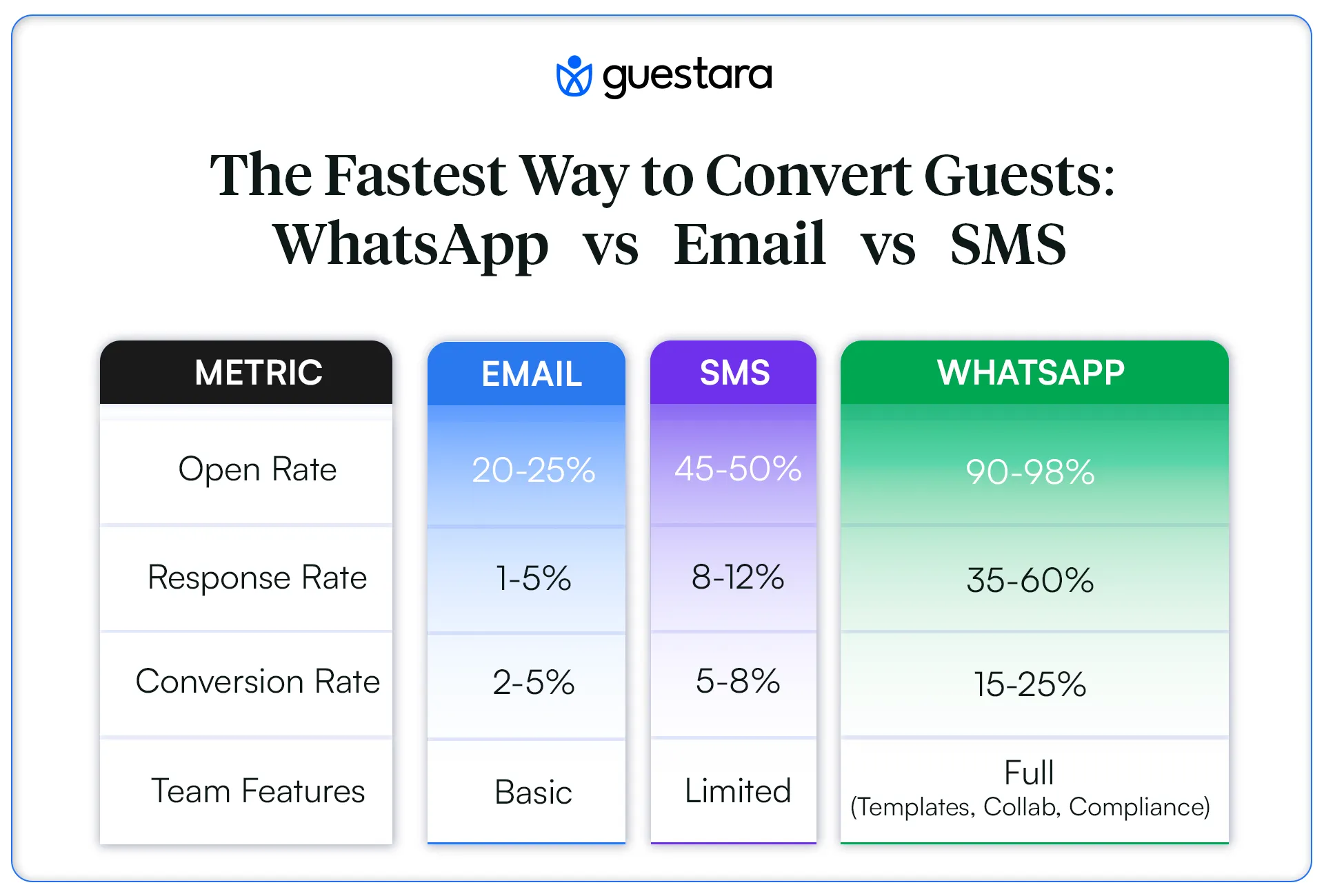
WhatsApp messages achieve open rates above 90%, with many platforms reporting rates as high as 98%. Email? You're lucky to hit 20-25%.
But here's what matters more than the open rate: guests actually respond to WhatsApp messages. Response rates reach 35-60%, compared to 1-5% for email. This means conversations happen and conversations convert.
When a guest replies to your message, they're raising their hand. They're interested. They're ready to engage. That's not a marketing message anymore that's a sales opportunity.
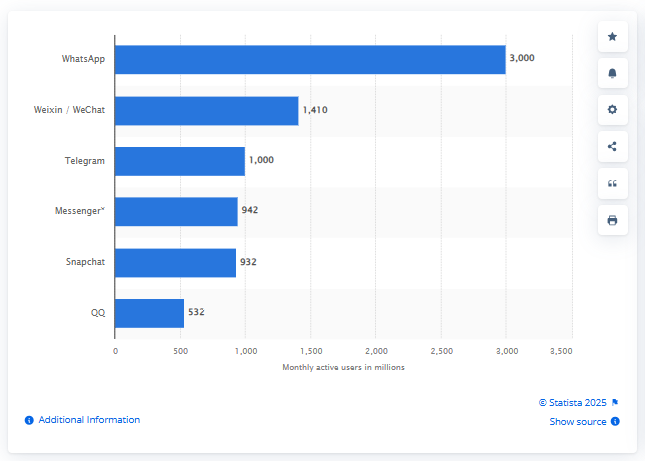
With WhatsApp's massive user base of 2 billion people across 188 countries and regions, there's a good chance your customers are already using WhatsApp. In markets like India, WhatsApp is the #1 communication platform for travelers, with 532-596.6 million users and over 100 billion messages sent daily.
Yet 88% of hotels aren't even trying.
When a guest receives a pre-arrival message confirming their booking and offering an upgrade, they often take it. When they get a mid-stay message about dinner reservations available tonight, they book it. When they receive a post-stay message asking for feedback with a review incentive, they leave it.
These aren't hypothetical. Hotels report conversion rates of 15-25% on WhatsApp upsells, compared to 2-5% for email campaigns. The channel itself drives higher intent and faster decision-making.
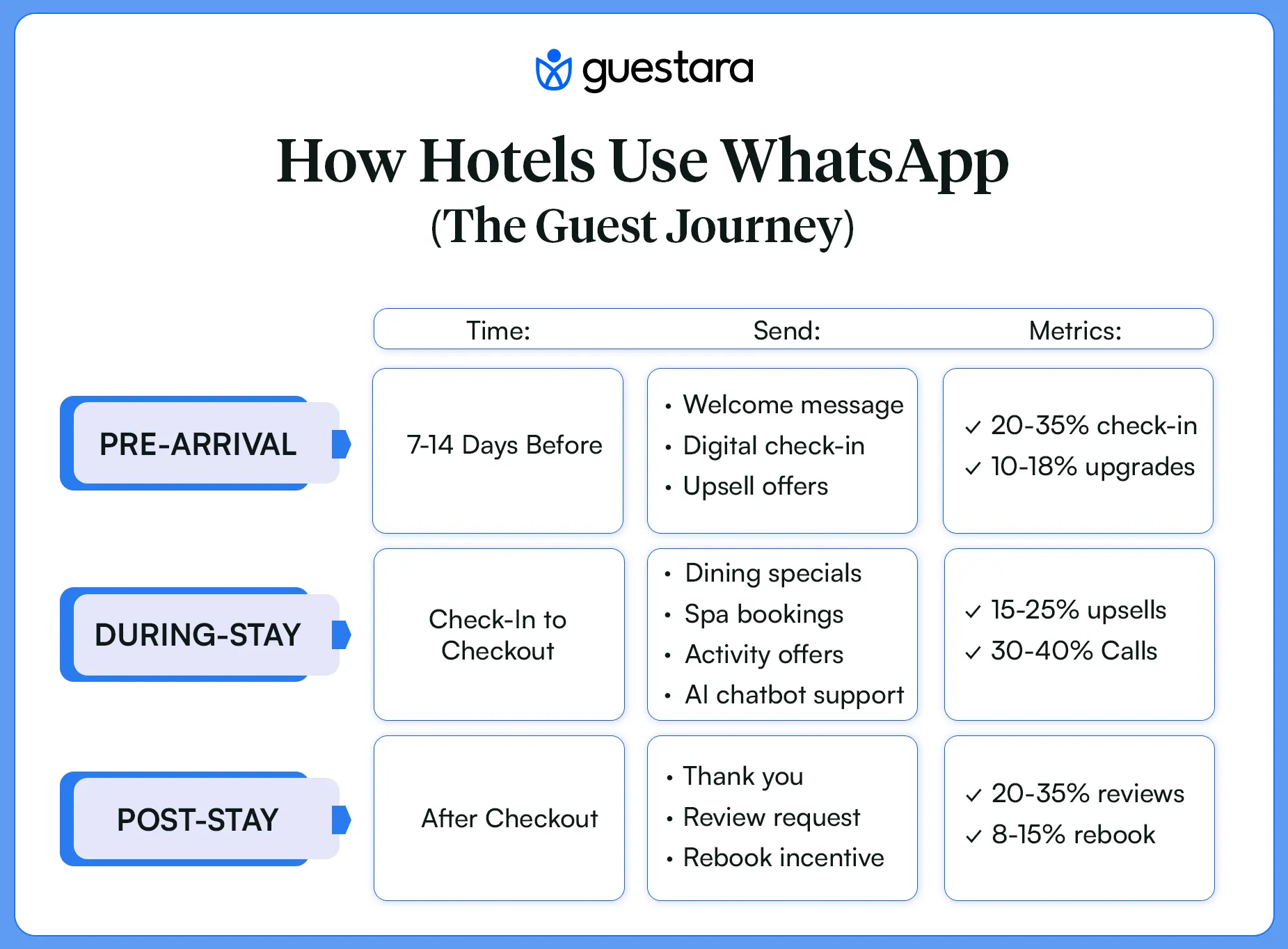
The best WhatsApp strategies follow guests across three distinct phases, each with different goals and different ROI.
Goal: Reduce no-shows, increase upsells, improve first impression.
Send a welcome message with booking details. Include a personalized digital check-in link. Offer services tailored to their booking—spa packages for couples, kids' clubs for families, early check-in for business travelers.
Real example: "Hi Sarah, we're excited to welcome you on March 15th! Complete your check-in now to skip lines [LINK]. Interested in a room upgrade? We have ocean-view availability. [VIEW OPTIONS]"
Why it works: You're solving problems before guests ask and creating revenue opportunities at the exact right moment.
Expected conversion: 20-35% will complete digital check-in. 10-18% will upgrade or add services.
Goal: Increase in-stay revenue, reduce operational requests, drive satisfaction.
Send messages about room service, spa bookings, activities, and event information. Let guests request housekeeping or late checkout via WhatsApp instead of calling. With an AI-powered chatbot, you can handle common queries instantly without staff intervention.
Real example: "Hi James, our chef prepared a special seafood menu tonight. Want us to deliver to your room? Also, sunset tour tomorrow is almost full. Reserve now? [YES] [NO]"
Expected revenue: 15-25% of guests purchase at least one upsell during their stay. Average upsell value: $30-80 per guest.
Operational benefit: WhatsApp requests reduce front desk calls by 30-40%, freeing staff for better guest service.
Goal: Capture reviews, gather feedback, drive repeat bookings.
Send a thank you message. Request a review with a direct link. Offer a special rebook incentive. Keep it short—guests are still in travel mode.
Real example: "Maria, thanks for staying with us! Help us improve—leave a review [LINK]. Book within 30 days for 15% off. [REBOOK]"
Expected results: 20-35% will leave a review when asked via WhatsApp (vs. 2-5% for email). 8-15% will rebook within 30 days with an incentive.
Send personalized messages to targeted guest segments. Use carousel cards to showcase multiple options (room upgrades, spa packages, dining experiences). Include media-rich content—images of your property, videos of amenities. Add limited-time offers with copiable coupon codes to drive urgency and conversions.
Example: Weekend escape promotion with carousel showing 3 room types, each with its own image, description, and clickable booking button.
Best uses: Seasonal promotions, flash sales, loyalty rewards, event announcements.
Expected results: 5-12% click-through rate (vs. 0.5-2% for email). Broadcasts typically drive 8-15% additional bookings.
Smart segmentation: Don't send the same message to everyone. Families get family-friendly offers. Couples get romantic experiences. Business travelers get work-focused services.
Set these up once, and they run automatically for every booking. No manual work required.
Pre-arrival flow: Welcome message → Digital check-in → Personalized upsells → Final confirmation.
In-stay flow: Welcome → Day 2 upsell → Service requests channel → Checkout reminder.
Post-stay flow: Thank you → Review request → Rebook incentive.
Each message triggers at the exact right moment. Every guest gets the same excellent experience. No message gets forgotten.
ROI: Automated journeys increase upsell conversion by 25-40% compared to ad-hoc messages because timing is perfect and messaging is consistent.
Send WhatsApp payment messages directly through the app. Guests can settle bills, book services, or complete purchases without leaving WhatsApp. Reduce late payments by sending payment reminders with one-click payment links.
Example: "Hi Sarah, your restaurant bill is ready: $145. Pay now via WhatsApp [PAY LINK] or front desk."
This turns WhatsApp into a revenue collection channel, not just a marketing channel.
Build no-code chatbots that answer common questions instantly. FAQ queries? Answered. Booking changes? Handled. Service requests? Processed. Your entire team can chat together in a unified inbox to solve complex queries that the bot can't handle alone.
When the chatbot encounters a question it can't answer, it seamlessly hands off to your team. Guests never know—they just get help.
Expected improvement: 70-80% of routine queries handled by the bot without staff involvement. The 20-30% that need human touch get prioritized and solved faster.
You have two ways to run WhatsApp marketing. Understanding the difference is critical because it determines what's actually possible.
This is WhatsApp's basic business tool. You download the app, create a business profile, and start messaging.
What it does: One person can manage messages on one phone You can create labels and quick replies to speed up responses Customers can message you directly You can add a business description and hours
What it doesn't do: No automation or scheduled messages No broadcast capability (you can't send one message to hundreds of guests) No templates for compliance messaging No integrations with your PMS or booking system No analytics or performance tracking Not designed for multi-agent teams
Bottom line: The Business App is fine for answering guest questions. It's not sufficient for marketing campaigns.
The Business API is what you actually need for hotel WhatsApp marketing at scale. It's provided through official partners and integrates directly with your hotel systems.
What it enables: Broadcast campaigns to segmented guest lists (send one message to hundreds of guests) Pre-approved message templates for compliance Full automation (scheduled messages triggered by booking events) Multi-agent access (entire team can manage conversations) Two-way conversations (guests message you, you respond) Integration with PMS systems like Mews, Apaleo, Opera Performance tracking and analytics Payment collection directly through WhatsApp Click-to-WhatsApp ads (drive traffic from Facebook and Instagram directly to WhatsApp)
Cost: $0.01-0.05 per message for business-initiated messages.it can vary country to country. Templates and automated messages often cost less than paid ads to achieve similar results.
Bottom line: If you're serious about WhatsApp marketing for your hotel, you need the API version. The Business App is like owning a store but not being allowed to advertise. The API lets you run a real business operation.
Technical setup: This requires partnering with an official WhatsApp Business API provider. Your hotel chooses a platform (some examples include Guestara, HiJiffy, Chatlyn, or Botshot), connects your PMS, and starts building campaigns.
Not all WhatsApp messages are created equal. Different campaign types serve different purposes and achieve different ROI.
Broadcast campaigns send the same message to a targeted group of guests. Think of it as email marketing, but on WhatsApp.
Best uses: Weekend getaway promotions to past guests Mid-week corporate package offers Seasonal packages (spring break, holiday season) Flash sales or last-minute availability Event promotions (if your hotel hosts events) Loyalty program announcements
Example broadcast for a seaside resort: "Feeling sandy? We've got a weekend escape calling your name. Book your next stay by Friday and get 20% off + free spa credit. Your paradise is waiting. [BOOK NOW]"
Expected results: 5-12% click-through rate (compared to 0.5-2% for email). Broadcast campaigns typically drive 8-15% additional bookings for the promoted period.
Key rule: Segment your broadcasts. Don't send the same message to families, couples, and business travelers. Send families information about kids' activities. Send couples details about romantic packages. Relevance is everything.
Set these up once, and they run automatically for every booking. No manual work required.
Key flows: New inquiry received → Automated welcome message + booking link 7 days before arrival → Digital check-in + pre-arrival upsells 1 day before arrival → Final confirmation + local tips Day of arrival → Welcome message + digital key Day 2 of stay → In-stay upsell (spa, dining, activities) Check-out day → Checkout reminders + review request Day after checkout → Thank you + review incentive + rebook offer
Example flow trigger: Guest books 10 days before arrival. Automatically send: (1) welcome message day 1, (2) digital check-in link day 3, (3) upgrade offer day 5, (4) final confirmation day 9, (5) arrival day message. Each message triggers at the exact right moment without staff involvement.
Why automation matters: You reach every single guest at the optimal moment. No message gets forgotten. No guest falls through the cracks because staff forgot to send the pre-arrival message.
ROI: Automated journeys increase upsell conversion by 25-40% compared to ad-hoc messages because timing is perfect and messaging is consistent.
This is where WhatsApp integrates with your digital advertising. You run an ad on Facebook or Instagram, and clicking it opens a conversation with your hotel via WhatsApp.
How it works: Guest sees your ad (e.g., "Book a beachfront suite for $150") Guest clicks the ad WhatsApp opens with a pre-written message already loaded (e.g., "Hi! I'm interested in the beachfront suite special") Your team responds directly via WhatsApp Conversation continues to booking
Why it's powerful: Friction drops dramatically. Instead of clicking the ad, finding your website, filling out a contact form, you go directly to conversation. Conversion rates are 3-5x higher than traditional ads.
Cost: You pay for the ad impression (like normal Facebook ads), but the "landing page" is free—it's just WhatsApp. This often reduces total customer acquisition cost by 30-50%.
Best use: Driving bookings for specific properties, packages, or seasonal offers to cold audiences.
Compliance (Simplified)
WhatsApp's core rule is simple: You need permission before sending marketing messages.
Collect explicit permission by asking guests during booking: "Yes, send me exclusive offers via WhatsApp". Also collect on your website, via QR codes, or email signup.
Don't send marketing messages without documented opt-in.
After a guest messages you, you have 24 hours to respond with any message you want. This is free conversation time. Outside that window, use pre-approved templates.
Document where you collected opt-in. Use approved templates for broadcasts. Include opt-out instructions in every message (Reply STOP). Track and honor opt-outs immediately. Include privacy policy link in welcome message. Don't send outside business hours without explicit request.
Setting up WhatsApp marketing yourself is possible. It's also time-consuming, fragmented, and easy to mess up.
Guestara was built specifically to make this simple for hotels.
Here's what we handle:
WhatsApp Business API Integration: We manage the relationship with WhatsApp. You don't worry about API documentation, authentication, or updates. It just works.
Pre-Built Guest Journey Templates: Don't start from scratch. Our templates cover pre-arrival, in-stay, and post-stay. Customize them in minutes.
Automated Workflows: Set it once, forget it. Every guest flows through your pre-arrival, in-stay, and post-stay sequence automatically. No manual work.
Segmentation & Personalization: Target different guest types differently. Families get family-friendly offers. Corporate guests get business-focused services. Couples get romantic experiences.
Unified Inbox: WhatsApp messages live alongside email and other guest channels. One inbox to manage all communication. Your team sees everything in context.
Templates & Compliance Built-In: All templates are pre-approved and GDPR compliant. We handle the technical compliance. You just send.
Analytics Dashboard: See opt-in rates, delivery, open rates, conversion rates, revenue generated. Understand what's working.
Two-Way Messaging: Guests message you. You respond. It's real conversation, not broadcast.
Integration With Your Systems: Connects directly with your PMS, booking system, and guest data. Messages are personalized automatically based on real booking information.
The Real Difference: Without a platform like Guestara, you're using WhatsApp's basic API, manually creating workflows, manually segmenting lists, and manually tracking results. You get 20% of the possible ROI and spend 80% of the setup time.
With Guestara, you get 80% of the ROI, spend 20% of the time, and actually understand what's working because analytics are built-in.
This is the difference between WhatsApp marketing that's a pain versus WhatsApp marketing that's a revenue engine.
Eighty-eight percent of hotels are not using WhatsApp for marketing.
That's not your competition that's your opportunity.
You now know:
You also know the stakes. Only 12% of hotels use WhatsApp strategically. Your guests expect it. Your competitors aren't doing it yet.
The gap between 12% adoption and where it will be in 18 months (probably 40%+) is enormous. Every hotel that waits is leaving money on the table.
Start this week. Begin with one automated flow the pre-arrival sequence. Get 50 guests through it. Measure results. Iterate. Then expand.
The hotels making the most revenue five years from now won't be the ones who had the best website. They'll be the ones who mastered direct guest communication.
WhatsApp is that channel.


Master hotel WhatsApp marketing with our complete guide. Learn automation strategies, compliance rules, message templates, and increase bookings.
Forget everything you know about hotel marketing emails.
Your guests check WhatsApp 40+ times per day. They check email maybe once. That gap? That's where your revenue opportunity lives.
Right now, only 12% of hotels use WhatsApp as part of their marketing strategy. For reference, 63% of hotels either ignore the platform entirely or use it only for operational updates like check-in confirmations. That leaves a massive competitive advantage for hotels willing to think differently about guest communication.
This guide walks you through exactly how to build a WhatsApp marketing strategy that drives direct bookings, increases in-stay revenue, and generates more reviews—without annoying your guests in the process.
WhatsApp marketing means using the WhatsApp platform to send timely, relevant messages to guests across their entire journey. It's not about blasting promotional offers at random times. It's about connecting with guests when they actually need you—before they arrive, during their stay, and after they leave.
Think of it as replacing the front desk phone call, the printed room guide, and the forgotten follow-up email with a single channel your guests already open dozens of times daily.
The platform works because it feels personal. A WhatsApp message from your hotel doesn't feel like corporate marketing. It feels like a friend texting you helpful information.
Here's why hospitality is the perfect fit for WhatsApp marketing:
Speed matters. Your guest books a room and wants confirmation fast. WhatsApp delivers it in seconds, with a read receipt that proves they saw it.
Personalization is expected. Guests want to feel like individuals, not just booking numbers. WhatsApp automation allows you to personalize at scale without sounding robotic.
High-intent conversations happen here. When a guest messages your hotel, they're actively engaged—not scrolling past an email. This is the ideal moment to upsell services, answer questions, or solve problems.
Before diving into tactics, understand why your competitors who ignore WhatsApp are actually losing money.
WhatsApp messages achieve open rates above 90%, with many platforms reporting rates as high as 98%. Email? You're lucky to hit 20-25%.
But here's what matters more than the open rate: guests actually respond to WhatsApp messages. Response rates reach 35-60%, compared to 1-5% for email. This means conversations happen and conversations convert.
When a guest replies to your message, they're raising their hand. They're interested. They're ready to engage. That's not a marketing message anymore that's a sales opportunity.
With WhatsApp's massive user base of 2 billion people across 188 countries and regions, there's a good chance your customers are already using WhatsApp. In markets like India, WhatsApp is the #1 communication platform for travelers, with 532-596.6 million users and over 100 billion messages sent daily.
Yet 88% of hotels aren't even trying.
When a guest receives a pre-arrival message confirming their booking and offering an upgrade, they often take it. When they get a mid-stay message about dinner reservations available tonight, they book it. When they receive a post-stay message asking for feedback with a review incentive, they leave it.
These aren't hypothetical. Hotels report conversion rates of 15-25% on WhatsApp upsells, compared to 2-5% for email campaigns. The channel itself drives higher intent and faster decision-making.
The best WhatsApp strategies follow guests across three distinct phases, each with different goals and different ROI.
Goal: Reduce no-shows, increase upsells, improve first impression.
Send a welcome message with booking details. Include a personalized digital check-in link. Offer services tailored to their booking—spa packages for couples, kids' clubs for families, early check-in for business travelers.
Real example: "Hi Sarah, we're excited to welcome you on March 15th! Complete your check-in now to skip lines [LINK]. Interested in a room upgrade? We have ocean-view availability. [VIEW OPTIONS]"
Why it works: You're solving problems before guests ask and creating revenue opportunities at the exact right moment.
Expected conversion: 20-35% will complete digital check-in. 10-18% will upgrade or add services.
Goal: Increase in-stay revenue, reduce operational requests, drive satisfaction.
Send messages about room service, spa bookings, activities, and event information. Let guests request housekeeping or late checkout via WhatsApp instead of calling. With an AI-powered chatbot, you can handle common queries instantly without staff intervention.
Real example: "Hi James, our chef prepared a special seafood menu tonight. Want us to deliver to your room? Also, sunset tour tomorrow is almost full. Reserve now? [YES] [NO]"
Expected revenue: 15-25% of guests purchase at least one upsell during their stay. Average upsell value: $30-80 per guest.
Operational benefit: WhatsApp requests reduce front desk calls by 30-40%, freeing staff for better guest service.
Goal: Capture reviews, gather feedback, drive repeat bookings.
Send a thank you message. Request a review with a direct link. Offer a special rebook incentive. Keep it short—guests are still in travel mode.
Real example: "Maria, thanks for staying with us! Help us improve—leave a review [LINK]. Book within 30 days for 15% off. [REBOOK]"
Expected results: 20-35% will leave a review when asked via WhatsApp (vs. 2-5% for email). 8-15% will rebook within 30 days with an incentive.
Send personalized messages to targeted guest segments. Use carousel cards to showcase multiple options (room upgrades, spa packages, dining experiences). Include media-rich content—images of your property, videos of amenities. Add limited-time offers with copiable coupon codes to drive urgency and conversions.
Example: Weekend escape promotion with carousel showing 3 room types, each with its own image, description, and clickable booking button.
Best uses: Seasonal promotions, flash sales, loyalty rewards, event announcements.
Expected results: 5-12% click-through rate (vs. 0.5-2% for email). Broadcasts typically drive 8-15% additional bookings.
Smart segmentation: Don't send the same message to everyone. Families get family-friendly offers. Couples get romantic experiences. Business travelers get work-focused services.
Set these up once, and they run automatically for every booking. No manual work required.
Pre-arrival flow: Welcome message → Digital check-in → Personalized upsells → Final confirmation.
In-stay flow: Welcome → Day 2 upsell → Service requests channel → Checkout reminder.
Post-stay flow: Thank you → Review request → Rebook incentive.
Each message triggers at the exact right moment. Every guest gets the same excellent experience. No message gets forgotten.
ROI: Automated journeys increase upsell conversion by 25-40% compared to ad-hoc messages because timing is perfect and messaging is consistent.
Send WhatsApp payment messages directly through the app. Guests can settle bills, book services, or complete purchases without leaving WhatsApp. Reduce late payments by sending payment reminders with one-click payment links.
Example: "Hi Sarah, your restaurant bill is ready: $145. Pay now via WhatsApp [PAY LINK] or front desk."
This turns WhatsApp into a revenue collection channel, not just a marketing channel.
Build no-code chatbots that answer common questions instantly. FAQ queries? Answered. Booking changes? Handled. Service requests? Processed. Your entire team can chat together in a unified inbox to solve complex queries that the bot can't handle alone.
When the chatbot encounters a question it can't answer, it seamlessly hands off to your team. Guests never know—they just get help.
Expected improvement: 70-80% of routine queries handled by the bot without staff involvement. The 20-30% that need human touch get prioritized and solved faster.
You have two ways to run WhatsApp marketing. Understanding the difference is critical because it determines what's actually possible.
This is WhatsApp's basic business tool. You download the app, create a business profile, and start messaging.
What it does: One person can manage messages on one phone You can create labels and quick replies to speed up responses Customers can message you directly You can add a business description and hours
What it doesn't do: No automation or scheduled messages No broadcast capability (you can't send one message to hundreds of guests) No templates for compliance messaging No integrations with your PMS or booking system No analytics or performance tracking Not designed for multi-agent teams
Bottom line: The Business App is fine for answering guest questions. It's not sufficient for marketing campaigns.
The Business API is what you actually need for hotel WhatsApp marketing at scale. It's provided through official partners and integrates directly with your hotel systems.
What it enables: Broadcast campaigns to segmented guest lists (send one message to hundreds of guests) Pre-approved message templates for compliance Full automation (scheduled messages triggered by booking events) Multi-agent access (entire team can manage conversations) Two-way conversations (guests message you, you respond) Integration with PMS systems like Mews, Apaleo, Opera Performance tracking and analytics Payment collection directly through WhatsApp Click-to-WhatsApp ads (drive traffic from Facebook and Instagram directly to WhatsApp)
Cost: $0.01-0.05 per message for business-initiated messages.it can vary country to country. Templates and automated messages often cost less than paid ads to achieve similar results.
Bottom line: If you're serious about WhatsApp marketing for your hotel, you need the API version. The Business App is like owning a store but not being allowed to advertise. The API lets you run a real business operation.
Technical setup: This requires partnering with an official WhatsApp Business API provider. Your hotel chooses a platform (some examples include Guestara, HiJiffy, Chatlyn, or Botshot), connects your PMS, and starts building campaigns.
Not all WhatsApp messages are created equal. Different campaign types serve different purposes and achieve different ROI.
Broadcast campaigns send the same message to a targeted group of guests. Think of it as email marketing, but on WhatsApp.
Best uses: Weekend getaway promotions to past guests Mid-week corporate package offers Seasonal packages (spring break, holiday season) Flash sales or last-minute availability Event promotions (if your hotel hosts events) Loyalty program announcements
Example broadcast for a seaside resort: "Feeling sandy? We've got a weekend escape calling your name. Book your next stay by Friday and get 20% off + free spa credit. Your paradise is waiting. [BOOK NOW]"
Expected results: 5-12% click-through rate (compared to 0.5-2% for email). Broadcast campaigns typically drive 8-15% additional bookings for the promoted period.
Key rule: Segment your broadcasts. Don't send the same message to families, couples, and business travelers. Send families information about kids' activities. Send couples details about romantic packages. Relevance is everything.
Set these up once, and they run automatically for every booking. No manual work required.
Key flows: New inquiry received → Automated welcome message + booking link 7 days before arrival → Digital check-in + pre-arrival upsells 1 day before arrival → Final confirmation + local tips Day of arrival → Welcome message + digital key Day 2 of stay → In-stay upsell (spa, dining, activities) Check-out day → Checkout reminders + review request Day after checkout → Thank you + review incentive + rebook offer
Example flow trigger: Guest books 10 days before arrival. Automatically send: (1) welcome message day 1, (2) digital check-in link day 3, (3) upgrade offer day 5, (4) final confirmation day 9, (5) arrival day message. Each message triggers at the exact right moment without staff involvement.
Why automation matters: You reach every single guest at the optimal moment. No message gets forgotten. No guest falls through the cracks because staff forgot to send the pre-arrival message.
ROI: Automated journeys increase upsell conversion by 25-40% compared to ad-hoc messages because timing is perfect and messaging is consistent.
This is where WhatsApp integrates with your digital advertising. You run an ad on Facebook or Instagram, and clicking it opens a conversation with your hotel via WhatsApp.
How it works: Guest sees your ad (e.g., "Book a beachfront suite for $150") Guest clicks the ad WhatsApp opens with a pre-written message already loaded (e.g., "Hi! I'm interested in the beachfront suite special") Your team responds directly via WhatsApp Conversation continues to booking
Why it's powerful: Friction drops dramatically. Instead of clicking the ad, finding your website, filling out a contact form, you go directly to conversation. Conversion rates are 3-5x higher than traditional ads.
Cost: You pay for the ad impression (like normal Facebook ads), but the "landing page" is free—it's just WhatsApp. This often reduces total customer acquisition cost by 30-50%.
Best use: Driving bookings for specific properties, packages, or seasonal offers to cold audiences.
Compliance (Simplified)
WhatsApp's core rule is simple: You need permission before sending marketing messages.
Collect explicit permission by asking guests during booking: "Yes, send me exclusive offers via WhatsApp". Also collect on your website, via QR codes, or email signup.
Don't send marketing messages without documented opt-in.
After a guest messages you, you have 24 hours to respond with any message you want. This is free conversation time. Outside that window, use pre-approved templates.
Document where you collected opt-in. Use approved templates for broadcasts. Include opt-out instructions in every message (Reply STOP). Track and honor opt-outs immediately. Include privacy policy link in welcome message. Don't send outside business hours without explicit request.
Setting up WhatsApp marketing yourself is possible. It's also time-consuming, fragmented, and easy to mess up.
Guestara was built specifically to make this simple for hotels.
Here's what we handle:
WhatsApp Business API Integration: We manage the relationship with WhatsApp. You don't worry about API documentation, authentication, or updates. It just works.
Pre-Built Guest Journey Templates: Don't start from scratch. Our templates cover pre-arrival, in-stay, and post-stay. Customize them in minutes.
Automated Workflows: Set it once, forget it. Every guest flows through your pre-arrival, in-stay, and post-stay sequence automatically. No manual work.
Segmentation & Personalization: Target different guest types differently. Families get family-friendly offers. Corporate guests get business-focused services. Couples get romantic experiences.
Unified Inbox: WhatsApp messages live alongside email and other guest channels. One inbox to manage all communication. Your team sees everything in context.
Templates & Compliance Built-In: All templates are pre-approved and GDPR compliant. We handle the technical compliance. You just send.
Analytics Dashboard: See opt-in rates, delivery, open rates, conversion rates, revenue generated. Understand what's working.
Two-Way Messaging: Guests message you. You respond. It's real conversation, not broadcast.
Integration With Your Systems: Connects directly with your PMS, booking system, and guest data. Messages are personalized automatically based on real booking information.
The Real Difference: Without a platform like Guestara, you're using WhatsApp's basic API, manually creating workflows, manually segmenting lists, and manually tracking results. You get 20% of the possible ROI and spend 80% of the setup time.
With Guestara, you get 80% of the ROI, spend 20% of the time, and actually understand what's working because analytics are built-in.
This is the difference between WhatsApp marketing that's a pain versus WhatsApp marketing that's a revenue engine.
Eighty-eight percent of hotels are not using WhatsApp for marketing.
That's not your competition that's your opportunity.
You now know:
You also know the stakes. Only 12% of hotels use WhatsApp strategically. Your guests expect it. Your competitors aren't doing it yet.
The gap between 12% adoption and where it will be in 18 months (probably 40%+) is enormous. Every hotel that waits is leaving money on the table.
Start this week. Begin with one automated flow the pre-arrival sequence. Get 50 guests through it. Measure results. Iterate. Then expand.
The hotels making the most revenue five years from now won't be the ones who had the best website. They'll be the ones who mastered direct guest communication.
WhatsApp is that channel.
Hotel WhatsApp marketing uses the WhatsApp platform to send timely messages to guests across their journey before arrival (confirmations, upsells), during stay (services, dining, experiences), and post-stay (reviews, rebook offers). It increases engagement because WhatsApp has 90%+ open rates versus 20% for email.
Use WhatsApp Business App only if you answer guest inquiries on WhatsApp but don't plan to send marketing messages. Use the API if you want to send broadcasts, automate journeys, or segment campaigns. The API costs pennies per message but enables unlimited scale. The app is free but limits you to manual, one-person management.
Marketing messages require explicit guest opt-in. Examples: upsells, promotions, newsletters. Service messages don't require opt-in because they respond to guest-initiated requests. Examples: confirming a booking, responding to a question, sending requested information. The rule: If it responds to something the guest asked for = service. If it's unsolicited promotion = marketing.
No. You need explicit permission for marketing messages. You can collect opt-in during booking ("Yes, send me exclusive offers via WhatsApp"), on your website, via QR codes, or email lists. Without documented opt-in, you risk account suspension. Service messages don't require opt-in because they respond to guest-initiated conversations.
After a guest messages you, you have 24 hours to respond with any message you want. This is free conversation time. Outside that window, you must use pre-approved message templates. Purpose: Prevent spam while allowing real customer service conversations.
We work closely with the industry leaders to offer seamless solutions



We’re here to help your whole team stay ahead of the curve as you grow.

Get up and running quickly with a personalized onboarding plan

Connect with real people who really get it, 24/7

Checkout our vast library of free resources, templates and more
There's only so much we can say — so let us show you! Schedule a demo today and reach your business goals.


.png)