Learn what hotel WhatsApp marketing is, why it works, and real examples of how hotels use it. Increase direct bookings, reviews, and guest revenue.




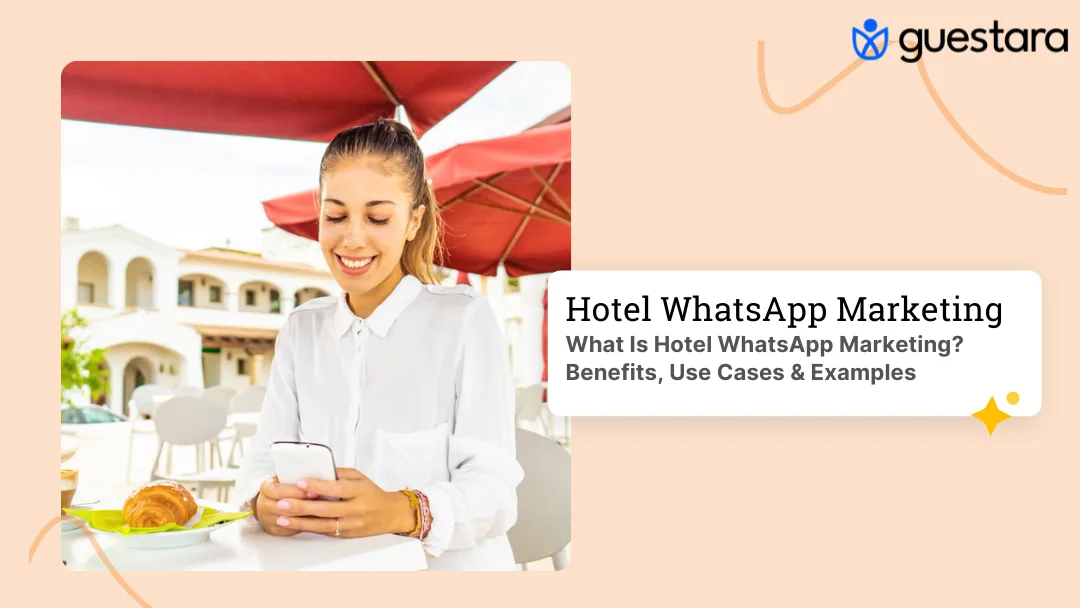
Your guests check WhatsApp 40+ times per day. Your emails sit unread.
That's not coincidence. That's the biggest shift in hotel marketing that most hoteliers are still sleeping on.
Hotel WhatsApp marketing is using WhatsApp to connect with guests before arrival, during their stay, and after checkout. It's where bookings get confirmed, upsells happen, problems get solved, and reviews get written—all on a platform your guests already love.
But it's not just another marketing channel. It's fundamentally different from email, SMS, or phone calls. It's faster. It's personal. It's more effective. And most importantly for your bottom line, it converts.
This guide explains what hotel WhatsApp marketing actually is, why it works, and how real hotels are using it to make serious money.
Hotel WhatsApp marketing means sending messages to guests via WhatsApp at key moments in their stay—booking confirmation, pre-arrival tips, in-stay upsells, and post-stay reviews.
The difference between WhatsApp marketing and other channels: guests actually see it and respond to it.
Here's what it looks like in practice:
A guest books a room. Within 60 seconds, they get a WhatsApp message saying "Thanks for booking! Here's your confirmation and a digital check-in link." They tap the link, check-in happens in 2 minutes. Done. No 15-minute front desk line.
Mid-stay, the guest gets a message: "Hi Sarah, our spa has an opening tomorrow at 3 PM. Want to book?" They tap yes. Revenue made.
After checkout, they get: "Thanks for staying! Leave a review [LINK]. Book again in 30 days for 15% off [LINK]." They leave a review. They rebook.
Same guest. Same property. Three different revenue opportunities. All because you reached them on a channel they actually use.
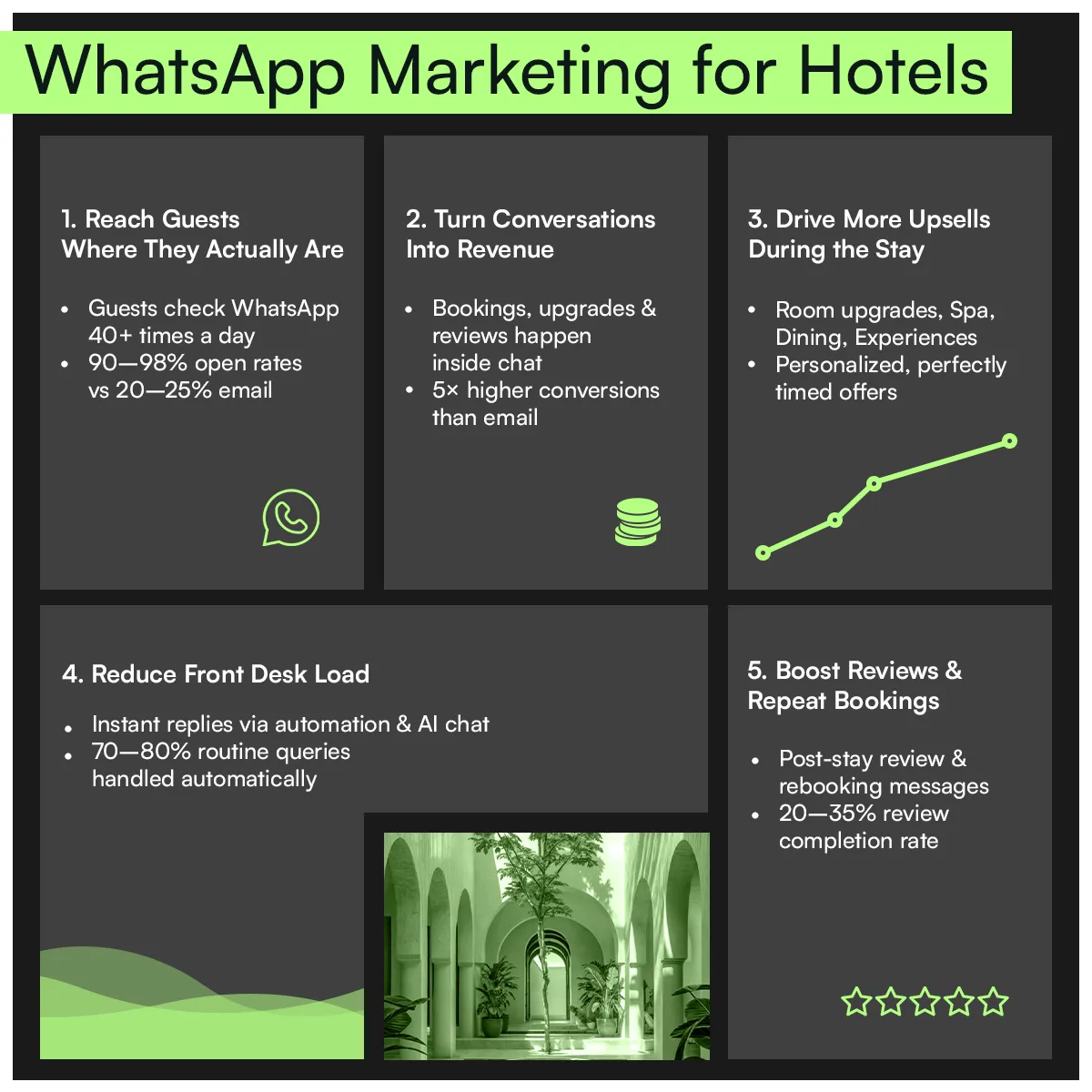
Email open rate: 20-25%
WhatsApp open rate: 90-98%
That's not a small difference. That's the difference between your message being seen by 1 in 5 guests and 19 in 20 guests.
Guests check WhatsApp constantly. They check email when they remember to. You're reaching people when they're actually paying attention.
Email response rate: 1-5%
WhatsApp response rate: 35-60%
This is the difference between a broadcast channel and a conversation channel. On WhatsApp, guests message back. They ask questions. They say yes to offers. They engage.
That engagement is where revenue happens.
Email upsell conversion: 2-5%
WhatsApp upsell conversion: 15-25%
Send a room upgrade offer via email to 1,000 guests, you might get 20-50 people to upgrade. Send the same offer via WhatsApp to 1,000 guests, you get 150-250 people upgrading.
Money.
Guest's AC breaks. On phone, they wait 10 minutes to connect with someone. Frustrated. Angry. Leaving a negative review.
On WhatsApp, they message maintenance. Instant response: "Coming in 5 minutes." Problem solved. Crisis averted.
The difference between a 3-star review and a 5-star review sometimes is just being fast.
Right now, your front desk probably spends 30-40% of their time on phone calls answering routine questions.
"Can I check in early?" "How do I get to the spa?" "What time is breakfast?" "Can I get housekeeping?"
With WhatsApp and AI chatbots, guests message these questions and get answers instantly without human intervention. Your front desk staff can focus on making guests happy in person instead of on the phone.
Email review request: 2-5% completion rate
WhatsApp review request: 20-35% completion rate
More reviews = higher ratings on Google. Higher ratings = more bookings. More bookings = more direct revenue.
What happens: Guest books a 2-star room on your website. Booking goes through. Confirmation email is automatically sent (they'll probably never read it).
At the same time, a WhatsApp message goes out: "Hi Sarah, thanks for booking! We have a 4-star ocean-view room available for just $50 more per night. Interested? [YES] [NO]"
Sarah is still on your website. She sees the message on her phone. She clicks YES. Upgrade confirmed.
The outcome: Single upsell offer: $50 × 3 nights = $150 additional revenue from one message.
Send this to 300 monthly bookings with 18% conversion rate = $8,100 additional monthly revenue from one workflow.
What happens: Guest booked for tomorrow. 4 hours before arrival, they get a WhatsApp: "Hi James, excited to welcome you! Skip the front desk line—complete your check-in now [LINK] and get a digital key. Takes 2 minutes."
James taps the link. Fills out form. Done. Tomorrow he walks straight to his room.
The outcome: 25-40% of guests use digital check-in. Each guest that uses it saves 5-10 minutes of front desk time. For a 200-room hotel with 80% occupancy, that's 240 minutes saved daily = 4 hours. In labor costs, that's $60-100 saved per day. Multiply by 30 days = $1,800-3,000 monthly.
Plus guest satisfaction increases because checkout is instant.
What happens: Guest checked in yesterday. It's day 2. Your system notes they're a couple, it's their honeymoon, and they haven't booked any services yet.
10 AM, they get: "Hi Sarah and Tom, we heard you're celebrating your honeymoon! Our spa has a couple's massage available this afternoon at 4 PM. 20% off for honeymooners. Reserve? [YES] [NO]"
They see it at coffee. They're relaxed. They want to treat themselves. They click YES.
The outcome: Couple's massage: $200. 18-25% conversion on personalized in-stay offers = 40-50 bookings per 200 couples per month. $8,000-10,000 monthly from one offer type alone.
What happens: Guest is in their room at 5 PM. They're hungry. They want dinner reservations but don't want to call the front desk.
They message your WhatsApp: "Can I get a reservation for 2 tonight at 7?"
Your AI chatbot responds instantly: "Absolutely! Our restaurant has availability at 7 PM and 8:30 PM. Oceanview or garden seating? [OCEAN] [GARDEN]"
Guest clicks OCEAN. Chatbot confirms: "Reserved for 2, 7 PM, oceanview table. See you then!"
The outcome: Problem solved in 30 seconds. Guest happy. No front desk call. No wait time. Plus hotel knows guest will eat dinner = food revenue.
AI chatbot handles 70-80% of routine requests without human staff involvement.
What happens: Guest checks out at 11 AM. 30 minutes later, they get a WhatsApp: "Maria, thanks for staying with us! We'd love your feedback. Leave a quick review: [GOOGLE] [TRIPADVISOR]"
Experience is still fresh. They have time while traveling. They tap Google link. They leave 5 stars. Done.
The outcome: 20-35% review rate via WhatsApp (vs 2-5% email). 200-room hotel getting 4,800 guest stays per month × 28% review rate = 1,344 new reviews per month.
More reviews = higher Google ratings = more booking clicks = more direct bookings = more revenue.
One review request message = potentially thousands in revenue from improved SEO and conversion lift.
WhatsApp Business App is free but limited. It's designed for small businesses answering customer messages, not for marketing.
WhatsApp Business API is the professional version that lets you:
Send automated messages triggered by bookings. Segment guests (families get different offers than couples). Use templates for compliance. Handle 2-way conversations. Integrate with your booking system.
Each message is scheduled automatically. No manual work. Every guest gets the same excellent sequence.
WhatsApp requires opt-in permission for marketing messages. But you can collect permission during booking.
Simple checkbox on your booking page: "Yes, send me exclusive offers and updates via WhatsApp."
That's it. You're compliant.
For the complete playbook, check out our comprehensive Hotel WhatsApp Marketing: The Complete Guide.
Email works, but it's slow. Guests check email once or twice daily. Messages get buried. Open rates hover around 20%.
Best for: Longer-form content, detailed information, non-urgent updates.
SMS is fast (open rates 45-50%). But SMS costs more and can feel spammy. Characters are limited. No images, no formatting.
Best for: Transactional alerts (flight delays, appointment reminders).
WhatsApp is fast (90%+ open rates), personal (feels like a friend texting), allows rich content (images, videos, carousels), and converts at 5X the rate of email.
Best for: Guest journey marketing, upsells, real-time communication, relationship building.
Honestly? All hotels. But especially:
Independent hotels (5-50 rooms) - You can't compete on brand recognition. WhatsApp creates personal connection that matters more.
Boutique hotels - Your differentiation is experience. WhatsApp lets you deliver personalized experiences at scale.
Resorts - High upsell potential (spa, dining, activities). WhatsApp is your direct line to selling those services.
Vacation rentals - No front desk. WhatsApp becomes your guest communication and support channel.
Multi-property groups - Centralized WhatsApp team can manage bookings and guest support across all properties.
The only hotels that don't benefit from WhatsApp marketing are those that don't care about direct bookings, in-stay revenue, or guest satisfaction. So... basically all hotels benefit.
Step 1: Decide Your Goal Direct bookings? In-stay revenue? Review capture? Start with your biggest pain point.
Step 2: Collect WhatsApp Numbers Add a checkbox to your booking page. Collect numbers from past guests via email. Use QR codes in your property.
Step 3: Choose a Platform You need WhatsApp Business API access. Providers like Guestara, HiJiffy, Chatlyn, and others handle the technical setup. (We recommend Guestara for hotels, but research what works for you.)
Step 4: Create Your First Workflow Start simple. Pre-arrival message + digital check-in link. Test with 50 guests. Measure results.
Step 5: Expand Gradually Once pre-arrival is working, add in-stay upsells. Then post-stay reviews. Build momentum.
Step 6: Optimize Based on Data Track open rates, click rates, conversion rates. Do more of what works. Stop what doesn't.
Hotel WhatsApp marketing isn't new. What's new is that hoteliers are finally realizing it works better than email. And it's better than SMS. And it's better than phone calls.
Guests prefer it. Guests engage with it. Guests spend money via it.
The 12% of hotels already using WhatsApp marketing are outcompeting everyone else. The 88% still using email are wondering why their conversion rates are stuck.
The gap won't stay open forever. But right now, it's wide.
The question isn't "Should we use WhatsApp marketing?" The question is "Why haven't we started yet?"


Learn what hotel WhatsApp marketing is, why it works, and real examples of how hotels use it. Increase direct bookings, reviews, and guest revenue.
Your guests check WhatsApp 40+ times per day. Your emails sit unread.
That's not coincidence. That's the biggest shift in hotel marketing that most hoteliers are still sleeping on.
Hotel WhatsApp marketing is using WhatsApp to connect with guests before arrival, during their stay, and after checkout. It's where bookings get confirmed, upsells happen, problems get solved, and reviews get written—all on a platform your guests already love.
But it's not just another marketing channel. It's fundamentally different from email, SMS, or phone calls. It's faster. It's personal. It's more effective. And most importantly for your bottom line, it converts.
This guide explains what hotel WhatsApp marketing actually is, why it works, and how real hotels are using it to make serious money.
Hotel WhatsApp marketing means sending messages to guests via WhatsApp at key moments in their stay—booking confirmation, pre-arrival tips, in-stay upsells, and post-stay reviews.
The difference between WhatsApp marketing and other channels: guests actually see it and respond to it.
Here's what it looks like in practice:
A guest books a room. Within 60 seconds, they get a WhatsApp message saying "Thanks for booking! Here's your confirmation and a digital check-in link." They tap the link, check-in happens in 2 minutes. Done. No 15-minute front desk line.
Mid-stay, the guest gets a message: "Hi Sarah, our spa has an opening tomorrow at 3 PM. Want to book?" They tap yes. Revenue made.
After checkout, they get: "Thanks for staying! Leave a review [LINK]. Book again in 30 days for 15% off [LINK]." They leave a review. They rebook.
Same guest. Same property. Three different revenue opportunities. All because you reached them on a channel they actually use.
Email open rate: 20-25%
WhatsApp open rate: 90-98%
That's not a small difference. That's the difference between your message being seen by 1 in 5 guests and 19 in 20 guests.
Guests check WhatsApp constantly. They check email when they remember to. You're reaching people when they're actually paying attention.
Email response rate: 1-5%
WhatsApp response rate: 35-60%
This is the difference between a broadcast channel and a conversation channel. On WhatsApp, guests message back. They ask questions. They say yes to offers. They engage.
That engagement is where revenue happens.
Email upsell conversion: 2-5%
WhatsApp upsell conversion: 15-25%
Send a room upgrade offer via email to 1,000 guests, you might get 20-50 people to upgrade. Send the same offer via WhatsApp to 1,000 guests, you get 150-250 people upgrading.
Money.
Guest's AC breaks. On phone, they wait 10 minutes to connect with someone. Frustrated. Angry. Leaving a negative review.
On WhatsApp, they message maintenance. Instant response: "Coming in 5 minutes." Problem solved. Crisis averted.
The difference between a 3-star review and a 5-star review sometimes is just being fast.
Right now, your front desk probably spends 30-40% of their time on phone calls answering routine questions.
"Can I check in early?" "How do I get to the spa?" "What time is breakfast?" "Can I get housekeeping?"
With WhatsApp and AI chatbots, guests message these questions and get answers instantly without human intervention. Your front desk staff can focus on making guests happy in person instead of on the phone.
Email review request: 2-5% completion rate
WhatsApp review request: 20-35% completion rate
More reviews = higher ratings on Google. Higher ratings = more bookings. More bookings = more direct revenue.
What happens: Guest books a 2-star room on your website. Booking goes through. Confirmation email is automatically sent (they'll probably never read it).
At the same time, a WhatsApp message goes out: "Hi Sarah, thanks for booking! We have a 4-star ocean-view room available for just $50 more per night. Interested? [YES] [NO]"
Sarah is still on your website. She sees the message on her phone. She clicks YES. Upgrade confirmed.
The outcome: Single upsell offer: $50 × 3 nights = $150 additional revenue from one message.
Send this to 300 monthly bookings with 18% conversion rate = $8,100 additional monthly revenue from one workflow.
What happens: Guest booked for tomorrow. 4 hours before arrival, they get a WhatsApp: "Hi James, excited to welcome you! Skip the front desk line—complete your check-in now [LINK] and get a digital key. Takes 2 minutes."
James taps the link. Fills out form. Done. Tomorrow he walks straight to his room.
The outcome: 25-40% of guests use digital check-in. Each guest that uses it saves 5-10 minutes of front desk time. For a 200-room hotel with 80% occupancy, that's 240 minutes saved daily = 4 hours. In labor costs, that's $60-100 saved per day. Multiply by 30 days = $1,800-3,000 monthly.
Plus guest satisfaction increases because checkout is instant.
What happens: Guest checked in yesterday. It's day 2. Your system notes they're a couple, it's their honeymoon, and they haven't booked any services yet.
10 AM, they get: "Hi Sarah and Tom, we heard you're celebrating your honeymoon! Our spa has a couple's massage available this afternoon at 4 PM. 20% off for honeymooners. Reserve? [YES] [NO]"
They see it at coffee. They're relaxed. They want to treat themselves. They click YES.
The outcome: Couple's massage: $200. 18-25% conversion on personalized in-stay offers = 40-50 bookings per 200 couples per month. $8,000-10,000 monthly from one offer type alone.
What happens: Guest is in their room at 5 PM. They're hungry. They want dinner reservations but don't want to call the front desk.
They message your WhatsApp: "Can I get a reservation for 2 tonight at 7?"
Your AI chatbot responds instantly: "Absolutely! Our restaurant has availability at 7 PM and 8:30 PM. Oceanview or garden seating? [OCEAN] [GARDEN]"
Guest clicks OCEAN. Chatbot confirms: "Reserved for 2, 7 PM, oceanview table. See you then!"
The outcome: Problem solved in 30 seconds. Guest happy. No front desk call. No wait time. Plus hotel knows guest will eat dinner = food revenue.
AI chatbot handles 70-80% of routine requests without human staff involvement.
What happens: Guest checks out at 11 AM. 30 minutes later, they get a WhatsApp: "Maria, thanks for staying with us! We'd love your feedback. Leave a quick review: [GOOGLE] [TRIPADVISOR]"
Experience is still fresh. They have time while traveling. They tap Google link. They leave 5 stars. Done.
The outcome: 20-35% review rate via WhatsApp (vs 2-5% email). 200-room hotel getting 4,800 guest stays per month × 28% review rate = 1,344 new reviews per month.
More reviews = higher Google ratings = more booking clicks = more direct bookings = more revenue.
One review request message = potentially thousands in revenue from improved SEO and conversion lift.
WhatsApp Business App is free but limited. It's designed for small businesses answering customer messages, not for marketing.
WhatsApp Business API is the professional version that lets you:
Send automated messages triggered by bookings. Segment guests (families get different offers than couples). Use templates for compliance. Handle 2-way conversations. Integrate with your booking system.
Each message is scheduled automatically. No manual work. Every guest gets the same excellent sequence.
WhatsApp requires opt-in permission for marketing messages. But you can collect permission during booking.
Simple checkbox on your booking page: "Yes, send me exclusive offers and updates via WhatsApp."
That's it. You're compliant.
For the complete playbook, check out our comprehensive Hotel WhatsApp Marketing: The Complete Guide.
Email works, but it's slow. Guests check email once or twice daily. Messages get buried. Open rates hover around 20%.
Best for: Longer-form content, detailed information, non-urgent updates.
SMS is fast (open rates 45-50%). But SMS costs more and can feel spammy. Characters are limited. No images, no formatting.
Best for: Transactional alerts (flight delays, appointment reminders).
WhatsApp is fast (90%+ open rates), personal (feels like a friend texting), allows rich content (images, videos, carousels), and converts at 5X the rate of email.
Best for: Guest journey marketing, upsells, real-time communication, relationship building.
Honestly? All hotels. But especially:
Independent hotels (5-50 rooms) - You can't compete on brand recognition. WhatsApp creates personal connection that matters more.
Boutique hotels - Your differentiation is experience. WhatsApp lets you deliver personalized experiences at scale.
Resorts - High upsell potential (spa, dining, activities). WhatsApp is your direct line to selling those services.
Vacation rentals - No front desk. WhatsApp becomes your guest communication and support channel.
Multi-property groups - Centralized WhatsApp team can manage bookings and guest support across all properties.
The only hotels that don't benefit from WhatsApp marketing are those that don't care about direct bookings, in-stay revenue, or guest satisfaction. So... basically all hotels benefit.
Step 1: Decide Your Goal Direct bookings? In-stay revenue? Review capture? Start with your biggest pain point.
Step 2: Collect WhatsApp Numbers Add a checkbox to your booking page. Collect numbers from past guests via email. Use QR codes in your property.
Step 3: Choose a Platform You need WhatsApp Business API access. Providers like Guestara, HiJiffy, Chatlyn, and others handle the technical setup. (We recommend Guestara for hotels, but research what works for you.)
Step 4: Create Your First Workflow Start simple. Pre-arrival message + digital check-in link. Test with 50 guests. Measure results.
Step 5: Expand Gradually Once pre-arrival is working, add in-stay upsells. Then post-stay reviews. Build momentum.
Step 6: Optimize Based on Data Track open rates, click rates, conversion rates. Do more of what works. Stop what doesn't.
Hotel WhatsApp marketing isn't new. What's new is that hoteliers are finally realizing it works better than email. And it's better than SMS. And it's better than phone calls.
Guests prefer it. Guests engage with it. Guests spend money via it.
The 12% of hotels already using WhatsApp marketing are outcompeting everyone else. The 88% still using email are wondering why their conversion rates are stuck.
The gap won't stay open forever. But right now, it's wide.
The question isn't "Should we use WhatsApp marketing?" The question is "Why haven't we started yet?"
Yes. You need explicit opt-in consent (collect during booking), and you must respect opt-outs. GDPR and most privacy laws are satisfied if you handle consent and data properly.
They can opt out by replying STOP. Respect that. About 35-45% of guests will opt in during booking if you're clear about benefits.
No. WhatsApp requires explicit permission for marketing messages. Service messages (confirmations, check-in reminders) can be sent without permission because they respond to the guest's booking action.
Start with 3-4 per stay. Pre-arrival (1), during-stay (1-2), post-stay (1-2). More than that risks opt-outs.
The free app works for answering guest questions, but it doesn't support broadcasting, automation, or segmentation. You need the API for real marketing at scale.
We work closely with the industry leaders to offer seamless solutions



We’re here to help your whole team stay ahead of the curve as you grow.

Get up and running quickly with a personalized onboarding plan

Connect with real people who really get it, 24/7

Checkout our vast library of free resources, templates and more
There's only so much we can say — so let us show you! Schedule a demo today and reach your business goals.


.png)