Learn what hotel guest messaging is, why guests prefer it, and how it transforms operations compared to traditional communication methods.




.webp)
Your front desk phone rings constantly. Your team diverts calls to voicemail. Emails pile up in inboxes. Meanwhile, a guest sends a WhatsApp message at midnight asking a question that takes 30 seconds to answer, and nobody sees it until morning.
This is the reality of hotel communication in 2025. Guests expect instant, asynchronous contact. They want to communicate on their terms, through their preferred channel, without being locked into a phone call or email chain.
Hotel guest messaging is no longer a luxury feature. It's becoming the default way guests expect to interact with your property. And if your operation still relies on phone calls, emails, and in-person conversations as your primary communication method, you're creating friction at every stage of the stay.
This article explains what guest messaging is, why guests prefer it, and how it's fundamentally changing hotel operations. For a comprehensive look at how to implement messaging across the entire guest journey, see our complete guide to hotel guest messaging and journey automation.
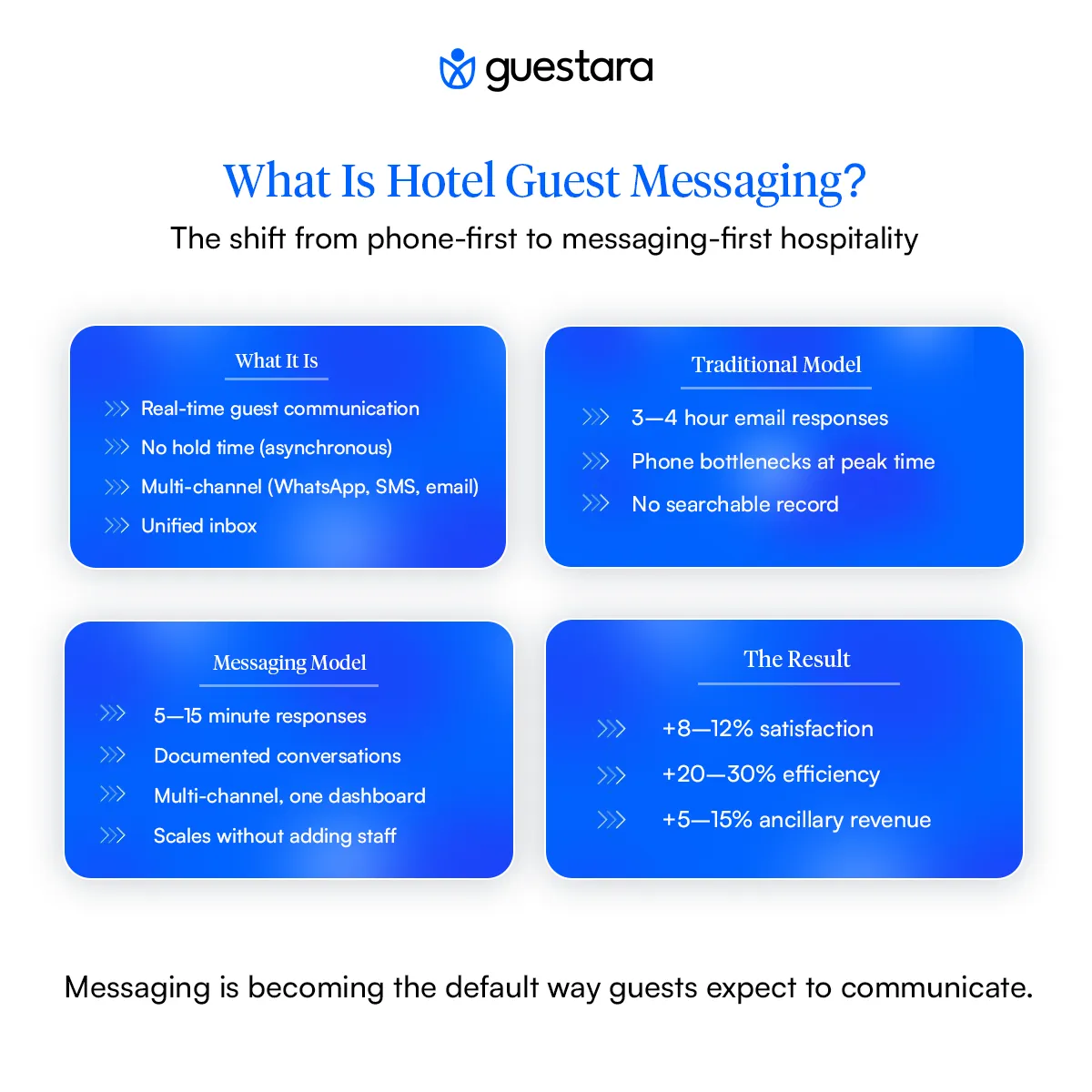
Hotel guest messaging is a direct, real-time (or near-real-time) communication method that lets guests and hotels exchange messages through channels like WhatsApp, SMS, email, and branded in-app platforms.
Unlike a phone call, which demands immediate availability from both parties, messaging lets guests ask questions, make requests, and provide information whenever it's convenient for them. Your team responds when they have capacity, but the expectation is that response happens quickly, often within minutes.
The key difference: messaging is asynchronous. It doesn't require both parties to be present at the same time.
A guest can send a message at 11 PM asking whether the restaurant is open. They don't need to wait on hold. Your night auditor can see the message on a unified inbox, check the restaurant hours, and reply within moments. The guest gets their answer. Your staff doesn't have to interrupt other tasks to handle an inbound call.
That simplicity is why messaging is replacing traditional hotel communication.
Three forces are driving this shift: guest preference, operational efficiency, and expectations set by tech companies.
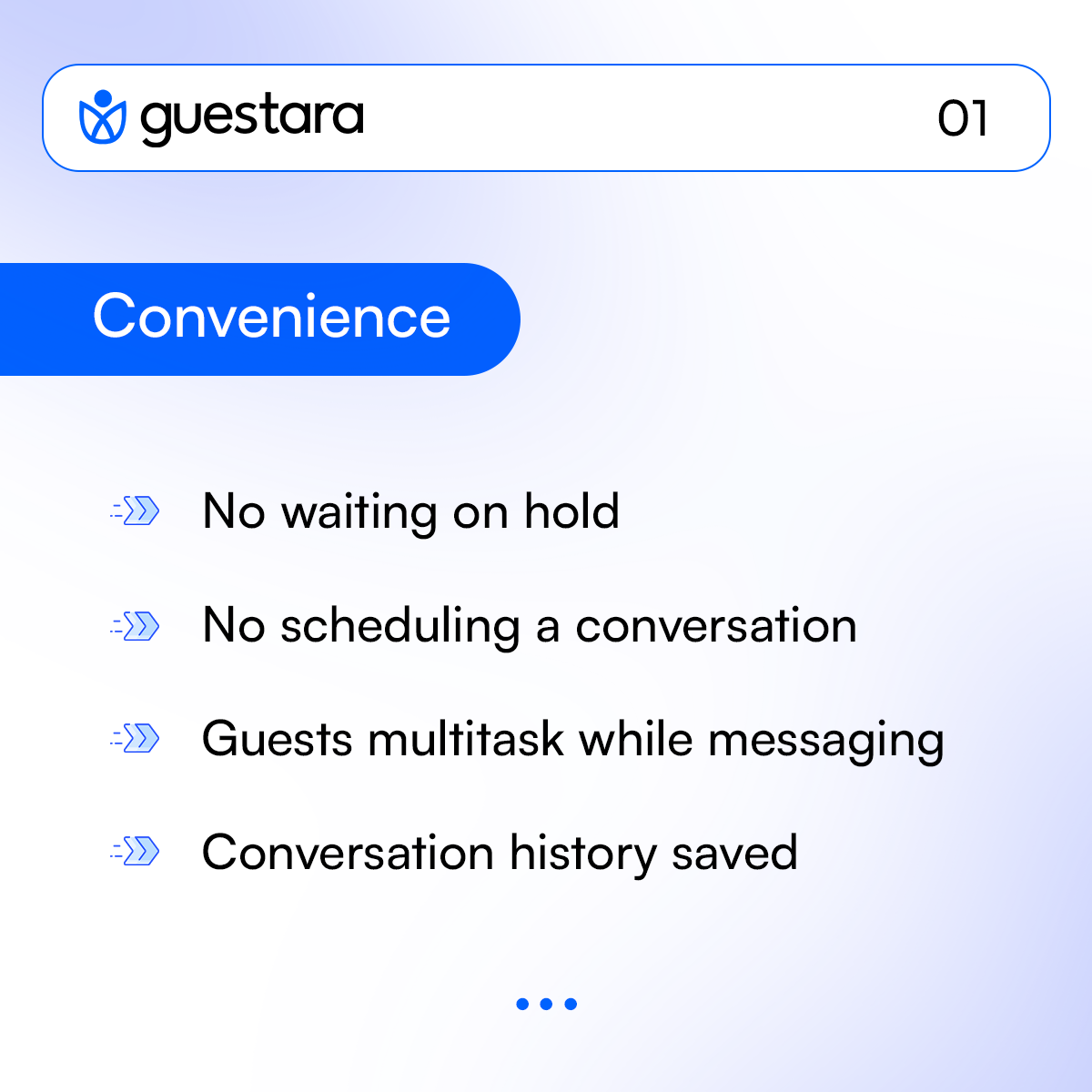
Think about your own behavior. When you need to contact a business—a bank, an airline, a restaurant—what do you reach for first? Most people try to avoid the phone. Calling requires scheduling a conversation. You sit on hold. You might need to repeat information. You have no record of what was discussed.
Messaging eliminates all of that friction. A guest books a room, then has a question about parking. They don't call. They open WhatsApp, type a message, and move on with their day. They can see when you've read their message. They have a record of the entire conversation. They can include a photo, a screenshot, or a document.
This preference isn't generation-specific anymore. Older guests appreciate messaging just as much as younger travelers. Why? Because it works.
Consumer expectations for response time have shifted dramatically in the last five years. Forrester research shows that consumers expect companies to respond to inquiries in under one hour, yet many hospitality businesses still operate on 24-hour email response windows.
For guests in your property right now, one hour might be too late. They need a question answered in minutes.
A guest arrives at check-in and realizes they forgot their phone charger. They message your front desk. If you respond in three minutes, they're grateful. If they don't hear back for two hours, they're frustrated—and likely calling a competitor nearby or leaving a negative review.
Messaging systems make fast response possible. When all incoming guest messages land on a unified inbox visible to your entire team, the person with availability can answer immediately. No voicemails. No missed emails in crowded inboxes.
Studies on hospitality response times show that hotels responding to guest inquiries in under 15 minutes see measurably higher satisfaction scores and booking conversion rates. Messaging makes that speed achievable at scale.
Why Guest Choose Message over Phone Calls - Convenience
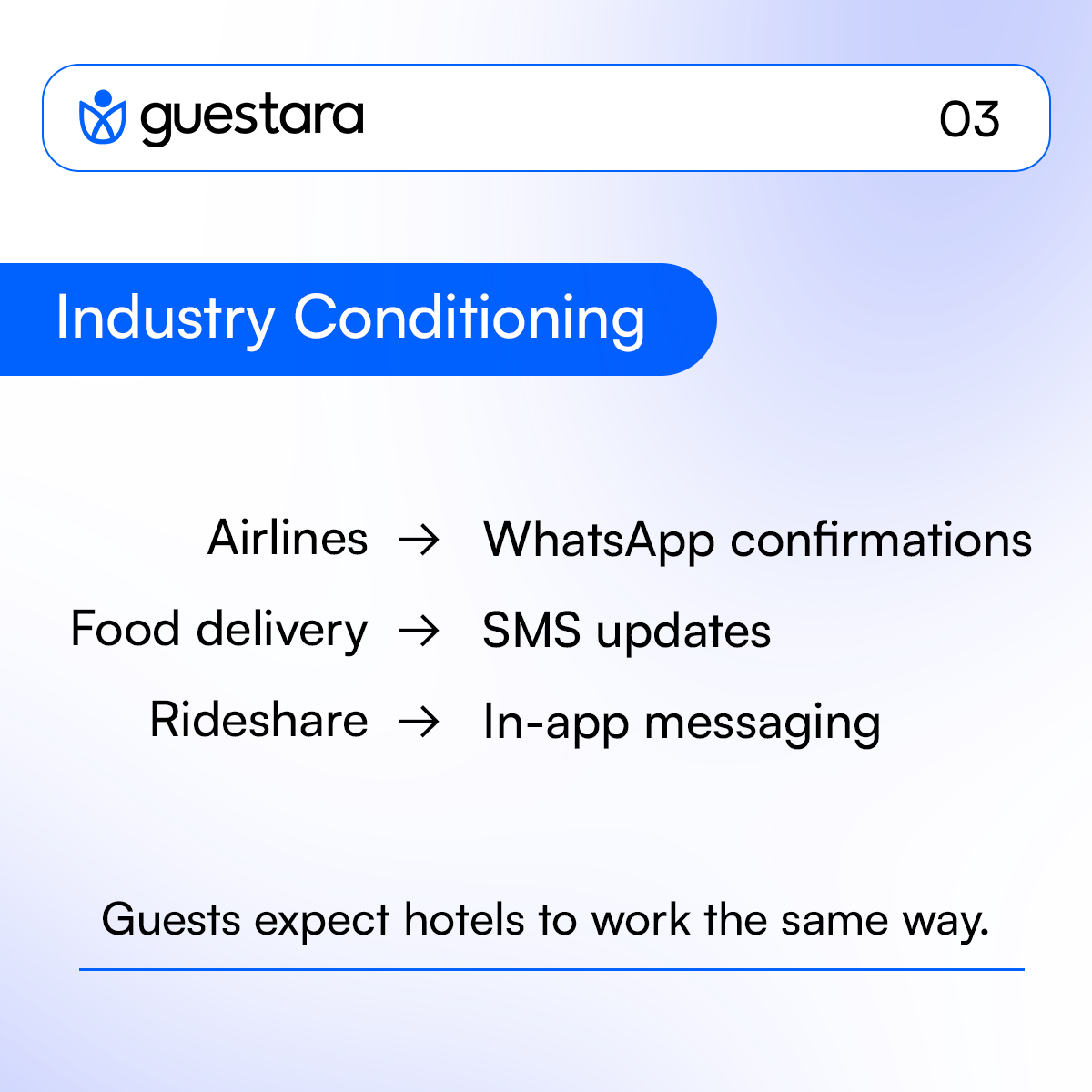
A guest books a flight, and the airline confirms via WhatsApp. They order a meal, and the restaurant sends status updates through SMS. They call a rideshare, and the driver communicates only through the app.
By the time that guest arrives at your hotel, they've already internalized that messaging is the standard way to interact with service businesses. When your hotel makes them call the front desk instead, it feels archaic.
Guests don't say this consciously. But they feel the friction. And they remember when they book their next hotel.
To understand why messaging is replacing older methods, you need to see how they differ operationally.
Pros: Immediate, personal, good for complex issues that need real-time dialogue
Cons: Requires both parties to be available simultaneously, creates a bottleneck when your team is busy, no searchable record of conversations, doesn't scale with property size, callers can't multitask while on hold, phone anxiety is real
Pros: Documented, asynchronous, allows guests to take time composing their message
Cons: No expectation of speed, emails get buried in inboxes, no context from previous conversations, doesn't work for urgent requests, can't support rich media (photos, videos) effectively, not a default communication channel for younger travelers
Pros: Nearly universal (95%+ of adults have mobile phones and use SMS), extremely fast response times, messages land on a primary device that people check constantly, searchable history, supports confirmations and time-sensitive information well
Cons: Limited to text and basic media, no in-conversation context from booking details, doesn't support upsells or detailed information, messages can feel impersonal at scale
Pros: Rich media support (photos, videos, documents), read receipts show delivery, allows two-way conversation with context, feels personal at scale, supports multimedia information (digital guidebooks, check-in instructions), can include buttons and quick-reply options, encrypted messaging feels secure to guests
Cons: Requires guests to have WhatsApp or download your app, not universal (though WhatsApp adoption in most markets exceeds 80%), businesses need to manage customer experience carefully to avoid spam perception
Adopting guest messaging doesn't mean eliminating the phone. It means rebalancing how your team spends time.
Your front desk team spends 40-50% of their time answering phones. Most calls are routine: "What time does breakfast start?" "Can I have a late checkout?" "Do you have a crib available?" These calls take one to three minutes each, but they fragment your team's attention throughout the day.
During peak hours (check-in time, breakfast service), phone demand explodes. Guests can't reach anyone. Calls roll to voicemail. Messages pile up. By end of day, your team has fielded 200+ calls, many of which could have been answered by a single message.
Routine requests come through messaging. Your team handles them between other tasks. A message asking about breakfast times gets answered in 30 seconds. A guest requesting a crib gets added to the property checklist before they arrive.
Phone calls now happen only for complex issues that actually need real-time dialogue: a guest with a major complaint, a family emergency, a dispute over charges. These conversations happen when they truly matter.
Your team spends less time on the phone and more time on service that guests value.
The shift also changes how properties manage peak times. During check-in rush, instead of eight guests in line at the front desk with two staff members juggling phones, check-in flows through the messaging channel. Guests send their arrival status. They receive digital keys and check-in instructions through WhatsApp. They read their digital guidebook while they're parking.
The front desk still helps guests with luggage, questions about dining, and personalized recommendations. But the volume of transactional interactions moving to messaging means your team can actually do that work instead of being stuck on the phone.
You might think the solution is simple: just use SMS. Or just WhatsApp.
But different guests prefer different channels. And different guest moments require different channels.
SMS works best for transactional confirmations. A guest receives an SMS 24 hours before arrival with check-in instructions. Another SMS arrives with their digital lock key. These are time-sensitive, brief messages that don't need context or rich media.
WhatsApp is ideal for ongoing conversations. A guest arrives, messages on WhatsApp, and has a back-and-forth exchange with your team about restaurant recommendations, local attractions, or a minor issue in their room. Learn more about WhatsApp marketing strategies for hotels to maximize this channel.
Email remains necessary for reservations, confirmations that need to be formal, and communications that require a receipt or legal documentation.
In-app messaging (through your hotel's branded app or a guest communication platform) works best when you want to guide guests through your property's features, showcase upsells, or provide rich content like your full dining menu or digital guidebook.
Hotels that rely on only one channel inevitably miss guests. An older traveler might prefer email. A younger guest might use WhatsApp. A business traveler might rely on SMS for quick confirmations. An international guest might not have SMS capability but does use WhatsApp.
The solution is a unified messaging platform that supports multiple channels but consolidates them into one dashboard. With a proper guest engagement platform, your team doesn't jump between tools. Guests get to choose how they communicate.
Many hotels still operate as though phone and email are sufficient. Here's why that strategy is increasingly costly.
As your property grows, or as guest expectations shift toward instant responses, phone capacity becomes your constraint. You can hire more staff, but each additional employee on the phone is one less person helping guests in the lobby.
Email inboxes are black holes. A guest emails a request on Tuesday. It sits in your general inbox. Your staff member is on vacation. The email gets buried under 50 others. The guest doesn't hear back. They leave a negative review. Your response rate has plummeted, but you don't know why.
A guest has a question about late checkout but feels awkward asking the busy front desk clerk. They don't ask. They leave upset. You never know why.
Traditional communication methods are inherently slower. Even if email response time is 4 hours, that's light-years slower than the 5-minute response guests now expect.
Guests call and talk to different staff members. There's no continuity. Staff member one promises one thing. Staff member two has no record of that promise. The guest gets frustrated.
Messaging solves all of these problems simultaneously.
The shift from traditional communication to guest messaging creates measurable operational improvements.
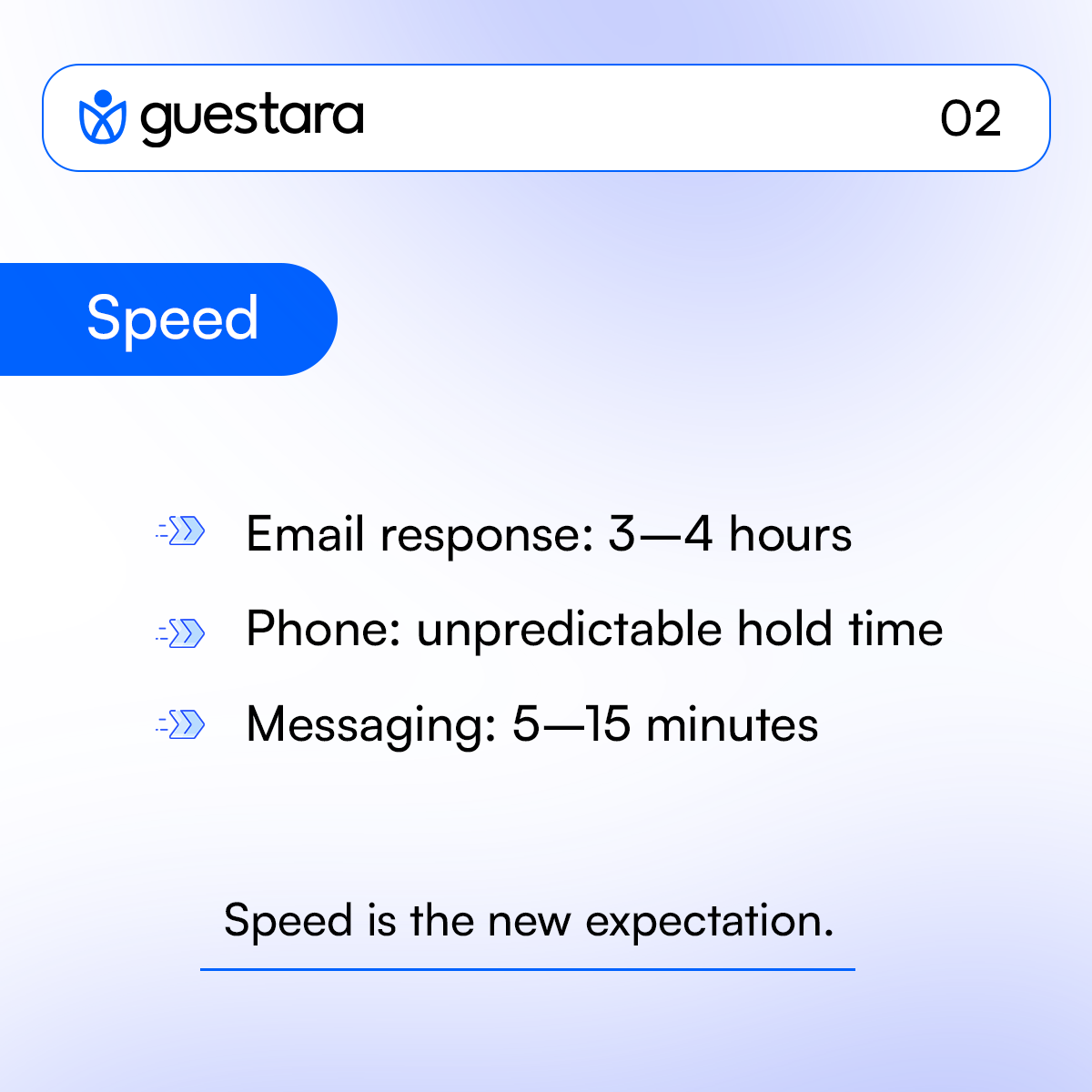
Hotels that implement unified guest messaging systems report response times dropping from 3-4 hours (typical for email) to 5-15 minutes. Guests notice this change immediately. Satisfaction metrics improve.
Front desk teams spend less time on phone calls. Check-in complexity decreases because digital check-in moves some guests entirely out of the line. Early checkout requests come through messaging instead of requiring a conversation. Your team's focus shifts from answering routine questions to providing genuine hospitality.
Studies of hotels that implemented messaging show guest satisfaction scores increase by 8-12% within the first quarter. Why? Because guests spend less time waiting, get their questions answered faster, and have a documented record of their interactions.
Before messaging, guests left reviews like "couldn't reach the hotel," "took forever to get a response," or "front desk was always busy." These complaints drop significantly once messaging is the default channel.
When you're communicating with guests via unified messaging, there are natural moments to mention services: "Would you like us to arrange airport transport?" or "We have room upgrade availability." This context-aware upselling, done respectfully through messaging, increases attachment revenue by 5-15%. Understanding how messaging fits into the complete guest journey helps maximize these revenue opportunities.
Every message is logged, timestamped, and tied to a reservation. Over time, you build a richer picture of each guest's preferences and behavior. This data informs future marketing, personalization, and operational decisions.
If you're still primarily using phone and email, how do you transition? For detailed, step-by-step implementation guidance across the entire guest journey, see our complete guide to hotel guest messaging and journey automation.
Here are the core messaging implementation steps:
Don't try to support SMS, WhatsApp, email, and in-app messaging all at once. Pick the channel your guests are most likely to use. For many properties, that's WhatsApp. For others, SMS. Start there.
Set up a unified inbox so all messages from that channel land on one dashboard. All team members can see it. Anyone with availability responds.
Include your WhatsApp number (or SMS number) on your confirmation email. Feature it prominently on your website and booking page. When guests call, your team can say, "For fastest response, message us on WhatsApp." After a few weeks, the majority of routine inquiries move to messaging.
Use templates for common questions. A guest asks "What time is breakfast?" Your team has a template that responds instantly with breakfast times, restaurant location, and dietary options. This takes 30 seconds and doesn't require a staff member to type out the response every time.
Automation should feel helpful, not robotic. The best setups use templates for speed but still allow personalization when needed.
Your inbox has filters. Routine check-in questions go to the team member who handles logistics. Guest complaints go to the manager. Room service requests go to F&B. This simple routing prevents messages from getting missed.
Set a target of responding to all messages within 15 minutes. Measure it. Share the metric with your team. Make it a team standard.
After you've nailed SMS or WhatsApp, add email integration. Then in-app messaging. Then live chat. Each channel adds complexity, but a good unified system handles all of them.
Hotels that haven't adopted messaging are missing something fundamental: the ability to communicate at scale without degrading response time or guest experience.
They're losing guests to competitors who respond faster. They're losing revenue on upsells they never mention because conversations are fragmented. They're losing operational efficiency because their team jumps between five different communication tools.
And they're missing the data. Every message is a data point. Which guests ask about airport transport? Which guests request late checkout? Which guests complain about noise? Over time, messaging gives you a complete picture of what guests actually care about.
Older hotels that haven't adopted messaging often tell themselves that "our guests prefer to call" or "email works fine for us." What they're not measuring is the volume of inquiries that never happen because guests don't want to call, or the satisfaction hit from 4-hour email response times.
Guest messaging isn't a trend. It's already the new baseline for hospitality in 2025.
Three years from now, hotels that rely primarily on phone and email will be seen as outdated. It's similar to how hotels without a website seemed outdated in 2005, or hotels without a mobile booking option seemed outdated in 2015.
The shift is driven by fundamental changes in how people expect to communicate. Business-to-consumer communication has become primarily asynchronous. Messaging is the natural channel.
Forward-thinking hotels are already moving. They're consolidating multiple communication channels into one unified inbox. They're automating routine conversations. They're using messaging data to personalize guest experience. And they're seeing the operational and revenue benefits.
The hotels still using primarily phone and email will eventually feel the pressure. Guests will choose competitors with faster response times. Staff turnover will increase because field jobs feel outdated. Satisfaction metrics will lag.


Learn what hotel guest messaging is, why guests prefer it, and how it transforms operations compared to traditional communication methods.
Your front desk phone rings constantly. Your team diverts calls to voicemail. Emails pile up in inboxes. Meanwhile, a guest sends a WhatsApp message at midnight asking a question that takes 30 seconds to answer, and nobody sees it until morning.
This is the reality of hotel communication in 2025. Guests expect instant, asynchronous contact. They want to communicate on their terms, through their preferred channel, without being locked into a phone call or email chain.
Hotel guest messaging is no longer a luxury feature. It's becoming the default way guests expect to interact with your property. And if your operation still relies on phone calls, emails, and in-person conversations as your primary communication method, you're creating friction at every stage of the stay.
This article explains what guest messaging is, why guests prefer it, and how it's fundamentally changing hotel operations. For a comprehensive look at how to implement messaging across the entire guest journey, see our complete guide to hotel guest messaging and journey automation.
Hotel guest messaging is a direct, real-time (or near-real-time) communication method that lets guests and hotels exchange messages through channels like WhatsApp, SMS, email, and branded in-app platforms.
Unlike a phone call, which demands immediate availability from both parties, messaging lets guests ask questions, make requests, and provide information whenever it's convenient for them. Your team responds when they have capacity, but the expectation is that response happens quickly, often within minutes.
The key difference: messaging is asynchronous. It doesn't require both parties to be present at the same time.
A guest can send a message at 11 PM asking whether the restaurant is open. They don't need to wait on hold. Your night auditor can see the message on a unified inbox, check the restaurant hours, and reply within moments. The guest gets their answer. Your staff doesn't have to interrupt other tasks to handle an inbound call.
That simplicity is why messaging is replacing traditional hotel communication.
Three forces are driving this shift: guest preference, operational efficiency, and expectations set by tech companies.
Think about your own behavior. When you need to contact a business—a bank, an airline, a restaurant—what do you reach for first? Most people try to avoid the phone. Calling requires scheduling a conversation. You sit on hold. You might need to repeat information. You have no record of what was discussed.
Messaging eliminates all of that friction. A guest books a room, then has a question about parking. They don't call. They open WhatsApp, type a message, and move on with their day. They can see when you've read their message. They have a record of the entire conversation. They can include a photo, a screenshot, or a document.
This preference isn't generation-specific anymore. Older guests appreciate messaging just as much as younger travelers. Why? Because it works.
Consumer expectations for response time have shifted dramatically in the last five years. Forrester research shows that consumers expect companies to respond to inquiries in under one hour, yet many hospitality businesses still operate on 24-hour email response windows.
For guests in your property right now, one hour might be too late. They need a question answered in minutes.
A guest arrives at check-in and realizes they forgot their phone charger. They message your front desk. If you respond in three minutes, they're grateful. If they don't hear back for two hours, they're frustrated—and likely calling a competitor nearby or leaving a negative review.
Messaging systems make fast response possible. When all incoming guest messages land on a unified inbox visible to your entire team, the person with availability can answer immediately. No voicemails. No missed emails in crowded inboxes.
Studies on hospitality response times show that hotels responding to guest inquiries in under 15 minutes see measurably higher satisfaction scores and booking conversion rates. Messaging makes that speed achievable at scale.
Why Guest Choose Message over Phone Calls - Convenience
A guest books a flight, and the airline confirms via WhatsApp. They order a meal, and the restaurant sends status updates through SMS. They call a rideshare, and the driver communicates only through the app.
By the time that guest arrives at your hotel, they've already internalized that messaging is the standard way to interact with service businesses. When your hotel makes them call the front desk instead, it feels archaic.
Guests don't say this consciously. But they feel the friction. And they remember when they book their next hotel.
To understand why messaging is replacing older methods, you need to see how they differ operationally.
Pros: Immediate, personal, good for complex issues that need real-time dialogue
Cons: Requires both parties to be available simultaneously, creates a bottleneck when your team is busy, no searchable record of conversations, doesn't scale with property size, callers can't multitask while on hold, phone anxiety is real
Pros: Documented, asynchronous, allows guests to take time composing their message
Cons: No expectation of speed, emails get buried in inboxes, no context from previous conversations, doesn't work for urgent requests, can't support rich media (photos, videos) effectively, not a default communication channel for younger travelers
Pros: Nearly universal (95%+ of adults have mobile phones and use SMS), extremely fast response times, messages land on a primary device that people check constantly, searchable history, supports confirmations and time-sensitive information well
Cons: Limited to text and basic media, no in-conversation context from booking details, doesn't support upsells or detailed information, messages can feel impersonal at scale
Pros: Rich media support (photos, videos, documents), read receipts show delivery, allows two-way conversation with context, feels personal at scale, supports multimedia information (digital guidebooks, check-in instructions), can include buttons and quick-reply options, encrypted messaging feels secure to guests
Cons: Requires guests to have WhatsApp or download your app, not universal (though WhatsApp adoption in most markets exceeds 80%), businesses need to manage customer experience carefully to avoid spam perception
Adopting guest messaging doesn't mean eliminating the phone. It means rebalancing how your team spends time.
Your front desk team spends 40-50% of their time answering phones. Most calls are routine: "What time does breakfast start?" "Can I have a late checkout?" "Do you have a crib available?" These calls take one to three minutes each, but they fragment your team's attention throughout the day.
During peak hours (check-in time, breakfast service), phone demand explodes. Guests can't reach anyone. Calls roll to voicemail. Messages pile up. By end of day, your team has fielded 200+ calls, many of which could have been answered by a single message.
Routine requests come through messaging. Your team handles them between other tasks. A message asking about breakfast times gets answered in 30 seconds. A guest requesting a crib gets added to the property checklist before they arrive.
Phone calls now happen only for complex issues that actually need real-time dialogue: a guest with a major complaint, a family emergency, a dispute over charges. These conversations happen when they truly matter.
Your team spends less time on the phone and more time on service that guests value.
The shift also changes how properties manage peak times. During check-in rush, instead of eight guests in line at the front desk with two staff members juggling phones, check-in flows through the messaging channel. Guests send their arrival status. They receive digital keys and check-in instructions through WhatsApp. They read their digital guidebook while they're parking.
The front desk still helps guests with luggage, questions about dining, and personalized recommendations. But the volume of transactional interactions moving to messaging means your team can actually do that work instead of being stuck on the phone.
You might think the solution is simple: just use SMS. Or just WhatsApp.
But different guests prefer different channels. And different guest moments require different channels.
SMS works best for transactional confirmations. A guest receives an SMS 24 hours before arrival with check-in instructions. Another SMS arrives with their digital lock key. These are time-sensitive, brief messages that don't need context or rich media.
WhatsApp is ideal for ongoing conversations. A guest arrives, messages on WhatsApp, and has a back-and-forth exchange with your team about restaurant recommendations, local attractions, or a minor issue in their room. Learn more about WhatsApp marketing strategies for hotels to maximize this channel.
Email remains necessary for reservations, confirmations that need to be formal, and communications that require a receipt or legal documentation.
In-app messaging (through your hotel's branded app or a guest communication platform) works best when you want to guide guests through your property's features, showcase upsells, or provide rich content like your full dining menu or digital guidebook.
Hotels that rely on only one channel inevitably miss guests. An older traveler might prefer email. A younger guest might use WhatsApp. A business traveler might rely on SMS for quick confirmations. An international guest might not have SMS capability but does use WhatsApp.
The solution is a unified messaging platform that supports multiple channels but consolidates them into one dashboard. With a proper guest engagement platform, your team doesn't jump between tools. Guests get to choose how they communicate.
Many hotels still operate as though phone and email are sufficient. Here's why that strategy is increasingly costly.
As your property grows, or as guest expectations shift toward instant responses, phone capacity becomes your constraint. You can hire more staff, but each additional employee on the phone is one less person helping guests in the lobby.
Email inboxes are black holes. A guest emails a request on Tuesday. It sits in your general inbox. Your staff member is on vacation. The email gets buried under 50 others. The guest doesn't hear back. They leave a negative review. Your response rate has plummeted, but you don't know why.
A guest has a question about late checkout but feels awkward asking the busy front desk clerk. They don't ask. They leave upset. You never know why.
Traditional communication methods are inherently slower. Even if email response time is 4 hours, that's light-years slower than the 5-minute response guests now expect.
Guests call and talk to different staff members. There's no continuity. Staff member one promises one thing. Staff member two has no record of that promise. The guest gets frustrated.
Messaging solves all of these problems simultaneously.
The shift from traditional communication to guest messaging creates measurable operational improvements.
Hotels that implement unified guest messaging systems report response times dropping from 3-4 hours (typical for email) to 5-15 minutes. Guests notice this change immediately. Satisfaction metrics improve.
Front desk teams spend less time on phone calls. Check-in complexity decreases because digital check-in moves some guests entirely out of the line. Early checkout requests come through messaging instead of requiring a conversation. Your team's focus shifts from answering routine questions to providing genuine hospitality.
Studies of hotels that implemented messaging show guest satisfaction scores increase by 8-12% within the first quarter. Why? Because guests spend less time waiting, get their questions answered faster, and have a documented record of their interactions.
Before messaging, guests left reviews like "couldn't reach the hotel," "took forever to get a response," or "front desk was always busy." These complaints drop significantly once messaging is the default channel.
When you're communicating with guests via unified messaging, there are natural moments to mention services: "Would you like us to arrange airport transport?" or "We have room upgrade availability." This context-aware upselling, done respectfully through messaging, increases attachment revenue by 5-15%. Understanding how messaging fits into the complete guest journey helps maximize these revenue opportunities.
Every message is logged, timestamped, and tied to a reservation. Over time, you build a richer picture of each guest's preferences and behavior. This data informs future marketing, personalization, and operational decisions.
If you're still primarily using phone and email, how do you transition? For detailed, step-by-step implementation guidance across the entire guest journey, see our complete guide to hotel guest messaging and journey automation.
Here are the core messaging implementation steps:
Don't try to support SMS, WhatsApp, email, and in-app messaging all at once. Pick the channel your guests are most likely to use. For many properties, that's WhatsApp. For others, SMS. Start there.
Set up a unified inbox so all messages from that channel land on one dashboard. All team members can see it. Anyone with availability responds.
Include your WhatsApp number (or SMS number) on your confirmation email. Feature it prominently on your website and booking page. When guests call, your team can say, "For fastest response, message us on WhatsApp." After a few weeks, the majority of routine inquiries move to messaging.
Use templates for common questions. A guest asks "What time is breakfast?" Your team has a template that responds instantly with breakfast times, restaurant location, and dietary options. This takes 30 seconds and doesn't require a staff member to type out the response every time.
Automation should feel helpful, not robotic. The best setups use templates for speed but still allow personalization when needed.
Your inbox has filters. Routine check-in questions go to the team member who handles logistics. Guest complaints go to the manager. Room service requests go to F&B. This simple routing prevents messages from getting missed.
Set a target of responding to all messages within 15 minutes. Measure it. Share the metric with your team. Make it a team standard.
After you've nailed SMS or WhatsApp, add email integration. Then in-app messaging. Then live chat. Each channel adds complexity, but a good unified system handles all of them.
Hotels that haven't adopted messaging are missing something fundamental: the ability to communicate at scale without degrading response time or guest experience.
They're losing guests to competitors who respond faster. They're losing revenue on upsells they never mention because conversations are fragmented. They're losing operational efficiency because their team jumps between five different communication tools.
And they're missing the data. Every message is a data point. Which guests ask about airport transport? Which guests request late checkout? Which guests complain about noise? Over time, messaging gives you a complete picture of what guests actually care about.
Older hotels that haven't adopted messaging often tell themselves that "our guests prefer to call" or "email works fine for us." What they're not measuring is the volume of inquiries that never happen because guests don't want to call, or the satisfaction hit from 4-hour email response times.
Guest messaging isn't a trend. It's already the new baseline for hospitality in 2025.
Three years from now, hotels that rely primarily on phone and email will be seen as outdated. It's similar to how hotels without a website seemed outdated in 2005, or hotels without a mobile booking option seemed outdated in 2015.
The shift is driven by fundamental changes in how people expect to communicate. Business-to-consumer communication has become primarily asynchronous. Messaging is the natural channel.
Forward-thinking hotels are already moving. They're consolidating multiple communication channels into one unified inbox. They're automating routine conversations. They're using messaging data to personalize guest experience. And they're seeing the operational and revenue benefits.
The hotels still using primarily phone and email will eventually feel the pressure. Guests will choose competitors with faster response times. Staff turnover will increase because field jobs feel outdated. Satisfaction metrics will lag.
No. Messaging has become universal across all demographics. SMS is used by over 95% of mobile phone users. WhatsApp adoption exceeds 80% in most major markets. Even guests who prefer email can use the email integration within a unified messaging system. The key is offering choice, not forcing guests into a single channel.
The opposite usually happens. A unified inbox that consolidates messages from multiple channels into one dashboard reduces overall communication volume and complexity. Routine questions get handled faster. Your team spends less time juggling different tools.
No. Phones remain important for guests with urgent, complex issues and for international guests or those without consistent data access. The shift is about rebalancing—phone becomes one option among several, rather than the default. Guest messaging absorbs the volume of routine, transactional questions.
Communicate clearly. When you send the booking confirmation, include your WhatsApp or SMS number with a note like "Message us anytime for questions—fastest response on WhatsApp." During check-in, mention it again. Within two weeks, you'll see 60-70% of routine inquiries shift to messaging.
WhatsApp uses end-to-end encryption, making it secure. SMS is less secure but doesn't require guests to share sensitive information through messaging (payment details, ID copies). Sensitive information can be collected through a secure form or traditional methods. Any reputable guest messaging platform has built-in compliance with data privacy laws.
We work closely with the industry leaders to offer seamless solutions




We’re here to help your whole team stay ahead of the curve as you grow.

Get up and running quickly with a personalized onboarding plan

Connect with real people who really get it, 24/7

Checkout our vast library of free resources, templates and more
There's only so much we can say — so let us show you! Schedule a demo today and reach your business goals.


.png)