WhatsApp delivers 90-98% open rates vs email's 22%. Discover why hotels achieve 3-7x higher conversion with WhatsApp marketing automation.




.webp)
Your hotel sends 1,000 emails promoting a weekend package. 180 people open them. Maybe 15 click through. Two book.
Same hotel sends 1,000 WhatsApp messages. 940 people read them. 130 reply. 45 book.
That's not a hypothetical comparison. That's what's actually happening in hotels right now.
Email worked for 20 years. Then guest behavior changed. Inboxes filled with spam. Open rates dropped. Guests stopped checking email on vacation.
Meanwhile, WhatsApp became the default communication tool for 2.8 billion people worldwide. Your guests check it 23 times per day. They respond in minutes, not hours.
This shift created the biggest opportunity in hotel marketing since online booking took over from phone reservations.
But most hotels still treat WhatsApp like an afterthought. A nice-to-have messaging app. Not the revenue-driving marketing channel it actually is.
This guide shows you exactly why hotel WhatsApp marketing delivers better results than every other channel. And how to use it properly in 2026.
Let's be honest about where hotel marketing stands in 2026.
Email marketing: Your carefully crafted promotional emails land in spam folders or get ignored among 100+ daily messages. Average open rate for hotel marketing emails: 22%. Click rate: 2-3%. Most guests don't even see your offers.
SMS marketing: Better than email but expensive. Costs $0.01-$0.05 per message with character limits that force you to abbreviate everything. Open rates around 60% but guests increasingly see SMS as intrusive for marketing.
Social media: Great for brand awareness. Terrible for direct bookings. Facebook organic reach dropped to 5.2% of followers. Instagram requires constant content production. Guests see your posts between memes and vacation photos, not when they're ready to book.
Phone calls: Your front desk spends hours answering the same questions. Guests don't want to call anymore. They want instant answers without talking to anyone.
OTA messaging: Restricted, monitored, and limited. You can't collect contact info. You can't send marketing messages. The OTA owns the relationship, not you.
The problem isn't that these channels stopped working completely. The problem is they can't compete with how guests actually want to communicate.
Guests want:
Traditional channels can't deliver all of that. WhatsApp can.
What Makes WhatsApp Different From Other Marketing Channels
WhatsApp isn't just another messaging app. It's fundamentally different from every marketing channel hotels have used before.
90-98% open rate within 3 minutes of sending. Compare that to email's 22%.
45-60 second average response time when guests reply. Email takes hours or days.
70% of messages result in two-way conversations. Email is one-way broadcasting.
3-7x higher conversion rates on upsells and promotions compared to email campaigns.
These aren't marginal improvements. These are category-defining differences.
You're not forcing guests onto a new platform. They're already there.
In India alone, WhatsApp reaches 535 million active users. In Latin America, it's the primary communication tool. In Europe and Middle East, it's standard for business communication.
Your guests use WhatsApp to talk to family, coordinate with friends, and message businesses. Adding your hotel to that mix feels natural. Asking them to check a separate hotel app or monitor email does not.
Think about your own behavior. When was the last time you enthusiastically opened a promotional email? Now when was the last time you ignored a WhatsApp message?
That difference is everything.
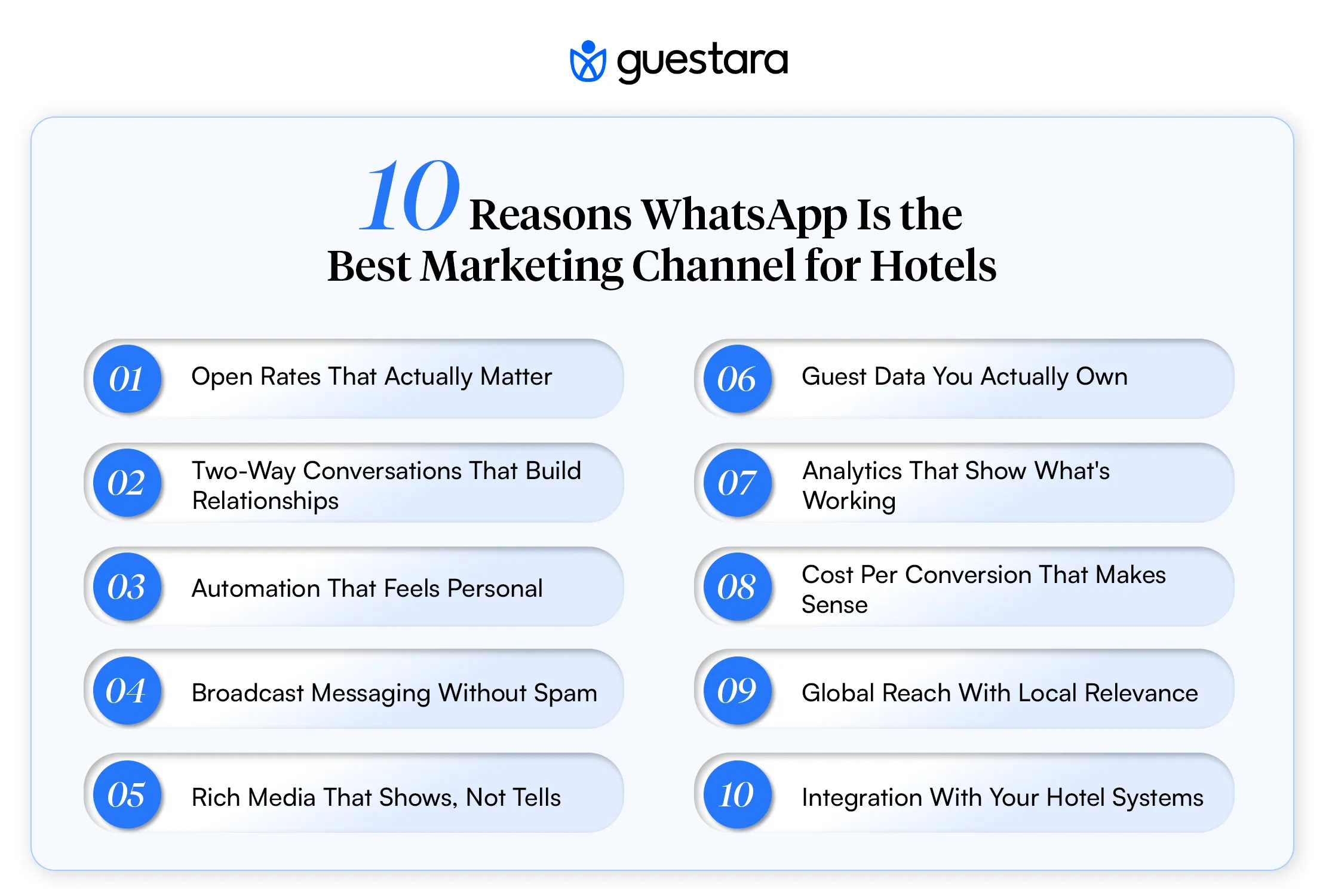
Email open rates for hotels average 22%. Your best campaigns might hit 30%.
WhatsApp messages get opened 90-98% of the time.
That's not a small advantage. That's the difference between guests seeing your offers and completely missing them.
Why the massive difference?
Push notifications guests actually check. WhatsApp notifications don't get lost in a sea of email badges. They appear on lock screens. They make sounds. They demand attention.
No spam folder. Your messages land directly in guest conversations, not in a promotions tab or junk folder.
Mobile-first design. Guests read WhatsApp on their phones, which is where they are 5+ hours daily.
This matters most for time-sensitive offers. Last-minute availability. Flash sales. Limited-time upgrades. If guests don't see these offers immediately, they lose value.
WhatsApp ensures they see them.
Email is broadcasting. You send. Maybe guests read. Rarely do they reply.
WhatsApp is conversation. You send. Guests reply. You answer. They ask follow-up questions. You close the booking.
This changes everything about how hotel marketing works.
Example conversation:
Hotel: "Hi Sarah, we have a special weekend rate starting at $149/night this Friday-Sunday. Interested?"
Guest: "What's included?"
Hotel: "Breakfast, parking, and late checkout until 2 PM."
Guest: "Can I bring my dog?"
Hotel: "Yes! We're pet-friendly. $25/night pet fee."
Guest: "Perfect, book me for Friday and Saturday."
Hotel: "Done! Confirmation sent. Anything else you need?"
Guest: "What time is breakfast?"
Hotel: "7 AM - 11 AM. See you Friday!"
That's seven messages exchanged. Multiple questions answered. Booking closed. Relationship built.
Try doing that with email. The guest might reply to your first message three days later. By then, the rooms are sold.
Here's the magic of hotel WhatsApp marketing: you can automate messages that feel like they came from a real person.
Pre-arrival WhatsApp messages send automatically based on reservation dates. The guest books on Monday. Seven days before arrival, they get directions and parking info. One day before, they get check-in instructions.
They don't know it's automated. They just think your hotel has great communication.
What you can automate:
All triggered by guest journey stages. All personalized with names, dates, and booking details.
Your team doesn't type anything. The system handles it. They only respond when guests ask questions.
This is what makes WhatsApp automation for hotels different from email automation. Email feels robotic. WhatsApp feels personal.
WhatsApp broadcast hotels functionality lets you send one message to unlimited guests. Each person receives it as an individual message, not a group chat.
This solves the biggest problem with hotel marketing: how do you reach past guests without annoying them?
Effective broadcast campaigns:
Last-minute flash sale: "Hi Maria! Quick heads up - we have surprise availability this weekend at 40% off. Friday-Sunday only. Book by tomorrow. [link]"
Sent to 500 past guests. 35 bookings in 24 hours.
Event-based promotion: "Hi David! Music festival announcement: [Artist] playing here in July. Rooms near the venue starting at $199. Early bird pricing ends Friday. [link]"
Sent to 1,200 past guests in that city. 87 bookings.
Seasonal return offer: "Hi Jennifer! It's been a while since your last visit. We miss you. Here's 25% off your next stay through [date]. Code: RETURN25 [link]"
Sent to guests who stayed 6-12 months ago. 12% conversion rate.
The key: these messages provide value. They're timely. They're personalized. They're not spam.
WhatsApp broadcast messaging works because it reaches guests on a platform they trust, with offers that matter.
Email lets you embed images. But they load slowly on mobile. They often don't display. Attachments require downloads.
WhatsApp makes rich media native. Photos load instantly. Videos play inline. PDFs open with one tap. Voice messages let staff explain complex directions.
How hotels use rich media:
Room showcase: Send photos of available upgrades with prices. Guest sees the ocean view suite, decides to upgrade, books it instantly. Conversion rate: 18%.
Directions: Voice message from front desk explaining exactly how to find parking. Guest listens while driving. No confusion. No calls asking for help.
Menus: PDF of restaurant menu sent before arrival. Guest sees options, makes reservation, orders in advance.
Local guides: Photos of nearby attractions, restaurants, beaches. Guest feels informed without asking questions.
Property walkthrough: Video showing check-in location, elevator access, parking entrance. Guest arrives knowing exactly where to go.
This type of visual communication reduces guest questions by 40%. Your front desk spends less time explaining. Guests feel more informed.
Try sending a video tour via email. Most guests won't watch it. Send it via WhatsApp. They watch it immediately.
When guests book through OTAs, the OTA owns the relationship. You can't message guests. You can't collect their contact info. You can't market to them after checkout.
When guests opt into WhatsApp, you own that relationship.
You have their phone number. You have permission to message them. You can build a database of past guests for future marketing.
This changes the economics of guest acquisition.
Traditional model: Pay OTA commission (15-25%) every single time the guest books. Even if they've stayed before. Even if they loved your property.
WhatsApp model: Pay OTA commission once. Collect guest's WhatsApp. Send them direct booking offers for all future stays. No more commission.
Let's do the math:
Guest books through OTA: $200/night × 3 nights = $600. OTA takes 18% = $108 commission.
Same guest books direct next time after WhatsApp promotion: $600 = $0 commission.
Third stay, fourth stay, fifth stay: All direct. All commission-free.
That one guest relationship is worth $500+ in saved commissions over their lifetime.
Multiply that by 100 guests. 1,000 guests. 10,000 guests.
WhatsApp marketing for hotels isn't just a communication channel. It's a direct booking strategy that compounds over time.
Email marketing gives you open rates and click rates. That's helpful but limited.
Hotel WhatsApp marketing platforms give you full conversation analytics:
You see exactly which messages drive bookings. Which upsells convert. Which staff members close sales. Which automation workflows need adjustment.
Example insights:
"Early check-in offers sent 3 days before arrival convert at 22%. Same offer sent 7 days before converts at 8%."
Action: Change automation to send early check-in offers 3 days out.
"Messages with room photos convert 3x higher than text-only upsells."
Action: Add photos to all upgrade offers.
"Response times under 10 minutes result in 45% higher satisfaction scores."
Action: Set team target for sub-10-minute replies.
This level of insight helps you optimize everything. You're not guessing what works. You know.
Let's compare actual costs:
Email marketing:
Paid advertising:
WhatsApp marketing:
The ROI difference is dramatic.
50-room hotel example:
1,200 guests per month receive automated upsell offers via WhatsApp.
Total monthly upsell revenue: $19,980
WhatsApp platform cost: $300-$400/month
ROI: 50x
No other marketing channel delivers that kind of return.
WhatsApp works in 180+ countries. Your international guests already use it.
But here's what makes it powerful: you can message guests in their local context.
Timezone automation: Messages send based on guest location, not your hotel's timezone. Pre-arrival message arrives at 10 AM in their timezone, not 10 AM yours.
Language support: Templates in multiple languages. Automatic language detection based on guest profile.
Local payment methods: Payment links that work in guest's country and currency.
Regional offers: Broadcast different promotions to guests in different markets.
This matters for hotels in tourist destinations. Your guests come from everywhere. Email can't handle this complexity well. WhatsApp can.
WhatsApp marketing for hotels works best when connected to your existing systems.
PMS integration: Guest books in Opera, Cloudbeds, Mews, Yanolja Cloud (eZee), or Hotelogix. WhatsApp system detects it automatically. Triggers appropriate message flow. Updates based on booking changes.
Channel manager sync: Reservation comes through Booking.com, Expedia, or Airbnb. Data flows to WhatsApp platform. Guest receives confirmation and pre-arrival messages seamlessly.
Payment processing: Upsell offers include payment links. Guest clicks, pays, upgrade confirms automatically in PMS.
Review platform connection: Post-stay message includes links to Google, TripAdvisor, Booking.com reviews. Guest clicks their preferred platform.
This integration eliminates manual work. Your staff doesn't copy-paste between systems. Everything flows automatically.
The result: your team focuses on service, not data entry.
Now let's look at the specific features you need in a WhatsApp marketing platform.
Your front desk, housekeeping, guest services, and management all need access to guest conversations.
A unified inbox shows:
Multiple staff members can respond. Managers can monitor quality. No messages get missed because someone's off duty.
This is the feature that makes multi-property or multi-team operations possible.
Remember the WhatsApp 24-hour rule. After 24 hours of no guest reply, you need pre-approved templates.
Good platforms provide:
You need 15-25 templates minimum:
The more templates you have approved, the more flexible your marketing becomes.
Automation is what scales hotel WhatsApp marketing from 10 guests to 10,000 guests.
Essential automation triggers:
Each trigger starts a workflow. Send message. Wait for reply. If reply contains X, do Y. If no reply in Z hours, move to next step.
Example workflow:
Pre-arrival upsell sequence:
This level of sophistication requires proper automation tools. Not just scheduled messages.
You don't send the same message to everyone. You segment.
Useful segments:
Each segment gets different messaging:
VIP past guests get exclusive offers first. Budget-conscious guests get value packages. International guests get content in their language. Repeat guests get loyalty rewards.
Segmentation increases conversion rates by 40-60% compared to generic broadcasts.
You need to see:
Track these metrics weekly. Optimize monthly. Double down on what works. Cut what doesn't.
Guests shouldn't leave WhatsApp to complete a purchase.
Payment integration allows:
This reduces friction. More offers convert when guests can pay instantly.
Works for:
One-click payment is the difference between 15% conversion and 30% conversion on upsells.
You don't need to implement everything at once. Start with the basics.
Set up WhatsApp Business API through a hospitality-focused provider like Guestara.
Connect your PMS so guest data flows automatically.
Create 5 essential templates:
Train your team on the unified inbox.
Build basic automation flows:
Test with small volume before scaling.
Add upsell offers:
Track conversion rates and revenue generated.
Build past guest segments based on stay date.
Launch first broadcast campaign to guests from 3-6 months ago with return offer.
Measure results and refine targeting.
Review analytics weekly.
Test message variations.
Add new templates for seasonal offers.
Expand automation workflows.
Most hotels see positive ROI by week 4. By month 3, WhatsApp is a major revenue driver.
For a detailed implementation guide with step-by-step workflows, check out our complete guide to hotel WhatsApp marketing and automation.
Let's look at actual performance data from hotels using WhatsApp marketing properly.
Before WhatsApp:
After WhatsApp (6 months):
Key tactics:
Before WhatsApp:
After WhatsApp (12 months):
Key tactics:
Before WhatsApp:
After WhatsApp (9 months):
Key tactics:
These aren't outlier results. This is what proper hotel WhatsApp marketing implementation delivers consistently.
Want to see platform features and pricing for your property size? Visit our hotel WhatsApp marketing solutions page.
The window is closing on early adopter advantage.
In 2023, less than 15% of hotels used WhatsApp marketing seriously. In 2024, that jumped to 28%. By end of 2025, it reached 45%.
In 2026, it's becoming table stakes.
Your competitors are implementing it now. Guests are expecting it. The technology is mature. The ROI is proven.
But there's still an advantage for hotels that move fast.
First-mover benefits:
Guest database building: Every month you wait is hundreds or thousands of guests you don't capture for future direct marketing.
Template library development: The more templates you have approved and tested, the more marketing flexibility you have.
Staff expertise: Your team gets better at WhatsApp communication with practice. Early adopters have trained teams. Late adopters have learning curves.
Competitive differentiation: In many markets, WhatsApp marketing is still rare enough to be a differentiator. That won't last.
Most importantly, guest expectations are shifting fast.
In 2023, guests were pleasantly surprised when hotels used WhatsApp well.
In 2026, guests are annoyed when hotels don't offer it.
The question isn't whether to implement hotel WhatsApp marketing. The question is whether you implement it before or after your competitors.
For a comparison of WhatsApp Business vs WhatsApp Business API to understand which solution fits your hotel, read our detailed comparison guide.
Even with the right platform, execution matters. Avoid these mistakes:
Sending 5 messages in one day feels like spam. Even on WhatsApp.
Solution: Space messages across the guest journey. Maximum 1 message per day, except when responding to guest inquiries.
"Dear Guest" defeats the purpose of WhatsApp's personal feel.
Solution: Always use guest names. Reference booking details. Make every message feel individual.
Guests need to feel in control. If they can't opt out easily, they'll block your number.
Solution: Include opt-out language: "Reply STOP to unsubscribe from promotional messages."
WhatsApp sets expectation of instant replies. Taking 3 hours to respond defeats the purpose.
Solution: Set team targets for response time. Use auto-replies during off-hours. Consider extended coverage hours.
You can't optimize what you don't measure.
Solution: Review analytics weekly. Track revenue per campaign. Calculate cost per conversion. Kill underperforming campaigns.
WhatsApp bans accounts that violate rules. No warnings. No appeals.
Solution: Get explicit opt-in consent. Never buy contact lists. Only send to guests with existing relationship. Use approved templates correctly.
If you're typing every message by hand, you're doing it wrong.
Solution: Automate repetitive messages. Use templates for common scenarios. Let staff focus on complex questions.
These mistakes are easy to avoid with proper setup and training


WhatsApp delivers 90-98% open rates vs email's 22%. Discover why hotels achieve 3-7x higher conversion with WhatsApp marketing automation.
Your hotel sends 1,000 emails promoting a weekend package. 180 people open them. Maybe 15 click through. Two book.
Same hotel sends 1,000 WhatsApp messages. 940 people read them. 130 reply. 45 book.
That's not a hypothetical comparison. That's what's actually happening in hotels right now.
Email worked for 20 years. Then guest behavior changed. Inboxes filled with spam. Open rates dropped. Guests stopped checking email on vacation.
Meanwhile, WhatsApp became the default communication tool for 2.8 billion people worldwide. Your guests check it 23 times per day. They respond in minutes, not hours.
This shift created the biggest opportunity in hotel marketing since online booking took over from phone reservations.
But most hotels still treat WhatsApp like an afterthought. A nice-to-have messaging app. Not the revenue-driving marketing channel it actually is.
This guide shows you exactly why hotel WhatsApp marketing delivers better results than every other channel. And how to use it properly in 2026.
Let's be honest about where hotel marketing stands in 2026.
Email marketing: Your carefully crafted promotional emails land in spam folders or get ignored among 100+ daily messages. Average open rate for hotel marketing emails: 22%. Click rate: 2-3%. Most guests don't even see your offers.
SMS marketing: Better than email but expensive. Costs $0.01-$0.05 per message with character limits that force you to abbreviate everything. Open rates around 60% but guests increasingly see SMS as intrusive for marketing.
Social media: Great for brand awareness. Terrible for direct bookings. Facebook organic reach dropped to 5.2% of followers. Instagram requires constant content production. Guests see your posts between memes and vacation photos, not when they're ready to book.
Phone calls: Your front desk spends hours answering the same questions. Guests don't want to call anymore. They want instant answers without talking to anyone.
OTA messaging: Restricted, monitored, and limited. You can't collect contact info. You can't send marketing messages. The OTA owns the relationship, not you.
The problem isn't that these channels stopped working completely. The problem is they can't compete with how guests actually want to communicate.
Guests want:
Traditional channels can't deliver all of that. WhatsApp can.
What Makes WhatsApp Different From Other Marketing Channels
WhatsApp isn't just another messaging app. It's fundamentally different from every marketing channel hotels have used before.
90-98% open rate within 3 minutes of sending. Compare that to email's 22%.
45-60 second average response time when guests reply. Email takes hours or days.
70% of messages result in two-way conversations. Email is one-way broadcasting.
3-7x higher conversion rates on upsells and promotions compared to email campaigns.
These aren't marginal improvements. These are category-defining differences.
You're not forcing guests onto a new platform. They're already there.
In India alone, WhatsApp reaches 535 million active users. In Latin America, it's the primary communication tool. In Europe and Middle East, it's standard for business communication.
Your guests use WhatsApp to talk to family, coordinate with friends, and message businesses. Adding your hotel to that mix feels natural. Asking them to check a separate hotel app or monitor email does not.
Think about your own behavior. When was the last time you enthusiastically opened a promotional email? Now when was the last time you ignored a WhatsApp message?
That difference is everything.
Email open rates for hotels average 22%. Your best campaigns might hit 30%.
WhatsApp messages get opened 90-98% of the time.
That's not a small advantage. That's the difference between guests seeing your offers and completely missing them.
Why the massive difference?
Push notifications guests actually check. WhatsApp notifications don't get lost in a sea of email badges. They appear on lock screens. They make sounds. They demand attention.
No spam folder. Your messages land directly in guest conversations, not in a promotions tab or junk folder.
Mobile-first design. Guests read WhatsApp on their phones, which is where they are 5+ hours daily.
This matters most for time-sensitive offers. Last-minute availability. Flash sales. Limited-time upgrades. If guests don't see these offers immediately, they lose value.
WhatsApp ensures they see them.
Email is broadcasting. You send. Maybe guests read. Rarely do they reply.
WhatsApp is conversation. You send. Guests reply. You answer. They ask follow-up questions. You close the booking.
This changes everything about how hotel marketing works.
Example conversation:
Hotel: "Hi Sarah, we have a special weekend rate starting at $149/night this Friday-Sunday. Interested?"
Guest: "What's included?"
Hotel: "Breakfast, parking, and late checkout until 2 PM."
Guest: "Can I bring my dog?"
Hotel: "Yes! We're pet-friendly. $25/night pet fee."
Guest: "Perfect, book me for Friday and Saturday."
Hotel: "Done! Confirmation sent. Anything else you need?"
Guest: "What time is breakfast?"
Hotel: "7 AM - 11 AM. See you Friday!"
That's seven messages exchanged. Multiple questions answered. Booking closed. Relationship built.
Try doing that with email. The guest might reply to your first message three days later. By then, the rooms are sold.
Here's the magic of hotel WhatsApp marketing: you can automate messages that feel like they came from a real person.
Pre-arrival WhatsApp messages send automatically based on reservation dates. The guest books on Monday. Seven days before arrival, they get directions and parking info. One day before, they get check-in instructions.
They don't know it's automated. They just think your hotel has great communication.
What you can automate:
All triggered by guest journey stages. All personalized with names, dates, and booking details.
Your team doesn't type anything. The system handles it. They only respond when guests ask questions.
This is what makes WhatsApp automation for hotels different from email automation. Email feels robotic. WhatsApp feels personal.
WhatsApp broadcast hotels functionality lets you send one message to unlimited guests. Each person receives it as an individual message, not a group chat.
This solves the biggest problem with hotel marketing: how do you reach past guests without annoying them?
Effective broadcast campaigns:
Last-minute flash sale: "Hi Maria! Quick heads up - we have surprise availability this weekend at 40% off. Friday-Sunday only. Book by tomorrow. [link]"
Sent to 500 past guests. 35 bookings in 24 hours.
Event-based promotion: "Hi David! Music festival announcement: [Artist] playing here in July. Rooms near the venue starting at $199. Early bird pricing ends Friday. [link]"
Sent to 1,200 past guests in that city. 87 bookings.
Seasonal return offer: "Hi Jennifer! It's been a while since your last visit. We miss you. Here's 25% off your next stay through [date]. Code: RETURN25 [link]"
Sent to guests who stayed 6-12 months ago. 12% conversion rate.
The key: these messages provide value. They're timely. They're personalized. They're not spam.
WhatsApp broadcast messaging works because it reaches guests on a platform they trust, with offers that matter.
Email lets you embed images. But they load slowly on mobile. They often don't display. Attachments require downloads.
WhatsApp makes rich media native. Photos load instantly. Videos play inline. PDFs open with one tap. Voice messages let staff explain complex directions.
How hotels use rich media:
Room showcase: Send photos of available upgrades with prices. Guest sees the ocean view suite, decides to upgrade, books it instantly. Conversion rate: 18%.
Directions: Voice message from front desk explaining exactly how to find parking. Guest listens while driving. No confusion. No calls asking for help.
Menus: PDF of restaurant menu sent before arrival. Guest sees options, makes reservation, orders in advance.
Local guides: Photos of nearby attractions, restaurants, beaches. Guest feels informed without asking questions.
Property walkthrough: Video showing check-in location, elevator access, parking entrance. Guest arrives knowing exactly where to go.
This type of visual communication reduces guest questions by 40%. Your front desk spends less time explaining. Guests feel more informed.
Try sending a video tour via email. Most guests won't watch it. Send it via WhatsApp. They watch it immediately.
When guests book through OTAs, the OTA owns the relationship. You can't message guests. You can't collect their contact info. You can't market to them after checkout.
When guests opt into WhatsApp, you own that relationship.
You have their phone number. You have permission to message them. You can build a database of past guests for future marketing.
This changes the economics of guest acquisition.
Traditional model: Pay OTA commission (15-25%) every single time the guest books. Even if they've stayed before. Even if they loved your property.
WhatsApp model: Pay OTA commission once. Collect guest's WhatsApp. Send them direct booking offers for all future stays. No more commission.
Let's do the math:
Guest books through OTA: $200/night × 3 nights = $600. OTA takes 18% = $108 commission.
Same guest books direct next time after WhatsApp promotion: $600 = $0 commission.
Third stay, fourth stay, fifth stay: All direct. All commission-free.
That one guest relationship is worth $500+ in saved commissions over their lifetime.
Multiply that by 100 guests. 1,000 guests. 10,000 guests.
WhatsApp marketing for hotels isn't just a communication channel. It's a direct booking strategy that compounds over time.
Email marketing gives you open rates and click rates. That's helpful but limited.
Hotel WhatsApp marketing platforms give you full conversation analytics:
You see exactly which messages drive bookings. Which upsells convert. Which staff members close sales. Which automation workflows need adjustment.
Example insights:
"Early check-in offers sent 3 days before arrival convert at 22%. Same offer sent 7 days before converts at 8%."
Action: Change automation to send early check-in offers 3 days out.
"Messages with room photos convert 3x higher than text-only upsells."
Action: Add photos to all upgrade offers.
"Response times under 10 minutes result in 45% higher satisfaction scores."
Action: Set team target for sub-10-minute replies.
This level of insight helps you optimize everything. You're not guessing what works. You know.
Let's compare actual costs:
Email marketing:
Paid advertising:
WhatsApp marketing:
The ROI difference is dramatic.
50-room hotel example:
1,200 guests per month receive automated upsell offers via WhatsApp.
Total monthly upsell revenue: $19,980
WhatsApp platform cost: $300-$400/month
ROI: 50x
No other marketing channel delivers that kind of return.
WhatsApp works in 180+ countries. Your international guests already use it.
But here's what makes it powerful: you can message guests in their local context.
Timezone automation: Messages send based on guest location, not your hotel's timezone. Pre-arrival message arrives at 10 AM in their timezone, not 10 AM yours.
Language support: Templates in multiple languages. Automatic language detection based on guest profile.
Local payment methods: Payment links that work in guest's country and currency.
Regional offers: Broadcast different promotions to guests in different markets.
This matters for hotels in tourist destinations. Your guests come from everywhere. Email can't handle this complexity well. WhatsApp can.
WhatsApp marketing for hotels works best when connected to your existing systems.
PMS integration: Guest books in Opera, Cloudbeds, Mews, Yanolja Cloud (eZee), or Hotelogix. WhatsApp system detects it automatically. Triggers appropriate message flow. Updates based on booking changes.
Channel manager sync: Reservation comes through Booking.com, Expedia, or Airbnb. Data flows to WhatsApp platform. Guest receives confirmation and pre-arrival messages seamlessly.
Payment processing: Upsell offers include payment links. Guest clicks, pays, upgrade confirms automatically in PMS.
Review platform connection: Post-stay message includes links to Google, TripAdvisor, Booking.com reviews. Guest clicks their preferred platform.
This integration eliminates manual work. Your staff doesn't copy-paste between systems. Everything flows automatically.
The result: your team focuses on service, not data entry.
Now let's look at the specific features you need in a WhatsApp marketing platform.
Your front desk, housekeeping, guest services, and management all need access to guest conversations.
A unified inbox shows:
Multiple staff members can respond. Managers can monitor quality. No messages get missed because someone's off duty.
This is the feature that makes multi-property or multi-team operations possible.
Remember the WhatsApp 24-hour rule. After 24 hours of no guest reply, you need pre-approved templates.
Good platforms provide:
You need 15-25 templates minimum:
The more templates you have approved, the more flexible your marketing becomes.
Automation is what scales hotel WhatsApp marketing from 10 guests to 10,000 guests.
Essential automation triggers:
Each trigger starts a workflow. Send message. Wait for reply. If reply contains X, do Y. If no reply in Z hours, move to next step.
Example workflow:
Pre-arrival upsell sequence:
This level of sophistication requires proper automation tools. Not just scheduled messages.
You don't send the same message to everyone. You segment.
Useful segments:
Each segment gets different messaging:
VIP past guests get exclusive offers first. Budget-conscious guests get value packages. International guests get content in their language. Repeat guests get loyalty rewards.
Segmentation increases conversion rates by 40-60% compared to generic broadcasts.
You need to see:
Track these metrics weekly. Optimize monthly. Double down on what works. Cut what doesn't.
Guests shouldn't leave WhatsApp to complete a purchase.
Payment integration allows:
This reduces friction. More offers convert when guests can pay instantly.
Works for:
One-click payment is the difference between 15% conversion and 30% conversion on upsells.
You don't need to implement everything at once. Start with the basics.
Set up WhatsApp Business API through a hospitality-focused provider like Guestara.
Connect your PMS so guest data flows automatically.
Create 5 essential templates:
Train your team on the unified inbox.
Build basic automation flows:
Test with small volume before scaling.
Add upsell offers:
Track conversion rates and revenue generated.
Build past guest segments based on stay date.
Launch first broadcast campaign to guests from 3-6 months ago with return offer.
Measure results and refine targeting.
Review analytics weekly.
Test message variations.
Add new templates for seasonal offers.
Expand automation workflows.
Most hotels see positive ROI by week 4. By month 3, WhatsApp is a major revenue driver.
For a detailed implementation guide with step-by-step workflows, check out our complete guide to hotel WhatsApp marketing and automation.
Let's look at actual performance data from hotels using WhatsApp marketing properly.
Before WhatsApp:
After WhatsApp (6 months):
Key tactics:
Before WhatsApp:
After WhatsApp (12 months):
Key tactics:
Before WhatsApp:
After WhatsApp (9 months):
Key tactics:
These aren't outlier results. This is what proper hotel WhatsApp marketing implementation delivers consistently.
Want to see platform features and pricing for your property size? Visit our hotel WhatsApp marketing solutions page.
The window is closing on early adopter advantage.
In 2023, less than 15% of hotels used WhatsApp marketing seriously. In 2024, that jumped to 28%. By end of 2025, it reached 45%.
In 2026, it's becoming table stakes.
Your competitors are implementing it now. Guests are expecting it. The technology is mature. The ROI is proven.
But there's still an advantage for hotels that move fast.
First-mover benefits:
Guest database building: Every month you wait is hundreds or thousands of guests you don't capture for future direct marketing.
Template library development: The more templates you have approved and tested, the more marketing flexibility you have.
Staff expertise: Your team gets better at WhatsApp communication with practice. Early adopters have trained teams. Late adopters have learning curves.
Competitive differentiation: In many markets, WhatsApp marketing is still rare enough to be a differentiator. That won't last.
Most importantly, guest expectations are shifting fast.
In 2023, guests were pleasantly surprised when hotels used WhatsApp well.
In 2026, guests are annoyed when hotels don't offer it.
The question isn't whether to implement hotel WhatsApp marketing. The question is whether you implement it before or after your competitors.
For a comparison of WhatsApp Business vs WhatsApp Business API to understand which solution fits your hotel, read our detailed comparison guide.
Even with the right platform, execution matters. Avoid these mistakes:
Sending 5 messages in one day feels like spam. Even on WhatsApp.
Solution: Space messages across the guest journey. Maximum 1 message per day, except when responding to guest inquiries.
"Dear Guest" defeats the purpose of WhatsApp's personal feel.
Solution: Always use guest names. Reference booking details. Make every message feel individual.
Guests need to feel in control. If they can't opt out easily, they'll block your number.
Solution: Include opt-out language: "Reply STOP to unsubscribe from promotional messages."
WhatsApp sets expectation of instant replies. Taking 3 hours to respond defeats the purpose.
Solution: Set team targets for response time. Use auto-replies during off-hours. Consider extended coverage hours.
You can't optimize what you don't measure.
Solution: Review analytics weekly. Track revenue per campaign. Calculate cost per conversion. Kill underperforming campaigns.
WhatsApp bans accounts that violate rules. No warnings. No appeals.
Solution: Get explicit opt-in consent. Never buy contact lists. Only send to guests with existing relationship. Use approved templates correctly.
If you're typing every message by hand, you're doing it wrong.
Solution: Automate repetitive messages. Use templates for common scenarios. Let staff focus on complex questions.
These mistakes are easy to avoid with proper setup and training
WhatsApp is available in 180+ countries, but marketing regulations vary. You need explicit opt-in consent everywhere. Some countries (like EU under GDPR) have stricter requirements about data storage and consent documentation. Always collect clear permission before messaging guests and provide easy opt-out. Most countries treat WhatsApp similarly to SMS marketing regulations.
Email platforms cost $50-$200/month with lower per-message costs but much lower engagement. WhatsApp platforms vary by volume and features - visit our hotel WhatsApp marketing page for pricing details. The key difference: WhatsApp typically delivers 3-7x higher conversion rates, making the cost per booking 50-80% lower than email despite potentially higher platform costs.
Yes, for small properties under 10 rooms using the free WhatsApp Business app. But you'll lack automation, multi-user access, PMS integration, analytics, and broadcast capabilities beyond 256 contacts.
Globally, WhatsApp has 2.8 billion users - it's likely 70-90% of your guests already use it depending on your market. For guests without WhatsApp, continue using email and SMS. Most hotels run WhatsApp alongside other channels, not as a replacement. Offer WhatsApp as the preferred channel but maintain backup communication methods.
Track: (1) Direct revenue from upsells (early check-in, upgrades, late checkout), (2) Repeat booking revenue from broadcast campaigns, (3) Staff time saved on guest queries, (4) Commission saved on direct bookings vs OTA bookings. Most hotels see ROI within 4-6 weeks of implementation. Use your platform's analytics dashboard to measure conversion rates per campaign type and calculate revenue per message sent.
We work closely with the industry leaders to offer seamless solutions



We’re here to help your whole team stay ahead of the curve as you grow.

Get up and running quickly with a personalized onboarding plan

Connect with real people who really get it, 24/7

Checkout our vast library of free resources, templates and more
There's only so much we can say — so let us show you! Schedule a demo today and reach your business goals.


.png)