Hotel WhatsApp marketing works best when you stop blasting everyone. Learn to segment guests by source, purpose, lead time and frequency to win more bookings.




Your guest list looks like one audience. It is actually a dozen.
A honeymoon couple. A corporate guest who stays every month. A family that booked six weeks ahead. A walk-in who found you on an OTA last night. They all sit in the same database, and most hotels send them the same WhatsApp message.
That message lands well for almost none of them.
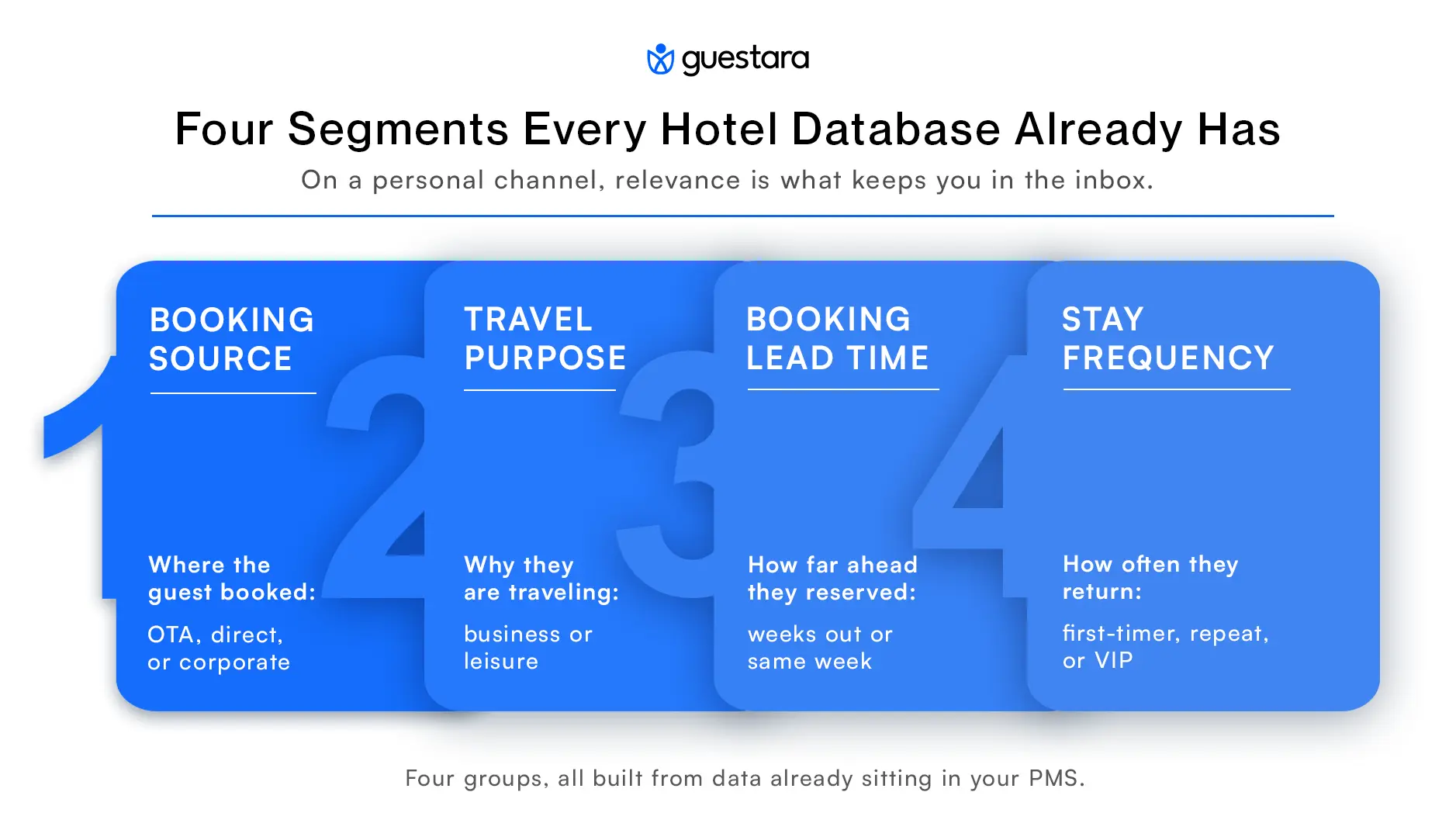
Segmenting hotel guests on WhatsApp means splitting your list into groups that share something real, then sending each group a message that fits. You group by where they booked, why they are traveling, how far ahead they planned, and how often they come back.
This guide shows you the four segments that matter most for hotels, what to send each one, and when.
Guest segmentation is the practice of dividing your hotel's contact list into smaller groups based on shared traits, then messaging each group differently. On WhatsApp, that means a returning corporate guest and a first-time leisure booker never receive the same broadcast.
The traits you segment by are simple. Where the guest booked. Why they came. How far ahead they reserved. How many times they have stayed.
Most hotels skip this step. They build one guest list and send one message to all of it. A spa offer goes to the business traveler who checked out this morning. A "book direct next time" note goes to the loyal regular who already books direct.
Segmentation fixes that mismatch. You stop talking to a crowd and start talking to a guest. The message feels written for them because, in effect, it was.
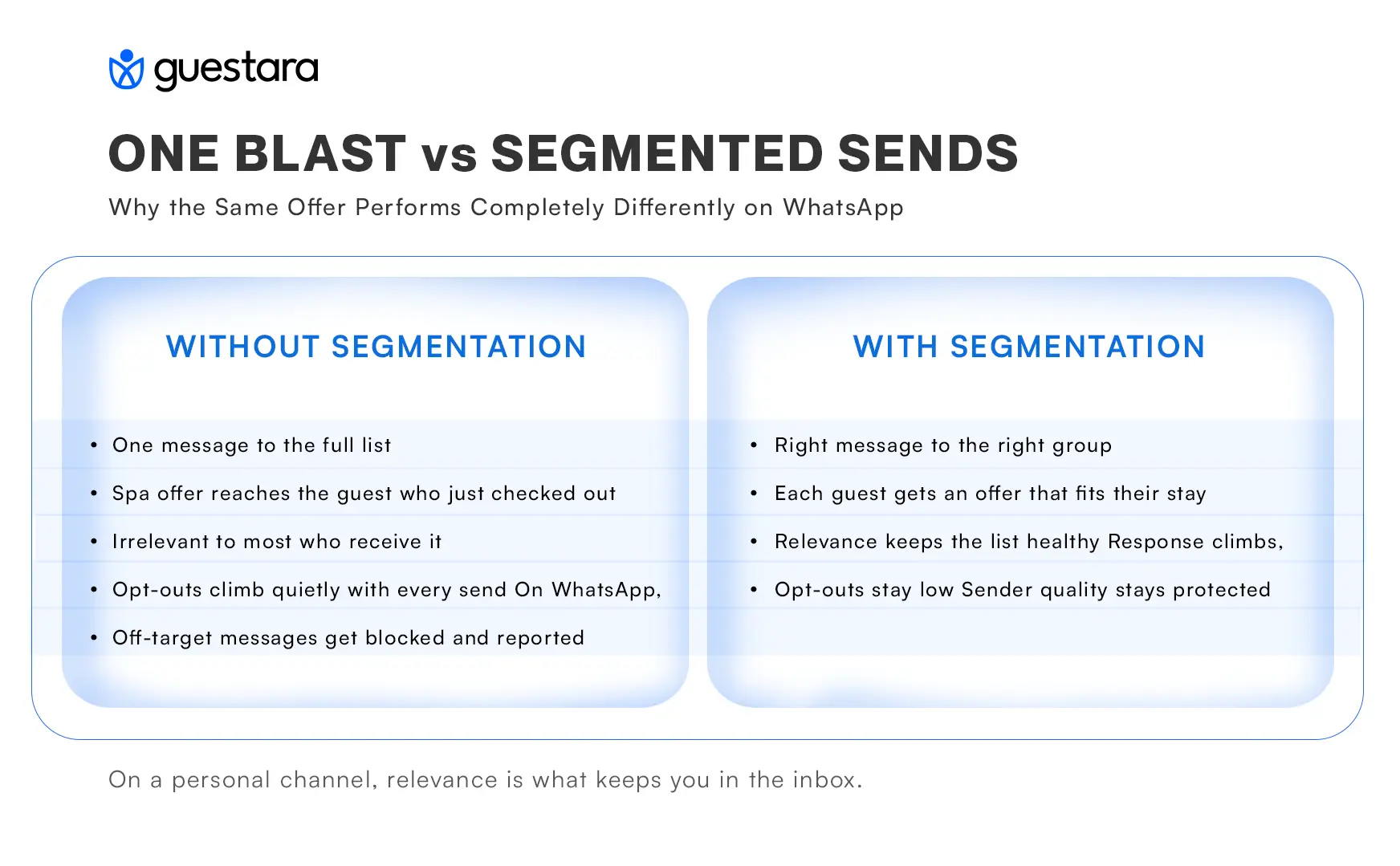
You segment because a single message sent to your whole list converts poorly, and WhatsApp punishes that harder than email does.
WhatsApp is a personal channel. People keep it for family, friends, and a small number of businesses they trust. An irrelevant broadcast does not just get ignored. It gets you blocked or reported, and that quietly damages your sender quality over time.
Relevance is the price of admission. When the message fits the guest, response rates climb. When it does not, opt-outs climb instead.
The performance gap is well documented across marketing. In one analysis of more than 30 million customers, the marketing data firm Optimove found that tighter, smaller segments produced higher uplift than broad sends. The pattern holds everywhere. Match the message to the group and more people act.
For a hotel, that action is concrete. A reservation. An upsell. A direct rebooking that skips the OTA commission. Segmentation is the difference between a list that earns revenue and a list that slowly burns out.
Booking source is the fastest way to segment hotel guests on WhatsApp, because where a guest booked tells you what they already know about you.
An OTA guest found you through Booking.com or Expedia. They may not know your direct rate, your loyalty perks, or your restaurant. You paid commission to win them. The job now is to bring them back direct next time. A simple post-stay message with a direct-booking benefit does more here than any generic newsletter. This is the heart of turning OTA guests into direct guests, which deserves its own playbook. (See the direct bookings guide.)
A direct guest already chose you on purpose. They do not need convincing to book direct. They need recognition and a reason to spend more while they are with you. Send them upgrades, dining, and early check-in offers, not a discount they did not ask for.
A corporate or travel-agent booking is a third group entirely. The person in your database may not even be the guest. Here you focus on the practical: fast check-in, invoicing, and consistency for the next trip.
Matching the message to the source is exactly the kind of targeting that lifts results. Marketing research consistently shows segmented campaigns outperform single broadcasts by a wide margin. Booking source is the easiest place to start because the data is already in your PMS.
Travel purpose splits your hotel guests into two groups that want completely different things: business and leisure.
Business guests value speed and predictability. They want a quick arrival, a working room, a clean invoice, and a late checkout when a meeting runs long. Most book their own room, so your WhatsApp message reaches the actual decision-maker. Keep it short and useful. Offer the late checkout. Confirm the invoice. Skip the holiday packages.
Leisure guests want the opposite. They came for the experience, so they are open to dining, spa, activities, and local recommendations. This is your upsell audience. A well-timed offer for a sunset dinner or a guided tour fits the reason they booked.
The two groups overlap more than they used to. Roughly a third of business trips now include leisure time, a pattern the Global Business Travel Association tracks as "bleisure." A business guest staying over the weekend becomes a leisure guest for two days. Watch the stay dates, not just the booking type, and move guests between segments when the calendar tells you to.
Travel purpose changes both the message and the timing. Business offers fire on weekdays. Leisure offers fire when the guest has free time to spend.
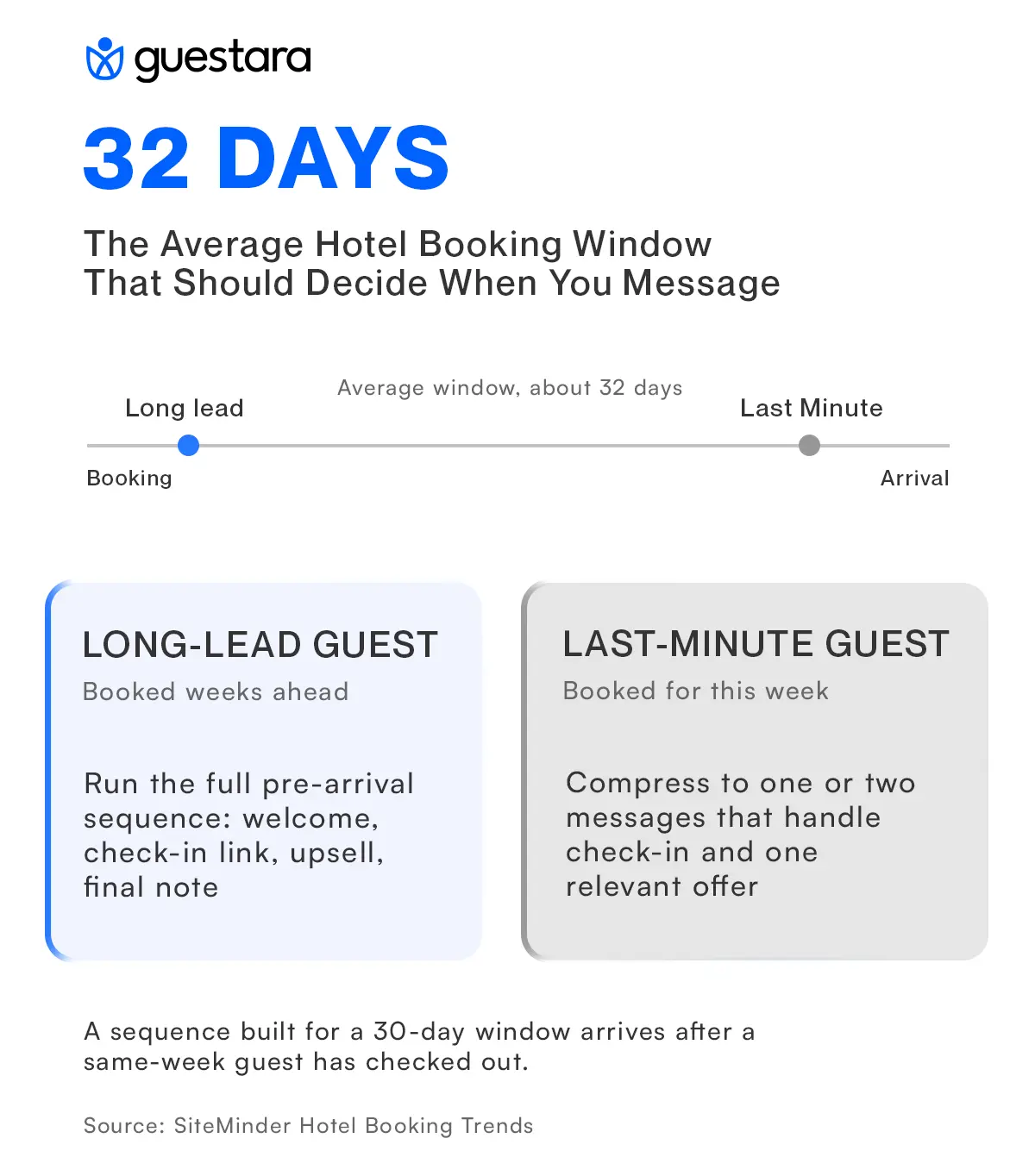
Booking lead time is how far ahead a guest reserves, and it tells you exactly when your WhatsApp messages should fire.
The average booking window for hotels sits at around 32 days globally, based on SiteMinder data covering more than 125 million bookings a year. But the average hides two very different guests.
The long-lead guest booked weeks out. You have time to run a full pre-arrival sequence. A welcome message, a "complete your check-in" link, an upsell offer a few days before arrival, and a final pre-arrival note. Spread it out and let each message do one job.
The last-minute guest booked yesterday for tonight. There is no four-message sequence here. You compress everything into one or two messages that handle check-in and one relevant offer. Anything slower misses the stay entirely.
Lead times are also getting shorter. Travelers now research longer and book closer to the travel date. That makes timing your messages by lead time more important, not less. A pre-arrival sequence built for a 30-day window will arrive after a same-week guest has already checked out.
None of this works if the messages go unseen. WhatsApp open rates clear most channels by a wide margin, which is why timing them to lead time pays off. (See the open rate comparison.)
Stay frequency separates guests who have visited once from guests who keep coming back, and the returning group is the most profitable list you own.
A first-time guest is unproven. The goal with them is a second stay. A warm post-checkout message, a thank-you, and a clear reason to return work better than a hard sell. You are building a habit, not closing a deal.
A repeat guest has already voted for you with their wallet, more than once. Treat them like it. Recognition matters more than discounts here. Remember their room preference. Greet them by name. Offer the perk before they ask. This group responds to feeling known.
A high-value or VIP guest is a small slice of the repeat group that deserves separate handling. A personal message from the front office, a small in-room gesture, a direct line to a real person. These guests carry your reputation in their reviews and referrals.
There is a fourth group hiding in your stay-frequency data: guests who used to come back and stopped. Winning them back is its own discipline, with its own timing and triggers, covered in the WhatsApp retargeting guide. For segmentation, the point is simpler. Tag them so you can find them, then run a dedicated campaign rather than folding them into a general broadcast.
Segments only matter when each one maps to a specific message and a specific moment in the guest journey.
Start with one message per segment. The OTA guest gets a direct-booking benefit after checkout. The business guest gets a late-checkout offer on the morning of departure. The long-lead leisure guest gets a pre-arrival upsell three days out. The repeat guest gets early access to a seasonal rate. Four segments, four messages, four triggers.
The hard part is not deciding the messages. It is sending the right one to the right guest at the right moment, every time, across hundreds of guests, without a staff member manually sorting the list.
This is where a platform built for hotels earns its place. With Guestara, your guest data flows from your PMS, your segments filter on real attributes like booking source and stay history, and the right message fires automatically at the right point in the journey. You build the logic once and it runs for every guest after that.
Two things sit just outside this guide. Setting up the tags and attributes that make these segments possible is its own how-to, covered in a companion post on guest tags and attributes. And letting the system find micro-segments you would never spot by hand is AI segmentation, covered in a separate guide. Both build on the four segments here.
For the full picture of how WhatsApp marketing fits together for hotels, start with the complete guide.
Want to send the right message to the right guest without sorting lists by hand? This is where platforms like Guestara help hotels turn guest data into timed, relevant WhatsApp campaigns while keeping every message personal. See it in action with a quick demo.


Hotel WhatsApp marketing works best when you stop blasting everyone. Learn to segment guests by source, purpose, lead time and frequency to win more bookings.
Your guest list looks like one audience. It is actually a dozen.
A honeymoon couple. A corporate guest who stays every month. A family that booked six weeks ahead. A walk-in who found you on an OTA last night. They all sit in the same database, and most hotels send them the same WhatsApp message.
That message lands well for almost none of them.
Segmenting hotel guests on WhatsApp means splitting your list into groups that share something real, then sending each group a message that fits. You group by where they booked, why they are traveling, how far ahead they planned, and how often they come back.
This guide shows you the four segments that matter most for hotels, what to send each one, and when.
Guest segmentation is the practice of dividing your hotel's contact list into smaller groups based on shared traits, then messaging each group differently. On WhatsApp, that means a returning corporate guest and a first-time leisure booker never receive the same broadcast.
The traits you segment by are simple. Where the guest booked. Why they came. How far ahead they reserved. How many times they have stayed.
Most hotels skip this step. They build one guest list and send one message to all of it. A spa offer goes to the business traveler who checked out this morning. A "book direct next time" note goes to the loyal regular who already books direct.
Segmentation fixes that mismatch. You stop talking to a crowd and start talking to a guest. The message feels written for them because, in effect, it was.
You segment because a single message sent to your whole list converts poorly, and WhatsApp punishes that harder than email does.
WhatsApp is a personal channel. People keep it for family, friends, and a small number of businesses they trust. An irrelevant broadcast does not just get ignored. It gets you blocked or reported, and that quietly damages your sender quality over time.
Relevance is the price of admission. When the message fits the guest, response rates climb. When it does not, opt-outs climb instead.
The performance gap is well documented across marketing. In one analysis of more than 30 million customers, the marketing data firm Optimove found that tighter, smaller segments produced higher uplift than broad sends. The pattern holds everywhere. Match the message to the group and more people act.
For a hotel, that action is concrete. A reservation. An upsell. A direct rebooking that skips the OTA commission. Segmentation is the difference between a list that earns revenue and a list that slowly burns out.
Booking source is the fastest way to segment hotel guests on WhatsApp, because where a guest booked tells you what they already know about you.
An OTA guest found you through Booking.com or Expedia. They may not know your direct rate, your loyalty perks, or your restaurant. You paid commission to win them. The job now is to bring them back direct next time. A simple post-stay message with a direct-booking benefit does more here than any generic newsletter. This is the heart of turning OTA guests into direct guests, which deserves its own playbook. (See the direct bookings guide.)
A direct guest already chose you on purpose. They do not need convincing to book direct. They need recognition and a reason to spend more while they are with you. Send them upgrades, dining, and early check-in offers, not a discount they did not ask for.
A corporate or travel-agent booking is a third group entirely. The person in your database may not even be the guest. Here you focus on the practical: fast check-in, invoicing, and consistency for the next trip.
Matching the message to the source is exactly the kind of targeting that lifts results. Marketing research consistently shows segmented campaigns outperform single broadcasts by a wide margin. Booking source is the easiest place to start because the data is already in your PMS.
Travel purpose splits your hotel guests into two groups that want completely different things: business and leisure.
Business guests value speed and predictability. They want a quick arrival, a working room, a clean invoice, and a late checkout when a meeting runs long. Most book their own room, so your WhatsApp message reaches the actual decision-maker. Keep it short and useful. Offer the late checkout. Confirm the invoice. Skip the holiday packages.
Leisure guests want the opposite. They came for the experience, so they are open to dining, spa, activities, and local recommendations. This is your upsell audience. A well-timed offer for a sunset dinner or a guided tour fits the reason they booked.
The two groups overlap more than they used to. Roughly a third of business trips now include leisure time, a pattern the Global Business Travel Association tracks as "bleisure." A business guest staying over the weekend becomes a leisure guest for two days. Watch the stay dates, not just the booking type, and move guests between segments when the calendar tells you to.
Travel purpose changes both the message and the timing. Business offers fire on weekdays. Leisure offers fire when the guest has free time to spend.
Booking lead time is how far ahead a guest reserves, and it tells you exactly when your WhatsApp messages should fire.
The average booking window for hotels sits at around 32 days globally, based on SiteMinder data covering more than 125 million bookings a year. But the average hides two very different guests.
The long-lead guest booked weeks out. You have time to run a full pre-arrival sequence. A welcome message, a "complete your check-in" link, an upsell offer a few days before arrival, and a final pre-arrival note. Spread it out and let each message do one job.
The last-minute guest booked yesterday for tonight. There is no four-message sequence here. You compress everything into one or two messages that handle check-in and one relevant offer. Anything slower misses the stay entirely.
Lead times are also getting shorter. Travelers now research longer and book closer to the travel date. That makes timing your messages by lead time more important, not less. A pre-arrival sequence built for a 30-day window will arrive after a same-week guest has already checked out.
None of this works if the messages go unseen. WhatsApp open rates clear most channels by a wide margin, which is why timing them to lead time pays off. (See the open rate comparison.)
Stay frequency separates guests who have visited once from guests who keep coming back, and the returning group is the most profitable list you own.
A first-time guest is unproven. The goal with them is a second stay. A warm post-checkout message, a thank-you, and a clear reason to return work better than a hard sell. You are building a habit, not closing a deal.
A repeat guest has already voted for you with their wallet, more than once. Treat them like it. Recognition matters more than discounts here. Remember their room preference. Greet them by name. Offer the perk before they ask. This group responds to feeling known.
A high-value or VIP guest is a small slice of the repeat group that deserves separate handling. A personal message from the front office, a small in-room gesture, a direct line to a real person. These guests carry your reputation in their reviews and referrals.
There is a fourth group hiding in your stay-frequency data: guests who used to come back and stopped. Winning them back is its own discipline, with its own timing and triggers, covered in the WhatsApp retargeting guide. For segmentation, the point is simpler. Tag them so you can find them, then run a dedicated campaign rather than folding them into a general broadcast.
Segments only matter when each one maps to a specific message and a specific moment in the guest journey.
Start with one message per segment. The OTA guest gets a direct-booking benefit after checkout. The business guest gets a late-checkout offer on the morning of departure. The long-lead leisure guest gets a pre-arrival upsell three days out. The repeat guest gets early access to a seasonal rate. Four segments, four messages, four triggers.
The hard part is not deciding the messages. It is sending the right one to the right guest at the right moment, every time, across hundreds of guests, without a staff member manually sorting the list.
This is where a platform built for hotels earns its place. With Guestara, your guest data flows from your PMS, your segments filter on real attributes like booking source and stay history, and the right message fires automatically at the right point in the journey. You build the logic once and it runs for every guest after that.
Two things sit just outside this guide. Setting up the tags and attributes that make these segments possible is its own how-to, covered in a companion post on guest tags and attributes. And letting the system find micro-segments you would never spot by hand is AI segmentation, covered in a separate guide. Both build on the four segments here.
For the full picture of how WhatsApp marketing fits together for hotels, start with the complete guide.
Want to send the right message to the right guest without sorting lists by hand? This is where platforms like Guestara help hotels turn guest data into timed, relevant WhatsApp campaigns while keeping every message personal. See it in action with a quick demo.
Guest segmentation is the practice of dividing your hotel's contact list into smaller groups based on shared traits, then sending each group a different WhatsApp message. Common traits include booking source, travel purpose, booking lead time, and stay frequency. The goal is to send fewer, more relevant messages so each guest receives something that fits their reason for staying. This lifts response rates and reduces opt-outs compared to sending one broadcast to your entire list.
Hotels segment guests using data they already hold in their PMS and booking systems. The four most useful starting points are where the guest booked, why they are traveling, how far ahead they reserved, and how many times they have stayed. Each segment then maps to a specific message and a specific moment, such as a direct-booking offer to OTA guests after checkout or a pre-arrival upsell to guests who booked weeks in advance.
Yes. A message matched to a guest's situation converts far better than a generic broadcast sent to everyone. Marketing data across millions of customers shows that tighter segments produce higher uplift, and on a personal channel like WhatsApp the effect is sharper because relevance protects your sender quality. For hotels, that uplift shows up as more direct rebookings, more upsells, and fewer opt-outs.
Start with four: booking source, travel purpose, booking lead time, and stay frequency. These four use data you already have and cover the differences that change what a guest wants to hear. You do not need more segments to begin. Once these four are running cleanly, you can layer in finer groups based on what your campaigns reveal.
Yes. Segmentation does not require headcount, it requires structured guest data and a tool that acts on it automatically. An independent hotel can filter its existing contact list by booking source or stay history and trigger the right message without manual sorting. The setup is done once, then the campaigns run on their own for every future guest.
We work closely with the industry leaders to offer seamless solutions




We’re here to help your whole team stay ahead of the curve as you grow.

Get up and running quickly with a personalized onboarding plan

Connect with real people who really get it, 24/7

Checkout our vast library of free resources, templates and more
There's only so much we can say — so let us show you! Schedule a demo today and reach your business goals.


.png)