Hotels sitting on thousands of guest contacts are using WhatsApp campaigns to drive repeat direct bookings. Here's how birthday, anniversary, and deal campaigns work.




Most hotels spend their entire marketing budget chasing strangers.
Paid ads, OTA listings, metasearch bidding. Every rupee or dollar going toward people who have never heard of the property, have no reason to trust it, and are comparing it against seventeen competitors on a tab they will close in forty seconds.
Meanwhile, the same hotel has a database of thousands of guests who already stayed, already paid, already liked it enough not to leave a bad review. Names, phone numbers, stay history, room preferences. All sitting in a PMS doing nothing.
That is the problem this post addresses. Not how to attract new guests through WhatsApp. How to activate the guests you already have, using targeted WhatsApp campaigns that feel personal and convert at a level email cannot come close to matching.
A guest who has stayed at your property before is not the same as a stranger browsing Booking.com.
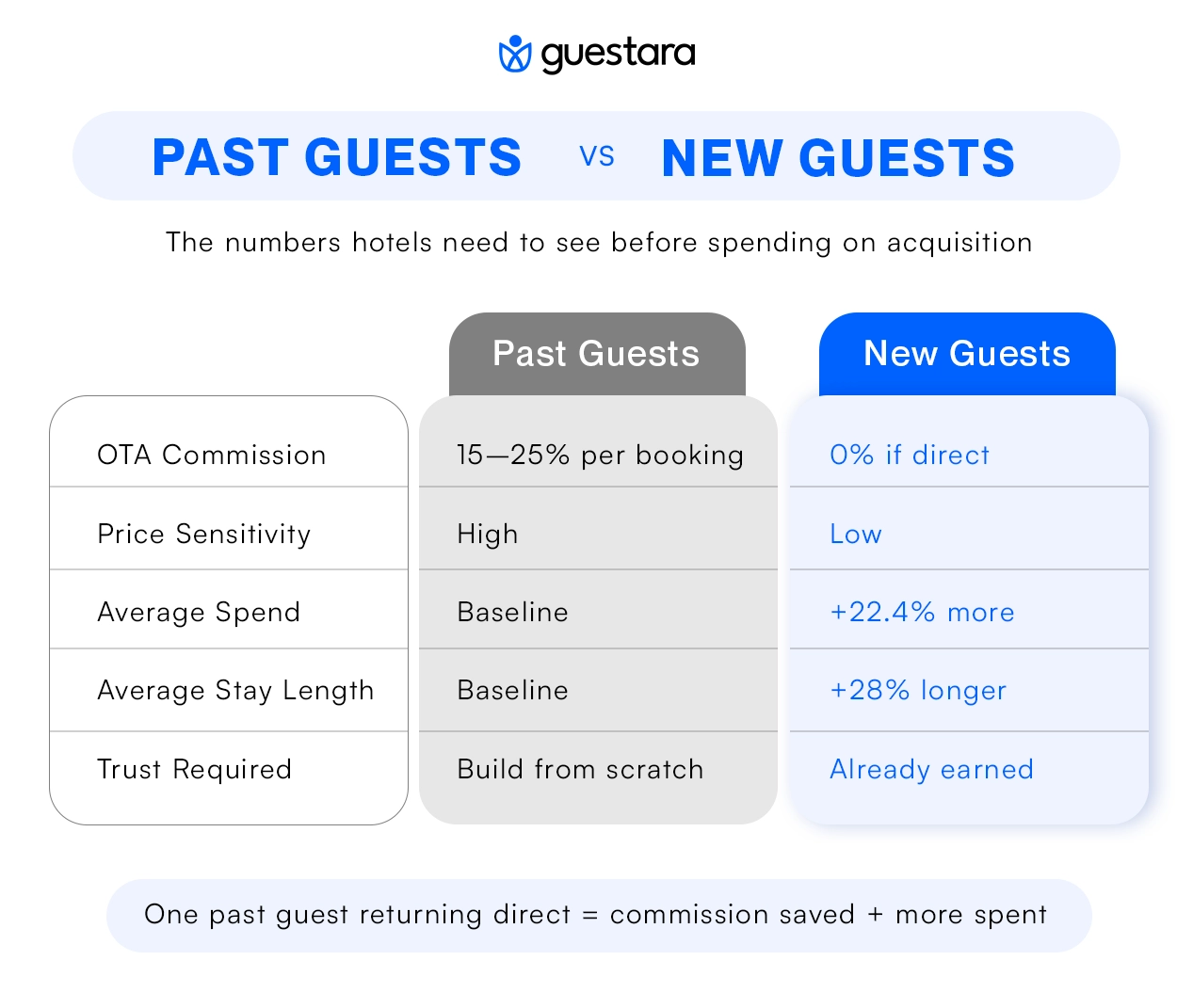
They already know where to park. They know the breakfast is good. They know the check-in staff by name. That familiarity has real economic weight. Loyalty members spend around 22.4% more and stay 28% longer than first-time guests, particularly when they receive personalised offers. Repeat guests are also less price-sensitive. They are not comparing your rate against a cheaper competitor on an OTA grid because they are not on the OTA grid anymore. They are responding to a message from a hotel they already trust.
The economics of reactivating a past guest beat new guest acquisition on every metric. There is no commission to pay. There is no cold awareness problem to solve. The only question is whether you can reach them on a channel they will actually open.
That is where hotel WhatsApp marketing changes the equation. Your past guests almost certainly have WhatsApp. With more than 2 billion active users across 180 countries, it is the most widely used messaging platform in the world, and in markets like India, the Middle East, and Southeast Asia, it is simply how people communicate. A message from a hotel they stayed at, arriving in their personal chat, reads nothing like a promotional email from a brand they barely remember. It reads like a message from somewhere they know.
The gap between email and WhatsApp on this is not marginal. WhatsApp messages are read by the vast majority of recipients, typically within minutes of arriving. Hotel email open rates in hospitality sit between 20% and 36%, and a large portion of those opens come too late to act on anything time-sensitive. For a flash deal, a birthday offer, or a seasonal package, the channel you choose determines whether the guest ever sees the offer at all.
.webp)
The hotels getting real results from WhatsApp are not running generic blasts. They are running targeted campaigns tied to specific moments that give the guest a clear reason to book now.
Here are the campaign types that work, why each one works, and what the message needs to do.
A guest turns 40. Their stay from two years ago is stored in your PMS. A WhatsApp message arrives a week before their birthday: a personalised offer for a two-night stay, a complimentary dinner, and early check-in already included in the rate.
This works for three reasons. It arrives on a channel they check constantly. It references something real and personal, not just "valued guest." And it lands at exactly the moment when a celebratory trip is already on their mind.
The same logic applies to wedding anniversaries. Couples who celebrated a milestone at your property before already associate your hotel with that occasion. A targeted message a few weeks before the date, acknowledging it and offering a package built around it, converts at a completely different rate than a generic promotional email sent to the entire database.
The trigger data already exists in your PMS. You have arrival dates, room types, any notes from check-in. You just need the mechanism to turn that data into a personalised WhatsApp message sent at the right time, automatically.
Not every guest has a birthday or anniversary on record. But every guest has travel moments tied to the calendar.
Long weekends. Festival seasons. School holidays. Summer breaks. A hotel that sends a targeted WhatsApp message two to three weeks before a major long weekend, with a specific rate and a direct booking link, is reaching guests when the decision to travel is already forming.
The message does not need to be elaborate. It needs to be timely, specific, and easy to act on.
"Hi Rahul, the Diwali long weekend is coming up. We have two nights available from the 30th at a rate only for past guests. Book directly here: [link]. Offer closes Friday."
That message arrives in a chat. It has one action. It expires. All three elements create enough momentum that a guest who was already half-thinking about a trip becomes a confirmed booking.
Segmentation matters here. A family that booked a deluxe room with an extra bed two years ago gets a different message than a couple who booked a sea-facing suite. Same occasion, different package, different angle. The conversion rate difference between a generic broadcast and a properly segmented one is significant.
Every hotel has a segment of guests who stayed once, rated the experience well, and then disappeared back into the OTA ecosystem on their next trip. Not because they had a bad experience. Because no one reached out.
A WhatsApp win-back campaign targets guests who have not returned within a defined window, typically 12 to 18 months, with a specific return offer.
The message acknowledges the gap without being awkward about it. It leads with the offer, not the sentiment.
"Hi Priya, it's been a while since your last stay with us. We've added a rooftop lounge and a new breakfast menu since you visited. Here's an exclusive rate for your next stay: [link]. Valid through [date]."
Short. Specific. Acts like a message from a place that remembers you, not a bulk campaign from a brand that does not.
Hotels using CRM data for targeted guest campaigns see up to a 35% increase in marketing engagement compared to untargeted sends, and around a 30% increase in repeat visits. WhatsApp gets those messages read. The combination is what drives the result.
Your revenue manager knows which weeknights next month look thin. Your front office manager knows which room categories are sitting empty. That information can power a WhatsApp campaign within hours.
A flash deal broadcast goes to a segment of past guests, typically those who stayed within the last year and whose booking history suggests flexibility on timing. The message is short, the offer is real, and the window is tight.
"Hi Amit, we have limited availability this Thursday and Friday at a rate we only offer to past guests. Three rooms left at [rate]. Book by tonight: [link]."
Scarcity in WhatsApp messages is not a gimmick. You do have three rooms left. The guest knows it is real because the channel feels personal rather than promotional. And because WhatsApp messages arrive in real time rather than sitting in an inbox, the campaign can fill those rooms in the same evening it goes out.
This one is different from the others because the guest has already booked. The campaign activates after a confirmed reservation, before arrival.
A guest who booked a standard room eight weeks out gets a WhatsApp message three weeks before arrival offering a room upgrade at a rate lower than the walk-in price. A guest who booked room-only gets an offer for a breakfast add-on or a spa package.
The timing and the channel together make this convert. Three weeks before a trip, the guest is starting to think about it. The message arrives in their chat, not their inbox. The offer is relevant to their actual booking. And the action is simple: one tap to accept, payment handled through the link.
Pre-arrival upsell emails are rarely opened. Pre-arrival WhatsApp messages are read by most guests who receive them, and a meaningful share accept the offer. That gap is the entire argument for shifting this campaign type to WhatsApp.
When a past guest books through an OTA on their second stay, you pay commission again. Typically 15% to 25% of the booking value. On a room rate of ₹8,000 per night for two nights, that is ₹2,400 to ₹4,000 paid to a platform for a guest who already knows you, already chose you, and had no need of the OTA's discovery function to find you.
A WhatsApp campaign to that same guest costs a fraction of a rupee per message. If they book direct, the commission is zero.
The compounding effect over a full year of repeat bookings from a database of a few thousand past guests is significant. And it is not a hypothetical. Research on customer retention consistently shows that a 5% increase in retention can increase profitability by 25 to 95%. Each direct booking that would otherwise have gone through an OTA is real margin recovered. The WhatsApp campaign is not just a marketing cost. It is a commission-reduction strategy.
Most hotels that try WhatsApp broadcast campaigns and give up make the same few mistakes.
They send the same message to everyone in the database regardless of stay history, room preference, or recency. They write messages that look like email copy: long, formatted, multiple links, a paragraph of context before the offer. They send too frequently, which trains guests to ignore the messages or opt out. And they send without a specific expiry or call to action, which removes the only reason to act now rather than later.
A high-converting hotel WhatsApp marketing campaign is different on every one of these dimensions.
It is segmented. A couple who stayed in a premium room gets a different message than a solo business traveller. A guest who visited six months ago gets a different message than one who visited three years ago.
It is short. The offer is in the first two lines. The action is one tap. There is nothing to read through before reaching the point.
It has a deadline. "Valid through Friday" is not pressure. It is information. Guests need a reason to act today rather than bookmarking the offer and forgetting it.
It arrives at the right time. A weekend getaway offer sent on a Monday morning, when the guest is at their desk thinking about the week ahead, converts better than the same message sent on a Saturday evening when they are already somewhere else.
And it uses the guest's name, references their stay history where relevant, and reads like a message from a hotel that knows them.
.webp)
The effectiveness of any WhatsApp campaign depends entirely on the quality of the segment it goes to. This is where most hotels underinvest.
Before sending a single message, pull your past guest data and organise it into segments that reflect real differences in intent and relevance.
Guests who stayed within the last six months. Guests who stayed six to eighteen months ago. Guests who stayed more than eighteen months ago. Each gets a different type of message. Recent guests are re-engagement targets. Older guests are win-back targets with a stronger incentive.
Guests with birthdays coming up in the next four to six weeks. Couples with anniversary dates in your records. Families with children, who respond to school holiday packages. Business travellers, who respond to midweek corporate rates.
Guests who previously upgraded at check-in are more likely to accept a pre-arrival upgrade offer. Guests who ordered in-room dining are more likely to respond to a dining package. Guests who added late checkout before are more likely to value a stay extension offer.
Guests who responded to a previous WhatsApp message are a warmer audience than those who have not yet been contacted. Treat them differently.
None of this requires sophisticated technology to start. It requires pulling the data your PMS already holds and organising it with intention before the campaign goes out.
The campaign mechanics above require two things to work at scale: a WhatsApp Business API connection and a way to trigger personalised messages from real guest data without someone building each campaign manually.
Guestara's hotel WhatsApp marketing platform connects directly to your PMS. When a birthday segment triggers, the message goes out automatically with the guest's name, the offer, and the booking link, without anyone manually building the broadcast. When a lapsed guest segment activates after 12 months of no booking, the win-back message goes out to the right people without a team member pulling a list and sending it by hand.
The platform supports broadcast campaigns, CSV uploads for bulk contact lists, scheduled campaigns for festivals and seasonal promotions, and one-click retargeting for guests who opened a previous offer but did not convert. Each contact can be tagged by booking type, VIP status, or preference, so the right segment gets the right offer every time.
The Unified Inbox means that when a guest replies to any campaign, whether they have a question, want to modify the package, or just want to confirm details, every conversation lands in one place. The team responds from there. No missed messages. No separate phone.
The analytics dashboard shows which campaigns drove bookings, what the revenue per campaign looked like, and which segments convert best. That data feeds back into the next campaign.
For hotels setting up WhatsApp for the first time alongside running campaigns for existing guests, the complete guide to hotel WhatsApp marketing covers the full implementation path. For a comparison of WhatsApp Business App versus the API that powers campaign functionality, the Business vs API guide is the right starting point.
WhatsApp requires explicit opt-in before you can send marketing messages to any guest. Booking a room does not automatically give you permission to message them.
Every guest in your broadcast segment must have opted in at some point, either during the booking process, at check-in, or through a post-stay opt-in request. If your existing database was built before you had a formal opt-in mechanism, you need to send an opt-in request through email or SMS first, then move confirmed opt-ins to your WhatsApp list before broadcasting.
Every marketing broadcast uses a pre-approved WhatsApp template. You cannot improvise the copy. Templates are submitted to WhatsApp for approval in advance. This is not a creative constraint. It is a compliance requirement that good platforms handle as part of the setup process.
Guests can opt out at any time by replying STOP. You must honour it immediately.
Getting this right protects your sending number. An account flagged for spam violations faces reduced sending limits or suspension. The WhatsApp account is the asset. Running compliant campaigns is how you protect it long-term.
Only 12% of hotels currently use WhatsApp marketing strategically. Most of the 88% who are not are not staying away because WhatsApp does not work for hotels. They are staying away because nobody has shown them how to do it compliantly and systematically. That gap is the opportunity.
A campaign that sends is not a campaign that works. Track a small number of clear metrics to know whether what you are running is generating real return.
If messages are not being delivered or read, something is wrong with the list quality or opt-in status of the contacts. Fix this before optimising anything else.
Guests who reply are engaged. A reply rate above 10% on a broadcast campaign to a past guest list is a strong signal. Below that, the message or the segment needs rethinking.
Track how many guests who received the message booked directly within 48 to 72 hours of receiving it. This is the only metric that proves the campaign earned its cost.
Total direct booking revenue attributable to the campaign divided by the cost of sending it. For most hotel WhatsApp campaigns targeted at past guests, this ratio is strong because the per-message cost is low and the commission saved on each direct booking is not.
A rising opt-out rate signals that you are messaging too frequently or sending offers that are not relevant to the segment. Pull back on frequency and sharpen segmentation before the next send.
Review these numbers after every campaign. The hotels that improve quickly treat each campaign as data, not just revenue.
If your property has thousands of past guest contacts sitting in a PMS and you are still paying OTA commission every time those guests rebook, the gap between what WhatsApp marketing costs and what it recovers is significant.
Guestara's platform connects your guest data to WhatsApp campaigns that run automatically, reach the right guests at the right time, and bring bookings back to your direct channel.
See how the platform works or book a demo to walk through it for a property like yours.


Hotels sitting on thousands of guest contacts are using WhatsApp campaigns to drive repeat direct bookings. Here's how birthday, anniversary, and deal campaigns work.
Most hotels spend their entire marketing budget chasing strangers.
Paid ads, OTA listings, metasearch bidding. Every rupee or dollar going toward people who have never heard of the property, have no reason to trust it, and are comparing it against seventeen competitors on a tab they will close in forty seconds.
Meanwhile, the same hotel has a database of thousands of guests who already stayed, already paid, already liked it enough not to leave a bad review. Names, phone numbers, stay history, room preferences. All sitting in a PMS doing nothing.
That is the problem this post addresses. Not how to attract new guests through WhatsApp. How to activate the guests you already have, using targeted WhatsApp campaigns that feel personal and convert at a level email cannot come close to matching.
A guest who has stayed at your property before is not the same as a stranger browsing Booking.com.
They already know where to park. They know the breakfast is good. They know the check-in staff by name. That familiarity has real economic weight. Loyalty members spend around 22.4% more and stay 28% longer than first-time guests, particularly when they receive personalised offers. Repeat guests are also less price-sensitive. They are not comparing your rate against a cheaper competitor on an OTA grid because they are not on the OTA grid anymore. They are responding to a message from a hotel they already trust.
The economics of reactivating a past guest beat new guest acquisition on every metric. There is no commission to pay. There is no cold awareness problem to solve. The only question is whether you can reach them on a channel they will actually open.
That is where hotel WhatsApp marketing changes the equation. Your past guests almost certainly have WhatsApp. With more than 2 billion active users across 180 countries, it is the most widely used messaging platform in the world, and in markets like India, the Middle East, and Southeast Asia, it is simply how people communicate. A message from a hotel they stayed at, arriving in their personal chat, reads nothing like a promotional email from a brand they barely remember. It reads like a message from somewhere they know.
The gap between email and WhatsApp on this is not marginal. WhatsApp messages are read by the vast majority of recipients, typically within minutes of arriving. Hotel email open rates in hospitality sit between 20% and 36%, and a large portion of those opens come too late to act on anything time-sensitive. For a flash deal, a birthday offer, or a seasonal package, the channel you choose determines whether the guest ever sees the offer at all.
The hotels getting real results from WhatsApp are not running generic blasts. They are running targeted campaigns tied to specific moments that give the guest a clear reason to book now.
Here are the campaign types that work, why each one works, and what the message needs to do.
A guest turns 40. Their stay from two years ago is stored in your PMS. A WhatsApp message arrives a week before their birthday: a personalised offer for a two-night stay, a complimentary dinner, and early check-in already included in the rate.
This works for three reasons. It arrives on a channel they check constantly. It references something real and personal, not just "valued guest." And it lands at exactly the moment when a celebratory trip is already on their mind.
The same logic applies to wedding anniversaries. Couples who celebrated a milestone at your property before already associate your hotel with that occasion. A targeted message a few weeks before the date, acknowledging it and offering a package built around it, converts at a completely different rate than a generic promotional email sent to the entire database.
The trigger data already exists in your PMS. You have arrival dates, room types, any notes from check-in. You just need the mechanism to turn that data into a personalised WhatsApp message sent at the right time, automatically.
Not every guest has a birthday or anniversary on record. But every guest has travel moments tied to the calendar.
Long weekends. Festival seasons. School holidays. Summer breaks. A hotel that sends a targeted WhatsApp message two to three weeks before a major long weekend, with a specific rate and a direct booking link, is reaching guests when the decision to travel is already forming.
The message does not need to be elaborate. It needs to be timely, specific, and easy to act on.
"Hi Rahul, the Diwali long weekend is coming up. We have two nights available from the 30th at a rate only for past guests. Book directly here: [link]. Offer closes Friday."
That message arrives in a chat. It has one action. It expires. All three elements create enough momentum that a guest who was already half-thinking about a trip becomes a confirmed booking.
Segmentation matters here. A family that booked a deluxe room with an extra bed two years ago gets a different message than a couple who booked a sea-facing suite. Same occasion, different package, different angle. The conversion rate difference between a generic broadcast and a properly segmented one is significant.
Every hotel has a segment of guests who stayed once, rated the experience well, and then disappeared back into the OTA ecosystem on their next trip. Not because they had a bad experience. Because no one reached out.
A WhatsApp win-back campaign targets guests who have not returned within a defined window, typically 12 to 18 months, with a specific return offer.
The message acknowledges the gap without being awkward about it. It leads with the offer, not the sentiment.
"Hi Priya, it's been a while since your last stay with us. We've added a rooftop lounge and a new breakfast menu since you visited. Here's an exclusive rate for your next stay: [link]. Valid through [date]."
Short. Specific. Acts like a message from a place that remembers you, not a bulk campaign from a brand that does not.
Hotels using CRM data for targeted guest campaigns see up to a 35% increase in marketing engagement compared to untargeted sends, and around a 30% increase in repeat visits. WhatsApp gets those messages read. The combination is what drives the result.
Your revenue manager knows which weeknights next month look thin. Your front office manager knows which room categories are sitting empty. That information can power a WhatsApp campaign within hours.
A flash deal broadcast goes to a segment of past guests, typically those who stayed within the last year and whose booking history suggests flexibility on timing. The message is short, the offer is real, and the window is tight.
"Hi Amit, we have limited availability this Thursday and Friday at a rate we only offer to past guests. Three rooms left at [rate]. Book by tonight: [link]."
Scarcity in WhatsApp messages is not a gimmick. You do have three rooms left. The guest knows it is real because the channel feels personal rather than promotional. And because WhatsApp messages arrive in real time rather than sitting in an inbox, the campaign can fill those rooms in the same evening it goes out.
This one is different from the others because the guest has already booked. The campaign activates after a confirmed reservation, before arrival.
A guest who booked a standard room eight weeks out gets a WhatsApp message three weeks before arrival offering a room upgrade at a rate lower than the walk-in price. A guest who booked room-only gets an offer for a breakfast add-on or a spa package.
The timing and the channel together make this convert. Three weeks before a trip, the guest is starting to think about it. The message arrives in their chat, not their inbox. The offer is relevant to their actual booking. And the action is simple: one tap to accept, payment handled through the link.
Pre-arrival upsell emails are rarely opened. Pre-arrival WhatsApp messages are read by most guests who receive them, and a meaningful share accept the offer. That gap is the entire argument for shifting this campaign type to WhatsApp.
When a past guest books through an OTA on their second stay, you pay commission again. Typically 15% to 25% of the booking value. On a room rate of ₹8,000 per night for two nights, that is ₹2,400 to ₹4,000 paid to a platform for a guest who already knows you, already chose you, and had no need of the OTA's discovery function to find you.
A WhatsApp campaign to that same guest costs a fraction of a rupee per message. If they book direct, the commission is zero.
The compounding effect over a full year of repeat bookings from a database of a few thousand past guests is significant. And it is not a hypothetical. Research on customer retention consistently shows that a 5% increase in retention can increase profitability by 25 to 95%. Each direct booking that would otherwise have gone through an OTA is real margin recovered. The WhatsApp campaign is not just a marketing cost. It is a commission-reduction strategy.
Most hotels that try WhatsApp broadcast campaigns and give up make the same few mistakes.
They send the same message to everyone in the database regardless of stay history, room preference, or recency. They write messages that look like email copy: long, formatted, multiple links, a paragraph of context before the offer. They send too frequently, which trains guests to ignore the messages or opt out. And they send without a specific expiry or call to action, which removes the only reason to act now rather than later.
A high-converting hotel WhatsApp marketing campaign is different on every one of these dimensions.
It is segmented. A couple who stayed in a premium room gets a different message than a solo business traveller. A guest who visited six months ago gets a different message than one who visited three years ago.
It is short. The offer is in the first two lines. The action is one tap. There is nothing to read through before reaching the point.
It has a deadline. "Valid through Friday" is not pressure. It is information. Guests need a reason to act today rather than bookmarking the offer and forgetting it.
It arrives at the right time. A weekend getaway offer sent on a Monday morning, when the guest is at their desk thinking about the week ahead, converts better than the same message sent on a Saturday evening when they are already somewhere else.
And it uses the guest's name, references their stay history where relevant, and reads like a message from a hotel that knows them.
The effectiveness of any WhatsApp campaign depends entirely on the quality of the segment it goes to. This is where most hotels underinvest.
Before sending a single message, pull your past guest data and organise it into segments that reflect real differences in intent and relevance.
Guests who stayed within the last six months. Guests who stayed six to eighteen months ago. Guests who stayed more than eighteen months ago. Each gets a different type of message. Recent guests are re-engagement targets. Older guests are win-back targets with a stronger incentive.
Guests with birthdays coming up in the next four to six weeks. Couples with anniversary dates in your records. Families with children, who respond to school holiday packages. Business travellers, who respond to midweek corporate rates.
Guests who previously upgraded at check-in are more likely to accept a pre-arrival upgrade offer. Guests who ordered in-room dining are more likely to respond to a dining package. Guests who added late checkout before are more likely to value a stay extension offer.
Guests who responded to a previous WhatsApp message are a warmer audience than those who have not yet been contacted. Treat them differently.
None of this requires sophisticated technology to start. It requires pulling the data your PMS already holds and organising it with intention before the campaign goes out.
The campaign mechanics above require two things to work at scale: a WhatsApp Business API connection and a way to trigger personalised messages from real guest data without someone building each campaign manually.
Guestara's hotel WhatsApp marketing platform connects directly to your PMS. When a birthday segment triggers, the message goes out automatically with the guest's name, the offer, and the booking link, without anyone manually building the broadcast. When a lapsed guest segment activates after 12 months of no booking, the win-back message goes out to the right people without a team member pulling a list and sending it by hand.
The platform supports broadcast campaigns, CSV uploads for bulk contact lists, scheduled campaigns for festivals and seasonal promotions, and one-click retargeting for guests who opened a previous offer but did not convert. Each contact can be tagged by booking type, VIP status, or preference, so the right segment gets the right offer every time.
The Unified Inbox means that when a guest replies to any campaign, whether they have a question, want to modify the package, or just want to confirm details, every conversation lands in one place. The team responds from there. No missed messages. No separate phone.
The analytics dashboard shows which campaigns drove bookings, what the revenue per campaign looked like, and which segments convert best. That data feeds back into the next campaign.
For hotels setting up WhatsApp for the first time alongside running campaigns for existing guests, the complete guide to hotel WhatsApp marketing covers the full implementation path. For a comparison of WhatsApp Business App versus the API that powers campaign functionality, the Business vs API guide is the right starting point.
WhatsApp requires explicit opt-in before you can send marketing messages to any guest. Booking a room does not automatically give you permission to message them.
Every guest in your broadcast segment must have opted in at some point, either during the booking process, at check-in, or through a post-stay opt-in request. If your existing database was built before you had a formal opt-in mechanism, you need to send an opt-in request through email or SMS first, then move confirmed opt-ins to your WhatsApp list before broadcasting.
Every marketing broadcast uses a pre-approved WhatsApp template. You cannot improvise the copy. Templates are submitted to WhatsApp for approval in advance. This is not a creative constraint. It is a compliance requirement that good platforms handle as part of the setup process.
Guests can opt out at any time by replying STOP. You must honour it immediately.
Getting this right protects your sending number. An account flagged for spam violations faces reduced sending limits or suspension. The WhatsApp account is the asset. Running compliant campaigns is how you protect it long-term.
Only 12% of hotels currently use WhatsApp marketing strategically. Most of the 88% who are not are not staying away because WhatsApp does not work for hotels. They are staying away because nobody has shown them how to do it compliantly and systematically. That gap is the opportunity.
A campaign that sends is not a campaign that works. Track a small number of clear metrics to know whether what you are running is generating real return.
If messages are not being delivered or read, something is wrong with the list quality or opt-in status of the contacts. Fix this before optimising anything else.
Guests who reply are engaged. A reply rate above 10% on a broadcast campaign to a past guest list is a strong signal. Below that, the message or the segment needs rethinking.
Track how many guests who received the message booked directly within 48 to 72 hours of receiving it. This is the only metric that proves the campaign earned its cost.
Total direct booking revenue attributable to the campaign divided by the cost of sending it. For most hotel WhatsApp campaigns targeted at past guests, this ratio is strong because the per-message cost is low and the commission saved on each direct booking is not.
A rising opt-out rate signals that you are messaging too frequently or sending offers that are not relevant to the segment. Pull back on frequency and sharpen segmentation before the next send.
Review these numbers after every campaign. The hotels that improve quickly treat each campaign as data, not just revenue.
If your property has thousands of past guest contacts sitting in a PMS and you are still paying OTA commission every time those guests rebook, the gap between what WhatsApp marketing costs and what it recovers is significant.
Guestara's platform connects your guest data to WhatsApp campaigns that run automatically, reach the right guests at the right time, and bring bookings back to your direct channel.
See how the platform works or book a demo to walk through it for a property like yours.
Hotel WhatsApp marketing for direct bookings means using the WhatsApp Business API to send targeted campaigns to past guests, with the goal of bringing them back to book directly rather than through an OTA. Campaigns target specific moments like birthdays, anniversaries, seasonal packages, or lapsed guest win-backs. Because WhatsApp messages are read by most recipients within minutes of arrival, these campaigns reach guests at a level email cannot match. A direct booking through WhatsApp saves the hotel the OTA commission it would otherwise pay on that stay.
Any hotel with a guest database of at least a few hundred opted-in contacts can run effective WhatsApp campaigns. The benefit scales with database size. Properties with thousands of past guest records, typical of mid-sized hotels, hotel groups, and resorts that have been operating for several years, have enough data to run properly segmented campaigns targeting different guest types with different offers simultaneously. A 30-room boutique with 300 past guests can run a birthday campaign or a seasonal offer. A 200-room property with 15,000 records can run five or six segmented campaigns at once targeting different cohorts.
The most effective method is collecting opt-in at the time of booking or check-in, with clear language: "Receive your check-in link, stay updates, and exclusive offers by WhatsApp." Post-stay, a review request sent by SMS or email can include a line offering exclusive deals if the guest opts into WhatsApp for future stays. Any guest who messages the hotel directly via WhatsApp is automatically opted in for service messages and, with a clear prompt, for marketing messages as well.
Monthly is a reasonable ceiling for most properties. Quarterly works well for smaller databases or properties with fewer campaign types. The risk of over-messaging is real: guests who feel spammed opt out, and once they are off the list they cannot be recontacted on WhatsApp. The priority is relevance over frequency. One well-targeted birthday campaign to the right 50 guests converts better than a generic blast to 5,000.
Results vary by property, database quality, and campaign type. Birthday and anniversary campaigns, which target a small but highly relevant segment, tend to convert at higher rates than seasonal broadcasts because the offer is directly relevant to the recipient's moment. Win-back campaigns to guests inactive for 12 to 18 months typically see strong open and reply rates if the offer is specific and time-limited. Across all campaign types, WhatsApp consistently outperforms email on both engagement and conversion because the message reaches people in a channel they use throughout the day.
We work closely with the industry leaders to offer seamless solutions




We’re here to help your whole team stay ahead of the curve as you grow.

Get up and running quickly with a personalized onboarding plan

Connect with real people who really get it, 24/7

Checkout our vast library of free resources, templates and more
There's only so much we can say — so let us show you! Schedule a demo today and reach your business goals.


.png)