WhatsApp open rates beat email and SMS for hotels, but revenue per message is the number that counts. See the real figures and what they mean for your property.




Only 12% of hotels use WhatsApp as part of their marketing. The rest are mostly sending email, the channel most guests never open.
That number comes from Bookboost's State of Data-driven Marketing in Hospitality report. Another 63% of hotels either ignore WhatsApp completely or use it only for operational notices like a booking confirmation. So while guests check WhatsApp through the day, the offers that could earn a property real upsell revenue sit unread in inboxes.
Most articles on this topic stop at one question. Which channel has the better open rate. That is the wrong question. Open rate tells you a message was seen. It tells you nothing about whether a guest acted on it. The number that decides whether a channel earns its place is revenue per message. On that number, the gap between WhatsApp and email is not small. It is a different outcome.
This blog covers the real WhatsApp open rates against email and SMS, what the numbers mean in revenue terms, where WhatsApp fits across the guest stay, what it costs, and where SMS still wins.
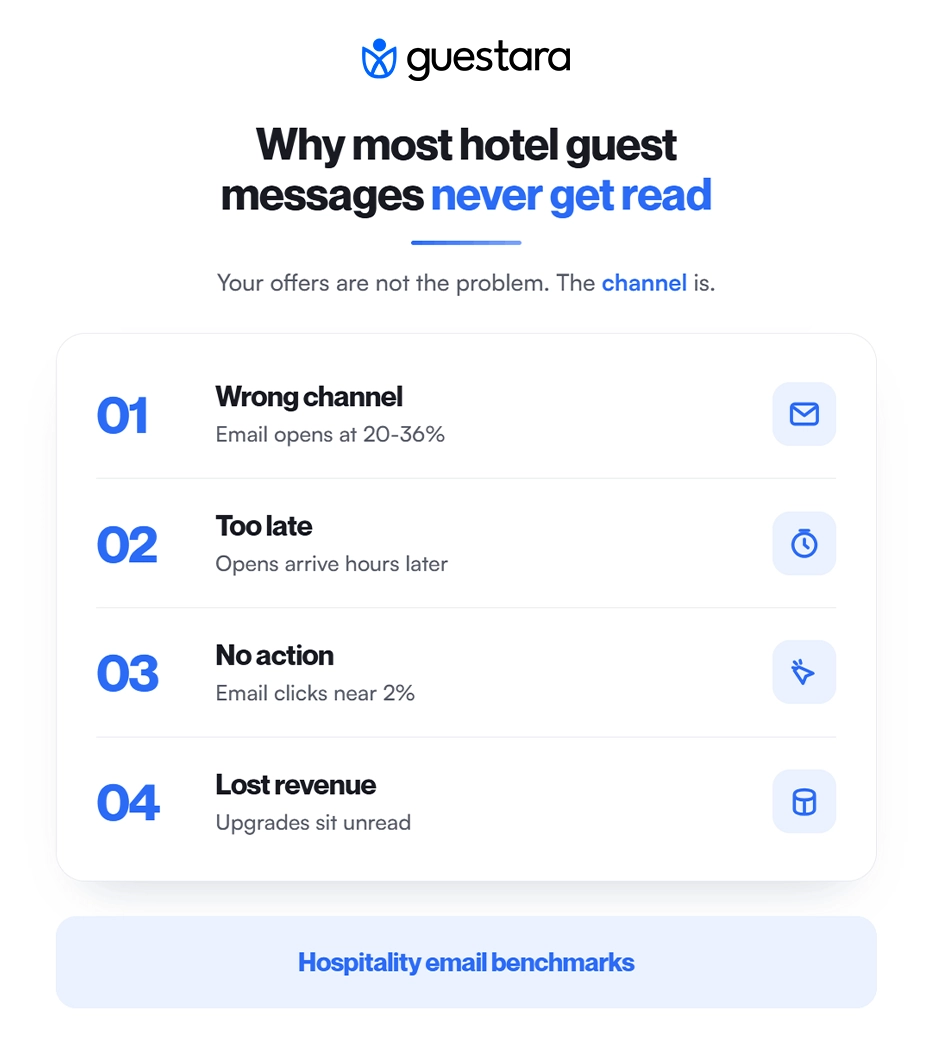
WhatsApp messages get read at far higher rates than hotel email. Reported WhatsApp read rates range from about 70% in measured campaign data to the 98% figure vendors often quote, and most messages are read within minutes of arriving. Hotel email open rates sit between roughly 20% and 36% depending on the report, and a large share of those opens happen hours later or not at all. SMS reads almost as well as WhatsApp.
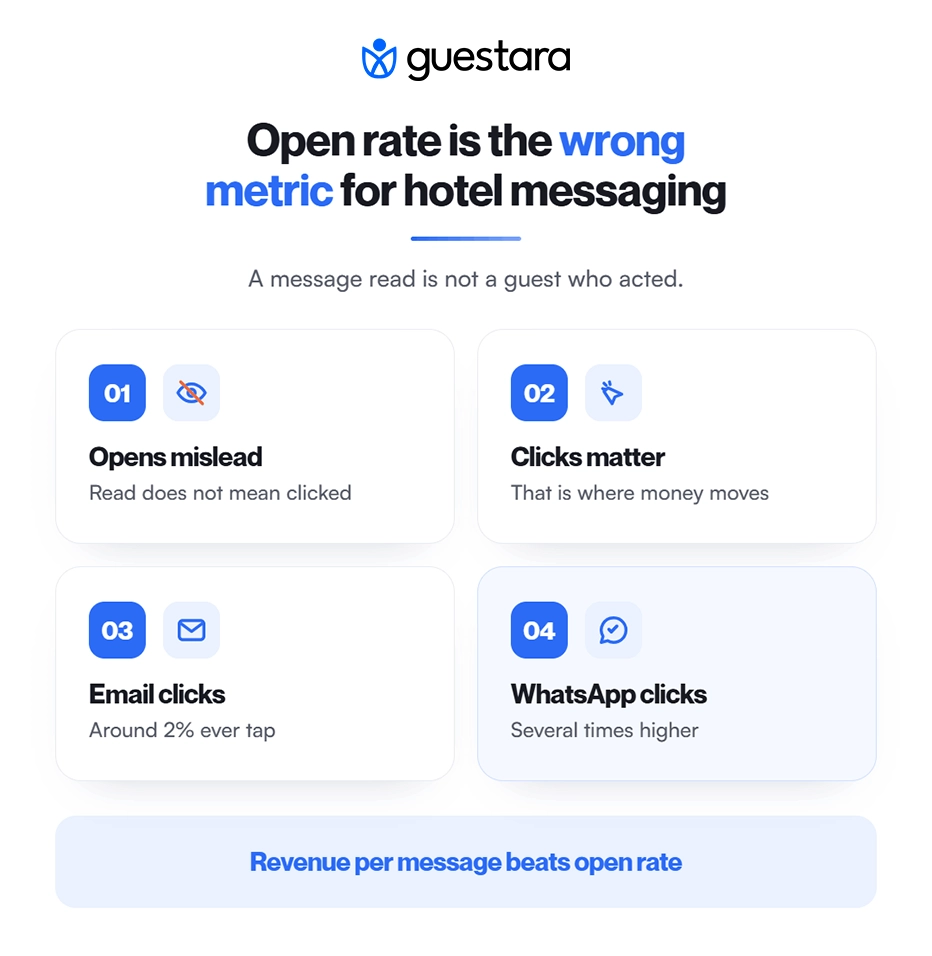
But open rate is the vanity metric. The metric that moves money is the click. A guest has to tap the offer for anything to happen.
This is where the three channels separate. Hotel email click rates sit near 2%. WhatsApp link clicks run several times higher, because the message lands in a chat the guest already checks and carries one clear action rather than a wall of formatted email. SMS sits in between. It gets read, but plain text with no rich buttons or images gives the guest less to act on.
Picture a room-upgrade offer sent to 1,000 arriving guests. By email, maybe 200 to 360 open it, and at a 2% click rate only a handful ever tap it. By WhatsApp, 700 or more read it, and even at a click rate well below the figures vendors quote, a few hundred treat the offer as a live option and a meaningful number act on it. That is not a few percent of difference. One channel reaches almost every guest and gets real responses. The other never reaches most of them. That is the case for treating WhatsApp as a revenue channel, not just a messaging one.
WhatsApp earns its place in hotel operations because it fits the moments where guests are already on their phone. Inside a guest experience platform like Guestara, it works across the whole stay rather than as a standalone campaign tool.
The check-in link goes out by WhatsApp 24 hours before arrival. The guest taps it, scans an ID, and the form auto-fills, so registration finishes in about 30 seconds. The same window is the best moment to offer a room upgrade or an add-on, because the guest is already thinking about the trip and looking at their phone. The same offer by email mostly goes unseen.
Requests for extra towels, room service, or a late checkout come in by WhatsApp and get answered fast. Over half of WhatsApp business messages get a reply within a minute, which matches what guests expect from a chat. Guestara's WhatsApp AI handles a large share of routine questions on its own, like WiFi passwords and pool hours, so staff are free for the requests that need a person. (Note for Pratik: confirm the exact share before publishing. The 30-40% figure in the brief is not on the approved claims list.)
A review request goes out by WhatsApp an hour or two before checkout, when the stay is fresh. A happy guest gets sent to Google or TripAdvisor to post publicly. An unhappy one triggers an internal alert so staff can fix the issue while the guest is still on property, before it becomes a public one-star.
A thank-you message and a return offer land in the same chat the guest already used through their stay, so re-engagement does not start cold the way a post-stay email does. The conversation is already open.
This is not only an independent-hotel idea. Hilton rolled out guest messaging across its 7,000-plus properties, including WhatsApp alongside its app and SMS, through a partner called Kipsu. In 2023 that messaging drove more than 10.5 million guest conversations, and 70% of guests who used it said it improved their stay. If the largest chains are building around guest messaging, smaller properties have room to do the same with far less complexity.
WhatsApp is the default way Indian guests communicate. India has more than 500 million WhatsApp users, the largest base in the world, and messages are typically read within minutes. For a guest in India, a WhatsApp message from a hotel feels normal. An email feels like a form.
Independent hotels have an advantage here that chains do not. A large chain runs WhatsApp as one channel inside a stack of enterprise systems. A single independent property can build its entire guest communication around WhatsApp, from the pre-arrival check-in link to in-stay requests to the review ask, and it reads as personal rather than corporate.
The 12% adoption gap is widest in the independent segment. A property that moves now is not an early adopter taking a risk. It is catching up to what guests already expect, which the chains are already meeting.
WhatsApp is not free the way email is, and that is the first thing operators want to know. Since July 2025, WhatsApp charges per message rather than per 24-hour conversation. Marketing templates, like a promotional upgrade offer, cost the most. Utility templates, like a booking confirmation or a check-in link, cost less, and they are free when sent inside the 24-hour window after a guest messages you. Replies to a guest who contacted you first are free for that 24-hour window.
Rates vary by country, and India has among the lowest in the world, which is part of why the channel works so well there. High-volume senders also unlock lower per-message rates.
For a property sending a few well-timed messages per guest, the cost per booking influenced is small set against an upgrade sold or a dining order placed. The point is not that WhatsApp is cheap. The point is that you pay for messages guests actually read. A cheap email that nobody opens costs you the upsell instead, which is the more expensive outcome.
WhatsApp is not always the right channel, and a credible comparison has to say so. SMS still wins in three cases.
First, guests who do not use WhatsApp. This matters in the United States and parts of East Asia, where other apps or plain SMS dominate. Second, the one message that must reach everyone regardless of app, like a booking confirmation or an emergency notice, because SMS reaches any phone with a signal. Third, markets or guest segments where you do not yet have WhatsApp opt-in.
SMS reads almost as well as WhatsApp, close to the high nineties, but it is text only. It cannot carry the buttons, images, and menus that make WhatsApp convert.
The practical answer for most hotels is not WhatsApp instead of SMS. It is WhatsApp as the primary channel for anything that needs a guest to act, with SMS as the fallback for guests you cannot reach on WhatsApp.
Here is the rule for which channel carries which message. If the message needs the guest to do something, like complete check-in, accept an upgrade, or leave a review, send it by WhatsApp, because that is where guests act. If the message only needs to reach the guest no matter what, like a confirmation or a safety notice, SMS is the safe fallback because it reaches any phone. If the message is long-form and not time-sensitive, like a monthly newsletter or a detailed receipt, email is fine, because nobody needs to act on it in the moment.
Most hotels do not need to pick a single channel. They need to stop using email for the messages that were always meant to drive action.
WhatsApp does not let hotels message guests freely, and getting consent right is the part most properties underestimate. You need explicit opt-in before sending marketing messages, which you collect at booking or check-in. Guests can opt out by replying STOP, and you must honor it.
Every business-initiated message uses a template that WhatsApp approves in advance, so you cannot improvise a promotional blast the way you can with email. Where data rules like GDPR apply, the same consent and data-handling standards you use for email apply here.
A platform built for hotels handles the opt-in records, the template approval workflow, and the opt-out logic for you. That is the difference between running WhatsApp safely and risking your sending number getting blocked.
The hotels that try WhatsApp and give up usually make the same few mistakes.
They treat it like email and send long, formatted messages with several links, when WhatsApp rewards one short message with one clear action. They send marketing templates with no opt-in and get reported as spam, which lowers their sending limits. They reply by hand from a single phone, which works for ten guests and collapses at fifty. And they run it as a separate tool with its own login, disconnected from the booking data that should trigger the messages, so every send is manual.
The properties that succeed do the opposite. Short messages. Clear consent. Automation tied to the PMS. One dashboard.
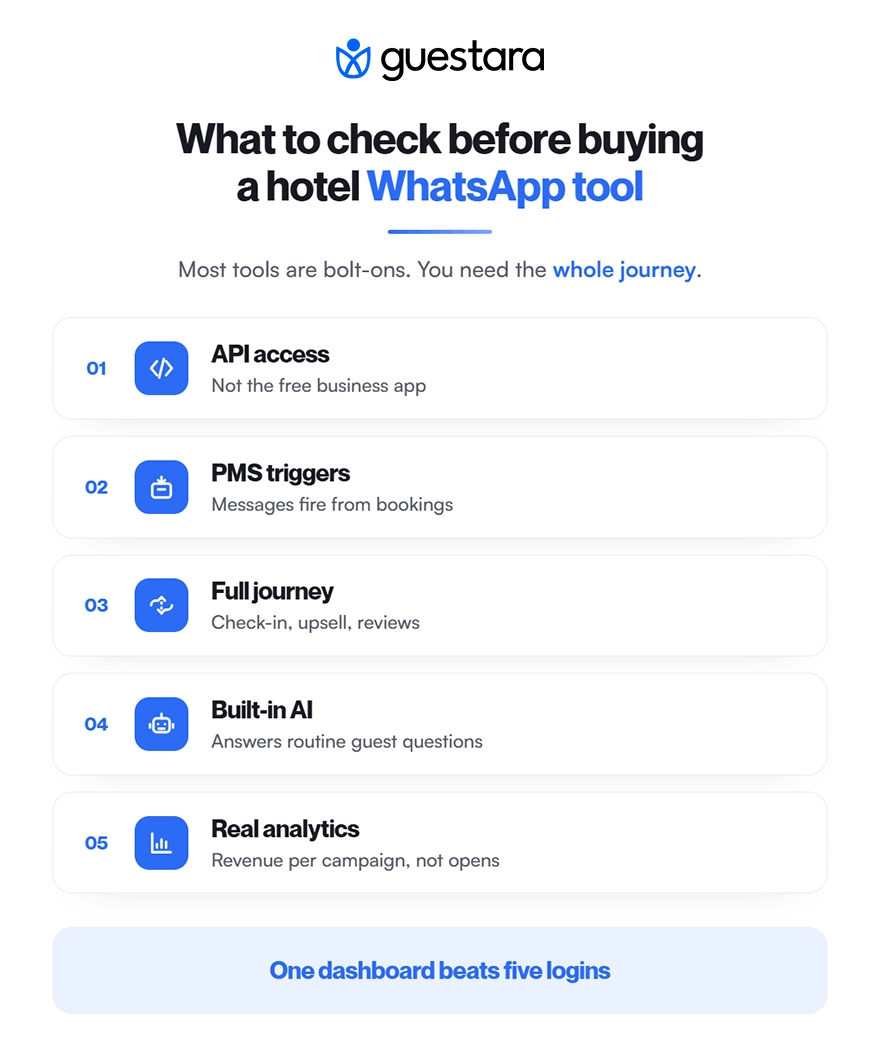
The first thing to check is WhatsApp Business API access, not just the free WhatsApp Business app. The app is fine for one person replying by hand. Automation, broadcasts, and reporting at the scale of a hotel need the API.
Next is the connection to your PMS. WhatsApp messages should fire from real booking and stay events, like a confirmed reservation or a completed checkout, rather than someone sending each one manually. That is the difference between a tool you operate and a system that runs itself.
From there, look for built-in guest journey automation, so the pre-arrival, in-stay, and pre-checkout messages already exist as templates and do not need custom development. Look for an AI layer that answers routine questions instead of only routing them to staff. Look for broadcast and segment features, so you can send a targeted offer to the right group of guests, not just reply to one chat at a time. Look for analytics that show open rates, click rates, and revenue per campaign, because revenue is the number that matters. And look for compliance handling: opt-in management, the WhatsApp template approval process, and data rules where they apply.
A WhatsApp marketing platform that runs inside the guest journey, triggering messages from actual booking and stay events in your PMS, will always outperform one that needs someone to send each campaign by hand.


WhatsApp open rates beat email and SMS for hotels, but revenue per message is the number that counts. See the real figures and what they mean for your property.
Only 12% of hotels use WhatsApp as part of their marketing. The rest are mostly sending email, the channel most guests never open.
That number comes from Bookboost's State of Data-driven Marketing in Hospitality report. Another 63% of hotels either ignore WhatsApp completely or use it only for operational notices like a booking confirmation. So while guests check WhatsApp through the day, the offers that could earn a property real upsell revenue sit unread in inboxes.
Most articles on this topic stop at one question. Which channel has the better open rate. That is the wrong question. Open rate tells you a message was seen. It tells you nothing about whether a guest acted on it. The number that decides whether a channel earns its place is revenue per message. On that number, the gap between WhatsApp and email is not small. It is a different outcome.
This blog covers the real WhatsApp open rates against email and SMS, what the numbers mean in revenue terms, where WhatsApp fits across the guest stay, what it costs, and where SMS still wins.
WhatsApp messages get read at far higher rates than hotel email. Reported WhatsApp read rates range from about 70% in measured campaign data to the 98% figure vendors often quote, and most messages are read within minutes of arriving. Hotel email open rates sit between roughly 20% and 36% depending on the report, and a large share of those opens happen hours later or not at all. SMS reads almost as well as WhatsApp.
But open rate is the vanity metric. The metric that moves money is the click. A guest has to tap the offer for anything to happen.
This is where the three channels separate. Hotel email click rates sit near 2%. WhatsApp link clicks run several times higher, because the message lands in a chat the guest already checks and carries one clear action rather than a wall of formatted email. SMS sits in between. It gets read, but plain text with no rich buttons or images gives the guest less to act on.
Picture a room-upgrade offer sent to 1,000 arriving guests. By email, maybe 200 to 360 open it, and at a 2% click rate only a handful ever tap it. By WhatsApp, 700 or more read it, and even at a click rate well below the figures vendors quote, a few hundred treat the offer as a live option and a meaningful number act on it. That is not a few percent of difference. One channel reaches almost every guest and gets real responses. The other never reaches most of them. That is the case for treating WhatsApp as a revenue channel, not just a messaging one.
WhatsApp earns its place in hotel operations because it fits the moments where guests are already on their phone. Inside a guest experience platform like Guestara, it works across the whole stay rather than as a standalone campaign tool.
The check-in link goes out by WhatsApp 24 hours before arrival. The guest taps it, scans an ID, and the form auto-fills, so registration finishes in about 30 seconds. The same window is the best moment to offer a room upgrade or an add-on, because the guest is already thinking about the trip and looking at their phone. The same offer by email mostly goes unseen.
Requests for extra towels, room service, or a late checkout come in by WhatsApp and get answered fast. Over half of WhatsApp business messages get a reply within a minute, which matches what guests expect from a chat. Guestara's WhatsApp AI handles a large share of routine questions on its own, like WiFi passwords and pool hours, so staff are free for the requests that need a person. (Note for Pratik: confirm the exact share before publishing. The 30-40% figure in the brief is not on the approved claims list.)
A review request goes out by WhatsApp an hour or two before checkout, when the stay is fresh. A happy guest gets sent to Google or TripAdvisor to post publicly. An unhappy one triggers an internal alert so staff can fix the issue while the guest is still on property, before it becomes a public one-star.
A thank-you message and a return offer land in the same chat the guest already used through their stay, so re-engagement does not start cold the way a post-stay email does. The conversation is already open.
This is not only an independent-hotel idea. Hilton rolled out guest messaging across its 7,000-plus properties, including WhatsApp alongside its app and SMS, through a partner called Kipsu. In 2023 that messaging drove more than 10.5 million guest conversations, and 70% of guests who used it said it improved their stay. If the largest chains are building around guest messaging, smaller properties have room to do the same with far less complexity.
WhatsApp is the default way Indian guests communicate. India has more than 500 million WhatsApp users, the largest base in the world, and messages are typically read within minutes. For a guest in India, a WhatsApp message from a hotel feels normal. An email feels like a form.
Independent hotels have an advantage here that chains do not. A large chain runs WhatsApp as one channel inside a stack of enterprise systems. A single independent property can build its entire guest communication around WhatsApp, from the pre-arrival check-in link to in-stay requests to the review ask, and it reads as personal rather than corporate.
The 12% adoption gap is widest in the independent segment. A property that moves now is not an early adopter taking a risk. It is catching up to what guests already expect, which the chains are already meeting.
WhatsApp is not free the way email is, and that is the first thing operators want to know. Since July 2025, WhatsApp charges per message rather than per 24-hour conversation. Marketing templates, like a promotional upgrade offer, cost the most. Utility templates, like a booking confirmation or a check-in link, cost less, and they are free when sent inside the 24-hour window after a guest messages you. Replies to a guest who contacted you first are free for that 24-hour window.
Rates vary by country, and India has among the lowest in the world, which is part of why the channel works so well there. High-volume senders also unlock lower per-message rates.
For a property sending a few well-timed messages per guest, the cost per booking influenced is small set against an upgrade sold or a dining order placed. The point is not that WhatsApp is cheap. The point is that you pay for messages guests actually read. A cheap email that nobody opens costs you the upsell instead, which is the more expensive outcome.
WhatsApp is not always the right channel, and a credible comparison has to say so. SMS still wins in three cases.
First, guests who do not use WhatsApp. This matters in the United States and parts of East Asia, where other apps or plain SMS dominate. Second, the one message that must reach everyone regardless of app, like a booking confirmation or an emergency notice, because SMS reaches any phone with a signal. Third, markets or guest segments where you do not yet have WhatsApp opt-in.
SMS reads almost as well as WhatsApp, close to the high nineties, but it is text only. It cannot carry the buttons, images, and menus that make WhatsApp convert.
The practical answer for most hotels is not WhatsApp instead of SMS. It is WhatsApp as the primary channel for anything that needs a guest to act, with SMS as the fallback for guests you cannot reach on WhatsApp.
Here is the rule for which channel carries which message. If the message needs the guest to do something, like complete check-in, accept an upgrade, or leave a review, send it by WhatsApp, because that is where guests act. If the message only needs to reach the guest no matter what, like a confirmation or a safety notice, SMS is the safe fallback because it reaches any phone. If the message is long-form and not time-sensitive, like a monthly newsletter or a detailed receipt, email is fine, because nobody needs to act on it in the moment.
Most hotels do not need to pick a single channel. They need to stop using email for the messages that were always meant to drive action.
WhatsApp does not let hotels message guests freely, and getting consent right is the part most properties underestimate. You need explicit opt-in before sending marketing messages, which you collect at booking or check-in. Guests can opt out by replying STOP, and you must honor it.
Every business-initiated message uses a template that WhatsApp approves in advance, so you cannot improvise a promotional blast the way you can with email. Where data rules like GDPR apply, the same consent and data-handling standards you use for email apply here.
A platform built for hotels handles the opt-in records, the template approval workflow, and the opt-out logic for you. That is the difference between running WhatsApp safely and risking your sending number getting blocked.
The hotels that try WhatsApp and give up usually make the same few mistakes.
They treat it like email and send long, formatted messages with several links, when WhatsApp rewards one short message with one clear action. They send marketing templates with no opt-in and get reported as spam, which lowers their sending limits. They reply by hand from a single phone, which works for ten guests and collapses at fifty. And they run it as a separate tool with its own login, disconnected from the booking data that should trigger the messages, so every send is manual.
The properties that succeed do the opposite. Short messages. Clear consent. Automation tied to the PMS. One dashboard.
The first thing to check is WhatsApp Business API access, not just the free WhatsApp Business app. The app is fine for one person replying by hand. Automation, broadcasts, and reporting at the scale of a hotel need the API.
Next is the connection to your PMS. WhatsApp messages should fire from real booking and stay events, like a confirmed reservation or a completed checkout, rather than someone sending each one manually. That is the difference between a tool you operate and a system that runs itself.
From there, look for built-in guest journey automation, so the pre-arrival, in-stay, and pre-checkout messages already exist as templates and do not need custom development. Look for an AI layer that answers routine questions instead of only routing them to staff. Look for broadcast and segment features, so you can send a targeted offer to the right group of guests, not just reply to one chat at a time. Look for analytics that show open rates, click rates, and revenue per campaign, because revenue is the number that matters. And look for compliance handling: opt-in management, the WhatsApp template approval process, and data rules where they apply.
A WhatsApp marketing platform that runs inside the guest journey, triggering messages from actual booking and stay events in your PMS, will always outperform one that needs someone to send each campaign by hand.
Yes. WhatsApp messages are read by most recipients, with reported read rates ranging from about 70% in measured data to higher figures from vendors, and most are read within minutes. Hotel email open rates average roughly 20% to 36%, and many of those opens happen too late to matter. The bigger gap is in clicks: hotel email click rates sit near 2%, while WhatsApp clicks run several times higher.
For most properties, yes, because guests act on WhatsApp and rarely act on email. WhatsApp gets read fast, carries one clear action, and suits time-sensitive moments like a pre-arrival upgrade offer or an in-stay request. Email still has a place for long-form newsletters and receipts, but for messages meant to drive a response, WhatsApp converts at a different level.
Hotels use WhatsApp at four points. Before arrival, to send the check-in link and offer upgrades or add-ons. During the stay, to handle requests like extra towels or late checkout, often with an AI handling routine questions. Before checkout, to send a review request at the moment the stay is freshest. And after the stay, to re-engage in a chat the guest already used. A guest experience platform ties all of these to booking data so they run automatically.
WhatsApp charges per message as of July 2025. Marketing templates, like a promotional offer, cost the most, while utility templates, like a check-in link, cost less and are free when sent within 24 hours of a guest messaging you. Replies inside that 24-hour window are free. Rates vary by country, and India has among the lowest in the world, so for most properties the cost per message is small against the revenue a well-timed upsell brings in.
Yes. You need explicit opt-in before sending marketing messages, usually collected at booking or check-in, and guests can opt out at any time by replying STOP. Business-initiated messages also use templates that WhatsApp approves in advance. A platform built for hotels manages the opt-in records, template approvals, and opt-outs, so you stay compliant without tracking it by hand.
We work closely with the industry leaders to offer seamless solutions




We’re here to help your whole team stay ahead of the curve as you grow.

Get up and running quickly with a personalized onboarding plan

Connect with real people who really get it, 24/7

Checkout our vast library of free resources, templates and more
There's only so much we can say — so let us show you! Schedule a demo today and reach your business goals.


.png)