Hotel WhatsApp marketing ROI is hard to measure because attribution is messy. Learn a workable method to prove the channel paid for itself, step by step.




Your GM asks a simple question. Is WhatsApp actually making us money?
You open the dashboard. It shows opens, clicks, and reply rates. Good numbers, all of them. None of them answer the question.
Opens are not revenue. A 98% open rate feels like proof, but it does not tell you whether the channel paid for itself.
Measuring hotel WhatsApp marketing ROI means comparing what the channel earned against what it cost. The earnings are real: direct bookings that skipped OTA commission, upsells that would not have happened, bookings you recovered. The cost is real too. The hard part, the part most guides skip, is attribution. Knowing which rupee came from WhatsApp and which would have arrived anyway.
This guide gives you the formula, an honest look at why attribution is hard, a workable method to track it, and a full worked example you can copy.
Hotel WhatsApp marketing ROI is the return your hotel earns from WhatsApp compared to what it spends to run the channel. It is a ratio, not a feeling, and it answers one question: for every rupee in, how many came back.
The formula is simple. ROI equals revenue from WhatsApp minus the cost of WhatsApp, divided by the cost of WhatsApp.
If WhatsApp earned you 60,000 rupees and cost you 15,000, your return is 45,000 rupees, or a 300% ROI. The math is never the hard part. Getting honest numbers to put into it is.
Open rate, click rate, and reply rate are engagement metrics. They tell you a message was seen and read. They do not tell you it earned anything.
A campaign can have a 95% open rate and a 0% return if nobody booked or bought. ROI lives one step further down, at the booking, the upsell, the recovered reservation. Tracking which metrics to watch week to week is its own subject, covered in the metrics guide. This post stays on the money.
WhatsApp ROI is hard to measure because guests rarely travel a straight line from message to booking. They see your WhatsApp offer, think about it, and book three days later at the front desk or on your website. The sale happened. Proving WhatsApp caused it is the problem.
This is not a small gap. Across marketing as a whole, only about an eighth of companies feel they measure their channel ROI adequately. Most are guessing, and hotels are no exception.
Attribution is the act of crediting a sale to the thing that caused it. On WhatsApp, that chain is rarely clean.
A guest gets a pre-arrival upgrade offer on WhatsApp. They do not tap the link. They mention it at check-in, and the front desk processes the upgrade in the PMS. The revenue shows up as a front desk upsell, not a WhatsApp one. WhatsApp earned it and got none of the credit.
This happens constantly, and it cuts both ways. Some bookings get credited to WhatsApp that would have happened anyway. The goal is not perfect attribution, which does not exist. The goal is a consistent, honest method you apply the same way every month.
The harder question is not what WhatsApp touched. It is what WhatsApp caused. A repeat guest who always rebooks direct would have rebooked direct without your message. Crediting that whole booking to WhatsApp overstates your return.
The fix is to count the incremental value, the part that only happened because of WhatsApp. For a direct rebooking that would have come anyway, the incremental value is the OTA commission you saved, not the full room rate. For an abandoned booking you recovered, the incremental value is the whole booking, because that guest had already left. Getting this distinction right is what separates a real ROI number from a flattering one.
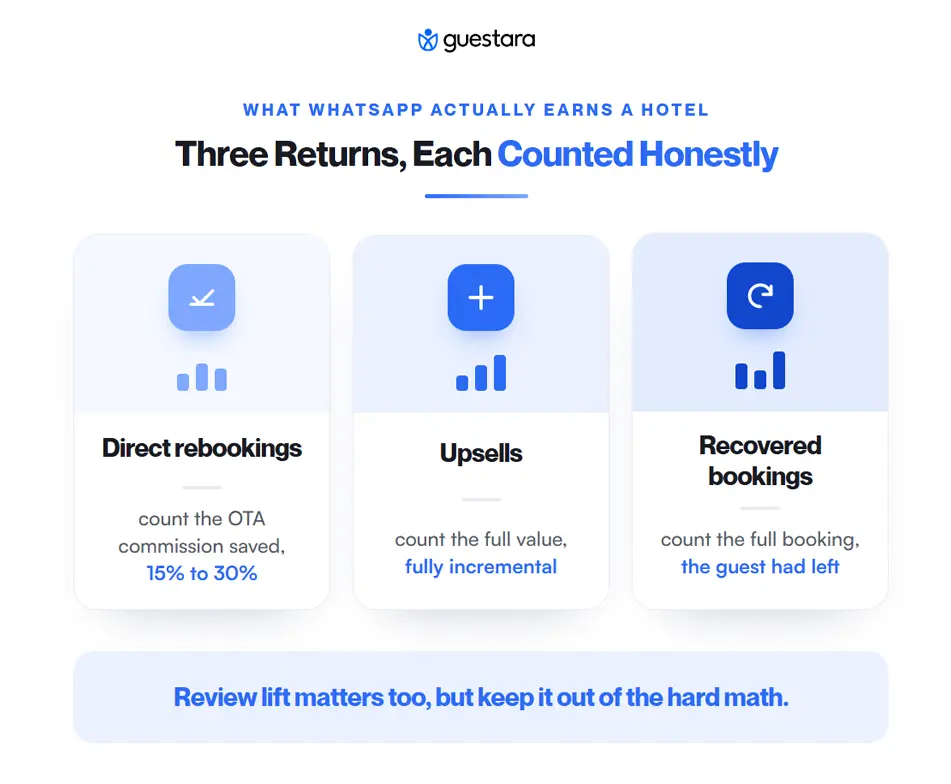
Three revenue sources make up most of WhatsApp's return for a hotel. Each one needs its own attribution logic, because each is incremental in a different way.
When WhatsApp turns an OTA guest into a direct rebooking, the return is the commission you no longer pay. For independent hotels, OTA commission runs from 15% to 30% of the booking, so a direct rebooking on a 6,000 rupee stay saves you roughly 900 to 1,800 rupees.
Count the commission saved, not the full booking value, when the guest was likely to return anyway. This keeps the number honest. The booking might have happened on an OTA. What WhatsApp changed was the channel, and the channel is worth the commission. Driving these direct rebookings is its own playbook, covered in the direct bookings guide.
When a WhatsApp message sells a room upgrade, an early check-in, a spa slot, or a dinner, that revenue is almost always fully incremental. The guest was not going to buy it on their own.
Count the full value of WhatsApp-driven upsells, because without the message, the sale does not happen. This is often the largest and cleanest part of WhatsApp ROI, especially when upsell offers fire automatically at the right moment. Automating those offers is covered in the automation guide.
WhatsApp review requests lift your review volume and score, and a better score drives future bookings. This return is real but slower and harder to pin to a rupee.
Do not invent a number here. Track the lift in review count and average rating, and treat it as a supporting return rather than a hard line in your ROI math. It matters, but it should not carry your case. The bookings and upsells above are what prove the channel.
The cost side is simpler than the return side, but skipping any part of it inflates your ROI. Count everything the channel actually consumes.
Add these into a single monthly number. That is the denominator in your ROI formula. An ROI that ignores staff time is not an ROI, it is a guess that looks good.
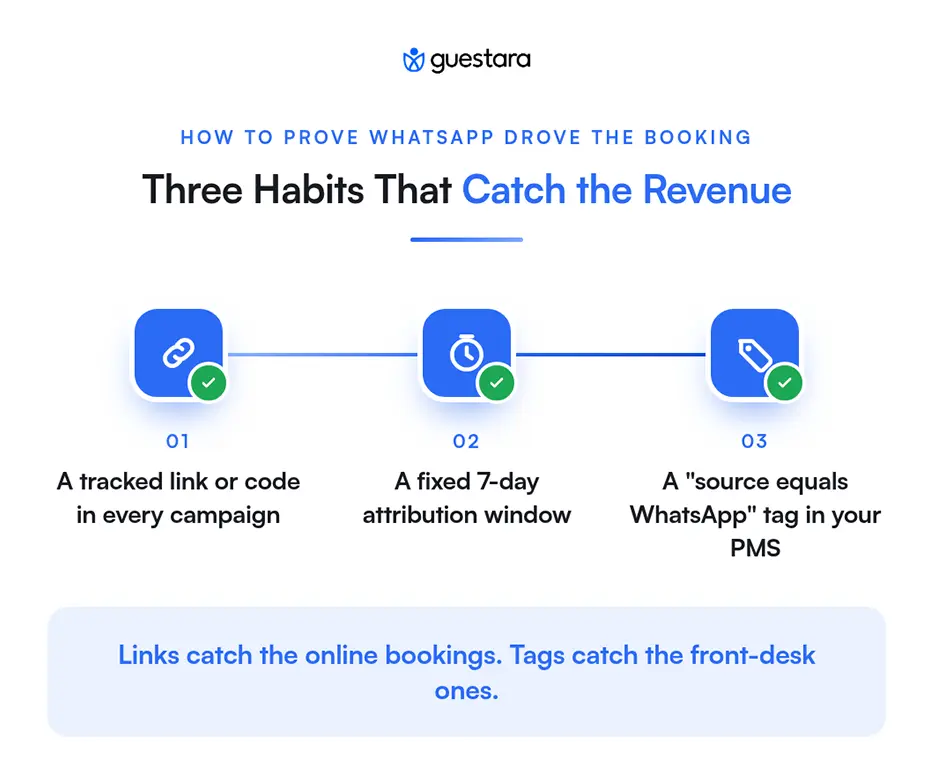
You cannot measure ROI you cannot attribute, so attribution comes first. You do not need perfect tracking. You need a consistent method that catches most of the value and applies the same way every month.
Put a unique link in every WhatsApp campaign that drives a booking or an upsell. A booking link with a tracking tag, or a WhatsApp-only offer code the guest mentions, ties the sale back to the message.
When a guest books through that link or quotes that code, you know WhatsApp earned it. This single habit recovers most of the attribution you would otherwise lose to the front desk.
Decide how long after a message you will credit a booking to WhatsApp. A common, fair window is seven days. A booking that lands within seven days of a WhatsApp message gets credited. One that lands a month later does not.
A fixed window stops two errors at once. It stops you crediting WhatsApp for bookings it had nothing to do with, and it forces a consistent rule instead of a judgment call every time.
Train the front desk to ask and record how a booking or upgrade came in. A single field in the PMS, source equals WhatsApp, captures the offline conversions that links miss.
This is the fix for the front desk problem. When a guest mentions a WhatsApp offer and books at the desk, the tag catches the revenue that the link did not. Together, links and source tags catch the large majority of what WhatsApp earns.
Here is a full month, with numbers you can replace with your own. The point is the method, not the figures.
Say your WhatsApp platform, message fees, and staff time cost 15,000 rupees for the month. That is your total cost.
Now the return, source by source, with honest attribution:
Total attributable return is 66,960 rupees. Subtract the 15,000 rupee cost, and WhatsApp earned a net 51,960 rupees that month. That is an ROI of about 346%.
Notice what the method did. It credited only the commission on rebookings that might have happened anyway, the full value of upsells that would not have, and the full value of recovered bookings that were already lost. The review lift sat outside the math as a supporting return. That is a number you can defend to your GM, because every rupee in it has a reason.
ROI is not a one-time calculation. It is a monthly rhythm that tells you what to do more of and what to stop. The hotels that grow WhatsApp revenue are the ones that measure it the same way every month and act on what they see.
A platform built for hotels makes this far easier, because the data already lives in one place. With Guestara, your campaigns, bookings, upsells, and review results sit on one analytics dashboard, so the return side of your ROI is not scattered across three systems. Your guest data flows from your PMS, which means the booking-source tagging that powers attribution is built into the same place you send from.
Two things sit just outside this guide. Which metrics to watch week to week, open rate, reply rate, opt-out rate, delivery, is ongoing monitoring, covered in the hotel WhatsApp metrics guide. And which campaign types earn the most is its own breakdown, covered in the revenue-by-campaign guide. This post is about proving the channel pays. Those two are about watching it and ranking it. For the full picture, start with the complete guide.
Want your bookings, upsells, and review results in one place so the ROI math is a five-minute monthly job instead of a spreadsheet hunt? This is where platforms like Guestara bring your WhatsApp revenue and your guest data together, so you can prove the channel pays and act on it. See how it works with a quick demo.


Hotel WhatsApp marketing ROI is hard to measure because attribution is messy. Learn a workable method to prove the channel paid for itself, step by step.
Your GM asks a simple question. Is WhatsApp actually making us money?
You open the dashboard. It shows opens, clicks, and reply rates. Good numbers, all of them. None of them answer the question.
Opens are not revenue. A 98% open rate feels like proof, but it does not tell you whether the channel paid for itself.
Measuring hotel WhatsApp marketing ROI means comparing what the channel earned against what it cost. The earnings are real: direct bookings that skipped OTA commission, upsells that would not have happened, bookings you recovered. The cost is real too. The hard part, the part most guides skip, is attribution. Knowing which rupee came from WhatsApp and which would have arrived anyway.
This guide gives you the formula, an honest look at why attribution is hard, a workable method to track it, and a full worked example you can copy.
Hotel WhatsApp marketing ROI is the return your hotel earns from WhatsApp compared to what it spends to run the channel. It is a ratio, not a feeling, and it answers one question: for every rupee in, how many came back.
The formula is simple. ROI equals revenue from WhatsApp minus the cost of WhatsApp, divided by the cost of WhatsApp.
If WhatsApp earned you 60,000 rupees and cost you 15,000, your return is 45,000 rupees, or a 300% ROI. The math is never the hard part. Getting honest numbers to put into it is.
Open rate, click rate, and reply rate are engagement metrics. They tell you a message was seen and read. They do not tell you it earned anything.
A campaign can have a 95% open rate and a 0% return if nobody booked or bought. ROI lives one step further down, at the booking, the upsell, the recovered reservation. Tracking which metrics to watch week to week is its own subject, covered in the metrics guide. This post stays on the money.
WhatsApp ROI is hard to measure because guests rarely travel a straight line from message to booking. They see your WhatsApp offer, think about it, and book three days later at the front desk or on your website. The sale happened. Proving WhatsApp caused it is the problem.
This is not a small gap. Across marketing as a whole, only about an eighth of companies feel they measure their channel ROI adequately. Most are guessing, and hotels are no exception.
Attribution is the act of crediting a sale to the thing that caused it. On WhatsApp, that chain is rarely clean.
A guest gets a pre-arrival upgrade offer on WhatsApp. They do not tap the link. They mention it at check-in, and the front desk processes the upgrade in the PMS. The revenue shows up as a front desk upsell, not a WhatsApp one. WhatsApp earned it and got none of the credit.
This happens constantly, and it cuts both ways. Some bookings get credited to WhatsApp that would have happened anyway. The goal is not perfect attribution, which does not exist. The goal is a consistent, honest method you apply the same way every month.
The harder question is not what WhatsApp touched. It is what WhatsApp caused. A repeat guest who always rebooks direct would have rebooked direct without your message. Crediting that whole booking to WhatsApp overstates your return.
The fix is to count the incremental value, the part that only happened because of WhatsApp. For a direct rebooking that would have come anyway, the incremental value is the OTA commission you saved, not the full room rate. For an abandoned booking you recovered, the incremental value is the whole booking, because that guest had already left. Getting this distinction right is what separates a real ROI number from a flattering one.
Three revenue sources make up most of WhatsApp's return for a hotel. Each one needs its own attribution logic, because each is incremental in a different way.
When WhatsApp turns an OTA guest into a direct rebooking, the return is the commission you no longer pay. For independent hotels, OTA commission runs from 15% to 30% of the booking, so a direct rebooking on a 6,000 rupee stay saves you roughly 900 to 1,800 rupees.
Count the commission saved, not the full booking value, when the guest was likely to return anyway. This keeps the number honest. The booking might have happened on an OTA. What WhatsApp changed was the channel, and the channel is worth the commission. Driving these direct rebookings is its own playbook, covered in the direct bookings guide.
When a WhatsApp message sells a room upgrade, an early check-in, a spa slot, or a dinner, that revenue is almost always fully incremental. The guest was not going to buy it on their own.
Count the full value of WhatsApp-driven upsells, because without the message, the sale does not happen. This is often the largest and cleanest part of WhatsApp ROI, especially when upsell offers fire automatically at the right moment. Automating those offers is covered in the automation guide.
WhatsApp review requests lift your review volume and score, and a better score drives future bookings. This return is real but slower and harder to pin to a rupee.
Do not invent a number here. Track the lift in review count and average rating, and treat it as a supporting return rather than a hard line in your ROI math. It matters, but it should not carry your case. The bookings and upsells above are what prove the channel.
The cost side is simpler than the return side, but skipping any part of it inflates your ROI. Count everything the channel actually consumes.
Add these into a single monthly number. That is the denominator in your ROI formula. An ROI that ignores staff time is not an ROI, it is a guess that looks good.
You cannot measure ROI you cannot attribute, so attribution comes first. You do not need perfect tracking. You need a consistent method that catches most of the value and applies the same way every month.
Put a unique link in every WhatsApp campaign that drives a booking or an upsell. A booking link with a tracking tag, or a WhatsApp-only offer code the guest mentions, ties the sale back to the message.
When a guest books through that link or quotes that code, you know WhatsApp earned it. This single habit recovers most of the attribution you would otherwise lose to the front desk.
Decide how long after a message you will credit a booking to WhatsApp. A common, fair window is seven days. A booking that lands within seven days of a WhatsApp message gets credited. One that lands a month later does not.
A fixed window stops two errors at once. It stops you crediting WhatsApp for bookings it had nothing to do with, and it forces a consistent rule instead of a judgment call every time.
Train the front desk to ask and record how a booking or upgrade came in. A single field in the PMS, source equals WhatsApp, captures the offline conversions that links miss.
This is the fix for the front desk problem. When a guest mentions a WhatsApp offer and books at the desk, the tag catches the revenue that the link did not. Together, links and source tags catch the large majority of what WhatsApp earns.
Here is a full month, with numbers you can replace with your own. The point is the method, not the figures.
Say your WhatsApp platform, message fees, and staff time cost 15,000 rupees for the month. That is your total cost.
Now the return, source by source, with honest attribution:
Total attributable return is 66,960 rupees. Subtract the 15,000 rupee cost, and WhatsApp earned a net 51,960 rupees that month. That is an ROI of about 346%.
Notice what the method did. It credited only the commission on rebookings that might have happened anyway, the full value of upsells that would not have, and the full value of recovered bookings that were already lost. The review lift sat outside the math as a supporting return. That is a number you can defend to your GM, because every rupee in it has a reason.
ROI is not a one-time calculation. It is a monthly rhythm that tells you what to do more of and what to stop. The hotels that grow WhatsApp revenue are the ones that measure it the same way every month and act on what they see.
A platform built for hotels makes this far easier, because the data already lives in one place. With Guestara, your campaigns, bookings, upsells, and review results sit on one analytics dashboard, so the return side of your ROI is not scattered across three systems. Your guest data flows from your PMS, which means the booking-source tagging that powers attribution is built into the same place you send from.
Two things sit just outside this guide. Which metrics to watch week to week, open rate, reply rate, opt-out rate, delivery, is ongoing monitoring, covered in the hotel WhatsApp metrics guide. And which campaign types earn the most is its own breakdown, covered in the revenue-by-campaign guide. This post is about proving the channel pays. Those two are about watching it and ranking it. For the full picture, start with the complete guide.
Want your bookings, upsells, and review results in one place so the ROI math is a five-minute monthly job instead of a spreadsheet hunt? This is where platforms like Guestara bring your WhatsApp revenue and your guest data together, so you can prove the channel pays and act on it. See how it works with a quick demo.
You calculate it by subtracting the cost of running WhatsApp from the revenue it earned, then dividing by the cost. The revenue includes direct bookings that saved OTA commission, upsells the channel drove, and recovered bookings. The cost includes your platform fee, WhatsApp message charges, and staff time. The hard part is attribution, crediting the right revenue to WhatsApp, which you handle with tracked links, a fixed attribution window, and a booking-source tag in your PMS.
It is hard because guests rarely book in a straight line from message to sale. A guest may see a WhatsApp offer and then book days later at the front desk or on the website, so the revenue lands without an obvious link to the message. Across marketing, only about an eighth of companies feel they measure ROI adequately. A consistent method using tracked links and booking-source tags closes most of that gap.
Count three sources, each with its own logic. For direct rebookings that might have happened anyway, count the OTA commission you saved, not the full room rate. For upsells, count the full value, because the guest would not have bought without the message. For recovered abandoned bookings, count the full booking, because that guest had already left. Review lift is a supporting return, tracked but kept out of the hard math.
Include the monthly platform fee, the per-conversation message charges that WhatsApp bills through the Business API, and the staff time spent building campaigns and reviewing results. Add one-time setup costs like connecting your PMS and getting templates approved. Leaving out staff time is the most common mistake, and it makes ROI look better than it is.
There is no single number, because it depends on your list quality, your upsell pricing, and how much OTA commission you save. A healthy channel returns several times its cost once attribution is set up properly. More important than hitting a benchmark is measuring the same way every month, so you can see whether your return is rising or falling and act on it.
We work closely with the industry leaders to offer seamless solutions




We’re here to help your whole team stay ahead of the curve as you grow.

Get up and running quickly with a personalized onboarding plan

Connect with real people who really get it, 24/7

Checkout our vast library of free resources, templates and more
There's only so much we can say — so let us show you! Schedule a demo today and reach your business goals.



.png)