The vacation rental guest journey runs with no front desk: seven stages, unattended access, ID capture and the STR registration rules that now apply.





The vacation rental guest journey has the same seven stages as a hotel's and none of the safety nets. No front desk, no night porter, no manager to walk a guest to their room when something goes wrong.
Think about what a hotel absorbs without noticing. A guest arrives and the booking is wrong, so reception fixes it in ninety seconds. A guest cannot work the shower, so housekeeping shows them. A guest lands at 1am after a cancelled flight and someone is awake. In a vacation rental, each of those becomes a message to you, or a one-star review written at midnight by somebody standing outside a locked door.
That is the real difference between the two journeys. Not the stages, which are identical. The absence of anyone to catch what the structure drops.
The vacation rental guest journey is the same seven-stage sequence as a hotel's, with every stage required to work without a member of staff present. Discovery, booking, pre-arrival, arrival, in-stay, checkout and post-stay all still happen. What changes is that nothing can be fixed in person.
A front desk is not one touchpoint. It is the fallback for all of them.
When arrival information does not reach a hotel guest, the desk tells them. When a vacation rental guest does not get it, they stand on a pavement with a suitcase and a phone. The same missing message produces a minor delay in one business and a crisis in the other.
That changes the priority order completely. In a hotel, pre-arrival is where revenue hides. In a vacation rental, pre-arrival is where the stay either works or fails. For the shared structure underneath both, the seven stages of the guest journey covers the sequence and our complete guide to the guest journey is the parent page.
More than operators expect, which is why the hotel playbook is still worth reading.
Guests still compare listings and reviews before booking. They still want to know what time they can get in and where to park. They still buy late checkout if you offer it at the right moment. They still write a review that decides whether the next guest books.
The stages and the guest psychology transfer. The staffing model does not, and that is the whole of the difference.
Each stage still has an owner in a vacation rental. The difference is that the owner is a system, a message or the guest themselves rather than a member of staff.
Read the pre-arrival row again, because it reorders the whole job.
In a hotel, a weak pre-arrival sequence costs you upsell revenue and some goodwill. In a vacation rental, it costs you the arrival. Access codes, parking, directions, door quirks, WiFi and house rules all have to reach the guest before they travel, because after they travel the only channel left is their phone and your response time.
Olive Hotels by Embassy saw a 248% lift in guest engagement using Guestara after activating its pre-arrival sequence. In a hotel that is upside. In an unattended property the same sequence is the difference between a smooth arrival and a phone call from the street. Guestara's Guest Journey module builds it against booking data, and the guest engagement platform covers the trigger logic.
Three owners replace the one desk: an automated sequence, a self-serve information layer, and you.
The goal of a well-built STR journey is to keep as little as possible in the third category. Every question that reaches you personally is a question the first two owners failed to answer. The full touchpoint inventory is a useful companion for working out which moments exist in your own operation.
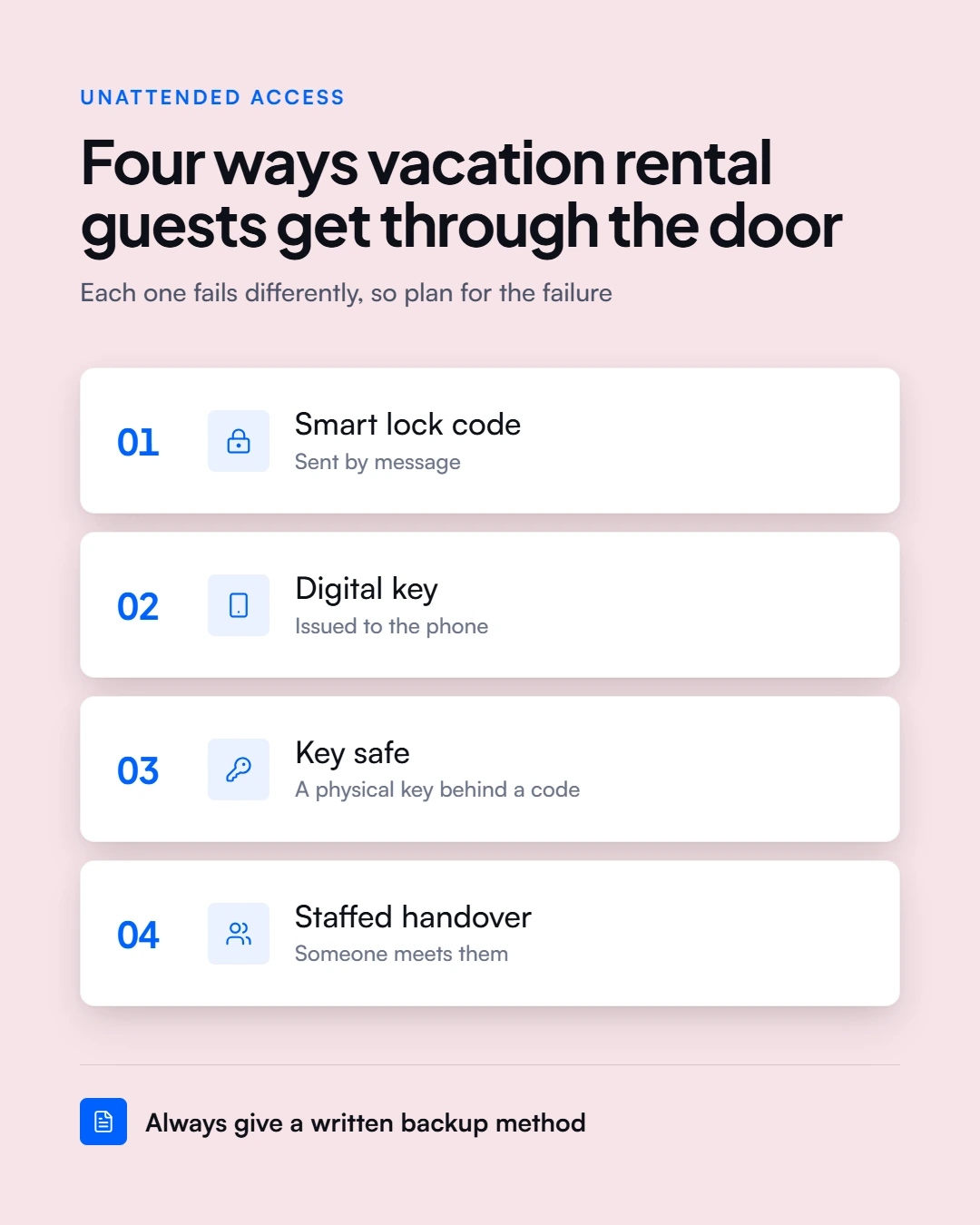
Access is delivered by a code, a digital key or a key safe, sent to the guest before or on arrival. It is the single most important mechanism in the whole vacation rental journey, because arrival is the one stage with no human fallback of any kind.
Four methods cover almost every property, and they fail in different ways.
Guestara integrates with 50+ smart lock systems and issues the digital key automatically the moment check-in completes, so access delivery is a consequence of the journey rather than a separate task someone has to remember. The smart locks page covers the integrations.
Plan for it, because it will happen and the guest is standing outside while it does.
Three things make a failed arrival survivable. A second access method the guest already has in writing. A number that reaches a human who can act, not a voicemail. And a message that goes out proactively when a lock reports a problem, rather than waiting for the guest to discover it.
The worst version is a guest who cannot get in, cannot reach anybody, and writes the review from their car. Guest message response time benchmarks is worth reading for what an acceptable response window looks like, and the gap between it and yours at 11pm.
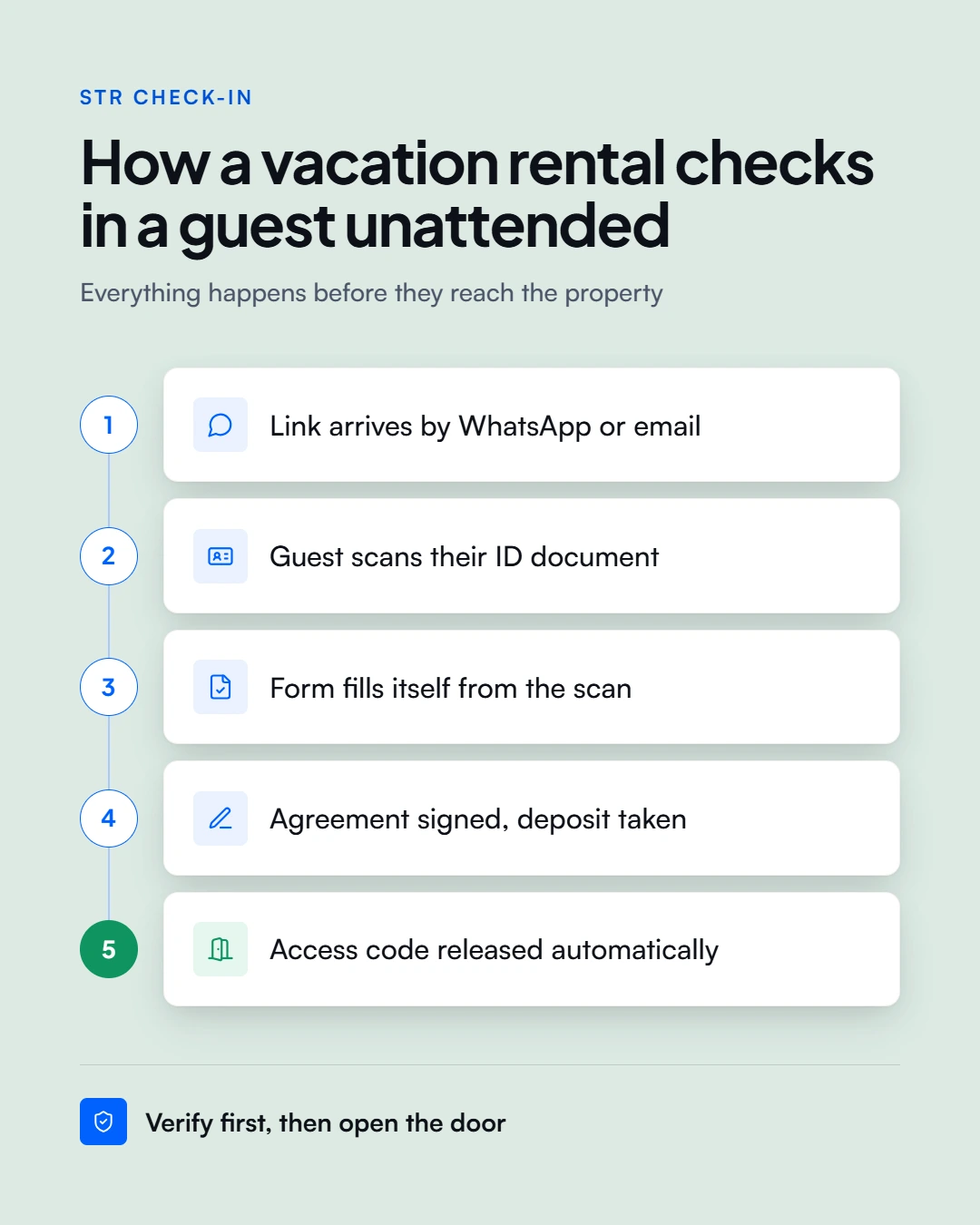
Identity is captured before arrival, on the guest's own phone, by scanning a document rather than filling a form. In a property with no counter, that is the only point in the journey where verification can happen at all.
The mechanism matters more here than in a hotel, because there is no second chance.
Guestara's Digital Check-In sends a link by WhatsApp, email or SMS. The guest scans their ID, the registration form auto-fills from the document data, and the whole thing takes 30 seconds. Olive Hotels by Embassy reached 99.8% verified guest profiles using Guestara, which is what verification looks like when it does not depend on anyone being present to ask.
Doing this before arrival also protects everything downstream. A verified guest can be issued a digital key automatically. An unverified one cannot, and in an unattended property that distinction is your only control over who walks through the door. Our vacation rental agreements page covers guest registration and agreement signing in the same flow.
Registration and data-sharing obligations for short-term rentals are tightening, and the European Union's version is now live.
Regulation (EU) 2024/1028 entered into force in May 2024 and has applied since 20 May 2026. In the areas that adopt it, each rented unit needs a registration number issued after the host declares the unit's address, its type, whether it is a primary or secondary residence, and its maximum bed places and guests. Those numbers are published in a public registry. Booking platforms then transmit guest rental activity data to a single digital entry point in each member state, with the registration number attached so the data ties back to a specific unit.
Enforcement is real. Authorities can verify a declaration at any time, and if a host does not correct requested information they can suspend the registration number and order platforms to remove or disable the listing.
Yours, and they are not the same as anyone else's.
The EU regulation above is one jurisdiction's approach and the direction of travel in many others, not a universal standard. Registration schemes, guest-data retention periods, police or tourism reporting duties and licensing caps all vary by country, and often by city within a country. Check your local requirements directly or take advice, rather than assuming what applies elsewhere applies to you.
What transfers across all of them is the operational need. Every version of these rules requires accurate guest and unit data, captured reliably and retrievable later, which is a journey design problem before it is a legal one.
A self-serve information layer and a messaging channel replace the front desk, and between them they have to answer everything a receptionist would have handled. The in-stay stage is where most unattended properties quietly generate their own workload.
Everything a guest would otherwise ask has to be somewhere they can reach in one tap.
WiFi name and password. How the heating works. Where the bins go. Check-out time and what to do with the key. Parking. The nearest shop at 10pm. Which beach is worth the drive. In a hotel these are small conversations. In a rental they are either documented or they are messages to you.
The answer is not an app. eviivo surveyed 430 travellers worldwide between August and September 2025 and found only 4% would download a property's own app, while 58% prefer SMS, WhatsApp or email links. Asking an STR guest to install software fails for almost all of them. Guestara's Guest App is web-based with no download, carrying the guidebook, house rules, local recommendations on a map and an upsell menu behind a single link, and the guest app page covers what sits inside it.
Something has to, and in most single-operator portfolios the honest answer is nobody.
That is the gap worth closing first, because overnight questions are disproportionately urgent. A guest asking about breakfast can wait. A guest who cannot get the heating on, or cannot get in, cannot. Guestara's AI Chatbot handles routine questions around the clock from your own property data and escalates what it should not answer, which gives an unstaffed property a 24-hour response capability without a night shift.
Guestara's Unified Inbox matters more in this business than in hotels, because platform threads are where your guests live. Airbnb, Vrbo, Booking.com and WhatsApp messages landing in one window is the difference between answering in minutes and discovering a thread three days late. What a unified inbox does covers the consolidation, and why guest messages go missing covers what happens without it.
[[cta:cta-5 | eyebrow=Guest Journey | heading=Run an unattended property that still feels *hosted* | btn=Explore Guest Engagement | link=https://www.guestara.com/guest-engagement-for-hospitality ]]
How do you protect the property without staff?
Protection runs on money collected and identity verified before the guest ever reaches the door, because nobody will be there to assess anything in person. A deposit, a card on file and a verified guest are the three controls available to an unattended property.
Collect before arrival, not after departure.
A hotel discovers damage at checkout while the guest is still at the desk and a card is still on file. A vacation rental discovers it when a cleaner walks in after the guest has gone, which is the worst possible moment to start a conversation about money.
Guestara's Payments module collects pre-arrival deposits automatically, tokenizes a card on file, and runs fraud checks including 3D Secure and address verification, with full PCI-DSS compliance. The security deposit page covers damage protection and the card authorization page covers holding a card against a stay.
Four things, and all of them before the access code goes out.
The deposit or damage cover. A verified identity document. A signed rental agreement with the house rules in it. A card on file that can still be charged after departure. Sequence those ahead of access delivery and the guest's incentives are aligned from the moment they walk in.
Reducing the guest's effort while collecting all four is the craft here. Research by the Corporate Executive Board covering more than 75,000 customers, published in Harvard Business Review in July 2010, found that reducing the effort a customer has to spend predicts loyalty where delighting them does not. Four separate emails asking for four things is four units of effort. One link that handles all of them is one.
Why do STR reviews carry more weight?
Reviews decide a vacation rental's visibility in a way they do not for a hotel, because the listing has almost no other ranking signal behind it. A hotel has a brand, a website, direct bookings and a location reputation. A rental has its reviews and its photographs.
That makes post-stay the stage with the longest reach in the whole journey.
A weak review period does not just cost you reputation. It costs you position in the only place most of your demand comes from, which then costs you bookings that would have produced the next reviews. The loop runs in both directions and it compounds quietly.
Ask during the stay, not after it, which is the only point at which a problem is still fixable.
Guestara's Review Collection sends a request over WhatsApp with a three-button reply of Good, Average or Bad. Positive answers route to the public listing. Negative answers get no public redirect and alert you instead. At AGC, a 52-room independent hotel in Aurangabad, 122 guests raised a problem that way rather than posting it publicly, and the team was alerted in real time. That is a hotel result and the mechanism is identical in a rental, except that an STR operator has further to travel and more riding on the outcome.
Pair that with a mid-stay check-in message on day one or two. A guest who tells you the shower is weak on Tuesday is a guest you can still satisfy. The same guest telling the platform on Sunday is a ranking problem. Our review management page covers the interception logic, and post-stay engagement strategy covers turning a departed guest into a direct repeat booking.
Automate in the order the stages fail. Arrival breaks hardest and recovers worst, so access and pre-arrival come first, with everything else following once a guest can reliably get through the door.
The ranking is not about effort or cost. It is about what a failure does to the guest.
Olive Hotels by Embassy reached a 6.1x annualized return on platform cost using Guestara, with efficiency arriving in the first three months, revenue from month four, and the reputation effect from month six. The order in that table follows the same logic: fix what breaks the stay, then what protects the asset, then what compounds.
Upselling, mostly, and anything that assumes the basics are already solid.
Mid-stay offers and late checkout sales are real revenue in a rental, and they are worth nothing while guests are still struggling to get in. Guestara drives up to 200% more upsells, and that figure only materialises on top of a journey that already works. Build the arrival first.
Approximately one week of onboarding covers the setup, and Guestara integrates with major PMS and channel systems including Cloudbeds, Hotelogix, Ezee Absolute, Apaleo, Beds24, SiteMinder, Little Hotelier and Oracle. Guest journey automation covers the build, how to find friction in your journey covers auditing what you have, and digital against human touchpoints covers the moments worth keeping personal even in an unattended property.
[[cta:cta-6 | eyebrow=Vacation Rentals | heading=Give unattended stays a *hosted* guest journey | btn=Talk to Sales | link=https://www.guestara.com/get-demo ]]


The vacation rental guest journey runs with no front desk: seven stages, unattended access, ID capture and the STR registration rules that now apply.
The vacation rental guest journey has the same seven stages as a hotel's and none of the safety nets. No front desk, no night porter, no manager to walk a guest to their room when something goes wrong.
Think about what a hotel absorbs without noticing. A guest arrives and the booking is wrong, so reception fixes it in ninety seconds. A guest cannot work the shower, so housekeeping shows them. A guest lands at 1am after a cancelled flight and someone is awake. In a vacation rental, each of those becomes a message to you, or a one-star review written at midnight by somebody standing outside a locked door.
That is the real difference between the two journeys. Not the stages, which are identical. The absence of anyone to catch what the structure drops.
The vacation rental guest journey is the same seven-stage sequence as a hotel's, with every stage required to work without a member of staff present. Discovery, booking, pre-arrival, arrival, in-stay, checkout and post-stay all still happen. What changes is that nothing can be fixed in person.
A front desk is not one touchpoint. It is the fallback for all of them.
When arrival information does not reach a hotel guest, the desk tells them. When a vacation rental guest does not get it, they stand on a pavement with a suitcase and a phone. The same missing message produces a minor delay in one business and a crisis in the other.
That changes the priority order completely. In a hotel, pre-arrival is where revenue hides. In a vacation rental, pre-arrival is where the stay either works or fails. For the shared structure underneath both, the seven stages of the guest journey covers the sequence and our complete guide to the guest journey is the parent page.
More than operators expect, which is why the hotel playbook is still worth reading.
Guests still compare listings and reviews before booking. They still want to know what time they can get in and where to park. They still buy late checkout if you offer it at the right moment. They still write a review that decides whether the next guest books.
The stages and the guest psychology transfer. The staffing model does not, and that is the whole of the difference.
Each stage still has an owner in a vacation rental. The difference is that the owner is a system, a message or the guest themselves rather than a member of staff.
Read the pre-arrival row again, because it reorders the whole job.
In a hotel, a weak pre-arrival sequence costs you upsell revenue and some goodwill. In a vacation rental, it costs you the arrival. Access codes, parking, directions, door quirks, WiFi and house rules all have to reach the guest before they travel, because after they travel the only channel left is their phone and your response time.
Olive Hotels by Embassy saw a 248% lift in guest engagement using Guestara after activating its pre-arrival sequence. In a hotel that is upside. In an unattended property the same sequence is the difference between a smooth arrival and a phone call from the street. Guestara's Guest Journey module builds it against booking data, and the guest engagement platform covers the trigger logic.
Three owners replace the one desk: an automated sequence, a self-serve information layer, and you.
The goal of a well-built STR journey is to keep as little as possible in the third category. Every question that reaches you personally is a question the first two owners failed to answer. The full touchpoint inventory is a useful companion for working out which moments exist in your own operation.
Access is delivered by a code, a digital key or a key safe, sent to the guest before or on arrival. It is the single most important mechanism in the whole vacation rental journey, because arrival is the one stage with no human fallback of any kind.
Four methods cover almost every property, and they fail in different ways.
Guestara integrates with 50+ smart lock systems and issues the digital key automatically the moment check-in completes, so access delivery is a consequence of the journey rather than a separate task someone has to remember. The smart locks page covers the integrations.
Plan for it, because it will happen and the guest is standing outside while it does.
Three things make a failed arrival survivable. A second access method the guest already has in writing. A number that reaches a human who can act, not a voicemail. And a message that goes out proactively when a lock reports a problem, rather than waiting for the guest to discover it.
The worst version is a guest who cannot get in, cannot reach anybody, and writes the review from their car. Guest message response time benchmarks is worth reading for what an acceptable response window looks like, and the gap between it and yours at 11pm.
Identity is captured before arrival, on the guest's own phone, by scanning a document rather than filling a form. In a property with no counter, that is the only point in the journey where verification can happen at all.
The mechanism matters more here than in a hotel, because there is no second chance.
Guestara's Digital Check-In sends a link by WhatsApp, email or SMS. The guest scans their ID, the registration form auto-fills from the document data, and the whole thing takes 30 seconds. Olive Hotels by Embassy reached 99.8% verified guest profiles using Guestara, which is what verification looks like when it does not depend on anyone being present to ask.
Doing this before arrival also protects everything downstream. A verified guest can be issued a digital key automatically. An unverified one cannot, and in an unattended property that distinction is your only control over who walks through the door. Our vacation rental agreements page covers guest registration and agreement signing in the same flow.
Registration and data-sharing obligations for short-term rentals are tightening, and the European Union's version is now live.
Regulation (EU) 2024/1028 entered into force in May 2024 and has applied since 20 May 2026. In the areas that adopt it, each rented unit needs a registration number issued after the host declares the unit's address, its type, whether it is a primary or secondary residence, and its maximum bed places and guests. Those numbers are published in a public registry. Booking platforms then transmit guest rental activity data to a single digital entry point in each member state, with the registration number attached so the data ties back to a specific unit.
Enforcement is real. Authorities can verify a declaration at any time, and if a host does not correct requested information they can suspend the registration number and order platforms to remove or disable the listing.
Yours, and they are not the same as anyone else's.
The EU regulation above is one jurisdiction's approach and the direction of travel in many others, not a universal standard. Registration schemes, guest-data retention periods, police or tourism reporting duties and licensing caps all vary by country, and often by city within a country. Check your local requirements directly or take advice, rather than assuming what applies elsewhere applies to you.
What transfers across all of them is the operational need. Every version of these rules requires accurate guest and unit data, captured reliably and retrievable later, which is a journey design problem before it is a legal one.
A self-serve information layer and a messaging channel replace the front desk, and between them they have to answer everything a receptionist would have handled. The in-stay stage is where most unattended properties quietly generate their own workload.
Everything a guest would otherwise ask has to be somewhere they can reach in one tap.
WiFi name and password. How the heating works. Where the bins go. Check-out time and what to do with the key. Parking. The nearest shop at 10pm. Which beach is worth the drive. In a hotel these are small conversations. In a rental they are either documented or they are messages to you.
The answer is not an app. eviivo surveyed 430 travellers worldwide between August and September 2025 and found only 4% would download a property's own app, while 58% prefer SMS, WhatsApp or email links. Asking an STR guest to install software fails for almost all of them. Guestara's Guest App is web-based with no download, carrying the guidebook, house rules, local recommendations on a map and an upsell menu behind a single link, and the guest app page covers what sits inside it.
Something has to, and in most single-operator portfolios the honest answer is nobody.
That is the gap worth closing first, because overnight questions are disproportionately urgent. A guest asking about breakfast can wait. A guest who cannot get the heating on, or cannot get in, cannot. Guestara's AI Chatbot handles routine questions around the clock from your own property data and escalates what it should not answer, which gives an unstaffed property a 24-hour response capability without a night shift.
Guestara's Unified Inbox matters more in this business than in hotels, because platform threads are where your guests live. Airbnb, Vrbo, Booking.com and WhatsApp messages landing in one window is the difference between answering in minutes and discovering a thread three days late. What a unified inbox does covers the consolidation, and why guest messages go missing covers what happens without it.
[[cta:cta-5 | eyebrow=Guest Journey | heading=Run an unattended property that still feels *hosted* | btn=Explore Guest Engagement | link=https://www.guestara.com/guest-engagement-for-hospitality ]]
How do you protect the property without staff?
Protection runs on money collected and identity verified before the guest ever reaches the door, because nobody will be there to assess anything in person. A deposit, a card on file and a verified guest are the three controls available to an unattended property.
Collect before arrival, not after departure.
A hotel discovers damage at checkout while the guest is still at the desk and a card is still on file. A vacation rental discovers it when a cleaner walks in after the guest has gone, which is the worst possible moment to start a conversation about money.
Guestara's Payments module collects pre-arrival deposits automatically, tokenizes a card on file, and runs fraud checks including 3D Secure and address verification, with full PCI-DSS compliance. The security deposit page covers damage protection and the card authorization page covers holding a card against a stay.
Four things, and all of them before the access code goes out.
The deposit or damage cover. A verified identity document. A signed rental agreement with the house rules in it. A card on file that can still be charged after departure. Sequence those ahead of access delivery and the guest's incentives are aligned from the moment they walk in.
Reducing the guest's effort while collecting all four is the craft here. Research by the Corporate Executive Board covering more than 75,000 customers, published in Harvard Business Review in July 2010, found that reducing the effort a customer has to spend predicts loyalty where delighting them does not. Four separate emails asking for four things is four units of effort. One link that handles all of them is one.
Why do STR reviews carry more weight?
Reviews decide a vacation rental's visibility in a way they do not for a hotel, because the listing has almost no other ranking signal behind it. A hotel has a brand, a website, direct bookings and a location reputation. A rental has its reviews and its photographs.
That makes post-stay the stage with the longest reach in the whole journey.
A weak review period does not just cost you reputation. It costs you position in the only place most of your demand comes from, which then costs you bookings that would have produced the next reviews. The loop runs in both directions and it compounds quietly.
Ask during the stay, not after it, which is the only point at which a problem is still fixable.
Guestara's Review Collection sends a request over WhatsApp with a three-button reply of Good, Average or Bad. Positive answers route to the public listing. Negative answers get no public redirect and alert you instead. At AGC, a 52-room independent hotel in Aurangabad, 122 guests raised a problem that way rather than posting it publicly, and the team was alerted in real time. That is a hotel result and the mechanism is identical in a rental, except that an STR operator has further to travel and more riding on the outcome.
Pair that with a mid-stay check-in message on day one or two. A guest who tells you the shower is weak on Tuesday is a guest you can still satisfy. The same guest telling the platform on Sunday is a ranking problem. Our review management page covers the interception logic, and post-stay engagement strategy covers turning a departed guest into a direct repeat booking.
Automate in the order the stages fail. Arrival breaks hardest and recovers worst, so access and pre-arrival come first, with everything else following once a guest can reliably get through the door.
The ranking is not about effort or cost. It is about what a failure does to the guest.
Olive Hotels by Embassy reached a 6.1x annualized return on platform cost using Guestara, with efficiency arriving in the first three months, revenue from month four, and the reputation effect from month six. The order in that table follows the same logic: fix what breaks the stay, then what protects the asset, then what compounds.
Upselling, mostly, and anything that assumes the basics are already solid.
Mid-stay offers and late checkout sales are real revenue in a rental, and they are worth nothing while guests are still struggling to get in. Guestara drives up to 200% more upsells, and that figure only materialises on top of a journey that already works. Build the arrival first.
Approximately one week of onboarding covers the setup, and Guestara integrates with major PMS and channel systems including Cloudbeds, Hotelogix, Ezee Absolute, Apaleo, Beds24, SiteMinder, Little Hotelier and Oracle. Guest journey automation covers the build, how to find friction in your journey covers auditing what you have, and digital against human touchpoints covers the moments worth keeping personal even in an unattended property.
[[cta:cta-6 | eyebrow=Vacation Rentals | heading=Give unattended stays a *hosted* guest journey | btn=Talk to Sales | link=https://www.guestara.com/get-demo ]]
The vacation rental guest journey is the sequence a guest moves through with a short-term rental property, running across the same seven stages as a hotel's: discovery, booking, pre-arrival, arrival, in-stay, checkout and post-stay. The difference is that every stage has to work without a member of staff present, so a system, a message or the guest themselves handles what a front desk would otherwise cover. That makes pre-arrival load-bearing rather than optional, since it is the last point at which a gap can be closed before the guest travels.
The stages are identical and the staffing model is not. A hotel front desk acts as the fallback for every touchpoint, absorbing wrong bookings, missing information and late arrivals in person, while a vacation rental has no equivalent. The same missing pre-arrival message that causes a minor delay at a hotel leaves a rental guest outside a locked door with only their phone, which is why access delivery and pre-arrival communication carry far more weight in short-term rentals.
Guests complete check-in on their own phone before arrival, usually by scanning an identity document that auto-fills the registration form, and then receive access by code, digital key or key safe combination. Guestara's Digital Check-In completes this in 30 seconds and integrates with 50+ smart lock systems, so the digital key is issued automatically once check-in finishes. Verifying identity before issuing access is also the only control an unattended property has over who enters.
They vary by country and often by city, so the only reliable answer is to check your own jurisdiction or take advice. As one current example, EU Regulation 2024/1028 has applied since 20 May 2026 and requires a registration number for each rented unit in adopting areas, issued after the host declares details including the address, unit type and maximum guests, with booking platforms then transmitting guest activity data to a national entry point. Authorities in that scheme can suspend a registration number and require platforms to delist a property if information is not corrected.
Because a rental listing has very few other ranking signals behind it. A hotel carries a brand, a website, direct booking traffic and a location reputation, while a short-term rental is ranked largely on its reviews and photographs, so a weak review period costs visibility in the channel most of its demand comes from. Asking for feedback during the stay rather than after it is what keeps a fixable problem from becoming a public one.
We work closely with the industry leaders to offer seamless solutions




We’re here to help your whole team stay ahead of the curve as you grow.

Get up and running quickly with a personalized onboarding plan

Connect with real people who really get it, 24/7

Checkout our vast library of free resources, templates and more
There's only so much we can say — so let us show you! Schedule a demo today and reach your business goals.