Hotel guest journey touchpoints mapped across all seven stages: 28 contact points, which ones you do not own, who owns each, and which to automate first.





A guest can leave you a one-star review without ever speaking to a single member of your team.
She found you on an OTA and compared your photos against four other properties. She booked, and the confirmation that arrived carried the OTA's logo rather than yours. She messaged a question about parking and waited two days. On arrival she queued behind a tour group, found the WiFi code taped to the desk drawer, called reception twice to order dinner, and left at 6am without seeing anyone. Then she wrote about all of it.
That stay contained at least a dozen points of contact. Your staff were involved in three. Every one of the others still shaped what she wrote, and that is what a touchpoint is: a moment where your property makes an impression, whether or not anybody from your side is in the room.
A guest journey touchpoint is any single point of contact between a guest and your hotel, from the OTA listing they compare before booking to the review request they get after checkout. Each one is a discrete moment with its own trigger, its own channel and its own owner, and a single stay contains dozens of them.
The word covers more than conversations. A touchpoint can be a message you send, a question the guest asks, a physical interaction with your team, or a page about you that lives on a platform you do not control. If it shapes the guest's impression, it counts.
A stage is a phase of the journey. A touchpoint is a single moment inside one.
Pre-arrival is a stage. The deposit reminder, the check-in link and the arrival day message are three separate touchpoints inside it. Check-in is a stage. The ID capture, the greeting and the room key handover are three touchpoints inside that.
If you are still working out the phases themselves, start with the seven stages of the hotel guest journey and come back to this inventory afterwards. The two documents do different jobs. Stages give you the timeline. Touchpoints give you the list of things that actually happen on it.
Hotels that think in stages fix stages, which usually means hiring. Hotels that think in touchpoints fix individual moments, which usually means a trigger, a routing rule or a template.
"Improve our check-in experience" has no first action. "Send the check-in link 24 hours before arrival so the form is already done" has one, and you can finish it this week.
That is the practical value of the inventory. It turns a vague ambition into a list of discrete items, each small enough to own. For the wider view of how the whole journey fits together, our complete guide to the hotel guest journey sits one level above this page.
A single hotel stay contains far more touchpoints than most operators count. The inventory below lists 28 across the seven stages, and that is before you add anything specific to your property such as a spa, a shuttle or an airport transfer.
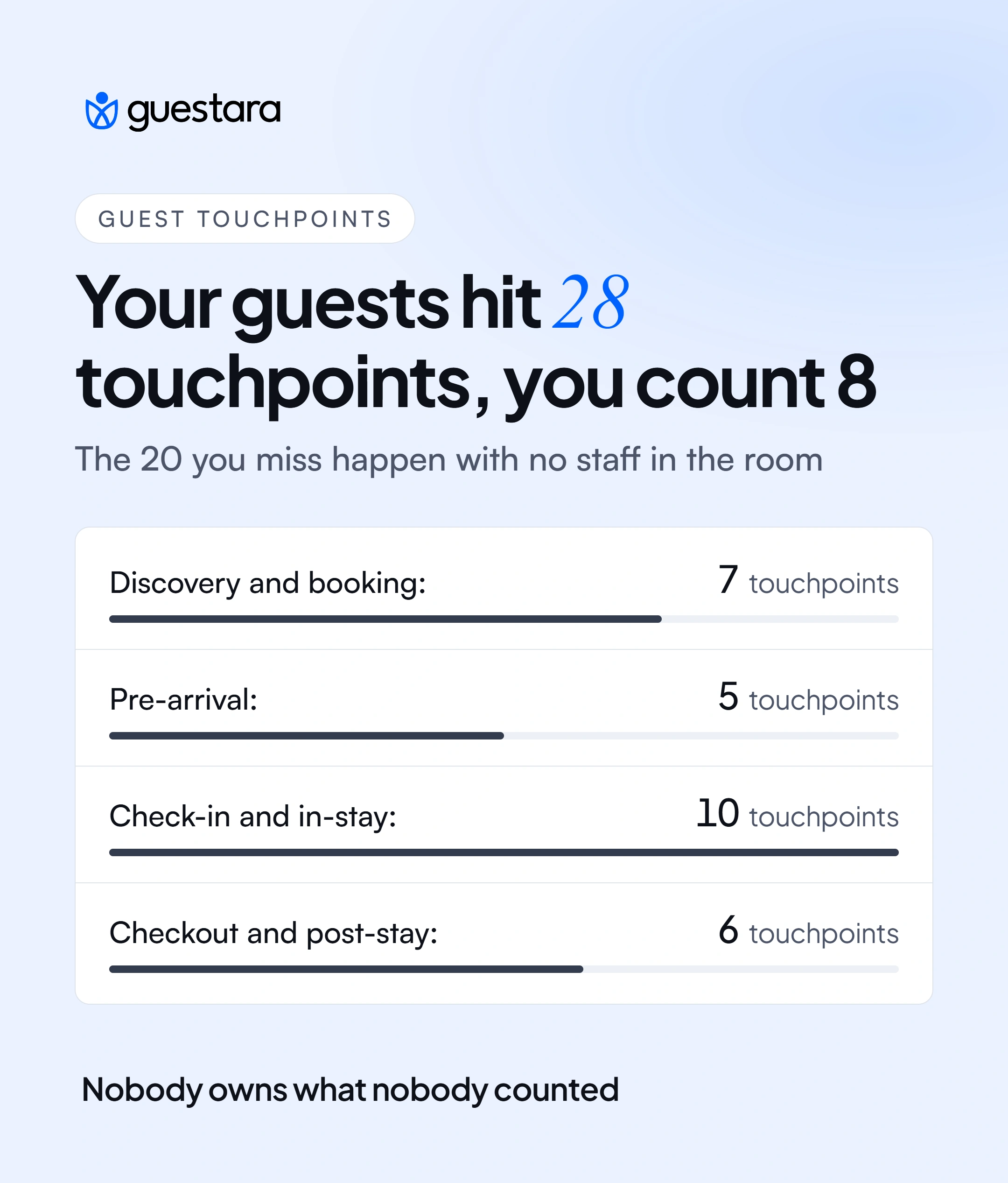
Ask a GM to list their guest touchpoints and the same handful comes back. The booking confirmation. Check-in. The front desk greeting. Housekeeping. Checkout. The review request. The OTA listing. A complaint, if one happens.
Those eight are real. They are also the ones already staffed and already visible, which is exactly why they are rarely where the problem is.
The uncounted ones share a pattern. Nobody is standing there when they happen.
The two days your reply sat unanswered. The confirmation email that came from the OTA instead of you. The moment the guest hunted for the WiFi code. The second call to reception to repeat a dinner order. The review that sold your hotel to a stranger eleven months after it was written. Each of those is a touchpoint, and each one left an impression without anyone on your team knowing it occurred.
Here is the full set, with what sets each one off. A touchpoint without a trigger is a touchpoint nobody owns.
Count the trigger column rather than the touchpoint column and the real finding appears. Only pre-arrival, checkout and post-stay fire on a schedule you set. Everything else fires when the guest decides, which is why half your touchpoints cannot be planned into a shift rota. Once you have the list, mapping it against your own property is the exercise that turns it into something specific to you.
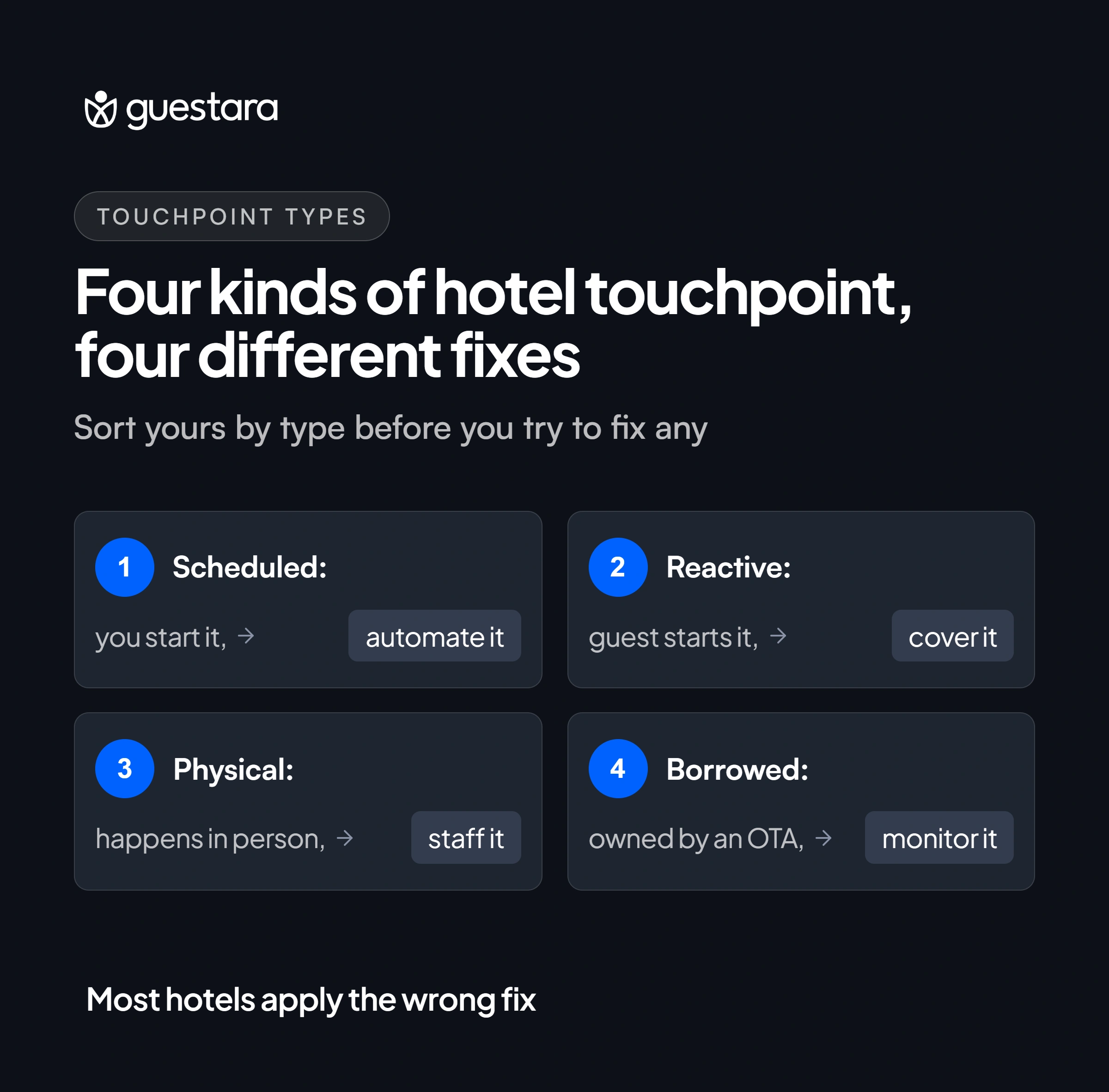
Hotel touchpoints fall into four types, and the type tells you what fixes it. Sorting your inventory this way is more useful than sorting it by stage, because all the touchpoints of one type get solved the same way.
Scheduled touchpoints are an automation problem. Build the trigger once and every future booking gets it.
Reactive touchpoints are a coverage problem. You cannot schedule a 2am question, so the fix is making sure something answers it.
Physical touchpoints are a people problem, and the only one of the four where more staff is the honest answer. Borrowed touchpoints are an influence problem, since you can shape them but never own them.
Most hotels apply the wrong fix. They add staff to a scheduled problem, or they buy software for a physical one.
Reactive touchpoints are where properties lose the most ground, because the guest chooses the channel and the hour.
eviivo surveyed 430 travellers worldwide between August and September 2025 and found 58% prefer SMS, WhatsApp or email links for quick exchanges, while 25% still want to speak to a person. Only 4% would download a property's own app.
That settles a design question for you. Your reactive touchpoints belong on the channels guests already have open, not behind an app download. Whether each of those moments should be answered by a person or by automation is a separate judgement, and our guide to digital against human touchpoints in the guest journey works through that balance properly.
Which touchpoints do you not control?
A significant share of your guest journey touchpoints are hosted by someone else. For independent hotels the OTA owns the first impression, the first message and often the payment, which means your guest relationship starts on rented ground.
The scale of it is documented. Cloudbeds analysed 90 million bookings across tens of thousands of properties in 180 countries for its 2026 State of Independent Hotels Report and found OTAs accounted for 63.4% of independent hotel bookings in 2025, with some markets approaching 80%.
It costs you the ability to act on that touchpoint directly, and sometimes it costs you the booking.
The same Cloudbeds data put OTA cancellation rates at 21.8% against 10.6% for direct bookings. A guest who booked through a platform, received a platform confirmation and asked a question in a platform thread has no relationship with your property yet. Nothing has arrived from you. Cancelling costs them nothing emotionally.
These are the borrowed touchpoints and what each one takes from you.
You do not take the OTA touchpoint away. You add one of your own immediately after it, on a channel you own.
The moment an OTA booking lands in your PMS, you have a name, a date and usually a contact. A message from your property sent within the hour creates the first touchpoint the guest has had with you rather than with the platform. Everything after that is yours.
This is also why channel consolidation matters operationally. Guest messages arriving across OTA threads, WhatsApp, email and social accounts are all reactive touchpoints, and managing WhatsApp, OTA and social messaging together is what stops them being answered at different speeds by different people.
The touchpoints that matter most are the ones with the longest reach and the fewest owners. Judged that way, four stand out: the pre-arrival sequence, the check-in link, the in-stay upsell offer and the review request. Each one is scheduled, which means each one is fixable without hiring.
The Cloudbeds report put the average independent hotel booking window at 40 days in 2025, up from 38 in 2023.
Forty days. Between the confirmation and the arrival, most independent properties send nothing at all. That window holds five of the 28 touchpoints in this inventory, and it is the cheapest stretch of the journey to activate because every trigger runs off booking data you already have.
Guestara's Guest Journey module builds that sequence against your PMS booking record and sends it over WhatsApp, email or SMS. Olive Hotels by Embassy saw a 248% lift in guest engagement using Guestara after switching those touchpoints on. Nothing about the guests changed. The silence did.
Our guest engagement platform shows how the triggers are structured, and personalizing each touchpoint by segment is the next layer once the sequence exists.
The in-stay upsell offer, when it is timed to a moment rather than sent on a fixed day.
A guest who has just dropped their bags is deciding how to spend. A guest at 7pm on their first evening does not want to go back out. A guest the night before departure is weighing an early start against a late checkout. Those are three different offers and three distinct touchpoints.
Guestara's Upsell module gives guests a branded mobile menu with payment at the point of order, and because it connects to the Guest Journey module the offer fires at the buying moment rather than at a convenient one. Olive Hotels by Embassy generated $30.2 in added revenue per room per month using Guestara, and Guestara drives up to 200% more upsells.
The in-room information touchpoint sits alongside this. Guests need the WiFi code, the pool hours and the restaurant menu, and the eviivo finding on app downloads explains why that cannot live behind an install. Guestara's Guest App is web-based with no download, which keeps the hotel guest app touchpoint one tap away.
The review request, because it decides which guests get heard publicly.
Accor surveyed 5,000 travellers across five European countries in 2024 and found 97% consult guest reviews before booking, while 67% ignore reviews more than six months old. Your review profile is a borrowed touchpoint that needs constant feeding, not an annual campaign.
Guestara's Review Collection sends the request over WhatsApp with a three-button reply of Good, Average or Bad. Positive answers route to Google, TripAdvisor or the OTA. Negative answers go nowhere public and alert your team instead, which converts a bad review into a service recovery touchpoint while the guest is still reachable. Guestara drives up to 300% more positive reviews, and our review management page covers the interception logic.
The emotional weight of individual moments is a related topic worth reading separately. Our piece on designing emotional moments across the guest journey deals with which touchpoints guests actually remember.
Every touchpoint needs a named owner, and in most independent hotels a third of them have none. The unowned ones are not neglected on purpose. They simply never appeared on anyone's job description, because nobody wrote the list.
Ownership pressure is real and documented. The American Hotel and Lodging Association surveyed 456 hoteliers in 2024 for its Front Desk Feedback report and found 76% of hotels were experiencing a staffing shortage, with housekeeping the top hiring need at 50%. Adding an owner for every touchpoint is not an option. Removing the need for one is.
The ones that fall between departments.
The OTA message thread, because front desk assumes reservations is watching it and reservations assumes front desk is. The 11pm question, because the shift that received it ended. The maintenance issue mentioned to a housekeeper in passing. The guest who said something was wrong at checkout to a cashier with a queue behind them.
Each of those is a touchpoint with a real guest on the other side and no name against it. The hidden gaps in the guest journey covers the same failure from the journey side.
By request type, automatically, rather than by whoever happens to see it.
Guestara's Task Board routes each inbound touchpoint to the department that resolves it. A room upgrade goes to front desk, a food order goes to F&B, a broken air conditioner goes to maintenance, and every task carries an audit trail so a handover does not lose it.
Guestara's Unified Inbox does the same job for the channels themselves. OTA threads, WhatsApp, Instagram, Facebook and email land in one window, so no touchpoint is invisible because nobody had that tab open. Guestara's AI Chatbot covers the routine volume around the clock and escalates anything it should not answer. If you are weighing the consolidation decision, start with what a unified inbox does for a hotel and then set a target using guest message response time benchmarks.
A touchpoint audit means walking your own guest journey as a guest would and writing down every point of contact, including the ones that did not happen. It takes an afternoon and needs no software.
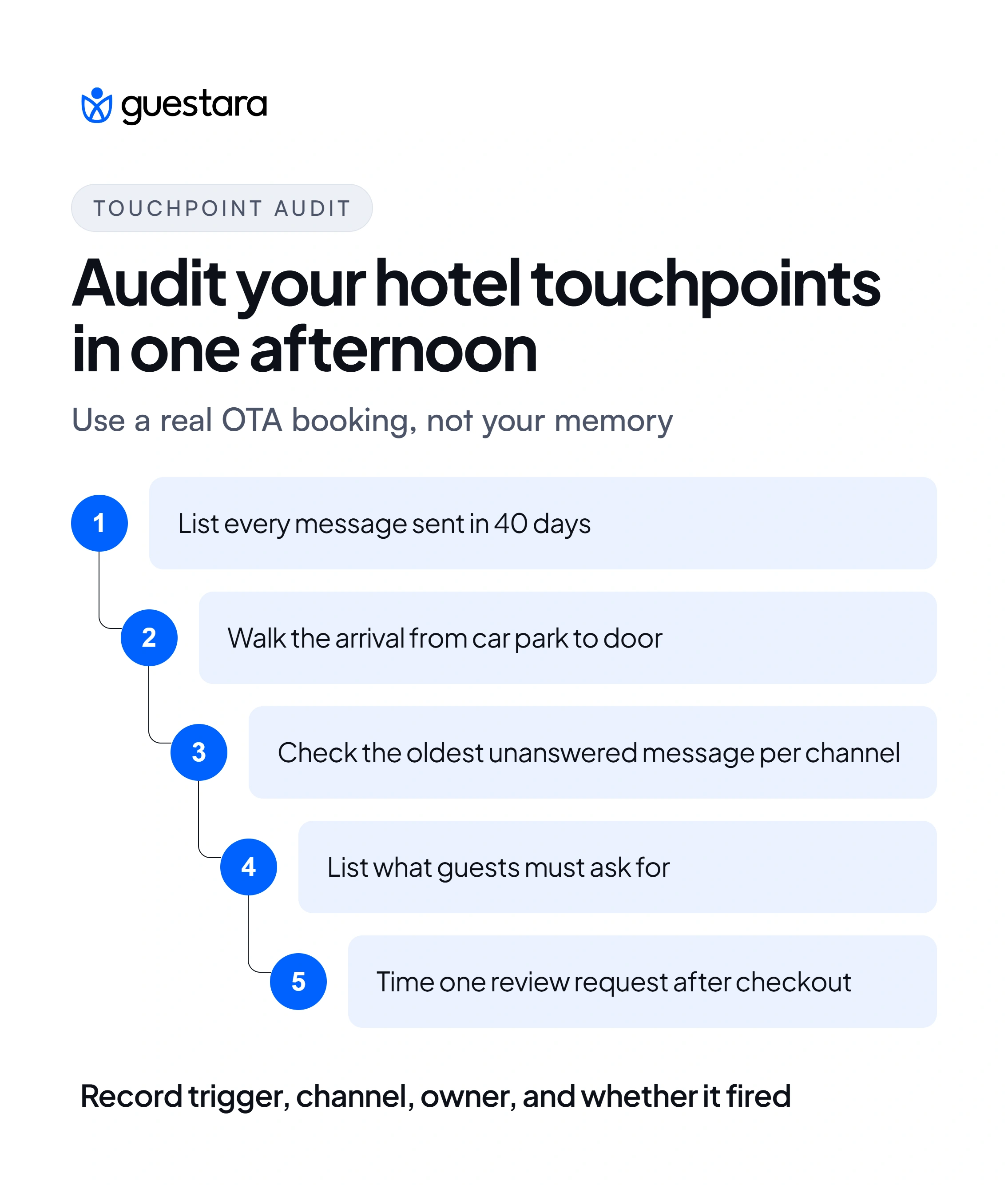
Work from a real booking rather than from memory. Pick one that came through an OTA, since that is the majority case for independent hotels.
Four things, because those four decide what you can do about it.
Record the trigger, meaning what sets it off. Record the channel it runs on. Record the owner by name, not by department. Record whether it fired at all for this booking.
That last column is the one that produces the work. A touchpoint that exists in theory and did not fire for a real guest is the same as a touchpoint you do not have. Reading the journey mistakes that quietly cost revenue before you start helps you spot what to look for.
[[cta:cta-1v | heading=Put every guest touchpoint on *one timeline* | btn=Explore Guest Journey | link=https://www.guestara.com/guest-engagement-for-hospitality ]]
Automate the scheduled touchpoints first, because they run on booking data you already hold and they repeat identically for every guest. The pre-arrival sequence, the check-in link, the in-stay offer and the review request are the four that return the most for the least setup.
The test is simple. How many guests does this touchpoint affect, and how similar is it each time?
The check-in link scores highest on both. Every arriving guest needs one, and the message is the same every time. Guestara's Digital Check-In sends it during pre-arrival, the guest scans their ID, and the registration form fills itself from the ID data in 30 seconds. Olive Hotels by Embassy reached 99.8% verified guest profiles using Guestara, which turns a compliance chore into clean data for every touchpoint after it. The full arrival flow sits on our contactless check-in and checkout page.
The review request scores the same way. AGC, a 52-room independent hotel in Aurangabad, captured 473 reviews across 3,584 checkouts using Guestara, a 13.2% capture rate, and 351 of those became positive public reviews. The other 122 were guests who raised a problem privately, where AGC's team was alerted in real time instead of reading it on Google a week later.
Here is what activating individual touchpoints produced at two properties.
Olive Hotels by Embassy reached a 6.1x annualized return on platform cost using Guestara, and the order of those gains is consistent. Months one to three return efficiency as automated touchpoints absorb manual work. Months four to six add upsell revenue on top. From month six the reputation effect arrives as reviews and rankings climb.
The physical touchpoints, and any reactive one carrying emotion.
A complaint, a bereavement, a guest arriving at 1am after a cancelled flight. Those need a person, and automating them is how properties end up with the stories that go viral for the wrong reasons.
Automation exists to clear the repetitive touchpoints off your team's plate so they have time for those. Guest journey automation covers the build in detail, guest journey KPIs covers how to measure whether each touchpoint improved, and AI across the hotel guest journey covers the technology layer across all 28.
[[cta:cta-7 | eyebrow=Unified Inbox | heading=Catch every inbound touchpoint in *one window* | btn=Explore Unified Inbox | link=https://www.guestara.com/unified-inbox ]]


Hotel guest journey touchpoints mapped across all seven stages: 28 contact points, which ones you do not own, who owns each, and which to automate first.
A guest can leave you a one-star review without ever speaking to a single member of your team.
She found you on an OTA and compared your photos against four other properties. She booked, and the confirmation that arrived carried the OTA's logo rather than yours. She messaged a question about parking and waited two days. On arrival she queued behind a tour group, found the WiFi code taped to the desk drawer, called reception twice to order dinner, and left at 6am without seeing anyone. Then she wrote about all of it.
That stay contained at least a dozen points of contact. Your staff were involved in three. Every one of the others still shaped what she wrote, and that is what a touchpoint is: a moment where your property makes an impression, whether or not anybody from your side is in the room.
A guest journey touchpoint is any single point of contact between a guest and your hotel, from the OTA listing they compare before booking to the review request they get after checkout. Each one is a discrete moment with its own trigger, its own channel and its own owner, and a single stay contains dozens of them.
The word covers more than conversations. A touchpoint can be a message you send, a question the guest asks, a physical interaction with your team, or a page about you that lives on a platform you do not control. If it shapes the guest's impression, it counts.
A stage is a phase of the journey. A touchpoint is a single moment inside one.
Pre-arrival is a stage. The deposit reminder, the check-in link and the arrival day message are three separate touchpoints inside it. Check-in is a stage. The ID capture, the greeting and the room key handover are three touchpoints inside that.
If you are still working out the phases themselves, start with the seven stages of the hotel guest journey and come back to this inventory afterwards. The two documents do different jobs. Stages give you the timeline. Touchpoints give you the list of things that actually happen on it.
Hotels that think in stages fix stages, which usually means hiring. Hotels that think in touchpoints fix individual moments, which usually means a trigger, a routing rule or a template.
"Improve our check-in experience" has no first action. "Send the check-in link 24 hours before arrival so the form is already done" has one, and you can finish it this week.
That is the practical value of the inventory. It turns a vague ambition into a list of discrete items, each small enough to own. For the wider view of how the whole journey fits together, our complete guide to the hotel guest journey sits one level above this page.
A single hotel stay contains far more touchpoints than most operators count. The inventory below lists 28 across the seven stages, and that is before you add anything specific to your property such as a spa, a shuttle or an airport transfer.
Ask a GM to list their guest touchpoints and the same handful comes back. The booking confirmation. Check-in. The front desk greeting. Housekeeping. Checkout. The review request. The OTA listing. A complaint, if one happens.
Those eight are real. They are also the ones already staffed and already visible, which is exactly why they are rarely where the problem is.
The uncounted ones share a pattern. Nobody is standing there when they happen.
The two days your reply sat unanswered. The confirmation email that came from the OTA instead of you. The moment the guest hunted for the WiFi code. The second call to reception to repeat a dinner order. The review that sold your hotel to a stranger eleven months after it was written. Each of those is a touchpoint, and each one left an impression without anyone on your team knowing it occurred.
Here is the full set, with what sets each one off. A touchpoint without a trigger is a touchpoint nobody owns.
Count the trigger column rather than the touchpoint column and the real finding appears. Only pre-arrival, checkout and post-stay fire on a schedule you set. Everything else fires when the guest decides, which is why half your touchpoints cannot be planned into a shift rota. Once you have the list, mapping it against your own property is the exercise that turns it into something specific to you.
Hotel touchpoints fall into four types, and the type tells you what fixes it. Sorting your inventory this way is more useful than sorting it by stage, because all the touchpoints of one type get solved the same way.
Scheduled touchpoints are an automation problem. Build the trigger once and every future booking gets it.
Reactive touchpoints are a coverage problem. You cannot schedule a 2am question, so the fix is making sure something answers it.
Physical touchpoints are a people problem, and the only one of the four where more staff is the honest answer. Borrowed touchpoints are an influence problem, since you can shape them but never own them.
Most hotels apply the wrong fix. They add staff to a scheduled problem, or they buy software for a physical one.
Reactive touchpoints are where properties lose the most ground, because the guest chooses the channel and the hour.
eviivo surveyed 430 travellers worldwide between August and September 2025 and found 58% prefer SMS, WhatsApp or email links for quick exchanges, while 25% still want to speak to a person. Only 4% would download a property's own app.
That settles a design question for you. Your reactive touchpoints belong on the channels guests already have open, not behind an app download. Whether each of those moments should be answered by a person or by automation is a separate judgement, and our guide to digital against human touchpoints in the guest journey works through that balance properly.
Which touchpoints do you not control?
A significant share of your guest journey touchpoints are hosted by someone else. For independent hotels the OTA owns the first impression, the first message and often the payment, which means your guest relationship starts on rented ground.
The scale of it is documented. Cloudbeds analysed 90 million bookings across tens of thousands of properties in 180 countries for its 2026 State of Independent Hotels Report and found OTAs accounted for 63.4% of independent hotel bookings in 2025, with some markets approaching 80%.
It costs you the ability to act on that touchpoint directly, and sometimes it costs you the booking.
The same Cloudbeds data put OTA cancellation rates at 21.8% against 10.6% for direct bookings. A guest who booked through a platform, received a platform confirmation and asked a question in a platform thread has no relationship with your property yet. Nothing has arrived from you. Cancelling costs them nothing emotionally.
These are the borrowed touchpoints and what each one takes from you.
You do not take the OTA touchpoint away. You add one of your own immediately after it, on a channel you own.
The moment an OTA booking lands in your PMS, you have a name, a date and usually a contact. A message from your property sent within the hour creates the first touchpoint the guest has had with you rather than with the platform. Everything after that is yours.
This is also why channel consolidation matters operationally. Guest messages arriving across OTA threads, WhatsApp, email and social accounts are all reactive touchpoints, and managing WhatsApp, OTA and social messaging together is what stops them being answered at different speeds by different people.
The touchpoints that matter most are the ones with the longest reach and the fewest owners. Judged that way, four stand out: the pre-arrival sequence, the check-in link, the in-stay upsell offer and the review request. Each one is scheduled, which means each one is fixable without hiring.
The Cloudbeds report put the average independent hotel booking window at 40 days in 2025, up from 38 in 2023.
Forty days. Between the confirmation and the arrival, most independent properties send nothing at all. That window holds five of the 28 touchpoints in this inventory, and it is the cheapest stretch of the journey to activate because every trigger runs off booking data you already have.
Guestara's Guest Journey module builds that sequence against your PMS booking record and sends it over WhatsApp, email or SMS. Olive Hotels by Embassy saw a 248% lift in guest engagement using Guestara after switching those touchpoints on. Nothing about the guests changed. The silence did.
Our guest engagement platform shows how the triggers are structured, and personalizing each touchpoint by segment is the next layer once the sequence exists.
The in-stay upsell offer, when it is timed to a moment rather than sent on a fixed day.
A guest who has just dropped their bags is deciding how to spend. A guest at 7pm on their first evening does not want to go back out. A guest the night before departure is weighing an early start against a late checkout. Those are three different offers and three distinct touchpoints.
Guestara's Upsell module gives guests a branded mobile menu with payment at the point of order, and because it connects to the Guest Journey module the offer fires at the buying moment rather than at a convenient one. Olive Hotels by Embassy generated $30.2 in added revenue per room per month using Guestara, and Guestara drives up to 200% more upsells.
The in-room information touchpoint sits alongside this. Guests need the WiFi code, the pool hours and the restaurant menu, and the eviivo finding on app downloads explains why that cannot live behind an install. Guestara's Guest App is web-based with no download, which keeps the hotel guest app touchpoint one tap away.
The review request, because it decides which guests get heard publicly.
Accor surveyed 5,000 travellers across five European countries in 2024 and found 97% consult guest reviews before booking, while 67% ignore reviews more than six months old. Your review profile is a borrowed touchpoint that needs constant feeding, not an annual campaign.
Guestara's Review Collection sends the request over WhatsApp with a three-button reply of Good, Average or Bad. Positive answers route to Google, TripAdvisor or the OTA. Negative answers go nowhere public and alert your team instead, which converts a bad review into a service recovery touchpoint while the guest is still reachable. Guestara drives up to 300% more positive reviews, and our review management page covers the interception logic.
The emotional weight of individual moments is a related topic worth reading separately. Our piece on designing emotional moments across the guest journey deals with which touchpoints guests actually remember.
Every touchpoint needs a named owner, and in most independent hotels a third of them have none. The unowned ones are not neglected on purpose. They simply never appeared on anyone's job description, because nobody wrote the list.
Ownership pressure is real and documented. The American Hotel and Lodging Association surveyed 456 hoteliers in 2024 for its Front Desk Feedback report and found 76% of hotels were experiencing a staffing shortage, with housekeeping the top hiring need at 50%. Adding an owner for every touchpoint is not an option. Removing the need for one is.
The ones that fall between departments.
The OTA message thread, because front desk assumes reservations is watching it and reservations assumes front desk is. The 11pm question, because the shift that received it ended. The maintenance issue mentioned to a housekeeper in passing. The guest who said something was wrong at checkout to a cashier with a queue behind them.
Each of those is a touchpoint with a real guest on the other side and no name against it. The hidden gaps in the guest journey covers the same failure from the journey side.
By request type, automatically, rather than by whoever happens to see it.
Guestara's Task Board routes each inbound touchpoint to the department that resolves it. A room upgrade goes to front desk, a food order goes to F&B, a broken air conditioner goes to maintenance, and every task carries an audit trail so a handover does not lose it.
Guestara's Unified Inbox does the same job for the channels themselves. OTA threads, WhatsApp, Instagram, Facebook and email land in one window, so no touchpoint is invisible because nobody had that tab open. Guestara's AI Chatbot covers the routine volume around the clock and escalates anything it should not answer. If you are weighing the consolidation decision, start with what a unified inbox does for a hotel and then set a target using guest message response time benchmarks.
A touchpoint audit means walking your own guest journey as a guest would and writing down every point of contact, including the ones that did not happen. It takes an afternoon and needs no software.
Work from a real booking rather than from memory. Pick one that came through an OTA, since that is the majority case for independent hotels.
Four things, because those four decide what you can do about it.
Record the trigger, meaning what sets it off. Record the channel it runs on. Record the owner by name, not by department. Record whether it fired at all for this booking.
That last column is the one that produces the work. A touchpoint that exists in theory and did not fire for a real guest is the same as a touchpoint you do not have. Reading the journey mistakes that quietly cost revenue before you start helps you spot what to look for.
[[cta:cta-1v | heading=Put every guest touchpoint on *one timeline* | btn=Explore Guest Journey | link=https://www.guestara.com/guest-engagement-for-hospitality ]]
Automate the scheduled touchpoints first, because they run on booking data you already hold and they repeat identically for every guest. The pre-arrival sequence, the check-in link, the in-stay offer and the review request are the four that return the most for the least setup.
The test is simple. How many guests does this touchpoint affect, and how similar is it each time?
The check-in link scores highest on both. Every arriving guest needs one, and the message is the same every time. Guestara's Digital Check-In sends it during pre-arrival, the guest scans their ID, and the registration form fills itself from the ID data in 30 seconds. Olive Hotels by Embassy reached 99.8% verified guest profiles using Guestara, which turns a compliance chore into clean data for every touchpoint after it. The full arrival flow sits on our contactless check-in and checkout page.
The review request scores the same way. AGC, a 52-room independent hotel in Aurangabad, captured 473 reviews across 3,584 checkouts using Guestara, a 13.2% capture rate, and 351 of those became positive public reviews. The other 122 were guests who raised a problem privately, where AGC's team was alerted in real time instead of reading it on Google a week later.
Here is what activating individual touchpoints produced at two properties.
Olive Hotels by Embassy reached a 6.1x annualized return on platform cost using Guestara, and the order of those gains is consistent. Months one to three return efficiency as automated touchpoints absorb manual work. Months four to six add upsell revenue on top. From month six the reputation effect arrives as reviews and rankings climb.
The physical touchpoints, and any reactive one carrying emotion.
A complaint, a bereavement, a guest arriving at 1am after a cancelled flight. Those need a person, and automating them is how properties end up with the stories that go viral for the wrong reasons.
Automation exists to clear the repetitive touchpoints off your team's plate so they have time for those. Guest journey automation covers the build in detail, guest journey KPIs covers how to measure whether each touchpoint improved, and AI across the hotel guest journey covers the technology layer across all 28.
[[cta:cta-7 | eyebrow=Unified Inbox | heading=Catch every inbound touchpoint in *one window* | btn=Explore Unified Inbox | link=https://www.guestara.com/unified-inbox ]]
A touchpoint is any single point of contact between a guest and a hotel, including moments where no staff member is present. It covers messages the hotel sends, questions the guest asks, in-person interactions, and pages about the property hosted on platforms such as OTAs and review sites. Each touchpoint has its own trigger, channel and owner, which is what makes it something a hotel can fix individually.
A typical stay contains around 28 touchpoints across the seven stages, from the OTA listing in discovery to the repeat booking offer after departure. Most hoteliers count only eight or so, because the uncounted ones happen when no staff member is present, such as a reply sitting unanswered or a guest hunting for the WiFi code. Properties with a spa, shuttle or restaurant add more on top of that baseline.
A stage is a phase of the journey and a touchpoint is a single moment inside one. Pre-arrival is a stage, while the deposit reminder, the check-in link and the arrival day message are three separate touchpoints within it. The distinction matters because stage-level problems invite staffing answers, while touchpoint-level problems usually resolve with a trigger, a template or a routing rule.
Automate the scheduled touchpoints first, meaning the ones you initiate at a time you choose: the pre-arrival sequence, the check-in link, the in-stay upsell offer and the post-checkout review request. All four run on booking data already in your PMS and repeat almost identically for every guest, so one build covers every future reservation. Reactive touchpoints such as complaints and physical touchpoints such as the front desk greeting are better served by coverage and staffing than by automation.
Pick a real booking, ideally one from an OTA, and walk its full journey while recording every point of contact. For each one note four things: what triggers it, which channel it runs on, who owns it by name, and whether it actually fired for that booking. The last column is where the work comes from, because a touchpoint that exists in theory and did not reach a real guest counts as missing.
We work closely with the industry leaders to offer seamless solutions




We’re here to help your whole team stay ahead of the curve as you grow.

Get up and running quickly with a personalized onboarding plan

Connect with real people who really get it, 24/7

Checkout our vast library of free resources, templates and more
There's only so much we can say — so let us show you! Schedule a demo today and reach your business goals.


