Hotel guest journey vs customer journey: the customer journey ends at the booking, the guest journey starts there. See how the two models translate.



The customer journey ends shortly after the purchase. The hotel guest journey begins there. Everything else about the two models follows from that one difference.
You have sat through the deck. An agency or a consultant presents a funnel: awareness, consideration, conversion, retention. It is a sound framework and it has sold a great deal of software. Then you look at it as an operator and notice something odd. Your front desk, your housekeeping, your pre-arrival messages, your upsells, your complaints, your checkout and your review requests all sit inside one box, usually the smallest one, labelled post-purchase.
That box is your entire business. This guide explains why the two models disagree, what each is actually good for, and how to translate between them without buying the wrong thing.
What is the customer journey?
The customer journey is a marketing model of how a buyer moves from first hearing about a brand to choosing it and then deciding whether to buy again. It is built to explain and improve purchase decisions, which is why almost all of its detail sits before the money changes hands.
The version most widely used in business comes from McKinsey Quarterly in 2009, which set out four phases in a circular path: initial consideration, active evaluation, closure, and postpurchase.
Older models run on the same logic with different labels. Awareness, interest, desire, action. Awareness, consideration, conversion, retention, advocacy. The labels change and the shape does not. Attention narrows toward a decision, the decision happens, and then a shorter phase covers what follows.
That shape is accurate for the categories it was built on. You research a washing machine, compare three, buy one, and own it that afternoon.
The purchase and the product arrive together. Everything before the purchase is persuasion and everything after it is ownership, so a model that puts most of its detail before the decision is describing those categories correctly.
Hotels do not work that way, and the rest of this guide is about the consequences. One part of the model does hold up well in hospitality: discovery is increasingly happening through AI assistants rather than search results, which is changing how guests find and book hotels.
The hotel guest journey is the operational sequence a guest moves through with a property, from discovery to post-stay, including everything that happens during the stay itself. It is a service delivery model rather than a buying model, which is the root of every difference in this guide.
It describes work rather than persuasion. Which message fires 24 hours before arrival. Who picks up a request at 2am. How a folio gets settled before the guest walks out.
The journey exists to make that work happen reliably for every booking, not to influence a decision that has already been made.
For the sequence itself, the seven stages of the hotel guest journey covers the phases and the full touchpoint inventory lists the individual moments inside them. The complete guide to the hotel guest journey is the parent page for the whole topic.
The product is delivered by people over several days, after the guest has already paid or committed.
That is unusual. In most categories the transaction is the end of the company's work. In a hotel the transaction is the start of it, and almost every cost, every staff hour and every review comes afterwards.
The two models answer different questions, and lining them up against what an operator needs makes the split obvious.
The customer journey treats a person as a buyer. The guest journey treats the same person as a resident.
A buyer needs persuading. A resident needs serving. One property can be excellent at the first and poor at the second, which is how a hotel ends up with strong booking numbers and weak reviews.
Partly, and the places they do not map are the useful part. The next section covers the structural reason, and the section after that gives you the phrase-by-phrase translation.
The related comparison worth reading alongside this one is the difference between the guest journey and guest experience, which separates the structure from how it feels. Once both distinctions are clear, mapping the hotel guest journey is the exercise that turns them into something specific to your property.
In hospitality the purchase happens long before the product is delivered, which inverts the structure every customer journey model assumes. The guest pays or commits, then waits, then receives the thing they bought over the following days.
Consider what that does to the model.
In the customer journey, closure is the moment of maximum effort and everything after it is a lighter postpurchase phase. In a hotel, closure is a 90-second transaction on an OTA and postpurchase contains the pre-arrival sequence, the check-in, the whole stay, the checkout and the review request.
One phase. Four operational stages. Essentially all of the property's labour and almost all of its cost.
It creates a stretch of time the customer journey has no name for.
Cloudbeds analysed 90 million bookings across 180 countries for its 2026 State of Independent Hotels Report and put the average independent hotel booking window at 40 days. Forty days between the purchase and the product, during which the guest is committed, curious and entirely reachable.
A customer journey model has nothing to say about that window because in its source categories the window does not exist. A guest journey model treats it as a stage with five touchpoints in it, including the deposit, the check-in link and the highest-converting upsell moment of the entire relationship.
Olive Hotels by Embassy saw a 248% lift in guest engagement using Guestara after activating those pre-arrival touchpoints. The guests were already booked. Nothing about acquisition changed. Guestara's Guest Journey module builds the sequence against PMS booking data, and deposit collection inside that window runs through Guestara's payment automation, while the guest engagement platform covers the messaging side.
Because of what they were built on. This is worth being specific about rather than treating as a matter of opinion.
The McKinsey research behind the four-phase model studied the purchase decisions of almost 20,000 consumers across five industries: automobiles, skin care, insurance, consumer electronics and mobile telecom. Three continents, qualitative and quantitative work, a serious piece of research.
Now read that list again as a hotelier. Not one of those five is a service delivered by staff over several days after the customer has paid. The closest, mobile telecom, is a subscription that mostly delivers itself.
The model is not wrong. It was built to explain categories where the product arrives with the purchase, and it does that well. Applying it unchanged to a business where delivery takes three days and forty people is where hotels get into trouble.
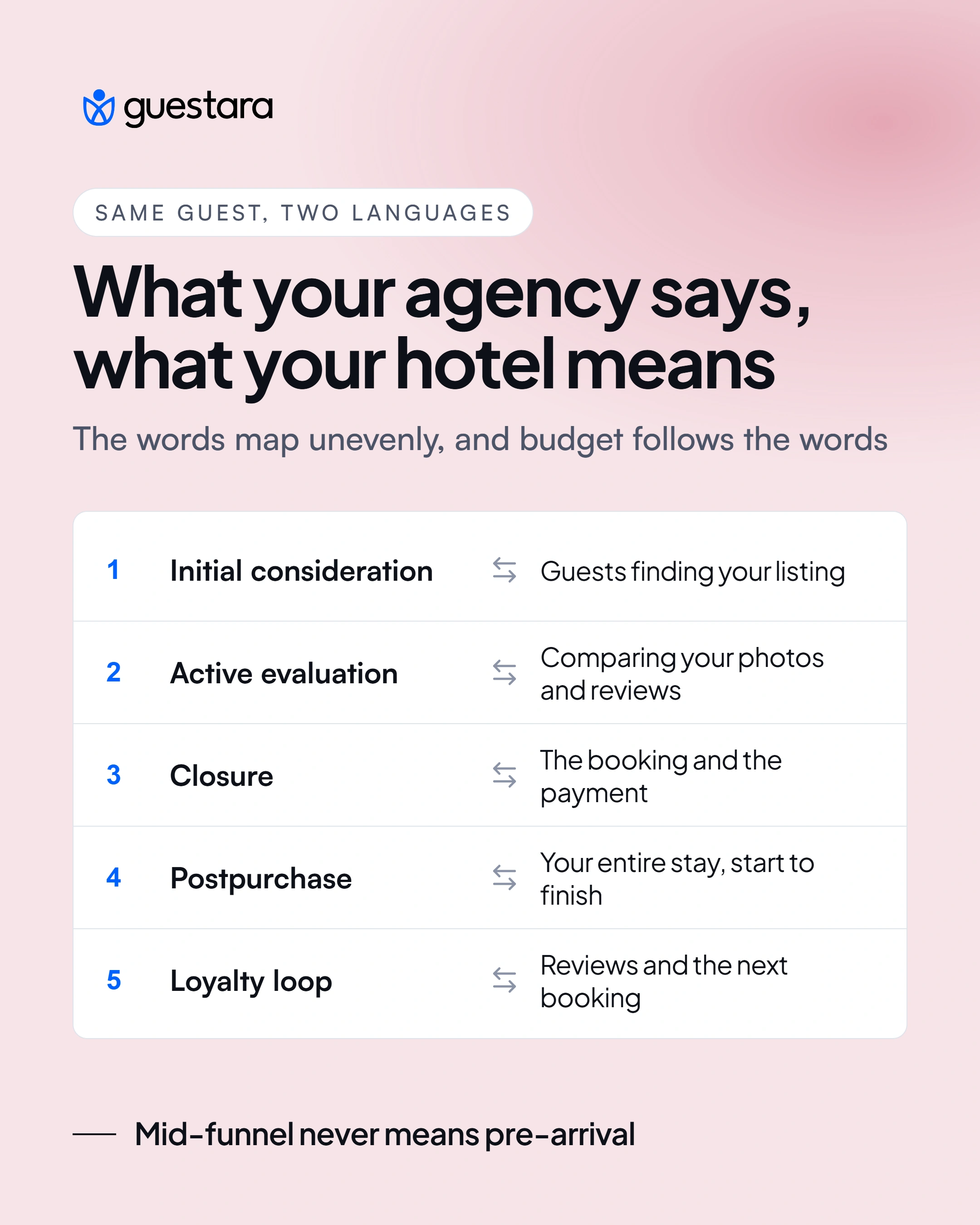
Most of the confusion is translation failure rather than disagreement. Your agency and your operations manager are describing the same guest in two languages, and the words map onto each other unevenly.
Here is the mapping, using McKinsey's four phases plus the loyalty loop.
They mean active evaluation, which in your property means your OTA listing and your review profile. They almost never mean pre-arrival, because pre-arrival is not a funnel concept.
That matters when budget gets allocated. A mid-funnel nurture campaign and a pre-arrival sequence sound adjacent and are completely different work owned by different teams. One chases people who have not booked. The other serves people who already have.
In two places, and both are expensive.
The first is postpurchase, as the table makes obvious. One phase, four stages, and no vocabulary inside it for the difference between a check-in link and a mid-stay upsell. Software sold against that phase tends to treat the whole stay as a single event.
The second is advocacy. Reviews look like a marketing outcome and they are produced operationally. Accor surveyed 5,000 travellers across five European countries in 2024 and found 97% consult guest reviews before booking, which makes your review profile a genuine acquisition asset. It is built by departing guests and duty managers rather than by anyone in marketing.
Guestara's Review Collection shows how operational it actually is. At AGC, a 52-room independent hotel in Aurangabad, 122 guests flagged a problem through the review flow rather than posting it publicly, and the team was alerted in real time, often while the guest was still on the property. That is an acquisition asset being protected by a housekeeping supervisor. Our review management page covers the interception logic, and personalizing across the guest journey covers the segment detail that makes postpurchase messaging land.
Running a hotel on a customer journey model points your effort at the half of the business you control least and hides the half where your margin lives. Both errors cost money and the second one is larger.
Usually, yes. The customer journey concentrates on acquisition, and for most independent hotels acquisition is not yours.
The same Cloudbeds analysis found OTAs accounted for 63.4% of independent hotel bookings in 2025, with some markets approaching 80%. When two thirds of your demand arrives through a platform, the listing, the comparison layout and the confirmation email all belong to that platform. You can influence them. You cannot rebuild them.
The data also shows what that dependence costs on the retention side. OTA bookings were cancelled at 21.8% against 10.6% for direct bookings. A guest who booked on a platform, received a platform confirmation and asked a question in a platform thread has no relationship with your property at all, and cancelling costs them nothing.
Worth checking before you sign anything, because it determines what the tool can see.
A CRM built on the customer journey organises around leads, campaigns and conversion. It is good at that. It has no concept of a room, a shift, a folio or a housekeeping handover, so the entire postpurchase phase arrives as one undifferentiated bucket.
That blind spot has a price. Olive Hotels by Embassy generated $30.2 in added revenue per room per month using Guestara, from upsells timed to moments inside the stay. A funnel that ends at conversion cannot see that revenue, cannot attribute it, and will not prompt you to go after it. Guestara drives up to 200% more upsells, and the hotel upsell software page shows how the branded menu and the timing work together.
Two further reads on where this goes wrong in practice: the hidden gaps in the guest journey and the journey mistakes that quietly cost revenue.
[[cta:cta-1v | heading=The revenue starts *after* the booking | btn=Explore Upsells | link=https://www.guestara.com/hotel-upsell-software ]]
Use both, for different decisions. The customer journey is the right tool for winning the booking and the guest journey is the right tool for everything that follows, and neither one substitutes for the other.
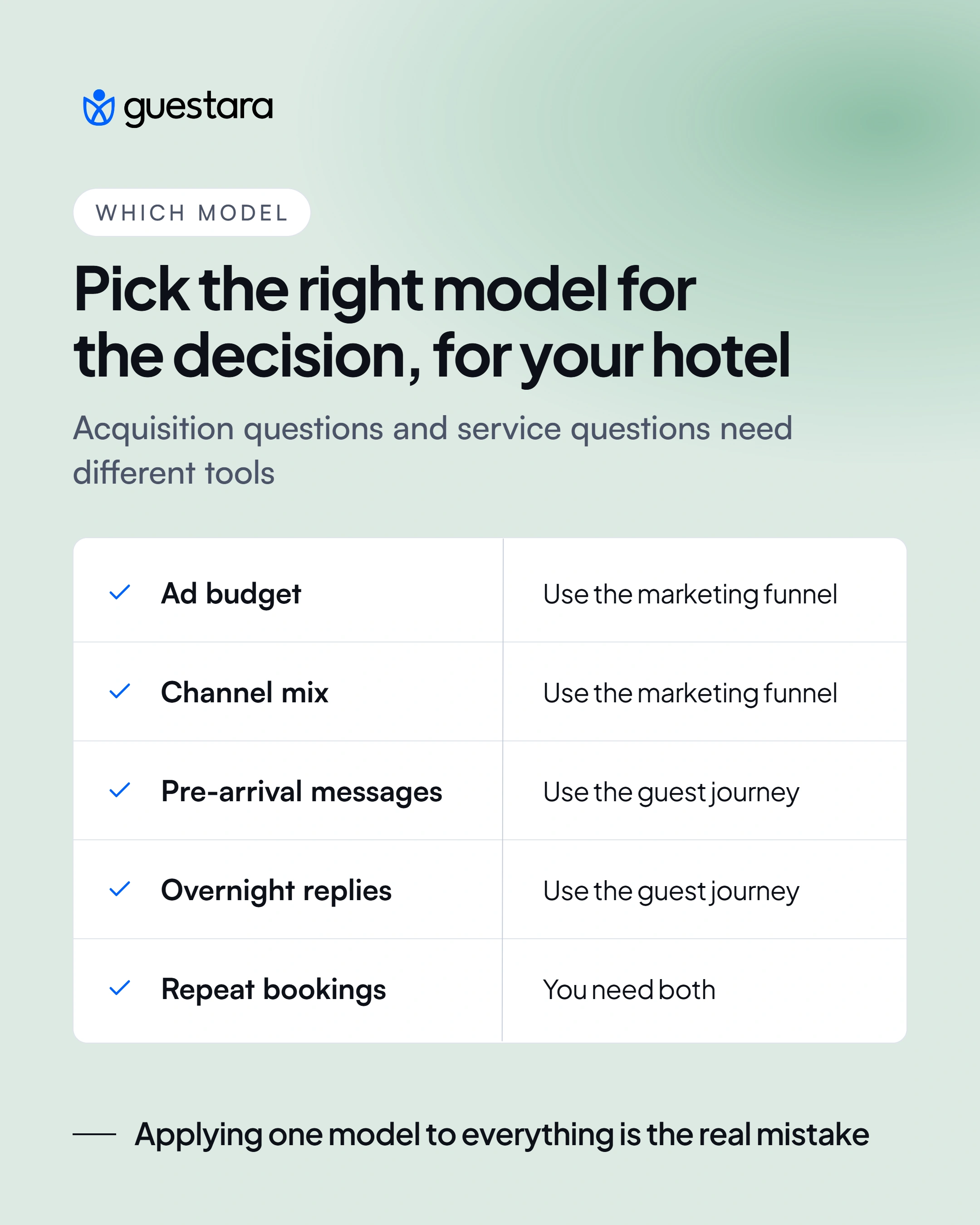
The failure mode is not picking the wrong model. It is picking one model and applying it to everything.
A hotel running purely on the customer journey over-invests in acquisition and under-serves the stay. A hotel running purely on the guest journey delivers beautifully to guests it never explains to anyone why they should book.
Here is which model answers which question.
Marketing owns the customer journey. Operations and revenue own the guest journey. The last row of that table is where they meet, and it is the row most hotels handle worst.
The McKinsey research is useful here too. It separates active loyalists, who stay and recommend, from passive loyalists, who stay out of inertia and are open to switching. Marketing can make a repeat offer to both. Only the stay itself decides which group the guest is in.
Practical next reads on that boundary: post-stay engagement strategy covers turning a departed guest into a repeat booker, thirteen ways to improve the journey is a starting list, and digital against human touchpoints covers which moments to automate.
Run both models off one set of booking data and keep the vocabularies separate in conversation. The confusion is almost never about the guest. It is about two teams using one word for different things.
Every booking record carries the same facts: channel, arrival date, length of stay, rate, guest contact. Marketing reads that record as an acquisition outcome. Operations reads it as a work order. Neither reading is wrong and both run off the same row in your PMS.
Keep the data shared and the language local. Marketing says conversion, operations says booking confirmed, and nobody needs to win that argument as long as both are looking at the same reservation. Guestara's Guest Journey module triggers off that record directly, and guest journey automation covers how the sequences get built.
Measure the handover rather than the whole thing.
Three numbers do most of the work. How many bookings arrive by channel, which is a marketing metric. How many of those guests complete pre-arrival, which is an operational metric. How many book again, which belongs to both and settles most arguments.
Olive Hotels by Embassy reached a 6.1x annualized return on platform cost using Guestara, and the order it arrived in maps onto the two models neatly. Months one to three returned efficiency, which is operational. Months four to six added upsell revenue, also operational. From month six the reputation effect arrived and started driving direct bookings, which lands in marketing's column. The acquisition gain came last, produced by the service delivery, not by the campaign.
Guest journey KPIs by stage covers the operational measurement properly, and AI across the hotel guest journey covers the technology layer across both halves.
[[cta:cta-2v | heading=Run the half of the journey your funnel *cannot see* | btn=Talk to Sales | link=https://www.guestara.com/get-demo ]]


Hotel guest journey vs customer journey: the customer journey ends at the booking, the guest journey starts there. See how the two models translate.
The customer journey ends shortly after the purchase. The hotel guest journey begins there. Everything else about the two models follows from that one difference.
You have sat through the deck. An agency or a consultant presents a funnel: awareness, consideration, conversion, retention. It is a sound framework and it has sold a great deal of software. Then you look at it as an operator and notice something odd. Your front desk, your housekeeping, your pre-arrival messages, your upsells, your complaints, your checkout and your review requests all sit inside one box, usually the smallest one, labelled post-purchase.
That box is your entire business. This guide explains why the two models disagree, what each is actually good for, and how to translate between them without buying the wrong thing.
What is the customer journey?
The customer journey is a marketing model of how a buyer moves from first hearing about a brand to choosing it and then deciding whether to buy again. It is built to explain and improve purchase decisions, which is why almost all of its detail sits before the money changes hands.
The version most widely used in business comes from McKinsey Quarterly in 2009, which set out four phases in a circular path: initial consideration, active evaluation, closure, and postpurchase.
Older models run on the same logic with different labels. Awareness, interest, desire, action. Awareness, consideration, conversion, retention, advocacy. The labels change and the shape does not. Attention narrows toward a decision, the decision happens, and then a shorter phase covers what follows.
That shape is accurate for the categories it was built on. You research a washing machine, compare three, buy one, and own it that afternoon.
The purchase and the product arrive together. Everything before the purchase is persuasion and everything after it is ownership, so a model that puts most of its detail before the decision is describing those categories correctly.
Hotels do not work that way, and the rest of this guide is about the consequences. One part of the model does hold up well in hospitality: discovery is increasingly happening through AI assistants rather than search results, which is changing how guests find and book hotels.
The hotel guest journey is the operational sequence a guest moves through with a property, from discovery to post-stay, including everything that happens during the stay itself. It is a service delivery model rather than a buying model, which is the root of every difference in this guide.
It describes work rather than persuasion. Which message fires 24 hours before arrival. Who picks up a request at 2am. How a folio gets settled before the guest walks out.
The journey exists to make that work happen reliably for every booking, not to influence a decision that has already been made.
For the sequence itself, the seven stages of the hotel guest journey covers the phases and the full touchpoint inventory lists the individual moments inside them. The complete guide to the hotel guest journey is the parent page for the whole topic.
The product is delivered by people over several days, after the guest has already paid or committed.
That is unusual. In most categories the transaction is the end of the company's work. In a hotel the transaction is the start of it, and almost every cost, every staff hour and every review comes afterwards.
The two models answer different questions, and lining them up against what an operator needs makes the split obvious.
The customer journey treats a person as a buyer. The guest journey treats the same person as a resident.
A buyer needs persuading. A resident needs serving. One property can be excellent at the first and poor at the second, which is how a hotel ends up with strong booking numbers and weak reviews.
Partly, and the places they do not map are the useful part. The next section covers the structural reason, and the section after that gives you the phrase-by-phrase translation.
The related comparison worth reading alongside this one is the difference between the guest journey and guest experience, which separates the structure from how it feels. Once both distinctions are clear, mapping the hotel guest journey is the exercise that turns them into something specific to your property.
In hospitality the purchase happens long before the product is delivered, which inverts the structure every customer journey model assumes. The guest pays or commits, then waits, then receives the thing they bought over the following days.
Consider what that does to the model.
In the customer journey, closure is the moment of maximum effort and everything after it is a lighter postpurchase phase. In a hotel, closure is a 90-second transaction on an OTA and postpurchase contains the pre-arrival sequence, the check-in, the whole stay, the checkout and the review request.
One phase. Four operational stages. Essentially all of the property's labour and almost all of its cost.
It creates a stretch of time the customer journey has no name for.
Cloudbeds analysed 90 million bookings across 180 countries for its 2026 State of Independent Hotels Report and put the average independent hotel booking window at 40 days. Forty days between the purchase and the product, during which the guest is committed, curious and entirely reachable.
A customer journey model has nothing to say about that window because in its source categories the window does not exist. A guest journey model treats it as a stage with five touchpoints in it, including the deposit, the check-in link and the highest-converting upsell moment of the entire relationship.
Olive Hotels by Embassy saw a 248% lift in guest engagement using Guestara after activating those pre-arrival touchpoints. The guests were already booked. Nothing about acquisition changed. Guestara's Guest Journey module builds the sequence against PMS booking data, and deposit collection inside that window runs through Guestara's payment automation, while the guest engagement platform covers the messaging side.
Because of what they were built on. This is worth being specific about rather than treating as a matter of opinion.
The McKinsey research behind the four-phase model studied the purchase decisions of almost 20,000 consumers across five industries: automobiles, skin care, insurance, consumer electronics and mobile telecom. Three continents, qualitative and quantitative work, a serious piece of research.
Now read that list again as a hotelier. Not one of those five is a service delivered by staff over several days after the customer has paid. The closest, mobile telecom, is a subscription that mostly delivers itself.
The model is not wrong. It was built to explain categories where the product arrives with the purchase, and it does that well. Applying it unchanged to a business where delivery takes three days and forty people is where hotels get into trouble.
Most of the confusion is translation failure rather than disagreement. Your agency and your operations manager are describing the same guest in two languages, and the words map onto each other unevenly.
Here is the mapping, using McKinsey's four phases plus the loyalty loop.
They mean active evaluation, which in your property means your OTA listing and your review profile. They almost never mean pre-arrival, because pre-arrival is not a funnel concept.
That matters when budget gets allocated. A mid-funnel nurture campaign and a pre-arrival sequence sound adjacent and are completely different work owned by different teams. One chases people who have not booked. The other serves people who already have.
In two places, and both are expensive.
The first is postpurchase, as the table makes obvious. One phase, four stages, and no vocabulary inside it for the difference between a check-in link and a mid-stay upsell. Software sold against that phase tends to treat the whole stay as a single event.
The second is advocacy. Reviews look like a marketing outcome and they are produced operationally. Accor surveyed 5,000 travellers across five European countries in 2024 and found 97% consult guest reviews before booking, which makes your review profile a genuine acquisition asset. It is built by departing guests and duty managers rather than by anyone in marketing.
Guestara's Review Collection shows how operational it actually is. At AGC, a 52-room independent hotel in Aurangabad, 122 guests flagged a problem through the review flow rather than posting it publicly, and the team was alerted in real time, often while the guest was still on the property. That is an acquisition asset being protected by a housekeeping supervisor. Our review management page covers the interception logic, and personalizing across the guest journey covers the segment detail that makes postpurchase messaging land.
Running a hotel on a customer journey model points your effort at the half of the business you control least and hides the half where your margin lives. Both errors cost money and the second one is larger.
Usually, yes. The customer journey concentrates on acquisition, and for most independent hotels acquisition is not yours.
The same Cloudbeds analysis found OTAs accounted for 63.4% of independent hotel bookings in 2025, with some markets approaching 80%. When two thirds of your demand arrives through a platform, the listing, the comparison layout and the confirmation email all belong to that platform. You can influence them. You cannot rebuild them.
The data also shows what that dependence costs on the retention side. OTA bookings were cancelled at 21.8% against 10.6% for direct bookings. A guest who booked on a platform, received a platform confirmation and asked a question in a platform thread has no relationship with your property at all, and cancelling costs them nothing.
Worth checking before you sign anything, because it determines what the tool can see.
A CRM built on the customer journey organises around leads, campaigns and conversion. It is good at that. It has no concept of a room, a shift, a folio or a housekeeping handover, so the entire postpurchase phase arrives as one undifferentiated bucket.
That blind spot has a price. Olive Hotels by Embassy generated $30.2 in added revenue per room per month using Guestara, from upsells timed to moments inside the stay. A funnel that ends at conversion cannot see that revenue, cannot attribute it, and will not prompt you to go after it. Guestara drives up to 200% more upsells, and the hotel upsell software page shows how the branded menu and the timing work together.
Two further reads on where this goes wrong in practice: the hidden gaps in the guest journey and the journey mistakes that quietly cost revenue.
[[cta:cta-1v | heading=The revenue starts *after* the booking | btn=Explore Upsells | link=https://www.guestara.com/hotel-upsell-software ]]
Use both, for different decisions. The customer journey is the right tool for winning the booking and the guest journey is the right tool for everything that follows, and neither one substitutes for the other.
The failure mode is not picking the wrong model. It is picking one model and applying it to everything.
A hotel running purely on the customer journey over-invests in acquisition and under-serves the stay. A hotel running purely on the guest journey delivers beautifully to guests it never explains to anyone why they should book.
Here is which model answers which question.
Marketing owns the customer journey. Operations and revenue own the guest journey. The last row of that table is where they meet, and it is the row most hotels handle worst.
The McKinsey research is useful here too. It separates active loyalists, who stay and recommend, from passive loyalists, who stay out of inertia and are open to switching. Marketing can make a repeat offer to both. Only the stay itself decides which group the guest is in.
Practical next reads on that boundary: post-stay engagement strategy covers turning a departed guest into a repeat booker, thirteen ways to improve the journey is a starting list, and digital against human touchpoints covers which moments to automate.
Run both models off one set of booking data and keep the vocabularies separate in conversation. The confusion is almost never about the guest. It is about two teams using one word for different things.
Every booking record carries the same facts: channel, arrival date, length of stay, rate, guest contact. Marketing reads that record as an acquisition outcome. Operations reads it as a work order. Neither reading is wrong and both run off the same row in your PMS.
Keep the data shared and the language local. Marketing says conversion, operations says booking confirmed, and nobody needs to win that argument as long as both are looking at the same reservation. Guestara's Guest Journey module triggers off that record directly, and guest journey automation covers how the sequences get built.
Measure the handover rather than the whole thing.
Three numbers do most of the work. How many bookings arrive by channel, which is a marketing metric. How many of those guests complete pre-arrival, which is an operational metric. How many book again, which belongs to both and settles most arguments.
Olive Hotels by Embassy reached a 6.1x annualized return on platform cost using Guestara, and the order it arrived in maps onto the two models neatly. Months one to three returned efficiency, which is operational. Months four to six added upsell revenue, also operational. From month six the reputation effect arrived and started driving direct bookings, which lands in marketing's column. The acquisition gain came last, produced by the service delivery, not by the campaign.
Guest journey KPIs by stage covers the operational measurement properly, and AI across the hotel guest journey covers the technology layer across both halves.
[[cta:cta-2v | heading=Run the half of the journey your funnel *cannot see* | btn=Talk to Sales | link=https://www.guestara.com/get-demo ]]
The customer journey is a marketing model of how a buyer reaches a purchase decision, with most of its detail sitting before the purchase and a single phase covering what follows. The hotel guest journey is an operational model of service delivery, covering everything from discovery through the stay to the next booking. The practical difference is that a hotel's entire operation, including pre-arrival, check-in, the stay and checkout, fits inside the customer journey's one postpurchase phase.
No, because the two models are weighted in opposite directions. The customer journey concentrates its detail before the transaction, which suits categories where the product arrives with the purchase. In hospitality the purchase comes an average of 40 days before delivery and the service then runs for several days, so the guest journey gives that period its own stages, touchpoints and owners instead of treating it as an afterthought.
Because of the categories it was built on. The widely used four-phase model came from McKinsey research into nearly 20,000 consumers across automobiles, skin care, insurance, consumer electronics and mobile telecom, none of which is a service delivered by staff over several days after payment. The model describes those categories accurately, and applying it unchanged to a business where delivery takes days and many people leaves the operational majority of the business unmodelled.
They should use both models and share the booking data underneath them. Marketing needs the customer journey to make acquisition and channel decisions, while operations needs the guest journey to run pre-arrival, arrival, in-stay and checkout. Keeping the vocabularies separate avoids the common failure where one word such as post-purchase means a single event to one team and four operational stages to the other.
They overlap at discovery, booking and the decision to return. Discovery and booking map almost directly, since both models describe a guest comparing options and then reserving. The return decision is genuinely shared, because marketing controls the repeat offer while the stay itself decides whether the guest recommends the property or switches on price.
We work closely with the industry leaders to offer seamless solutions




We’re here to help your whole team stay ahead of the curve as you grow.

Get up and running quickly with a personalized onboarding plan

Connect with real people who really get it, 24/7

Checkout our vast library of free resources, templates and more
There's only so much we can say — so let us show you! Schedule a demo today and reach your business goals.


