See how AI-powered personalization across the hotel guest journey lifts revenue, loyalty, and reviews — from booking to post-stay.




Think about the last hotel stay you really remembered.
It probably was not the thread count. It was a moment. The receptionist who noticed it was your anniversary. The pillow menu the housekeeper left without being asked. The restaurant recommendation that turned into the best meal of the trip.
None of it was expensive. None of it was random. Someone, somewhere, paid attention and acted on it.
That is personalization. And it is now the single biggest lever in hospitality. Not a nice-to-have. Not a luxury-tier differentiator. The thing that decides whether a guest books you again or forgets your name by Tuesday.
This blog walks through how real personalization works across the hotel guest journey, from booking to post-stay, where most hotels go wrong, and how AI-powered segmentation and behavior triggers make it actually scale.
Let us start with what it is not.
Personalization is not putting the guest's first name in the subject line of an email. Personalization is not sending every guest the same welcome message with their name changed. That is mail merge. That is 2010.
Real personalization is different. It means the right message, at the right moment, on the right channel, for the right guest.
A honeymoon couple gets pre-arrival notes about sunset boat rides. A business traveler gets express check-in details. A returning guest gets "welcome back" instead of the standard welcome template. A family with kids gets pool hours, not spa hours.
None of this is the guest's name. All of it is about recognition.
McKinsey's latest research on personalized marketing found that 71% of consumers expect companies to deliver personalized interactions, and 76% get frustrated when it does not happen.
That gap, the difference between what guests expect and what hotels deliver, is where reviews, revenue, and repeat bookings are won or lost.
For years, hotel loyalty meant points. Stay 10 nights, get 1 free. Reach gold tier, get a welcome drink. The whole system ran on transactions.
That era is over.
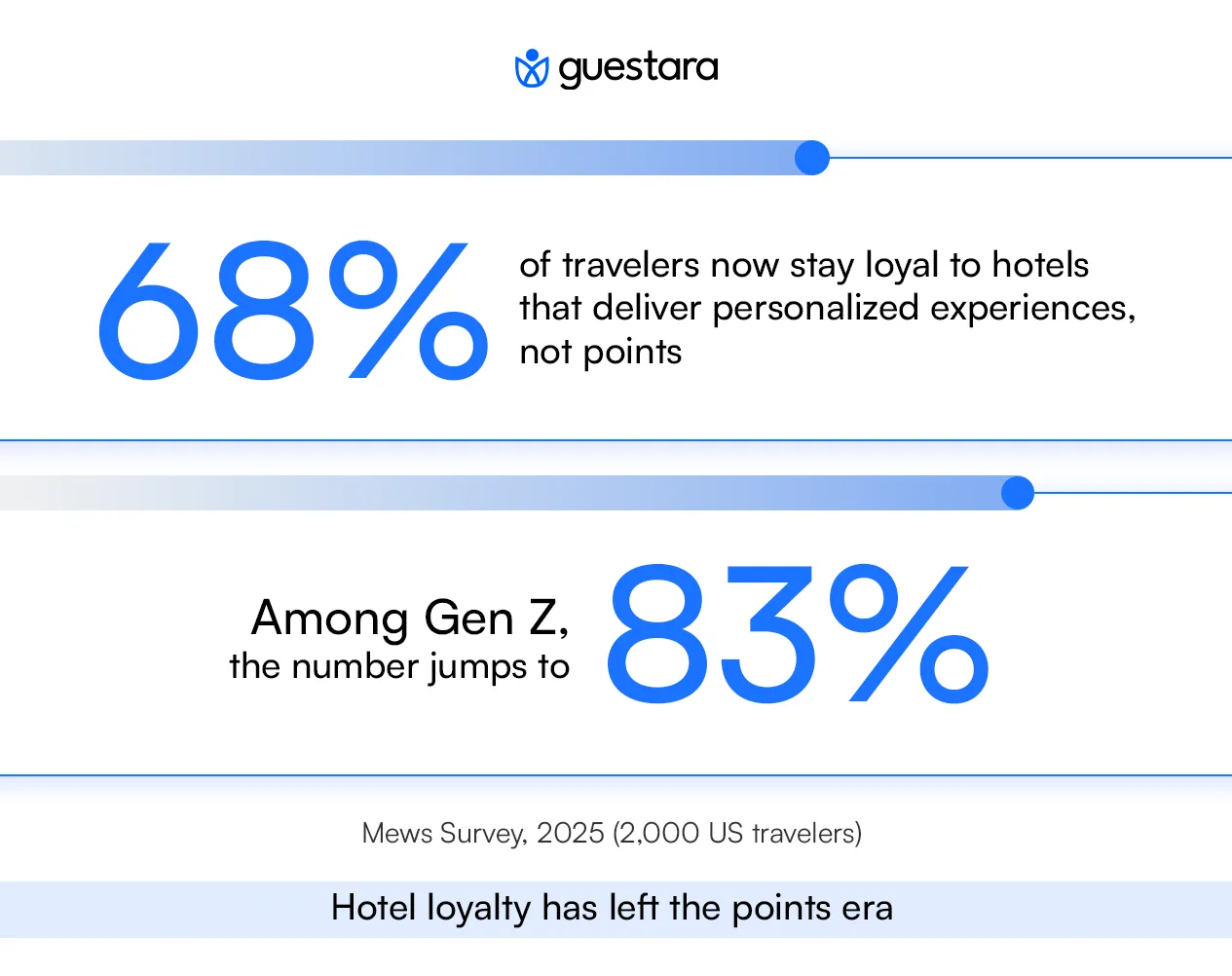
A 2025 Mews survey of 2,000 American travelers found that 68% of travelers now say they will stay loyal to hotels that deliver standout, personalized experiences, leaving traditional points-based rewards behind. Among Gen Z, the number climbs to 83%. Among high-income earners, 71% prefer experiences tailored to them over loyalty points.
The guests who bring you the most revenue are the ones who care least about your points system. They care about being recognized.
And here is the part most hotels miss. Medallia's 2024 research shows that 61% of consumers are willing to spend more with companies that offer a customized experience. Personalization is not a cost center. It is a margin lever.
Yet the same Medallia study found that only 23% of consumers report experiencing high levels of personalization after recent hotel stays.
That is the gap. Guests want it. Will pay for it. Will come back for it. Most hotels do not deliver it.
Personalization does not happen at one moment. It happens at every moment. Here is how it maps across the guest journey.
For a full overview of what a guest journey looks like end to end, see our complete hotel guest journey guide.
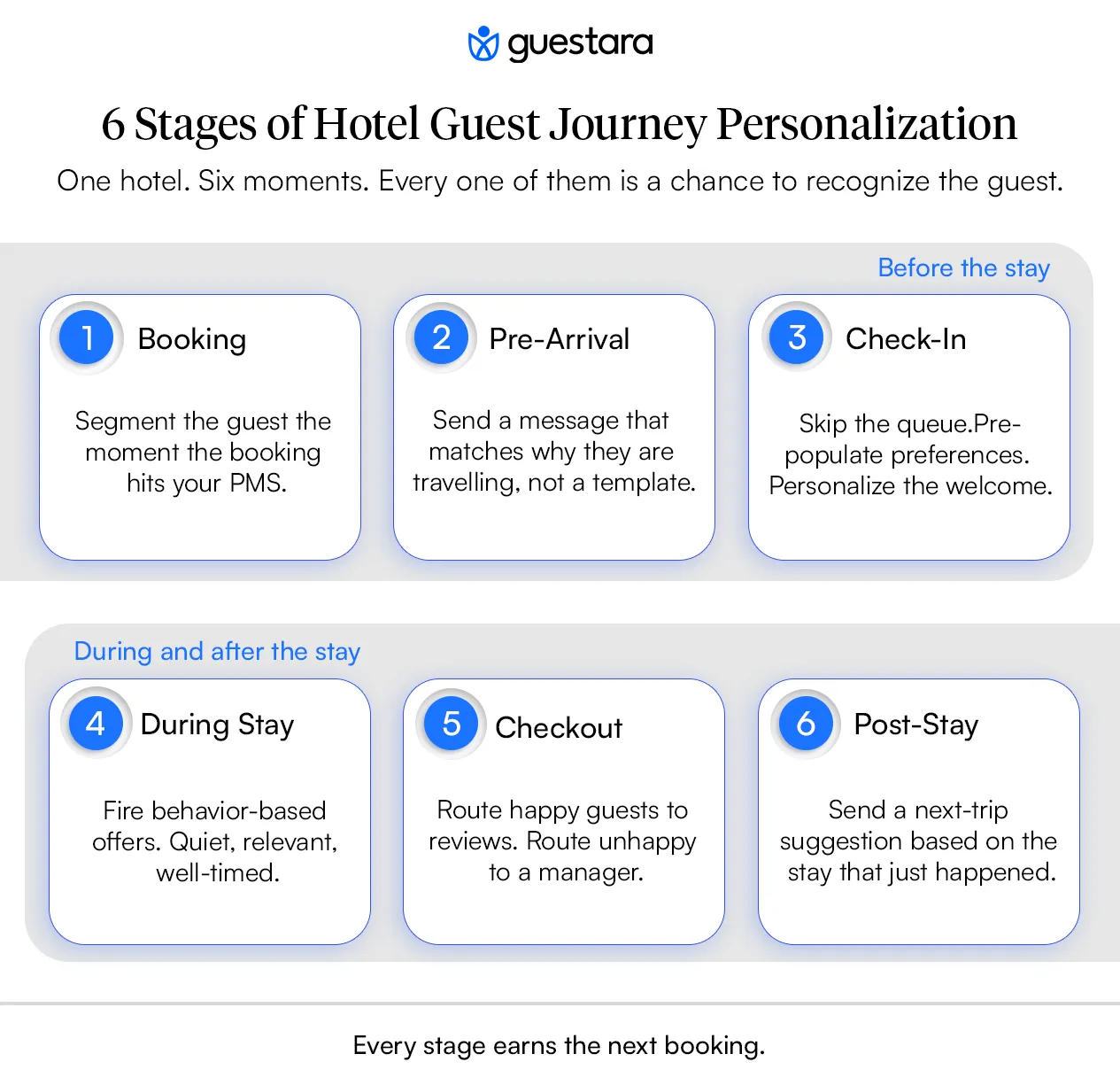
The journey starts the second the booking hits your PMS. This is when AI segmentation goes to work.
What to infer: A solo weeknight booking at a city property is probably a business traveler. A Friday-to-Sunday booking for two adults at a beach resort is probably a leisure trip. A family room booked six months out is probably a vacation, not a last-minute decision.
The segmentation writes itself. The hotel just has to act on it.
This is the highest-leverage moment in the entire journey and most hotels waste it.
A good pre-arrival sequence does four things. It confirms the booking. It collects preferences. It introduces relevant upsells. It sets the emotional tone of the stay before the guest even leaves home.
AI-driven triggers make this actually scale. Booking confirmed fires message 1. Seven days before arrival fires message 2 with local tips. 24 hours before arrival fires the check-in link. Landed in the city fires a welcome message with arrival instructions.
None of this requires a staff member to lift a finger. All of it feels personal to the guest.
Check-in is where the first physical impression forms. And it is where Medallia's data gets uncomfortable.
Their research found that hotels deliver meaningful personalization at the booking, post-stay, and check-in stages. But the during-stay moment, the actual hotel experience, scored only 46% on personalization recall, the lowest of any stage.
Check-in is where that changes or breaks. A digital check-in that skips the queue, auto-populates known preferences, and sends a personalized "welcome, room 412, we upgraded you because you are a repeat guest" message on WhatsApp turns the arrival into a recognition moment.
A paper form at a crowded front desk does the opposite.
This is where most hotels go dark. The guest is in the property. The communication stops. The chance to personalize evaporates.
It should not.
Mid-stay is when behavior triggers earn their keep. A guest who orders coffee at 7am every morning should get a "good morning, shall we send your usual?" on day three. A guest whose weather shifted to rain should get a spa offer. A guest booked for a special occasion should get a complimentary dessert at dinner.
None of this requires a human to notice. It requires a system that is paying attention.
Checkout personalization is usually an afterthought. It should not be.
A guest who had a smooth stay gets a review request on WhatsApp. A guest who had a problem gets a follow-up from a manager, not a review request. A guest who paid for a spa treatment gets a "would you like us to book your next one?" offer.
One stage. Three different paths, all driven by what actually happened during the stay.
Most hotels send one generic email two days after checkout. That is not a post-stay journey. That is a newsletter.
A real post-stay sequence uses the data from the stay to segment the next message. A guest who liked their room type gets a reminder about their anniversary next year. A guest who stayed during a conference gets a "we noticed you were here for an event, would you like to know about next month's?" message. A guest who gave a 5-star review gets invited to refer a friend with a credit.
Every message knows something about the guest. Every message has a reason to exist.
For a deeper walkthrough of each stage and where revenue leaks happen, see our piece on guest journey mapping.
Segmentation is the word every marketing article uses. In most hotels, it means almost nothing. Let us make it concrete.
A smart segmentation layer pulls from three data sources:
1. Booking data from your PMS. Length of stay, room type, channel, rate code, arrival date, group size.
2. Behavioral data from the guest journey. Which pre-arrival messages they opened. Whether they completed mobile check-in. What upsells they clicked on. Which channel they prefer to message on.
3. Historical data from past stays. Repeat guest flag. Previous room preferences. Previous upsells bought. Previous complaints. Previous review scores.
The AI layer combines these three inputs and assigns the guest to a working segment in real time. "Repeat business traveler on a weeknight" triggers one journey. "First-time leisure family with young kids" triggers another. "High-spend repeat guest booking a suite" triggers a third.
Every segment has its own message cadence, channel preference, and upsell logic. All of it runs automatically.
McKinsey found that gen-AI-enhanced personalization can produce content and offers 50 times faster than a manual approach. This is why AI segmentation is not optional anymore. Hotels that do it by hand cannot keep up.
For more on how this connects to actual message delivery, read our guide on the role of guest communication in shaping the hotel guest journey.
.webp)
Segmentation decides who gets what. Behavior triggers decide when.
A trigger is a rule that says "if this happens, fire this message." The power comes from chaining them together across the guest journey.
Here are examples of triggers that move the needle.
Booking confirmation received → send personalized welcome message on preferred channel. A business traveler gets a business-tone message. A honeymoon couple gets a warm, celebratory one. Same platform, different message.
7 days before arrival → send city tips and weather forecast. The system pulls live weather data and adjusts recommendations. Rain forecast triggers indoor suggestions. Clear weather triggers outdoor ones.
24 hours before arrival → send check-in link and room preview. Guest gets to skip the front desk entirely. Property gets a verified ID and a signed registration before arrival.
Guest arrives on property → send in-room welcome and restaurant recommendations. Geofencing or check-in completion triggers the message. Recommendations match the guest profile.
Mid-stay, no mid-stay upsell engagement → send a targeted offer based on booking profile. A guest who booked a city stay gets a dinner deal. A guest who booked a resort gets a spa offer.
Checkout completed → send review request on preferred channel. Positive NPS redirects to Google or TripAdvisor. Negative NPS routes to a manager for service recovery.
45 days after checkout → send a return-trip suggestion based on stay pattern. Business travelers who stayed Monday get a "we notice you travel for work often" message. Leisure travelers get a "book again for the same week next year" offer.
None of this is futuristic. All of this is running at properties right now. The hotels that set these triggers up once are out-earning the hotels that do not by margins that keep widening.
See our breakdown of how guest journey automation enhances guest satisfaction for a deeper look.
A repeat guest is worth 5-10 times a first-time guest. Most hotels treat them exactly the same.
Real repeat guest recognition looks like this:
Most hotels have all this data in their PMS. Almost none of them use it.
Mews research reinforces the upside. The same 2025 survey found that 88% of travelers will return if hotels consistently meet expectations. Repeat business is not about dazzle. It is about remembering.
A few patterns show up over and over at properties that try to personalize and fail.
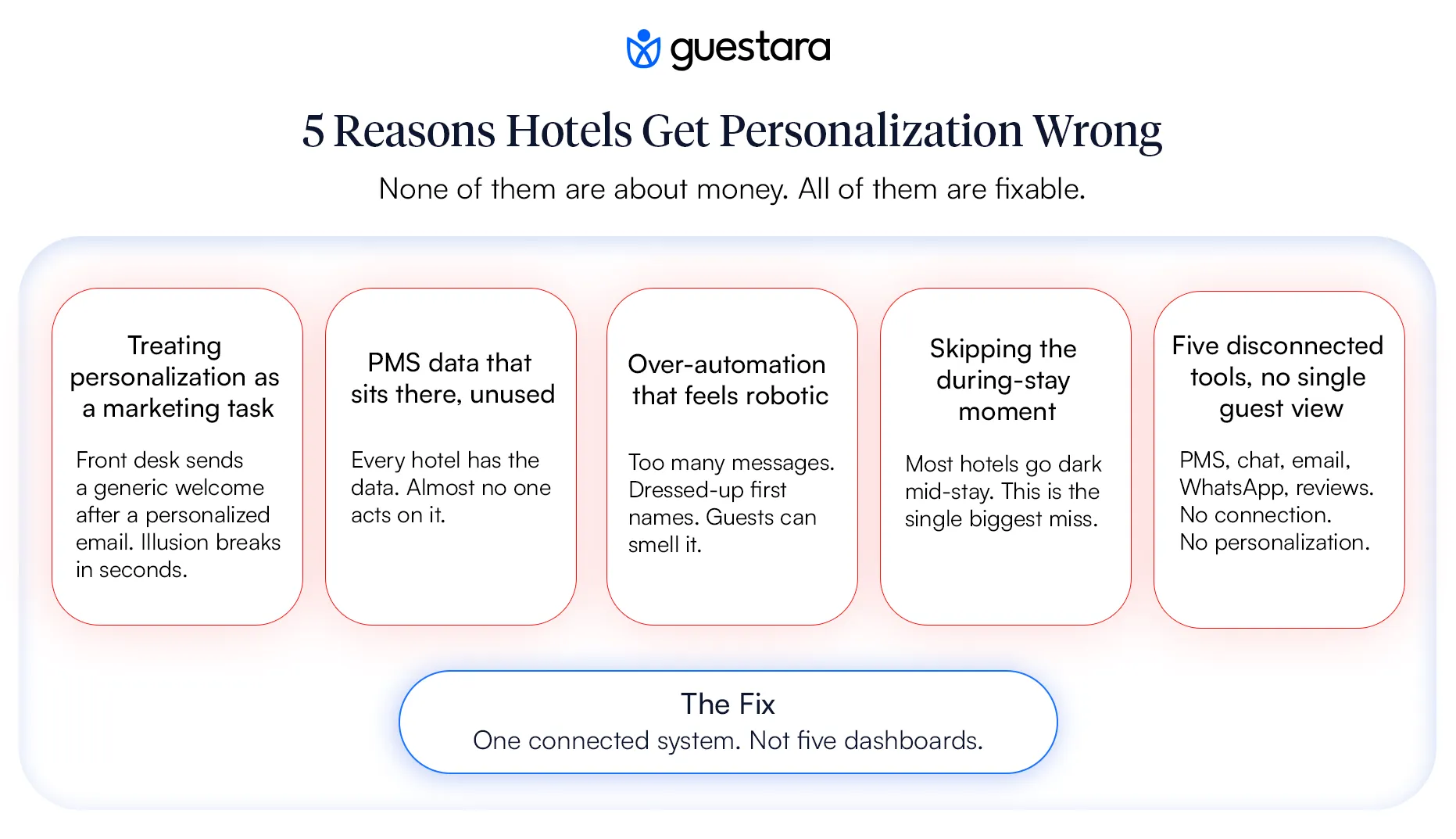
Personalization is not an email segment. It is an operating model. If the front desk, housekeeping, F&B, and marketing all work off different guest profiles, you will never deliver consistency. The guest gets a personalized email, then a generic welcome at the front desk, then a standard mini-bar. The illusion breaks in seconds.
Every property collects booking history, preferences, spending, and review data. Very few act on it. The PMS is not a personalization engine. It is a storage unit. Hotels need a layer on top that turns data into action.
There is a version of personalization that tries too hard. Messages every day. Generic offers dressed up with a first name. Emails that say "based on your profile" and clearly were not. Guests can smell this immediately and it actively hurts trust.
Good personalization feels quiet. It does not announce itself. It just makes the experience better.
Hotels tend to personalize booking, pre-arrival, and post-stay. They go dark during the stay itself. This is the exact opposite of where the guest actually is. Medallia's data confirms it, during-stay is the weakest personalization moment at most hotels. Fix this and everything else lifts.
A PMS. A marketing tool. A chat tool. A reviews tool. A separate WhatsApp account. No single source of truth. This is how 70% of hotels run today. Real personalization needs one connected system, not five tools and a spreadsheet.
A guest books. The PMS syncs to Guestara. An automated pre-arrival journey fires on the guest's preferred channel. The check-in link arrives 24 hours before. Smart lock keys push to the phone on check-in. Mid-stay upsells fire based on guest profile. Checkout is one tap. A review request lands at the right moment.
All of it runs on one connected platform. All of it is personalized based on segmentation and behavior triggers built from your own PMS data.
The Guestara stack that powers this:
See the full engagement stack on our guest engagement for hospitality page. Onboarding takes about a week. Guestara integrates with major PMS systems including Cloudbeds, Hotelogix, Ezee Absolute, Apaleo, SiteMinder, Little Hotelier, and Oracle.
You do not have to rebuild everything. You have to start with what makes the biggest difference.
List every touchpoint from booking confirmation to post-stay review. Mark which ones are currently personalized and which are not. Most hotels find 70% of their journey is one-size-fits-all.
In most cases these are pre-arrival, check-in, and post-stay review request. Personalize these three and you capture about 60% of the total gain.
Business, leisure, and repeat guest. That is enough to start. You do not need 14 segments to see results.
Booking confirmed. 24 hours before arrival. Checkout completed. Each one sends a segment-aware message. Start here.
Track open rates, click rates, upsell conversions, and review scores across segments. Add more segments and triggers as the data tells you what works.
Most hotels see measurable improvement in upsell revenue and review scores within 30-60 days of switching from generic to segmented communication.
Guests are no longer comparing you to the hotel down the street. They are comparing you to every other brand in their life.
Netflix knows what they want to watch tonight. Amazon remembers the last six things they bought. Spotify built a playlist for their Tuesday morning. Every consumer brand has quietly moved to personalization-as-default.
When a guest then walks into a hotel and gets handed a paper form and a generic email, the gap is obvious. Personalization is no longer a luxury feature. It is the minimum quality bar for being a modern hotel.
The good news is the technology to deliver it is no longer expensive or complex. A connected platform does the segmentation. Behavior triggers do the timing. Your team does what they are best at, which is making the guest feel seen.
Want to deliver personalization across your full guest journey without adding more staff? This is exactly where platforms like Guestara help hotels run segmented, trigger-based guest journeys on one connected system. Book a personalized demo to see what it looks like on your property.


See how AI-powered personalization across the hotel guest journey lifts revenue, loyalty, and reviews — from booking to post-stay.
Think about the last hotel stay you really remembered.
It probably was not the thread count. It was a moment. The receptionist who noticed it was your anniversary. The pillow menu the housekeeper left without being asked. The restaurant recommendation that turned into the best meal of the trip.
None of it was expensive. None of it was random. Someone, somewhere, paid attention and acted on it.
That is personalization. And it is now the single biggest lever in hospitality. Not a nice-to-have. Not a luxury-tier differentiator. The thing that decides whether a guest books you again or forgets your name by Tuesday.
This blog walks through how real personalization works across the hotel guest journey, from booking to post-stay, where most hotels go wrong, and how AI-powered segmentation and behavior triggers make it actually scale.
Let us start with what it is not.
Personalization is not putting the guest's first name in the subject line of an email. Personalization is not sending every guest the same welcome message with their name changed. That is mail merge. That is 2010.
Real personalization is different. It means the right message, at the right moment, on the right channel, for the right guest.
A honeymoon couple gets pre-arrival notes about sunset boat rides. A business traveler gets express check-in details. A returning guest gets "welcome back" instead of the standard welcome template. A family with kids gets pool hours, not spa hours.
None of this is the guest's name. All of it is about recognition.
McKinsey's latest research on personalized marketing found that 71% of consumers expect companies to deliver personalized interactions, and 76% get frustrated when it does not happen.
That gap, the difference between what guests expect and what hotels deliver, is where reviews, revenue, and repeat bookings are won or lost.
For years, hotel loyalty meant points. Stay 10 nights, get 1 free. Reach gold tier, get a welcome drink. The whole system ran on transactions.
That era is over.
A 2025 Mews survey of 2,000 American travelers found that 68% of travelers now say they will stay loyal to hotels that deliver standout, personalized experiences, leaving traditional points-based rewards behind. Among Gen Z, the number climbs to 83%. Among high-income earners, 71% prefer experiences tailored to them over loyalty points.
The guests who bring you the most revenue are the ones who care least about your points system. They care about being recognized.
And here is the part most hotels miss. Medallia's 2024 research shows that 61% of consumers are willing to spend more with companies that offer a customized experience. Personalization is not a cost center. It is a margin lever.
Yet the same Medallia study found that only 23% of consumers report experiencing high levels of personalization after recent hotel stays.
That is the gap. Guests want it. Will pay for it. Will come back for it. Most hotels do not deliver it.
Personalization does not happen at one moment. It happens at every moment. Here is how it maps across the guest journey.
For a full overview of what a guest journey looks like end to end, see our complete hotel guest journey guide.
The journey starts the second the booking hits your PMS. This is when AI segmentation goes to work.
What to infer: A solo weeknight booking at a city property is probably a business traveler. A Friday-to-Sunday booking for two adults at a beach resort is probably a leisure trip. A family room booked six months out is probably a vacation, not a last-minute decision.
The segmentation writes itself. The hotel just has to act on it.
This is the highest-leverage moment in the entire journey and most hotels waste it.
A good pre-arrival sequence does four things. It confirms the booking. It collects preferences. It introduces relevant upsells. It sets the emotional tone of the stay before the guest even leaves home.
AI-driven triggers make this actually scale. Booking confirmed fires message 1. Seven days before arrival fires message 2 with local tips. 24 hours before arrival fires the check-in link. Landed in the city fires a welcome message with arrival instructions.
None of this requires a staff member to lift a finger. All of it feels personal to the guest.
Check-in is where the first physical impression forms. And it is where Medallia's data gets uncomfortable.
Their research found that hotels deliver meaningful personalization at the booking, post-stay, and check-in stages. But the during-stay moment, the actual hotel experience, scored only 46% on personalization recall, the lowest of any stage.
Check-in is where that changes or breaks. A digital check-in that skips the queue, auto-populates known preferences, and sends a personalized "welcome, room 412, we upgraded you because you are a repeat guest" message on WhatsApp turns the arrival into a recognition moment.
A paper form at a crowded front desk does the opposite.
This is where most hotels go dark. The guest is in the property. The communication stops. The chance to personalize evaporates.
It should not.
Mid-stay is when behavior triggers earn their keep. A guest who orders coffee at 7am every morning should get a "good morning, shall we send your usual?" on day three. A guest whose weather shifted to rain should get a spa offer. A guest booked for a special occasion should get a complimentary dessert at dinner.
None of this requires a human to notice. It requires a system that is paying attention.
Checkout personalization is usually an afterthought. It should not be.
A guest who had a smooth stay gets a review request on WhatsApp. A guest who had a problem gets a follow-up from a manager, not a review request. A guest who paid for a spa treatment gets a "would you like us to book your next one?" offer.
One stage. Three different paths, all driven by what actually happened during the stay.
Most hotels send one generic email two days after checkout. That is not a post-stay journey. That is a newsletter.
A real post-stay sequence uses the data from the stay to segment the next message. A guest who liked their room type gets a reminder about their anniversary next year. A guest who stayed during a conference gets a "we noticed you were here for an event, would you like to know about next month's?" message. A guest who gave a 5-star review gets invited to refer a friend with a credit.
Every message knows something about the guest. Every message has a reason to exist.
For a deeper walkthrough of each stage and where revenue leaks happen, see our piece on guest journey mapping.
Segmentation is the word every marketing article uses. In most hotels, it means almost nothing. Let us make it concrete.
A smart segmentation layer pulls from three data sources:
1. Booking data from your PMS. Length of stay, room type, channel, rate code, arrival date, group size.
2. Behavioral data from the guest journey. Which pre-arrival messages they opened. Whether they completed mobile check-in. What upsells they clicked on. Which channel they prefer to message on.
3. Historical data from past stays. Repeat guest flag. Previous room preferences. Previous upsells bought. Previous complaints. Previous review scores.
The AI layer combines these three inputs and assigns the guest to a working segment in real time. "Repeat business traveler on a weeknight" triggers one journey. "First-time leisure family with young kids" triggers another. "High-spend repeat guest booking a suite" triggers a third.
Every segment has its own message cadence, channel preference, and upsell logic. All of it runs automatically.
McKinsey found that gen-AI-enhanced personalization can produce content and offers 50 times faster than a manual approach. This is why AI segmentation is not optional anymore. Hotels that do it by hand cannot keep up.
For more on how this connects to actual message delivery, read our guide on the role of guest communication in shaping the hotel guest journey.
Segmentation decides who gets what. Behavior triggers decide when.
A trigger is a rule that says "if this happens, fire this message." The power comes from chaining them together across the guest journey.
Here are examples of triggers that move the needle.
Booking confirmation received → send personalized welcome message on preferred channel. A business traveler gets a business-tone message. A honeymoon couple gets a warm, celebratory one. Same platform, different message.
7 days before arrival → send city tips and weather forecast. The system pulls live weather data and adjusts recommendations. Rain forecast triggers indoor suggestions. Clear weather triggers outdoor ones.
24 hours before arrival → send check-in link and room preview. Guest gets to skip the front desk entirely. Property gets a verified ID and a signed registration before arrival.
Guest arrives on property → send in-room welcome and restaurant recommendations. Geofencing or check-in completion triggers the message. Recommendations match the guest profile.
Mid-stay, no mid-stay upsell engagement → send a targeted offer based on booking profile. A guest who booked a city stay gets a dinner deal. A guest who booked a resort gets a spa offer.
Checkout completed → send review request on preferred channel. Positive NPS redirects to Google or TripAdvisor. Negative NPS routes to a manager for service recovery.
45 days after checkout → send a return-trip suggestion based on stay pattern. Business travelers who stayed Monday get a "we notice you travel for work often" message. Leisure travelers get a "book again for the same week next year" offer.
None of this is futuristic. All of this is running at properties right now. The hotels that set these triggers up once are out-earning the hotels that do not by margins that keep widening.
See our breakdown of how guest journey automation enhances guest satisfaction for a deeper look.
A repeat guest is worth 5-10 times a first-time guest. Most hotels treat them exactly the same.
Real repeat guest recognition looks like this:
Most hotels have all this data in their PMS. Almost none of them use it.
Mews research reinforces the upside. The same 2025 survey found that 88% of travelers will return if hotels consistently meet expectations. Repeat business is not about dazzle. It is about remembering.
A few patterns show up over and over at properties that try to personalize and fail.
Personalization is not an email segment. It is an operating model. If the front desk, housekeeping, F&B, and marketing all work off different guest profiles, you will never deliver consistency. The guest gets a personalized email, then a generic welcome at the front desk, then a standard mini-bar. The illusion breaks in seconds.
Every property collects booking history, preferences, spending, and review data. Very few act on it. The PMS is not a personalization engine. It is a storage unit. Hotels need a layer on top that turns data into action.
There is a version of personalization that tries too hard. Messages every day. Generic offers dressed up with a first name. Emails that say "based on your profile" and clearly were not. Guests can smell this immediately and it actively hurts trust.
Good personalization feels quiet. It does not announce itself. It just makes the experience better.
Hotels tend to personalize booking, pre-arrival, and post-stay. They go dark during the stay itself. This is the exact opposite of where the guest actually is. Medallia's data confirms it, during-stay is the weakest personalization moment at most hotels. Fix this and everything else lifts.
A PMS. A marketing tool. A chat tool. A reviews tool. A separate WhatsApp account. No single source of truth. This is how 70% of hotels run today. Real personalization needs one connected system, not five tools and a spreadsheet.
A guest books. The PMS syncs to Guestara. An automated pre-arrival journey fires on the guest's preferred channel. The check-in link arrives 24 hours before. Smart lock keys push to the phone on check-in. Mid-stay upsells fire based on guest profile. Checkout is one tap. A review request lands at the right moment.
All of it runs on one connected platform. All of it is personalized based on segmentation and behavior triggers built from your own PMS data.
The Guestara stack that powers this:
See the full engagement stack on our guest engagement for hospitality page. Onboarding takes about a week. Guestara integrates with major PMS systems including Cloudbeds, Hotelogix, Ezee Absolute, Apaleo, SiteMinder, Little Hotelier, and Oracle.
You do not have to rebuild everything. You have to start with what makes the biggest difference.
List every touchpoint from booking confirmation to post-stay review. Mark which ones are currently personalized and which are not. Most hotels find 70% of their journey is one-size-fits-all.
In most cases these are pre-arrival, check-in, and post-stay review request. Personalize these three and you capture about 60% of the total gain.
Business, leisure, and repeat guest. That is enough to start. You do not need 14 segments to see results.
Booking confirmed. 24 hours before arrival. Checkout completed. Each one sends a segment-aware message. Start here.
Track open rates, click rates, upsell conversions, and review scores across segments. Add more segments and triggers as the data tells you what works.
Most hotels see measurable improvement in upsell revenue and review scores within 30-60 days of switching from generic to segmented communication.
Guests are no longer comparing you to the hotel down the street. They are comparing you to every other brand in their life.
Netflix knows what they want to watch tonight. Amazon remembers the last six things they bought. Spotify built a playlist for their Tuesday morning. Every consumer brand has quietly moved to personalization-as-default.
When a guest then walks into a hotel and gets handed a paper form and a generic email, the gap is obvious. Personalization is no longer a luxury feature. It is the minimum quality bar for being a modern hotel.
The good news is the technology to deliver it is no longer expensive or complex. A connected platform does the segmentation. Behavior triggers do the timing. Your team does what they are best at, which is making the guest feel seen.
Want to deliver personalization across your full guest journey without adding more staff? This is exactly where platforms like Guestara help hotels run segmented, trigger-based guest journeys on one connected system. Book a personalized demo to see what it looks like on your property.
Personalization in the hotel guest journey means tailoring messages, offers, and service moments to each guest based on their booking data, behavior, and stay history. It covers every stage from booking to post-stay and goes far beyond putting a first name in an email.
A 2025 Mews survey found that 68% of travelers now prioritize personalized experiences over points-based rewards. Among Gen Z, the number jumps to 83%. Guests increasingly see loyalty points as transactional and look instead for recognition, relevance, and tailored service.
Behavior-based triggers are automated rules that fire specific messages or actions when a guest does something specific. Examples include "booking confirmed" triggering a welcome sequence, "24 hours before arrival" triggering a check-in link, and "checkout completed" triggering a review request. They are the engine behind real personalization at scale.
AI segmentation combines booking data, behavioral data, and historical stay data to automatically assign each guest to a working segment in real time. A "repeat business traveler on a weeknight" triggers one journey, while a "first-time leisure family" triggers another. The system adapts as new data comes in.
Most hotels see measurable improvement within 30-60 days of switching from generic messaging to segmented, trigger-based communication. You can start with three segments (business, leisure, repeat) and three triggers (booking, pre-arrival, checkout) and expand from there.
We work closely with the industry leaders to offer seamless solutions




We’re here to help your whole team stay ahead of the curve as you grow.

Get up and running quickly with a personalized onboarding plan

Connect with real people who really get it, 24/7

Checkout our vast library of free resources, templates and more
There's only so much we can say — so let us show you! Schedule a demo today and reach your business goals.


.png)