Hotel guest journey vs guest experience: the journey is the structure you design, the experience is how it feels. See the difference and which to fix first.





The hotel guest journey is the structure a guest moves through. Guest experience is how that structure feels to them. One is a sequence you design, the other is a perception you earn, and confusing the two is why most guest satisfaction projects spend money in the wrong place.
You have already read both failure modes in your own reviews. "The staff were lovely, but we waited forty minutes to check in." That is a broken journey with a good team inside it. "Everything ran smoothly, though it felt a bit impersonal." That is a working journey with nothing human in it. Neither property has the problem it thinks it has, and neither one fixes it by trying harder at service.
This guide separates the two properly: what each covers, how each breaks, who owns each, and which to repair first.
The hotel guest journey covers every stage a guest moves through with your property, from the moment they discover you to the moment they decide whether to return, plus the handoffs between those stages. It is a designed sequence rather than a feeling, and it repeats in the same shape for every booking you take.
The journey is the set of decisions you make once and then stop making. Which message fires and when. Which data carries from the booking into the arrival. Who picks up a request raised at 11pm.
Those decisions sit in your systems, not in anyone's judgement on the day. Change one and it changes for every future guest, which is what makes the journey the only part of guest satisfaction that scales without headcount.
If you want the sequence itself, the seven stages of the hotel guest journey lays out the phases and the full touchpoint inventory lists the individual moments inside them.
It does not include quality of delivery.
Your journey can specify that a welcome message goes out 24 hours before arrival. It says nothing about whether that message reads warmly or reads like a utility bill. It can route a complaint to a duty manager in 90 seconds and say nothing about what the manager says when they arrive.
The journey decides whether a moment exists, when it happens and who handles it. Everything about how that moment lands belongs to the experience. Our complete guide to the hotel guest journey covers the structural side in full.
Guest experience is the guest's perception of your property, built from every interaction they have with it. It is the subjective layer that sits on top of the journey: how welcomed they felt, how a problem got handled, whether the room matched the photographs.
Experience lives in the guest's head rather than in your systems, which is the whole difficulty with it.
Two guests can move through an identical journey and come away with opposite impressions. Same messages, same check-in, same room category. One had a good week and a helpful receptionist. The other had a delayed flight and reached a desk at its busiest hour.
Nothing in your structure differed. The experience did.
Because it depends on variables you do not own.
The guest's mood, their expectations, the last hotel they stayed in, whether their meeting went well. You influence experience, you do not set it. The journey you can set exactly, down to the minute a message leaves.
That asymmetry is the practical argument for treating them separately. You get leverage on the journey and you get probability on the experience. Related reading on the experience side: what guests expect from a modern stay and designing the emotional moments guests actually remember.
The clearest way to hold the two apart is to line them up against the questions an operator actually asks. The journey and the experience differ on every one of them.
There is a one-line test. If you can draw it on a whiteboard, it belongs to the journey. If you can only describe how it felt, it belongs to the experience.
A check-in link sent 24 hours ahead is drawable. The receptionist noticing a guest looked exhausted and offering to carry a bag is not. Both matter. Only one of them can be scheduled.
Yes, and both combinations are common enough to have their own review signatures.
Strong experience inside a weak journey depends on the right person being on shift. It produces good reviews on good days and nothing you can promise a guest in advance. Strong journey with no experience produces guests who were satisfied and remember nothing, which is a different kind of expensive. The next two sections take each one in turn. If you want to document your own structure before diagnosing either, start with mapping the hotel guest journey.
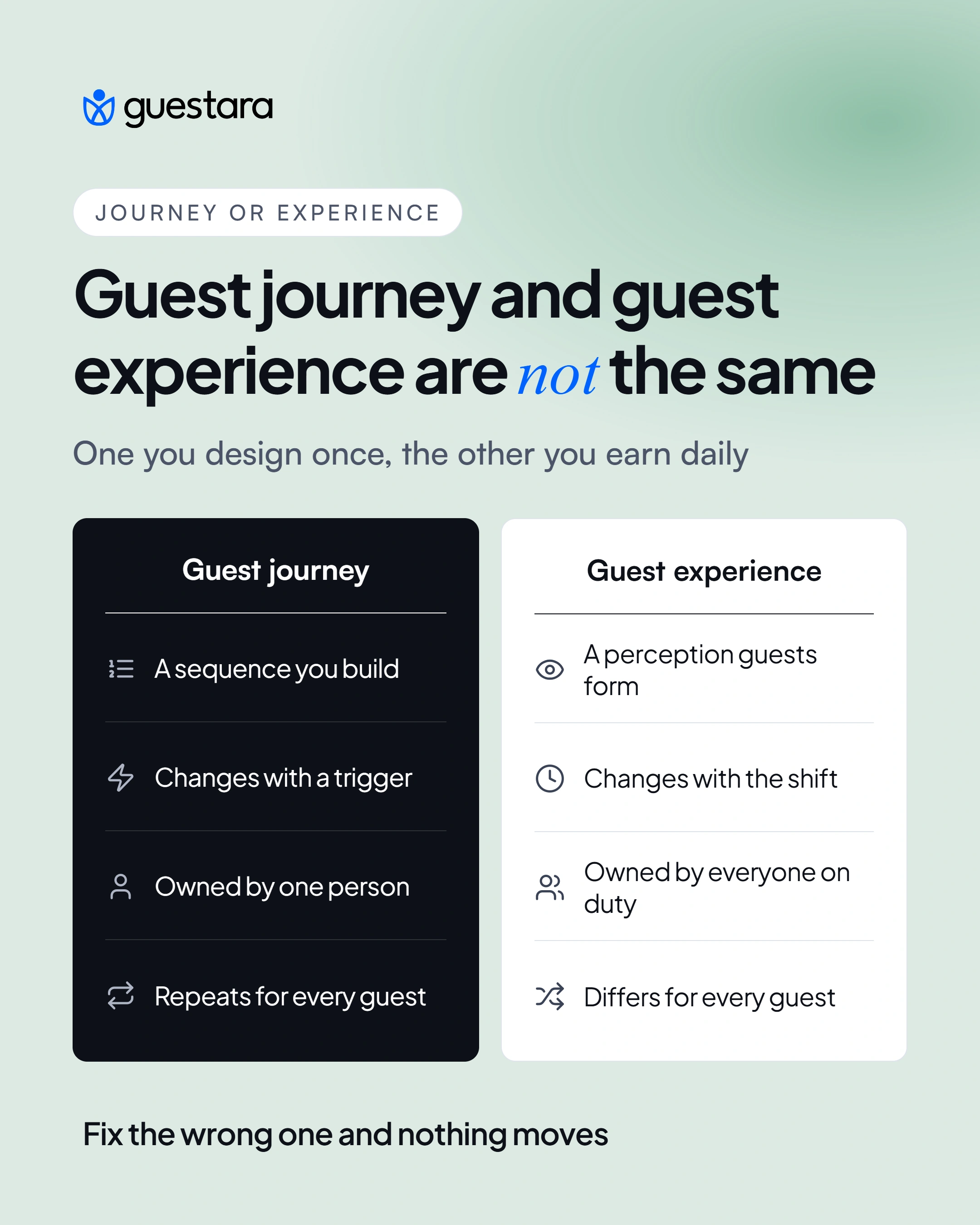
The difference matters because the two have different fixes, different owners and different costs. Misdiagnose which one is broken and you buy training when you needed a trigger, or software when you needed a standard.
This is not a distinction invented by content marketers. It is how hotels are already scored.
J.D. Power's 2026 North America Hotel Guest Satisfaction Index, now in its 30th year, surveyed 44,787 branded hotel guests across 104 brands on stays between May 2025 and May 2026. It measures seven dimensions, and the split is right there in the list: check-in and checkout is scored as one dimension, staff service as another, alongside guest room, hotel facility, connectivity, food and beverage, and value for the price paid.
Check-in and checkout is a journey dimension. It asks whether the process worked. Staff service is an experience dimension. It asks how the people felt to deal with.
The study separates them because they move independently. Overall satisfaction rose 13 points to 665 on a 1,000-point scale in the 2026 study, with gains credited to positive interactions with staff, including front desk courtesy and responsiveness to requests. A property can gain on staff service while its check-in dimension stays flat, and the reverse happens just as often.
Sort your intended fix into one of two lists and the answer appears.
Training, scripts, hiring, incentives and service standards are experience fixes. Triggers, routing rules, data handoffs, channel coverage and timing are journey fixes.
Most hotels reach for the experience list, because "improve guest satisfaction" sounds like it means being better with people. Then they discover the limit. A training programme cannot make a message arrive that was never scheduled, and no amount of front desk warmth reaches a guest who is still three weeks from arriving.
Olive Hotels by Embassy saw a 248% lift in guest engagement using Guestara after activating its pre-arrival touchpoints. Nothing changed about its service during that period. A structural gap closed, and the guests who were always there started hearing from the property. For the failure patterns that sit behind most of these misdiagnoses, see the journey mistakes that quietly cost revenue.
A broken journey shows up in reviews that praise your people and criticise your process. The signature phrase is "the staff were lovely, but," and every hotelier has read it about their own property.
The journey is what makes good service repeatable. Without it, every good stay depends on the right person being rostered at the right hour.
The scale of the structural gap is easy to underestimate. Cloudbeds analysed 90 million bookings across 180 countries for its 2026 State of Independent Hotels Report and put the average independent hotel booking window at 40 days. Forty days during which the guest is not on your property and no member of your team can reach them by being good at their job. That window is structural by definition, and warmth cannot cross it.
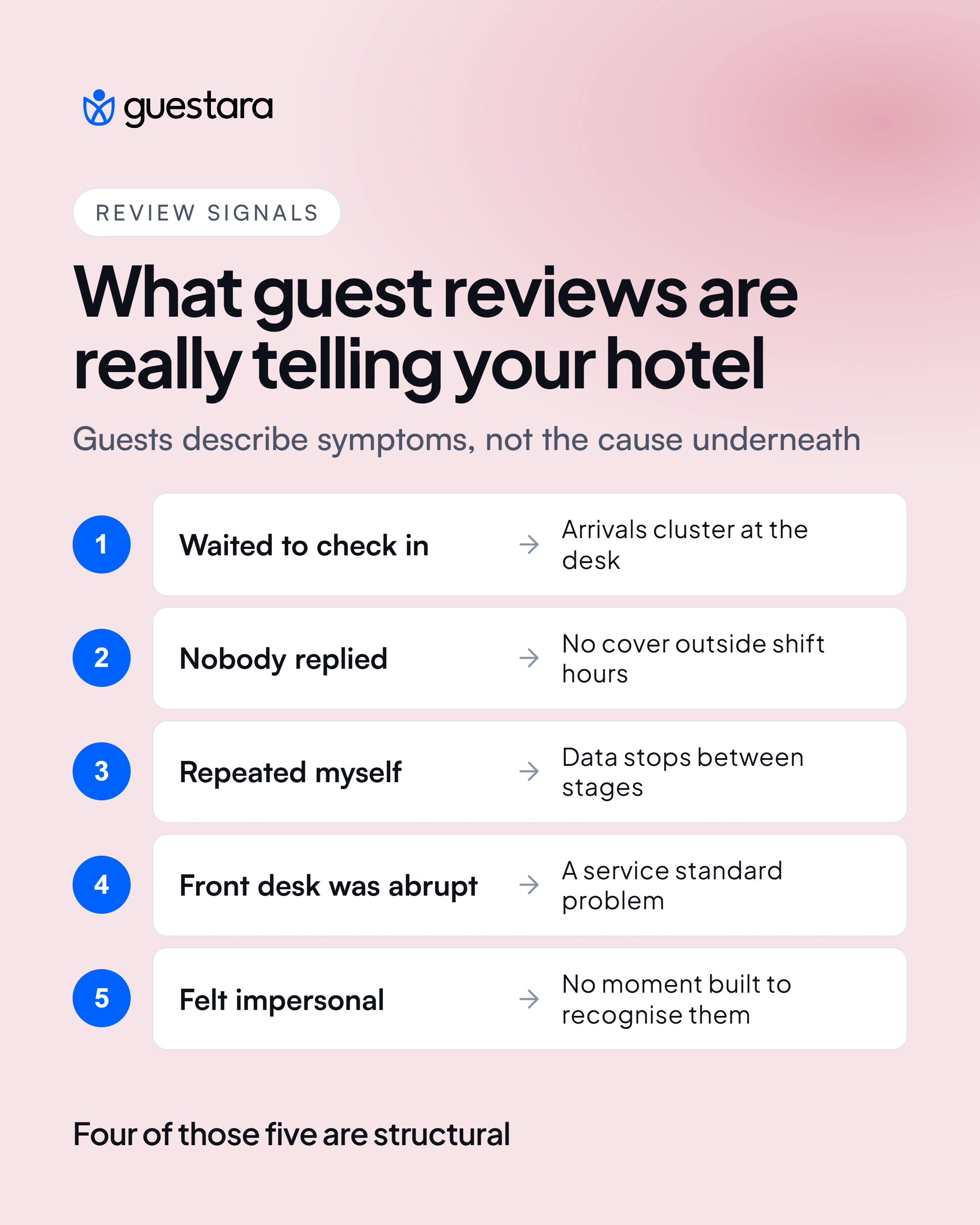
Most of them, once you read past the wording. Guests describe symptoms rather than causes, so the same review phrase can mean very different things.
How do you improve both together?
Read your last fifty reviews against that middle column and you get a work list rather than a mood. Two pieces worth reading alongside it: the hidden gaps in the guest journey and why guest messages go missing.
A perfectly built journey with nothing human in it produces guests who were satisfied and remember nothing about you. That costs repeat bookings and it costs the kind of review that mentions a member of staff by name.
When every touchpoint is automated and templated, a guest can complete an entire stay without one human moment. Nothing goes wrong. Nothing stands out either.
The reviews that follow are neutral, and neutral reviews are a weak asset. Accor surveyed 5,000 travellers across five European countries in 2024 and found 97% consult guest reviews before booking, ranking them second only to rooms and amenities. A profile full of three-star competence persuades nobody, even when the operation is clean.
Personalization is part of the answer here, and it is a journey capability aimed at an experience outcome. Personalizing across the guest journey covers how segment-level detail gets into an automated touchpoint.
Anything carrying emotion. A complaint, a bereavement, a guest arriving at 1am after a cancelled flight. Those need a person, and handing them to a template is how properties end up in screenshots.
The best version of this is not a choice between the two. It is the journey creating the opening and a person filling it.
Guestara's Review Collection shows the mechanism plainly. The request goes out over WhatsApp with a three-button reply of Good, Average or Bad. A negative answer gets no public redirect and instead alerts the team immediately. At AGC, a 52-room independent hotel in Aurangabad, 122 guests raised a problem that way rather than posting it publicly, and the team was alerted in real time, often while the guest was still on the property.
Look at what each half did there. The journey made sure every departing guest was asked, which no busy team does reliably by hand. A human then walked to the room and fixed it, which no automation can do. Neither half works alone. Our review management page covers the interception logic, and digital against human touchpoints works through the wider allocation question.
The journey needs one named owner and the experience is owned by everyone who meets a guest. Reversing that is why both drift: a journey owned by committee never changes, and an experience assigned to one person never improves.
Someone has to be able to change a trigger without calling a meeting.
That person is usually in operations or revenue, and the test is authority rather than title. If nobody can alter when the check-in link sends, you do not have a journey owner. You have a journey nobody is responsible for.
Everyone on shift, which means it is managed through standards and training rather than assignment.
The constraint there is real. The American Hotel and Lodging Association surveyed 456 hoteliers in 2024 and found 76% of hotels were experiencing a staffing shortage, with housekeeping the top hiring need at 50%. Most properties cannot staff their way to a better experience this year. That is the strongest practical argument for taking structural work off the team: the hours have to come from somewhere.
At the handoff and at the alert. Every touchpoint has a structural half and a delivered half, and both need a name against them.
Guestara's Task Board handles the structural half of that routing, sending a room upgrade to front desk, a food order to F&B and a maintenance issue to the right team, with an audit trail so a shift change does not lose it. Guestara's Unified Inbox does the same for channels, pulling OTA threads, WhatsApp, Instagram, Facebook and email into one window so no inbound touchpoint is invisible. If you are weighing that consolidation, what a unified inbox does for a hotel is the place to start, and the unified inbox page covers the channels it absorbs.
[[cta:cta-5 | eyebrow=Guest Journey | heading=Give every guest the same *reliable* journey | btn=Explore Guest Engagement | link=https://www.guestara.com/guest-engagement-for-hospitality ]]
Fix the journey first, then invest in the experience. The order matters because a structural fix frees the hours that experience needs, and no amount of service effort closes a gap in the structure.
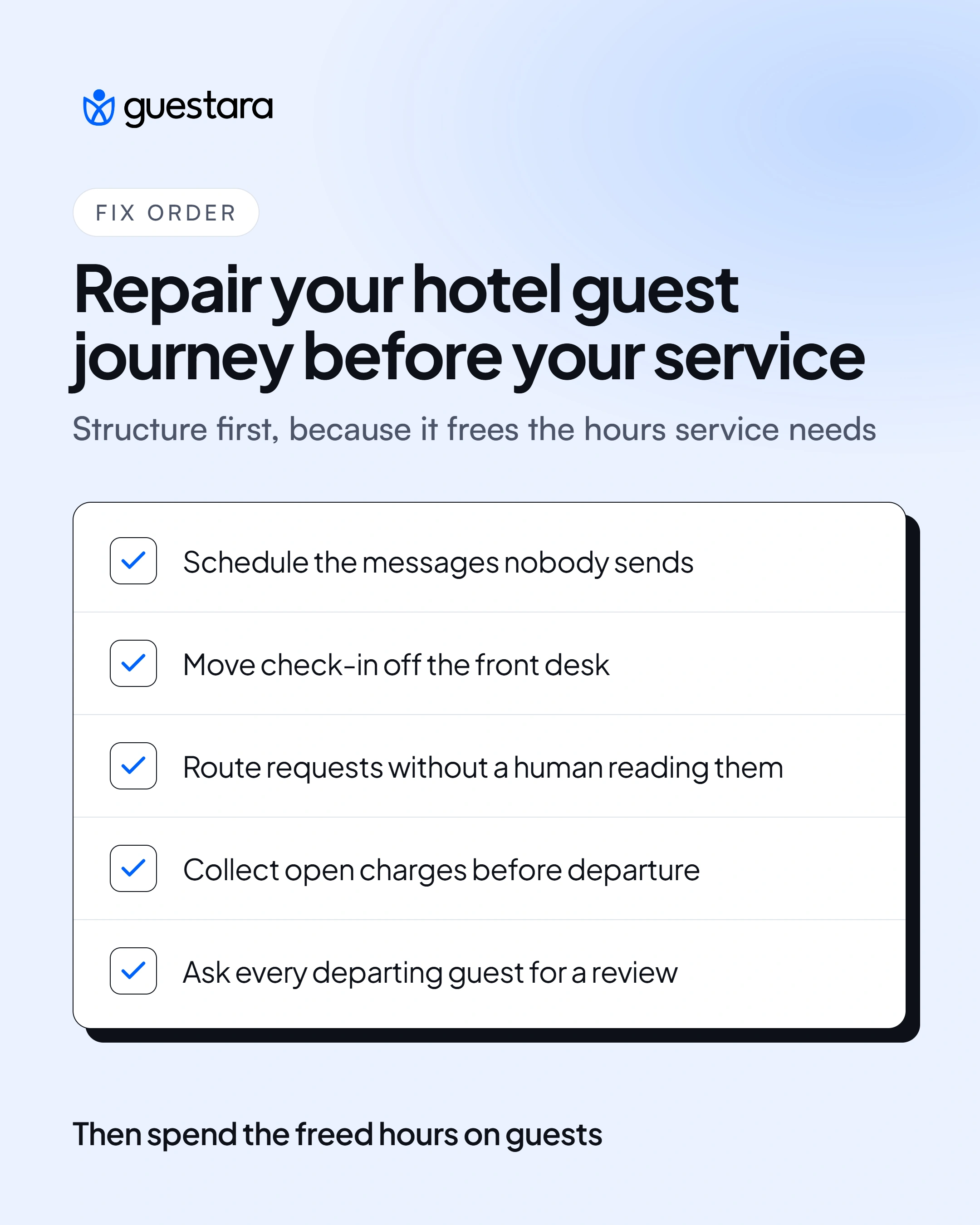
Structural gaps consume the time your team would otherwise spend with guests.
Every manually sent confirmation, every re-asked question, every chased deposit is an hour taken from the floor. Automate the repetitive touchpoints and you buy back the attention that produces experience in the first place. Guestara's Guest Journey module builds those sequences against your PMS booking record, and guest journey automation covers the build.
The returns arrive in an order that proves the sequence. Olive Hotels by Embassy reached a 6.1x annualized return on platform cost using Guestara, and the gains landed in three phases. Months one to three returned efficiency as automation absorbed manual work. Months four to six added upsell revenue on top. From month six the reputation effect arrived, as reviews and rankings climbed.
Read that order again. The reputation gain came last. Experience improvements showed up after the structure was repaired, not before, which is exactly the opposite of how most improvement plans are sequenced. Thirteen practical ways to improve the journey is a useful starting list, and AI across the hotel guest journey covers the technology layer.
Measure them separately, because a single satisfaction score hides which half moved.
Journey metrics ask mechanical questions. Did each touchpoint fire. How fast. How many guests completed check-in before arrival. Experience metrics ask perceptual ones. Scores, sentiment, and the language guests use about your team.
The combinations tell you what to do next. Journey metrics improving while experience metrics stay flat means you have a delivery problem, and the fix is on the training side. Experience improving while journey metrics stay flat means you got lucky with rostering, and it will not hold through a busy month. Both moving together is the only pattern that compounds. Guest journey KPIs by stage covers the measurement side properly.
[[cta:cta-6 | eyebrow=Guest Experience | heading=See where your journey is *costing* you reviews | btn=Talk to Sales | link=https://www.guestara.com/get-demo ]]


Hotel guest journey vs guest experience: the journey is the structure you design, the experience is how it feels. See the difference and which to fix first.
The hotel guest journey is the structure a guest moves through. Guest experience is how that structure feels to them. One is a sequence you design, the other is a perception you earn, and confusing the two is why most guest satisfaction projects spend money in the wrong place.
You have already read both failure modes in your own reviews. "The staff were lovely, but we waited forty minutes to check in." That is a broken journey with a good team inside it. "Everything ran smoothly, though it felt a bit impersonal." That is a working journey with nothing human in it. Neither property has the problem it thinks it has, and neither one fixes it by trying harder at service.
This guide separates the two properly: what each covers, how each breaks, who owns each, and which to repair first.
The hotel guest journey covers every stage a guest moves through with your property, from the moment they discover you to the moment they decide whether to return, plus the handoffs between those stages. It is a designed sequence rather than a feeling, and it repeats in the same shape for every booking you take.
The journey is the set of decisions you make once and then stop making. Which message fires and when. Which data carries from the booking into the arrival. Who picks up a request raised at 11pm.
Those decisions sit in your systems, not in anyone's judgement on the day. Change one and it changes for every future guest, which is what makes the journey the only part of guest satisfaction that scales without headcount.
If you want the sequence itself, the seven stages of the hotel guest journey lays out the phases and the full touchpoint inventory lists the individual moments inside them.
It does not include quality of delivery.
Your journey can specify that a welcome message goes out 24 hours before arrival. It says nothing about whether that message reads warmly or reads like a utility bill. It can route a complaint to a duty manager in 90 seconds and say nothing about what the manager says when they arrive.
The journey decides whether a moment exists, when it happens and who handles it. Everything about how that moment lands belongs to the experience. Our complete guide to the hotel guest journey covers the structural side in full.
Guest experience is the guest's perception of your property, built from every interaction they have with it. It is the subjective layer that sits on top of the journey: how welcomed they felt, how a problem got handled, whether the room matched the photographs.
Experience lives in the guest's head rather than in your systems, which is the whole difficulty with it.
Two guests can move through an identical journey and come away with opposite impressions. Same messages, same check-in, same room category. One had a good week and a helpful receptionist. The other had a delayed flight and reached a desk at its busiest hour.
Nothing in your structure differed. The experience did.
Because it depends on variables you do not own.
The guest's mood, their expectations, the last hotel they stayed in, whether their meeting went well. You influence experience, you do not set it. The journey you can set exactly, down to the minute a message leaves.
That asymmetry is the practical argument for treating them separately. You get leverage on the journey and you get probability on the experience. Related reading on the experience side: what guests expect from a modern stay and designing the emotional moments guests actually remember.
The clearest way to hold the two apart is to line them up against the questions an operator actually asks. The journey and the experience differ on every one of them.
There is a one-line test. If you can draw it on a whiteboard, it belongs to the journey. If you can only describe how it felt, it belongs to the experience.
A check-in link sent 24 hours ahead is drawable. The receptionist noticing a guest looked exhausted and offering to carry a bag is not. Both matter. Only one of them can be scheduled.
Yes, and both combinations are common enough to have their own review signatures.
Strong experience inside a weak journey depends on the right person being on shift. It produces good reviews on good days and nothing you can promise a guest in advance. Strong journey with no experience produces guests who were satisfied and remember nothing, which is a different kind of expensive. The next two sections take each one in turn. If you want to document your own structure before diagnosing either, start with mapping the hotel guest journey.
The difference matters because the two have different fixes, different owners and different costs. Misdiagnose which one is broken and you buy training when you needed a trigger, or software when you needed a standard.
This is not a distinction invented by content marketers. It is how hotels are already scored.
J.D. Power's 2026 North America Hotel Guest Satisfaction Index, now in its 30th year, surveyed 44,787 branded hotel guests across 104 brands on stays between May 2025 and May 2026. It measures seven dimensions, and the split is right there in the list: check-in and checkout is scored as one dimension, staff service as another, alongside guest room, hotel facility, connectivity, food and beverage, and value for the price paid.
Check-in and checkout is a journey dimension. It asks whether the process worked. Staff service is an experience dimension. It asks how the people felt to deal with.
The study separates them because they move independently. Overall satisfaction rose 13 points to 665 on a 1,000-point scale in the 2026 study, with gains credited to positive interactions with staff, including front desk courtesy and responsiveness to requests. A property can gain on staff service while its check-in dimension stays flat, and the reverse happens just as often.
Sort your intended fix into one of two lists and the answer appears.
Training, scripts, hiring, incentives and service standards are experience fixes. Triggers, routing rules, data handoffs, channel coverage and timing are journey fixes.
Most hotels reach for the experience list, because "improve guest satisfaction" sounds like it means being better with people. Then they discover the limit. A training programme cannot make a message arrive that was never scheduled, and no amount of front desk warmth reaches a guest who is still three weeks from arriving.
Olive Hotels by Embassy saw a 248% lift in guest engagement using Guestara after activating its pre-arrival touchpoints. Nothing changed about its service during that period. A structural gap closed, and the guests who were always there started hearing from the property. For the failure patterns that sit behind most of these misdiagnoses, see the journey mistakes that quietly cost revenue.
A broken journey shows up in reviews that praise your people and criticise your process. The signature phrase is "the staff were lovely, but," and every hotelier has read it about their own property.
The journey is what makes good service repeatable. Without it, every good stay depends on the right person being rostered at the right hour.
The scale of the structural gap is easy to underestimate. Cloudbeds analysed 90 million bookings across 180 countries for its 2026 State of Independent Hotels Report and put the average independent hotel booking window at 40 days. Forty days during which the guest is not on your property and no member of your team can reach them by being good at their job. That window is structural by definition, and warmth cannot cross it.
Most of them, once you read past the wording. Guests describe symptoms rather than causes, so the same review phrase can mean very different things.
How do you improve both together?
Read your last fifty reviews against that middle column and you get a work list rather than a mood. Two pieces worth reading alongside it: the hidden gaps in the guest journey and why guest messages go missing.
A perfectly built journey with nothing human in it produces guests who were satisfied and remember nothing about you. That costs repeat bookings and it costs the kind of review that mentions a member of staff by name.
When every touchpoint is automated and templated, a guest can complete an entire stay without one human moment. Nothing goes wrong. Nothing stands out either.
The reviews that follow are neutral, and neutral reviews are a weak asset. Accor surveyed 5,000 travellers across five European countries in 2024 and found 97% consult guest reviews before booking, ranking them second only to rooms and amenities. A profile full of three-star competence persuades nobody, even when the operation is clean.
Personalization is part of the answer here, and it is a journey capability aimed at an experience outcome. Personalizing across the guest journey covers how segment-level detail gets into an automated touchpoint.
Anything carrying emotion. A complaint, a bereavement, a guest arriving at 1am after a cancelled flight. Those need a person, and handing them to a template is how properties end up in screenshots.
The best version of this is not a choice between the two. It is the journey creating the opening and a person filling it.
Guestara's Review Collection shows the mechanism plainly. The request goes out over WhatsApp with a three-button reply of Good, Average or Bad. A negative answer gets no public redirect and instead alerts the team immediately. At AGC, a 52-room independent hotel in Aurangabad, 122 guests raised a problem that way rather than posting it publicly, and the team was alerted in real time, often while the guest was still on the property.
Look at what each half did there. The journey made sure every departing guest was asked, which no busy team does reliably by hand. A human then walked to the room and fixed it, which no automation can do. Neither half works alone. Our review management page covers the interception logic, and digital against human touchpoints works through the wider allocation question.
The journey needs one named owner and the experience is owned by everyone who meets a guest. Reversing that is why both drift: a journey owned by committee never changes, and an experience assigned to one person never improves.
Someone has to be able to change a trigger without calling a meeting.
That person is usually in operations or revenue, and the test is authority rather than title. If nobody can alter when the check-in link sends, you do not have a journey owner. You have a journey nobody is responsible for.
Everyone on shift, which means it is managed through standards and training rather than assignment.
The constraint there is real. The American Hotel and Lodging Association surveyed 456 hoteliers in 2024 and found 76% of hotels were experiencing a staffing shortage, with housekeeping the top hiring need at 50%. Most properties cannot staff their way to a better experience this year. That is the strongest practical argument for taking structural work off the team: the hours have to come from somewhere.
At the handoff and at the alert. Every touchpoint has a structural half and a delivered half, and both need a name against them.
Guestara's Task Board handles the structural half of that routing, sending a room upgrade to front desk, a food order to F&B and a maintenance issue to the right team, with an audit trail so a shift change does not lose it. Guestara's Unified Inbox does the same for channels, pulling OTA threads, WhatsApp, Instagram, Facebook and email into one window so no inbound touchpoint is invisible. If you are weighing that consolidation, what a unified inbox does for a hotel is the place to start, and the unified inbox page covers the channels it absorbs.
[[cta:cta-5 | eyebrow=Guest Journey | heading=Give every guest the same *reliable* journey | btn=Explore Guest Engagement | link=https://www.guestara.com/guest-engagement-for-hospitality ]]
Fix the journey first, then invest in the experience. The order matters because a structural fix frees the hours that experience needs, and no amount of service effort closes a gap in the structure.
Structural gaps consume the time your team would otherwise spend with guests.
Every manually sent confirmation, every re-asked question, every chased deposit is an hour taken from the floor. Automate the repetitive touchpoints and you buy back the attention that produces experience in the first place. Guestara's Guest Journey module builds those sequences against your PMS booking record, and guest journey automation covers the build.
The returns arrive in an order that proves the sequence. Olive Hotels by Embassy reached a 6.1x annualized return on platform cost using Guestara, and the gains landed in three phases. Months one to three returned efficiency as automation absorbed manual work. Months four to six added upsell revenue on top. From month six the reputation effect arrived, as reviews and rankings climbed.
Read that order again. The reputation gain came last. Experience improvements showed up after the structure was repaired, not before, which is exactly the opposite of how most improvement plans are sequenced. Thirteen practical ways to improve the journey is a useful starting list, and AI across the hotel guest journey covers the technology layer.
Measure them separately, because a single satisfaction score hides which half moved.
Journey metrics ask mechanical questions. Did each touchpoint fire. How fast. How many guests completed check-in before arrival. Experience metrics ask perceptual ones. Scores, sentiment, and the language guests use about your team.
The combinations tell you what to do next. Journey metrics improving while experience metrics stay flat means you have a delivery problem, and the fix is on the training side. Experience improving while journey metrics stay flat means you got lucky with rostering, and it will not hold through a busy month. Both moving together is the only pattern that compounds. Guest journey KPIs by stage covers the measurement side properly.
[[cta:cta-6 | eyebrow=Guest Experience | heading=See where your journey is *costing* you reviews | btn=Talk to Sales | link=https://www.guestara.com/get-demo ]]
The hotel guest journey is the designed structure of a guest relationship, meaning the stages, touchpoints, timings and handoffs that repeat for every booking. Guest experience is the guest's perception of those moments, shaped by delivery, staffing and factors outside the hotel's control. The journey decides whether a moment happens, when and who handles it, while the experience is how that moment lands. The practical consequence is that journey problems are fixed with triggers and routing, and experience problems are fixed with standards and training.
They are two layers rather than one containing the other. The journey is the container of designed moments, and the experience is the perception that forms inside it, including from moments the hotel never designed such as a chance interaction in a corridor. A hotel can change its journey without changing its experience, and the reverse happens whenever a particularly good or bad shift alters how the same structure feels.
Fix the journey first. Structural gaps consume the staff hours that good experience depends on, so repairing them frees the attention that service requires, and a training programme cannot deliver a message that was never scheduled. Olive Hotels by Embassy saw a 248% lift in guest engagement using Guestara after activating pre-arrival touchpoints, with no change to its service delivery in that period.
Yes, and it is one of the most common patterns in independent hotels. It produces reviews that praise the staff while criticising the process, usually about waiting, repeating information or messages going unanswered. The limitation is that it does not scale, because every good stay depends on the right person being rostered at the right hour rather than on anything the property can promise in advance.
Journey metrics are mechanical: whether each touchpoint fired, how fast it fired, and how many guests completed steps such as check-in before arrival. Experience metrics are perceptual: satisfaction scores, sentiment, and the language guests use in reviews. Keeping them apart is what makes the result actionable, since journey metrics improving while experience stays flat points to a delivery problem, and the reverse points to rostering luck that will not survive a busy month.
We work closely with the industry leaders to offer seamless solutions




We’re here to help your whole team stay ahead of the curve as you grow.

Get up and running quickly with a personalized onboarding plan

Connect with real people who really get it, 24/7

Checkout our vast library of free resources, templates and more
There's only so much we can say — so let us show you! Schedule a demo today and reach your business goals.


