The hotel star rating system explained: what each star certifies, who awards ratings in India, Europe and the US, and how hotels move up a category.





A guest filtering an online travel agency for four stars and up never sees your property if you hold three. They are not judging the hotel at that moment. They are shortening a list of four hundred options down to forty, and the star is the fastest filter available to them.
That is what makes the hotel star rating system worth understanding properly. The star decides who sees you. Yet the body awarding it, the criteria behind it and even whether anyone is required to hold one all change the moment you cross a border. Here is how the system actually works.
A hotel star rating is a classification awarded by an authorised body after inspecting a property against a published list of criteria covering rooms, facilities, service and safety. Ratings run from one to five stars. The rating certifies what a hotel offers, not how satisfied its guests were.
Each hotel star represents a verified step up in facilities and service standards, running from basic shelter at one star to full-service luxury at five. One star certifies a clean, safe room. Five stars certifies multiple dining outlets, round-the-clock room service, a full spa and a staffing ratio high enough to deliver personalised service.
Some systems add half stars for properties that clear most but not all of the next tier. A four-and-a-half-star hotel is signalling that guests should expect something close to five-star, without the full set.
The five tiers break down along consistent lines, even though the exact requirements shift between authorities.
Read that as a pattern, not a rulebook. Every authority publishes its own catalogue, and the gap between two four-star properties in different countries can be wide enough to surprise a guest who booked on the star alone.
A 1-star hotel is a property certified for clean, safe accommodation and nothing beyond it. Reception is staffed for limited hours, there is rarely a restaurant, and in some systems bathrooms can still be shared between rooms. It suits a traveller buying a bed near a transport hub rather than a stay.
A 2-star hotel adds consistency to the basics. Every room has a private bathroom, housekeeping runs daily, and a simple breakfast or coffee service is available. The step up from one star is reliability rather than range, which is why short business trips and single-night stopovers cluster at this tier.
A 3-star hotel is the first tier where the property becomes somewhere to spend time rather than sleep. The defining additions are a staffed 24-hour reception and an on-site restaurant or bar, usually with a fitness room or meeting space alongside. This is the broadest tier in most markets and the one where independent hotels compete hardest.
A 4-star hotel moves the measurement from facilities to finish. Rooms are larger with premium bedding, the restaurant is full-service, room service and concierge are available, and a pool or spa is normally part of the offer. The separation from three stars comes from quality and staffing depth, not a longer amenity list.
A 5-star hotel is certified on service delivery as much as on facilities. Multiple dining outlets, 24-hour room service, a full spa and butler or personalised attendance are standard, supported by a staff-to-guest ratio high enough to anticipate requests. At this tier inspectors score how consistently service lands, not whether the amenity exists.
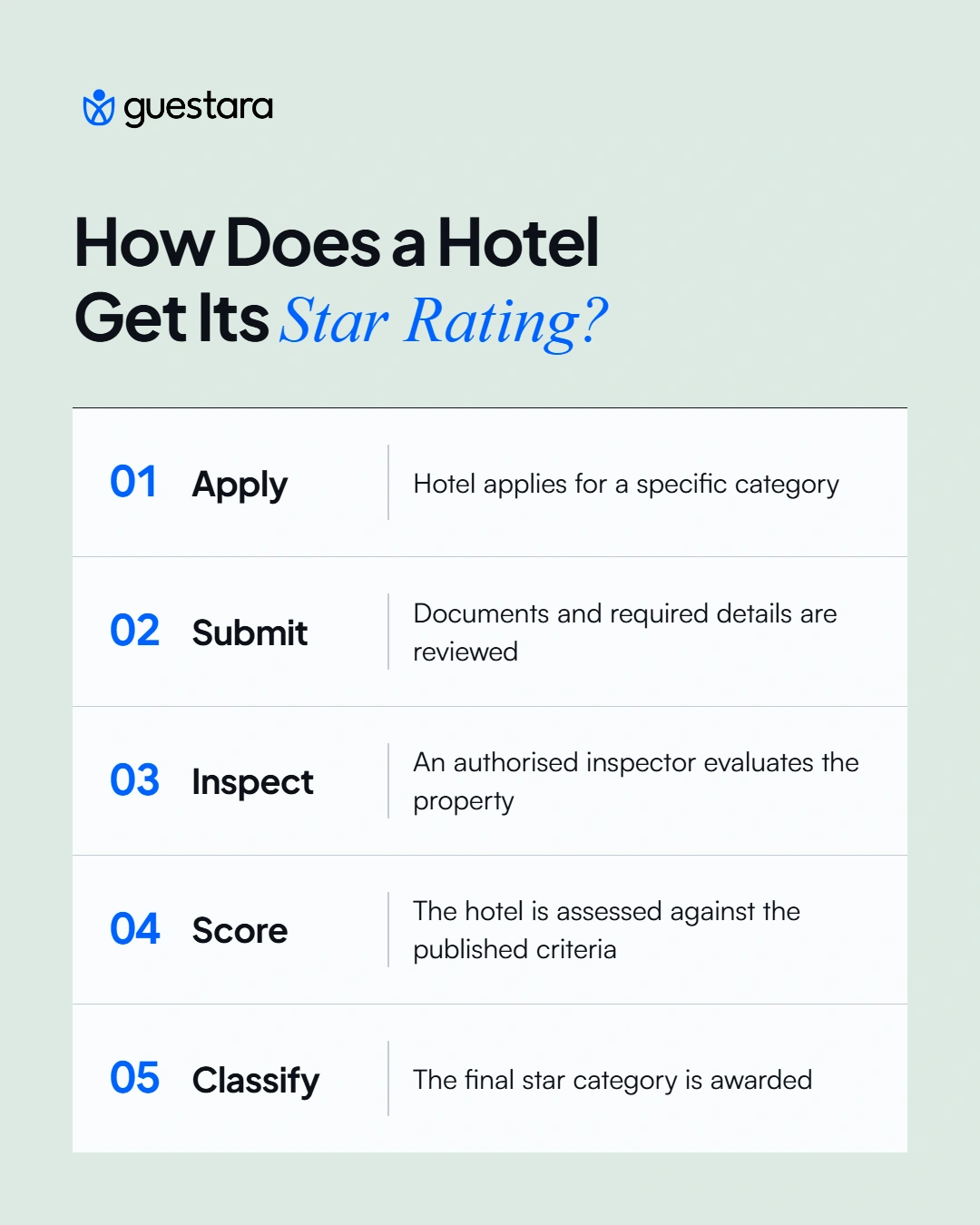
Hotel star ratings are decided by an independent inspection scored against a published criteria catalogue. The hotel applies for a specific category, submits documentation, receives an on-site visit from an inspector or committee, and is awarded a rating based on how many required and optional criteria it meets. A property cannot award itself a rating.
The catalogues are far more granular than most operators expect. The Hotelstars Union criteria catalogue for 2025 to 2030 contains 239 criteria across seven sections, each carrying a point value, with a minimum point total set for every star category. Hotels must clear both the mandatory criteria for their tier and the point threshold, which they reach by picking up optional criteria.
That catalogue was trimmed from 247 criteria in the previous cycle. The 2025 revision raised the weight given to sustainability and allowed shorter staffed reception hours where digital self check-in and check-out cover the gap, which is the clearest sign yet that classification bodies now treat automation as an acceptable substitute for desk coverage rather than a shortcut around it.
At the luxury end the bar rises sharply. Forbes Travel Guide sends anonymous inspectors who pay their own way, stay as ordinary guests, and score the property against up to 900 objective standards weighted heavily toward service delivery rather than facilities.
Most systems re-inspect on a fixed cycle of three to five years, and several reserve the right to arrive unannounced in between.
Stars are awarded by whichever body holds the mandate in a given market, and those bodies fall into three groups: government ministries, national hotel associations, and private luxury guides. There is no global hotel rating authority, which is the root cause of almost every inconsistency travellers complain about.
Six bodies cover most of the properties a hotelier will encounter.
Note the gap in the United States. No compulsory national scheme exists there, so properties routinely advertise themselves as four or five star with no certificate behind the claim. Markets with a licensed symbol work differently. In Australia, the star symbol is a trademark administered by the industry body, and a property displaying one it has not earned is making a false representation in its advertising. The same logic applies across several European markets.
AAA Diamonds differ from stars in where the scale begins. A property must first pass a baseline approval inspection covering cleanliness, comfort and safety before any Diamond is assigned, so there is no substandard end of the scale in the way there is at one star. As the scale rises, the assessment also shifts from which facilities exist toward how staff anticipate and handle guest needs.
No classification body awards more than five stars. Six-star and seven-star labels are self-applied marketing terms used by ultra-luxury properties in Dubai, Seoul and elsewhere to signal that they sit above the top of the official scale. The properties themselves are often genuinely exceptional. The rating is issued by nobody, which is why it never appears on an official certificate.
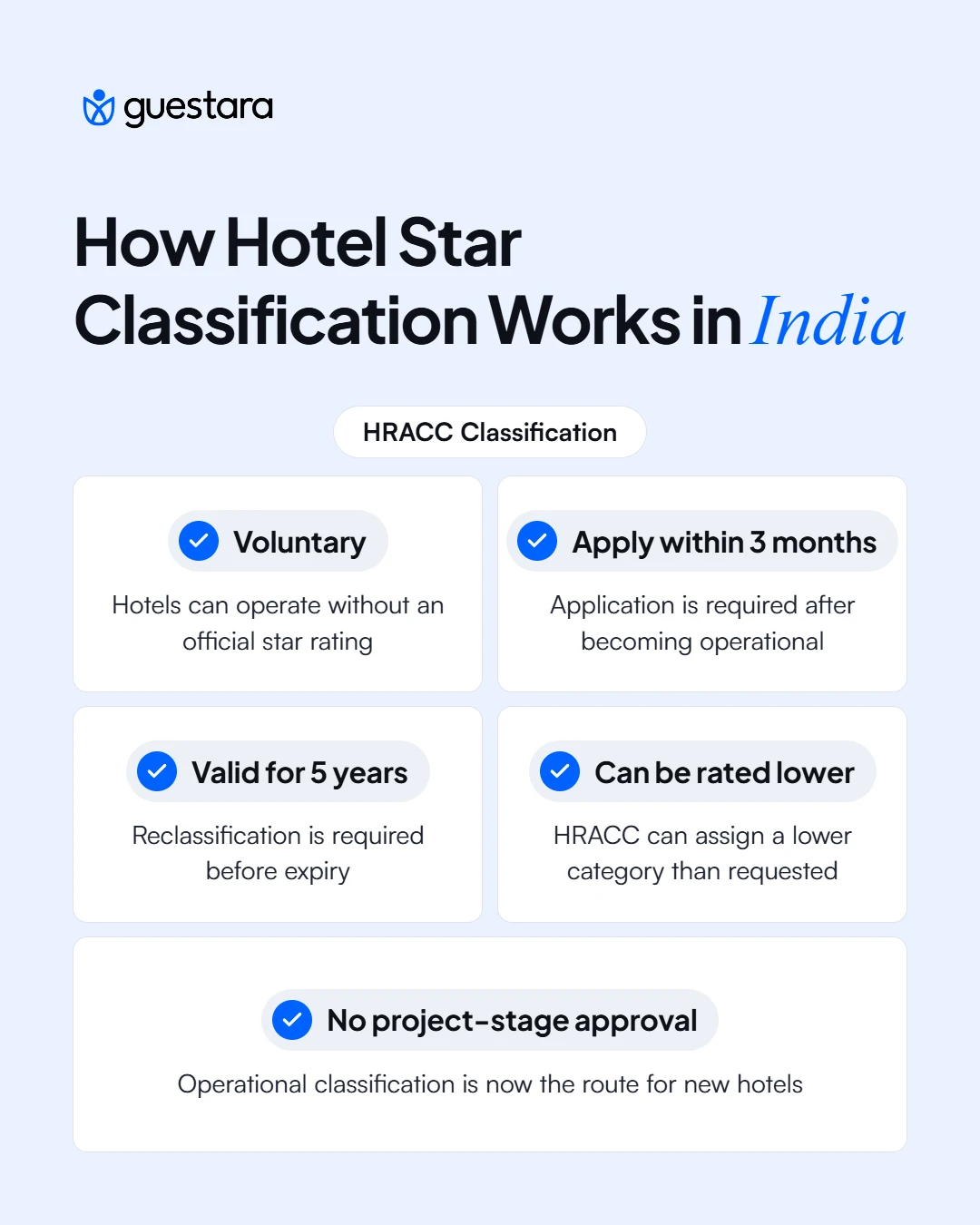
In India, hotel star ratings are awarded by the Hotel and Restaurant Approval and Classification Committee, known as HRACC, which operates under the Ministry of Tourism. Classification is voluntary. A property can trade legally, list on every online travel agency and fill every room without ever holding a star.
The category structure is wider than the standard one to five, because it carries two additions that have no equivalent in the European or American systems.
Four rules decide how the process runs in practice.
For an independent property weighing whether to apply at all, the deciding factor is the guest mix. Corporate travel policies and government per-diem rules frequently require a classified category before a booking is approved, which makes classification a revenue question for city hotels with business demand. Pure leisure demand arriving through online travel agencies almost never checks. Read the current Ministry of Tourism guidelines before applying, since the criteria are revised periodically.
A star rating and a guest review score both use a five-point scale and measure entirely different things. The star certifies the inventory a property holds. The review score reports how the stay actually felt. Confusing the two is the single most common mistake hoteliers make when reading their own market position.
The difference shows up across four dimensions.
This is why a two-star property can hold a 9.2 review score while a five-star hotel sits at 7.4. The two-star hotel promised a clean room at a fair price and delivered exactly that. The five-star hotel charged a premium the stay did not justify. Neither score is wrong, because they are answering different questions.
The practical read for an independent hotel is straightforward. The star rating gets you into the consideration set. The review score gets you booked. One of them moves once every five years and the other moves this week, which tells you where the daily attention belongs.
Hotel star ratings still matter, but their job has narrowed. They now function mainly as a search filter and a corporate booking requirement rather than as the quality signal guests trust most. The trust role has moved to review scores, which are current, specific and written by people in the same position as the reader.
Three situations still make classification worth the fee and the inspection:
Against that, two shifts have reduced the star's weight. Online travel agencies display review scores next to star ratings, so a guest sees both at the same moment and the fresher number wins attention. And classification cycles of three to five years mean a rating can reflect a property that has since been renovated, sold or allowed to decline.
The honest summary: a star rating is a floor, not a verdict. It tells a guest what the property is equipped to do. Everything after that is service, and service is measured somewhere else.
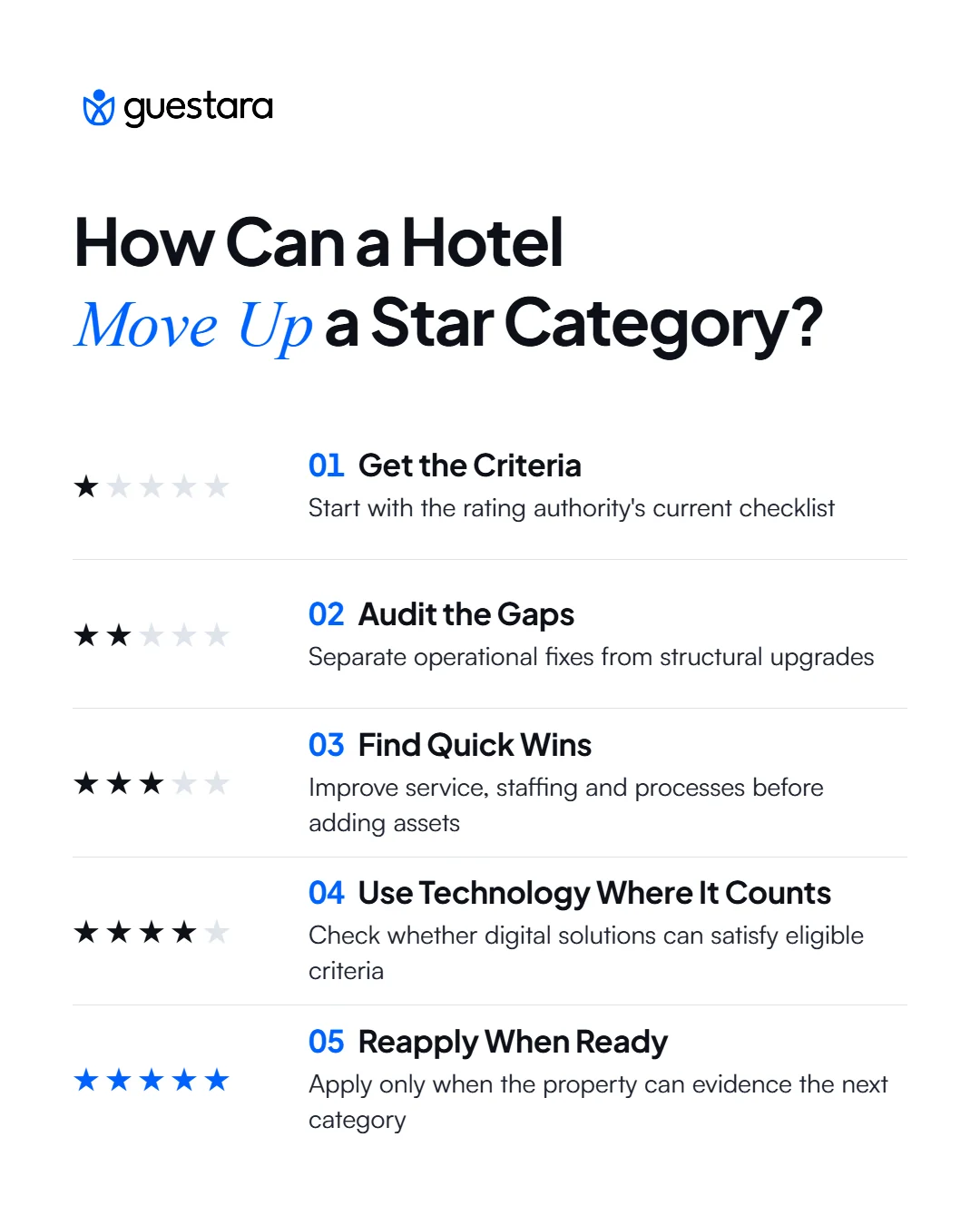
A hotel improves its star rating by obtaining the current criteria catalogue from its rating authority, auditing the property against it line by line, and closing the specific gaps blocking the next category. Most upgrade attempts fail because the operator guesses at the requirements instead of reading the published list.
Start by requesting the catalogue and your last inspection notes. Rating bodies publish their criteria openly, so the distance between your property and the next tier is a short, specific list rather than a vague standard, and it costs nothing to find out what is on it. From there the work splits into two groups.
Operational criteria are the cheapest points on the board. Reception hours, laundry turnaround, room service windows and linen change frequency are scheduling decisions you can change inside a quarter, with no capital approval behind them.
Check whether digital alternatives now earn credit before you add payroll. The 2025 to 2030 European criteria award points for self check-in and check-out in place of longer staffed reception hours, which means a technology decision can close a gap that previously needed a hiring decision.
Then fix service consistency. At four and five stars, inspectors score delivery rather than assets, so response times, handover accuracy between shifts and complaint resolution speed carry more weight than another amenity in the room.
Guest complaints and inspector findings usually point at the same failures, so properties that act on reviews tend to arrive at inspection already compliant. Catching the problem while the guest is still on-property is the part most teams miss, which is what Guestara's Review Collection handles by routing negative feedback to an internal alert instead of letting it land on a public page.
Room sizes, lift provision, bathroom dimensions and the addition of a pool, spa or second dining outlet are capital projects measured in years rather than quarters. Price them against the rate uplift the next category actually supports in your market, not against the category itself.
Run the operational fixes first in every case. They often close enough of the gap that the capital list shortens to one or two items, and they cost nothing to reverse if the strategy changes.
Reapply once you can evidence the category, not before. Most committees can assign a category lower than the one applied for but never a higher one, so an optimistic application costs the fee, the inspection and the cycle.
Where a classification is already held, apply for reclassification ahead of expiry rather than after it. A lapsed rating removes you from filtered searches and corporate approval lists until the new one is issued.
[[cta:cta-5 | eyebrow=Guest Engagement | heading=See how hotels keep service consistent across *every stay* | btn=Explore Guest Engagement | link=https://www.guestara.com/guest-engagement-for-hospitality ]]


The hotel star rating system explained: what each star certifies, who awards ratings in India, Europe and the US, and how hotels move up a category.
A guest filtering an online travel agency for four stars and up never sees your property if you hold three. They are not judging the hotel at that moment. They are shortening a list of four hundred options down to forty, and the star is the fastest filter available to them.
That is what makes the hotel star rating system worth understanding properly. The star decides who sees you. Yet the body awarding it, the criteria behind it and even whether anyone is required to hold one all change the moment you cross a border. Here is how the system actually works.
A hotel star rating is a classification awarded by an authorised body after inspecting a property against a published list of criteria covering rooms, facilities, service and safety. Ratings run from one to five stars. The rating certifies what a hotel offers, not how satisfied its guests were.
Each hotel star represents a verified step up in facilities and service standards, running from basic shelter at one star to full-service luxury at five. One star certifies a clean, safe room. Five stars certifies multiple dining outlets, round-the-clock room service, a full spa and a staffing ratio high enough to deliver personalised service.
Some systems add half stars for properties that clear most but not all of the next tier. A four-and-a-half-star hotel is signalling that guests should expect something close to five-star, without the full set.
The five tiers break down along consistent lines, even though the exact requirements shift between authorities.
Read that as a pattern, not a rulebook. Every authority publishes its own catalogue, and the gap between two four-star properties in different countries can be wide enough to surprise a guest who booked on the star alone.
A 1-star hotel is a property certified for clean, safe accommodation and nothing beyond it. Reception is staffed for limited hours, there is rarely a restaurant, and in some systems bathrooms can still be shared between rooms. It suits a traveller buying a bed near a transport hub rather than a stay.
A 2-star hotel adds consistency to the basics. Every room has a private bathroom, housekeeping runs daily, and a simple breakfast or coffee service is available. The step up from one star is reliability rather than range, which is why short business trips and single-night stopovers cluster at this tier.
A 3-star hotel is the first tier where the property becomes somewhere to spend time rather than sleep. The defining additions are a staffed 24-hour reception and an on-site restaurant or bar, usually with a fitness room or meeting space alongside. This is the broadest tier in most markets and the one where independent hotels compete hardest.
A 4-star hotel moves the measurement from facilities to finish. Rooms are larger with premium bedding, the restaurant is full-service, room service and concierge are available, and a pool or spa is normally part of the offer. The separation from three stars comes from quality and staffing depth, not a longer amenity list.
A 5-star hotel is certified on service delivery as much as on facilities. Multiple dining outlets, 24-hour room service, a full spa and butler or personalised attendance are standard, supported by a staff-to-guest ratio high enough to anticipate requests. At this tier inspectors score how consistently service lands, not whether the amenity exists.
Hotel star ratings are decided by an independent inspection scored against a published criteria catalogue. The hotel applies for a specific category, submits documentation, receives an on-site visit from an inspector or committee, and is awarded a rating based on how many required and optional criteria it meets. A property cannot award itself a rating.
The catalogues are far more granular than most operators expect. The Hotelstars Union criteria catalogue for 2025 to 2030 contains 239 criteria across seven sections, each carrying a point value, with a minimum point total set for every star category. Hotels must clear both the mandatory criteria for their tier and the point threshold, which they reach by picking up optional criteria.
That catalogue was trimmed from 247 criteria in the previous cycle. The 2025 revision raised the weight given to sustainability and allowed shorter staffed reception hours where digital self check-in and check-out cover the gap, which is the clearest sign yet that classification bodies now treat automation as an acceptable substitute for desk coverage rather than a shortcut around it.
At the luxury end the bar rises sharply. Forbes Travel Guide sends anonymous inspectors who pay their own way, stay as ordinary guests, and score the property against up to 900 objective standards weighted heavily toward service delivery rather than facilities.
Most systems re-inspect on a fixed cycle of three to five years, and several reserve the right to arrive unannounced in between.
Stars are awarded by whichever body holds the mandate in a given market, and those bodies fall into three groups: government ministries, national hotel associations, and private luxury guides. There is no global hotel rating authority, which is the root cause of almost every inconsistency travellers complain about.
Six bodies cover most of the properties a hotelier will encounter.
Note the gap in the United States. No compulsory national scheme exists there, so properties routinely advertise themselves as four or five star with no certificate behind the claim. Markets with a licensed symbol work differently. In Australia, the star symbol is a trademark administered by the industry body, and a property displaying one it has not earned is making a false representation in its advertising. The same logic applies across several European markets.
AAA Diamonds differ from stars in where the scale begins. A property must first pass a baseline approval inspection covering cleanliness, comfort and safety before any Diamond is assigned, so there is no substandard end of the scale in the way there is at one star. As the scale rises, the assessment also shifts from which facilities exist toward how staff anticipate and handle guest needs.
No classification body awards more than five stars. Six-star and seven-star labels are self-applied marketing terms used by ultra-luxury properties in Dubai, Seoul and elsewhere to signal that they sit above the top of the official scale. The properties themselves are often genuinely exceptional. The rating is issued by nobody, which is why it never appears on an official certificate.
In India, hotel star ratings are awarded by the Hotel and Restaurant Approval and Classification Committee, known as HRACC, which operates under the Ministry of Tourism. Classification is voluntary. A property can trade legally, list on every online travel agency and fill every room without ever holding a star.
The category structure is wider than the standard one to five, because it carries two additions that have no equivalent in the European or American systems.
Four rules decide how the process runs in practice.
For an independent property weighing whether to apply at all, the deciding factor is the guest mix. Corporate travel policies and government per-diem rules frequently require a classified category before a booking is approved, which makes classification a revenue question for city hotels with business demand. Pure leisure demand arriving through online travel agencies almost never checks. Read the current Ministry of Tourism guidelines before applying, since the criteria are revised periodically.
A star rating and a guest review score both use a five-point scale and measure entirely different things. The star certifies the inventory a property holds. The review score reports how the stay actually felt. Confusing the two is the single most common mistake hoteliers make when reading their own market position.
The difference shows up across four dimensions.
This is why a two-star property can hold a 9.2 review score while a five-star hotel sits at 7.4. The two-star hotel promised a clean room at a fair price and delivered exactly that. The five-star hotel charged a premium the stay did not justify. Neither score is wrong, because they are answering different questions.
The practical read for an independent hotel is straightforward. The star rating gets you into the consideration set. The review score gets you booked. One of them moves once every five years and the other moves this week, which tells you where the daily attention belongs.
Hotel star ratings still matter, but their job has narrowed. They now function mainly as a search filter and a corporate booking requirement rather than as the quality signal guests trust most. The trust role has moved to review scores, which are current, specific and written by people in the same position as the reader.
Three situations still make classification worth the fee and the inspection:
Against that, two shifts have reduced the star's weight. Online travel agencies display review scores next to star ratings, so a guest sees both at the same moment and the fresher number wins attention. And classification cycles of three to five years mean a rating can reflect a property that has since been renovated, sold or allowed to decline.
The honest summary: a star rating is a floor, not a verdict. It tells a guest what the property is equipped to do. Everything after that is service, and service is measured somewhere else.
A hotel improves its star rating by obtaining the current criteria catalogue from its rating authority, auditing the property against it line by line, and closing the specific gaps blocking the next category. Most upgrade attempts fail because the operator guesses at the requirements instead of reading the published list.
Start by requesting the catalogue and your last inspection notes. Rating bodies publish their criteria openly, so the distance between your property and the next tier is a short, specific list rather than a vague standard, and it costs nothing to find out what is on it. From there the work splits into two groups.
Operational criteria are the cheapest points on the board. Reception hours, laundry turnaround, room service windows and linen change frequency are scheduling decisions you can change inside a quarter, with no capital approval behind them.
Check whether digital alternatives now earn credit before you add payroll. The 2025 to 2030 European criteria award points for self check-in and check-out in place of longer staffed reception hours, which means a technology decision can close a gap that previously needed a hiring decision.
Then fix service consistency. At four and five stars, inspectors score delivery rather than assets, so response times, handover accuracy between shifts and complaint resolution speed carry more weight than another amenity in the room.
Guest complaints and inspector findings usually point at the same failures, so properties that act on reviews tend to arrive at inspection already compliant. Catching the problem while the guest is still on-property is the part most teams miss, which is what Guestara's Review Collection handles by routing negative feedback to an internal alert instead of letting it land on a public page.
Room sizes, lift provision, bathroom dimensions and the addition of a pool, spa or second dining outlet are capital projects measured in years rather than quarters. Price them against the rate uplift the next category actually supports in your market, not against the category itself.
Run the operational fixes first in every case. They often close enough of the gap that the capital list shortens to one or two items, and they cost nothing to reverse if the strategy changes.
Reapply once you can evidence the category, not before. Most committees can assign a category lower than the one applied for but never a higher one, so an optimistic application costs the fee, the inspection and the cycle.
Where a classification is already held, apply for reclassification ahead of expiry rather than after it. A lapsed rating removes you from filtered searches and corporate approval lists until the new one is issued.
[[cta:cta-5 | eyebrow=Guest Engagement | heading=See how hotels keep service consistent across *every stay* | btn=Explore Guest Engagement | link=https://www.guestara.com/guest-engagement-for-hospitality ]]
Star ratings in India are awarded by the Hotel and Restaurant Approval and Classification Committee, known as HRACC, which operates under the Ministry of Tourism. It classifies hotels from 1 Star to 5 Star, with additional 5 Star Deluxe and Heritage categories. A classification is valid for five years from the date of approval, after which the property must apply for reclassification.
It depends on the country. In India the scheme is voluntary, and a hotel can operate and sell on every booking channel without any official rating. Several European countries and Australia run licensed systems where the star symbol itself is a trademark, and only properties that have been rated may display it.
In markets with no compulsory scheme, such as the United States, self-declared star claims are common and carry no certification behind them. In markets where the symbol is licensed, advertising an uncertified rating is a false representation and can be actioned. Describing the property with language such as luxury or boutique is the safer route when no official rating is held.
AAA uses Diamonds rather than stars across North America, and the scales are not equivalent. A property must first pass a baseline approval inspection covering cleanliness, comfort and safety before any Diamond is assigned, so there is no substandard end of the scale. Higher Diamond levels also shift the emphasis from facilities toward the quality of service delivery.
The timeline varies by authority and usually runs from a few weeks to several months, covering the application, a document review and an on-site inspection. Properties are normally expected to be inspection-ready from the moment they apply, since several committees reserve the right to visit without notice. Where deficiencies are found, a period is typically allowed to correct them before the category is confirmed.
We work closely with the industry leaders to offer seamless solutions




We’re here to help your whole team stay ahead of the curve as you grow.

Get up and running quickly with a personalized onboarding plan

Connect with real people who really get it, 24/7

Checkout our vast library of free resources, templates and more
There's only so much we can say — so let us show you! Schedule a demo today and reach your business goals.