Hotel housekeeping explained: room status codes, the cleaning sequence in order, how to calculate attendants needed, linen par levels and trolley setup.





It is 2pm. Fourteen rooms are still showing dirty, nine guests are waiting in the lobby, and the front desk is calling the floor supervisor for the third time. Somewhere upstairs an attendant has finished a room but has not updated its status, so a clean room is sitting unsold while a guest stands downstairs waiting for it.
Nothing in that scene is a cleaning problem. It is a system problem, and housekeeping is mostly system. The cleaning itself is the part everyone understands. The codes, the sequence, the par levels and the handoff to the front desk are what decide whether the cleaning turns into a sold room on time.
Hotel housekeeping is the department responsible for cleaning guest rooms and public areas, managing linen and laundry, maintaining supply stock, and reporting the status of every room to the front desk. It sets the standard guests judge a property on and controls the inventory the front desk can actually sell.
Hotel housekeeping is the operational department that prepares and maintains the physical product a hotel sells. Its work splits into four jobs: cleaning guest rooms, maintaining public and back of house areas, controlling linen and supplies, and keeping room status accurate so rooms can be sold.
The fourth job is the one most often forgotten and the one that costs money fastest. A clean room nobody has marked clean cannot be sold, and a room marked clean that was not inspected gets sold to a guest who walks straight back down to reception.
Housekeeping is also the largest labour line in most rooms-division budgets and the department most exposed to turnover. That combination is why the standards below are written down rather than taught by shadowing. A property that trains by shadowing teaches whatever the last person happened to do.
The department runs on three layers: an executive housekeeper who owns standards, budget and scheduling, floor supervisors who allocate work and inspect it, and room attendants who clean. Larger properties add a houseman for heavy lifting and public areas, a linen room attendant, and a laundry team if the laundry is in-house.
Supervisors carry the quality standard. One supervisor to roughly ten to fifteen attendants is a workable span, because beyond that the inspections stop happening and the standard drifts within a month.
The control desk is the layer people miss. Somebody has to hold the live picture of which rooms are ready, which are blocked and which are waiting on maintenance, and relay it to the front desk. In large hotels that is a dedicated desk coordinator. In small ones it is whoever has the radio, which works only if it is always the same person.
At under 40 rooms the three layers collapse into two. The owner or duty manager holds the executive housekeeper role alongside other duties, and one senior attendant supervises and cleans.
That collapse is fine as long as one thing survives it: somebody other than the person who cleaned the room checks the room. Self-inspection is where small-property standards fail, not lack of staff. Two attendants checking each other's rooms costs nothing and catches most of what a supervisor would.
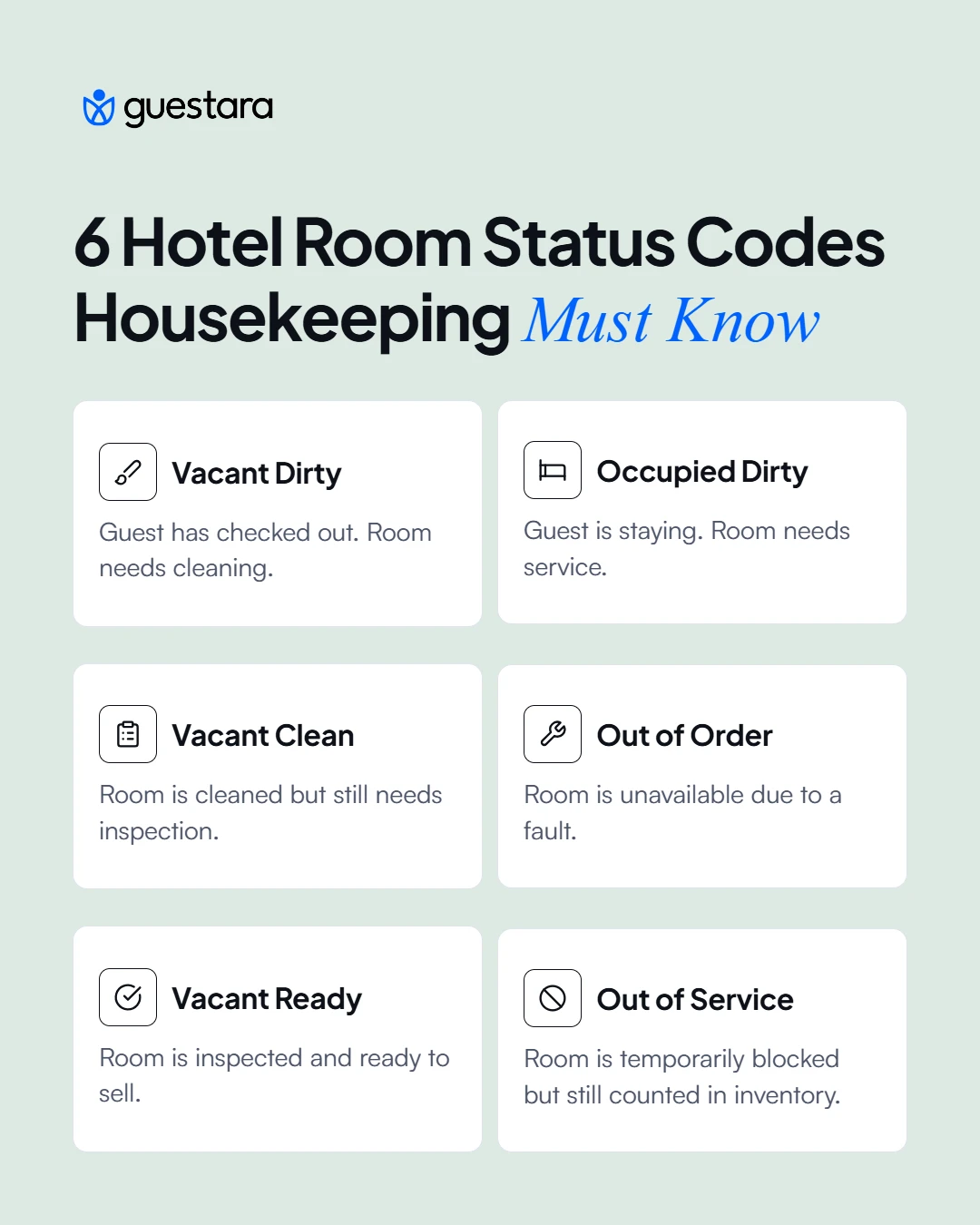
Room status codes are the standard abbreviations housekeeping and the front desk use to describe the condition of every room. They exist so two departments can agree on what a room is without a phone call, and getting them wrong is the most common cause of a guest being sent to an unready room.
Eight codes cover almost everything a property needs.
The OOO and OOS distinction matters for your numbers, not just your operations. A room out of order is taken out of available room count, which raises your occupancy percentage. A room out of service stays in the count. Coding a short maintenance block as OOO flatters occupancy and corrupts the comparison with last year.
Three more codes appear on most systems. Due out marks a room scheduled to depart today, which drives the morning priority list. Slept out means the room was paid for but not slept in. Skip means the attendant could not gain access, which always requires a follow-up rather than an assumption.
A room is cleaned in a fixed order, not as a list of tasks completed in any sequence. The order exists because chemicals need dwell time, dust falls downward and the vacuum has to leave the room last. Attendants working from an unordered checklist redo work without noticing.
This is the working sequence for a departure clean:
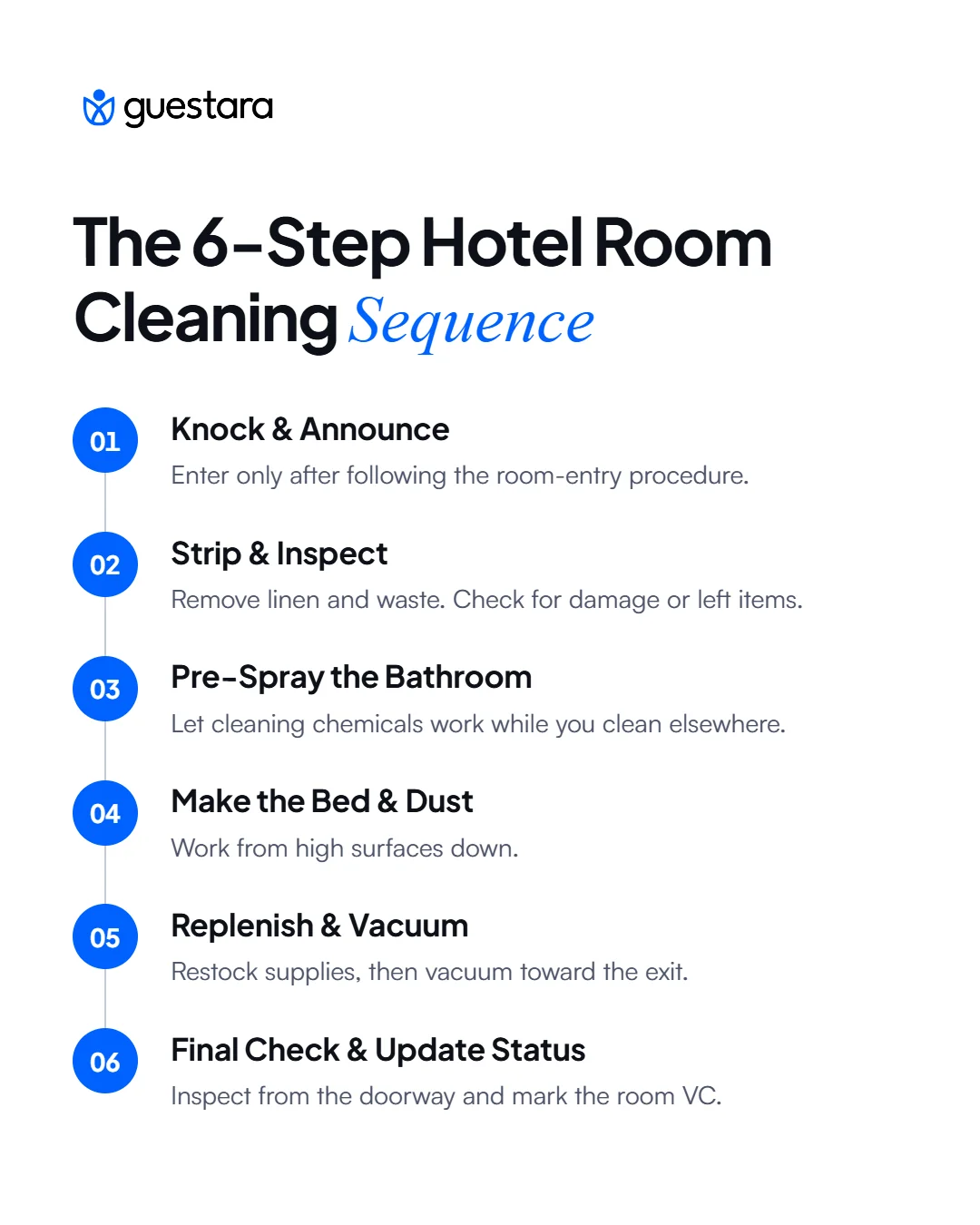
Step 10 is the one that fails most often, and it is the one that strands a clean room unsold.
A stayover clean services an occupied room, which changes the task list and roughly a third of the time. The guest's belongings are present, which sets the rule that governs everything else: tidy around possessions, never into drawers, and never move anything you do not have to.
Most attendants complete 12 to 18 rooms in an eight-hour shift, and where a property sits in that range depends on its departure ratio, not on how fast anyone works. A floor of departures is a different day from a floor of stayovers, and treating them as the same number is why allocations run late.
These are the working ranges for a mid-scale property. Treat them as a starting point to measure against rather than a target to impose, and time your own rooms before setting a standard.
Staff from cleaning minutes, never from room count. Here is an 80-room hotel running at 70% occupancy, with 56 occupied rooms tonight splitting into 24 departures and 32 stayovers tomorrow.
Start with the minutes required:
Then the minutes actually available per attendant. An eight-hour shift is 480 minutes, but briefing, trolley setup, breaks, travel between floors and linen runs take roughly 60 of them. Productive cleaning time is about 420 minutes.
1,360 divided by 420 gives 3.24 attendants. Round up to 4, never down, because the fraction is a real room that somebody has to clean.
Sense-check it against the quota: 56 rooms across 4 attendants is 14 rooms each, which sits inside the 12 to 18 range. If the check falls outside that range, the time assumptions are wrong for your property and need remeasuring rather than overriding.
Run this the evening before, not on the morning of. A shortfall found at 7am is a shortfall you work through.
One par of linen is the quantity needed to outfit every guest room once. Par levels decide whether a laundry delay becomes a guest-facing problem, and running short is the most common supply failure in small properties.
The accepted standard is five par. Nitschke and Frye, in Managing Housekeeping Operations for the American Hotel and Lodging Educational Institute, set out a minimum of five par held across the year, with a sixth added where an outside commercial laundry is used.
Calculate each linen type separately, because sheets, pillowcases, bath towels, hand towels and bath mats all cycle differently.
The method is beds multiplied by pieces per bed, multiplied by par. For an 80-room hotel with one double bed per room at three sheets per bed: 80 times 3 gives 240 sheets in one par. At five par that is 1,200 sheets, and at six par with an outside laundry, 1,440.
Repeat for every item. Towels usually need the higher par because they cycle fastest, and properties that set one blanket par across all items run out of bath towels first.
Two things change the answer. A faster laundry turnaround can support the lower end, and a property with no on-site laundry needs the sixth par rather than treating it as optional.
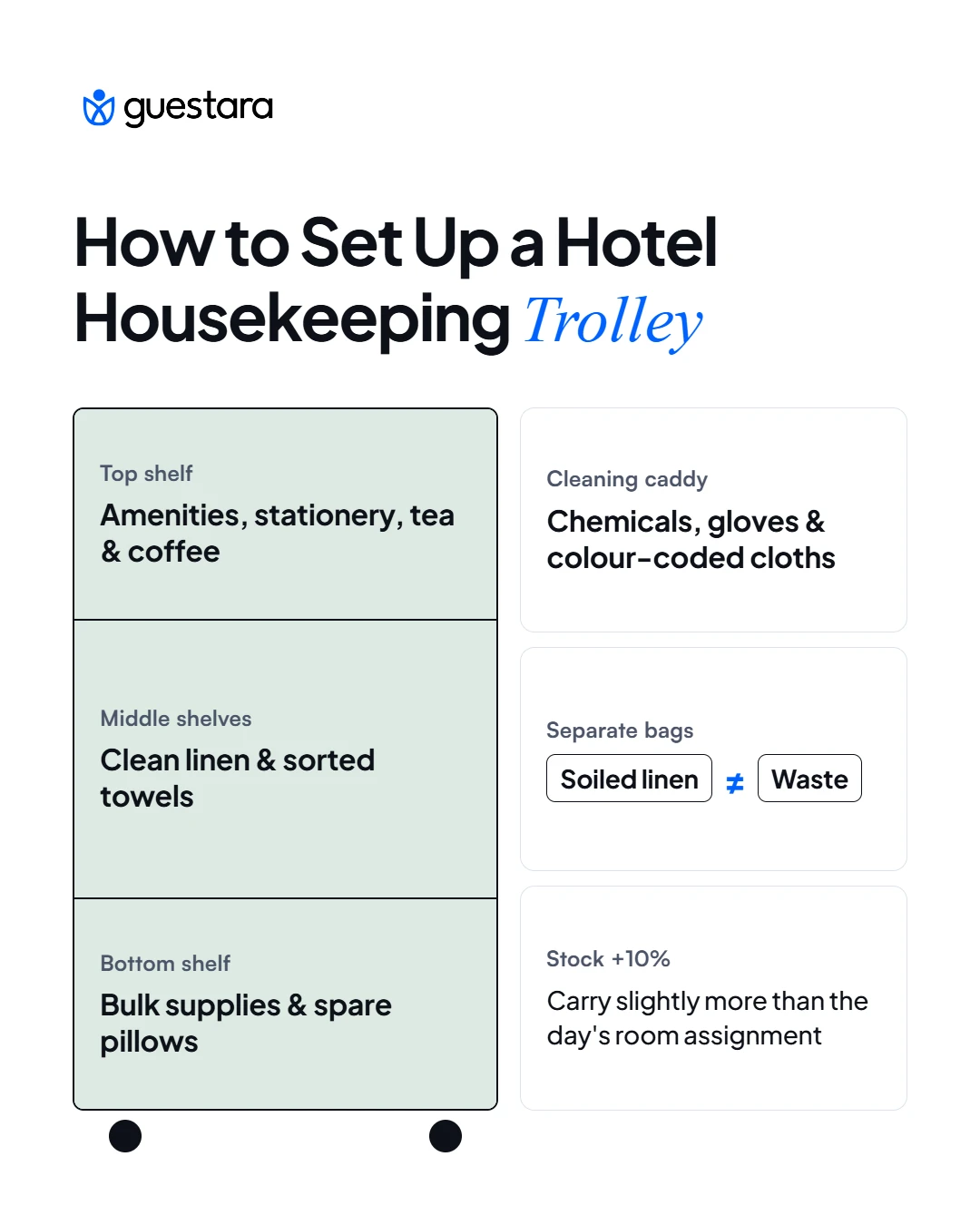
A housekeeping trolley carries everything needed for a full room assignment so the attendant never leaves the floor mid-shift. Every trip back to the linen room costs five to ten minutes, and three trips a day across four attendants is most of an hour of paid time.
Load it the same way every time, so anyone can work from anyone's trolley.
Stock to the assignment plus about 10%. An attendant with 14 rooms carries linen for roughly 15, because the alternative is a trip downstairs for one set.
Colour-code the cloths and keep the scheme on the trolley in writing. A common scheme uses one colour for toilets, one for the rest of the bathroom and one for guest room surfaces, which prevents the cross-contamination nobody can see afterwards.
Dilute chemicals to the manufacturer's stated ratio rather than by eye. Over-concentration damages surfaces and leaves residue, under-concentration does not disinfect, and both look identical on a finished room.
The two departments coordinate through room status and a shared priority list, and the handoff has one rule: the front desk sells what housekeeping releases, and housekeeping releases only what a supervisor has inspected.
Three moments decide whether that holds.
The morning priority list is the first. Housekeeping should receive the day's arrivals with any early check-in requests and specific room allocations before the shift starts, so attendants clean in arrival order rather than room order. Cleaning floor by floor is efficient and wrong when nine guests are waiting for four specific rooms.
The arrivals peak is the second. When the lobby fills and rooms are short, the supervisor works the inspection queue rather than the floors, because the constraint at that moment is release, not cleaning.
Checkout is the third and the one most often delayed. Housekeeping cannot start a departure clean until it knows the guest has gone, and a guest who leaves at 9am but is only marked out at 11 has cost two hours of turnaround. Properties that let guests complete checkout from their phone close that gap, which is what Guestara's Smart Checkout does by notifying housekeeping the moment checkout completes rather than when someone reaches the desk.
Keep DND handling explicit. A room still showing DND after a set hour, commonly 2pm, is escalated to the duty manager rather than left for tomorrow, because the sign sometimes means a guest wants privacy and occasionally means something else.
Inspection and deep cleaning are the two scheduled controls that keep daily standards from drifting. Daily cleaning maintains the room. These two catch what daily cleaning structurally cannot.
Inspect every room from a new attendant for their first 90 days, then move to a random sample of roughly a quarter to a third of their rooms.
Sample randomly rather than on a schedule. An attendant who knows Tuesday is inspection day produces a Tuesday standard. Score against the same checklist the attendant works from, so a fail is a specific missed item rather than an opinion, and track the pass rate per attendant over time. A pass rate that drops for one person is a training conversation. A pass rate that drops across the team is a standard or staffing problem.
Any room that fails inspection goes back to VC and is re-released only after recheck.
Run a rotation so every room is deep cleaned on a fixed cycle, typically quarterly, rather than deep cleaning when a room looks bad. A rotation of one room per day covers a 90-room property in a quarter without ever blocking more than one room.
Deep cleaning covers what the daily clean never reaches: mattress rotation and protector check, curtain and upholstery cleaning, carpet shampoo or hard floor treatment, descaling shower heads and taps, air conditioning vents and filters, and the floor behind and under furniture.
Block the room as out of service for the duration and put it in the schedule in advance. A deep clean competing with a sold room never wins, which is why a rotation planned against the forecast beats one planned against appearance.
[[cta:cta-5 | eyebrow=Smart Checkout | heading=Tell housekeeping a room is free *the moment* it is | btn=Explore Smart Checkout | link=https://www.guestara.com/smart-checkout ]]


Hotel housekeeping explained: room status codes, the cleaning sequence in order, how to calculate attendants needed, linen par levels and trolley setup.
It is 2pm. Fourteen rooms are still showing dirty, nine guests are waiting in the lobby, and the front desk is calling the floor supervisor for the third time. Somewhere upstairs an attendant has finished a room but has not updated its status, so a clean room is sitting unsold while a guest stands downstairs waiting for it.
Nothing in that scene is a cleaning problem. It is a system problem, and housekeeping is mostly system. The cleaning itself is the part everyone understands. The codes, the sequence, the par levels and the handoff to the front desk are what decide whether the cleaning turns into a sold room on time.
Hotel housekeeping is the department responsible for cleaning guest rooms and public areas, managing linen and laundry, maintaining supply stock, and reporting the status of every room to the front desk. It sets the standard guests judge a property on and controls the inventory the front desk can actually sell.
Hotel housekeeping is the operational department that prepares and maintains the physical product a hotel sells. Its work splits into four jobs: cleaning guest rooms, maintaining public and back of house areas, controlling linen and supplies, and keeping room status accurate so rooms can be sold.
The fourth job is the one most often forgotten and the one that costs money fastest. A clean room nobody has marked clean cannot be sold, and a room marked clean that was not inspected gets sold to a guest who walks straight back down to reception.
Housekeeping is also the largest labour line in most rooms-division budgets and the department most exposed to turnover. That combination is why the standards below are written down rather than taught by shadowing. A property that trains by shadowing teaches whatever the last person happened to do.
The department runs on three layers: an executive housekeeper who owns standards, budget and scheduling, floor supervisors who allocate work and inspect it, and room attendants who clean. Larger properties add a houseman for heavy lifting and public areas, a linen room attendant, and a laundry team if the laundry is in-house.
Supervisors carry the quality standard. One supervisor to roughly ten to fifteen attendants is a workable span, because beyond that the inspections stop happening and the standard drifts within a month.
The control desk is the layer people miss. Somebody has to hold the live picture of which rooms are ready, which are blocked and which are waiting on maintenance, and relay it to the front desk. In large hotels that is a dedicated desk coordinator. In small ones it is whoever has the radio, which works only if it is always the same person.
At under 40 rooms the three layers collapse into two. The owner or duty manager holds the executive housekeeper role alongside other duties, and one senior attendant supervises and cleans.
That collapse is fine as long as one thing survives it: somebody other than the person who cleaned the room checks the room. Self-inspection is where small-property standards fail, not lack of staff. Two attendants checking each other's rooms costs nothing and catches most of what a supervisor would.
Room status codes are the standard abbreviations housekeeping and the front desk use to describe the condition of every room. They exist so two departments can agree on what a room is without a phone call, and getting them wrong is the most common cause of a guest being sent to an unready room.
Eight codes cover almost everything a property needs.
The OOO and OOS distinction matters for your numbers, not just your operations. A room out of order is taken out of available room count, which raises your occupancy percentage. A room out of service stays in the count. Coding a short maintenance block as OOO flatters occupancy and corrupts the comparison with last year.
Three more codes appear on most systems. Due out marks a room scheduled to depart today, which drives the morning priority list. Slept out means the room was paid for but not slept in. Skip means the attendant could not gain access, which always requires a follow-up rather than an assumption.
A room is cleaned in a fixed order, not as a list of tasks completed in any sequence. The order exists because chemicals need dwell time, dust falls downward and the vacuum has to leave the room last. Attendants working from an unordered checklist redo work without noticing.
This is the working sequence for a departure clean:
Step 10 is the one that fails most often, and it is the one that strands a clean room unsold.
A stayover clean services an occupied room, which changes the task list and roughly a third of the time. The guest's belongings are present, which sets the rule that governs everything else: tidy around possessions, never into drawers, and never move anything you do not have to.
Most attendants complete 12 to 18 rooms in an eight-hour shift, and where a property sits in that range depends on its departure ratio, not on how fast anyone works. A floor of departures is a different day from a floor of stayovers, and treating them as the same number is why allocations run late.
These are the working ranges for a mid-scale property. Treat them as a starting point to measure against rather than a target to impose, and time your own rooms before setting a standard.
Staff from cleaning minutes, never from room count. Here is an 80-room hotel running at 70% occupancy, with 56 occupied rooms tonight splitting into 24 departures and 32 stayovers tomorrow.
Start with the minutes required:
Then the minutes actually available per attendant. An eight-hour shift is 480 minutes, but briefing, trolley setup, breaks, travel between floors and linen runs take roughly 60 of them. Productive cleaning time is about 420 minutes.
1,360 divided by 420 gives 3.24 attendants. Round up to 4, never down, because the fraction is a real room that somebody has to clean.
Sense-check it against the quota: 56 rooms across 4 attendants is 14 rooms each, which sits inside the 12 to 18 range. If the check falls outside that range, the time assumptions are wrong for your property and need remeasuring rather than overriding.
Run this the evening before, not on the morning of. A shortfall found at 7am is a shortfall you work through.
One par of linen is the quantity needed to outfit every guest room once. Par levels decide whether a laundry delay becomes a guest-facing problem, and running short is the most common supply failure in small properties.
The accepted standard is five par. Nitschke and Frye, in Managing Housekeeping Operations for the American Hotel and Lodging Educational Institute, set out a minimum of five par held across the year, with a sixth added where an outside commercial laundry is used.
Calculate each linen type separately, because sheets, pillowcases, bath towels, hand towels and bath mats all cycle differently.
The method is beds multiplied by pieces per bed, multiplied by par. For an 80-room hotel with one double bed per room at three sheets per bed: 80 times 3 gives 240 sheets in one par. At five par that is 1,200 sheets, and at six par with an outside laundry, 1,440.
Repeat for every item. Towels usually need the higher par because they cycle fastest, and properties that set one blanket par across all items run out of bath towels first.
Two things change the answer. A faster laundry turnaround can support the lower end, and a property with no on-site laundry needs the sixth par rather than treating it as optional.
A housekeeping trolley carries everything needed for a full room assignment so the attendant never leaves the floor mid-shift. Every trip back to the linen room costs five to ten minutes, and three trips a day across four attendants is most of an hour of paid time.
Load it the same way every time, so anyone can work from anyone's trolley.
Stock to the assignment plus about 10%. An attendant with 14 rooms carries linen for roughly 15, because the alternative is a trip downstairs for one set.
Colour-code the cloths and keep the scheme on the trolley in writing. A common scheme uses one colour for toilets, one for the rest of the bathroom and one for guest room surfaces, which prevents the cross-contamination nobody can see afterwards.
Dilute chemicals to the manufacturer's stated ratio rather than by eye. Over-concentration damages surfaces and leaves residue, under-concentration does not disinfect, and both look identical on a finished room.
The two departments coordinate through room status and a shared priority list, and the handoff has one rule: the front desk sells what housekeeping releases, and housekeeping releases only what a supervisor has inspected.
Three moments decide whether that holds.
The morning priority list is the first. Housekeeping should receive the day's arrivals with any early check-in requests and specific room allocations before the shift starts, so attendants clean in arrival order rather than room order. Cleaning floor by floor is efficient and wrong when nine guests are waiting for four specific rooms.
The arrivals peak is the second. When the lobby fills and rooms are short, the supervisor works the inspection queue rather than the floors, because the constraint at that moment is release, not cleaning.
Checkout is the third and the one most often delayed. Housekeeping cannot start a departure clean until it knows the guest has gone, and a guest who leaves at 9am but is only marked out at 11 has cost two hours of turnaround. Properties that let guests complete checkout from their phone close that gap, which is what Guestara's Smart Checkout does by notifying housekeeping the moment checkout completes rather than when someone reaches the desk.
Keep DND handling explicit. A room still showing DND after a set hour, commonly 2pm, is escalated to the duty manager rather than left for tomorrow, because the sign sometimes means a guest wants privacy and occasionally means something else.
Inspection and deep cleaning are the two scheduled controls that keep daily standards from drifting. Daily cleaning maintains the room. These two catch what daily cleaning structurally cannot.
Inspect every room from a new attendant for their first 90 days, then move to a random sample of roughly a quarter to a third of their rooms.
Sample randomly rather than on a schedule. An attendant who knows Tuesday is inspection day produces a Tuesday standard. Score against the same checklist the attendant works from, so a fail is a specific missed item rather than an opinion, and track the pass rate per attendant over time. A pass rate that drops for one person is a training conversation. A pass rate that drops across the team is a standard or staffing problem.
Any room that fails inspection goes back to VC and is re-released only after recheck.
Run a rotation so every room is deep cleaned on a fixed cycle, typically quarterly, rather than deep cleaning when a room looks bad. A rotation of one room per day covers a 90-room property in a quarter without ever blocking more than one room.
Deep cleaning covers what the daily clean never reaches: mattress rotation and protector check, curtain and upholstery cleaning, carpet shampoo or hard floor treatment, descaling shower heads and taps, air conditioning vents and filters, and the floor behind and under furniture.
Block the room as out of service for the duration and put it in the schedule in advance. A deep clean competing with a sold room never wins, which is why a rotation planned against the forecast beats one planned against appearance.
[[cta:cta-5 | eyebrow=Smart Checkout | heading=Tell housekeeping a room is free *the moment* it is | btn=Explore Smart Checkout | link=https://www.guestara.com/smart-checkout ]]
VC stands for vacant clean, meaning the room has been cleaned by an attendant but not yet inspected or released for sale. It becomes VR, vacant ready, once a supervisor has inspected and approved it. Keeping the two states separate is what prevents an uninspected room being sold to an arriving guest.
An out of order room is unsellable because of a fault and is removed from the available room count, which raises the property's reported occupancy percentage. An out of service room is temporarily blocked but remains in the available count. Coding a short maintenance block as out of order inflates occupancy and breaks year-on-year comparison, so the distinction matters for reporting as much as for operations.
A departure clean typically takes 30 to 45 minutes and a stayover clean 20 to 30, varying with room size, bathroom type and how many amenities are restocked. Suites and rooms with separate bathtubs sit at the higher end. Properties should time their own rooms across a week before setting an internal standard, since layout and travel distance between floors change the figure materially.
Most room attendants complete 12 to 18 rooms in an eight-hour shift. The departure to stayover ratio drives where a property lands, because a floor of departures takes roughly 50% longer per room than a floor of stayovers. Calculate the daily requirement from total cleaning minutes rather than applying a flat room quota.
One par is the quantity of a linen item needed to outfit every guest room once. The accepted standard is five par, covering linen on the beds, in floor closets, in the laundry, held as replacement stock and kept as emergency reserve, with a sixth par where an outside commercial laundry adds linen in transit. Par is calculated per item type, since towels cycle faster than sheets.
We work closely with the industry leaders to offer seamless solutions




We’re here to help your whole team stay ahead of the curve as you grow.

Get up and running quickly with a personalized onboarding plan

Connect with real people who really get it, 24/7

Checkout our vast library of free resources, templates and more
There's only so much we can say — so let us show you! Schedule a demo today and reach your business goals.