The hotel guest journey stages are discovery, booking, pre-arrival, check-in, in-stay, checkout and post-stay. See what happens at each and what to fix first.





Your guest decided what kind of stay they were having long before they reached your front desk.
They read your reviews on a Tuesday night. They booked on an OTA on Thursday. They spent the next three weeks wondering what time they could drop their bags, whether parking was included, and whether anyone would answer if they asked. By the time they walk through your door, they have already been your guest for a month. You just have not been talking to them.
That gap is what the hotel guest journey describes. It is the full sequence of stages a guest moves through with your property, and most of it happens when nobody from your team is in the room.
The hotel guest journey is the complete sequence of interactions a guest has with your property, from the moment they first discover you to the moment they decide whether to book again. It covers seven stages and spans weeks or months, not just the nights the guest sleeps in your room.
Operators often use "guest journey" and "guest experience" to mean the same thing. The journey is the structure that repeats for every guest, while the experience is how any single moment inside it feels, and our guide to the difference between the guest journey and guest experience works through where that distinction changes your decisions.
For the full picture across personalization, automation and measurement, start with our complete guide to the hotel guest journey. If you want the wider view of what guests expect from a modern stay, that sits one level above the stages.
The seven hotel guest journey stages are discovery, booking, pre-arrival, check-in, in-stay, checkout and post-stay. Each one has a different guest intent and a different operational job, which is why treating them as one continuous blur costs hotels money.
Here is what the guest is doing at each stage and what your property has to get right.
The seven stages group into three phases. Discovery, booking and pre-arrival sit in pre-stay. Check-in, in-stay and checkout sit in in-stay. Post-stay stands alone.
Use the three-phase grouping when you talk to owners about strategy. Use the seven stages when you build the actual workflow, because each one needs its own trigger, its own owner and its own message. Once you know the stages, mapping them against your own property is the next exercise, and there are 13 practical ways to improve each stage once the map exists.
Many travel frameworks collapse the journey into five stages. That works for marketers describing traveller behaviour. It fails for operators.
Pre-arrival and checkout get folded away in the shorter models, and those are exactly the two stages where independent hotels leak the most revenue. Pre-arrival is where deposits, upgrades and check-in completion live. Checkout is where pending payments, late checkout sales and the review request live. Collapse them and you stop staffing them.
Discovery and booking are the first two stages, and almost all of the activity happens on channels you do not control. A guest finds you through an OTA listing, a search result or a recommendation, then validates that choice by reading what other guests said.
Reviews do most of the work at this stage. Research by Accor, surveying 5,000 travellers across five European countries in 2024, found that 97% consulted guest reviews when looking to book a hotel or resort stay, ranking reviews second only to rooms and amenities in the booking decision.
That matters operationally for a reason most hoteliers miss. Your discovery stage is powered entirely by your post-stay stage. The reviews that win you a booking in January were captured from guests who checked out in November. Stage one and stage seven are the same loop.
Discovery itself is shifting. Guests increasingly ask an AI assistant rather than scroll a results page, which changes how hotels get found and booked. The property that answers questions fastest wins the comparison, and an AI chatbot trained on your own property data answers them at 2am when your team is asleep.
Booking itself is the shortest stage in the journey and the one most hotels have already solved. The real question at booking is what data you capture. Every booking lands in your PMS with a name, a channel, an arrival date and a length of stay. That record is what every later stage runs on. If your booking data is thin or trapped in a channel manager nobody reads, stages three through seven have nothing to work with.
Pre-arrival is the window between booking confirmation and arrival day, and at most independent hotels it is completely silent. The guest gets an automated confirmation email and then hears nothing until they turn up.
That silence is expensive. Your guest spends those weeks with open questions. What time can I check in? Is there parking? Can I get a late checkout? Every one of those questions is a conversation you could have been having, and several of them are things you could have sold.
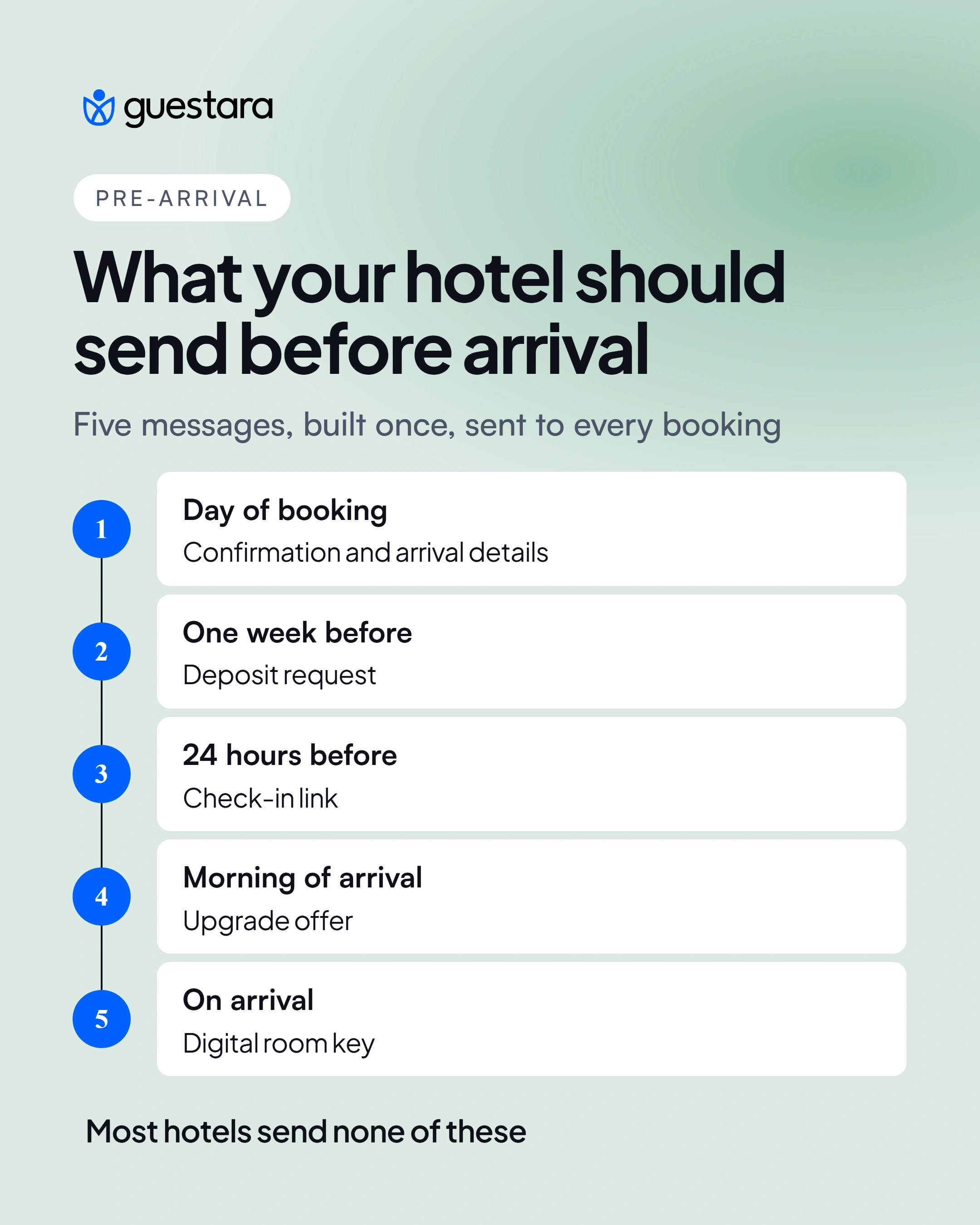
Pre-arrival is also where three operational jobs belong. You collect the deposit. You send the check-in link so arrival day is already handled. You put an upgrade or an add-on in front of a guest who is still in planning mode and happy to spend.
Guestara's Guest Journey module runs this stage automatically. Triggers fire off your PMS booking data across WhatsApp, email and SMS, so a confirmation goes out on booking, a check-in link goes out 24 hours before arrival, and an upsell offer lands at the point the guest is most likely to say yes. You build the sequence once and it runs for every booking after that.
Olive Hotels by Embassy saw a 248% lift in guest engagement using Guestara. That number is what filling an empty stage looks like. The guests were always there. Nobody was talking to them.
If you want to see how automated pre-arrival to post-stay messaging is structured, our guest engagement platform shows the trigger logic in detail. Pre-arrival is also the first point where personalizing by segment rather than blasting everyone starts paying, and it is where guest communication begins shaping the whole journey.
Check-in is the stage where your guest forms their first physical impression of your property, and it is the easiest one to lose. A guest who waited twenty minutes in a lobby after a six-hour journey has already started drafting the review.
The pressure here is structural, not a staff problem. The American Hotel and Lodging Association's Front Desk Feedback survey of 456 hoteliers in 2024 found that 76% of hotels were experiencing a staffing shortage, with 13% severely understaffed. Arrivals cluster. Your team does not.
Guests have also stopped expecting a desk to be involved. Oracle Hospitality's research with Skift, covering 5,266 consumers and 633 hotel executives in 2022, found that 73% were more likely to stay at a hotel offering self-service technology and the same share wanted to manage their stay from their phone.
Guestara's Digital Check-In closes the gap. The guest taps the link sent during pre-arrival, scans their ID, and the registration form fills itself from the ID data. The whole thing takes 30 seconds with no manual form filling. Guestara integrates with 50+ smart lock systems, so the digital room key is issued automatically the moment check-in completes and the guest walks straight to the room.
This stage also carries your compliance load. Guest registration, identity verification and the records your local authority expects all get created here. Doing it on paper means the data is unsearchable the moment the guest walks away. Olive Hotels by Embassy reached 99.8% verified guest profiles using Guestara, which is a compliance outcome and a data outcome at the same time.
Automating arrival does not mean removing people from it. Deciding which touchpoints stay human and which go digital is a judgement call every property makes differently, and check-in is where it bites hardest.
For guests who arrive without completing mobile check-in, Guestara's Tablet Registration runs the identical 30-second flow at the desk, so nobody ends up with a clipboard. See how the full arrival flow fits together on our contactless check-in and checkout page.
In-stay is the longest stage in the hotel guest journey and the only one where you can still fix a problem before it becomes a public review. Everything that goes wrong here is recoverable, as long as you hear about it.
Two things decide whether this stage works. Can the guest reach you easily, and does what they ask for get to the right team.
Guestara's Unified Inbox handles the first. Messages from OTAs, WhatsApp, Instagram, Facebook and email land in one window, so your team replies from a single place instead of discovering a Booking.com message three days late. If you are weighing whether a single inbox is worth consolidating into, the in-stay stage is where it earns its keep, and response time benchmarks show how fast is fast enough. Guestara's AI Chatbot absorbs the routine volume, answering WiFi passwords, pool hours and house rules around the clock, and escalating anything complex to a real person.
Guestara's Task Board handles the second. A room upgrade request routes to the front desk, a food order routes to F&B, a broken air conditioner routes to maintenance. The routing is automatic and every task carries an audit trail, which replaces the WhatsApp group where requests go to die.
In-stay is also where ancillary revenue lives. Guestara's Upsell module gives guests a branded mobile menu they order from directly, with payment taken at the point of order. Because it connects to the Guest Journey module, offers fire at the moments guests actually buy.
Timing is most of the skill here. These are the moments that convert.
Olive Hotels by Embassy generated $30.2 in added revenue per room per month using Guestara. Across a 60-room property that is real money arriving from a stage most hotels treat as passive. Guestara drives up to 200% more upsells, and none of it requires a staff member to make the ask. Our hotel upsell software page shows how the branded menu is built.
[[cta:cta-5 | eyebrow=Guest Journey | heading=Run every stage *automatically*, for every guest | btn=Explore Guest Engagement | link=https://www.guestara.com/guest-engagement-for-hospitality ]]
Checkout and post-stay are two separate stages, and hotels that treat them as one lose revenue at the first and reputation at the second.
Checkout is an operational stage with a deadline. The folio has to settle, pending charges have to be collected before the guest walks out, and housekeeping needs to know the room is free. That last point matters more than it sounds. The same AHLA survey found housekeeping was the hardest department to staff, ranked the top hiring need by 50% of hoteliers. Every minute between a guest leaving and housekeeping finding out is a minute of turnaround you cannot get back.
Guestara's Smart Checkout runs this from the guest's phone with no download. They settle pending payments, sign the folio digitally and can buy late checkout or extend the stay on the way out. Housekeeping is notified the moment checkout completes. See the full flow on our smart checkout page.
Post-stay is a different job entirely. This is where you ask for the review, and the ask has to happen while the stay is still fresh.
Guestara's Review Collection sends a review link over WhatsApp with a three-button response: Good, Average or Bad. Positive responses redirect to Google, TripAdvisor or your OTA. Negative responses go nowhere public and instead fire an instant alert to your team, often while the guest is still on property and the problem is still fixable.
AGC, a 52-room independent hotel in Aurangabad, captured 473 reviews across 3,584 checkouts using Guestara, a 13.2% capture rate. 351 of those became positive public reviews. The other 122 were guests who flagged a problem privately, and AGC's team was alerted in real time rather than reading about it on Google a week later. Guestara drives up to 300% more positive reviews.
This stage then feeds straight back into discovery. The Accor research found that 67% of travellers ignore reviews more than six months old, which means review capture is not a campaign you run once. It is a tap that has to stay open. Our review management page covers how the interception logic works, the inbox and review connection explains why response speed shows up in review scores, and a post-stay engagement strategy turns a departed guest into a repeat booker.
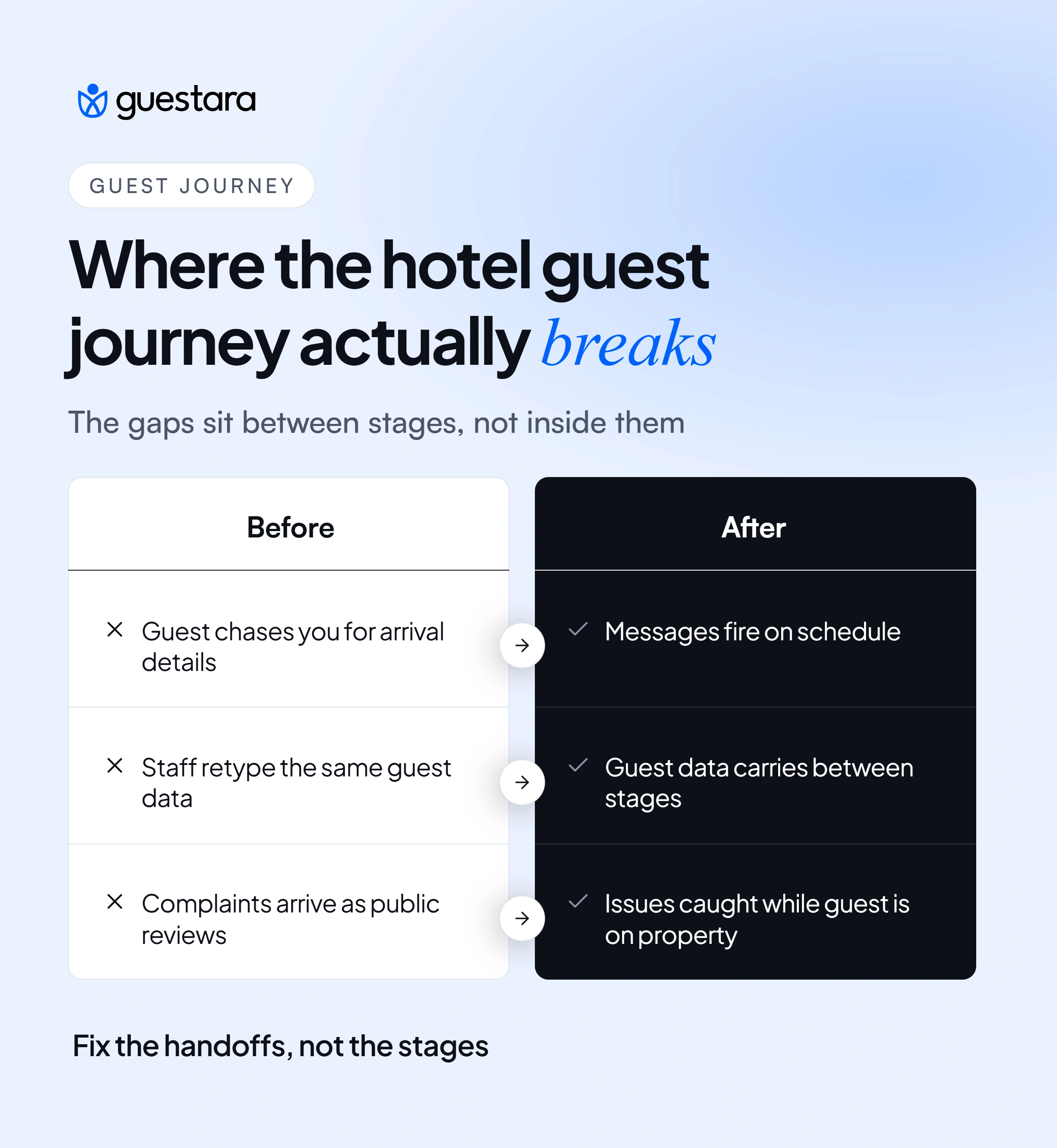
The hotel guest journey breaks at the handoffs between stages, not inside them. Most properties run each individual stage reasonably well. What fails is the moment one stage has to pass something to the next, which is why the full touchpoint inventory is often more useful than the stage list when you are hunting for the fault.
Five handoffs account for almost all of it.
Booking to pre-arrival breaks when the booking lands in a channel nobody monitors, so no pre-arrival sequence ever starts. Pre-arrival to check-in breaks when the guest never got a check-in link, so arrival day begins with a paper form. Check-in to in-stay breaks when the data captured at the desk never reaches the team serving the guest, so they get asked their name three more times.
In-stay to checkout breaks when open charges are scattered across a bar tab, a spa slip and a room service docket, so the guest leaves before anyone totals them. Checkout to post-stay breaks when the review request is sent manually by someone who was busy that afternoon, which is to say it is not sent. These are the same hidden gaps that quietly cost properties revenue, and most of them trace back to messages that fell between channels rather than to anyone doing their job badly.
Fix the handoff that touches the most guests with the least work. For most independent hotels that is booking to pre-arrival, because one trigger built against PMS booking data repairs the silence for every reservation you take from that day forward.
Fix checkout to post-stay second. It is the other fully automatable handoff, and it compounds, since the reviews you capture this month are what wins you bookings next quarter.
Fixing the handoffs is what produces results across stages rather than in one of them.
The returns arrive in a predictable order. In the first three months the gain is efficiency, as automated messaging and check-in absorb work the front desk was doing by hand. From month four the upsell revenue stacks on top of those savings. From month six the reputation effect shows up, as reviews and rankings climb and drive more direct bookings. Olive Hotels by Embassy reached a 6.1x annualized return on platform cost using Guestara.
Once you know which handoffs leak, put the repaired ones on autopilot with guest journey automation, and watch for the journey mistakes that kill revenue as you rebuild. Decide what good looks like using guest journey KPIs by stage, and if you want the AI layer across all seven stages, AI in the hotel guest journey covers it end to end.
[[cta:cta-7 | eyebrow=Hospitality AI | heading=Connect every guest journey stage in *one platform* | btn=Explore Hospitality AI | link=https://www.guestara.com/hospitality-ai ]]


The hotel guest journey stages are discovery, booking, pre-arrival, check-in, in-stay, checkout and post-stay. See what happens at each and what to fix first.
Your guest decided what kind of stay they were having long before they reached your front desk.
They read your reviews on a Tuesday night. They booked on an OTA on Thursday. They spent the next three weeks wondering what time they could drop their bags, whether parking was included, and whether anyone would answer if they asked. By the time they walk through your door, they have already been your guest for a month. You just have not been talking to them.
That gap is what the hotel guest journey describes. It is the full sequence of stages a guest moves through with your property, and most of it happens when nobody from your team is in the room.
The hotel guest journey is the complete sequence of interactions a guest has with your property, from the moment they first discover you to the moment they decide whether to book again. It covers seven stages and spans weeks or months, not just the nights the guest sleeps in your room.
Operators often use "guest journey" and "guest experience" to mean the same thing. The journey is the structure that repeats for every guest, while the experience is how any single moment inside it feels, and our guide to the difference between the guest journey and guest experience works through where that distinction changes your decisions.
For the full picture across personalization, automation and measurement, start with our complete guide to the hotel guest journey. If you want the wider view of what guests expect from a modern stay, that sits one level above the stages.
The seven hotel guest journey stages are discovery, booking, pre-arrival, check-in, in-stay, checkout and post-stay. Each one has a different guest intent and a different operational job, which is why treating them as one continuous blur costs hotels money.
Here is what the guest is doing at each stage and what your property has to get right.
The seven stages group into three phases. Discovery, booking and pre-arrival sit in pre-stay. Check-in, in-stay and checkout sit in in-stay. Post-stay stands alone.
Use the three-phase grouping when you talk to owners about strategy. Use the seven stages when you build the actual workflow, because each one needs its own trigger, its own owner and its own message. Once you know the stages, mapping them against your own property is the next exercise, and there are 13 practical ways to improve each stage once the map exists.
Many travel frameworks collapse the journey into five stages. That works for marketers describing traveller behaviour. It fails for operators.
Pre-arrival and checkout get folded away in the shorter models, and those are exactly the two stages where independent hotels leak the most revenue. Pre-arrival is where deposits, upgrades and check-in completion live. Checkout is where pending payments, late checkout sales and the review request live. Collapse them and you stop staffing them.
Discovery and booking are the first two stages, and almost all of the activity happens on channels you do not control. A guest finds you through an OTA listing, a search result or a recommendation, then validates that choice by reading what other guests said.
Reviews do most of the work at this stage. Research by Accor, surveying 5,000 travellers across five European countries in 2024, found that 97% consulted guest reviews when looking to book a hotel or resort stay, ranking reviews second only to rooms and amenities in the booking decision.
That matters operationally for a reason most hoteliers miss. Your discovery stage is powered entirely by your post-stay stage. The reviews that win you a booking in January were captured from guests who checked out in November. Stage one and stage seven are the same loop.
Discovery itself is shifting. Guests increasingly ask an AI assistant rather than scroll a results page, which changes how hotels get found and booked. The property that answers questions fastest wins the comparison, and an AI chatbot trained on your own property data answers them at 2am when your team is asleep.
Booking itself is the shortest stage in the journey and the one most hotels have already solved. The real question at booking is what data you capture. Every booking lands in your PMS with a name, a channel, an arrival date and a length of stay. That record is what every later stage runs on. If your booking data is thin or trapped in a channel manager nobody reads, stages three through seven have nothing to work with.
Pre-arrival is the window between booking confirmation and arrival day, and at most independent hotels it is completely silent. The guest gets an automated confirmation email and then hears nothing until they turn up.
That silence is expensive. Your guest spends those weeks with open questions. What time can I check in? Is there parking? Can I get a late checkout? Every one of those questions is a conversation you could have been having, and several of them are things you could have sold.
Pre-arrival is also where three operational jobs belong. You collect the deposit. You send the check-in link so arrival day is already handled. You put an upgrade or an add-on in front of a guest who is still in planning mode and happy to spend.
Guestara's Guest Journey module runs this stage automatically. Triggers fire off your PMS booking data across WhatsApp, email and SMS, so a confirmation goes out on booking, a check-in link goes out 24 hours before arrival, and an upsell offer lands at the point the guest is most likely to say yes. You build the sequence once and it runs for every booking after that.
Olive Hotels by Embassy saw a 248% lift in guest engagement using Guestara. That number is what filling an empty stage looks like. The guests were always there. Nobody was talking to them.
If you want to see how automated pre-arrival to post-stay messaging is structured, our guest engagement platform shows the trigger logic in detail. Pre-arrival is also the first point where personalizing by segment rather than blasting everyone starts paying, and it is where guest communication begins shaping the whole journey.
Check-in is the stage where your guest forms their first physical impression of your property, and it is the easiest one to lose. A guest who waited twenty minutes in a lobby after a six-hour journey has already started drafting the review.
The pressure here is structural, not a staff problem. The American Hotel and Lodging Association's Front Desk Feedback survey of 456 hoteliers in 2024 found that 76% of hotels were experiencing a staffing shortage, with 13% severely understaffed. Arrivals cluster. Your team does not.
Guests have also stopped expecting a desk to be involved. Oracle Hospitality's research with Skift, covering 5,266 consumers and 633 hotel executives in 2022, found that 73% were more likely to stay at a hotel offering self-service technology and the same share wanted to manage their stay from their phone.
Guestara's Digital Check-In closes the gap. The guest taps the link sent during pre-arrival, scans their ID, and the registration form fills itself from the ID data. The whole thing takes 30 seconds with no manual form filling. Guestara integrates with 50+ smart lock systems, so the digital room key is issued automatically the moment check-in completes and the guest walks straight to the room.
This stage also carries your compliance load. Guest registration, identity verification and the records your local authority expects all get created here. Doing it on paper means the data is unsearchable the moment the guest walks away. Olive Hotels by Embassy reached 99.8% verified guest profiles using Guestara, which is a compliance outcome and a data outcome at the same time.
Automating arrival does not mean removing people from it. Deciding which touchpoints stay human and which go digital is a judgement call every property makes differently, and check-in is where it bites hardest.
For guests who arrive without completing mobile check-in, Guestara's Tablet Registration runs the identical 30-second flow at the desk, so nobody ends up with a clipboard. See how the full arrival flow fits together on our contactless check-in and checkout page.
In-stay is the longest stage in the hotel guest journey and the only one where you can still fix a problem before it becomes a public review. Everything that goes wrong here is recoverable, as long as you hear about it.
Two things decide whether this stage works. Can the guest reach you easily, and does what they ask for get to the right team.
Guestara's Unified Inbox handles the first. Messages from OTAs, WhatsApp, Instagram, Facebook and email land in one window, so your team replies from a single place instead of discovering a Booking.com message three days late. If you are weighing whether a single inbox is worth consolidating into, the in-stay stage is where it earns its keep, and response time benchmarks show how fast is fast enough. Guestara's AI Chatbot absorbs the routine volume, answering WiFi passwords, pool hours and house rules around the clock, and escalating anything complex to a real person.
Guestara's Task Board handles the second. A room upgrade request routes to the front desk, a food order routes to F&B, a broken air conditioner routes to maintenance. The routing is automatic and every task carries an audit trail, which replaces the WhatsApp group where requests go to die.
In-stay is also where ancillary revenue lives. Guestara's Upsell module gives guests a branded mobile menu they order from directly, with payment taken at the point of order. Because it connects to the Guest Journey module, offers fire at the moments guests actually buy.
Timing is most of the skill here. These are the moments that convert.
Olive Hotels by Embassy generated $30.2 in added revenue per room per month using Guestara. Across a 60-room property that is real money arriving from a stage most hotels treat as passive. Guestara drives up to 200% more upsells, and none of it requires a staff member to make the ask. Our hotel upsell software page shows how the branded menu is built.
[[cta:cta-5 | eyebrow=Guest Journey | heading=Run every stage *automatically*, for every guest | btn=Explore Guest Engagement | link=https://www.guestara.com/guest-engagement-for-hospitality ]]
Checkout and post-stay are two separate stages, and hotels that treat them as one lose revenue at the first and reputation at the second.
Checkout is an operational stage with a deadline. The folio has to settle, pending charges have to be collected before the guest walks out, and housekeeping needs to know the room is free. That last point matters more than it sounds. The same AHLA survey found housekeeping was the hardest department to staff, ranked the top hiring need by 50% of hoteliers. Every minute between a guest leaving and housekeeping finding out is a minute of turnaround you cannot get back.
Guestara's Smart Checkout runs this from the guest's phone with no download. They settle pending payments, sign the folio digitally and can buy late checkout or extend the stay on the way out. Housekeeping is notified the moment checkout completes. See the full flow on our smart checkout page.
Post-stay is a different job entirely. This is where you ask for the review, and the ask has to happen while the stay is still fresh.
Guestara's Review Collection sends a review link over WhatsApp with a three-button response: Good, Average or Bad. Positive responses redirect to Google, TripAdvisor or your OTA. Negative responses go nowhere public and instead fire an instant alert to your team, often while the guest is still on property and the problem is still fixable.
AGC, a 52-room independent hotel in Aurangabad, captured 473 reviews across 3,584 checkouts using Guestara, a 13.2% capture rate. 351 of those became positive public reviews. The other 122 were guests who flagged a problem privately, and AGC's team was alerted in real time rather than reading about it on Google a week later. Guestara drives up to 300% more positive reviews.
This stage then feeds straight back into discovery. The Accor research found that 67% of travellers ignore reviews more than six months old, which means review capture is not a campaign you run once. It is a tap that has to stay open. Our review management page covers how the interception logic works, the inbox and review connection explains why response speed shows up in review scores, and a post-stay engagement strategy turns a departed guest into a repeat booker.
The hotel guest journey breaks at the handoffs between stages, not inside them. Most properties run each individual stage reasonably well. What fails is the moment one stage has to pass something to the next, which is why the full touchpoint inventory is often more useful than the stage list when you are hunting for the fault.
Five handoffs account for almost all of it.
Booking to pre-arrival breaks when the booking lands in a channel nobody monitors, so no pre-arrival sequence ever starts. Pre-arrival to check-in breaks when the guest never got a check-in link, so arrival day begins with a paper form. Check-in to in-stay breaks when the data captured at the desk never reaches the team serving the guest, so they get asked their name three more times.
In-stay to checkout breaks when open charges are scattered across a bar tab, a spa slip and a room service docket, so the guest leaves before anyone totals them. Checkout to post-stay breaks when the review request is sent manually by someone who was busy that afternoon, which is to say it is not sent. These are the same hidden gaps that quietly cost properties revenue, and most of them trace back to messages that fell between channels rather than to anyone doing their job badly.
Fix the handoff that touches the most guests with the least work. For most independent hotels that is booking to pre-arrival, because one trigger built against PMS booking data repairs the silence for every reservation you take from that day forward.
Fix checkout to post-stay second. It is the other fully automatable handoff, and it compounds, since the reviews you capture this month are what wins you bookings next quarter.
Fixing the handoffs is what produces results across stages rather than in one of them.
The returns arrive in a predictable order. In the first three months the gain is efficiency, as automated messaging and check-in absorb work the front desk was doing by hand. From month four the upsell revenue stacks on top of those savings. From month six the reputation effect shows up, as reviews and rankings climb and drive more direct bookings. Olive Hotels by Embassy reached a 6.1x annualized return on platform cost using Guestara.
Once you know which handoffs leak, put the repaired ones on autopilot with guest journey automation, and watch for the journey mistakes that kill revenue as you rebuild. Decide what good looks like using guest journey KPIs by stage, and if you want the AI layer across all seven stages, AI in the hotel guest journey covers it end to end.
[[cta:cta-7 | eyebrow=Hospitality AI | heading=Connect every guest journey stage in *one platform* | btn=Explore Hospitality AI | link=https://www.guestara.com/hospitality-ai ]]
The seven stages are discovery, booking, pre-arrival, check-in, in-stay, checkout and post-stay. Discovery and booking happen on OTAs, search and review sites before the guest has any direct contact with the property. Pre-arrival, check-in, in-stay and checkout cover the operational stay itself. Post-stay covers reviews, service recovery and the decision to rebook.
Pre-arrival is the stage most independent hotels neglect, because nothing inside the property forces it to happen. The guest receives an automated booking confirmation and then hears nothing until arrival day, which leaves the deposit uncollected, the registration form unfilled and the highest-converting upsell window unused. Olive Hotels by Embassy recorded a 248% lift in guest engagement using Guestara after activating that stage. Checkout is the second most neglected, since pending charges and the review request both depend on a busy person remembering to act.
Checkout and post-stay have the biggest impact, because that is when the review request is sent and when the guest's memory of the stay is sharpest. AGC, a 52-room independent hotel in Aurangabad, captured 473 reviews across 3,584 checkouts using Guestara, and 122 of those guests flagged a problem privately rather than posting it publicly. In-stay matters too, since it is the last stage at which a problem can still be fixed before the guest leaves.
Automate the stages that run on data you already have. Booking records in your PMS carry the arrival date, length of stay and channel, which is everything needed to trigger pre-arrival messages, check-in links, upsell offers and review requests without anyone sending them manually. Guestara onboards in approximately 1 week and integrates with major PMS systems including Cloudbeds, Hotelogix, Ezee Absolute, Apaleo, Beds24, SiteMinder, Little Hotelier and Oracle.
Yes, and the stages matter more there because no front desk exists to absorb gaps. Discovery and booking usually run through OTA listings, pre-arrival carries the rental agreement and access instructions, and check-in depends entirely on digital keys or codes rather than a person handing over a key. The seven stages are identical, but every one of them has to work unattended.
We work closely with the industry leaders to offer seamless solutions




We’re here to help your whole team stay ahead of the curve as you grow.

Get up and running quickly with a personalized onboarding plan

Connect with real people who really get it, 24/7

Checkout our vast library of free resources, templates and more
There's only so much we can say — so let us show you! Schedule a demo today and reach your business goals.