How fast should hotels respond to guest messages? Get channel-by-channel benchmarks, SLA frameworks, and practical fixes for slow response times that cost bookings.




A guest sends a WhatsApp message at 2pm asking about late checkout.
By 3pm, no reply. By evening, they have made other plans.
No complaint. No escalation. Just a slightly worse review.
A single unanswered message does not create a problem. It creates a quiet drop in guest satisfaction, review scores, and future bookings. And when this repeats across dozens of guests a month, the impact compounds in ways that are almost impossible to trace back to the cause.
Every delayed response is a guest choosing another hotel in real time.
Response time is not just a service metric. It is a revenue driver with measurable thresholds.
Most hotels have a rough sense that they should reply quickly. Very few have defined what quickly actually means, tracked whether they are hitting it, or understood what happens when they do not.
This guide sets out the benchmarks, explains the mechanisms behind each one, and gives you a practical hotel SLA response time framework you can implement with what you have today.
Before the full breakdown, here is the guest messaging response time benchmark every hotel team should have on the wall.
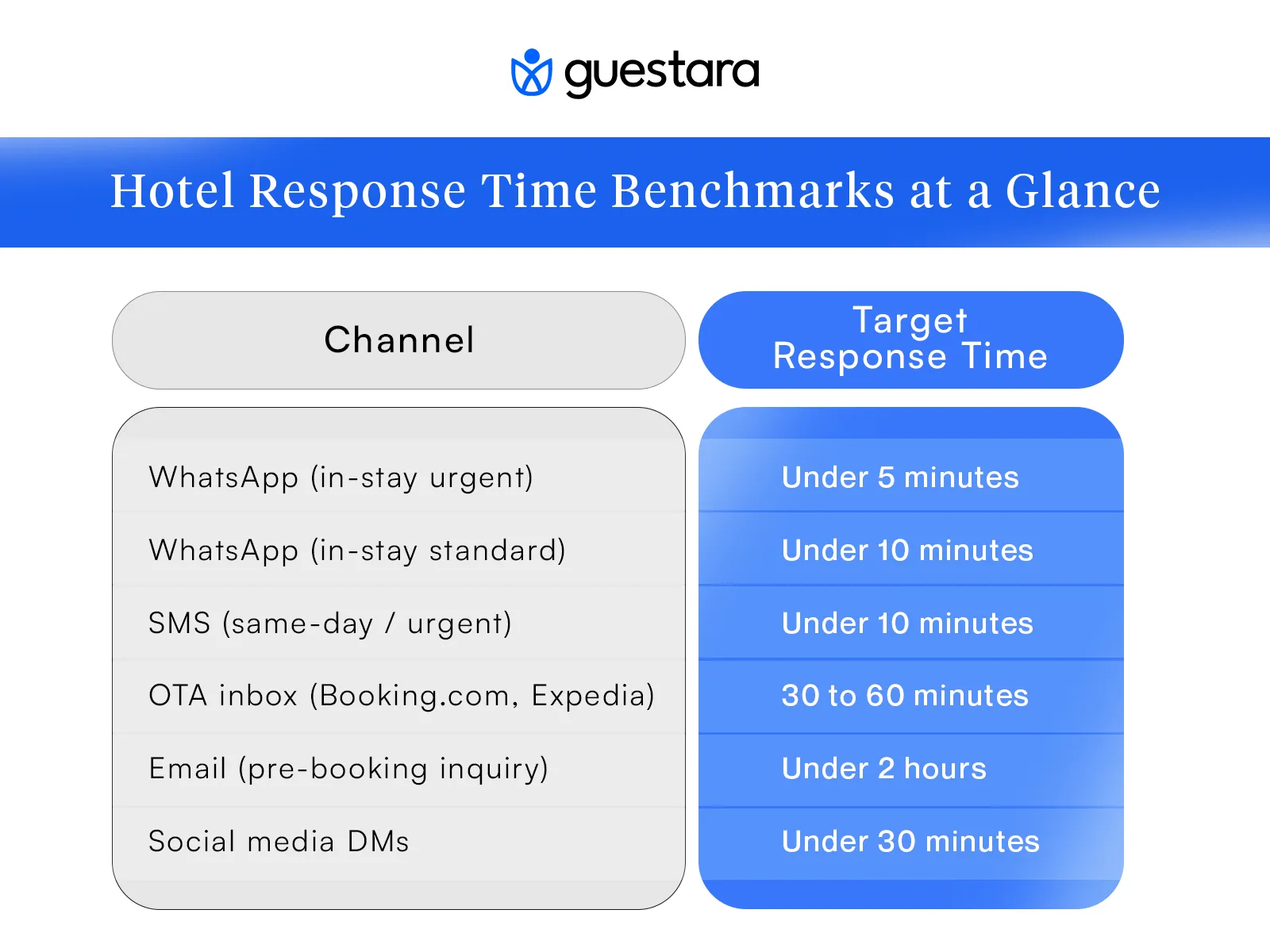
These are not aspirational targets. They are the thresholds where guest experience measurably changes.
The underlying logic is simple:
Response Time shapes Guest Perception which shapes Review Score which shapes Revenue
Break the chain at step one and you lose ground at every step that follows. Fix it at step one and the rest compounds in your favour.
Response time is not just a service quality metric. It is a revenue metric.
The connection runs through three mechanisms, each of which operates independently and compounds on the others.
A first response time exceeding 5 minutes reduces the likelihood of converting a pre-booking inquiry by 65%, according to data across customer service channels. In hospitality, where a guest asking about availability is often simultaneously checking three other properties, the hotel that replies first captures the booking. The one that replies 45 minutes later is responding to someone who has already made a decision.
A guest who sends a service request during their stay and waits 90 minutes for a response has had a fundamentally different experience than a guest whose request was acknowledged in 8 minutes. The problem itself, whether a noisy room or a broken light, is secondary to the signal sent by how fast the hotel noticed they had a need. Speed communicates attentiveness. Silence communicates indifference, even when the team is genuinely busy.
Hotels that respond faster to guest communication during the stay generate higher Global Review Index scores. According to Shiji's 2025 Guest Experience Benchmark, hotel response times improved by 50% over three years and that improvement correlates directly with rising guest satisfaction scores. The causal direction matters: faster responses drive higher satisfaction, which produces better reviews, which drives more bookings.
These three mechanisms mean that a hotel's average response time is not a single-department operational number. It is a figure that touches front desk efficiency, occupancy, review scores, and repeat booking rate simultaneously. The complete guide to the hotel guest journey maps these connection points across every stage of the stay, from the first pre-booking touchpoint through to post-stay follow-up.
The hospitality industry tends to talk about response time in terms of what hotels consider reasonable. The more useful frame is what guests have come to expect based on how every other service they use operates.
A guest who books a flight receives a confirmation in under 30 seconds. They order food via an app and get a real-time status update every two minutes. They message a friend on WhatsApp and receive a reply in minutes. By the time they message your hotel, they have been conditioned by every other digital interaction in their life to expect fast responses as the default.
This shapes expectation at each stage of the guest journey differently.
A guest asking about availability or room types is in active comparison mode. Research across customer service industries consistently shows that 65% of consumers will buy from the first business that responds. In hospitality, this window is short. A response within 5 minutes dramatically outperforms one at 30 minutes for pre-booking conversion. Beyond one hour, the inquiry is effectively cold.
Guests messaging in the week before arrival are generally not in a rush. They are planning. A response within 1 hour is acceptable for most pre-arrival messages. What matters more here is consistency: a guest who messages Monday morning and gets a reply Tuesday afternoon arrives with a slightly lower baseline of confidence in the hotel's attentiveness.
This is where response time expectations are tightest. Research from ALICE, based on a survey of over 400 frequent travelers, found that hotel guests feel they have a right to complain if staff do not respond to text requests within 12 minutes, emails within 26 minutes, and social media messages within 27 minutes. A guest on property who messages about a service need expects acknowledgment within 10 minutes and resolution within a reasonable timeframe after that. The acknowledgment matters as much as the resolution. A guest who receives "Got it, we'll have someone with you in 20 minutes" within 5 minutes of sending a message is far more satisfied than a guest who receives the same resolution 25 minutes later with no initial acknowledgment.
These are the most forgiving for response time. A guest who has already left is not in an urgent situation. Responding to a post-stay query within 2 hours is considered excellent. The more important metric at this stage is whether the response happens at all, not how fast it arrives.
Response time expectations vary significantly by channel. A guest sending a WhatsApp message expects something different than a guest who sent an email. Getting this wrong in either direction creates problems: too slow on WhatsApp feels like the hotel is ignoring them, too slow on email barely registers.
Here are the benchmarks that reflect both guest expectations and operational best practice.
Target: Under 5 minutes during operating hours, automated acknowledgment within 30 seconds after hours.
WhatsApp is a conversational channel. Guests who message on WhatsApp have the same psychological expectation as sending a message to a friend. They are not expecting to wait. A response time of 5 to 10 minutes is acceptable for most in-stay requests. Beyond 15 minutes, guests begin to experience the channel as slow. Beyond 30 minutes, the guest experience has already been affected.
For after-hours messages, an automated acknowledgment is essential. A guest who messages at 10pm and sees an instant reply confirming their message was received and will be responded to in the morning has a completely different experience than a guest who sees nothing until the next day.
Target: Under 10 minutes for same-day or urgent messages, under 1 hour for general inquiries.
SMS occupies a middle position between WhatsApp and email in terms of urgency expectations. Reporting on the same ALICE survey data, Skift noted that guests were willing to wait approximately 12 minutes for a text response, 19 minutes for a mobile app request, and 26 minutes for an email reply. Those numbers represent the outer patience threshold, not the ideal. The 10-minute target for SMS covers same-day arrival coordination, access code questions, and any time-sensitive request. For general SMS messages about non-urgent matters, within the hour is fine.
Target: Under 1 hour, ideally under 30 minutes.
OTA messaging comes with an additional operational dimension: Booking.com and Expedia both track your response rate and response time as ranking factors. A slow OTA response rate does not just affect the individual guest. It depresses your property's visibility in search results on that platform, which means fewer future bookings. The industry standard Booking.com holds properties to is a response rate above 90% within 24 hours, but the practical benchmark for competitive properties is 30 minutes to 1 hour during operating hours.
Target: Under 2 hours for pre-booking inquiries, under 4 hours for general correspondence.
Email is a lower-urgency channel by convention. Guests who send a hotel email are not expecting an instant reply. A pre-booking inquiry left for more than 2 hours during business hours risks losing the booking. General correspondence, including information requests and confirmations, should be addressed within 4 hours. Post-stay email follow-up is acceptable within 24 hours.
Target: Under 30 minutes for pre-booking discovery messages.
Social DMs arrive from guests who are in exploration mode. They have not yet committed to a stay and are often comparing options simultaneously. A reply within 30 minutes captures a high proportion of those conversations and can convert them toward a booking. A reply the next day is almost always too late. The social DM has served its purpose for the guest by then, even if they chose a different property.
The link between response time and review scores is direct, but it operates through guest psychology rather than a mechanical formula.
Here is how it works.
A guest who sent a request during their stay and received a fast, helpful response remembers the hotel as attentive. When they write their review, that memory shapes the overall impression they report. A guest who sent the same request and waited 90 minutes for an answer has a different memory. The request was eventually resolved, but the experience of waiting is what they carry out the door.
Review platforms are downstream of stay experience, and stay experience is shaped significantly by the quality of communication moments. The Shiji Guest Experience Benchmark data, drawn from over 39 million reviews across 11,200 properties, shows consistent correlation between properties improving their response behaviors and rising Global Review Index scores. Hotel response times dropping by 50% over three years coincided with guest satisfaction reaching its highest point in four years by Q1 2025.
The effect extends beyond in-stay speed. Hotels that actively respond to reviews on platforms like TripAdvisor see compounding benefits. Research cited by TourismTiger shows that hotels which start responding to reviews see an average increase of 0.12 stars in the ratings they subsequently receive, and that 57% of users say seeing management responses to reviews makes them more likely to book a property. Listings with at least half of their reviews responded to are 24% more likely to receive a booking inquiry. The speed of response during the stay and the consistency of engaging with reviews afterwards operate through the same underlying signal: this hotel pays attention.
The practical implication is that improving in-stay response time is one of the highest-leverage actions a hotel can take to improve review scores, because it affects every guest who sends a message during their stay and it does not require a physical renovation, a menu change, or a staffing increase. It requires a system. The role guest communication plays in shaping the entire guest journey explains why response speed sits at the center of experience design rather than at the edge of it.
Most hotel teams do not respond slowly because they do not care about guests. They respond slowly because the system makes it hard to respond quickly.
An analysis of hotel guest request response patterns published by eHotelier highlights how the operational structure of most hotels, with separate tools for each channel and no unified accountability, makes slow responses an almost inevitable outcome rather than a choice. Understanding the structural causes is important because solving each one requires a different action.
A WhatsApp message arrives. An OTA message arrives two minutes later. An email arrives shortly after. Each is in a different tool, checked at different intervals, by different people. The WhatsApp is handled quickly because the front desk agent happens to be on their phone. The OTA message sits until someone logs into the extranet. The email waits until someone opens their laptop.
This is not a staffing problem. It is a visibility problem. When all channels arrive in a single inbox, the team sees everything with the same priority and the same urgency. When channels are split, coverage is accidental. Slow response from split inboxes is one of the critical hotel guest journey mistakes that consistently shows up in review scores before anyone on the team connects the cause to the outcome.
During the morning shift, someone monitors the inbox. Between 1pm and 3pm, there is a handoff gap where two staff members each assume the other is watching. A message that arrives at 1:45pm may not be seen until 3:30pm. Nobody deliberately ignored it. It fell into an ownership gap.
This is solved with explicit shift coverage rules: one named person owns the inbox at every hour of operating hours. Not "whoever is available." One named person per shift.
A guest messages at 11pm. The front desk night audit is managing check-ins and cannot monitor the messaging inbox. The message sits until morning. The guest woke up at 3am wondering if their message was received.
An automated acknowledgment sent within 30 seconds of any after-hours message removes this problem completely. It costs nothing operationally and eliminates a significant source of guest frustration.
A maintenance request arrives in the general inbox. The team member handling messages is the junior staff member on the evening shift, who does not have the authority or the contact to escalate a plumbing issue. The message gets a polite holding reply. The maintenance team never sees it until the next morning.
An escalation rule that automatically routes maintenance-tagged messages to the duty manager solves this. The technology exists. The configuration takes minutes. Without it, urgent messages follow the same path as routine ones.
The team knows what to say to a guest asking about checkout time. But every time the message arrives, someone types out a response from scratch. This takes 2 to 3 minutes per message and introduces variability. With a template, the same message takes 15 seconds and is consistent.
The ten most common message types in any hotel can be templated within a few hours. Pre-arrival logistics, check-in instructions, checkout time, WiFi password, pool hours, parking instructions. These are not creative responses. They are information delivery. Templates serve that purpose and free the team's attention for messages that actually require judgment.
.webp)
An SLA is a service level agreement: a defined commitment about how fast a specific type of message will receive a response. Most hotels do not have one. Having one changes how a team operates because it turns response time from a vague aspiration into a measurable standard. As hospitality marketing research consistently shows, response time is directly tied to reputation, loyalty, and revenue in ways that most hotels only recognize after they start tracking it.
Here is a framework that works across property sizes.
Maintenance issues, safety concerns, room problems that affect the guest's ability to sleep or function. These should trigger an immediate routing rule that escalates to the duty manager and the relevant department simultaneously. Acknowledgment within 5 minutes is non-negotiable.
Extra towels, room service, noise complaints, temperature issues. These are handled by the messaging team on duty. Acknowledgment within 10 minutes, resolution updates as they occur.
Check-in questions, late arrival notices, room upgrade requests, special requests. These do not have the same urgency as in-stay messages, but prompt handling during the pre-arrival window has a meaningful impact on the guest's arrival experience.
These are high-value conversion moments. The team member monitoring pre-booking channels needs to respond within 15 minutes during operating hours. After hours, an automated reply that captures the inquiry and promises a morning response is acceptable.
These should arrive in the same unified view as other messages and receive the same priority. The OTA response rate tracking means that letting these slide has compounding consequences beyond the individual conversation.
Handled in batches if needed, but pre-booking email inquiries should be treated with the same urgency as social DMs. A booking inquiry left for 4 hours during operating hours risks losing the guest.
Understanding the benchmarks is not the same as hitting them. Here are the operational changes that make the difference.
This is the single highest-leverage change a hotel can make to improve response time. When WhatsApp, OTA messages, email, and SMS all arrive in the same view, the team sees everything. Nothing falls through a channel-specific gap. Research into how a unified inbox boosts hotel staff productivity and response times shows this is consistently the fastest and most measurable improvement available to hotel teams. Guestara's unified inbox connects all guest communication channels to one dashboard, linked to your PMS so every message carries booking context.
Write down who is responsible for the inbox during every hour of operating hours. Post it. Review it weekly for the first month. The habit takes time to form but the accountability is immediate.
An automated acknowledgment for after-hours messages takes 10 minutes to configure and eliminates a significant source of guest frustration permanently. FAQ auto-replies for WiFi, checkout time, pool hours, and parking take an afternoon to build and reduce inbound message volume by 30 to 50% within the first few weeks.
Identify the 10 most common messages your team receives. Write a clear, warm response to each one. Store them in your messaging platform as quick-reply templates. Your team will reach for them within days.
If you cannot see your average response time by channel, you cannot improve it. Any hotel guest communication platform worth using will surface this number. Review it in your weekly team briefing. When a channel slips, investigate why before the pattern becomes habitual.
Configure your messaging platform to flag any message that has not received a response within 10 minutes. The alert becomes the accountability mechanism that replaces the assumption that "someone is handling it."
The complete hotel guest communication and journey automation guide covers how response time fits into the broader communication system, from the first pre-arrival message through to post-stay follow-up.
Improving response time increases repeat bookings through a chain of effects that compounds over time.
Faster in-stay responses raise guest satisfaction. Higher satisfaction generates better reviews. Better reviews bring in more new bookings. And guests who experienced attentive communication are more likely to return and book direct.
The hotel guest journey KPIs that predict repeat bookings all trace back to the quality of communication during the stay. Response time is not a standalone metric. It is the leading indicator that shapes everything downstream.
Hotels that take response time seriously do not approach it as a hospitality nicety. They approach it as a revenue driver with measurable thresholds. The 5-minute window for conversion. The 10-minute acknowledgment for in-stay requests. The 30-minute OTA response that protects ranking. Each threshold is a point where the math changes. And when response time is consistently strong throughout the stay, it feeds directly into the post-stay engagement outcomes that turn one-time guests into repeat bookers.
Most hotels have the team capable of responding quickly. What they lack is the system that makes it possible.
Every channel split, every uncovered shift gap, every message that arrives in an inbox nobody is watching — these are not edge cases. They are the daily reality for most independent hotels. And every one of them is a guest who is choosing to book somewhere else, or a reviewer who remembers the wait more than the resolution.
When messages from WhatsApp, OTA inboxes, email, and SMS all arrive in one place, assigned to the right team member, with SLA timers running and alerts firing when something sits too long, the guest messaging response time problem largely solves itself.
Guestara is built for exactly this. One unified inbox, connected to your PMS, with routing rules and automation that give your team the visibility to respond to every guest quickly and consistently, without hiring anyone new.
See how Guestara brings response times under 10 minutes across every channel. Book a demo.


How fast should hotels respond to guest messages? Get channel-by-channel benchmarks, SLA frameworks, and practical fixes for slow response times that cost bookings.
A guest sends a WhatsApp message at 2pm asking about late checkout.
By 3pm, no reply. By evening, they have made other plans.
No complaint. No escalation. Just a slightly worse review.
A single unanswered message does not create a problem. It creates a quiet drop in guest satisfaction, review scores, and future bookings. And when this repeats across dozens of guests a month, the impact compounds in ways that are almost impossible to trace back to the cause.
Every delayed response is a guest choosing another hotel in real time.
Response time is not just a service metric. It is a revenue driver with measurable thresholds.
Most hotels have a rough sense that they should reply quickly. Very few have defined what quickly actually means, tracked whether they are hitting it, or understood what happens when they do not.
This guide sets out the benchmarks, explains the mechanisms behind each one, and gives you a practical hotel SLA response time framework you can implement with what you have today.
Before the full breakdown, here is the guest messaging response time benchmark every hotel team should have on the wall.
These are not aspirational targets. They are the thresholds where guest experience measurably changes.
The underlying logic is simple:
Response Time shapes Guest Perception which shapes Review Score which shapes Revenue
Break the chain at step one and you lose ground at every step that follows. Fix it at step one and the rest compounds in your favour.
Response time is not just a service quality metric. It is a revenue metric.
The connection runs through three mechanisms, each of which operates independently and compounds on the others.
A first response time exceeding 5 minutes reduces the likelihood of converting a pre-booking inquiry by 65%, according to data across customer service channels. In hospitality, where a guest asking about availability is often simultaneously checking three other properties, the hotel that replies first captures the booking. The one that replies 45 minutes later is responding to someone who has already made a decision.
A guest who sends a service request during their stay and waits 90 minutes for a response has had a fundamentally different experience than a guest whose request was acknowledged in 8 minutes. The problem itself, whether a noisy room or a broken light, is secondary to the signal sent by how fast the hotel noticed they had a need. Speed communicates attentiveness. Silence communicates indifference, even when the team is genuinely busy.
Hotels that respond faster to guest communication during the stay generate higher Global Review Index scores. According to Shiji's 2025 Guest Experience Benchmark, hotel response times improved by 50% over three years and that improvement correlates directly with rising guest satisfaction scores. The causal direction matters: faster responses drive higher satisfaction, which produces better reviews, which drives more bookings.
These three mechanisms mean that a hotel's average response time is not a single-department operational number. It is a figure that touches front desk efficiency, occupancy, review scores, and repeat booking rate simultaneously. The complete guide to the hotel guest journey maps these connection points across every stage of the stay, from the first pre-booking touchpoint through to post-stay follow-up.
The hospitality industry tends to talk about response time in terms of what hotels consider reasonable. The more useful frame is what guests have come to expect based on how every other service they use operates.
A guest who books a flight receives a confirmation in under 30 seconds. They order food via an app and get a real-time status update every two minutes. They message a friend on WhatsApp and receive a reply in minutes. By the time they message your hotel, they have been conditioned by every other digital interaction in their life to expect fast responses as the default.
This shapes expectation at each stage of the guest journey differently.
A guest asking about availability or room types is in active comparison mode. Research across customer service industries consistently shows that 65% of consumers will buy from the first business that responds. In hospitality, this window is short. A response within 5 minutes dramatically outperforms one at 30 minutes for pre-booking conversion. Beyond one hour, the inquiry is effectively cold.
Guests messaging in the week before arrival are generally not in a rush. They are planning. A response within 1 hour is acceptable for most pre-arrival messages. What matters more here is consistency: a guest who messages Monday morning and gets a reply Tuesday afternoon arrives with a slightly lower baseline of confidence in the hotel's attentiveness.
This is where response time expectations are tightest. Research from ALICE, based on a survey of over 400 frequent travelers, found that hotel guests feel they have a right to complain if staff do not respond to text requests within 12 minutes, emails within 26 minutes, and social media messages within 27 minutes. A guest on property who messages about a service need expects acknowledgment within 10 minutes and resolution within a reasonable timeframe after that. The acknowledgment matters as much as the resolution. A guest who receives "Got it, we'll have someone with you in 20 minutes" within 5 minutes of sending a message is far more satisfied than a guest who receives the same resolution 25 minutes later with no initial acknowledgment.
These are the most forgiving for response time. A guest who has already left is not in an urgent situation. Responding to a post-stay query within 2 hours is considered excellent. The more important metric at this stage is whether the response happens at all, not how fast it arrives.
Response time expectations vary significantly by channel. A guest sending a WhatsApp message expects something different than a guest who sent an email. Getting this wrong in either direction creates problems: too slow on WhatsApp feels like the hotel is ignoring them, too slow on email barely registers.
Here are the benchmarks that reflect both guest expectations and operational best practice.
Target: Under 5 minutes during operating hours, automated acknowledgment within 30 seconds after hours.
WhatsApp is a conversational channel. Guests who message on WhatsApp have the same psychological expectation as sending a message to a friend. They are not expecting to wait. A response time of 5 to 10 minutes is acceptable for most in-stay requests. Beyond 15 minutes, guests begin to experience the channel as slow. Beyond 30 minutes, the guest experience has already been affected.
For after-hours messages, an automated acknowledgment is essential. A guest who messages at 10pm and sees an instant reply confirming their message was received and will be responded to in the morning has a completely different experience than a guest who sees nothing until the next day.
Target: Under 10 minutes for same-day or urgent messages, under 1 hour for general inquiries.
SMS occupies a middle position between WhatsApp and email in terms of urgency expectations. Reporting on the same ALICE survey data, Skift noted that guests were willing to wait approximately 12 minutes for a text response, 19 minutes for a mobile app request, and 26 minutes for an email reply. Those numbers represent the outer patience threshold, not the ideal. The 10-minute target for SMS covers same-day arrival coordination, access code questions, and any time-sensitive request. For general SMS messages about non-urgent matters, within the hour is fine.
Target: Under 1 hour, ideally under 30 minutes.
OTA messaging comes with an additional operational dimension: Booking.com and Expedia both track your response rate and response time as ranking factors. A slow OTA response rate does not just affect the individual guest. It depresses your property's visibility in search results on that platform, which means fewer future bookings. The industry standard Booking.com holds properties to is a response rate above 90% within 24 hours, but the practical benchmark for competitive properties is 30 minutes to 1 hour during operating hours.
Target: Under 2 hours for pre-booking inquiries, under 4 hours for general correspondence.
Email is a lower-urgency channel by convention. Guests who send a hotel email are not expecting an instant reply. A pre-booking inquiry left for more than 2 hours during business hours risks losing the booking. General correspondence, including information requests and confirmations, should be addressed within 4 hours. Post-stay email follow-up is acceptable within 24 hours.
Target: Under 30 minutes for pre-booking discovery messages.
Social DMs arrive from guests who are in exploration mode. They have not yet committed to a stay and are often comparing options simultaneously. A reply within 30 minutes captures a high proportion of those conversations and can convert them toward a booking. A reply the next day is almost always too late. The social DM has served its purpose for the guest by then, even if they chose a different property.
The link between response time and review scores is direct, but it operates through guest psychology rather than a mechanical formula.
Here is how it works.
A guest who sent a request during their stay and received a fast, helpful response remembers the hotel as attentive. When they write their review, that memory shapes the overall impression they report. A guest who sent the same request and waited 90 minutes for an answer has a different memory. The request was eventually resolved, but the experience of waiting is what they carry out the door.
Review platforms are downstream of stay experience, and stay experience is shaped significantly by the quality of communication moments. The Shiji Guest Experience Benchmark data, drawn from over 39 million reviews across 11,200 properties, shows consistent correlation between properties improving their response behaviors and rising Global Review Index scores. Hotel response times dropping by 50% over three years coincided with guest satisfaction reaching its highest point in four years by Q1 2025.
The effect extends beyond in-stay speed. Hotels that actively respond to reviews on platforms like TripAdvisor see compounding benefits. Research cited by TourismTiger shows that hotels which start responding to reviews see an average increase of 0.12 stars in the ratings they subsequently receive, and that 57% of users say seeing management responses to reviews makes them more likely to book a property. Listings with at least half of their reviews responded to are 24% more likely to receive a booking inquiry. The speed of response during the stay and the consistency of engaging with reviews afterwards operate through the same underlying signal: this hotel pays attention.
The practical implication is that improving in-stay response time is one of the highest-leverage actions a hotel can take to improve review scores, because it affects every guest who sends a message during their stay and it does not require a physical renovation, a menu change, or a staffing increase. It requires a system. The role guest communication plays in shaping the entire guest journey explains why response speed sits at the center of experience design rather than at the edge of it.
Most hotel teams do not respond slowly because they do not care about guests. They respond slowly because the system makes it hard to respond quickly.
An analysis of hotel guest request response patterns published by eHotelier highlights how the operational structure of most hotels, with separate tools for each channel and no unified accountability, makes slow responses an almost inevitable outcome rather than a choice. Understanding the structural causes is important because solving each one requires a different action.
A WhatsApp message arrives. An OTA message arrives two minutes later. An email arrives shortly after. Each is in a different tool, checked at different intervals, by different people. The WhatsApp is handled quickly because the front desk agent happens to be on their phone. The OTA message sits until someone logs into the extranet. The email waits until someone opens their laptop.
This is not a staffing problem. It is a visibility problem. When all channels arrive in a single inbox, the team sees everything with the same priority and the same urgency. When channels are split, coverage is accidental. Slow response from split inboxes is one of the critical hotel guest journey mistakes that consistently shows up in review scores before anyone on the team connects the cause to the outcome.
During the morning shift, someone monitors the inbox. Between 1pm and 3pm, there is a handoff gap where two staff members each assume the other is watching. A message that arrives at 1:45pm may not be seen until 3:30pm. Nobody deliberately ignored it. It fell into an ownership gap.
This is solved with explicit shift coverage rules: one named person owns the inbox at every hour of operating hours. Not "whoever is available." One named person per shift.
A guest messages at 11pm. The front desk night audit is managing check-ins and cannot monitor the messaging inbox. The message sits until morning. The guest woke up at 3am wondering if their message was received.
An automated acknowledgment sent within 30 seconds of any after-hours message removes this problem completely. It costs nothing operationally and eliminates a significant source of guest frustration.
A maintenance request arrives in the general inbox. The team member handling messages is the junior staff member on the evening shift, who does not have the authority or the contact to escalate a plumbing issue. The message gets a polite holding reply. The maintenance team never sees it until the next morning.
An escalation rule that automatically routes maintenance-tagged messages to the duty manager solves this. The technology exists. The configuration takes minutes. Without it, urgent messages follow the same path as routine ones.
The team knows what to say to a guest asking about checkout time. But every time the message arrives, someone types out a response from scratch. This takes 2 to 3 minutes per message and introduces variability. With a template, the same message takes 15 seconds and is consistent.
The ten most common message types in any hotel can be templated within a few hours. Pre-arrival logistics, check-in instructions, checkout time, WiFi password, pool hours, parking instructions. These are not creative responses. They are information delivery. Templates serve that purpose and free the team's attention for messages that actually require judgment.
An SLA is a service level agreement: a defined commitment about how fast a specific type of message will receive a response. Most hotels do not have one. Having one changes how a team operates because it turns response time from a vague aspiration into a measurable standard. As hospitality marketing research consistently shows, response time is directly tied to reputation, loyalty, and revenue in ways that most hotels only recognize after they start tracking it.
Here is a framework that works across property sizes.
Maintenance issues, safety concerns, room problems that affect the guest's ability to sleep or function. These should trigger an immediate routing rule that escalates to the duty manager and the relevant department simultaneously. Acknowledgment within 5 minutes is non-negotiable.
Extra towels, room service, noise complaints, temperature issues. These are handled by the messaging team on duty. Acknowledgment within 10 minutes, resolution updates as they occur.
Check-in questions, late arrival notices, room upgrade requests, special requests. These do not have the same urgency as in-stay messages, but prompt handling during the pre-arrival window has a meaningful impact on the guest's arrival experience.
These are high-value conversion moments. The team member monitoring pre-booking channels needs to respond within 15 minutes during operating hours. After hours, an automated reply that captures the inquiry and promises a morning response is acceptable.
These should arrive in the same unified view as other messages and receive the same priority. The OTA response rate tracking means that letting these slide has compounding consequences beyond the individual conversation.
Handled in batches if needed, but pre-booking email inquiries should be treated with the same urgency as social DMs. A booking inquiry left for 4 hours during operating hours risks losing the guest.
Understanding the benchmarks is not the same as hitting them. Here are the operational changes that make the difference.
This is the single highest-leverage change a hotel can make to improve response time. When WhatsApp, OTA messages, email, and SMS all arrive in the same view, the team sees everything. Nothing falls through a channel-specific gap. Research into how a unified inbox boosts hotel staff productivity and response times shows this is consistently the fastest and most measurable improvement available to hotel teams. Guestara's unified inbox connects all guest communication channels to one dashboard, linked to your PMS so every message carries booking context.
Write down who is responsible for the inbox during every hour of operating hours. Post it. Review it weekly for the first month. The habit takes time to form but the accountability is immediate.
An automated acknowledgment for after-hours messages takes 10 minutes to configure and eliminates a significant source of guest frustration permanently. FAQ auto-replies for WiFi, checkout time, pool hours, and parking take an afternoon to build and reduce inbound message volume by 30 to 50% within the first few weeks.
Identify the 10 most common messages your team receives. Write a clear, warm response to each one. Store them in your messaging platform as quick-reply templates. Your team will reach for them within days.
If you cannot see your average response time by channel, you cannot improve it. Any hotel guest communication platform worth using will surface this number. Review it in your weekly team briefing. When a channel slips, investigate why before the pattern becomes habitual.
Configure your messaging platform to flag any message that has not received a response within 10 minutes. The alert becomes the accountability mechanism that replaces the assumption that "someone is handling it."
The complete hotel guest communication and journey automation guide covers how response time fits into the broader communication system, from the first pre-arrival message through to post-stay follow-up.
Improving response time increases repeat bookings through a chain of effects that compounds over time.
Faster in-stay responses raise guest satisfaction. Higher satisfaction generates better reviews. Better reviews bring in more new bookings. And guests who experienced attentive communication are more likely to return and book direct.
The hotel guest journey KPIs that predict repeat bookings all trace back to the quality of communication during the stay. Response time is not a standalone metric. It is the leading indicator that shapes everything downstream.
Hotels that take response time seriously do not approach it as a hospitality nicety. They approach it as a revenue driver with measurable thresholds. The 5-minute window for conversion. The 10-minute acknowledgment for in-stay requests. The 30-minute OTA response that protects ranking. Each threshold is a point where the math changes. And when response time is consistently strong throughout the stay, it feeds directly into the post-stay engagement outcomes that turn one-time guests into repeat bookers.
Most hotels have the team capable of responding quickly. What they lack is the system that makes it possible.
Every channel split, every uncovered shift gap, every message that arrives in an inbox nobody is watching — these are not edge cases. They are the daily reality for most independent hotels. And every one of them is a guest who is choosing to book somewhere else, or a reviewer who remembers the wait more than the resolution.
When messages from WhatsApp, OTA inboxes, email, and SMS all arrive in one place, assigned to the right team member, with SLA timers running and alerts firing when something sits too long, the guest messaging response time problem largely solves itself.
Guestara is built for exactly this. One unified inbox, connected to your PMS, with routing rules and automation that give your team the visibility to respond to every guest quickly and consistently, without hiring anyone new.
See how Guestara brings response times under 10 minutes across every channel. Book a demo.
A good hotel response time depends on the channel and context. For in-stay WhatsApp messages, under 10 minutes is the benchmark most guests expect and under 5 minutes is the target for urgent requests. For OTA messages, under 1 hour during operating hours protects both guest experience and platform ranking. For email pre-booking inquiries, under 2 hours during business hours is considered strong. For social media DMs from prospective guests, under 30 minutes captures most conversion opportunities. As a general hotel SLA response time rule: the more personal the channel and the more urgent the context, the faster the response needs to be. A guest messaging on WhatsApp about a problem they are experiencing right now should never wait more than 10 minutes for an acknowledgment. For in-stay requests on WhatsApp, the target is under 5 minutes for urgent issues and under 10 minutes for standard service requests. WhatsApp is a conversational channel with higher speed expectations than email or OTA messaging. Guests who message on WhatsApp expect a response similar to texting a person, not submitting a support ticket. After hours, an automated acknowledgment within 30 seconds of the message arriving removes the frustration of a guest not knowing whether their message was received.
For Booking.com and Expedia, the practical benchmark for competitive properties is under 30 minutes to 1 hour during operating hours. Both platforms track your response rate and response time as ranking factors. A property that consistently responds within 30 minutes will generally outperform one that averages 4 hours in OTA search visibility, all other things being equal. The minimum threshold Booking.com uses to avoid ranking penalties is a 90% response rate within 24 hours, but the competitive standard is significantly faster than that.
Yes, and the mechanism is direct. Guests who receive fast, helpful responses during their stay remember the hotel as attentive and write reviews that reflect that impression. Guests who experienced slow responses during the stay often reference communication or service responsiveness in their review comments, even when the underlying issue was resolved. Shiji's 2025 benchmark data, drawn from over 39 million reviews across 11,200 properties, shows that hotel response times improving by 50% over three years correlated with guest satisfaction reaching a four-year high. Improving response time is one of the highest-leverage actions available to raise review scores because it affects every guest who sends a message during their stay.
The most common causes are structural rather than attitudinal. Split inboxes across multiple channels mean messages are missed because nobody is monitoring all channels simultaneously. Unclear shift ownership means messages fall into handoff gaps between team members. No after-hours automation means evening and overnight messages go unanswered until morning. No escalation rules mean urgent messages wait in the same queue as routine ones. And the absence of response templates means even simple messages take longer than necessary to answer. Each of these is fixable with the right system and a defined operating model.
An SLA (service level agreement) for hotel guest messaging is a defined commitment about how fast specific types of messages will receive a response. A practical framework: urgent in-stay requests should be acknowledged within 5 minutes; standard in-stay requests within 10 minutes; pre-arrival messages within 30 minutes; pre-booking inquiries via social or chat within 15 minutes; OTA messages within 30 to 60 minutes; and email inquiries within 2 hours. These targets should be tracked weekly by channel and reviewed when any channel consistently falls below the standard.
We work closely with the industry leaders to offer seamless solutions




We’re here to help your whole team stay ahead of the curve as you grow.

Get up and running quickly with a personalized onboarding plan

Connect with real people who really get it, 24/7

Checkout our vast library of free resources, templates and more
There's only so much we can say — so let us show you! Schedule a demo today and reach your business goals.


.png)