Learn how to turn one-time guests into repeat bookers with post-stay messaging, review requests, feedback collection, and WhatsApp retargeting that actually works.




.webp)
Most hotels put all their energy into the stay itself.
The checkout happens, the guest walks out, and the relationship goes cold. No message. No follow-up. No reason to come back. That guest may have had a great time — but without the right nudge at the right moment, they will book somewhere else next time.
Post-stay engagement is where most hotels leave real money on the table.
.webp)
Post-stay guest engagement refers to all communication a hotel initiates with a guest after they check out — with the goal of collecting feedback, generating reviews, and driving repeat bookings.
It is not a single email. It is a structured sequence of touchpoints, each designed to do something specific at the right moment in the guest's post-checkout window.
A complete post-stay engagement program covers five areas:
Hotels that treat post-stay as a planned phase of the guest journey not an afterthought consistently outperform those that do not. Higher review volumes, stronger repeat rates, and more direct bookings are the measurable outcomes.
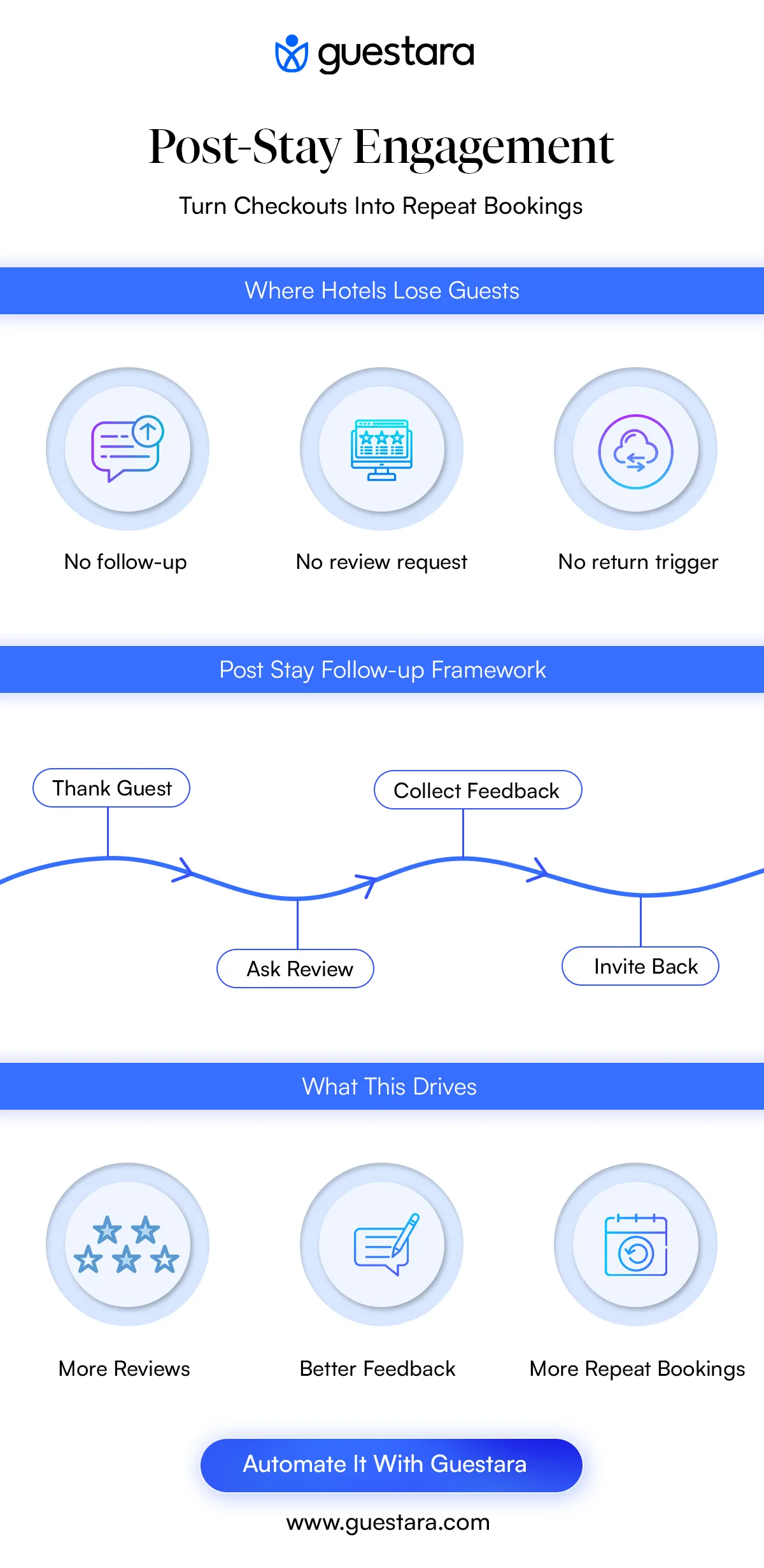
The 48-hour window after checkout is the highest-value moment in the entire post-stay phase — and most hotels waste it by doing nothing.
Here is why it matters: a guest's emotional memory of a stay is strongest immediately after they leave. Their opinion has not fully solidified. Their likelihood of writing a review is highest. And their instinct to book again — if prompted correctly — is at its peak.
After 48 hours, that window starts to close fast. The guest re-enters their daily routine. Other experiences compete for attention. What felt like a 9 out of 10 stay fades into a pleasant memory that never gets acted on.
The hotels that show up in this window — with a genuine thank-you, a well-timed review request, and a clear path to give feedback — convert that fleeting positive feeling into a review, a return visit, or both.
Those that go quiet lose the moment. The guest still had a great stay. They just have no reason to think about your property again.
That is the core case for taking post-stay engagement seriously. It is not about bombarding guests with messages. It is about showing up at the right time so the relationship continues.
Post-stay hotel guest communication only works when each message arrives at the right moment. Send something too early and the guest is still traveling. Send it too late and the stay feels distant. The sequence below is built on what consistently works across property types.
This message does one thing: makes the guest feel appreciated. Use their name. Keep it to two or three sentences. Do not attach any offer or ask. The sole purpose is to close the stay on a warm, human note before the memory fades.
This is the highest-conversion window for review requests. The guest is back home, settled, and the stay is still vivid. A single message with a direct link to Google or TripAdvisor is enough. No lengthy preamble. No pressure. Just a clear, easy ask from the channel they were already communicating on.
By day three, guests who had any friction during their stay are more willing to share it privately than they were immediately after checkout. A short, four-to-six-question survey captures honest operational data — the kind that helps you fix service gaps before they become public reviews.
At this point the guest is fully back in their normal routine. A direct booking offer, loyalty program invite, or seasonal rate for their next visit lands in a different emotional context than it would have at checkout. They are not in travel mode yet — but they are open to planning ahead.
One well-timed, relevant message at the 30-90 day mark keeps your property in consideration for the guest's next trip. This works best when it is tied to something specific — an upcoming season, an event in your destination, or an anniversary of their stay.
[Image suggestion: Timeline graphic showing all five touchpoints with timing labels and channel icons — WhatsApp, email, SMS]
A hotel post-stay thank-you message should sound like it came from a person, not a system.
The version most hotels send looks something like this:
"Dear Guest, thank you for choosing to stay with us. We hope to see you again soon."
That reads like a receipt, not a thank-you. It says nothing that makes the guest feel seen or remembered.
A message that works does three things: uses the guest's name, references something specific about their stay, and asks for nothing in return.
Here is what that looks like in practice:
"Hi Sarah, thank you for spending your anniversary weekend with us. It was wonderful having you both. We hope the dinner recommendation worked out — that place has been a guest favorite for years."
You do not need to write this manually for every guest. With the right hotel guest communication platform, automated messages can pull in booking data — guest name, occasion type, room category, length of stay — and produce a message that feels handwritten at scale.
A few rules worth keeping:
The best time to ask a hotel guest for a review is 20 to 28 hours after checkout.
At this point, the experience is still fresh but the guest has had time to travel home and settle. They are not rushing through an airport. They are not mid-checkout. They have a few minutes, and the stay is still top of mind.
Here is the formula that consistently generates responses:
An example message that works:
"Hi Marcus, we hope you had a safe trip home. If you have a couple of minutes, we would genuinely appreciate you sharing your experience on Google. Your feedback means a lot to us and to future guests. [Link]"
One thing worth understanding: the quality of your in-stay communication directly affects the reviews you collect post-stay. Research from HFTP shows that hotels miss up to 40% of phone calls — meaning a significant share of service issues never get resolved during the stay. Those unresolved problems surface in reviews, not in-person complaints.
If your review scores are lower than they should be, the fix often starts with better in-stay communication, not a better post-stay ask.
Post-checkout feedback collection serves a different purpose than a public review and it requires a different approach.
A review is public and reflects the guest's general impression. Post-stay feedback is private, specific, and most valuable when it captures experiences the guest would not have posted publicly. Guests are more candid in a private channel. That candor is your most useful operational data.
When to send it: Three days after checkout is the sweet spot. Early enough that the stay is still clear in their mind. Late enough that a guest who had a minor frustration has moved past the initial emotion and can give a more measured response.
How long it should be: Four to six questions maximum. Longer surveys get abandoned. Every question beyond six reduces completion rates significantly.
Questions worth asking:
What to do with responses: This is where most hotels fail. The survey gets completed, the data goes into a spreadsheet, and nothing changes. Feedback collection only earns its place in your workflow if responses are reviewed by someone with the authority to act on them.
Connect what you learn here to your hotel guest journey mapping process. If three guests in the same month flag slow room service response times, that is not three individual complaints. That is a staffing or communication pattern that needs fixing.
Private feedback that gets acted on also reduces public negative reviews. When a guest feels heard privately, they are far less likely to take the frustration to Google.
WhatsApp retargeting is one of the most direct and high-performing channels available to hotels for post-stay re-engagement and most properties are barely using it.
Here is why it works where email often does not: WhatsApp messages sent to opted-in contacts are read by over 90% of recipients. Email open rates in hospitality hover around 25-35%. The difference is not small it fundamentally changes the return on effort for every message you send.
The hospitality guest messaging platforms market was valued at USD 425 million in 2024 and is projected to reach USD 1,200 million by 2033, growing at 11.2% annually. A large portion of that growth is hotels recognizing WhatsApp as a revenue-generating channel, not just a service tool.
WhatsApp requires opt-in consent before you can message guests for marketing purposes. You need to use approved message templates for outbound campaigns. Breaking these rules can get your business account suspended.
Generic broadcast messages with no connection to the guest's actual stay. These get ignored and blocked. The moment WhatsApp starts feeling like a marketing blast, you have lost the channel's advantage.
The goal is to feel like a hotel that pays attention — not one that is managing a mass campaign.
Email retargeting works when it is relevant and segmented. It fails when it is generic.
The most common mistake hotels make with post-stay email is adding every checkout guest to one general marketing list and sending the same promotions to everyone. A couple who came for their honeymoon does not need your corporate midweek rate. A solo business traveler who stayed two nights does not need your family summer package.
Irrelevant emails get unsubscribed. Relevant ones get booked.
Then send content that matches. A domestic leisure guest who visited in winter is a strong target for a spring return offer in February. An international guest who stayed for a conference is worth reaching before the same event next year.
The role of guest communication in shaping the hotel guest journey does not end at checkout. Every email you send post-stay is either reinforcing the guest's positive experience or diluting it. Frequency without relevance does the latter.
The default move for most hotels trying to drive repeat bookings is a discount. 10% off your next stay. A free upgrade if you book direct. A loyalty points accelerator.
Discounts work, but they train guests to wait for an offer before booking. Over time, that erodes your rate integrity and your margins.
There are more effective ways to drive repeat bookings that do not require cutting rate.
A message that references something specific from a guest's previous stay creates emotional recall that a discount cannot replicate. "We still have that corner suite you loved last spring" is more compelling than "10% off your next stay" to the right guest.
A return offer sent 8-9 months after a guest's stay, timed to arrive just before they would need to plan a similar trip, converts better than the same offer sent immediately after checkout. The relevance of the timing does the work.
Rate parity means the price on your website often matches OTAs. But benefits do not have to. Early check-in, room preference guaranteed, welcome amenity these cost far less than a 10% discount and feel more personal.
"We are hosting a wine evening in October that we think you would love based on your last visit" is an invitation, not a sales pitch. It gives the guest a reason that is about them, not your occupancy targets.
For a full look at how journey design affects guest decisions to return, the guide on 13 ideas to improve your hotel guest journey covers the in-stay touchpoints that set up the post-stay phase for success.
Understanding what goes wrong is as useful as knowing what to do right. These are the patterns that consistently undercut post-stay results.
Sending a thank-you, review request, feedback survey, and return offer in a single email — or within 24 hours of each other — guarantees most of them go unread. Each message needs its own moment. Stack them and they compete with each other.
If your guest communicated with you on WhatsApp throughout their stay and you send your entire post-stay sequence by email, your open rate will reflect that mismatch. Use the channel where the guest was already active. The data from the stay tells you which one that is.
"Leave a review and receive a complimentary drink on your next visit" sounds like you are purchasing a positive review. It creates trust problems and violates review platform guidelines. Ask honestly or do not ask at all.
Most post-stay sequences end at day 7 or 10. The guest either converted or they did not, and the hotel moves on. But a guest who stayed in January and did not respond to a February return offer may be very receptive to an April message about summer availability. The relationship does not expire after the first follow-up cycle.
A guest completes your feedback survey and flags a specific problem. Six months later, the same problem is still happening, and you are still asking guests to fill out the same survey. If feedback data does not reach someone who can act on it, the survey becomes noise — and guests eventually stop filling it in.
For a broader look at where hotels lose guests before they even reach the post-stay phase, the guide on critical hotel guest journey mistakes covers the in-stay failures that make post-stay recovery much harder.
Post-stay automation means setting up your full follow-up sequence once — and having it run consistently for every guest, every checkout, without manual effort from your team.
Here is how a hotel typically sets this up:
Every message in the sequence is triggered by the checkout event in your PMS. The system registers checkout, and the sequence begins. Time delays — 2 hours, 24 hours, 72 hours, 7 days — are set per message.
Each template includes personalization tokens that pull from the booking record: guest name, stay dates, room type, stay occasion if captured. The message looks personal because the data behind it is specific to that guest.
If your hotel guest communication platform is connected to your PMS and messaging history, it can route each message through the channel the guest was most active on during their stay. WhatsApp for guests who messaged there. Email for guests who did not.
When a guest replies to any message in the sequence, the conversation should route to a team member — not continue as an automated exchange. Automation handles the outbound cadence. Humans handle the conversation that follows.
Survey responses should trigger a notification to the relevant department head when they fall below a threshold — not sit in a reporting dashboard that gets checked once a month.
Research on the digital guest journey shows that 73% of travelers prefer hotels that offer self-service technology and digital communication options throughout their stay. Guests who communicated digitally during the stay expect the same after checkout. Manual follow-up cannot match that expectation at scale.
This is where a platform like Guestara is built specifically for this workflow. Post-stay sequences run automatically from checkout trigger. WhatsApp, SMS, and email are managed from one unified inbox. Review collection and feedback flows are built into the same system — no separate tools to manage or sync.
Tracking the right metrics tells you what is working in your post-stay program and where it is breaking down. These are the numbers worth monitoring.
If your post-stay review request sequence is working, your review count on Google and TripAdvisor should increase within 30-60 days of launching the program. Track volume separately from rating — you want both to move.
A rising review count with a flat or declining average rating means guests are responding to the ask but the underlying experience has gaps. That is a signal to look at your in-stay feedback, not adjust your post-stay messaging.
Industry benchmark is 20-30% for post-stay surveys. Below 10% usually points to one of two problems: the survey is too long, or the send timing is off. Test shorter surveys and the 72-hour send window if you are below benchmark.
For opted-in contacts, a well-timed WhatsApp message should achieve 80%+ read rates. If yours is significantly below that, look at message frequency first, then content relevance.
Hospitality email benchmarks sit around 25-35% for post-stay sequences. Subject line quality and send timing are the two variables with the most impact.
This is the metric everything else feeds into. Track what percentage of guests who completed your post-stay sequence booked again within 12 months, compared to those who did not receive a structured follow-up. That delta is the business case for the entire program.
Understanding how the hotel guest journey works end to end puts these post-stay metrics in context. A low repeat booking rate despite strong review scores often points to something earlier in the journey — not a failure of the post-stay sequence itself.
Most hotel teams understand the value of post-stay engagement. The problem is not awareness — it is execution. When your front desk is managing arrivals, handling requests, and keeping operations running, post-stay follow-up gets deprioritized.
It happens inconsistently. Or not at all.
Guestara automates your full post-stay sequence — thank-you messages, review requests, feedback surveys, and return offers — across WhatsApp, SMS, and email. Triggers run from checkout. Personalization pulls from your booking data. Responses route to your team through a unified inbox.
Your staff focuses on conversations that need a human. The routine follow-up runs in the background.
Book a demo with the Guestara team to see how it works for a property like yours.


Learn how to turn one-time guests into repeat bookers with post-stay messaging, review requests, feedback collection, and WhatsApp retargeting that actually works.
Most hotels put all their energy into the stay itself.
The checkout happens, the guest walks out, and the relationship goes cold. No message. No follow-up. No reason to come back. That guest may have had a great time — but without the right nudge at the right moment, they will book somewhere else next time.
Post-stay engagement is where most hotels leave real money on the table.
Post-stay guest engagement refers to all communication a hotel initiates with a guest after they check out — with the goal of collecting feedback, generating reviews, and driving repeat bookings.
It is not a single email. It is a structured sequence of touchpoints, each designed to do something specific at the right moment in the guest's post-checkout window.
A complete post-stay engagement program covers five areas:
Hotels that treat post-stay as a planned phase of the guest journey not an afterthought consistently outperform those that do not. Higher review volumes, stronger repeat rates, and more direct bookings are the measurable outcomes.
The 48-hour window after checkout is the highest-value moment in the entire post-stay phase — and most hotels waste it by doing nothing.
Here is why it matters: a guest's emotional memory of a stay is strongest immediately after they leave. Their opinion has not fully solidified. Their likelihood of writing a review is highest. And their instinct to book again — if prompted correctly — is at its peak.
After 48 hours, that window starts to close fast. The guest re-enters their daily routine. Other experiences compete for attention. What felt like a 9 out of 10 stay fades into a pleasant memory that never gets acted on.
The hotels that show up in this window — with a genuine thank-you, a well-timed review request, and a clear path to give feedback — convert that fleeting positive feeling into a review, a return visit, or both.
Those that go quiet lose the moment. The guest still had a great stay. They just have no reason to think about your property again.
That is the core case for taking post-stay engagement seriously. It is not about bombarding guests with messages. It is about showing up at the right time so the relationship continues.
Post-stay hotel guest communication only works when each message arrives at the right moment. Send something too early and the guest is still traveling. Send it too late and the stay feels distant. The sequence below is built on what consistently works across property types.
This message does one thing: makes the guest feel appreciated. Use their name. Keep it to two or three sentences. Do not attach any offer or ask. The sole purpose is to close the stay on a warm, human note before the memory fades.
This is the highest-conversion window for review requests. The guest is back home, settled, and the stay is still vivid. A single message with a direct link to Google or TripAdvisor is enough. No lengthy preamble. No pressure. Just a clear, easy ask from the channel they were already communicating on.
By day three, guests who had any friction during their stay are more willing to share it privately than they were immediately after checkout. A short, four-to-six-question survey captures honest operational data — the kind that helps you fix service gaps before they become public reviews.
At this point the guest is fully back in their normal routine. A direct booking offer, loyalty program invite, or seasonal rate for their next visit lands in a different emotional context than it would have at checkout. They are not in travel mode yet — but they are open to planning ahead.
One well-timed, relevant message at the 30-90 day mark keeps your property in consideration for the guest's next trip. This works best when it is tied to something specific — an upcoming season, an event in your destination, or an anniversary of their stay.
[Image suggestion: Timeline graphic showing all five touchpoints with timing labels and channel icons — WhatsApp, email, SMS]
A hotel post-stay thank-you message should sound like it came from a person, not a system.
The version most hotels send looks something like this:
"Dear Guest, thank you for choosing to stay with us. We hope to see you again soon."
That reads like a receipt, not a thank-you. It says nothing that makes the guest feel seen or remembered.
A message that works does three things: uses the guest's name, references something specific about their stay, and asks for nothing in return.
Here is what that looks like in practice:
"Hi Sarah, thank you for spending your anniversary weekend with us. It was wonderful having you both. We hope the dinner recommendation worked out — that place has been a guest favorite for years."
You do not need to write this manually for every guest. With the right hotel guest communication platform, automated messages can pull in booking data — guest name, occasion type, room category, length of stay — and produce a message that feels handwritten at scale.
A few rules worth keeping:
The best time to ask a hotel guest for a review is 20 to 28 hours after checkout.
At this point, the experience is still fresh but the guest has had time to travel home and settle. They are not rushing through an airport. They are not mid-checkout. They have a few minutes, and the stay is still top of mind.
Here is the formula that consistently generates responses:
An example message that works:
"Hi Marcus, we hope you had a safe trip home. If you have a couple of minutes, we would genuinely appreciate you sharing your experience on Google. Your feedback means a lot to us and to future guests. [Link]"
One thing worth understanding: the quality of your in-stay communication directly affects the reviews you collect post-stay. Research from HFTP shows that hotels miss up to 40% of phone calls — meaning a significant share of service issues never get resolved during the stay. Those unresolved problems surface in reviews, not in-person complaints.
If your review scores are lower than they should be, the fix often starts with better in-stay communication, not a better post-stay ask.
Post-checkout feedback collection serves a different purpose than a public review and it requires a different approach.
A review is public and reflects the guest's general impression. Post-stay feedback is private, specific, and most valuable when it captures experiences the guest would not have posted publicly. Guests are more candid in a private channel. That candor is your most useful operational data.
When to send it: Three days after checkout is the sweet spot. Early enough that the stay is still clear in their mind. Late enough that a guest who had a minor frustration has moved past the initial emotion and can give a more measured response.
How long it should be: Four to six questions maximum. Longer surveys get abandoned. Every question beyond six reduces completion rates significantly.
Questions worth asking:
What to do with responses: This is where most hotels fail. The survey gets completed, the data goes into a spreadsheet, and nothing changes. Feedback collection only earns its place in your workflow if responses are reviewed by someone with the authority to act on them.
Connect what you learn here to your hotel guest journey mapping process. If three guests in the same month flag slow room service response times, that is not three individual complaints. That is a staffing or communication pattern that needs fixing.
Private feedback that gets acted on also reduces public negative reviews. When a guest feels heard privately, they are far less likely to take the frustration to Google.
WhatsApp retargeting is one of the most direct and high-performing channels available to hotels for post-stay re-engagement and most properties are barely using it.
Here is why it works where email often does not: WhatsApp messages sent to opted-in contacts are read by over 90% of recipients. Email open rates in hospitality hover around 25-35%. The difference is not small it fundamentally changes the return on effort for every message you send.
The hospitality guest messaging platforms market was valued at USD 425 million in 2024 and is projected to reach USD 1,200 million by 2033, growing at 11.2% annually. A large portion of that growth is hotels recognizing WhatsApp as a revenue-generating channel, not just a service tool.
WhatsApp requires opt-in consent before you can message guests for marketing purposes. You need to use approved message templates for outbound campaigns. Breaking these rules can get your business account suspended.
Generic broadcast messages with no connection to the guest's actual stay. These get ignored and blocked. The moment WhatsApp starts feeling like a marketing blast, you have lost the channel's advantage.
The goal is to feel like a hotel that pays attention — not one that is managing a mass campaign.
Email retargeting works when it is relevant and segmented. It fails when it is generic.
The most common mistake hotels make with post-stay email is adding every checkout guest to one general marketing list and sending the same promotions to everyone. A couple who came for their honeymoon does not need your corporate midweek rate. A solo business traveler who stayed two nights does not need your family summer package.
Irrelevant emails get unsubscribed. Relevant ones get booked.
Then send content that matches. A domestic leisure guest who visited in winter is a strong target for a spring return offer in February. An international guest who stayed for a conference is worth reaching before the same event next year.
The role of guest communication in shaping the hotel guest journey does not end at checkout. Every email you send post-stay is either reinforcing the guest's positive experience or diluting it. Frequency without relevance does the latter.
The default move for most hotels trying to drive repeat bookings is a discount. 10% off your next stay. A free upgrade if you book direct. A loyalty points accelerator.
Discounts work, but they train guests to wait for an offer before booking. Over time, that erodes your rate integrity and your margins.
There are more effective ways to drive repeat bookings that do not require cutting rate.
A message that references something specific from a guest's previous stay creates emotional recall that a discount cannot replicate. "We still have that corner suite you loved last spring" is more compelling than "10% off your next stay" to the right guest.
A return offer sent 8-9 months after a guest's stay, timed to arrive just before they would need to plan a similar trip, converts better than the same offer sent immediately after checkout. The relevance of the timing does the work.
Rate parity means the price on your website often matches OTAs. But benefits do not have to. Early check-in, room preference guaranteed, welcome amenity these cost far less than a 10% discount and feel more personal.
"We are hosting a wine evening in October that we think you would love based on your last visit" is an invitation, not a sales pitch. It gives the guest a reason that is about them, not your occupancy targets.
For a full look at how journey design affects guest decisions to return, the guide on 13 ideas to improve your hotel guest journey covers the in-stay touchpoints that set up the post-stay phase for success.
Understanding what goes wrong is as useful as knowing what to do right. These are the patterns that consistently undercut post-stay results.
Sending a thank-you, review request, feedback survey, and return offer in a single email — or within 24 hours of each other — guarantees most of them go unread. Each message needs its own moment. Stack them and they compete with each other.
If your guest communicated with you on WhatsApp throughout their stay and you send your entire post-stay sequence by email, your open rate will reflect that mismatch. Use the channel where the guest was already active. The data from the stay tells you which one that is.
"Leave a review and receive a complimentary drink on your next visit" sounds like you are purchasing a positive review. It creates trust problems and violates review platform guidelines. Ask honestly or do not ask at all.
Most post-stay sequences end at day 7 or 10. The guest either converted or they did not, and the hotel moves on. But a guest who stayed in January and did not respond to a February return offer may be very receptive to an April message about summer availability. The relationship does not expire after the first follow-up cycle.
A guest completes your feedback survey and flags a specific problem. Six months later, the same problem is still happening, and you are still asking guests to fill out the same survey. If feedback data does not reach someone who can act on it, the survey becomes noise — and guests eventually stop filling it in.
For a broader look at where hotels lose guests before they even reach the post-stay phase, the guide on critical hotel guest journey mistakes covers the in-stay failures that make post-stay recovery much harder.
Post-stay automation means setting up your full follow-up sequence once — and having it run consistently for every guest, every checkout, without manual effort from your team.
Here is how a hotel typically sets this up:
Every message in the sequence is triggered by the checkout event in your PMS. The system registers checkout, and the sequence begins. Time delays — 2 hours, 24 hours, 72 hours, 7 days — are set per message.
Each template includes personalization tokens that pull from the booking record: guest name, stay dates, room type, stay occasion if captured. The message looks personal because the data behind it is specific to that guest.
If your hotel guest communication platform is connected to your PMS and messaging history, it can route each message through the channel the guest was most active on during their stay. WhatsApp for guests who messaged there. Email for guests who did not.
When a guest replies to any message in the sequence, the conversation should route to a team member — not continue as an automated exchange. Automation handles the outbound cadence. Humans handle the conversation that follows.
Survey responses should trigger a notification to the relevant department head when they fall below a threshold — not sit in a reporting dashboard that gets checked once a month.
Research on the digital guest journey shows that 73% of travelers prefer hotels that offer self-service technology and digital communication options throughout their stay. Guests who communicated digitally during the stay expect the same after checkout. Manual follow-up cannot match that expectation at scale.
This is where a platform like Guestara is built specifically for this workflow. Post-stay sequences run automatically from checkout trigger. WhatsApp, SMS, and email are managed from one unified inbox. Review collection and feedback flows are built into the same system — no separate tools to manage or sync.
Tracking the right metrics tells you what is working in your post-stay program and where it is breaking down. These are the numbers worth monitoring.
If your post-stay review request sequence is working, your review count on Google and TripAdvisor should increase within 30-60 days of launching the program. Track volume separately from rating — you want both to move.
A rising review count with a flat or declining average rating means guests are responding to the ask but the underlying experience has gaps. That is a signal to look at your in-stay feedback, not adjust your post-stay messaging.
Industry benchmark is 20-30% for post-stay surveys. Below 10% usually points to one of two problems: the survey is too long, or the send timing is off. Test shorter surveys and the 72-hour send window if you are below benchmark.
For opted-in contacts, a well-timed WhatsApp message should achieve 80%+ read rates. If yours is significantly below that, look at message frequency first, then content relevance.
Hospitality email benchmarks sit around 25-35% for post-stay sequences. Subject line quality and send timing are the two variables with the most impact.
This is the metric everything else feeds into. Track what percentage of guests who completed your post-stay sequence booked again within 12 months, compared to those who did not receive a structured follow-up. That delta is the business case for the entire program.
Understanding how the hotel guest journey works end to end puts these post-stay metrics in context. A low repeat booking rate despite strong review scores often points to something earlier in the journey — not a failure of the post-stay sequence itself.
Most hotel teams understand the value of post-stay engagement. The problem is not awareness — it is execution. When your front desk is managing arrivals, handling requests, and keeping operations running, post-stay follow-up gets deprioritized.
It happens inconsistently. Or not at all.
Guestara automates your full post-stay sequence — thank-you messages, review requests, feedback surveys, and return offers — across WhatsApp, SMS, and email. Triggers run from checkout. Personalization pulls from your booking data. Responses route to your team through a unified inbox.
Your staff focuses on conversations that need a human. The routine follow-up runs in the background.
Book a demo with the Guestara team to see how it works for a property like yours.
Post-stay guest engagement is the process of communicating with guests after they check out to collect feedback, generate reviews, and encourage repeat bookings. It typically includes a thank-you message sent within 2 hours of checkout, a review request at the 24-hour mark, a private feedback survey at 72 hours, and a return incentive at 7-10 days. Hotels that run a structured post-stay engagement program consistently see higher review volumes, better ratings, and stronger repeat booking rates than those that rely on guests to initiate contact after leaving.
The best window is 20-28 hours after checkout. At this point the stay is still vivid, the guest has had time to travel home and settle, and they are not yet in the habit of thinking about something else. Sending earlier — within hours of checkout — often catches guests mid-travel when they have no time or inclination to write. Sending later than 48 hours means the emotional warmth of the stay has faded, which produces shorter, less detailed, and sometimes lower-rated reviews.
Use the channel your guest was most active on during their stay. If they responded quickly on WhatsApp throughout their visit, continue on WhatsApp post-checkout — read rates for opted-in WhatsApp contacts exceed 90%. If a guest only communicated via email, keep the post-stay sequence in email. Switching channels after checkout creates friction and reduces engagement. Your hotel guest communication platform should track which channel each guest used and route accordingly.
The most effective approach is timing and personalization rather than price. A return offer that references the guest's specific previous stay — their room type, occasion, or travel season — converts significantly better than a flat percentage discount. Timing matters equally: a message sent 8-9 months after a guest's stay, arriving just as they would be planning a similar trip, outperforms the same offer sent at the 7-day mark. Direct booking benefits like guaranteed room preference or early check-in also drive returns without cutting rate.
Four to five messages over a 10-day period is the effective range for the initial post-stay sequence. Beyond five messages in 10 days, you risk fatigue and unsubscribes. The sequence should be: thank-you at 2 hours, review request at 24 hours, feedback survey at 72 hours, and return offer at 7-10 days. After the initial sequence, drop to once per month for engaged guests and once per quarter for those who have not opened or responded. Long-term retargeting at 30, 60, and 90 days is appropriate for guests who opted into WhatsApp communication.
We work closely with the industry leaders to offer seamless solutions




We’re here to help your whole team stay ahead of the curve as you grow.

Get up and running quickly with a personalized onboarding plan

Connect with real people who really get it, 24/7

Checkout our vast library of free resources, templates and more
There's only so much we can say — so let us show you! Schedule a demo today and reach your business goals.


.png)