In This Article:
Subscribe to our newsletter
Read about our privacy policy.
Thank you! Your submission has been received!
Oops! Something went wrong while submitting the form.
Hotel Operations

Hotel Workforce Management: Staffing and Labor Costs

A practical guide to hotel workforce management: core components, the labor KPIs and formulas that matter, and how to optimize staffing without cutting service.


Published on:
12/10/2026
Summarise with:
Hotel Workforce Management: Staffing and Labor Costs Complete Guide by Guestara
TL;DR — Key Takeaways
  • Hotel workforce management is the planning, scheduling, and tracking of staff to control labor cost while protecting service.
  • Its core components are labor forecasting, scheduling, time and compliance tracking, payroll integration, and reporting.
  • The key metrics are labor cost as a percentage of revenue, labor cost per occupied room, staff-to-room ratio, overtime percentage, and turnover.
  • The goal is to match staffing to real demand, so you avoid both overstaffing on slow days and overtime on busy ones.
  • Labor is a hotel's largest controllable cost, and in India it is complicated by roughly 30% attrition and thin staff-to-room ratios.

Hotel workforce management is how you plan, schedule, and track your staff so the right people are working at the right time, at a labor cost your revenue can support.

Labor is the largest controllable line on most hotel P&Ls, and getting it wrong is expensive in both directions. Overstaff a slow Tuesday and you burn margin. Understaff a busy check-in window and you burn guests. This guide covers the components, the metrics that matter, how to optimize without hurting service, and what changes in the Indian and Gulf markets.

What Is Hotel Workforce Management?

Hotel workforce management is the planning, scheduling, and tracking of hotel staff to control labor cost while maintaining service standards. It matches the number and skills of people working to the demand at any given hour, day, or season.

It covers five things: forecasting how much labor you will need, scheduling people to shifts, tracking time and compliance, feeding that into payroll, and reporting on the result. Done well, it keeps payroll in step with revenue and keeps your team from burning out.

It matters because labor is usually a hotel's single largest controllable expense. A few points of labor cost saved, or a few overtime hours avoided, flow straight to the bottom line.

Key takeaways

  • Hotel workforce management plans, schedules, and tracks staff to control labor cost while protecting service.
  • Labor is usually a hotel's largest controllable cost, so small efficiencies move the bottom line directly.

Why Is Workforce Management So Hard in Hotels?

Workforce management is hard in hotels because demand never sits still and the property never closes. A hotel runs 24/7, occupancy swings daily and seasonally, and every department peaks at a different time.

Three forces make it harder right now:

  • A labor shortage. In the US, 77% of hotels reported staffing shortages in 2024, with housekeeping the hardest role to fill (AHLA), and wages have climbed as a result.
  • High attrition. Turnover is costly, and in India hospitality attrition runs around 30%, so teams are constantly rebuilding.
  • Rising guest expectations. Guests want fast, personal service even as teams run leaner.

The result is a constant balancing act between cost, coverage, and morale.

Key takeaways

  • Hotels are hard to staff because they run 24/7 with demand that swings by hour, day, and season.
  • A labor shortage, high attrition, and rising guest expectations force teams to do more with less.
Guestara infographic explaining five key hotel labor KPIs: labor cost percentage, labor cost per occupied room, staff-to-room ratio, overtime percentage, and turnover rate, with formulas and a focus on efficient staffing without hurting service.

The Core Components of Workforce Management

Workforce management has five core components. Weakness in any one ripples into the others.

Component What it does
Labor forecasting Predicts staffing needs from occupancy, events, and historical demand
Scheduling Matches staff availability and skills to forecasted shifts
Time and compliance Tracks hours, breaks, and overtime against labor law
Payroll integration Feeds time data into payroll to cut manual entry and errors
Reporting Shows labor cost, productivity, and overtime in real time

Dedicated scheduling and payroll platforms handle these, and this is the category properly called workforce management software. It is separate from guest-experience tools, though the two connect: the less manual guest work your team carries, the fewer hours you have to schedule.

Key takeaways

  • The five components are forecasting, scheduling, time and compliance, payroll integration, and reporting.
  • Workforce management software handles these, separate from but connected to guest-experience tools.

Key Labor KPIs and How to Calculate Them

You cannot manage labor you do not measure. These are the core hotel labor KPIs and how to calculate each.

KPI How to calculate it What it tells you
Labor cost percentage Labor cost / total revenue Whether payroll is in step with revenue
Labor cost per occupied room Labor cost / rooms sold Labor efficiency per room
Staff-to-room ratio Number of staff / number of rooms How lean or service-heavy your staffing is
Overtime percentage Overtime hours / total hours Whether scheduling is failing
Turnover rate Departures / average headcount How stable your team is

Staff-to-room ratios vary widely by class. Budget and economy hotels often run 0.2 to 0.4 staff per room, midscale around 0.5 to 1, and full-service or luxury 1.5 to 3 or more, since they operate restaurants, spas, and concierge desks. Track your own ratio against similar properties, not a universal number.

A simple rule: keep labor cost as a percentage of revenue stable or falling as occupancy grows. If it rises while occupancy is flat, something in scheduling or productivity has slipped.

Key takeaways

  • The core labor KPIs are labor cost percentage, cost per occupied room, staff-to-room ratio, overtime percentage, and turnover.
  • Staff-to-room ratios range from about 0.2 to 0.4 in economy hotels to 1.5 to 3 or more in luxury, so benchmark against similar properties.

How Do You Optimize Labor Without Hurting Service?

Guestara infographic outlining five key areas of hotel workforce management: forecasting staffing needs, scheduling employees, tracking time, connecting payroll, and reporting labor costs and productivity.

You optimize labor by matching staffing to real demand and removing the work that does not need a person, not by simply cutting shifts. The most efficient hotels use technology for the transactional so their people handle the exceptional.

Practical moves:

  • Forecast and schedule to demand. Build schedules from occupancy and arrival data, and staff the front desk to check-in peaks rather than a flat line.
  • Cross-train. Staff who cover two roles let you flex coverage during a rush without adding headcount.
  • Automate scheduling. A digital scheduling tool flags overtime and compliance risks that a spreadsheet misses.
  • Reduce the workload itself. This is the lever most hotels underuse: move routine guest tasks off your team.

That last lever is where guest-experience automation helps. Guestara is not a scheduling tool, but it cuts the workload a lean team carries. Contactless check-in and a self-service kiosk shrink front desk queues, an AI chatbot answers routine questions 24/7, and a unified inbox handles messages across channels without extra staff. With the labor shortage pushing wages up, doing more with less is no longer optional, and Hilton's 2026 trends found 73% of travelers are more likely to choose a hotel that offers self-service technology, so guests welcome it too. See the self-check-in guide for how the arrival flow works.

Key takeaways

  • Optimize labor by scheduling to real demand, cross-training, and removing work that does not need a person.
  • Guest-experience automation reduces the workload a lean team carries, which is the lever most hotels underuse.

How Do You Improve Staff Retention?

You improve retention by giving staff predictable schedules, fair workloads, recognition, and a path to grow, because most hotel staff leave over how they are managed, not only pay. Turnover is expensive, since every departure means recruiting and retraining.

What works:

  • Publish schedules early. Last-minute changes are a top driver of burnout and exits.
  • Balance workloads. Spread weekend, holiday, and heavy shifts evenly across the team.
  • Recognize good work. Regular appreciation and fair tip distribution lift morale.
  • Offer a path. Cross-training and upskilling give people a reason to stay. In one Indian industry survey, 81% of hospitality workers said they would stay longer if offered relevant upskilling.

Retention is a labor-cost strategy, not just an HR one. A stable team is cheaper to run and delivers more consistent service.

Key takeaways

  • Predictable schedules, fair workloads, recognition, and a growth path keep hotel staff longer than pay alone.
  • Retention is a cost strategy, since every departure adds recruiting and retraining expense.

What Is Different About Workforce Management in India and the GCC?

Workforce management in India and the Gulf carries extra pressure: leaner staffing, higher attrition, and a skilled-labor shortage. The playbook is the same, but the constraints are tighter.

  • Thin staffing ratios. Indian mid-tier hotels report staff-to-room ratios as low as 0.45, well below global norms, so every absence hits harder.
  • High attrition and a skills gap. Hospitality attrition runs near 30%, and demand for trained front-office, housekeeping, and F&B staff outpaces supply.
  • A shifting labor market. In the GCC, hospitality employment fell more than 18% after the pandemic, tightening supply further.

Two moves matter most here. Invest in retention and upskilling to fight attrition, and lean harder on automation, since a smaller team cannot absorb the manual load that a US full-service hotel can. WhatsApp-based guest messaging in particular removes a large volume of routine queries from the front desk.

Key takeaways

  • Indian and Gulf hotels run leaner staffing, near 30% attrition, and a skilled-labor shortage, so constraints are tighter.
  • Retention, upskilling, and automation matter more where teams are smaller and harder to rebuild.

[[cta:cta-5 | eyebrow=HOTEL AUTOMATION | heading= Do more with a leaner team, not a longer schedule. | btn=Explore Hospitality AI | link=https://www.guestara.com/hospitality-ai ]]

Pratik Bhondve
Marketing Manager
One Platform

Run your entire guest journey from one platform

Automate check-in, messaging, upsells and reviews, all in one place.

Get a demo
Looking for Guest Management guide in 2026?
Book a personalised demo now.
Book a demo
Subscribe to our newsletter
Read about our privacy policy.
Thank you! Your submission has been received!
Oops! Something went wrong while submitting the form.
Hotel Operations

Hotel Workforce Management: Staffing and Labor Costs

A practical guide to hotel workforce management: core components, the labor KPIs and formulas that matter, and how to optimize staffing without cutting service.

10/12/2026
Hotel Workforce Management: Staffing and Labor Costs Complete Guide by Guestara
Summarise with:
TL;DR — Key Takeaways
  • Hotel workforce management is the planning, scheduling, and tracking of staff to control labor cost while protecting service.
  • Its core components are labor forecasting, scheduling, time and compliance tracking, payroll integration, and reporting.
  • The key metrics are labor cost as a percentage of revenue, labor cost per occupied room, staff-to-room ratio, overtime percentage, and turnover.
  • The goal is to match staffing to real demand, so you avoid both overstaffing on slow days and overtime on busy ones.
  • Labor is a hotel's largest controllable cost, and in India it is complicated by roughly 30% attrition and thin staff-to-room ratios.

Hotel workforce management is how you plan, schedule, and track your staff so the right people are working at the right time, at a labor cost your revenue can support.

Labor is the largest controllable line on most hotel P&Ls, and getting it wrong is expensive in both directions. Overstaff a slow Tuesday and you burn margin. Understaff a busy check-in window and you burn guests. This guide covers the components, the metrics that matter, how to optimize without hurting service, and what changes in the Indian and Gulf markets.

What Is Hotel Workforce Management?

Hotel workforce management is the planning, scheduling, and tracking of hotel staff to control labor cost while maintaining service standards. It matches the number and skills of people working to the demand at any given hour, day, or season.

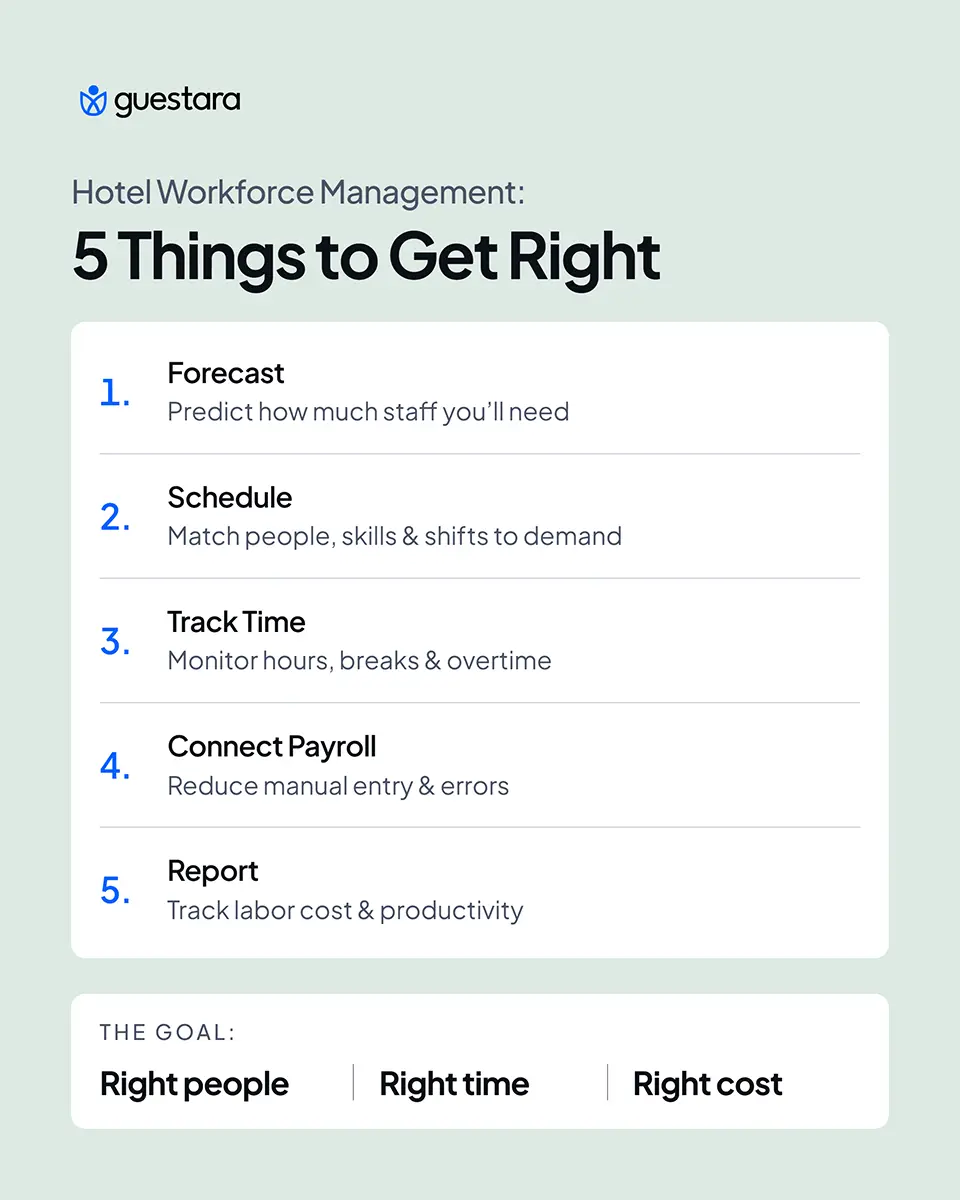
It covers five things: forecasting how much labor you will need, scheduling people to shifts, tracking time and compliance, feeding that into payroll, and reporting on the result. Done well, it keeps payroll in step with revenue and keeps your team from burning out.

It matters because labor is usually a hotel's single largest controllable expense. A few points of labor cost saved, or a few overtime hours avoided, flow straight to the bottom line.

Key takeaways

  • Hotel workforce management plans, schedules, and tracks staff to control labor cost while protecting service.
  • Labor is usually a hotel's largest controllable cost, so small efficiencies move the bottom line directly.

Why Is Workforce Management So Hard in Hotels?

Workforce management is hard in hotels because demand never sits still and the property never closes. A hotel runs 24/7, occupancy swings daily and seasonally, and every department peaks at a different time.

Three forces make it harder right now:

  • A labor shortage. In the US, 77% of hotels reported staffing shortages in 2024, with housekeeping the hardest role to fill (AHLA), and wages have climbed as a result.
  • High attrition. Turnover is costly, and in India hospitality attrition runs around 30%, so teams are constantly rebuilding.
  • Rising guest expectations. Guests want fast, personal service even as teams run leaner.

The result is a constant balancing act between cost, coverage, and morale.
Key takeaways

  • Hotels are hard to staff because they run 24/7 with demand that swings by hour, day, and season.
  • A labor shortage, high attrition, and rising guest expectations force teams to do more with less.
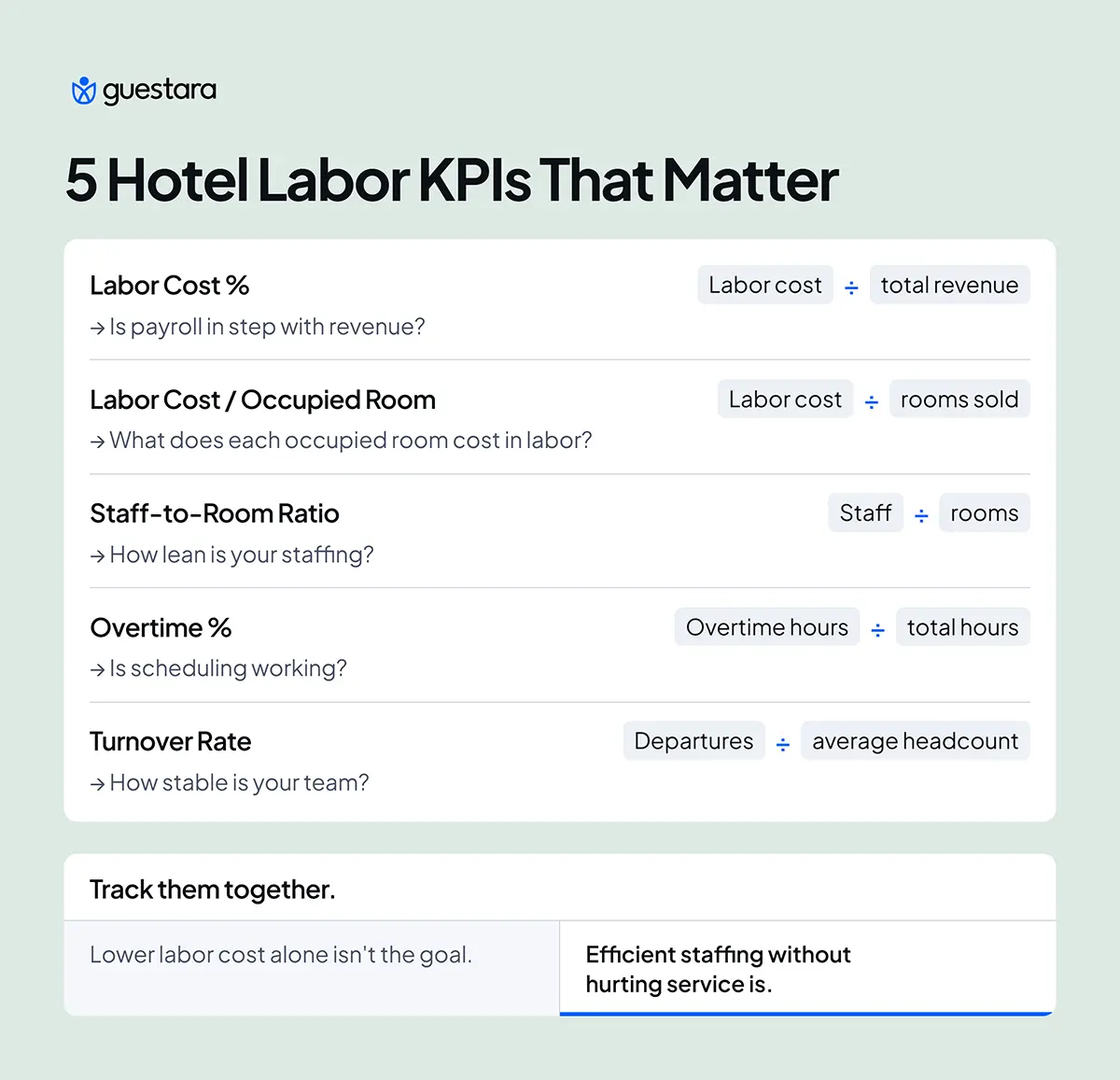
Guestara infographic explaining five key hotel labor KPIs: labor cost percentage, labor cost per occupied room, staff-to-room ratio, overtime percentage, and turnover rate, with formulas and a focus on efficient staffing without hurting service.

The Core Components of Workforce Management

Workforce management has five core components. Weakness in any one ripples into the others.

Component What it does
Labor forecasting Predicts staffing needs from occupancy, events, and historical demand
Scheduling Matches staff availability and skills to forecasted shifts
Time and compliance Tracks hours, breaks, and overtime against labor law
Payroll integration Feeds time data into payroll to cut manual entry and errors
Reporting Shows labor cost, productivity, and overtime in real time

Dedicated scheduling and payroll platforms handle these, and this is the category properly called workforce management software. It is separate from guest-experience tools, though the two connect: the less manual guest work your team carries, the fewer hours you have to schedule.

Key takeaways

  • The five components are forecasting, scheduling, time and compliance, payroll integration, and reporting.
  • Workforce management software handles these, separate from but connected to guest-experience tools.

Key Labor KPIs and How to Calculate Them

You cannot manage labor you do not measure. These are the core hotel labor KPIs and how to calculate each.

KPI How to calculate it What it tells you
Labor cost percentage Labor cost / total revenue Whether payroll is in step with revenue
Labor cost per occupied room Labor cost / rooms sold Labor efficiency per room
Staff-to-room ratio Number of staff / number of rooms How lean or service-heavy your staffing is
Overtime percentage Overtime hours / total hours Whether scheduling is failing
Turnover rate Departures / average headcount How stable your team is

Staff-to-room ratios vary widely by class. Budget and economy hotels often run 0.2 to 0.4 staff per room, midscale around 0.5 to 1, and full-service or luxury 1.5 to 3 or more, since they operate restaurants, spas, and concierge desks. Track your own ratio against similar properties, not a universal number.

A simple rule: keep labor cost as a percentage of revenue stable or falling as occupancy grows. If it rises while occupancy is flat, something in scheduling or productivity has slipped.
Key takeaways

  • The core labor KPIs are labor cost percentage, cost per occupied room, staff-to-room ratio, overtime percentage, and turnover.
  • Staff-to-room ratios range from about 0.2 to 0.4 in economy hotels to 1.5 to 3 or more in luxury, so benchmark against similar properties.

How Do You Optimize Labor Without Hurting Service?

Guestara infographic outlining five key areas of hotel workforce management: forecasting staffing needs, scheduling employees, tracking time, connecting payroll, and reporting labor costs and productivity.

You optimize labor by matching staffing to real demand and removing the work that does not need a person, not by simply cutting shifts. The most efficient hotels use technology for the transactional so their people handle the exceptional.

Practical moves:

  • Forecast and schedule to demand. Build schedules from occupancy and arrival data, and staff the front desk to check-in peaks rather than a flat line.
  • Cross-train. Staff who cover two roles let you flex coverage during a rush without adding headcount.
  • Automate scheduling. A digital scheduling tool flags overtime and compliance risks that a spreadsheet misses.
  • Reduce the workload itself. This is the lever most hotels underuse: move routine guest tasks off your team.

That last lever is where guest-experience automation helps. Guestara is not a scheduling tool, but it cuts the workload a lean team carries. Contactless check-in and a self-service kiosk shrink front desk queues, an AI chatbot answers routine questions 24/7, and a unified inbox handles messages across channels without extra staff. With the labor shortage pushing wages up, doing more with less is no longer optional, and Hilton's 2026 trends found 73% of travelers are more likely to choose a hotel that offers self-service technology, so guests welcome it too. See the self-check-in guide for how the arrival flow works.

Key takeaways

  • Optimize labor by scheduling to real demand, cross-training, and removing work that does not need a person.
  • Guest-experience automation reduces the workload a lean team carries, which is the lever most hotels underuse.

How Do You Improve Staff Retention?

You improve retention by giving staff predictable schedules, fair workloads, recognition, and a path to grow, because most hotel staff leave over how they are managed, not only pay. Turnover is expensive, since every departure means recruiting and retraining.

What works:

  • Publish schedules early. Last-minute changes are a top driver of burnout and exits.
  • Balance workloads. Spread weekend, holiday, and heavy shifts evenly across the team.
  • Recognize good work. Regular appreciation and fair tip distribution lift morale.
  • Offer a path. Cross-training and upskilling give people a reason to stay. In one Indian industry survey, 81% of hospitality workers said they would stay longer if offered relevant upskilling.

Retention is a labor-cost strategy, not just an HR one. A stable team is cheaper to run and delivers more consistent service.

Key takeaways

  • Predictable schedules, fair workloads, recognition, and a growth path keep hotel staff longer than pay alone.
  • Retention is a cost strategy, since every departure adds recruiting and retraining expense.

What Is Different About Workforce Management in India and the GCC?

Workforce management in India and the Gulf carries extra pressure: leaner staffing, higher attrition, and a skilled-labor shortage. The playbook is the same, but the constraints are tighter.

  • Thin staffing ratios. Indian mid-tier hotels report staff-to-room ratios as low as 0.45, well below global norms, so every absence hits harder.
  • High attrition and a skills gap. Hospitality attrition runs near 30%, and demand for trained front-office, housekeeping, and F&B staff outpaces supply.
  • A shifting labor market. In the GCC, hospitality employment fell more than 18% after the pandemic, tightening supply further.

Two moves matter most here. Invest in retention and upskilling to fight attrition, and lean harder on automation, since a smaller team cannot absorb the manual load that a US full-service hotel can. WhatsApp-based guest messaging in particular removes a large volume of routine queries from the front desk.

Key takeaways

  • Indian and Gulf hotels run leaner staffing, near 30% attrition, and a skilled-labor shortage, so constraints are tighter.
  • Retention, upskilling, and automation matter more where teams are smaller and harder to rebuild.

[[cta:cta-5 | eyebrow=HOTEL AUTOMATION | heading= Do more with a leaner team, not a longer schedule. | btn=Explore Hospitality AI | link=https://www.guestara.com/hospitality-ai ]]

Pratik Bhondve
Marketing Manager
Subscribe to our newsletter
Read about our privacy policy.
Thank you! Your submission has been received!
Oops! Something went wrong while submitting the form.

Frequently Asked Questions

What is hotel workforce management?

Hotel workforce management is the planning, scheduling, and tracking of staff so the right number of people with the right skills are working at the right time. It covers labor forecasting, scheduling, time and compliance tracking, payroll, and reporting. Its goal is to control labor cost while maintaining service standards.

How do you calculate hotel labor cost percentage?

Divide total labor cost by total revenue for the same period, then multiply by 100. For example, $40,000 in labor cost against $160,000 in revenue is a 25% labor cost percentage. Tracking it over time shows whether payroll is keeping pace with revenue or outgrowing it.

What is a good staff-to-room ratio for a hotel?

It depends on the hotel's class and services, so there is no single number. Budget and economy hotels often run 0.2 to 0.4 staff per room, midscale around 0.5 to 1, and full-service or luxury 1.5 to 3 or more. Benchmark against similar properties in your market rather than a global average.

How does technology reduce hotel labor costs?

Technology reduces labor cost by removing routine tasks so a smaller team covers the same service. Contactless check-in and kiosks cut front desk queues, an AI chatbot handles common guest questions, and a unified inbox manages messages without extra staff. This lets hotels match leaner staffing to demand without lowering service quality.

Why is staff turnover so high in hotels?

Hotel turnover is high because of unpredictable schedules, heavy workloads, limited recognition, and pay that competes with other service sectors. In India, hospitality attrition runs around 30%, worsened by a skilled-labor shortage. Predictable scheduling, fair workloads, recognition, and upskilling are the most effective ways to bring it down.

Your hospitality tech stack’s best friend

We work closely with the industry leaders to offer seamless solutions

Guestara is already easy to use. But we’re still here for you

We’re here to help your whole team stay ahead of the curve as you grow.

heart handshake icon
Onboarding Services

Get up and running quickly with a personalized onboarding plan

customer support icon
24/7 Support

Connect with real people who really get it, 24/7

book icon
Guides and Templates

Checkout our vast library of free resources, templates and more

See Guestara in action now.

There's only so much we can say — so let us show you! Schedule a demo today and reach your business goals.