Find hotel guest journey friction points by counting three things: actions, waits and repeats. A six-step audit, plus where friction hides in every stage.





A friction point is effort your guest should not have had to spend. Not something missing, which is a gap, but something present that costs more than it needs to.
Picture the guest who did everything you asked. She completed check-in on her phone the night before, then handed over her passport at the desk anyway because the form had not reached anyone. She asked about pool hours at 9pm and heard back at 10am. She gave her car registration to the booking engine, to the receptionist, and again to the valet. Nothing failed. Nothing was missing. She left mildly tired of you, and her review said the place was fine.
That is friction, and it is invisible to most of the ways hotels look for problems. This guide is a method for finding it in your own property.
A guest journey friction point is any moment where a guest has to spend more effort than the outcome requires. It can be an extra form, an avoidable wait, a question they have to ask twice, or a step that exists because of how your systems are arranged rather than because the guest needs it.
This is the distinction that makes friction findable.
A missing pre-arrival message is an absence. A pre-arrival message that arrives at 3am in the guest's time zone and links to a form asking for details already in your PMS is friction. The second one is harder to spot precisely because something is happening. Reports look healthy. The work got done.
Friction lives in the difference between work happening and work being easy for the person on the other end.
It costs you the difference between a guest who returns and a guest who thought you were fine.
Friction rarely produces a complaint. It produces a neutral review, a guest who books elsewhere next time without any particular grievance, and staff hours spent on steps that should not exist. None of those three show up as an incident, which is why friction accumulates for years in properties that are otherwise well run.
For the wider structure this sits inside, our complete guide to the hotel guest journey is the parent page.
Gaps and friction are different faults that need different hunting methods. A gap is something that never happens. Friction is something that happens the hard way. Confusing the two is why audits come back clean while guests stay mildly annoyed.
The test is whether anything fired at all.
Nobody sent a check-in link, so arrival started with a paper form. That is a gap, and you find it by checking whether each touchpoint exists and runs. The link was sent, the guest completed it, and the desk asked for the same passport anyway. That is friction, and no presence check will ever find it.
Our guide to the hidden gaps in the hotel guest journey covers the common absences and how to close them. This page covers the effort that survives after you have closed them.
Routinely, and these are the most expensive ones to leave alone because everybody believes that part is solved.
A check-in link that opens a form requesting data you already hold. A review request that arrives four days after departure when the stay has faded. A WhatsApp confirmation sent in English to a guest who booked in Portuguese. An upsell offer timed to the morning of arrival, when the guest is on a plane.
Each of those touchpoints is live, logged and counted as done. Each one makes the guest work for no reason. Two related reads: the journey mistakes that quietly cost revenue covers design faults, and the difference between the guest journey and guest experience separates the structure from how it feels.
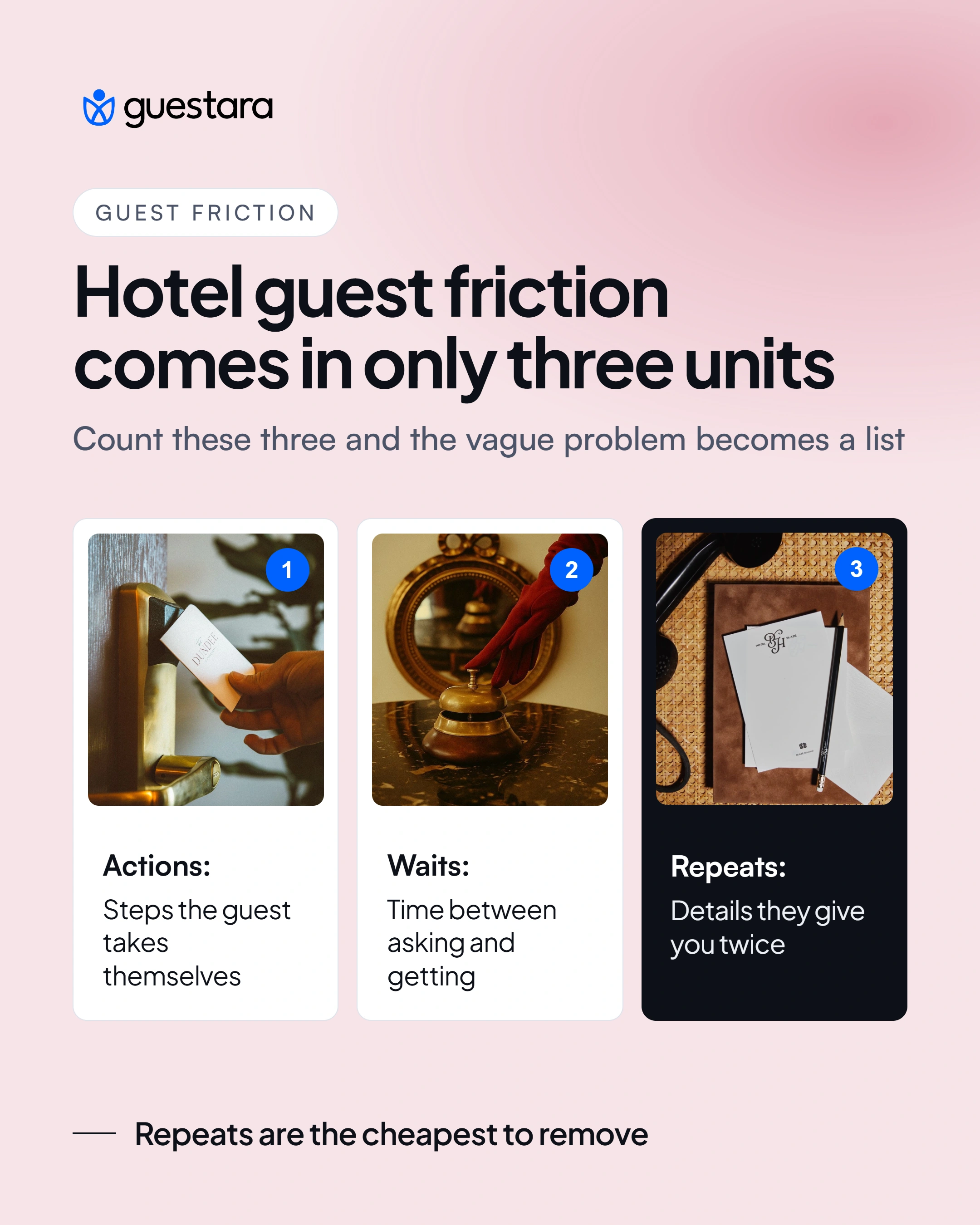
Friction is measurable, and it comes in three units: actions the guest takes, waits they absorb, and repeats where they give you the same thing twice. Every friction point in a hotel reduces to one of those three, which is what makes an audit possible rather than a matter of opinion.
Counting effort rather than scoring satisfaction is the right instrument here, and there is serious evidence behind that choice. Research by the Corporate Executive Board covering more than 75,000 customers, published in Harvard Business Review in July 2010, found that reducing the effort a customer has to spend predicts loyalty where delighting them does not.
That finding transfers to hotels even though a retail purchase funnel does not. A funnel breaks in hospitality because the purchase comes weeks before the product. Effort research studied service interactions, and a hotel stay is nothing but service interactions.
Walk one booking and count every action the guest has to perform. Taps, form fields, signatures, phone calls, queues joined, staff members spoken to about the same thing.
The number itself matters less than where it clusters. Three actions spread across a stay is invisible. Three actions stacked at the front desk at 4pm is a queue.
A wait is the gap between a guest raising something and it being resolved, not the gap between shifts.
Measure from the guest's timestamp. A message arriving at 9pm and answered at 10am is a 13-hour wait, regardless of whether anyone was rostered. Guest message response time benchmarks gives you something to measure against.
Repeats are the purest form of friction, because the information already exists on your side.
Name, passport, car registration, dietary preference, the reason for the visit. Every time a guest supplies one of those twice, your systems failed to carry it and the guest paid for it. Guestara's Digital Check-In captures identity once from an AI ID scan and carries it forward, and Olive Hotels by Embassy reached 99.8% verified guest profiles using Guestara, which closes the most common repeat in the entire journey.
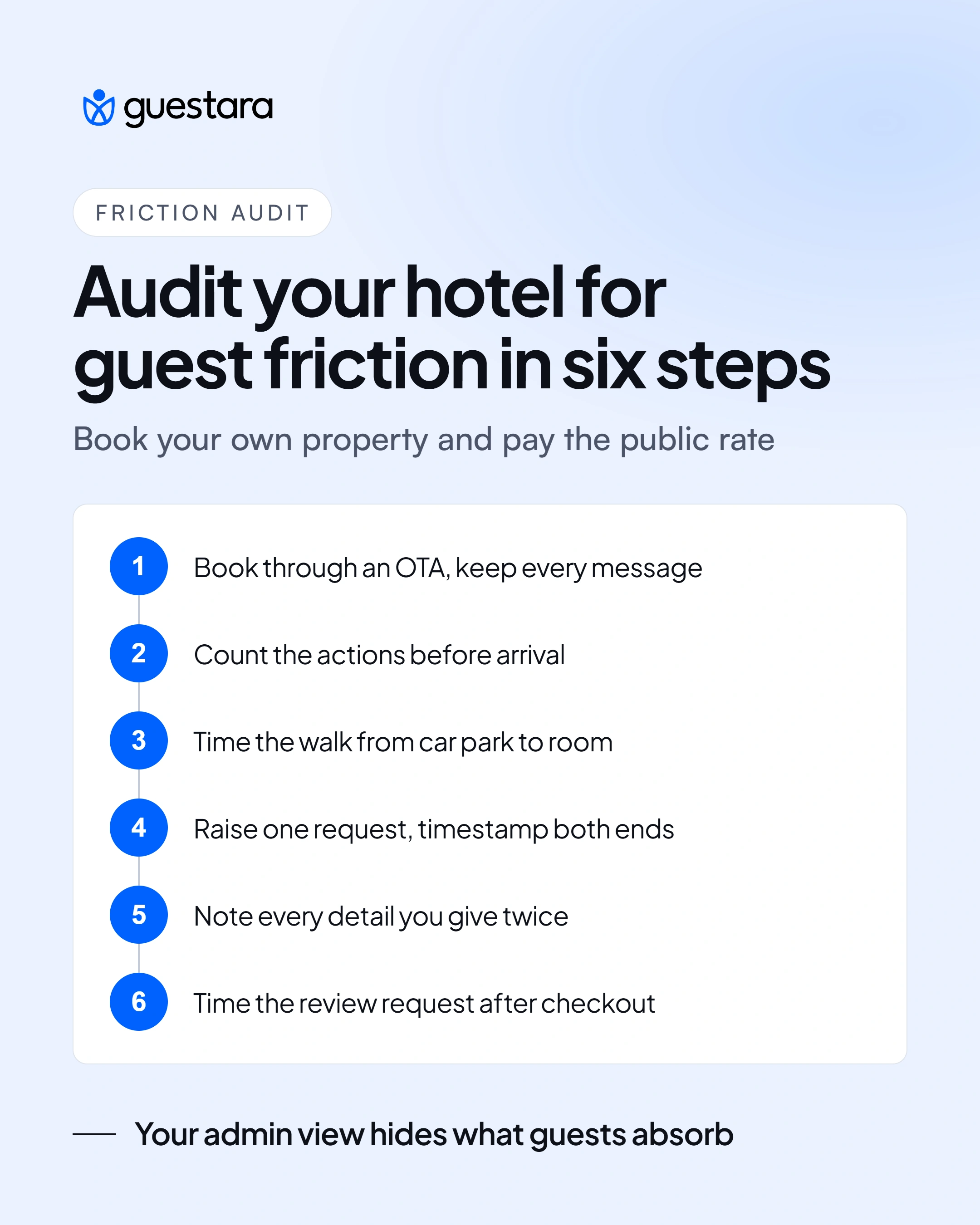
A friction audit walks one real booking end to end while counting actions, waits and repeats. It takes an afternoon, needs no software, and produces a list rather than an impression.
Start by booking your own property through an OTA, paying the rate a stranger pays, and saying nothing to your team.
This matters more than it sounds. An audit run from your own admin view shows you what the system did. Booking as a guest shows you what the guest absorbed, which is the only thing friction is made of.
Then work the six steps.
Four fields per friction point, because those four decide what you do next.
Record the stage it sits in. Record which unit it is, meaning action, wait or repeat. Record how many guests it affects, from all of them down to a handful. Record whether fixing it needs a setting changed, a process changed, or a building changed.
That last field is what separates a week of work from a capital project, and it is usually the one nobody writes down. The touchpoint inventory is a useful companion here, since it tells you whether a touchpoint exists at all, which this audit assumes. Mapping the hotel guest journey covers documenting the structure before you start measuring the effort inside it.
One afternoon for the walkthrough and about a week of elapsed time, because some of it has to happen in real time.
The booking and pre-arrival steps need the actual gap between booking and arrival, so start the audit with a reservation you make for a date a few weeks out. The arrival, stay and checkout steps happen in a single day. The review request step happens after you leave.
Friction concentrates in predictable places, and knowing where to look first makes an audit faster. Here is where it typically sits in each of the seven stages, and which unit it shows up as.
Before the guest reaches the building, in whether registration already happened.
If identity capture waits for the desk, every arriving guest performs the same actions in the same twenty minutes, and arrivals cluster whether your team does or not. Moving registration ahead of arrival removes the actions and the queue in one change. Guestara's Digital Check-In completes it in 30 seconds from the guest's phone, with the digital key issued automatically across 50+ smart lock integrations, and the full flow sits on our contactless check-in and checkout page.
For guests who arrive without having done it, Guestara's Tablet Registration runs the same 30-second flow at the desk, so the fallback is not a clipboard. The seven stages of the guest journey covers how arrival connects to what comes next.
In everything the guest has to ask for that could have been available.
WiFi codes, pool hours, breakfast times, how to get a taxi, what the restaurant serves. Each one is a small action, and in-stay friction is almost entirely made of small actions stacked together.
The answer is not an app. eviivo surveyed 430 travellers worldwide between August and September 2025 and found only 4% would download a property's own app, while 58% prefer SMS, WhatsApp or email links. Asking for a download is itself friction, and it fails for almost everyone. Guestara's Guest App is web-based with no download, which keeps the hotel guest app one tap from a message the guest already has. Whether each of these moments should be handled digitally or by a person is covered in digital against human touchpoints.
[[cta:cta-5 | eyebrow=Guest Journey | heading=Take out the effort guests should never *spend* | btn=Explore Guest Engagement | link=https://www.guestara.com/guest-engagement-for-hospitality ]]
What do your reviews reveal about friction?
Your reviews already contain a friction inventory, written in the guest's own words rather than in operational language. The trick is reading for effort rather than for sentiment, because friction hides in positive and neutral reviews as often as in negative ones.
Effort words rather than anger words.
Search your last hundred reviews for these: waited, queue, took ages, had to ask, nobody told us, asked twice, finally, eventually, couldn't find, kept, again. Each one is a guest describing effort. Pair them with the stage they mention and you have friction points located without any audit at all.
Notice what is missing from that list. None of those words are complaints. They sit inside reviews that often end with "but overall a lovely stay," which is why sentiment scoring skips straight past them.
The four and three-star ones, which most properties read last.
A one-star review names an incident. A five-star review names a person. The middle is where friction lives, because the stay worked and still cost the guest more than it should have.
This is also where satisfaction scores mislead. The Corporate Executive Board research found 20% of customers who described themselves as satisfied intended to leave anyway, and 28% of dissatisfied customers intended to stay. A satisfaction number is not a friction detector.
Industry measurement is starting to separate the two. J.D. Power's 2026 North America Hotel Guest Satisfaction Index, covering 44,787 guests across 104 brands, scores check-in and checkout as its own dimension alongside staff service, which means process effort is already tracked apart from how the people felt.
Guestara's Review Collection makes the signal faster to read by asking at departure over WhatsApp with a three-button reply, and our review management page covers how the responses route. The inbox and review connection covers why response speed shows up in scores.
The friction your guests never mention is the largest category, and your own team is the only place it is recorded. Guests complain to staff constantly in ways that never become a review, a ticket or a score.
A receptionist knows exactly which question gets asked forty times a week. A housekeeper knows which room's air conditioning panel confuses everyone. A night porter knows what guests cannot find at 2am.
None of that is written down anywhere, and all of it is friction data gathered by people who were never asked for it.
Guestara's Review Collection also surfaces a slice of this directly. At AGC, a 52-room independent hotel in Aurangabad, 122 guests raised a problem through the review flow rather than posting it publicly, and the team was alerted in real time, often while the guest was still on the property. Without that structured ask, most of those 122 would have left quietly.
Four questions, asked separately by department, and never in a group meeting where the answer becomes a performance review.
What do guests ask you that you wish they already knew. What do you apologise for most often. What do you have to explain twice. What takes you longest that guests have to wait through.
Those four produce more friction points per hour than any other method, and they cost nothing. Pair the answers with the channel problem described in why guest messages go missing, and with what a unified inbox does for a hotel if your waits turn out to cluster by channel. Guestara's unified inbox is where the channel half of that gets resolved.
Rank friction by how many guests it touches against what the fix actually costs, and start where those two are most favourable. A long list with no ranking produces no action, which is the usual fate of an audit.
Sort every friction point into one of four bands.
The fourth band is the one most operators resist and it is the cheapest win on the list. Friction a guest expected is barely friction at all. The surprise is what costs you.
The repeats, almost always, because the data already exists on your side.
Nothing has to be built, bought or staffed. The information is in your PMS and something simply has to carry it forward. Repeats are also the friction guests resent most, because supplying a passport number twice feels like being ignored rather than being delayed.
Waits come second, since most of them are coverage problems rather than speed problems. Actions come last, because reducing them usually means changing a process.
Olive Hotels by Embassy reached a 6.1x annualized return on platform cost using Guestara, and the order of those gains tracks this ranking. Months one to three returned efficiency as automated touchpoints absorbed manual work. Months four to six added revenue. From month six the reputation effect arrived. The cheap structural fixes paid first.
Three further reads for the work itself: guest journey automation covers building the triggers, thirteen ways to improve the journey is a practical starting list, and guest journey KPIs by stage covers keeping the measurement running after the audit.
[[cta:cta-4 | eyebrow=Digital Check-In | heading=Stop asking guests for what you already know | sub=One scan, no forms | btn=Book a demo | link=https://www.guestara.com/get-demo ]]


Find hotel guest journey friction points by counting three things: actions, waits and repeats. A six-step audit, plus where friction hides in every stage.
A friction point is effort your guest should not have had to spend. Not something missing, which is a gap, but something present that costs more than it needs to.
Picture the guest who did everything you asked. She completed check-in on her phone the night before, then handed over her passport at the desk anyway because the form had not reached anyone. She asked about pool hours at 9pm and heard back at 10am. She gave her car registration to the booking engine, to the receptionist, and again to the valet. Nothing failed. Nothing was missing. She left mildly tired of you, and her review said the place was fine.
That is friction, and it is invisible to most of the ways hotels look for problems. This guide is a method for finding it in your own property.
A guest journey friction point is any moment where a guest has to spend more effort than the outcome requires. It can be an extra form, an avoidable wait, a question they have to ask twice, or a step that exists because of how your systems are arranged rather than because the guest needs it.
This is the distinction that makes friction findable.
A missing pre-arrival message is an absence. A pre-arrival message that arrives at 3am in the guest's time zone and links to a form asking for details already in your PMS is friction. The second one is harder to spot precisely because something is happening. Reports look healthy. The work got done.
Friction lives in the difference between work happening and work being easy for the person on the other end.
It costs you the difference between a guest who returns and a guest who thought you were fine.
Friction rarely produces a complaint. It produces a neutral review, a guest who books elsewhere next time without any particular grievance, and staff hours spent on steps that should not exist. None of those three show up as an incident, which is why friction accumulates for years in properties that are otherwise well run.
For the wider structure this sits inside, our complete guide to the hotel guest journey is the parent page.
Gaps and friction are different faults that need different hunting methods. A gap is something that never happens. Friction is something that happens the hard way. Confusing the two is why audits come back clean while guests stay mildly annoyed.
The test is whether anything fired at all.
Nobody sent a check-in link, so arrival started with a paper form. That is a gap, and you find it by checking whether each touchpoint exists and runs. The link was sent, the guest completed it, and the desk asked for the same passport anyway. That is friction, and no presence check will ever find it.
Our guide to the hidden gaps in the hotel guest journey covers the common absences and how to close them. This page covers the effort that survives after you have closed them.
Routinely, and these are the most expensive ones to leave alone because everybody believes that part is solved.
A check-in link that opens a form requesting data you already hold. A review request that arrives four days after departure when the stay has faded. A WhatsApp confirmation sent in English to a guest who booked in Portuguese. An upsell offer timed to the morning of arrival, when the guest is on a plane.
Each of those touchpoints is live, logged and counted as done. Each one makes the guest work for no reason. Two related reads: the journey mistakes that quietly cost revenue covers design faults, and the difference between the guest journey and guest experience separates the structure from how it feels.
Friction is measurable, and it comes in three units: actions the guest takes, waits they absorb, and repeats where they give you the same thing twice. Every friction point in a hotel reduces to one of those three, which is what makes an audit possible rather than a matter of opinion.
Counting effort rather than scoring satisfaction is the right instrument here, and there is serious evidence behind that choice. Research by the Corporate Executive Board covering more than 75,000 customers, published in Harvard Business Review in July 2010, found that reducing the effort a customer has to spend predicts loyalty where delighting them does not.
That finding transfers to hotels even though a retail purchase funnel does not. A funnel breaks in hospitality because the purchase comes weeks before the product. Effort research studied service interactions, and a hotel stay is nothing but service interactions.
Walk one booking and count every action the guest has to perform. Taps, form fields, signatures, phone calls, queues joined, staff members spoken to about the same thing.
The number itself matters less than where it clusters. Three actions spread across a stay is invisible. Three actions stacked at the front desk at 4pm is a queue.
A wait is the gap between a guest raising something and it being resolved, not the gap between shifts.
Measure from the guest's timestamp. A message arriving at 9pm and answered at 10am is a 13-hour wait, regardless of whether anyone was rostered. Guest message response time benchmarks gives you something to measure against.
Repeats are the purest form of friction, because the information already exists on your side.
Name, passport, car registration, dietary preference, the reason for the visit. Every time a guest supplies one of those twice, your systems failed to carry it and the guest paid for it. Guestara's Digital Check-In captures identity once from an AI ID scan and carries it forward, and Olive Hotels by Embassy reached 99.8% verified guest profiles using Guestara, which closes the most common repeat in the entire journey.
A friction audit walks one real booking end to end while counting actions, waits and repeats. It takes an afternoon, needs no software, and produces a list rather than an impression.
Start by booking your own property through an OTA, paying the rate a stranger pays, and saying nothing to your team.
This matters more than it sounds. An audit run from your own admin view shows you what the system did. Booking as a guest shows you what the guest absorbed, which is the only thing friction is made of.
Then work the six steps.
Four fields per friction point, because those four decide what you do next.
Record the stage it sits in. Record which unit it is, meaning action, wait or repeat. Record how many guests it affects, from all of them down to a handful. Record whether fixing it needs a setting changed, a process changed, or a building changed.
That last field is what separates a week of work from a capital project, and it is usually the one nobody writes down. The touchpoint inventory is a useful companion here, since it tells you whether a touchpoint exists at all, which this audit assumes. Mapping the hotel guest journey covers documenting the structure before you start measuring the effort inside it.
One afternoon for the walkthrough and about a week of elapsed time, because some of it has to happen in real time.
The booking and pre-arrival steps need the actual gap between booking and arrival, so start the audit with a reservation you make for a date a few weeks out. The arrival, stay and checkout steps happen in a single day. The review request step happens after you leave.
Friction concentrates in predictable places, and knowing where to look first makes an audit faster. Here is where it typically sits in each of the seven stages, and which unit it shows up as.
Before the guest reaches the building, in whether registration already happened.
If identity capture waits for the desk, every arriving guest performs the same actions in the same twenty minutes, and arrivals cluster whether your team does or not. Moving registration ahead of arrival removes the actions and the queue in one change. Guestara's Digital Check-In completes it in 30 seconds from the guest's phone, with the digital key issued automatically across 50+ smart lock integrations, and the full flow sits on our contactless check-in and checkout page.
For guests who arrive without having done it, Guestara's Tablet Registration runs the same 30-second flow at the desk, so the fallback is not a clipboard. The seven stages of the guest journey covers how arrival connects to what comes next.
In everything the guest has to ask for that could have been available.
WiFi codes, pool hours, breakfast times, how to get a taxi, what the restaurant serves. Each one is a small action, and in-stay friction is almost entirely made of small actions stacked together.
The answer is not an app. eviivo surveyed 430 travellers worldwide between August and September 2025 and found only 4% would download a property's own app, while 58% prefer SMS, WhatsApp or email links. Asking for a download is itself friction, and it fails for almost everyone. Guestara's Guest App is web-based with no download, which keeps the hotel guest app one tap from a message the guest already has. Whether each of these moments should be handled digitally or by a person is covered in digital against human touchpoints.
[[cta:cta-5 | eyebrow=Guest Journey | heading=Take out the effort guests should never *spend* | btn=Explore Guest Engagement | link=https://www.guestara.com/guest-engagement-for-hospitality ]]
What do your reviews reveal about friction?
Your reviews already contain a friction inventory, written in the guest's own words rather than in operational language. The trick is reading for effort rather than for sentiment, because friction hides in positive and neutral reviews as often as in negative ones.
Effort words rather than anger words.
Search your last hundred reviews for these: waited, queue, took ages, had to ask, nobody told us, asked twice, finally, eventually, couldn't find, kept, again. Each one is a guest describing effort. Pair them with the stage they mention and you have friction points located without any audit at all.
Notice what is missing from that list. None of those words are complaints. They sit inside reviews that often end with "but overall a lovely stay," which is why sentiment scoring skips straight past them.
The four and three-star ones, which most properties read last.
A one-star review names an incident. A five-star review names a person. The middle is where friction lives, because the stay worked and still cost the guest more than it should have.
This is also where satisfaction scores mislead. The Corporate Executive Board research found 20% of customers who described themselves as satisfied intended to leave anyway, and 28% of dissatisfied customers intended to stay. A satisfaction number is not a friction detector.
Industry measurement is starting to separate the two. J.D. Power's 2026 North America Hotel Guest Satisfaction Index, covering 44,787 guests across 104 brands, scores check-in and checkout as its own dimension alongside staff service, which means process effort is already tracked apart from how the people felt.
Guestara's Review Collection makes the signal faster to read by asking at departure over WhatsApp with a three-button reply, and our review management page covers how the responses route. The inbox and review connection covers why response speed shows up in scores.
The friction your guests never mention is the largest category, and your own team is the only place it is recorded. Guests complain to staff constantly in ways that never become a review, a ticket or a score.
A receptionist knows exactly which question gets asked forty times a week. A housekeeper knows which room's air conditioning panel confuses everyone. A night porter knows what guests cannot find at 2am.
None of that is written down anywhere, and all of it is friction data gathered by people who were never asked for it.
Guestara's Review Collection also surfaces a slice of this directly. At AGC, a 52-room independent hotel in Aurangabad, 122 guests raised a problem through the review flow rather than posting it publicly, and the team was alerted in real time, often while the guest was still on the property. Without that structured ask, most of those 122 would have left quietly.
Four questions, asked separately by department, and never in a group meeting where the answer becomes a performance review.
What do guests ask you that you wish they already knew. What do you apologise for most often. What do you have to explain twice. What takes you longest that guests have to wait through.
Those four produce more friction points per hour than any other method, and they cost nothing. Pair the answers with the channel problem described in why guest messages go missing, and with what a unified inbox does for a hotel if your waits turn out to cluster by channel. Guestara's unified inbox is where the channel half of that gets resolved.
Rank friction by how many guests it touches against what the fix actually costs, and start where those two are most favourable. A long list with no ranking produces no action, which is the usual fate of an audit.
Sort every friction point into one of four bands.
The fourth band is the one most operators resist and it is the cheapest win on the list. Friction a guest expected is barely friction at all. The surprise is what costs you.
The repeats, almost always, because the data already exists on your side.
Nothing has to be built, bought or staffed. The information is in your PMS and something simply has to carry it forward. Repeats are also the friction guests resent most, because supplying a passport number twice feels like being ignored rather than being delayed.
Waits come second, since most of them are coverage problems rather than speed problems. Actions come last, because reducing them usually means changing a process.
Olive Hotels by Embassy reached a 6.1x annualized return on platform cost using Guestara, and the order of those gains tracks this ranking. Months one to three returned efficiency as automated touchpoints absorbed manual work. Months four to six added revenue. From month six the reputation effect arrived. The cheap structural fixes paid first.
Three further reads for the work itself: guest journey automation covers building the triggers, thirteen ways to improve the journey is a practical starting list, and guest journey KPIs by stage covers keeping the measurement running after the audit.
[[cta:cta-4 | eyebrow=Digital Check-In | heading=Stop asking guests for what you already know | sub=One scan, no forms | btn=Book a demo | link=https://www.guestara.com/get-demo ]]
A friction point is any moment where a guest has to spend more effort than the outcome requires, such as filling a form with details the hotel already holds, waiting overnight for an answer, or supplying the same information to three different people. It differs from a gap, where a touchpoint is missing entirely. Friction is harder to detect because the touchpoint is present and working, so operational reports show the task as complete while the guest absorbs the cost.
Book your own property through an OTA at the public rate and walk the whole journey while counting three things: the actions you have to take, the waits you absorb, and the details you supply more than once. Record the stage, the unit, how many guests it affects, and whether the fix needs a setting, a process or a building changed. Then read your last hundred reviews for effort words such as waited, had to ask and asked twice, and ask each department what guests ask them most often.
A gap is a touchpoint that never fires, such as a check-in link nobody sent. A friction point is a touchpoint that fires and still costs the guest unnecessary effort, such as a check-in link that opens a form requesting a passport number already stored in the PMS. Gaps are found with a presence check that asks whether each step happened, while friction is only found by measuring the effort inside steps already marked as working.
Repeats cost the most relative to how cheap they are to remove, because the information already exists on the property's side and the guest resents supplying it twice. Waits come next, and most of them are coverage problems rather than speed problems, since a message arriving at 9pm and answered at 10am is a 13-hour wait regardless of rostering. Actions are usually the most expensive to reduce, because fewer actions normally means changing a process rather than a setting.
Not reliably. Corporate Executive Board research covering more than 75,000 customers found 20% of customers who described themselves as satisfied intended to leave anyway, and 28% of dissatisfied customers intended to stay, which means a satisfaction number and a friction level are different measurements. Reading reviews for effort language and counting actions, waits and repeats directly will find friction that a score reports as fine.
We work closely with the industry leaders to offer seamless solutions




We’re here to help your whole team stay ahead of the curve as you grow.

Get up and running quickly with a personalized onboarding plan

Connect with real people who really get it, 24/7

Checkout our vast library of free resources, templates and more
There's only so much we can say — so let us show you! Schedule a demo today and reach your business goals.


