Learn how to write a hotel welcome message for guests that feels personal, with a simple five-part formula, ready-to-use examples, and the mistakes to avoid.





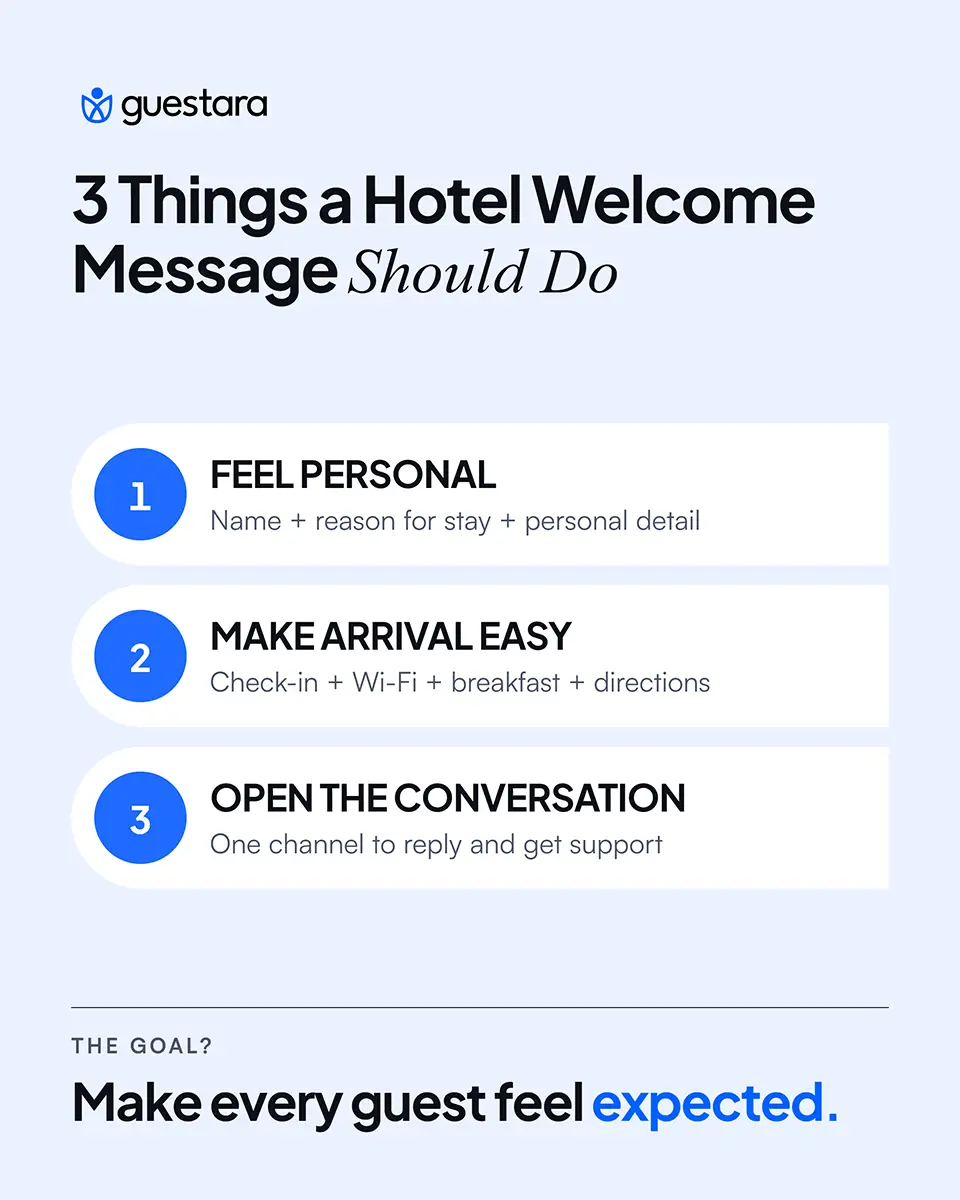
A great hotel welcome message greets the guest by name, confirms the details that matter, and tells them exactly what happens next, all in a few warm and specific lines.
Think about the last time you arrived somewhere tired after a long trip. The properties that got it right made you feel expected, not processed. That feeling starts with words, often before you reach the front desk. This guide shows you how to write welcome messages that do the same for your guests, with a formula, examples for every guest type, and the mistakes that quietly undo the effort.
A hotel welcome message is a short, personalized greeting a property sends a guest before or during arrival to confirm booking details, share practical information, and make the guest feel expected. It can arrive by WhatsApp, email, SMS, or as a printed note in the room.
It is one of the first impressions your property makes, and it sets the tone for the whole stay. A generic mass message tells the guest they are one of many. A message that uses their name and their reason for travel says the opposite.
The stakes are higher than they look. According to TakeUp's 2025 Voice of the Boutique Travel Guest report, 95% of travelers say personalized offers or recommendations would make them more likely to book an independent hotel. A welcome message is the earliest and cheapest place to deliver that personal touch.
Send a hotel welcome message at three moments: pre-arrival, one or two days before check-in, at check-in itself, and once the guest is settled in the room. Each moment does a different job.
The pre-arrival message confirms the booking, sets expectations, and offers useful extras like directions or early check-in. The check-in message greets the guest by name and hands over the essentials: wifi, breakfast times, and checkout. The in-room note is the personal touch that turns a room into a welcome. These map to the touchpoints that hospitality research names as the highest value for personalization, pre-arrival, check-in, and post-stay.
Channel matters as much as timing. Meet guests where they already are. 77% of guests prefer automated messaging or chatbots for quick communication, so a message on the right channel gets read. In India and much of the region, that channel is WhatsApp, which sees around 98% open rates versus roughly 20% for email. Whatever channels you use, keep replies in one place. Guestara's Unified Inbox pulls every hotel guest messaging channel into a single window, so a guest reply never slips past a busy front desk, which matters because guests judge you on response time benchmarks they set in their heads.
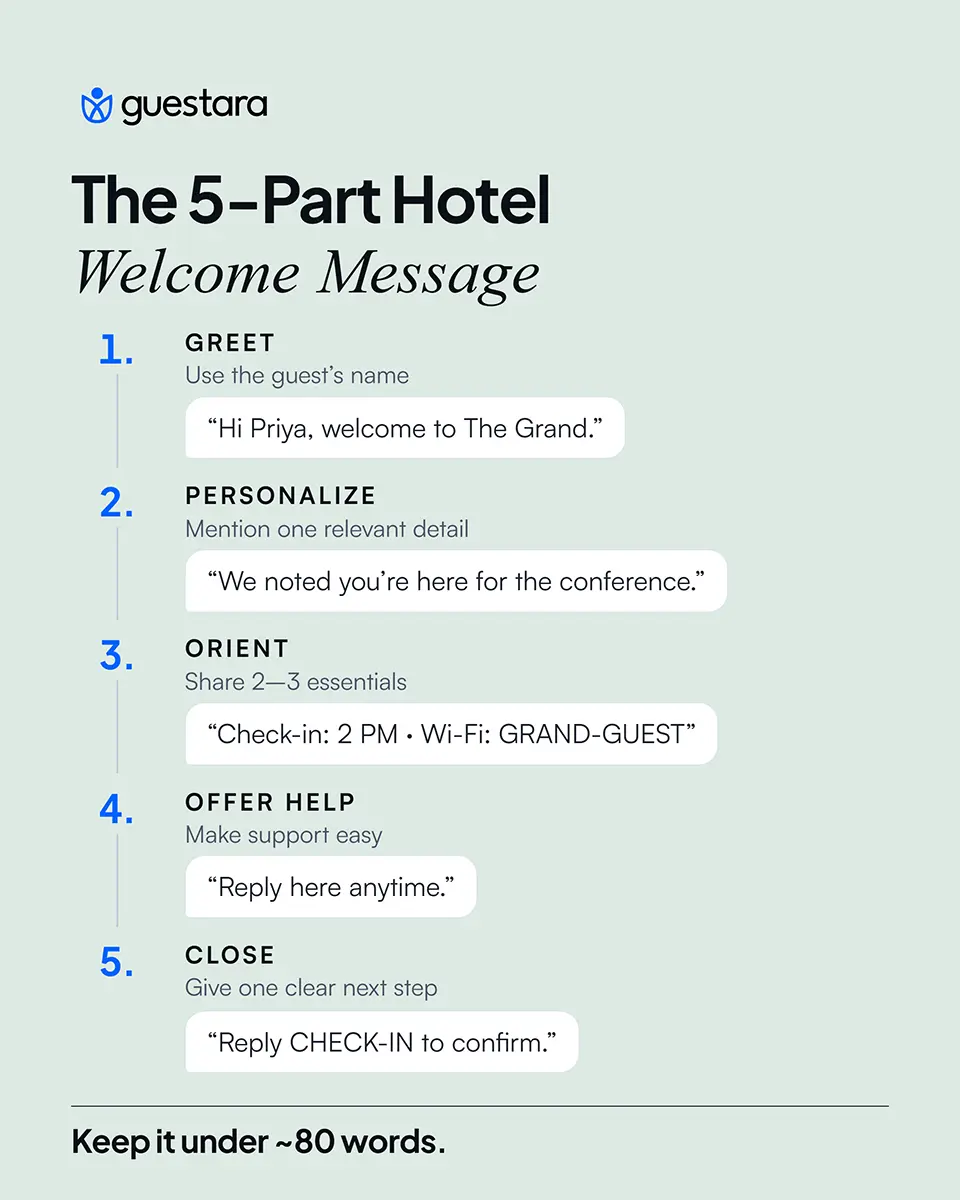
Write a hotel welcome message in five parts: greet the guest by name, personalize one detail, orient them with practical information, offer help, and close with a clear next step. Keep the whole thing under about 80 words so it reads on a phone in one glance.
Tone carries the message. Write the way a warm, competent host speaks: short sentences, plain words, no corporate language. Read it aloud before you send it. If it sounds like a form letter, rewrite it.
The best welcome message changes with the guest. A business traveler wants speed and wifi, a honeymooning couple wants warmth, and a returning guest wants recognition. Below are ready-to-adapt examples for the most common guest types.
Notice that every example uses the same five-part formula. You are not writing five different messages from scratch. You are adjusting one structure to fit the guest in front of you.
The most common welcome-message mistakes are sending a generic mass note, writing too much, choosing the wrong channel, and sending too late to be useful. Each one quietly undoes the personal impression you were trying to make.
You automate welcome messages by connecting them to your booking data, so each guest gets the right message at the right moment without a staff member typing it. A trigger, such as a new booking or an approaching check-in date, fires a pre-written, personalized template on the guest's preferred channel.
The building blocks are simple. You write templates once, add merge fields for the details that change (name, room, dates, reason for stay), and tie each template to a booking event in your property management system. The guest gets a message that feels handwritten, and your team spends zero minutes sending it. This is not a compromise on the personal touch. It is what makes the personal touch possible at every arrival, not just the ones staff have time for. It also lines up with guest preference, since 77% of guests prefer automated messaging for quick communication.
Guestara's Guest Journey does exactly this. It ties trigger-based message journeys to your PMS booking data across WhatsApp, email, and SMS, so every guest gets a personalized welcome automatically, from pre-arrival to post-stay.
[[cta:cta-5 | eyebrow=GUEST ENGAGEMENT | heading=See how every guest gets a *personal welcome* automatically. | btn=Explore Guest Engagement | link=https://www.guestara.com/guest-engagement-for-hospitality ]]


Learn how to write a hotel welcome message for guests that feels personal, with a simple five-part formula, ready-to-use examples, and the mistakes to avoid.
A great hotel welcome message greets the guest by name, confirms the details that matter, and tells them exactly what happens next, all in a few warm and specific lines.
Think about the last time you arrived somewhere tired after a long trip. The properties that got it right made you feel expected, not processed. That feeling starts with words, often before you reach the front desk. This guide shows you how to write welcome messages that do the same for your guests, with a formula, examples for every guest type, and the mistakes that quietly undo the effort.
A hotel welcome message is a short, personalized greeting a property sends a guest before or during arrival to confirm booking details, share practical information, and make the guest feel expected. It can arrive by WhatsApp, email, SMS, or as a printed note in the room.
It is one of the first impressions your property makes, and it sets the tone for the whole stay. A generic mass message tells the guest they are one of many. A message that uses their name and their reason for travel says the opposite.
The stakes are higher than they look. According to TakeUp's 2025 Voice of the Boutique Travel Guest report, 95% of travelers say personalized offers or recommendations would make them more likely to book an independent hotel. A welcome message is the earliest and cheapest place to deliver that personal touch.
Send a hotel welcome message at three moments: pre-arrival, one or two days before check-in, at check-in itself, and once the guest is settled in the room. Each moment does a different job.
The pre-arrival message confirms the booking, sets expectations, and offers useful extras like directions or early check-in. The check-in message greets the guest by name and hands over the essentials: wifi, breakfast times, and checkout. The in-room note is the personal touch that turns a room into a welcome. These map to the touchpoints that hospitality research names as the highest value for personalization, pre-arrival, check-in, and post-stay.
Channel matters as much as timing. Meet guests where they already are. 77% of guests prefer automated messaging or chatbots for quick communication, so a message on the right channel gets read. In India and much of the region, that channel is WhatsApp, which sees around 98% open rates versus roughly 20% for email. Whatever channels you use, keep replies in one place. Guestara's Unified Inbox pulls every hotel guest messaging channel into a single window, so a guest reply never slips past a busy front desk, which matters because guests judge you on response time benchmarks they set in their heads.
Write a hotel welcome message in five parts: greet the guest by name, personalize one detail, orient them with practical information, offer help, and close with a clear next step. Keep the whole thing under about 80 words so it reads on a phone in one glance.
Tone carries the message. Write the way a warm, competent host speaks: short sentences, plain words, no corporate language. Read it aloud before you send it. If it sounds like a form letter, rewrite it.
The best welcome message changes with the guest. A business traveler wants speed and wifi, a honeymooning couple wants warmth, and a returning guest wants recognition. Below are ready-to-adapt examples for the most common guest types.
Notice that every example uses the same five-part formula. You are not writing five different messages from scratch. You are adjusting one structure to fit the guest in front of you.
The most common welcome-message mistakes are sending a generic mass note, writing too much, choosing the wrong channel, and sending too late to be useful. Each one quietly undoes the personal impression you were trying to make.
You automate welcome messages by connecting them to your booking data, so each guest gets the right message at the right moment without a staff member typing it. A trigger, such as a new booking or an approaching check-in date, fires a pre-written, personalized template on the guest's preferred channel.
The building blocks are simple. You write templates once, add merge fields for the details that change (name, room, dates, reason for stay), and tie each template to a booking event in your property management system. The guest gets a message that feels handwritten, and your team spends zero minutes sending it. This is not a compromise on the personal touch. It is what makes the personal touch possible at every arrival, not just the ones staff have time for. It also lines up with guest preference, since 77% of guests prefer automated messaging for quick communication.
Guestara's Guest Journey does exactly this. It ties trigger-based message journeys to your PMS booking data across WhatsApp, email, and SMS, so every guest gets a personalized welcome automatically, from pre-arrival to post-stay.
[[cta:cta-5 | eyebrow=GUEST ENGAGEMENT | heading=See how every guest gets a *personal welcome* automatically. | btn=Explore Guest Engagement | link=https://www.guestara.com/guest-engagement-for-hospitality ]]
A good welcome message greets the guest by name, personalizes one detail about their trip, shares the two or three things they need to know on arrival, and offers an easy way to reach you. Keep it under about 80 words and end with a clear next step. For example: "Hi Priya, welcome to The Grand. Your room is ready, wifi is GRAND-GUEST, and breakfast runs 7 to 10 AM. Reply here anytime you need us."
Aim for under 80 words, roughly three to five short lines. Guests read welcome messages on a phone, often mid-arrival, so anything longer gets skimmed or ignored. Include only what the guest needs right now and save everything else for later in the stay.
Send on the channel your guests actually use, which in India and much of the region is WhatsApp, where open rates run near 98% compared with about 20% for email. Email still works for detailed pre-arrival information and formal confirmations. The strongest approach uses both: email for depth and WhatsApp for the fast, conversational welcome.
Send a first message one to two days before arrival to confirm the booking and set expectations, then a second at check-in with the practical details. A short in-room note or message once the guest has settled adds a final personal touch. These pre-arrival and arrival moments are when a welcome message has the most impact.
We work closely with the industry leaders to offer seamless solutions




We’re here to help your whole team stay ahead of the curve as you grow.

Get up and running quickly with a personalized onboarding plan

Connect with real people who really get it, 24/7

Checkout our vast library of free resources, templates and more
There's only so much we can say — so let us show you! Schedule a demo today and reach your business goals.


.png)