Hotel guest messaging is transforming how hotels communicate. Learn what it is, how it works, and why it's replacing phone calls and front desk queues for good.




Your guest booked a room three weeks ago.
Since then, they've received one automated confirmation email — probably buried in their inbox — and nothing else.
They arrive not knowing your check-in time. They're not sure if their upgrade went through. They want to ask if the pool is open, but they don't want to call the front desk. So they just... show up and hope for the best.
This is the reality for most hotels today. And it's costing them more than they realize — in guest satisfaction scores, in staff time, and in revenue that never gets captured.
Hotel guest communication has traditionally meant phone calls, printed folios, and face-to-face interactions at the front desk. That worked when guests expected it. It doesn't work anymore.
Today, guests communicate the way they communicate everywhere else — through WhatsApp, SMS, and messaging apps. They expect fast responses, personalized touchpoints, and the ability to reach out without picking up a phone.
Hotel guest messaging is the system that makes that possible. And the industry is taking notice: according to Data Horizzon Research, the hospitality guest messaging platforms market was valued at $425 million in 2024 and is projected to reach $1.2 billion by 2033 — a CAGR of 11.2%. Hotels that aren't investing in this infrastructure today are already falling behind.
In this guide, we'll break down exactly what hotel guest messaging is, why traditional communication is failing, how modern guest messaging software works, and why so many hotels are making the switch right now.
If you want the complete picture of how guest messaging fits into a broader automation strategy, start with our Hotel Guest Messaging & Journey Automation: The Complete Guide for Modern Hotels — then come back here for the operational detail.
Hotel guest messaging is a structured approach to communicating with guests across digital channels — before arrival, during their stay, and after they check out.
It goes beyond sending a booking confirmation. True guest messaging means:
A well-built guest communication platform connects every stage of the guest journey — from booking confirmation to post-stay review request — through a single, organized system.
Think of it this way: just as you wouldn't want your sales team working out of five different CRMs, you don't want your front desk juggling WhatsApp on a personal phone, OTA message portals in one tab, email in another, and a notepad for walk-in requests.
Hotel guest messaging brings all of that into one place, with automation handling the repetitive touchpoints and staff focusing on the moments that actually require a human.
Let's be honest about how most hotels still handle guest communication.
A guest calls the front desk. The front desk agent is in the middle of a check-in. The phone rings eight times and goes unanswered. The guest sends a message through the OTA portal. Nobody sees it for four hours because the portal isn't open on anyone's screen. The guest leaves a review that mentions "unresponsive staff."
This is not a staffing problem. It's a hotel communication systems problem.
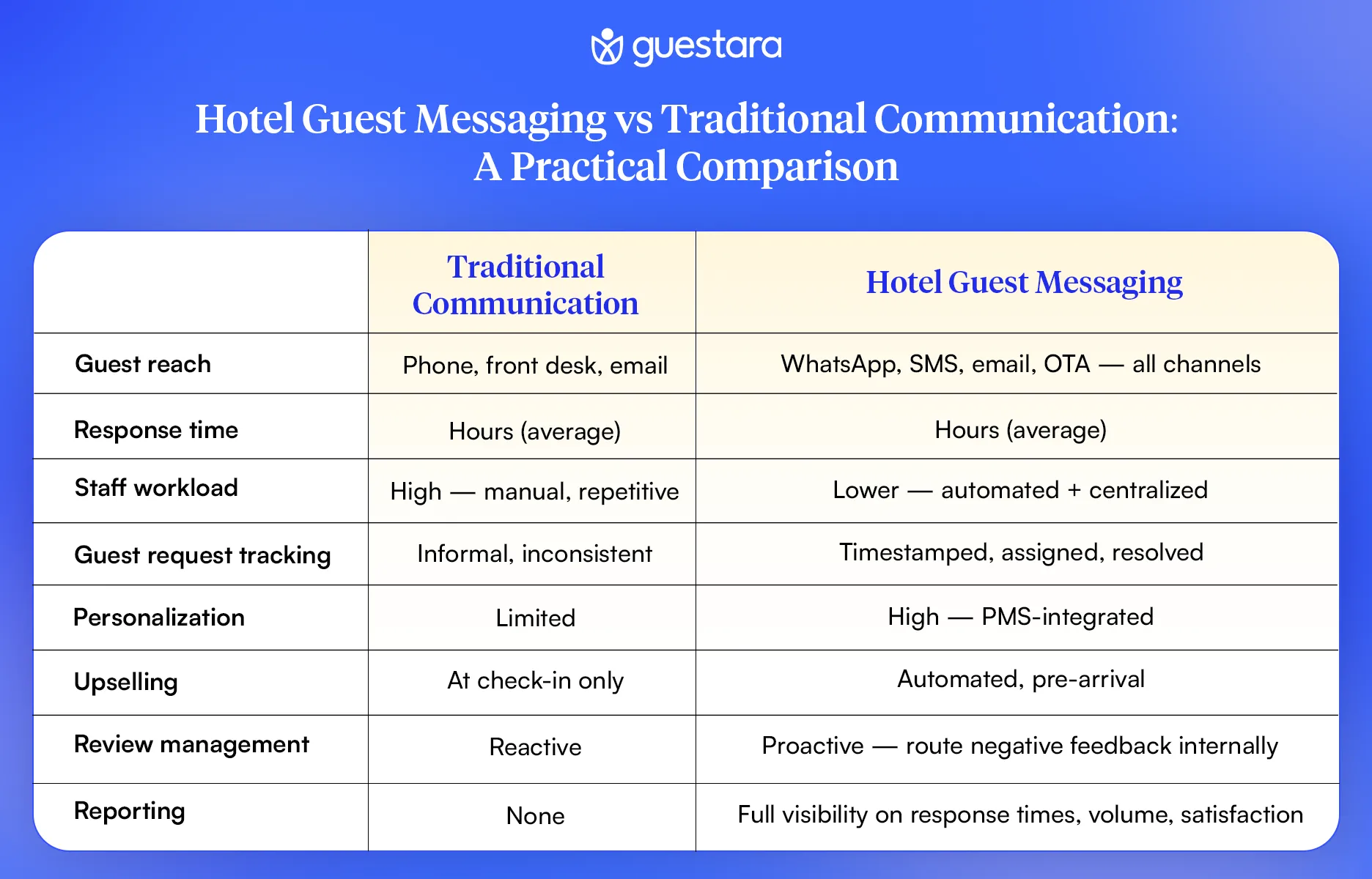
Here's what traditional communication typically looks like in practice:
Phone calls — still the default for many hotels, but guests under 40 increasingly avoid phone calls. A 2023 study found that over 60% of millennials prefer messaging over calling for service requests. When they do call and nobody answers, that frustration doesn't stay private.
Front desk queues — a holdover from an era when the front desk was the only touchpoint. Today it's a bottleneck. During peak hours, guests wait five to ten minutes for simple requests. Staff get pulled away from complex issues to answer questions that could have been automated.
OTA messaging portals — guests book on Booking.com or Expedia and send messages through those platforms. Hotels often log into these portals inconsistently. Messages get missed. Response times stretch to hours. OTAs notice this, and it affects your ranking.
Email — still important, but open rates for generic hotel emails hover around 20-25%. A pre-arrival email with useful information gets sent; it rarely gets read at the right time.
Paper-based requests — in-room compendiums, physical forms, paper receipts. Guests ignore them. Staff have to manually log information that could be captured digitally in seconds.
The result? Guests don't get what they need. Staff spend disproportionate time on communication overhead. And the hotel has no data, no tracking, and no way to improve.
Guest messaging software solves these problems not by adding another communication tool, but by replacing the fragmented approach entirely.
Here's what changes when a hotel moves to a proper guest messaging system:
WhatsApp has over 2 billion monthly active users. In many markets — Southeast Asia, the Middle East, Europe, Latin America — it's the primary messaging app. SMS for hotels remains highly effective in North America, where open rates sit above 90%.
When you reach guests where they already are, message open rates and response rates go up dramatically. A pre-arrival message on WhatsApp gets opened. The same message sent as a generic email often doesn't.
Traditional hotel communication is reactive — guests have to reach out first. Guest messaging flips that. The hotel sends timely, relevant messages based on where the guest is in their journey:
This kind of automated guest journey means guests feel looked after without any additional manual effort from staff.
3. Staff handle conversations in a single workspace
Without a unified system, staff are switching between platforms constantly. That switching has a real cost — missed messages, delayed responses, duplicated effort.
With a hotel text messaging system connected to a unified inbox, every conversation from every channel shows up in one place. The front desk agent doesn't need to check three different portals. They open one dashboard and see everything.
Hotels report cutting average response time by 40-60% just by consolidating channels — and you can see exactly how that works in practice on Guestara's Unified Inbox page.
When a guest calls to say the shower drain is slow, that information lives in the head of whoever answered the phone. Maybe they tell housekeeping. Maybe they write a sticky note. Maybe it gets lost.
When a guest sends a message through a guest messaging system, that request becomes a tracked task — assigned to the right team member, timestamped, and monitored for resolution. Management can see open requests, average resolution time, and which issues recur.
This matters for guest experience management because you can't improve what you can't measure.
A complete hotel guest messaging setup covers multiple channels, because different guests prefer different ways to communicate. Here's how each channel fits:
The highest-engagement channel for most international hotels. WhatsApp messages typically see 70-80% open rates, compared to 20-25% for email. For hotels serving European, Middle Eastern, or Asian guests, WhatsApp is often the first choice.
The challenge has been that hotels were using personal WhatsApp numbers — a GM's phone, a front desk agent's personal account. That's not scalable, it's not compliant with WhatsApp Business API policies, and it disappears when that staff member leaves.
A proper guest communication platform integrates the WhatsApp Business API, so all messages go through the hotel's official account and flow into a central inbox.
Still extremely effective, particularly for guests in North America and for last-minute communications. Hotel guest text messaging via SMS works because it requires no app download — every guest has it. SMS is often used for:
Open rates for SMS remain above 90%, making it one of the most reliable channels for time-sensitive messages.
Email isn't going away — it's just not the right channel for real-time communication. In a guest messaging strategy, email works well for:
Where hotels go wrong is treating email as their only channel. It should be part of a multi-channel strategy, not the whole strategy.
Guests who book through Booking.com, Expedia, or Airbnb often send messages through those platforms. These messages need to be managed — but they shouldn't live in isolation.
A good hotel guest request software pulls OTA messages into the same inbox as WhatsApp, SMS, and email. This is where multi-channel guest messaging becomes genuinely operational rather than aspirational.
Not all guest messaging software is created equal. Here are the capabilities that actually matter for mid-size and enterprise hotels:
Automated message flows — the ability to set up pre-stay, in-stay, and post-stay message sequences that trigger automatically based on reservation events. This is the core of guest journey automation and what saves the most staff time.
Multi-channel support — WhatsApp, SMS, email, and OTA messaging in a single system. If a platform only handles one or two channels, you'll end up back to juggling multiple tools.
Two-way messaging — not just broadcast capability, but the ability for guests to respond and for staff to reply in real time. One-way messaging tools are limited; guests have questions, and those questions need answers.
Task management integration — guest requests should automatically create trackable tasks for the relevant department. This closes the loop between communication and operations.
Review management — the ability to automate post-stay review requests, and — critically — to route negative feedback internally before it hits Google or OTAs.
PMS integration — the system should connect to your property management system to pull reservation data automatically, so guest communications can be personalized (room number, name, arrival time, booking details) without manual data entry.
Reporting and analytics — response time metrics, message open rates, request volume by department, and guest satisfaction trends. Hotel communication KPIs need to be visible, not buried in spreadsheets.
For a deeper look at how all of this comes together in a real guest engagement platform, the Guestara Guest Engagement for Hospitality page walks through how these capabilities connect end-to-end.
Here's the thing about guest messaging strategy: the channels don't matter if your team can't manage them efficiently.
A hotel can be on WhatsApp, SMS, email, and every OTA messaging platform — and still deliver terrible response times if those conversations are spread across different tools that different staff members check at different times.
This is why the unified inbox has become the operational backbone of modern hotel communication.
A unified inbox aggregates every guest message from every channel into a single, shared workspace. Staff see conversations in real time. Messages can be assigned to specific team members. Response time is tracked. Escalations have a clear path.
Without this infrastructure, guest messaging becomes noise. With it, it becomes a genuine competitive advantage.
This isn't just about guest satisfaction. Hotel guest messaging has a direct line to revenue and reputation.
Review scores improve with response speed. Research consistently shows that guests who receive fast, helpful responses during their stay are significantly more likely to leave positive reviews. One analysis of TripAdvisor data found that hotels with higher response rates had review scores averaging 0.4 points higher than comparable properties. Over thousands of reviews, that difference moves you up in search rankings and drives bookings.
Upselling becomes possible at scale. When you have a direct line to a guest on WhatsApp or SMS, you can send personalized offers — room upgrades, spa bookings, restaurant reservations — at exactly the right moment. Sending an upgrade offer 24 hours before arrival converts at a much higher rate than anything offered at check-in, because the guest has time to consider it.
Direct bookings increase. Guests who have a positive messaging experience are more likely to book directly next time, bypassing the OTA. When your communication feels personal and responsive, you build the kind of relationship that OTAs can't replicate.
Staff time is redirected. Hotels report that 30-40% of front desk inquiries are repetitive questions that could be answered automatically — check-in time, pool hours, parking instructions, Wi-Fi password. Automating these frees staff for revenue-generating and experience-creating activities.
Hotel guest technology is moving fast, and messaging sits at the center of the shift.
The numbers tell that story clearly. While some industry estimates put the hospitality guest messaging market at $425 million today (DHR, 2024), others tracking the broader hotel messaging technology space project a market reaching $4.7 billion by 2033, growing at a CAGR of 16.5%, according to Research Intelo. Regardless of which figure you use, the direction is unmistakable — this isn't a niche category anymore.
AI-assisted messaging — where a system suggests or automatically sends responses to common guest questions — is moving from novelty to operational standard. Hotels are using it to handle routine inquiries after hours without sacrificing response quality.
Hotel chatbot technology is increasingly integrated into guest messaging systems, handling first-contact queries and routing complex requests to human staff. The best implementations feel seamless to the guest — they don't know or care whether the first response came from automation or a person, as long as it was fast and accurate.
Digital guest journeys — where the entire arc from booking to checkout to post-stay is managed through a mobile-first, messaging-led experience — are becoming the expectation rather than the exception. Digital check-in, mobile room access, in-app service requests, and digital departure are all building toward a guest experience that doesn't require physical interaction unless the guest wants it.
Traditional hotel communication isn't just inefficient. It's creating a gap between what guests expect and what hotels deliver — and that gap shows up in reviews, in direct booking rates, and in the bottom line.
Hotel guest messaging closes that gap. It's not a luxury feature or a nice-to-have. It's the infrastructure modern hotel guest engagement runs on.
The hotels winning on guest satisfaction right now aren't necessarily the ones with the biggest budgets or the most staff. They're the ones who communicate better — proactively, personally, and at scale.
And they're using guest messaging to do it.
Ready to see how hotel guest messaging works in practice? Explore how Guestara's Guest Engagement platform helps hotels automate multi-channel communication across WhatsApp, SMS, and email — from pre-arrival to post-stay.


Hotel guest messaging is transforming how hotels communicate. Learn what it is, how it works, and why it's replacing phone calls and front desk queues for good.
Your guest booked a room three weeks ago.
Since then, they've received one automated confirmation email — probably buried in their inbox — and nothing else.
They arrive not knowing your check-in time. They're not sure if their upgrade went through. They want to ask if the pool is open, but they don't want to call the front desk. So they just... show up and hope for the best.
This is the reality for most hotels today. And it's costing them more than they realize — in guest satisfaction scores, in staff time, and in revenue that never gets captured.
Hotel guest communication has traditionally meant phone calls, printed folios, and face-to-face interactions at the front desk. That worked when guests expected it. It doesn't work anymore.
Today, guests communicate the way they communicate everywhere else — through WhatsApp, SMS, and messaging apps. They expect fast responses, personalized touchpoints, and the ability to reach out without picking up a phone.
Hotel guest messaging is the system that makes that possible. And the industry is taking notice: according to Data Horizzon Research, the hospitality guest messaging platforms market was valued at $425 million in 2024 and is projected to reach $1.2 billion by 2033 — a CAGR of 11.2%. Hotels that aren't investing in this infrastructure today are already falling behind.
In this guide, we'll break down exactly what hotel guest messaging is, why traditional communication is failing, how modern guest messaging software works, and why so many hotels are making the switch right now.
If you want the complete picture of how guest messaging fits into a broader automation strategy, start with our Hotel Guest Messaging & Journey Automation: The Complete Guide for Modern Hotels — then come back here for the operational detail.
Hotel guest messaging is a structured approach to communicating with guests across digital channels — before arrival, during their stay, and after they check out.
It goes beyond sending a booking confirmation. True guest messaging means:
A well-built guest communication platform connects every stage of the guest journey — from booking confirmation to post-stay review request — through a single, organized system.
Think of it this way: just as you wouldn't want your sales team working out of five different CRMs, you don't want your front desk juggling WhatsApp on a personal phone, OTA message portals in one tab, email in another, and a notepad for walk-in requests.
Hotel guest messaging brings all of that into one place, with automation handling the repetitive touchpoints and staff focusing on the moments that actually require a human.
Let's be honest about how most hotels still handle guest communication.
A guest calls the front desk. The front desk agent is in the middle of a check-in. The phone rings eight times and goes unanswered. The guest sends a message through the OTA portal. Nobody sees it for four hours because the portal isn't open on anyone's screen. The guest leaves a review that mentions "unresponsive staff."
This is not a staffing problem. It's a hotel communication systems problem.
Here's what traditional communication typically looks like in practice:
Phone calls — still the default for many hotels, but guests under 40 increasingly avoid phone calls. A 2023 study found that over 60% of millennials prefer messaging over calling for service requests. When they do call and nobody answers, that frustration doesn't stay private.
Front desk queues — a holdover from an era when the front desk was the only touchpoint. Today it's a bottleneck. During peak hours, guests wait five to ten minutes for simple requests. Staff get pulled away from complex issues to answer questions that could have been automated.
OTA messaging portals — guests book on Booking.com or Expedia and send messages through those platforms. Hotels often log into these portals inconsistently. Messages get missed. Response times stretch to hours. OTAs notice this, and it affects your ranking.
Email — still important, but open rates for generic hotel emails hover around 20-25%. A pre-arrival email with useful information gets sent; it rarely gets read at the right time.
Paper-based requests — in-room compendiums, physical forms, paper receipts. Guests ignore them. Staff have to manually log information that could be captured digitally in seconds.
The result? Guests don't get what they need. Staff spend disproportionate time on communication overhead. And the hotel has no data, no tracking, and no way to improve.
Guest messaging software solves these problems not by adding another communication tool, but by replacing the fragmented approach entirely.
Here's what changes when a hotel moves to a proper guest messaging system:
WhatsApp has over 2 billion monthly active users. In many markets — Southeast Asia, the Middle East, Europe, Latin America — it's the primary messaging app. SMS for hotels remains highly effective in North America, where open rates sit above 90%.
When you reach guests where they already are, message open rates and response rates go up dramatically. A pre-arrival message on WhatsApp gets opened. The same message sent as a generic email often doesn't.
Traditional hotel communication is reactive — guests have to reach out first. Guest messaging flips that. The hotel sends timely, relevant messages based on where the guest is in their journey:
This kind of automated guest journey means guests feel looked after without any additional manual effort from staff.
3. Staff handle conversations in a single workspace
Without a unified system, staff are switching between platforms constantly. That switching has a real cost — missed messages, delayed responses, duplicated effort.
With a hotel text messaging system connected to a unified inbox, every conversation from every channel shows up in one place. The front desk agent doesn't need to check three different portals. They open one dashboard and see everything.
Hotels report cutting average response time by 40-60% just by consolidating channels — and you can see exactly how that works in practice on Guestara's Unified Inbox page.
When a guest calls to say the shower drain is slow, that information lives in the head of whoever answered the phone. Maybe they tell housekeeping. Maybe they write a sticky note. Maybe it gets lost.
When a guest sends a message through a guest messaging system, that request becomes a tracked task — assigned to the right team member, timestamped, and monitored for resolution. Management can see open requests, average resolution time, and which issues recur.
This matters for guest experience management because you can't improve what you can't measure.
A complete hotel guest messaging setup covers multiple channels, because different guests prefer different ways to communicate. Here's how each channel fits:
The highest-engagement channel for most international hotels. WhatsApp messages typically see 70-80% open rates, compared to 20-25% for email. For hotels serving European, Middle Eastern, or Asian guests, WhatsApp is often the first choice.
The challenge has been that hotels were using personal WhatsApp numbers — a GM's phone, a front desk agent's personal account. That's not scalable, it's not compliant with WhatsApp Business API policies, and it disappears when that staff member leaves.
A proper guest communication platform integrates the WhatsApp Business API, so all messages go through the hotel's official account and flow into a central inbox.
Still extremely effective, particularly for guests in North America and for last-minute communications. Hotel guest text messaging via SMS works because it requires no app download — every guest has it. SMS is often used for:
Open rates for SMS remain above 90%, making it one of the most reliable channels for time-sensitive messages.
Email isn't going away — it's just not the right channel for real-time communication. In a guest messaging strategy, email works well for:
Where hotels go wrong is treating email as their only channel. It should be part of a multi-channel strategy, not the whole strategy.
Guests who book through Booking.com, Expedia, or Airbnb often send messages through those platforms. These messages need to be managed — but they shouldn't live in isolation.
A good hotel guest request software pulls OTA messages into the same inbox as WhatsApp, SMS, and email. This is where multi-channel guest messaging becomes genuinely operational rather than aspirational.
Not all guest messaging software is created equal. Here are the capabilities that actually matter for mid-size and enterprise hotels:
Automated message flows — the ability to set up pre-stay, in-stay, and post-stay message sequences that trigger automatically based on reservation events. This is the core of guest journey automation and what saves the most staff time.
Multi-channel support — WhatsApp, SMS, email, and OTA messaging in a single system. If a platform only handles one or two channels, you'll end up back to juggling multiple tools.
Two-way messaging — not just broadcast capability, but the ability for guests to respond and for staff to reply in real time. One-way messaging tools are limited; guests have questions, and those questions need answers.
Task management integration — guest requests should automatically create trackable tasks for the relevant department. This closes the loop between communication and operations.
Review management — the ability to automate post-stay review requests, and — critically — to route negative feedback internally before it hits Google or OTAs.
PMS integration — the system should connect to your property management system to pull reservation data automatically, so guest communications can be personalized (room number, name, arrival time, booking details) without manual data entry.
Reporting and analytics — response time metrics, message open rates, request volume by department, and guest satisfaction trends. Hotel communication KPIs need to be visible, not buried in spreadsheets.
For a deeper look at how all of this comes together in a real guest engagement platform, the Guestara Guest Engagement for Hospitality page walks through how these capabilities connect end-to-end.
Here's the thing about guest messaging strategy: the channels don't matter if your team can't manage them efficiently.
A hotel can be on WhatsApp, SMS, email, and every OTA messaging platform — and still deliver terrible response times if those conversations are spread across different tools that different staff members check at different times.
This is why the unified inbox has become the operational backbone of modern hotel communication.
A unified inbox aggregates every guest message from every channel into a single, shared workspace. Staff see conversations in real time. Messages can be assigned to specific team members. Response time is tracked. Escalations have a clear path.
Without this infrastructure, guest messaging becomes noise. With it, it becomes a genuine competitive advantage.
This isn't just about guest satisfaction. Hotel guest messaging has a direct line to revenue and reputation.
Review scores improve with response speed. Research consistently shows that guests who receive fast, helpful responses during their stay are significantly more likely to leave positive reviews. One analysis of TripAdvisor data found that hotels with higher response rates had review scores averaging 0.4 points higher than comparable properties. Over thousands of reviews, that difference moves you up in search rankings and drives bookings.
Upselling becomes possible at scale. When you have a direct line to a guest on WhatsApp or SMS, you can send personalized offers — room upgrades, spa bookings, restaurant reservations — at exactly the right moment. Sending an upgrade offer 24 hours before arrival converts at a much higher rate than anything offered at check-in, because the guest has time to consider it.
Direct bookings increase. Guests who have a positive messaging experience are more likely to book directly next time, bypassing the OTA. When your communication feels personal and responsive, you build the kind of relationship that OTAs can't replicate.
Staff time is redirected. Hotels report that 30-40% of front desk inquiries are repetitive questions that could be answered automatically — check-in time, pool hours, parking instructions, Wi-Fi password. Automating these frees staff for revenue-generating and experience-creating activities.
Hotel guest technology is moving fast, and messaging sits at the center of the shift.
The numbers tell that story clearly. While some industry estimates put the hospitality guest messaging market at $425 million today (DHR, 2024), others tracking the broader hotel messaging technology space project a market reaching $4.7 billion by 2033, growing at a CAGR of 16.5%, according to Research Intelo. Regardless of which figure you use, the direction is unmistakable — this isn't a niche category anymore.
AI-assisted messaging — where a system suggests or automatically sends responses to common guest questions — is moving from novelty to operational standard. Hotels are using it to handle routine inquiries after hours without sacrificing response quality.
Hotel chatbot technology is increasingly integrated into guest messaging systems, handling first-contact queries and routing complex requests to human staff. The best implementations feel seamless to the guest — they don't know or care whether the first response came from automation or a person, as long as it was fast and accurate.
Digital guest journeys — where the entire arc from booking to checkout to post-stay is managed through a mobile-first, messaging-led experience — are becoming the expectation rather than the exception. Digital check-in, mobile room access, in-app service requests, and digital departure are all building toward a guest experience that doesn't require physical interaction unless the guest wants it.
Traditional hotel communication isn't just inefficient. It's creating a gap between what guests expect and what hotels deliver — and that gap shows up in reviews, in direct booking rates, and in the bottom line.
Hotel guest messaging closes that gap. It's not a luxury feature or a nice-to-have. It's the infrastructure modern hotel guest engagement runs on.
The hotels winning on guest satisfaction right now aren't necessarily the ones with the biggest budgets or the most staff. They're the ones who communicate better — proactively, personally, and at scale.
And they're using guest messaging to do it.
Ready to see how hotel guest messaging works in practice? Explore how Guestara's Guest Engagement platform helps hotels automate multi-channel communication across WhatsApp, SMS, and email — from pre-arrival to post-stay.
No. WhatsApp is one channel in a broader strategy. A complete guest messaging approach covers every channel a guest might use — SMS, email, OTA portals, and in-app messaging — and manages all of them from a single system.
Yes — when messages are relevant and timely. Generic marketing blasts don't work. But a WhatsApp message telling a guest their room is ready, or a pre-arrival message with directions and parking info, is genuinely useful. Personalization and timing are everything.
A good guest messaging strategy doesn't eliminate phone calls — it reduces unnecessary ones. Guests who want to call still can. But the majority of routine inquiries get resolved faster through messaging, and guests appreciate having the option.
Not at all. A 20-room boutique property benefits from automation as much as a 400-room full-service hotel — arguably more, because small teams have less capacity to handle communication overhead manually. Hotel guest management tools are increasingly designed for mid-size operators, not just enterprise chains.
We work closely with the industry leaders to offer seamless solutions




We’re here to help your whole team stay ahead of the curve as you grow.

Get up and running quickly with a personalized onboarding plan

Connect with real people who really get it, 24/7

Checkout our vast library of free resources, templates and more
There's only so much we can say — so let us show you! Schedule a demo today and reach your business goals.


.png)