The most complete list of hotel AI statistics for 2026. Verified data on adoption, ROI, guest behavior, and the operational impact of AI in hospitality.




If you have spent the last six months trying to make sense of where AI actually stands in the hotel industry, you are not alone.
Every week brings a new headline. A new vendor study. A new prediction from a consulting firm. Some of it is solid research. Some of it is recycled marketing copy with a percentage sign attached.
What is missing is one place where every credible hotel AI statistic lives, sourced properly, organized by what it actually measures.
That is what this page is.
Every stat below has been pulled from primary research, named industry studies, or the original press release of the source. Where data is older or less robust, we have flagged it. Where claims could not be verified, we have left them out.
Use this as your reference when writing a board memo, building a vendor pitch, or trying to figure out whether AI is really worth the investment for your property.
The hotel industry is in the middle of two squeezes happening at the same time.
On one side, guests are arriving with new expectations shaped by AI tools they use every day. They book differently. They search differently. They expect the on-property experience to feel as smooth as the apps on their phone.
On the other side, hotels are running on roughly 10% fewer staff than they had before the pandemic, while wages keep climbing. The math no longer works without technology in the loop.
The numbers below tell the story of how the industry is responding. Some properties are leaning in fast and seeing measurable returns. Others are still on the sidelines. The gap between the two groups is widening every quarter.
These are the stats that frame the whole conversation. How many hotels are actually using AI today, what they are using it for, and how the gap between chains and independents is shaping up.
78% of hotel chains already use AI in some form. Based on the H2c 2025 global study of 171 hotel chains representing more than 11,000 properties.
89% of hotel chains plan to expand AI use in the next 12 to 24 months. From the same H2c study.
Only 41% of independent hotels report using AI in any capacity. Reported by PhocusWire, this is the headline gap. Chains are nearly twice as likely to use AI as independents.
45% of independent hotels report no AI usage at all. Lighthouse research, January 2025. The number has improved since but still represents a major opportunity gap.
Only 7% of hotel chains operate with a comprehensive AI strategy. From the H2c study. Most chains are using AI without a defined plan for what to use it for or how to measure success.
Hoteliers give AI a trust score of 6.6 out of 10, but actual reliance averages 4.7. Trust is ahead of behavior. Most hoteliers believe in AI more than they have integrated it into daily operations.
63% of hotels now use AI in some form for revenue management. Lighthouse, 2025. Revenue management is the single largest entry point for AI tools for hotel revenue in hospitality.
Chatbots are the most common AI deployment among chains, used by 42%. H2c study.
Customer data management is the leading area of planned AI investment, cited by 50% of chains. H2c study.
This is where the demand-side picture comes into focus. The shift in how guests find hotels is happening faster than most operators realize.
83% of travelers either use or want to use AI tools to plan their trips. TravelBoom 2026 Leisure Travel Study, based on a survey of 500 active US leisure travelers.
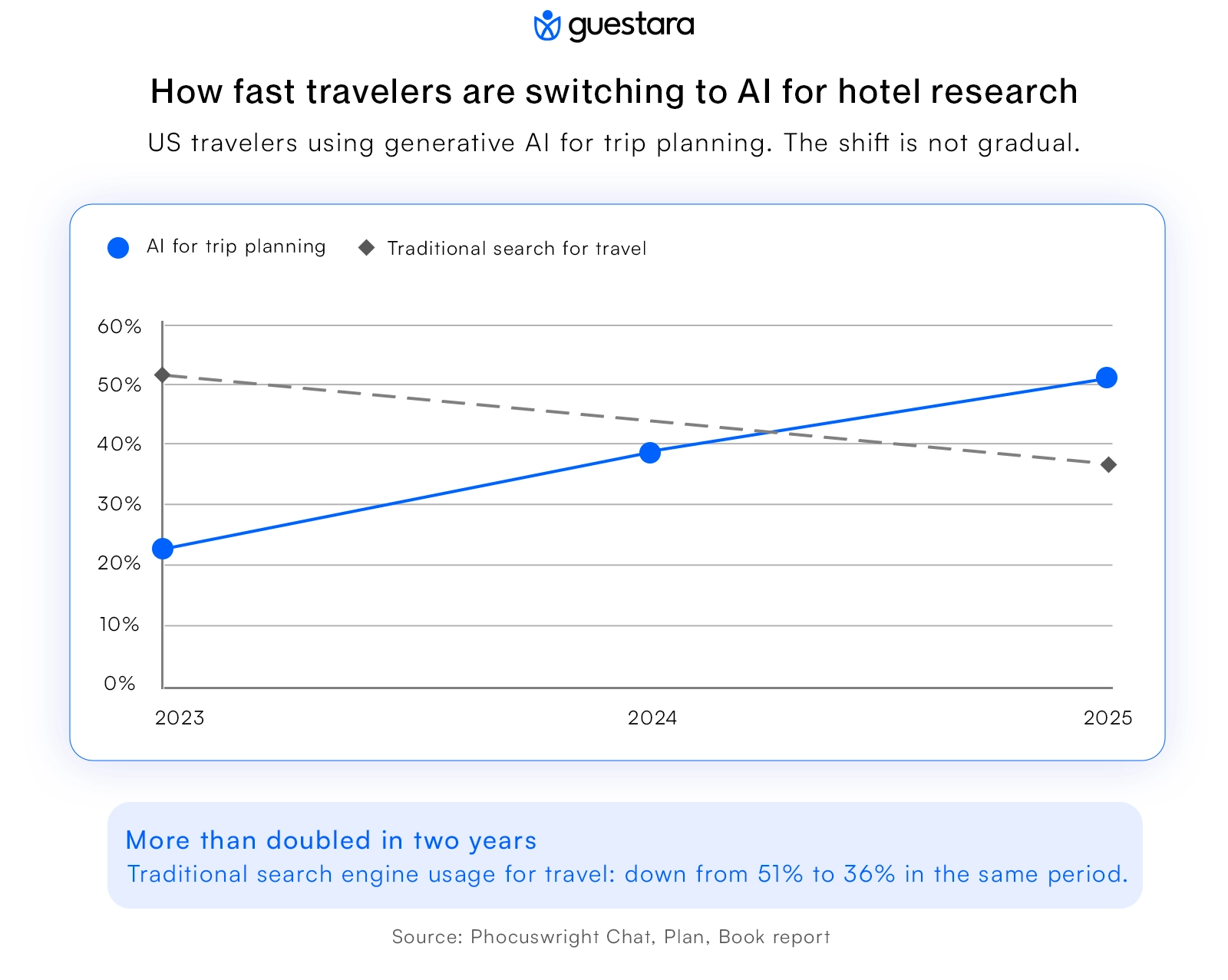
51% of US travelers now use generative AI tools for trip research and planning. Phocuswright's Chat, Plan, Book report, cited via PhocusWire. This is up from 39% in 2024 and 22% in 2023.
40% of travelers globally use AI tools for trip planning and booking. Operto data, cited in Hotel Dive.
70% of hotel bookings now involve AI-driven recommendations at some point in the journey. Operto data, via Hotel Dive.
60% of millennials and Gen Z travelers use AI to plan trips. Compared to just 33% of Gen X and Boomers. From Phocuswright research cited in industry trade press.
Among AI users, 75% say they will probably or definitely use AI again for travel. TakeUp's Rise of AI-Planned Travel in 2026 report, based on 300 US leisure travelers.
94% of AI users trust AI-generated travel recommendations at least as much as other sources. TakeUp study.
More than three-quarters of AI users have booked travel based primarily on an AI recommendation. TakeUp study.
Traffic from AI sources to US travel and hospitality sites rose 3500% year over year in July 2025. Adobe Analytics data. The AI search funnel is no longer a side channel.
Search engine usage for travel research has fallen from 51% to 36% of US travelers. Phocuswright research cited by Cloudbeds. Traditional search is shrinking as AI search grows.
Gartner predicts traditional search engine volume will drop 25% by 2026 as more queries shift to generative engines.
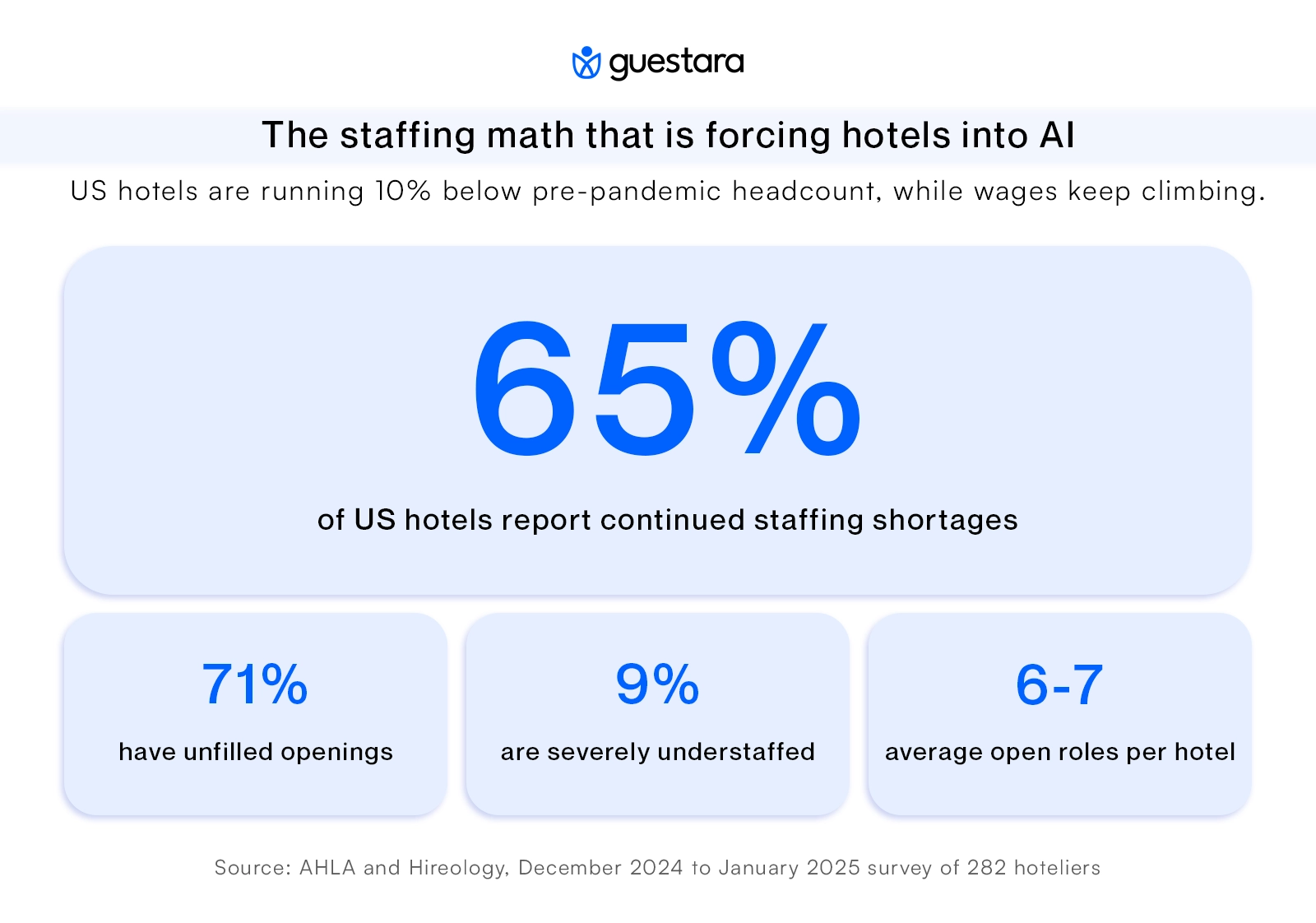
You cannot understand why hotels are turning to AI without understanding the labor squeeze. These numbers are the engine behind everything else.
65% of US hotels report continued staffing shortages. AHLA and Hireology survey of 282 hoteliers, conducted December 2024 to January 2025.
9% of US hotels describe themselves as severely understaffed. Down from 13% in May 2024, but still meaningful.
71% of hotels have job openings they cannot fill despite active recruiting. AHLA study.
The average hotel has 6 to 7 open positions at any given time. AHLA study.
38% of US hotels report shortages specifically in housekeeping. The single most-affected department.
26% report shortages in front desk roles. The second most-affected, and the area most directly addressable through AI and self-service technology.
Hotel employment is still nearly 10% below pre-pandemic staffing levels. AHLA, 2025.
Total hotel compensation in the US is expected to rise 2.13% in 2025, representing a 25.6% increase over 2019. Wages are climbing faster than headcount.
Labor accounts for 30 to 45% of total hotel operating costs. HVS data cited by Infor, 2026.
The accommodation and food services industry had 809,000 open jobs as of December 2025. US BLS JOLTS data.
The quits rate for accommodation and food services was 4.9% in December 2025. Nearly 1 in 20 workers voluntarily left their position in a single month.
Here is where most statistics pages get unreliable. We have stripped out the inflated vendor case studies and kept only the numbers backed by primary research or peer-reviewed analysis.
74.5% of independent hotels using AI report positive results. TakeUp's AI Hospitality Revolution 2025 study of 200 independent property owners and managers.
Among independent hotels reporting revenue gains from AI, 25.5% saw revenue rise between 6% and 10%. TakeUp study.
Another 35% reported revenue increases of between 11% and 20%. TakeUp study.
66% of independent hoteliers using AI have been doing so for between six months and two years. Most are still early in the adoption curve.
Nearly 70% of independent hoteliers view AI as essential to staying competitive. TakeUp study.
39% of independent hoteliers describe AI as a significant competitive advantage. TakeUp study.
Generative AI delivers a 14% productivity increase in customer service roles. McKinsey research cited in Hospitality Upgrade.
Generative AI delivers a 20 to 40% productivity boost in consulting and knowledge work contexts when full process changes are adopted. McKinsey research.
Approximately 80% of AI projects fail to deliver measurable P&L impact. Harvard Business Review estimates cited in industry analysis.
95% of enterprise generative AI efforts showed no measurable P&L impact. MIT 2025 report. The gap between AI hype and AI value is real.
The industry-wide median AI investment payback period is 2 to 4 years. Deloitte 2025 AI ROI survey. Anyone promising returns inside 12 months is overpromising.
Median ROI on enterprise AI implementations sits around 10%, with top performers significantly higher. Stange et al, 2025.
This is where AI meets the actual guest journey. These stats matter because they show what travelers expect when they walk through your door.
73% of guests actively prefer hotels that offer mobile check-in services. Oracle 2024 Hospitality Technology Report.
76% of guests said a fully contactless hotel experience would make them more likely to return. Oracle Hospitality survey.
71% of guests are more likely to choose hotels offering self-service technology. Oracle Hospitality and Skift, 2022.
74% of travelers are interested in hotels using AI to tailor services and offers. Oracle Hospitality and Skift study.
80% of travelers prefer hotels with apps that offer features like room service ordering and digital check-in. Industry surveys cited by HelloShift.
Hotels with mobile check-in see 23% higher guest satisfaction rates compared to those with traditional check-in only. Industry data cited by hospitality technology providers.
Hotels report 15 to 20% more revenue through targeted automated upselling at the point of mobile check-in. Industry benchmark data.
Digital check-in saves approximately 6 minutes per guest, and digital checkout saves approximately 4 minutes. Alliants platform data.
A 5-minute delay at check-in can cut guest satisfaction by up to 50%. Hotel Tech Report.
62% of hoteliers say a fully contactless experience is likely to be the most widely adopted technology in the next three years. Oracle Hospitality and Skift.
96% of hoteliers are investing in contactless technology. Oracle Hospitality and Skift.
These numbers tell you why AI on the booking flow matters. Most of the booking abandonment problem is friction, and most of that friction can be removed.
The average online hotel booking abandonment rate is 84.63%. SaleCycle 2019 research, reported by The Drum. This figure is widely cited in the industry but is now several years old. More recent estimates from Revinate place hotel cart abandonment at approximately 80%, which still represents a massive revenue leak that consistent guest communication can help recover.
OTA booking abandonment rates run as high as 89%. SaleCycle data, via The Drum.
52% of travelers abandon a booking because of a bad digital experience. SiteMinder Changing Traveler Report 2025, via Hotel Online.
53% of abandoned hotel bookings happen at the moment the final price including fees and taxes is revealed. Industry research cited by O'Rourke Hospitality.
87% of people who have abandoned a booking would consider returning to complete it. Econsultancy, cited by O'Rourke.
Travelers visit up to 38 travel sites when planning a single trip. Econsultancy data.
80% of hotel travel purchases take longer than four weeks to complete. TripAdvisor research. Long consideration windows mean multiple opportunities for abandonment, and multiple opportunities for re-engagement.
The average hotel cart abandonment rate is 81.7% according to broader travel industry data. Hotel Online citing Revinate.
These stats focus on what AI is actually doing inside a hotel today, beyond the headline adoption numbers.
Self-service technology can reduce front desk workload by up to 40%. Industry research cited in CiHMS labor shortage analysis.
Almost 80% of travelers now prefer fully automated front desks. Same source.
13.5% reduction in guest services hours per occupied room from January to September 2025. HotelData.com benchmark data, attributed to better peak-matching and digital self-service tools.
Room attendant productivity improved 5.5% from January to September 2025. Time per occupied room dropped from 25.8 minutes to 24.39 minutes.
Hotel wages rose 3.7 to 5.9% year over year in the same period. Productivity improvements alone are not enough to offset wage inflation.
52% of full-service hotel operating expenses are salaries, wages, bonuses, and benefits. CBRE 2025 Trends sample.
57% of hotels reported revenue growth after implementing digital adoption in 2025. Alliants platform data.
42% of hotel chains use chatbots as their primary AI deployment. H2c study. The shift toward AI-powered guest messaging is the single biggest entry point for AI in hospitality operations.
Anthropic Economic Index data shows 57% of AI-assisted tasks are augmented (human-in-the-loop) versus 43% fully automated. This is significant for hotels because it suggests AI is best used to amplify human staff, not replace them outright.
Among consumers using AI, augmentation has edged further ahead at 52% of tasks in late 2025. Anthropic Economic Index.
The investment side of the picture. These numbers tell you what the broader market is betting on.
65% of all tech investment in global travel and mobility from 2018 to 2024 went into AI and machine learning. Statista data. AI is not a side bet for the industry, it is the dominant investment thesis.
The global AI tourism market is projected to reach $13.38 billion by 2030. SiteMinder data.
The contactless check-in hotel technology market was valued at approximately $1.5 billion in 2023, projected to reach $4.8 billion by 2032. This is a 15.7% compound annual growth rate.
Global hotel booking market value reached $523 billion in 2024. Industry data cited by Prostay.
The hotel booking market is projected to reach $1.3 trillion by 2030. A 13.1% compound annual growth rate.
67% of Hilton Diamond members prefer mobile check-in over the front desk counter. Hilton internal data. The most valuable guests are the most digitally adapted guests.
Hotels reporting AI deployment see a 30% cost reduction within six months on average across guest communication functions. San Francisco hotels using AI communication platforms, per industry benchmarks.
Independent hotels using AI report a 19.7% time savings as the top benefit. TakeUp study.
The pattern across all of these numbers is clear.
Hotel chains are moving fast on AI adoption but most do not have a comprehensive strategy yet. Independent hotels are roughly half as likely to use AI as chains, but those that have adopted it are seeing strong results, with 74.5% reporting positive outcomes.
Guests have already changed how they search for and choose hotels. AI-driven discovery is now responsible for 70% of bookings touching some form of AI recommendation along the way.
Staffing remains the structural pressure that makes AI a near-necessity rather than a nice-to-have. Hotels are running 10% below pre-pandemic headcount with rising wages and 6 to 7 open positions on average. Self-service and AI-powered tools are not replacing staff. They are filling the gaps that staff cannot cover.
ROI is real but it is not the 300 to 700% returns some vendors claim. Realistic expectations are revenue increases in the 6 to 20% range over 12 to 24 months for properties that adopt thoughtfully and integrate AI into existing workflows. Anyone selling faster, larger, or more guaranteed returns is selling fiction.
If you are an independent hotelier looking at this data and wondering where to start, the entry points with the strongest evidence base are guest communication automation, dynamic pricing, and contactless check-in. These three categories show up consistently across the credible studies as the highest-ROI starting points.
This is where platforms like Guestara come in. Guestara unifies the parts of the AI stack most directly tied to the numbers above. Digital Check-In addresses the contactless adoption stat where 73% of guests prefer hotels offering mobile check-in. The AI Chatbot module handles routine guest queries 24/7 and feeds the broader trend of AI handling 42% of guest communication touchpoints in modern hotels. Unified Inbox consolidates the channel-switching that makes guest messaging the most-cited AI adoption category. Upsell and Smart Checkout both contribute to the 15 to 20% mobile check-in revenue uplift documented above.
You do not need every module on day one. The ROI evidence above suggests starting with one or two well-integrated tools beats deploying everything at once.
Bookmark this page. Reference it when building your vendor pitch deck, internal memo, or board presentation.
Every stat above has been sourced from primary research, peer-reviewed analysis, or the originating organization's published data. Where a number is older or weaker, we have said so. Where claims could not be verified, we left them out.
If you spot a stat that needs updating, or you have data from your own property that adds to this picture, we would like to hear from you.


The most complete list of hotel AI statistics for 2026. Verified data on adoption, ROI, guest behavior, and the operational impact of AI in hospitality.
If you have spent the last six months trying to make sense of where AI actually stands in the hotel industry, you are not alone.
Every week brings a new headline. A new vendor study. A new prediction from a consulting firm. Some of it is solid research. Some of it is recycled marketing copy with a percentage sign attached.
What is missing is one place where every credible hotel AI statistic lives, sourced properly, organized by what it actually measures.
That is what this page is.
Every stat below has been pulled from primary research, named industry studies, or the original press release of the source. Where data is older or less robust, we have flagged it. Where claims could not be verified, we have left them out.
Use this as your reference when writing a board memo, building a vendor pitch, or trying to figure out whether AI is really worth the investment for your property.
The hotel industry is in the middle of two squeezes happening at the same time.
On one side, guests are arriving with new expectations shaped by AI tools they use every day. They book differently. They search differently. They expect the on-property experience to feel as smooth as the apps on their phone.
On the other side, hotels are running on roughly 10% fewer staff than they had before the pandemic, while wages keep climbing. The math no longer works without technology in the loop.
The numbers below tell the story of how the industry is responding. Some properties are leaning in fast and seeing measurable returns. Others are still on the sidelines. The gap between the two groups is widening every quarter.
These are the stats that frame the whole conversation. How many hotels are actually using AI today, what they are using it for, and how the gap between chains and independents is shaping up.
78% of hotel chains already use AI in some form. Based on the H2c 2025 global study of 171 hotel chains representing more than 11,000 properties.
89% of hotel chains plan to expand AI use in the next 12 to 24 months. From the same H2c study.
Only 41% of independent hotels report using AI in any capacity. Reported by PhocusWire, this is the headline gap. Chains are nearly twice as likely to use AI as independents.
45% of independent hotels report no AI usage at all. Lighthouse research, January 2025. The number has improved since but still represents a major opportunity gap.
Only 7% of hotel chains operate with a comprehensive AI strategy. From the H2c study. Most chains are using AI without a defined plan for what to use it for or how to measure success.
Hoteliers give AI a trust score of 6.6 out of 10, but actual reliance averages 4.7. Trust is ahead of behavior. Most hoteliers believe in AI more than they have integrated it into daily operations.
63% of hotels now use AI in some form for revenue management. Lighthouse, 2025. Revenue management is the single largest entry point for AI tools for hotel revenue in hospitality.
Chatbots are the most common AI deployment among chains, used by 42%. H2c study.
Customer data management is the leading area of planned AI investment, cited by 50% of chains. H2c study.
This is where the demand-side picture comes into focus. The shift in how guests find hotels is happening faster than most operators realize.
83% of travelers either use or want to use AI tools to plan their trips. TravelBoom 2026 Leisure Travel Study, based on a survey of 500 active US leisure travelers.
51% of US travelers now use generative AI tools for trip research and planning. Phocuswright's Chat, Plan, Book report, cited via PhocusWire. This is up from 39% in 2024 and 22% in 2023.
40% of travelers globally use AI tools for trip planning and booking. Operto data, cited in Hotel Dive.
70% of hotel bookings now involve AI-driven recommendations at some point in the journey. Operto data, via Hotel Dive.
60% of millennials and Gen Z travelers use AI to plan trips. Compared to just 33% of Gen X and Boomers. From Phocuswright research cited in industry trade press.
Among AI users, 75% say they will probably or definitely use AI again for travel. TakeUp's Rise of AI-Planned Travel in 2026 report, based on 300 US leisure travelers.
94% of AI users trust AI-generated travel recommendations at least as much as other sources. TakeUp study.
More than three-quarters of AI users have booked travel based primarily on an AI recommendation. TakeUp study.
Traffic from AI sources to US travel and hospitality sites rose 3500% year over year in July 2025. Adobe Analytics data. The AI search funnel is no longer a side channel.
Search engine usage for travel research has fallen from 51% to 36% of US travelers. Phocuswright research cited by Cloudbeds. Traditional search is shrinking as AI search grows.
Gartner predicts traditional search engine volume will drop 25% by 2026 as more queries shift to generative engines.
You cannot understand why hotels are turning to AI without understanding the labor squeeze. These numbers are the engine behind everything else.
65% of US hotels report continued staffing shortages. AHLA and Hireology survey of 282 hoteliers, conducted December 2024 to January 2025.
9% of US hotels describe themselves as severely understaffed. Down from 13% in May 2024, but still meaningful.
71% of hotels have job openings they cannot fill despite active recruiting. AHLA study.
The average hotel has 6 to 7 open positions at any given time. AHLA study.
38% of US hotels report shortages specifically in housekeeping. The single most-affected department.
26% report shortages in front desk roles. The second most-affected, and the area most directly addressable through AI and self-service technology.
Hotel employment is still nearly 10% below pre-pandemic staffing levels. AHLA, 2025.
Total hotel compensation in the US is expected to rise 2.13% in 2025, representing a 25.6% increase over 2019. Wages are climbing faster than headcount.
Labor accounts for 30 to 45% of total hotel operating costs. HVS data cited by Infor, 2026.
The accommodation and food services industry had 809,000 open jobs as of December 2025. US BLS JOLTS data.
The quits rate for accommodation and food services was 4.9% in December 2025. Nearly 1 in 20 workers voluntarily left their position in a single month.
Here is where most statistics pages get unreliable. We have stripped out the inflated vendor case studies and kept only the numbers backed by primary research or peer-reviewed analysis.
74.5% of independent hotels using AI report positive results. TakeUp's AI Hospitality Revolution 2025 study of 200 independent property owners and managers.
Among independent hotels reporting revenue gains from AI, 25.5% saw revenue rise between 6% and 10%. TakeUp study.
Another 35% reported revenue increases of between 11% and 20%. TakeUp study.
66% of independent hoteliers using AI have been doing so for between six months and two years. Most are still early in the adoption curve.
Nearly 70% of independent hoteliers view AI as essential to staying competitive. TakeUp study.
39% of independent hoteliers describe AI as a significant competitive advantage. TakeUp study.
Generative AI delivers a 14% productivity increase in customer service roles. McKinsey research cited in Hospitality Upgrade.
Generative AI delivers a 20 to 40% productivity boost in consulting and knowledge work contexts when full process changes are adopted. McKinsey research.
Approximately 80% of AI projects fail to deliver measurable P&L impact. Harvard Business Review estimates cited in industry analysis.
95% of enterprise generative AI efforts showed no measurable P&L impact. MIT 2025 report. The gap between AI hype and AI value is real.
The industry-wide median AI investment payback period is 2 to 4 years. Deloitte 2025 AI ROI survey. Anyone promising returns inside 12 months is overpromising.
Median ROI on enterprise AI implementations sits around 10%, with top performers significantly higher. Stange et al, 2025.
This is where AI meets the actual guest journey. These stats matter because they show what travelers expect when they walk through your door.
73% of guests actively prefer hotels that offer mobile check-in services. Oracle 2024 Hospitality Technology Report.
76% of guests said a fully contactless hotel experience would make them more likely to return. Oracle Hospitality survey.
71% of guests are more likely to choose hotels offering self-service technology. Oracle Hospitality and Skift, 2022.
74% of travelers are interested in hotels using AI to tailor services and offers. Oracle Hospitality and Skift study.
80% of travelers prefer hotels with apps that offer features like room service ordering and digital check-in. Industry surveys cited by HelloShift.
Hotels with mobile check-in see 23% higher guest satisfaction rates compared to those with traditional check-in only. Industry data cited by hospitality technology providers.
Hotels report 15 to 20% more revenue through targeted automated upselling at the point of mobile check-in. Industry benchmark data.
Digital check-in saves approximately 6 minutes per guest, and digital checkout saves approximately 4 minutes. Alliants platform data.
A 5-minute delay at check-in can cut guest satisfaction by up to 50%. Hotel Tech Report.
62% of hoteliers say a fully contactless experience is likely to be the most widely adopted technology in the next three years. Oracle Hospitality and Skift.
96% of hoteliers are investing in contactless technology. Oracle Hospitality and Skift.
These numbers tell you why AI on the booking flow matters. Most of the booking abandonment problem is friction, and most of that friction can be removed.
The average online hotel booking abandonment rate is 84.63%. SaleCycle 2019 research, reported by The Drum. This figure is widely cited in the industry but is now several years old. More recent estimates from Revinate place hotel cart abandonment at approximately 80%, which still represents a massive revenue leak that consistent guest communication can help recover.
OTA booking abandonment rates run as high as 89%. SaleCycle data, via The Drum.
52% of travelers abandon a booking because of a bad digital experience. SiteMinder Changing Traveler Report 2025, via Hotel Online.
53% of abandoned hotel bookings happen at the moment the final price including fees and taxes is revealed. Industry research cited by O'Rourke Hospitality.
87% of people who have abandoned a booking would consider returning to complete it. Econsultancy, cited by O'Rourke.
Travelers visit up to 38 travel sites when planning a single trip. Econsultancy data.
80% of hotel travel purchases take longer than four weeks to complete. TripAdvisor research. Long consideration windows mean multiple opportunities for abandonment, and multiple opportunities for re-engagement.
The average hotel cart abandonment rate is 81.7% according to broader travel industry data. Hotel Online citing Revinate.
These stats focus on what AI is actually doing inside a hotel today, beyond the headline adoption numbers.
Self-service technology can reduce front desk workload by up to 40%. Industry research cited in CiHMS labor shortage analysis.
Almost 80% of travelers now prefer fully automated front desks. Same source.
13.5% reduction in guest services hours per occupied room from January to September 2025. HotelData.com benchmark data, attributed to better peak-matching and digital self-service tools.
Room attendant productivity improved 5.5% from January to September 2025. Time per occupied room dropped from 25.8 minutes to 24.39 minutes.
Hotel wages rose 3.7 to 5.9% year over year in the same period. Productivity improvements alone are not enough to offset wage inflation.
52% of full-service hotel operating expenses are salaries, wages, bonuses, and benefits. CBRE 2025 Trends sample.
57% of hotels reported revenue growth after implementing digital adoption in 2025. Alliants platform data.
42% of hotel chains use chatbots as their primary AI deployment. H2c study. The shift toward AI-powered guest messaging is the single biggest entry point for AI in hospitality operations.
Anthropic Economic Index data shows 57% of AI-assisted tasks are augmented (human-in-the-loop) versus 43% fully automated. This is significant for hotels because it suggests AI is best used to amplify human staff, not replace them outright.
Among consumers using AI, augmentation has edged further ahead at 52% of tasks in late 2025. Anthropic Economic Index.
The investment side of the picture. These numbers tell you what the broader market is betting on.
65% of all tech investment in global travel and mobility from 2018 to 2024 went into AI and machine learning. Statista data. AI is not a side bet for the industry, it is the dominant investment thesis.
The global AI tourism market is projected to reach $13.38 billion by 2030. SiteMinder data.
The contactless check-in hotel technology market was valued at approximately $1.5 billion in 2023, projected to reach $4.8 billion by 2032. This is a 15.7% compound annual growth rate.
Global hotel booking market value reached $523 billion in 2024. Industry data cited by Prostay.
The hotel booking market is projected to reach $1.3 trillion by 2030. A 13.1% compound annual growth rate.
67% of Hilton Diamond members prefer mobile check-in over the front desk counter. Hilton internal data. The most valuable guests are the most digitally adapted guests.
Hotels reporting AI deployment see a 30% cost reduction within six months on average across guest communication functions. San Francisco hotels using AI communication platforms, per industry benchmarks.
Independent hotels using AI report a 19.7% time savings as the top benefit. TakeUp study.
The pattern across all of these numbers is clear.
Hotel chains are moving fast on AI adoption but most do not have a comprehensive strategy yet. Independent hotels are roughly half as likely to use AI as chains, but those that have adopted it are seeing strong results, with 74.5% reporting positive outcomes.
Guests have already changed how they search for and choose hotels. AI-driven discovery is now responsible for 70% of bookings touching some form of AI recommendation along the way.
Staffing remains the structural pressure that makes AI a near-necessity rather than a nice-to-have. Hotels are running 10% below pre-pandemic headcount with rising wages and 6 to 7 open positions on average. Self-service and AI-powered tools are not replacing staff. They are filling the gaps that staff cannot cover.
ROI is real but it is not the 300 to 700% returns some vendors claim. Realistic expectations are revenue increases in the 6 to 20% range over 12 to 24 months for properties that adopt thoughtfully and integrate AI into existing workflows. Anyone selling faster, larger, or more guaranteed returns is selling fiction.
If you are an independent hotelier looking at this data and wondering where to start, the entry points with the strongest evidence base are guest communication automation, dynamic pricing, and contactless check-in. These three categories show up consistently across the credible studies as the highest-ROI starting points.
This is where platforms like Guestara come in. Guestara unifies the parts of the AI stack most directly tied to the numbers above. Digital Check-In addresses the contactless adoption stat where 73% of guests prefer hotels offering mobile check-in. The AI Chatbot module handles routine guest queries 24/7 and feeds the broader trend of AI handling 42% of guest communication touchpoints in modern hotels. Unified Inbox consolidates the channel-switching that makes guest messaging the most-cited AI adoption category. Upsell and Smart Checkout both contribute to the 15 to 20% mobile check-in revenue uplift documented above.
You do not need every module on day one. The ROI evidence above suggests starting with one or two well-integrated tools beats deploying everything at once.
Bookmark this page. Reference it when building your vendor pitch deck, internal memo, or board presentation.
Every stat above has been sourced from primary research, peer-reviewed analysis, or the originating organization's published data. Where a number is older or weaker, we have said so. Where claims could not be verified, we left them out.
If you spot a stat that needs updating, or you have data from your own property that adds to this picture, we would like to hear from you.
The H2c 2025 global study, based on 171 hotel chains representing more than 11,000 properties, found that 78% of chains already use AI and 89% plan to expand. For independents, the most reliable figure is 41% reporting some AI usage.
No. The most credible industry data, including Deloitte's 2025 AI ROI survey, shows median payback periods of 2 to 4 years and median returns around 10%. TakeUp's research on independent hotels shows 6 to 20% revenue lift for properties that adopt AI thoughtfully, not the 300 to 700% returns some vendor blogs claim.
Research from SiteMinder, Revinate, and O'Rourke Hospitality consistently identifies friction as the primary cause, not price. 52% of travelers abandon because of a bad digital experience. 53% abandon at the moment the final price including fees and taxes is revealed.
Augmentation means a human stays in the loop and uses AI to do their job better. Automation means the task is fully handled by AI. Anthropic Economic Index data shows 57% of AI-assisted tasks are augmented and 43% are automated. For hotels, augmentation tends to outperform pure automation in guest-facing roles.
The three categories with the strongest evidence base for fast, reliable returns are guest communication automation, dynamic pricing, and contactless check-in. Each addresses both the staffing pressure and the guest expectation shift simultaneously.
We work closely with the industry leaders to offer seamless solutions




We’re here to help your whole team stay ahead of the curve as you grow.

Get up and running quickly with a personalized onboarding plan

Connect with real people who really get it, 24/7

Checkout our vast library of free resources, templates and more
There's only so much we can say — so let us show you! Schedule a demo today and reach your business goals.


.webp)
.png)

