Hotels lose guest satisfaction most when a mid-stay problem goes unfixed. See where satisfaction drops across the guest journey and how to catch it in time.





Hotels lose guest satisfaction most in the middle of the stay, when a problem the guest noticed never gets fixed.
A guest waits twenty minutes to check in, finds the air conditioning broken, calls the desk twice, and hears nothing back. They will not argue at checkout. They will smile, leave, and write the review from the airport. This guide walks the guest journey stage by stage, shows where satisfaction actually drops, and explains how to catch the damage before it reaches a public review.
Hotels lose guest satisfaction most at three points in the stay, in this order of damage: an unresolved problem during the stay, friction at check-in, and a slow or surprising checkout. The mid-stay failure does the most harm because it compounds. A single unfixed issue colors every hour that follows it.
The pattern behind all three is timing. Satisfaction rarely collapses from one big disaster. It erodes from small failures the hotel never hears about in time to fix. JD Power's guest satisfaction research treats check-in and checkout as core measured dimensions, which is why friction at either end weighs heavily on the overall score, and why a quiet mid-stay failure that no survey captures is the most dangerous of all.
The rest of this guide takes each stage in turn, then maps the whole journey in one table.
Check-in is where many guests form their first judgment, and a slow or chaotic arrival sets a tone that colors the rest of the stay. A tired guest who waits in line, repeats booking details already on file, and fills out a paper form has lost patience before they reach the room.
The common failures are predictable. Long front desk queues at peak arrival times. Unclear directions for finding or accessing the property. Repetitive data entry for information the hotel already holds. Because check-in sits among the core dimensions of guest satisfaction, a rough arrival costs more than a few minutes. It shapes the score the guest gives everything that follows.
The fix is to remove steps before the guest reaches the desk. Guestara's Digital Check-In sends a check-in link by WhatsApp or email, scans the guest's ID, and auto-fills the form, so arrival takes seconds instead of a queue. The front desk becomes a welcome, not a bottleneck.
Mid-stay problems hurt satisfaction most because they go unreported, and therefore unfixed. Most guests will not walk to the front desk to complain. They swallow the frustration, let it color the stay, and release it in a public review after they leave.
The numbers explain the trap. Industry survey data finds only about a quarter of guests report a service problem to the hotel, yet more than half say they would return if the issue were put right. The complaint you actually hear is the small tip of a much larger silent group. Customer-experience analyst Esteban Kolsky's often-cited estimate puts it at roughly 26 silent guests for every one who speaks up.
This is why post-stay surveys fail as an early-warning system. By the time the survey arrives, the guest has gone and the review may already be live. The only real fix is to make it effortless for guests to reach you during the stay, and to route what they say to the right team fast. Guestara's Unified Inbox pulls every guest message, across WhatsApp, SMS, and OTA channels, into one window, so a problem raised at 9pm is seen and acted on, not lost in a channel no one is watching.
Checkout affects guest satisfaction most through two failures: a slow, queued departure and a surprise on the bill. A guest rushing to a flight has no patience for a line or a charge they did not expect, and either one becomes the last thing they remember about the stay.
Billing surprises are the sharper risk. An unexplained fee, or a folio the guest cannot review calmly, reads as a trust problem rather than a service one, and trust problems end up in reviews. A smooth checkout does the opposite. It settles the folio, confirms the charges, and sends the guest off without friction, so the final impression is competence.
Modern checkout removes the desk entirely. Phone-based checkout lets the guest settle the bill, review the folio, and leave on their own schedule, which also frees your team from the morning queue. For practical steps across arrival and departure, see these tips to enhance the guest experience.
Pre-arrival and post-stay are the quiet bookends where satisfaction leaks before and after the stay itself. Before arrival, the gap is silence: no confirmation, no directions, no easy way to ask a question. After checkout, the gap is a hotel that collects feedback and does nothing visible with it.
Before the stay, a short, well-timed message sets expectations and heads off the questions that otherwise pile up at the front desk. Guestara's Guest Journey triggers these messages automatically from booking data, so every guest gets a timely pre-arrival touch without staff effort. After the stay, closing the loop matters. Acknowledging feedback and showing a change keeps a guest who felt heard, while silence quietly loses them.
Personalization sharpens both ends. A message that reflects the guest's reason for travel lands harder than a template, and there are ways to personalize the guest experience that cost little and lift satisfaction at the margins that matter.
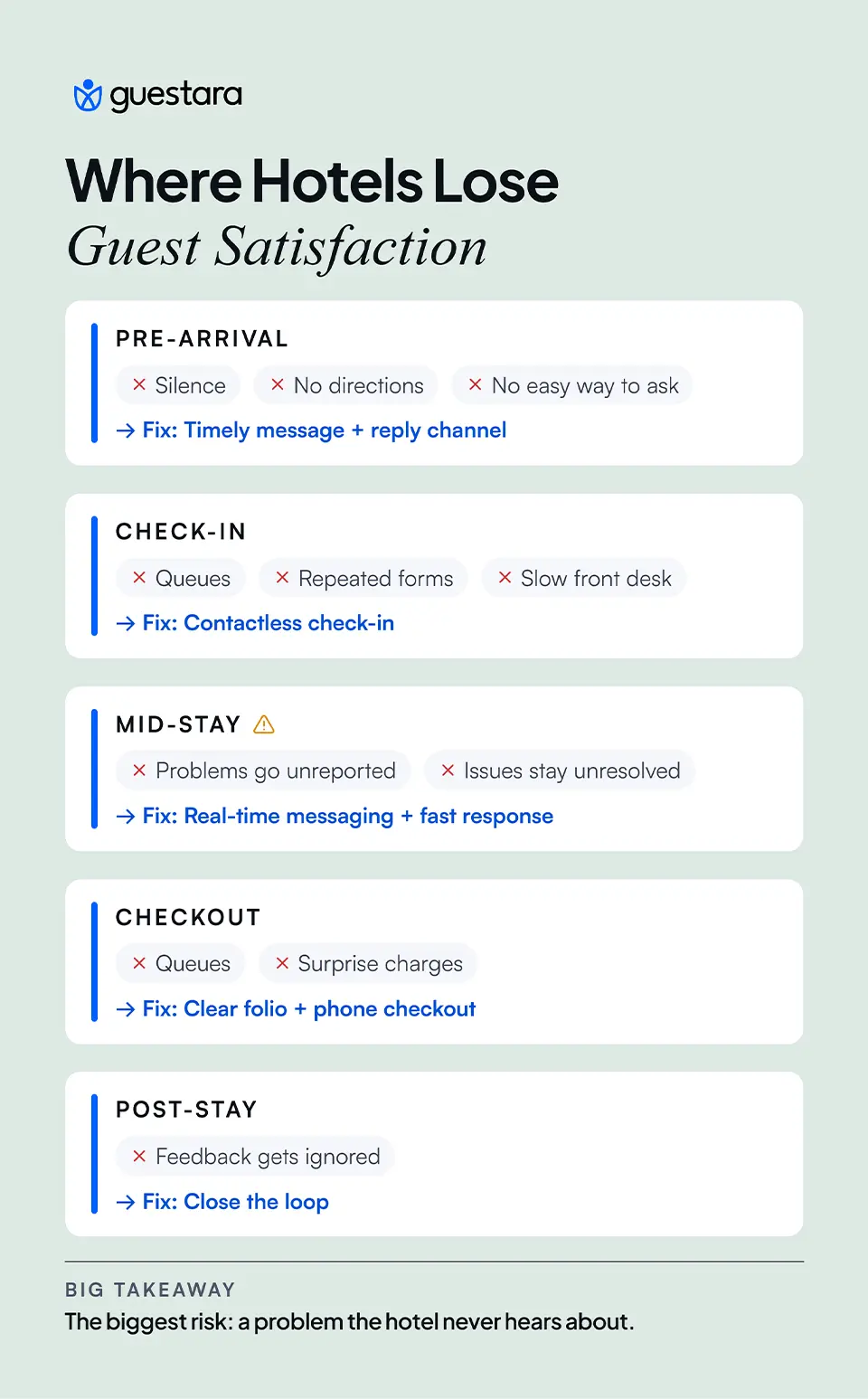
Here is where satisfaction is won or lost at each stage of the guest journey, and the fix for each. Use it as a checklist against your own property.
These stages line up with how the industry measures satisfaction. Check-in and checkout are two of the seven core dimensions JD Power tracks in its North America guest satisfaction study, and the mid-stay experience feeds directly into the staff-service and guest-room dimensions. For the complete framework across the journey, see the guide to hotel guest experience.
.webp)
You catch problems before they become bad reviews by making it effortless for guests to flag issues during the stay, routing each one to the team that owns it, and confirming the fix before checkout. A problem closed on-property is a review that never gets written.
Two moves protect the score. First, real-time messaging, so a frustrated guest can reach you in a tap instead of walking to the desk or staying silent. Second, a review request timed for after the stay that sends happy guests to public sites and routes an unhappy signal to your team privately first. Guestara's Review Collection does exactly that, intercepting a negative experience for internal recovery before it becomes a public one-star.
The order matters. Recovery done inside the building protects the score, and the score protects the rate, especially where a large share of demand comes through OTAs. For more on lifting scores across the stay, see these techniques to boost guest satisfaction.
[[cta:cta-4 | eyebrow=GUEST MESSAGING | heading=Catch a guest problem *before* it becomes a review. | btn=Explore Unified Inbox | link=https://www.guestara.com/unified-inbox ]]
[[cta:cta-5 | eyebrow=GUEST ENGAGEMENT | heading=Protect satisfaction at *every stage* of the stay. | btn=Explore Guest Engagement | link=https://www.guestara.com/guest-engagement-for-hospitality ]]


Hotels lose guest satisfaction most when a mid-stay problem goes unfixed. See where satisfaction drops across the guest journey and how to catch it in time.
Hotels lose guest satisfaction most in the middle of the stay, when a problem the guest noticed never gets fixed.
A guest waits twenty minutes to check in, finds the air conditioning broken, calls the desk twice, and hears nothing back. They will not argue at checkout. They will smile, leave, and write the review from the airport. This guide walks the guest journey stage by stage, shows where satisfaction actually drops, and explains how to catch the damage before it reaches a public review.
Hotels lose guest satisfaction most at three points in the stay, in this order of damage: an unresolved problem during the stay, friction at check-in, and a slow or surprising checkout. The mid-stay failure does the most harm because it compounds. A single unfixed issue colors every hour that follows it.
The pattern behind all three is timing. Satisfaction rarely collapses from one big disaster. It erodes from small failures the hotel never hears about in time to fix. JD Power's guest satisfaction research treats check-in and checkout as core measured dimensions, which is why friction at either end weighs heavily on the overall score, and why a quiet mid-stay failure that no survey captures is the most dangerous of all.
The rest of this guide takes each stage in turn, then maps the whole journey in one table.
Check-in is where many guests form their first judgment, and a slow or chaotic arrival sets a tone that colors the rest of the stay. A tired guest who waits in line, repeats booking details already on file, and fills out a paper form has lost patience before they reach the room.
The common failures are predictable. Long front desk queues at peak arrival times. Unclear directions for finding or accessing the property. Repetitive data entry for information the hotel already holds. Because check-in sits among the core dimensions of guest satisfaction, a rough arrival costs more than a few minutes. It shapes the score the guest gives everything that follows.
The fix is to remove steps before the guest reaches the desk. Guestara's Digital Check-In sends a check-in link by WhatsApp or email, scans the guest's ID, and auto-fills the form, so arrival takes seconds instead of a queue. The front desk becomes a welcome, not a bottleneck.
Mid-stay problems hurt satisfaction most because they go unreported, and therefore unfixed. Most guests will not walk to the front desk to complain. They swallow the frustration, let it color the stay, and release it in a public review after they leave.
The numbers explain the trap. Industry survey data finds only about a quarter of guests report a service problem to the hotel, yet more than half say they would return if the issue were put right. The complaint you actually hear is the small tip of a much larger silent group. Customer-experience analyst Esteban Kolsky's often-cited estimate puts it at roughly 26 silent guests for every one who speaks up.
This is why post-stay surveys fail as an early-warning system. By the time the survey arrives, the guest has gone and the review may already be live. The only real fix is to make it effortless for guests to reach you during the stay, and to route what they say to the right team fast. Guestara's Unified Inbox pulls every guest message, across WhatsApp, SMS, and OTA channels, into one window, so a problem raised at 9pm is seen and acted on, not lost in a channel no one is watching.
Checkout affects guest satisfaction most through two failures: a slow, queued departure and a surprise on the bill. A guest rushing to a flight has no patience for a line or a charge they did not expect, and either one becomes the last thing they remember about the stay.
Billing surprises are the sharper risk. An unexplained fee, or a folio the guest cannot review calmly, reads as a trust problem rather than a service one, and trust problems end up in reviews. A smooth checkout does the opposite. It settles the folio, confirms the charges, and sends the guest off without friction, so the final impression is competence.
Modern checkout removes the desk entirely. Phone-based checkout lets the guest settle the bill, review the folio, and leave on their own schedule, which also frees your team from the morning queue. For practical steps across arrival and departure, see these tips to enhance the guest experience.
Pre-arrival and post-stay are the quiet bookends where satisfaction leaks before and after the stay itself. Before arrival, the gap is silence: no confirmation, no directions, no easy way to ask a question. After checkout, the gap is a hotel that collects feedback and does nothing visible with it.
Before the stay, a short, well-timed message sets expectations and heads off the questions that otherwise pile up at the front desk. Guestara's Guest Journey triggers these messages automatically from booking data, so every guest gets a timely pre-arrival touch without staff effort. After the stay, closing the loop matters. Acknowledging feedback and showing a change keeps a guest who felt heard, while silence quietly loses them.
Personalization sharpens both ends. A message that reflects the guest's reason for travel lands harder than a template, and there are ways to personalize the guest experience that cost little and lift satisfaction at the margins that matter.
Here is where satisfaction is won or lost at each stage of the guest journey, and the fix for each. Use it as a checklist against your own property.
These stages line up with how the industry measures satisfaction. Check-in and checkout are two of the seven core dimensions JD Power tracks in its North America guest satisfaction study, and the mid-stay experience feeds directly into the staff-service and guest-room dimensions. For the complete framework across the journey, see the guide to hotel guest experience.
You catch problems before they become bad reviews by making it effortless for guests to flag issues during the stay, routing each one to the team that owns it, and confirming the fix before checkout. A problem closed on-property is a review that never gets written.
Two moves protect the score. First, real-time messaging, so a frustrated guest can reach you in a tap instead of walking to the desk or staying silent. Second, a review request timed for after the stay that sends happy guests to public sites and routes an unhappy signal to your team privately first. Guestara's Review Collection does exactly that, intercepting a negative experience for internal recovery before it becomes a public one-star.
The order matters. Recovery done inside the building protects the score, and the score protects the rate, especially where a large share of demand comes through OTAs. For more on lifting scores across the stay, see these techniques to boost guest satisfaction.
[[cta:cta-4 | eyebrow=GUEST MESSAGING | heading=Catch a guest problem *before* it becomes a review. | btn=Explore Unified Inbox | link=https://www.guestara.com/unified-inbox ]]
[[cta:cta-5 | eyebrow=GUEST ENGAGEMENT | heading=Protect satisfaction at *every stage* of the stay. | btn=Explore Guest Engagement | link=https://www.guestara.com/guest-engagement-for-hospitality ]]
Hotels lose the most guest satisfaction in the middle of the stay, when a problem the guest noticed goes unaddressed. Check-in friction and a poor checkout are the next biggest drops. The mid-stay failure is the most damaging because it goes unreported and colors the guest's memory of everything else.
Most guests avoid complaining because they do not want to be seen as difficult, or because there is no quick and easy way to raise the issue. Only about a quarter of dissatisfied guests report a problem to the hotel. The rest stay quiet during the stay and express their frustration later in an online review.
Yes. Check-in is the first real interaction, so a slow or chaotic arrival sets a negative tone that carries into the rest of the stay. It is also one of the core dimensions the industry uses to measure hotel guest satisfaction. Removing queues and repetitive forms at arrival protects the score at the moment it first forms.
Make it effortless for guests to message the hotel during the stay, route each issue to the team that owns it, and confirm the fix before checkout. A problem resolved on-property rarely becomes a public review. Timing a review request after the stay, so unhappy signals reach staff privately first, protects the online score further.
Survey guests per touchpoint rather than only after checkout, using short questions at pre-arrival, mid-stay, and post-stay moments. Track a satisfaction score for each stage and watch review themes for the stage they mention. This shows exactly where the drop happens instead of averaging it into one number.
We work closely with the industry leaders to offer seamless solutions




We’re here to help your whole team stay ahead of the curve as you grow.

Get up and running quickly with a personalized onboarding plan

Connect with real people who really get it, 24/7

Checkout our vast library of free resources, templates and more
There's only so much we can say — so let us show you! Schedule a demo today and reach your business goals.



.png)