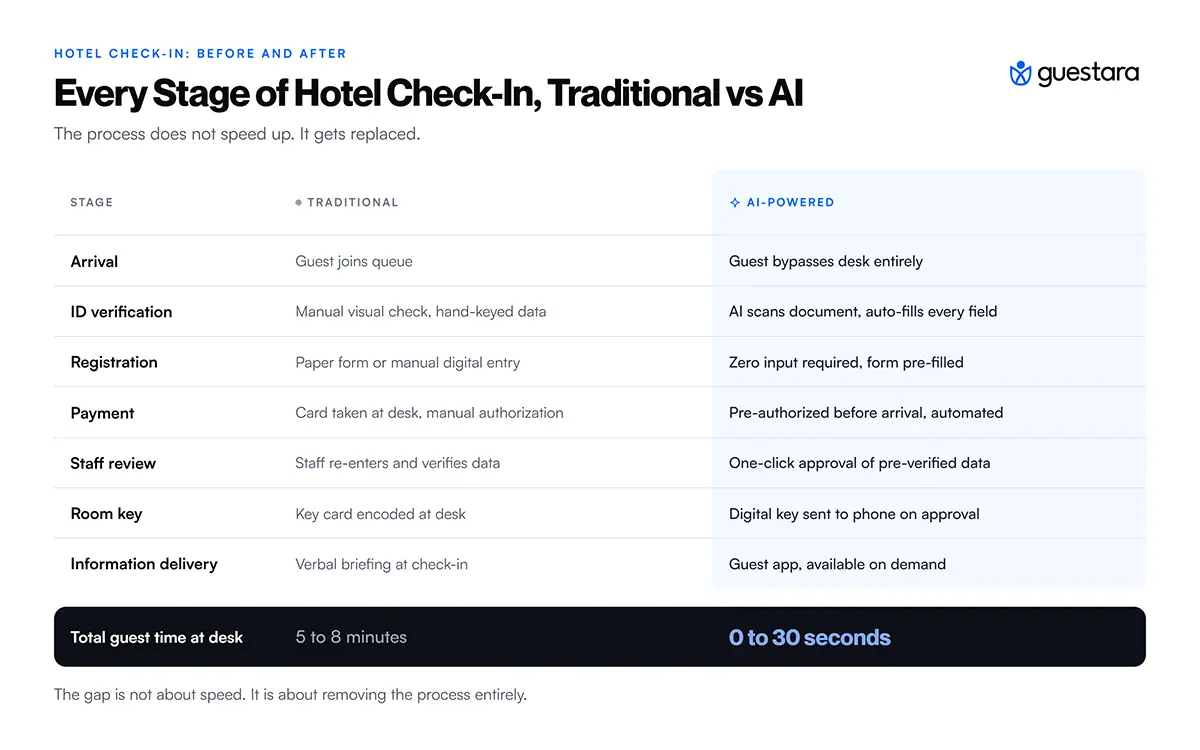
Traditional hotel check-in takes 5 to 8 minutes per guest. AI check-in takes 30 seconds. Here is a complete before and after comparison across every stage.





Picture your front desk at 3pm on a Friday.
Four guests in the queue. One staff member typing. A guest at the counter spelling out their surname for the third time. The couple behind them checking their watches. The solo traveller at the back already reaching for their phone to take a photo of the wait.
This is not a staffing problem. It is a process problem. And it happens at the same time, every day, at thousands of hotels across the world.
Traditional hotel check-in was designed for a different era. Paper forms, manual ID checks, hand-keyed registration data, physical key cards encoded at the desk. The process has not changed much in decades. The guests have.
AI-powered hotel self check-in does not speed up the traditional process. It replaces it. And the gap between hotels that have made that shift and those that have not is widening every year.
This post breaks down the full before and after: every stage of the check-in journey, what it looks like without AI, and what it looks like with it. No jargon. No abstract claims. Just a clear comparison so you can see exactly where the friction lives and what removing it actually changes.
Before comparing, it helps to map exactly what the traditional process involves. Most hotel operators know their check-in is slow. Fewer have mapped out why.
Here is the standard flow at a traditional front desk:
No pre-notification. No status update. The guest walks in and waits.
Staff search the PMS by name or booking reference. If the booking does not pull up cleanly, this step alone takes one to two minutes.
Staff inspect the document visually and enter the details by hand: name, nationality, document number, date of birth, expiry date. For international guests with non-Latin names or documents in unfamiliar scripts, this step is slow and error-prone.
Credit card authorization, incidental deposit, or cash handling. Each adds time. If the card declines, the interaction stalls entirely.
Either the guest fills in a paper form or the staff member completes a digital one. Either way, the data that was already provided at booking is being re-entered.
Staff encode a physical key card, confirm the room number verbally, and hand it over.
WiFi password, breakfast times, pool hours, checkout time. The guest is tired and trying to absorb too much information at once.
Total time: five to eight minutes per guest under normal conditions. During peak arrival windows, with a queue forming, it runs longer.
At a 100-room property running 75% occupancy, that is roughly 75 check-ins per day. At six minutes each, that is seven and a half hours of front desk time spent on a process that adds no value to the guest experience.
.webp)
Hotel self check-in powered by AI does not reshuffle the traditional stages. It removes most of them entirely, and automates the rest. Here is the same journey after AI.
Twenty-four hours before arrival, the guest receives a check-in link via WhatsApp, email, or SMS. No app download required. They open it in a browser on their phone.
The queue does not form because most guests never reach the desk in the first place.
The guest holds their passport, national ID, or driving licence up to their phone camera. The AI scans the document and extracts every field automatically: name, nationality, document number, date of birth, expiry date.
The guest types nothing. There are no errors from manual entry. The data is verified at the point of scan, not after.
Every registration field is populated from the scan data. The guest glances at the pre-filled form to confirm it looks right. One tap to submit.
From opening the link to submitting the form: under 30 seconds for most guests.
Deposit collection, card-on-file tokenization, and pre-authorization happen automatically through the platform before the guest arrives. Fraud protection via 3D Secure, address verification, and CVC check runs in the background. No manual card handling at the desk.
The completed registration appears in the hotel dashboard. A staff member reviews it — which takes seconds because all the data is already there and verified — and approves with one click.
On approval, the platform sends a digital room key directly to the guest's phone. For hotels without smart locks, a key card is prepared in advance and handed over in seconds on arrival. Either way, the guest does not stand at the desk while a key card is encoded.
The guest arrives at the property, goes directly to their room, and opens the door with their phone. Their first physical interaction with the property is the door.
The WiFi password, breakfast times, pool hours, and checkout information are in the guest app. The guest accesses them when they need them, not when they are standing tired at the front desk.
Total time at the desk for a guest who completed pre-arrival check-in: zero.
The JD Power 2025 North America Hotel Guest Satisfaction Index, based on 39,219 guests across 102 hotel brands, measures check-in and check-out as one of seven core dimensions of overall guest satisfaction. It is the dimension guests encounter first. It sets the frame for everything that follows.
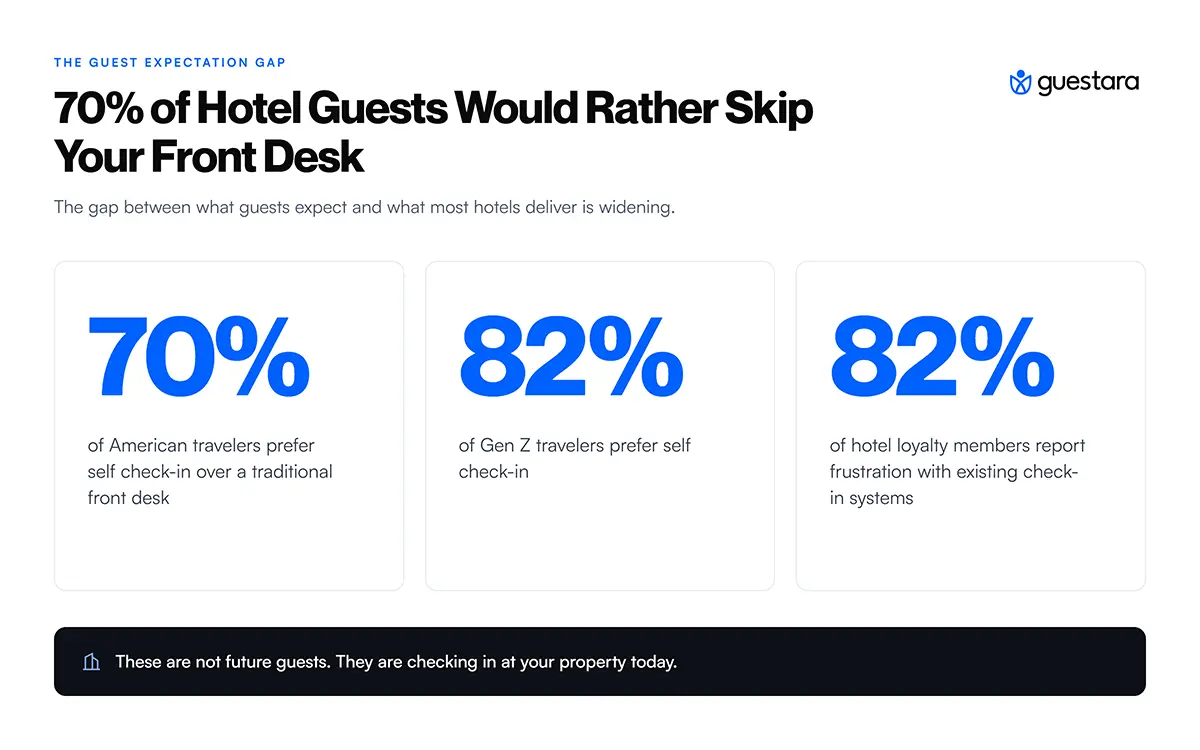
A 2025 survey by Mews covering 2,000 American travelers found that 70% would prefer to skip the front desk entirely in favour of an app or self-service channel. That number rises to 82% among Gen Z travelers. And 82% of hotel loyalty members — the guests most likely to return — report frustration with existing check-in systems.
This is not future preference data. These guests are arriving at your property today.
The gap is not between budget hotels and luxury hotels. It is between hotels that have automated the arrival process and hotels that have not. That gap currently sits at around five to eight minutes per guest. Over a peak arrival window, it is the difference between a queue and no queue. Between a stressed front desk team and a team with time to make a genuine welcome.
Hotels on the wrong side of that gap are not just slower. They are being reviewed differently, rebooking at different rates, and competing for the same guests with a fundamentally different arrival experience.
The most common concern hotel GMs raise about AI-powered hotel self check-in is what it means for staff. The concern is understandable. The answer is not what most people expect.
AI does not reduce the need for a good front desk team. It changes what that team does.
Manual check-in occupies trained hospitality professionals with data entry: typing passport numbers, re-reading form fields, asking guests to repeat their surname. These tasks exist because someone has to do them. They require time and attention. But they produce no guest experience value whatsoever.
When AI handles those tasks, your front desk team gets the most valuable resource in hospitality: time and attention to spend on people.
Noticing that a guest looks exhausted and offering to have a drink sent to the room before they ask. Remembering the couple who stayed last year and asking if they want the same table at dinner. Catching the first-time visitor who is nervous about getting around and spending three minutes on directions that turn a satisfactory stay into a memorable one.
That is what the freed time is worth. Not headcount reduction. Redeployment toward the parts of hospitality that cannot be automated.
For more on managing the front desk during peak arrival windows once self check-in is running, see our post on the hotel self check-in peak-hour playbook.
Not every guest will complete check-in before they arrive. Some will miss the link. Others will intend to do it later and forget. International travelers with connectivity issues may not see the message until they land.
A well-built system accounts for this without breaking the experience.
The fallback is a tablet at the front desk. The guest walks up, the staff member hands them the tablet, and they scan their ID right there. The AI does the same scan in the same 30 seconds. The form fills itself. Staff approve on the spot.
Guestara's hotel self-service kiosk covers exactly this on-arrival flow. The pre-arrival and on-arrival experiences use the same AI scanning technology, so the process is consistent for every guest regardless of when they check in.
What this means in practice: there is no longer a category of guest who creates a slow check-in. Every guest either checks in in under 30 seconds before arrival, or in under 30 seconds at the desk. The five-to-eight-minute process is gone in both cases.
To understand how the pre-arrival message sequence affects check-in completion rates, see our guide on how pre-arrival messages boost hotel self check-in completion.
A question that comes up consistently when hotels evaluate AI-powered check-in is whether removing a human from ID verification reduces security. The data suggests the opposite.
Manual ID checks at a traditional front desk depend on a staff member being trained, alert, and consistent. A busy Friday evening with a full arrival queue is not the optimal environment for accurate document verification. Staff under pressure rush. They make exceptions. They approve documents they are not entirely sure about because there are four guests waiting behind the one in front of them.
AI ID scanning does not get tired. It applies the same verification criteria to every document, every time, regardless of queue length or time of day. Modern systems go beyond reading the printed data, assessing document authenticity in real time to identify manipulation or forgery.
For properties with local compliance requirements, every registration captured through AI scanning can be exported in a compliant format for authority submission. The digital process does not remove the compliance requirement. It makes meeting it more reliable.
For a detailed breakdown of AI identity verification from a guest privacy angle, see our post on how AI verifies guest identity at digital check-in.
There is one step in traditional hotel check-in that even a completed digital registration cannot solve without the right technology: handing over a room key.
If a guest completes their pre-arrival check-in but still has to stop at the front desk to collect a key card, the queue has not been eliminated. It has moved to a different point in the process.
Smart lock integration closes that gap.
When a staff member approves a digital registration in the platform, the system automatically sends a digital key to the guest's phone. The guest walks from the car park to their room door without any interaction with the front desk. Guestara integrates with over 50 smart lock providers, covering the major systems already installed across independent hotels globally. You can see the full list of supported systems on the hotel smart locks page.
For most properties that already have smart locks installed, this is not a new hardware investment. It is connecting the check-in system to the door access system, so approval and key delivery happen in a single automated step.
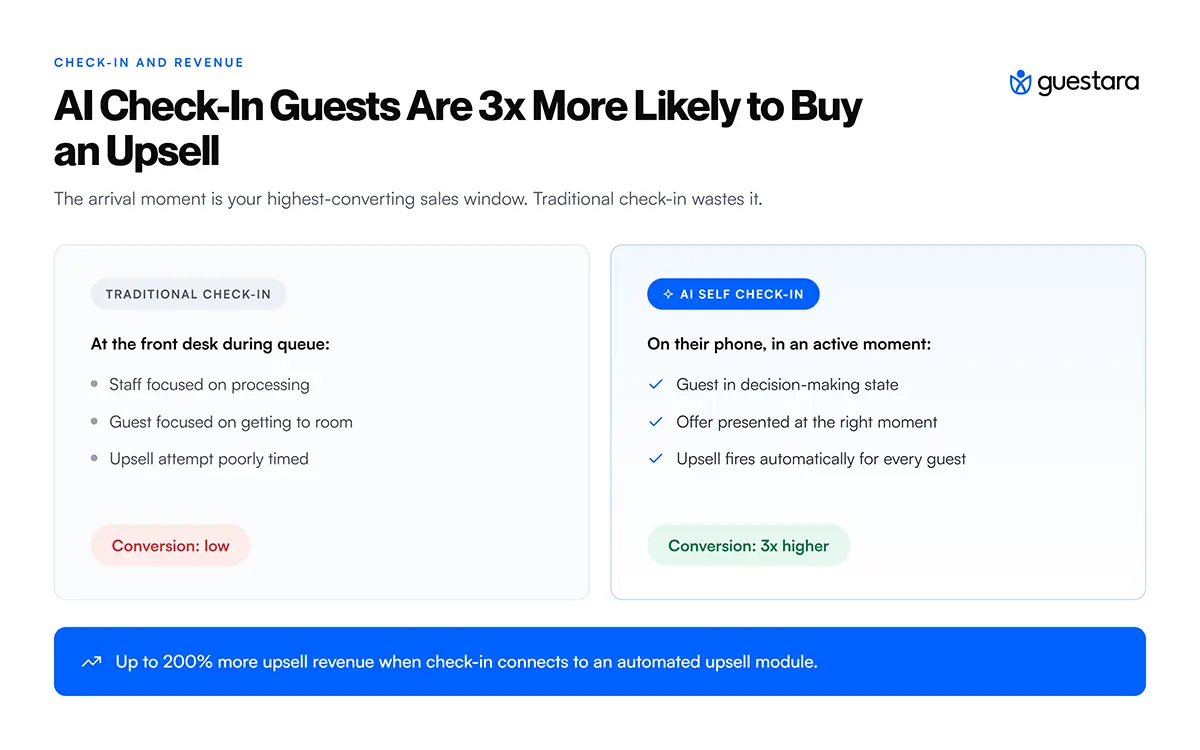
The traditional front desk check-in is not a revenue moment. Staff are focused on processing. Guests are focused on getting to their rooms. Upsell attempts at a busy desk are poorly timed and rarely convert.
AI-powered hotel self check-in changes the timing of the revenue moment entirely.
Mews kiosk data shows that guests who check in via a self-service channel are three times more likely to purchase an upsell compared to guests who check in at a traditional front desk. The reason is context: a guest completing check-in on their phone is in an active, decision-making state. They are already in the flow of arrival. An offer for a room upgrade, an early check-in, a dinner reservation, or a late checkout presented at that moment lands differently than a verbal suggestion made while someone else's key card is being encoded.
When the check-in flow is connected to an upsell module, those offers fire automatically at the right moment for every guest. Not some guests. Every guest. Guestara's upsell module connects directly to the check-in flow and can present tailored offers based on booking type, room category, and stay length. Hotels using the combined check-in and upsell flow have reported up to 200% more upsell revenue compared to traditional desk-based approaches.
There is a direct relationship between check-in experience and review scores. It is not subtle.
A guest who waits eight minutes in a queue, fills in a form with information they already provided at booking, and then waits while a key card is encoded has started their stay with friction. That friction does not stay at the front desk. It colours every subsequent interaction. The room that would have felt fine after a smooth arrival now feels smaller. The slow WiFi that would have been a minor annoyance now feels like one more thing.
When the arrival experience is frictionless — guest walks in, goes to their room, everything is ready — the stay begins with a positive frame. The same room, the same WiFi, the same breakfast produces a better review.
Guestara's review collection module sends a review request at the optimal moment after checkout. For properties using the full check-in to checkout flow, including the smart checkout that prompts guests to rate their stay before leaving, the positive review rate increases significantly. Properties using Guestara have reported up to 300% more positive reviews compared to their previous approach.
For the full picture on how check-in connects to review outcomes, see our post on intercepting bad hotel reviews at check-in.
Guestara's contactless check-in and checkout platform covers the complete before and after described in this post.
The check-in flow includes:
The platform also includes Guestara's hospitality AI layer, which handles routine guest queries 24/7, escalates complex requests to staff, and proactively surfaces upsell opportunities based on conversation context.
Onboarding takes approximately one week. Guestara integrates with major PMS systems including Cloudbeds, Hotelogix, Ezee Absolute, Apaleo, Beds24, SiteMinder, Little Hotelier, and Oracle.
If you want to see what this looks like on your specific property setup, the Guestara team can walk you through a configuration for your PMS and lock system.


Traditional hotel check-in takes 5 to 8 minutes per guest. AI check-in takes 30 seconds. Here is a complete before and after comparison across every stage.
Picture your front desk at 3pm on a Friday.
Four guests in the queue. One staff member typing. A guest at the counter spelling out their surname for the third time. The couple behind them checking their watches. The solo traveller at the back already reaching for their phone to take a photo of the wait.
This is not a staffing problem. It is a process problem. And it happens at the same time, every day, at thousands of hotels across the world.
Traditional hotel check-in was designed for a different era. Paper forms, manual ID checks, hand-keyed registration data, physical key cards encoded at the desk. The process has not changed much in decades. The guests have.
AI-powered hotel self check-in does not speed up the traditional process. It replaces it. And the gap between hotels that have made that shift and those that have not is widening every year.
This post breaks down the full before and after: every stage of the check-in journey, what it looks like without AI, and what it looks like with it. No jargon. No abstract claims. Just a clear comparison so you can see exactly where the friction lives and what removing it actually changes.
Before comparing, it helps to map exactly what the traditional process involves. Most hotel operators know their check-in is slow. Fewer have mapped out why.
Here is the standard flow at a traditional front desk:
No pre-notification. No status update. The guest walks in and waits.
Staff search the PMS by name or booking reference. If the booking does not pull up cleanly, this step alone takes one to two minutes.
Staff inspect the document visually and enter the details by hand: name, nationality, document number, date of birth, expiry date. For international guests with non-Latin names or documents in unfamiliar scripts, this step is slow and error-prone.
Credit card authorization, incidental deposit, or cash handling. Each adds time. If the card declines, the interaction stalls entirely.
Either the guest fills in a paper form or the staff member completes a digital one. Either way, the data that was already provided at booking is being re-entered.
Staff encode a physical key card, confirm the room number verbally, and hand it over.
WiFi password, breakfast times, pool hours, checkout time. The guest is tired and trying to absorb too much information at once.
Total time: five to eight minutes per guest under normal conditions. During peak arrival windows, with a queue forming, it runs longer.
At a 100-room property running 75% occupancy, that is roughly 75 check-ins per day. At six minutes each, that is seven and a half hours of front desk time spent on a process that adds no value to the guest experience.
Hotel self check-in powered by AI does not reshuffle the traditional stages. It removes most of them entirely, and automates the rest. Here is the same journey after AI.
Twenty-four hours before arrival, the guest receives a check-in link via WhatsApp, email, or SMS. No app download required. They open it in a browser on their phone.
The queue does not form because most guests never reach the desk in the first place.
The guest holds their passport, national ID, or driving licence up to their phone camera. The AI scans the document and extracts every field automatically: name, nationality, document number, date of birth, expiry date.
The guest types nothing. There are no errors from manual entry. The data is verified at the point of scan, not after.
Every registration field is populated from the scan data. The guest glances at the pre-filled form to confirm it looks right. One tap to submit.
From opening the link to submitting the form: under 30 seconds for most guests.
Deposit collection, card-on-file tokenization, and pre-authorization happen automatically through the platform before the guest arrives. Fraud protection via 3D Secure, address verification, and CVC check runs in the background. No manual card handling at the desk.
The completed registration appears in the hotel dashboard. A staff member reviews it — which takes seconds because all the data is already there and verified — and approves with one click.
On approval, the platform sends a digital room key directly to the guest's phone. For hotels without smart locks, a key card is prepared in advance and handed over in seconds on arrival. Either way, the guest does not stand at the desk while a key card is encoded.
The guest arrives at the property, goes directly to their room, and opens the door with their phone. Their first physical interaction with the property is the door.
The WiFi password, breakfast times, pool hours, and checkout information are in the guest app. The guest accesses them when they need them, not when they are standing tired at the front desk.
Total time at the desk for a guest who completed pre-arrival check-in: zero.
The JD Power 2025 North America Hotel Guest Satisfaction Index, based on 39,219 guests across 102 hotel brands, measures check-in and check-out as one of seven core dimensions of overall guest satisfaction. It is the dimension guests encounter first. It sets the frame for everything that follows.
A 2025 survey by Mews covering 2,000 American travelers found that 70% would prefer to skip the front desk entirely in favour of an app or self-service channel. That number rises to 82% among Gen Z travelers. And 82% of hotel loyalty members — the guests most likely to return — report frustration with existing check-in systems.
This is not future preference data. These guests are arriving at your property today.
The gap is not between budget hotels and luxury hotels. It is between hotels that have automated the arrival process and hotels that have not. That gap currently sits at around five to eight minutes per guest. Over a peak arrival window, it is the difference between a queue and no queue. Between a stressed front desk team and a team with time to make a genuine welcome.
Hotels on the wrong side of that gap are not just slower. They are being reviewed differently, rebooking at different rates, and competing for the same guests with a fundamentally different arrival experience.
The most common concern hotel GMs raise about AI-powered hotel self check-in is what it means for staff. The concern is understandable. The answer is not what most people expect.
AI does not reduce the need for a good front desk team. It changes what that team does.
Manual check-in occupies trained hospitality professionals with data entry: typing passport numbers, re-reading form fields, asking guests to repeat their surname. These tasks exist because someone has to do them. They require time and attention. But they produce no guest experience value whatsoever.
When AI handles those tasks, your front desk team gets the most valuable resource in hospitality: time and attention to spend on people.
Noticing that a guest looks exhausted and offering to have a drink sent to the room before they ask. Remembering the couple who stayed last year and asking if they want the same table at dinner. Catching the first-time visitor who is nervous about getting around and spending three minutes on directions that turn a satisfactory stay into a memorable one.
That is what the freed time is worth. Not headcount reduction. Redeployment toward the parts of hospitality that cannot be automated.
For more on managing the front desk during peak arrival windows once self check-in is running, see our post on the hotel self check-in peak-hour playbook.
Not every guest will complete check-in before they arrive. Some will miss the link. Others will intend to do it later and forget. International travelers with connectivity issues may not see the message until they land.
A well-built system accounts for this without breaking the experience.
The fallback is a tablet at the front desk. The guest walks up, the staff member hands them the tablet, and they scan their ID right there. The AI does the same scan in the same 30 seconds. The form fills itself. Staff approve on the spot.
Guestara's hotel self-service kiosk covers exactly this on-arrival flow. The pre-arrival and on-arrival experiences use the same AI scanning technology, so the process is consistent for every guest regardless of when they check in.
What this means in practice: there is no longer a category of guest who creates a slow check-in. Every guest either checks in in under 30 seconds before arrival, or in under 30 seconds at the desk. The five-to-eight-minute process is gone in both cases.
To understand how the pre-arrival message sequence affects check-in completion rates, see our guide on how pre-arrival messages boost hotel self check-in completion.
A question that comes up consistently when hotels evaluate AI-powered check-in is whether removing a human from ID verification reduces security. The data suggests the opposite.
Manual ID checks at a traditional front desk depend on a staff member being trained, alert, and consistent. A busy Friday evening with a full arrival queue is not the optimal environment for accurate document verification. Staff under pressure rush. They make exceptions. They approve documents they are not entirely sure about because there are four guests waiting behind the one in front of them.
AI ID scanning does not get tired. It applies the same verification criteria to every document, every time, regardless of queue length or time of day. Modern systems go beyond reading the printed data, assessing document authenticity in real time to identify manipulation or forgery.
For properties with local compliance requirements, every registration captured through AI scanning can be exported in a compliant format for authority submission. The digital process does not remove the compliance requirement. It makes meeting it more reliable.
For a detailed breakdown of AI identity verification from a guest privacy angle, see our post on how AI verifies guest identity at digital check-in.
There is one step in traditional hotel check-in that even a completed digital registration cannot solve without the right technology: handing over a room key.
If a guest completes their pre-arrival check-in but still has to stop at the front desk to collect a key card, the queue has not been eliminated. It has moved to a different point in the process.
Smart lock integration closes that gap.
When a staff member approves a digital registration in the platform, the system automatically sends a digital key to the guest's phone. The guest walks from the car park to their room door without any interaction with the front desk. Guestara integrates with over 50 smart lock providers, covering the major systems already installed across independent hotels globally. You can see the full list of supported systems on the hotel smart locks page.
For most properties that already have smart locks installed, this is not a new hardware investment. It is connecting the check-in system to the door access system, so approval and key delivery happen in a single automated step.
The traditional front desk check-in is not a revenue moment. Staff are focused on processing. Guests are focused on getting to their rooms. Upsell attempts at a busy desk are poorly timed and rarely convert.
AI-powered hotel self check-in changes the timing of the revenue moment entirely.
Mews kiosk data shows that guests who check in via a self-service channel are three times more likely to purchase an upsell compared to guests who check in at a traditional front desk. The reason is context: a guest completing check-in on their phone is in an active, decision-making state. They are already in the flow of arrival. An offer for a room upgrade, an early check-in, a dinner reservation, or a late checkout presented at that moment lands differently than a verbal suggestion made while someone else's key card is being encoded.
When the check-in flow is connected to an upsell module, those offers fire automatically at the right moment for every guest. Not some guests. Every guest. Guestara's upsell module connects directly to the check-in flow and can present tailored offers based on booking type, room category, and stay length. Hotels using the combined check-in and upsell flow have reported up to 200% more upsell revenue compared to traditional desk-based approaches.
There is a direct relationship between check-in experience and review scores. It is not subtle.
A guest who waits eight minutes in a queue, fills in a form with information they already provided at booking, and then waits while a key card is encoded has started their stay with friction. That friction does not stay at the front desk. It colours every subsequent interaction. The room that would have felt fine after a smooth arrival now feels smaller. The slow WiFi that would have been a minor annoyance now feels like one more thing.
When the arrival experience is frictionless — guest walks in, goes to their room, everything is ready — the stay begins with a positive frame. The same room, the same WiFi, the same breakfast produces a better review.
Guestara's review collection module sends a review request at the optimal moment after checkout. For properties using the full check-in to checkout flow, including the smart checkout that prompts guests to rate their stay before leaving, the positive review rate increases significantly. Properties using Guestara have reported up to 300% more positive reviews compared to their previous approach.
For the full picture on how check-in connects to review outcomes, see our post on intercepting bad hotel reviews at check-in.
Guestara's contactless check-in and checkout platform covers the complete before and after described in this post.
The check-in flow includes:
The platform also includes Guestara's hospitality AI layer, which handles routine guest queries 24/7, escalates complex requests to staff, and proactively surfaces upsell opportunities based on conversation context.
Onboarding takes approximately one week. Guestara integrates with major PMS systems including Cloudbeds, Hotelogix, Ezee Absolute, Apaleo, Beds24, SiteMinder, Little Hotelier, and Oracle.
If you want to see what this looks like on your specific property setup, the Guestara team can walk you through a configuration for your PMS and lock system.
Traditional hotel check-in requires guests to present their ID at the front desk, where a staff member verifies the document and enters every detail manually into the system. The process takes five to eight minutes per guest and creates a queue during peak arrival windows. AI-powered hotel self check-in sends the guest a check-in link before arrival. The guest scans their own ID on their phone, and the AI reads the document and fills every registration field automatically — no typing required. The entire process takes under 30 seconds. Staff review and approve the completed registration in a dashboard, then the platform sends a digital room key to the guest's phone. The guest arrives at the property and goes directly to their room without stopping at the front desk.
AI ID scanning is more consistent than manual verification at a busy front desk. A staff member verifying documents during a peak arrival window is subject to time pressure, fatigue, and inconsistency. AI applies the same verification criteria to every document, every time, regardless of conditions. Modern systems also assess document authenticity in real time, going beyond the printed data to check whether the document itself is genuine. For compliance purposes, registration data captured via AI scanning can be exported in formats that meet local regulatory requirements, making the compliance step more reliable, not less.
Guests who miss the pre-arrival link check in on a tablet at the front desk. The tablet runs the same AI scanning flow: the guest holds up their ID, the AI reads and auto-fills the form in 30 seconds, and staff approve on the spot. The experience is consistent regardless of when the guest checks in. There is no longer a category of guest who creates a five-to-eight-minute desk interaction. Every guest checks in in under 30 seconds, whether they do it the night before or when they arrive.
Guests who check in via a self-service channel are three times more likely to purchase an upsell compared to guests who check in at a traditional front desk, according to Mews kiosk data. The timing is the reason: a guest completing their check-in on their phone is in an active, decision-making state and is more likely to respond to a well-placed offer for a room upgrade, early check-in, or F&B package. When the check-in flow connects to an automated upsell module, those offers reach every guest at the optimal moment, not just the guests who happen to be in front of a staff member with time to make the pitch.
With Guestara, onboarding takes approximately one week. The platform integrates with major PMS systems including Cloudbeds, Hotelogix, Ezee Absolute, Apaleo, Beds24, SiteMinder, Little Hotelier, and Oracle. The setup covers the pre-arrival check-in flow, the tablet fallback for on-arrival guests, smart lock connection for digital key delivery, and the upsell and payment modules. Most hotels run both the new digital flow and the traditional desk process in parallel during the first few days, then phase out the manual process as pre-arrival completion rates climb.
We work closely with the industry leaders to offer seamless solutions




We’re here to help your whole team stay ahead of the curve as you grow.

Get up and running quickly with a personalized onboarding plan

Connect with real people who really get it, 24/7

Checkout our vast library of free resources, templates and more
There's only so much we can say — so let us show you! Schedule a demo today and reach your business goals.


.png)