In This Article:
Subscribe to our newsletter
Read about our privacy policy.
Thank you! Your submission has been received!
Oops! Something went wrong while submitting the form.
Hotel Operations

Hotel Business Plan: A Complete Guide and Template

A complete hotel business plan guide with every section, real startup-cost numbers, a boutique template, and the financial projections investors expect.


Published on:
1/10/2026
Summarise with:
How to Write a Hotel Business Plan That Gets Funded Complete Guide by Guestara
TL;DR — Key Takeaways
  • A hotel business plan is a formal document covering your concept, market, operations, marketing, and financials, used mainly to secure funding and guide launch.
  • It has seven core sections: executive summary, company description, market analysis, services, operations, marketing, and the financial plan.
  • Entrepreneurs who write a formal plan are about 16% more likely to reach viability than those who do not (Harvard Business Review).
  • Budget by per-room cost: US development runs a median near $219,000 per room, from about $167,000 for limited-service to over $1 million for luxury (HVS, 2025), with many emerging markets lower.
  • A boutique plan leads with concept and niche, a budget plan with efficiency and occupancy, and a resort plan with the destination experience.

A hotel business plan is the document that turns your idea for a property into something a bank or investor will fund. It sets out your concept, your market, how you will operate, and the numbers that prove it can work.

Most hotels are won or lost on paper long before the doors open. A vague plan gets a polite no from lenders. A clear, specific one gets the meeting, the loan, and a roadmap your team can follow. This guide walks through every section of a hotel business plan, shows the real startup numbers to budget for, and gives you a boutique template you can adapt today.

What Is a Hotel Business Plan and Why Do You Need One?

A hotel business plan is a formal document that explains how you will launch, operate, and grow a hotel, and it exists mainly to secure funding and align your team. It covers your concept, market research, operating model, marketing strategy, and financial projections in one place.

You need one for three reasons:

  • Lenders and investors require it. They will not commit capital without seeing your concept, your market position, and your path to profit.
  • It reduces risk. Writing it forces you to confront staffing, seasonality, and cost obstacles before they become real.
  • It creates clarity. It gives every pricing, hiring, and marketing decision a single reference point.

The discipline itself pays off. Harvard Business Review research found that entrepreneurs who write a formal plan are about 16% more likely to reach viability than otherwise identical founders who skip it. The plan is not paperwork. It is the first real test of whether the business works.

Key takeaways

  • A hotel business plan documents your concept, market, operations, marketing, and financials, primarily to secure funding and guide launch.
  • Writing a formal plan makes a founder about 16% more likely to reach viability (Harvard Business Review).

What Sections Does a Hotel Business Plan Include?

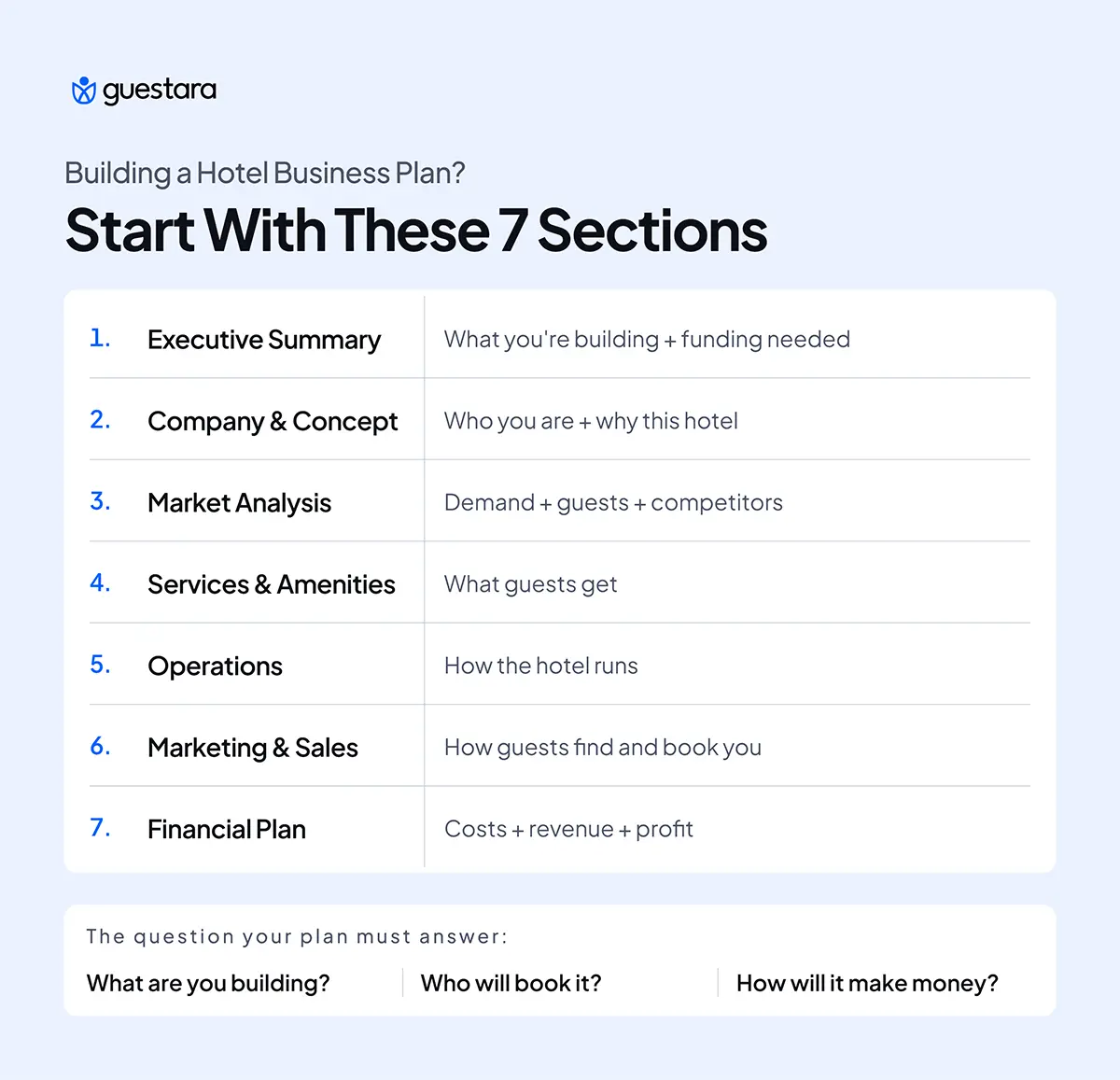
Guestara infographic outlining the seven sections of a hotel business plan: executive summary, company and concept, market analysis, services and amenities, operations, marketing and sales, and financial plan.

A hotel business plan includes seven core sections: an executive summary, a company description, a market and competitor analysis, a services and amenities section, an operations and management plan, a marketing and sales strategy, and a financial plan. Together they answer what you are building, for whom, how you will run it, and whether the numbers work.

Use this as the skeleton of your document and the checklist for what a complete plan contains.

Section What it answers
Executive summary What you are building, why now, and what you need
Company description Your concept, structure, ownership, and unique selling point
Market and competitor analysis Who your guests are and why demand exists
Services, amenities, and technology What guests get and how you deliver it
Operations and management How the hotel runs day to day and at scale
Marketing and sales How guests find and book you
Financial plan Startup costs, revenue model, and the path to profit

Key takeaways

  • A complete hotel business plan has seven core sections, from the executive summary to the financial plan.
  • The executive summary is written last but read first, so it must stand on its own.

Writing the Core Sections of Your Plan

Here is what belongs in each core section. Write the executive summary last, once the rest gives you the material.

Executive Summary

A one-page pitch that captures the whole plan. Include:

  • Your concept and location in one or two lines
  • Room count and property type
  • A short market-opportunity statement
  • Headline financial projections
  • The funding you need and how you will use it
  • A target opening date

An investor who reads only this page should understand your value proposition and want to keep reading.

Company Description and Concept

What your hotel is and who it is for. Include:

  • Property name and branding concept
  • Legal structure and ownership
  • Founding team and relevant experience
  • Location and property overview
  • Your single unique selling point

Tell the origin story briefly. A concept an investor remembers beats a page of adjectives.

Market and Competitor Analysis

This section proves demand exists and that you can capture it. Include:

  • Local tourism and demand data for your city
  • Guest personas: who they are and why they travel
  • Seasonality and the events that drive traffic
  • A competitor matrix of three to five nearby hotels on rate, occupancy, and review scores
  • The specific gap you fill

For context, India's hotel demand has outpaced new supply for three years running, with national occupancy near 64% in 2025 (Horwath HTL, 2025). Cite your own city's figures, not national averages.

Services, Amenities, and Technology

What guests experience and the systems that deliver it. Cover your room types, on-site services, and guest-facing amenities, then name the technology that runs them, since investors expect a tech-forward operation that holds service quality without heavy headcount. A modern stack usually includes:

Match the amenities to your target guest. A business traveler wants fast wifi and a workspace, while a family wants flexibility and safety. For how these pieces connect across the stay, see the hotel guest journey guide and this self-check-in guide.

Operations and Management

How the hotel runs day to day and scales without losing consistency. Include:

  • Daily operations workflow
  • Staffing model by department, with an org chart
  • Key team bios and relevant experience
  • Training and quality-assurance standards
  • Core systems: PMS, housekeeping and task tools, and back-office accounting and payroll

An automated guest engagement platform that runs the messaging journey and routes tasks is what lets a lean team deliver a full-service experience. Investors want to see a scalable, tech-forward plan, not one that adds headcount for every new guest.

Marketing and Sales Strategy

How guests discover and book you. Include:

  • Brand identity: voice, look, and positioning
  • Website and booking engine
  • SEO, paid search, social, and email
  • OTA distribution and a direct-booking strategy
  • PR, influencer, and loyalty or referral programs
  • KPIs and a sales forecast tied to your revenue projections

Channel choice matters in your market. WhatsApp marketing reaches guests where they already are across India and the GCC. For building these journeys, see the guest communication automation guide.

Key takeaways

  • Each core section answers a distinct investor question, from concept to daily operations to how guests book.
  • Name your technology and team explicitly, since investors fund a plan that scales service without scaling headcount.
Guestara infographic showing what different hotel types should prioritize in a business plan, comparing boutique, budget or economy, and resort hotels by their lead focus and key proof points for investors.

How Do You Build the Financial Plan?

You build the financial plan in three parts: your startup costs and funding request, your revenue model, and your profit-and-loss, cash-flow, and break-even projections. This is the section investors scrutinize most, so every number must trace back to your market and operating assumptions.

Startup Costs and Funding Request

Itemize every one-time cost to open:

Then state how much you need and how you will use it, split into debt and equity, with repayment terms or projected investor return. Precision here signals competence.

Revenue Model

Forecast revenue over three to five years using:

  • Occupancy by month or season
  • Average daily rate by room type
  • The resulting revenue per available room (RevPAR)
  • Ancillary income from F&B, upsells, spa, and events

Anchor the numbers to real benchmarks. India's hotels held about 64% occupancy in 2025 with RevPAR up nearly 11% year over year (Horwath HTL, 2025), and Tier 1 cities reached roughly 75% occupancy at an average daily rate near $119. Use your own market's figures, and show the math in a table so a reader can follow every assumption.

P&L, Cash Flow, and Break-Even

Provide three things:

  • A full profit-and-loss statement showing revenue, operating expenses, and net profit
  • A monthly cash-flow projection to show liquidity across the year
  • A break-even analysis showing when revenue covers your fixed costs

Add a best-case and worst-case scenario so investors see you can adapt to a soft season or a cost spike. This matters most for a budget hotel plan, where margins are thin and the path to profit must be exact.

Key takeaways

  • The financial plan has three parts: startup costs and funding ask, the revenue model, and P&L with cash flow and break-even.
  • Every projection must trace to your market and operating assumptions, or investors will not trust the numbers.

How Much Does It Cost to Open a Hotel?

The cost to open a hotel is driven mostly by per-room development cost, which varies widely by class and location. In the US, all-in development runs a median near $219,000 per room, according to the HVS 2025 survey, from roughly $167,000 for limited-service to over $1 million for luxury. Emerging markets in India and much of Southeast Asia typically build for less, while prime GCC locations can run higher.

Hotel class Approx. all-in cost per room (US benchmark)
Limited-service / economy around $167,000
Midscale and extended-stay around $170,000 to $250,000
Full-service / upscale $400,000 and up
Luxury / resort $1,000,000 and up

Those medians come from the HVS 2025 US Hotel Development Cost Survey, which tracks actual construction budgets. To estimate your own budget:

  • Multiply the per-room figure for your class by your room count for a first estimate
  • Localize it, since construction and labor cost far less in many Indian and Southeast Asian markets
  • Commission a local feasibility study for the real number
  • Add pre-opening costs, FF&E at roughly 5% to 9% of construction, and a working-capital cushion for the ramp-up months

Key takeaways

  • US hotel development runs a median near $219,000 per room, from about $167,000 for limited-service to over $1 million for luxury (HVS, 2025).
  • Start from the per-room benchmark for your class, then localize it and add FF&E, pre-opening, and working-capital costs.

How Do You Adapt the Plan by Hotel Type?

You adapt a hotel business plan by leading with what makes each property type win. The seven sections stay the same, but the emphasis shifts with the concept.

Hotel type Lead the plan with Emphasize in the financials
Boutique A distinct concept and target niche Rate premium and direct-booking mix
Budget / economy Lean operations and high occupancy Cost control and break-even occupancy
Resort The destination and on-site experience Multiple revenue streams and seasonality
  • Boutique plans win on identity, so make the concept, design, and local story the spine and show how a distinct experience earns a rate premium and loyal direct bookings.
  • Budget plans win on discipline, so lead with standard operating procedures, self-service technology, and the occupancy needed to break even.
  • Resort plans sell the destination itself, so detail the programming and the multiple revenue streams, from F&B and spa to events, and staff for the seasonality.

If your property is a vacation rental or short-term rental rather than a hotel, the plan is similar but leans on rental agreements and direct booking rather than a front desk.

Key takeaways

  • The seven plan sections stay constant across hotel types, but the emphasis shifts with the property.
  • A boutique plan leads with concept and niche, a budget plan with efficiency and occupancy, and a resort plan with experience.

Boutique Hotel Business Plan Template

Here is a boutique hotel business plan template you can copy and fill in. Each line is the prompt to answer for that section, tuned for a small, concept-led property.

Section Fill in for your boutique hotel
Executive summary Your concept in one line, location, room count, target guest, funding ask, opening date
Company description The story and design concept, legal structure, owners, and your single differentiator
Market analysis Local demand and tourism data, your niche guest persona, three to five competitors, the gap you fill
Services and amenities Room types, signature on-site experiences, local partnerships, and the guest technology you will run
Operations and management Lean staffing with cross-trained roles, owner involvement, your PMS and automation stack, service standards
Marketing and sales Brand voice, website and direct-booking engine, social and content, OTA mix, and a loyalty or referral loop
Financial plan Startup budget by line item, a three-year revenue model on your ADR and occupancy, P&L, and break-even

Fill each row with specifics, not adjectives. A boutique plan earns funding on a sharp concept and honest numbers, not on atmosphere.

Key takeaways

  • A boutique template keeps all seven sections but tunes each prompt to a small, concept-led property.
  • Fill every section with specifics, since a distinct concept plus honest numbers is what wins boutique funding.

What Mistakes Should You Avoid in a Hotel Business Plan?

The most common hotel business plan mistakes are vague financials, an unrealistic market view, a generic concept, and projections that do not match the operating plan. Each one costs credibility with the exact people you need to convince.

  • Financials that do not tie out. If your revenue forecast ignores your marketing spend or staffing model, investors notice immediately.
  • Optimism without evidence. Best-case occupancy with no worst-case scenario reads as naive.
  • A concept anyone could copy. Without a clear niche, a boutique or independent hotel has no reason to win.
  • Ignoring seasonality and ramp-up. New hotels rarely hit stabilized occupancy in year one, and a plan that assumes they do loses trust.
  • Hiding the technology and staffing math. Investors fund plans that scale service without scaling headcount, so show how you will.

Key takeaways

  • The costliest plan mistakes are financials that do not tie out and optimism without a worst-case scenario.
  • A generic concept sinks an independent or boutique plan, since a clear niche is the whole reason to win.

[[cta:cta-7 | eyebrow=HOTEL TECHNOLOGY | heading=Build the technology into your plan from *day one*.  | btn=Explore Hospitality AI  | link=https://www.guestara.com/hospitality-ai ]]

Pratik Bhondve
Marketing Manager
One Platform

Run your entire guest journey from one platform

Automate check-in, messaging, upsells and reviews, all in one place.

Get a demo
Looking for Guest Management guide in 2026?
Book a personalised demo now.
Book a demo
Subscribe to our newsletter
Read about our privacy policy.
Thank you! Your submission has been received!
Oops! Something went wrong while submitting the form.
Hotel Operations

Hotel Business Plan: A Complete Guide and Template

A complete hotel business plan guide with every section, real startup-cost numbers, a boutique template, and the financial projections investors expect.

10/1/2026
How to Write a Hotel Business Plan That Gets Funded Complete Guide by Guestara
Summarise with:
TL;DR — Key Takeaways
  • A hotel business plan is a formal document covering your concept, market, operations, marketing, and financials, used mainly to secure funding and guide launch.
  • It has seven core sections: executive summary, company description, market analysis, services, operations, marketing, and the financial plan.
  • Entrepreneurs who write a formal plan are about 16% more likely to reach viability than those who do not (Harvard Business Review).
  • Budget by per-room cost: US development runs a median near $219,000 per room, from about $167,000 for limited-service to over $1 million for luxury (HVS, 2025), with many emerging markets lower.
  • A boutique plan leads with concept and niche, a budget plan with efficiency and occupancy, and a resort plan with the destination experience.

A hotel business plan is the document that turns your idea for a property into something a bank or investor will fund. It sets out your concept, your market, how you will operate, and the numbers that prove it can work.

Most hotels are won or lost on paper long before the doors open. A vague plan gets a polite no from lenders. A clear, specific one gets the meeting, the loan, and a roadmap your team can follow. This guide walks through every section of a hotel business plan, shows the real startup numbers to budget for, and gives you a boutique template you can adapt today.

What Is a Hotel Business Plan and Why Do You Need One?

A hotel business plan is a formal document that explains how you will launch, operate, and grow a hotel, and it exists mainly to secure funding and align your team. It covers your concept, market research, operating model, marketing strategy, and financial projections in one place.

You need one for three reasons:

  • Lenders and investors require it. They will not commit capital without seeing your concept, your market position, and your path to profit.
  • It reduces risk. Writing it forces you to confront staffing, seasonality, and cost obstacles before they become real.
  • It creates clarity. It gives every pricing, hiring, and marketing decision a single reference point.

The discipline itself pays off. Harvard Business Review research found that entrepreneurs who write a formal plan are about 16% more likely to reach viability than otherwise identical founders who skip it. The plan is not paperwork. It is the first real test of whether the business works.
Key takeaways

  • A hotel business plan documents your concept, market, operations, marketing, and financials, primarily to secure funding and guide launch.
  • Writing a formal plan makes a founder about 16% more likely to reach viability (Harvard Business Review).

What Sections Does a Hotel Business Plan Include?

Guestara infographic outlining the seven sections of a hotel business plan: executive summary, company and concept, market analysis, services and amenities, operations, marketing and sales, and financial plan.

A hotel business plan includes seven core sections: an executive summary, a company description, a market and competitor analysis, a services and amenities section, an operations and management plan, a marketing and sales strategy, and a financial plan. Together they answer what you are building, for whom, how you will run it, and whether the numbers work.

Use this as the skeleton of your document and the checklist for what a complete plan contains.

Section What it answers
Executive summary What you are building, why now, and what you need
Company description Your concept, structure, ownership, and unique selling point
Market and competitor analysis Who your guests are and why demand exists
Services, amenities, and technology What guests get and how you deliver it
Operations and management How the hotel runs day to day and at scale
Marketing and sales How guests find and book you
Financial plan Startup costs, revenue model, and the path to profit

Key takeaways

  • A complete hotel business plan has seven core sections, from the executive summary to the financial plan.
  • The executive summary is written last but read first, so it must stand on its own.

Writing the Core Sections of Your Plan

Here is what belongs in each core section. Write the executive summary last, once the rest gives you the material.

Executive Summary

A one-page pitch that captures the whole plan. Include:

  • Your concept and location in one or two lines
  • Room count and property type
  • A short market-opportunity statement
  • Headline financial projections
  • The funding you need and how you will use it
  • A target opening date

An investor who reads only this page should understand your value proposition and want to keep reading.

Company Description and Concept

What your hotel is and who it is for. Include:

  • Property name and branding concept
  • Legal structure and ownership
  • Founding team and relevant experience
  • Location and property overview
  • Your single unique selling point

Tell the origin story briefly. A concept an investor remembers beats a page of adjectives.

Market and Competitor Analysis

This section proves demand exists and that you can capture it. Include:

  • Local tourism and demand data for your city
  • Guest personas: who they are and why they travel
  • Seasonality and the events that drive traffic
  • A competitor matrix of three to five nearby hotels on rate, occupancy, and review scores
  • The specific gap you fill

For context, India's hotel demand has outpaced new supply for three years running, with national occupancy near 64% in 2025 (Horwath HTL, 2025). Cite your own city's figures, not national averages.

Services, Amenities, and Technology

What guests experience and the systems that deliver it. Cover your room types, on-site services, and guest-facing amenities, then name the technology that runs them, since investors expect a tech-forward operation that holds service quality without heavy headcount. A modern stack usually includes:

Match the amenities to your target guest. A business traveler wants fast wifi and a workspace, while a family wants flexibility and safety. For how these pieces connect across the stay, see the hotel guest journey guide and this self-check-in guide.

Operations and Management

How the hotel runs day to day and scales without losing consistency. Include:

  • Daily operations workflow
  • Staffing model by department, with an org chart
  • Key team bios and relevant experience
  • Training and quality-assurance standards
  • Core systems: PMS, housekeeping and task tools, and back-office accounting and payroll

An automated guest engagement platform that runs the messaging journey and routes tasks is what lets a lean team deliver a full-service experience. Investors want to see a scalable, tech-forward plan, not one that adds headcount for every new guest.

Marketing and Sales Strategy

How guests discover and book you. Include:

  • Brand identity: voice, look, and positioning
  • Website and booking engine
  • SEO, paid search, social, and email
  • OTA distribution and a direct-booking strategy
  • PR, influencer, and loyalty or referral programs
  • KPIs and a sales forecast tied to your revenue projections

Channel choice matters in your market. WhatsApp marketing reaches guests where they already are across India and the GCC. For building these journeys, see the guest communication automation guide.

Key takeaways

  • Each core section answers a distinct investor question, from concept to daily operations to how guests book.
  • Name your technology and team explicitly, since investors fund a plan that scales service without scaling headcount.
Guestara infographic showing what different hotel types should prioritize in a business plan, comparing boutique, budget or economy, and resort hotels by their lead focus and key proof points for investors.

How Do You Build the Financial Plan?

You build the financial plan in three parts: your startup costs and funding request, your revenue model, and your profit-and-loss, cash-flow, and break-even projections. This is the section investors scrutinize most, so every number must trace back to your market and operating assumptions.

Startup Costs and Funding Request

Itemize every one-time cost to open:

Then state how much you need and how you will use it, split into debt and equity, with repayment terms or projected investor return. Precision here signals competence.

Revenue Model

Forecast revenue over three to five years using:

  • Occupancy by month or season
  • Average daily rate by room type
  • The resulting revenue per available room (RevPAR)
  • Ancillary income from F&B, upsells, spa, and events

Anchor the numbers to real benchmarks. India's hotels held about 64% occupancy in 2025 with RevPAR up nearly 11% year over year (Horwath HTL, 2025), and Tier 1 cities reached roughly 75% occupancy at an average daily rate near $119. Use your own market's figures, and show the math in a table so a reader can follow every assumption.

P&L, Cash Flow, and Break-Even

Provide three things:

  • A full profit-and-loss statement showing revenue, operating expenses, and net profit
  • A monthly cash-flow projection to show liquidity across the year
  • A break-even analysis showing when revenue covers your fixed costs

Add a best-case and worst-case scenario so investors see you can adapt to a soft season or a cost spike. This matters most for a budget hotel plan, where margins are thin and the path to profit must be exact.

Key takeaways

  • The financial plan has three parts: startup costs and funding ask, the revenue model, and P&L with cash flow and break-even.
  • Every projection must trace to your market and operating assumptions, or investors will not trust the numbers.

How Much Does It Cost to Open a Hotel?

The cost to open a hotel is driven mostly by per-room development cost, which varies widely by class and location. In the US, all-in development runs a median near $219,000 per room, according to the HVS 2025 survey, from roughly $167,000 for limited-service to over $1 million for luxury. Emerging markets in India and much of Southeast Asia typically build for less, while prime GCC locations can run higher.

Hotel class Approx. all-in cost per room (US benchmark)
Limited-service / economy around $167,000
Midscale and extended-stay around $170,000 to $250,000
Full-service / upscale $400,000 and up
Luxury / resort $1,000,000 and up

Those medians come from the HVS 2025 US Hotel Development Cost Survey, which tracks actual construction budgets. To estimate your own budget:

  • Multiply the per-room figure for your class by your room count for a first estimate
  • Localize it, since construction and labor cost far less in many Indian and Southeast Asian markets
  • Commission a local feasibility study for the real number
  • Add pre-opening costs, FF&E at roughly 5% to 9% of construction, and a working-capital cushion for the ramp-up months

Key takeaways

  • US hotel development runs a median near $219,000 per room, from about $167,000 for limited-service to over $1 million for luxury (HVS, 2025).
  • Start from the per-room benchmark for your class, then localize it and add FF&E, pre-opening, and working-capital costs.

How Do You Adapt the Plan by Hotel Type?

You adapt a hotel business plan by leading with what makes each property type win. The seven sections stay the same, but the emphasis shifts with the concept.

Hotel type Lead the plan with Emphasize in the financials
Boutique A distinct concept and target niche Rate premium and direct-booking mix
Budget / economy Lean operations and high occupancy Cost control and break-even occupancy
Resort The destination and on-site experience Multiple revenue streams and seasonality
  • Boutique plans win on identity, so make the concept, design, and local story the spine and show how a distinct experience earns a rate premium and loyal direct bookings.
  • Budget plans win on discipline, so lead with standard operating procedures, self-service technology, and the occupancy needed to break even.
  • Resort plans sell the destination itself, so detail the programming and the multiple revenue streams, from F&B and spa to events, and staff for the seasonality.

If your property is a vacation rental or short-term rental rather than a hotel, the plan is similar but leans on rental agreements and direct booking rather than a front desk.

Key takeaways

  • The seven plan sections stay constant across hotel types, but the emphasis shifts with the property.
  • A boutique plan leads with concept and niche, a budget plan with efficiency and occupancy, and a resort plan with experience.

Boutique Hotel Business Plan Template

Here is a boutique hotel business plan template you can copy and fill in. Each line is the prompt to answer for that section, tuned for a small, concept-led property.

Section Fill in for your boutique hotel
Executive summary Your concept in one line, location, room count, target guest, funding ask, opening date
Company description The story and design concept, legal structure, owners, and your single differentiator
Market analysis Local demand and tourism data, your niche guest persona, three to five competitors, the gap you fill
Services and amenities Room types, signature on-site experiences, local partnerships, and the guest technology you will run
Operations and management Lean staffing with cross-trained roles, owner involvement, your PMS and automation stack, service standards
Marketing and sales Brand voice, website and direct-booking engine, social and content, OTA mix, and a loyalty or referral loop
Financial plan Startup budget by line item, a three-year revenue model on your ADR and occupancy, P&L, and break-even

Fill each row with specifics, not adjectives. A boutique plan earns funding on a sharp concept and honest numbers, not on atmosphere.

Key takeaways

  • A boutique template keeps all seven sections but tunes each prompt to a small, concept-led property.
  • Fill every section with specifics, since a distinct concept plus honest numbers is what wins boutique funding.

What Mistakes Should You Avoid in a Hotel Business Plan?

The most common hotel business plan mistakes are vague financials, an unrealistic market view, a generic concept, and projections that do not match the operating plan. Each one costs credibility with the exact people you need to convince.

  • Financials that do not tie out. If your revenue forecast ignores your marketing spend or staffing model, investors notice immediately.
  • Optimism without evidence. Best-case occupancy with no worst-case scenario reads as naive.
  • A concept anyone could copy. Without a clear niche, a boutique or independent hotel has no reason to win.
  • Ignoring seasonality and ramp-up. New hotels rarely hit stabilized occupancy in year one, and a plan that assumes they do loses trust.
  • Hiding the technology and staffing math. Investors fund plans that scale service without scaling headcount, so show how you will.

Key takeaways

  • The costliest plan mistakes are financials that do not tie out and optimism without a worst-case scenario.
  • A generic concept sinks an independent or boutique plan, since a clear niche is the whole reason to win.

[[cta:cta-7 | eyebrow=HOTEL TECHNOLOGY | heading=Build the technology into your plan from *day one*.  | btn=Explore Hospitality AI  | link=https://www.guestara.com/hospitality-ai ]]

Pratik Bhondve
Marketing Manager
Subscribe to our newsletter
Read about our privacy policy.
Thank you! Your submission has been received!
Oops! Something went wrong while submitting the form.

Frequently Asked Questions

What is a hotel business plan?

A hotel business plan is a formal document that sets out how you will launch, operate, and grow a hotel. It covers your concept, market analysis, services, operations, marketing, and financial projections. Its main jobs are to secure funding from lenders or investors and to give your team a clear roadmap to opening day.

How long should a hotel business plan be?

Most hotel business plans run 15 to 30 pages, plus financial appendices. Investors value clarity over length, so a tight, specific plan beats a padded one. The executive summary should stand alone on a single page, since some readers will only get that far.

How much does it cost to open a small or boutique hotel?

It depends mostly on per-room development cost. In the US, limited-service and economy properties run around $167,000 per room, so a 20-room boutique could start around $3 million to $5 million before land, and often more, since boutique design raises the per-room cost. Costs run lower in many Indian and Southeast Asian markets, so always commission a local feasibility study and add pre-opening, FF&E, and a working-capital cushion.

What are the seven sections of a hotel business plan?

The seven core sections are the executive summary, company description, market and competitor analysis, services and amenities, operations and management, marketing and sales strategy, and the financial plan. Together they explain what you are building, for whom, how you will run it, and whether the numbers work. The executive summary is written last but read first.

Do investors really require a hotel business plan?

Yes, in almost all cases. Banks and investors will not commit capital without a plan that shows your concept, market position, and path to profit. Even a self-funded owner benefits, since the discipline of writing the plan surfaces risks and sharpens decisions before opening, and research links formal planning to a meaningfully higher chance of viability.

Your hospitality tech stack’s best friend

We work closely with the industry leaders to offer seamless solutions

Guestara is already easy to use. But we’re still here for you

We’re here to help your whole team stay ahead of the curve as you grow.

heart handshake icon
Onboarding Services

Get up and running quickly with a personalized onboarding plan

customer support icon
24/7 Support

Connect with real people who really get it, 24/7

book icon
Guides and Templates

Checkout our vast library of free resources, templates and more

See Guestara in action now.

There's only so much we can say — so let us show you! Schedule a demo today and reach your business goals.