Want to get more hotel reviews? Most independent hotels lose 5-star reviews to bad timing, not bad service. Here is the three-stage system that fixes it.





Most independent hotels have a review volume problem that no amount of asking guests at checkout will fix.
The issue is not that guests do not want to leave reviews. The request reaches them at the wrong moment, through the wrong channel, after the window to shape their experience has already closed.
By the time a guest is at the front desk with their bags, their opinion of the stay is set. The friendly nudge to leave a review arrives too late. So does the email two days later. The guest who would have written five stars on the morning of checkout writes nothing once they are home.
Getting more hotel reviews is not a collection problem. It is a timing and system problem.
This blog walks through a three-stage approach that works inside the guest journey, from the moment a guest arrives to the hour before they leave.
.webp)
Independent hotels get fewer reviews than they deserve for three reasons. None of them is poor service.
The first is inconsistent asking. Manual review requests live and die on staff memory. Some shifts ask every guest. Most ask no one. You get a trickle from a fraction of happy guests.
The American Hotel and Lodging Association's 2025 State of the Industry Report found that hotel staffing levels still have not recovered to pre-pandemic levels. A lean team cannot ask every departing guest, every shift, every day.
The second is timing. Post-stay emails land after the guest is home and back to normal life. The peak feeling of a good stay has faded. The window that works is the hour or two before checkout, not the day after.
The third is unresolved friction. A small issue left unfixed during the stay quietly caps the review at four stars. Slow Wi-Fi. A noisy room. A cold breakfast. The guest does not raise it at the desk. They raise it on TripAdvisor.
And the problem often starts at arrival, which is how a slow check-in turns into a bad review. Cornell University's Center for Hospitality Research found that a check-in wait over five minutes causes a 47% drop in guest satisfaction. The ceiling on a guest's review is often set in the first ten minutes, before they have even seen their room.
A guest's review score is shaped by their first ten minutes, not just their stay.
A guest who waits twenty minutes at the front desk carries that frustration into the room and into the review. The bed and the breakfast cannot fully undo it. A frictionless arrival does the opposite. It sets a higher baseline that everything after it builds on.
Guestara removes the arrival variable. The guest gets a check-in link by WhatsApp, SMS, or email before they arrive. They scan their ID. The form fills itself in about thirty seconds. A smart lock key lands on their phone.
They walk in and go straight to their room. No queue. No paperwork. No first impression to recover from. You can see the full breakdown in our guide to cutting check-in wait times.
Suba Hotels cut their front desk to a single staff member after moving check-in to Guestara. When arrival runs itself, your team stops processing paperwork and starts creating the small moments during the stay that actually earn five stars.
Most hotels lose five-star reviews to problems they could have fixed in ten minutes, if anyone had asked.
Guestara's guest journey can trigger a mid-stay message, usually the morning after the first night. The guest gets a short WhatsApp note. How is everything going, let us know if there is anything we can do.
If the guest flags something, your team sees it and can act while the guest is still on property. Room temperature. Noise. A maintenance issue. A problem fixed before checkout turns a three-star stay into a four or five-star one, and it keeps a bad review from being written in the first place. The review then reflects how you handled it, not that it happened.
The reviews you are losing are rarely about bad stays. They are about fixable problems nobody knew about.
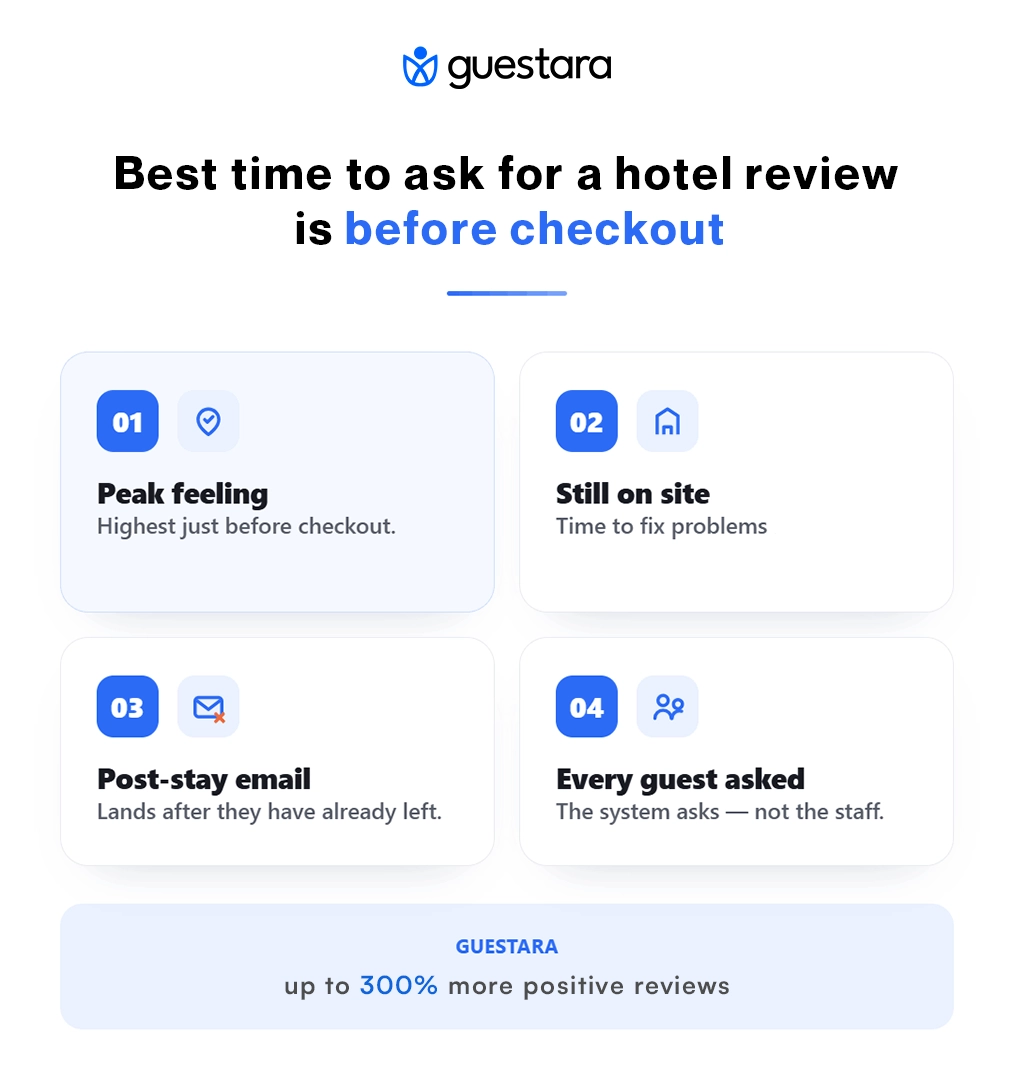
The best moment to ask for a review is one to two hours before checkout, not the day after.
By then the guest has formed a complete impression of the stay. The good feeling is still active. There is still time to recover if something went wrong. Post-stay emails miss all of this. They arrive after the guest has mentally moved on.
Guestara triggers the request automatically, one to two hours before the guest's scheduled checkout. It goes out by WhatsApp, SMS, or email. You can show a star rating or a simple three-button choice of Good, Average, or Bad.
You set the threshold. Most hotels redirect at four stars and above. Many short-term rental operators set five stars only.
Above your threshold, the guest goes straight to Google, TripAdvisor, or your preferred OTA to post publicly. Below it, the review stays internal. Your team gets an instant alert and a window to reach the guest before they leave. This is sentiment-based routing, not a single blast to every guest hoping for the best.
Hotel Tech Report's 2025 State of Guest Technology Report found that 58% of guests already expect AI-driven tools to improve their stay. An automated pre-checkout request by WhatsApp is not an imposition. It is an expected touchpoint.
Hotels using Guestara's pre-checkout sentiment system report up to 300% more positive reviews. The reason is the timing. It captures feedback at the highest point of stay satisfaction, not days after departure.
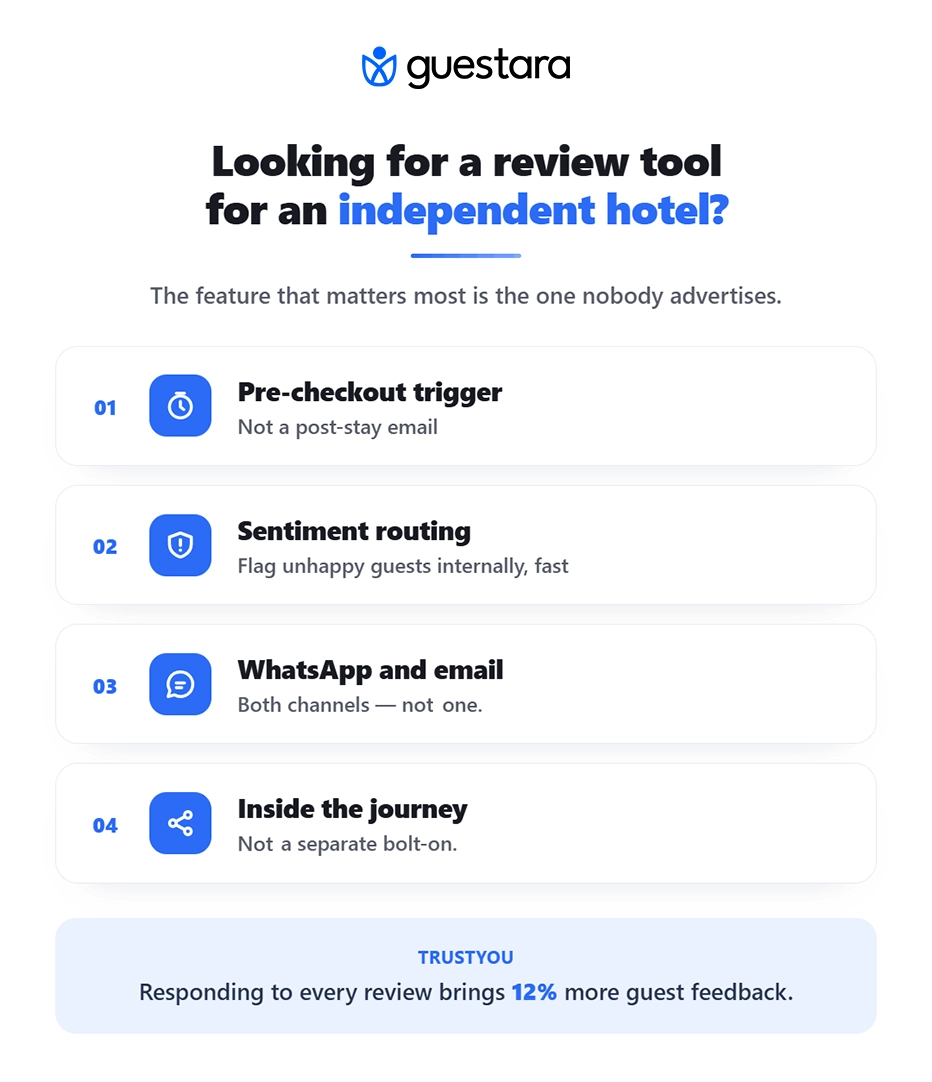
The most important feature in a review generation system is the one nobody advertises. When it asks.
Here is what to look for, in order of what actually moves review volume:
One thing the volume question hides. Responding matters. TrustYou's research found that hotels which reply to every review, positive and negative, receive 12% more feedback over time. That compounds in a way passive collection never does. If replying to every review sounds like a lot of work, a set of hotel review response templates makes it faster to keep up.
A review system that works inside the guest journey, from check-in through checkout, will always outperform one that starts working only after the guest has left.
If you want to see how Guestara's three-stage review system works for a property your size, book a demo. We will set up the exact pre-checkout flow around your check-in times and your thresholds.


Want to get more hotel reviews? Most independent hotels lose 5-star reviews to bad timing, not bad service. Here is the three-stage system that fixes it.
Most independent hotels have a review volume problem that no amount of asking guests at checkout will fix.
The issue is not that guests do not want to leave reviews. The request reaches them at the wrong moment, through the wrong channel, after the window to shape their experience has already closed.
By the time a guest is at the front desk with their bags, their opinion of the stay is set. The friendly nudge to leave a review arrives too late. So does the email two days later. The guest who would have written five stars on the morning of checkout writes nothing once they are home.
Getting more hotel reviews is not a collection problem. It is a timing and system problem.
This blog walks through a three-stage approach that works inside the guest journey, from the moment a guest arrives to the hour before they leave.
Independent hotels get fewer reviews than they deserve for three reasons. None of them is poor service.
The first is inconsistent asking. Manual review requests live and die on staff memory. Some shifts ask every guest. Most ask no one. You get a trickle from a fraction of happy guests.
The American Hotel and Lodging Association's 2025 State of the Industry Report found that hotel staffing levels still have not recovered to pre-pandemic levels. A lean team cannot ask every departing guest, every shift, every day.
The second is timing. Post-stay emails land after the guest is home and back to normal life. The peak feeling of a good stay has faded. The window that works is the hour or two before checkout, not the day after.
The third is unresolved friction. A small issue left unfixed during the stay quietly caps the review at four stars. Slow Wi-Fi. A noisy room. A cold breakfast. The guest does not raise it at the desk. They raise it on TripAdvisor.
And the problem often starts at arrival, which is how a slow check-in turns into a bad review. Cornell University's Center for Hospitality Research found that a check-in wait over five minutes causes a 47% drop in guest satisfaction. The ceiling on a guest's review is often set in the first ten minutes, before they have even seen their room.
A guest's review score is shaped by their first ten minutes, not just their stay.
A guest who waits twenty minutes at the front desk carries that frustration into the room and into the review. The bed and the breakfast cannot fully undo it. A frictionless arrival does the opposite. It sets a higher baseline that everything after it builds on.
Guestara removes the arrival variable. The guest gets a check-in link by WhatsApp, SMS, or email before they arrive. They scan their ID. The form fills itself in about thirty seconds. A smart lock key lands on their phone.
They walk in and go straight to their room. No queue. No paperwork. No first impression to recover from. You can see the full breakdown in our guide to cutting check-in wait times.
Suba Hotels cut their front desk to a single staff member after moving check-in to Guestara. When arrival runs itself, your team stops processing paperwork and starts creating the small moments during the stay that actually earn five stars.
Most hotels lose five-star reviews to problems they could have fixed in ten minutes, if anyone had asked.
Guestara's guest journey can trigger a mid-stay message, usually the morning after the first night. The guest gets a short WhatsApp note. How is everything going, let us know if there is anything we can do.
If the guest flags something, your team sees it and can act while the guest is still on property. Room temperature. Noise. A maintenance issue. A problem fixed before checkout turns a three-star stay into a four or five-star one, and it keeps a bad review from being written in the first place. The review then reflects how you handled it, not that it happened.
The reviews you are losing are rarely about bad stays. They are about fixable problems nobody knew about.
The best moment to ask for a review is one to two hours before checkout, not the day after.
By then the guest has formed a complete impression of the stay. The good feeling is still active. There is still time to recover if something went wrong. Post-stay emails miss all of this. They arrive after the guest has mentally moved on.
Guestara triggers the request automatically, one to two hours before the guest's scheduled checkout. It goes out by WhatsApp, SMS, or email. You can show a star rating or a simple three-button choice of Good, Average, or Bad.
You set the threshold. Most hotels redirect at four stars and above. Many short-term rental operators set five stars only.
Above your threshold, the guest goes straight to Google, TripAdvisor, or your preferred OTA to post publicly. Below it, the review stays internal. Your team gets an instant alert and a window to reach the guest before they leave. This is sentiment-based routing, not a single blast to every guest hoping for the best.
Hotel Tech Report's 2025 State of Guest Technology Report found that 58% of guests already expect AI-driven tools to improve their stay. An automated pre-checkout request by WhatsApp is not an imposition. It is an expected touchpoint.
Hotels using Guestara's pre-checkout sentiment system report up to 300% more positive reviews. The reason is the timing. It captures feedback at the highest point of stay satisfaction, not days after departure.
The most important feature in a review generation system is the one nobody advertises. When it asks.
Here is what to look for, in order of what actually moves review volume:
One thing the volume question hides. Responding matters. TrustYou's research found that hotels which reply to every review, positive and negative, receive 12% more feedback over time. That compounds in a way passive collection never does. If replying to every review sounds like a lot of work, a set of hotel review response templates makes it faster to keep up.
A review system that works inside the guest journey, from check-in through checkout, will always outperform one that starts working only after the guest has left.
If you want to see how Guestara's three-stage review system works for a property your size, book a demo. We will set up the exact pre-checkout flow around your check-in times and your thresholds.
Most hotels with low review volume do not have a service problem. They have a timing and consistency problem. Review requests usually depend on staff remembering to ask, and they reach guests by email after checkout when the good feeling of the stay has already faded. To get more hotel reviews, send an automated request to every guest one to two hours before checkout, while the impression is fresh and there is still time to fix anything that went wrong.
Send the review request before the guest leaves, not after. One to two hours before checkout, message the guest by WhatsApp or SMS and let them rate the stay. Send happy guests straight to your Google listing to post publicly, and keep unhappy responses internal so your team can resolve the issue on property. Asking every guest at the right moment lifts Google review volume far more than a QR code at reception.
Use a pre-checkout review request that can route satisfied guests directly to your TripAdvisor page. A small hotel cannot rely on staff to ask every guest by hand, so an automated trigger tied to checkout time does the asking for you. Guests who rate the stay highly are redirected to TripAdvisor to post, while lower ratings stay internal for your team to address before the guest checks out.
A hotel review generation system automates how and when you ask guests for reviews. The strongest versions request feedback before checkout, route positive responses to public sites like Google, TripAdvisor, or an OTA, and keep negative responses internal with an instant staff alert. Built into the wider guest journey, it also reduces the check-in and mid-stay friction that suppresses reviews in the first place.
This is sentiment-based routing, not review gating, when it is set up correctly. Review gating means blocking unhappy guests from leaving a public review at all. Sentiment-based routing invites every guest to give feedback, redirects satisfied guests to public sites, and alerts your team to dissatisfied guests so the issue can be resolved on property. Every guest remains free to post a public review on their own. Check your review platforms' current policies before you configure thresholds.
We work closely with the industry leaders to offer seamless solutions




We’re here to help your whole team stay ahead of the curve as you grow.

Get up and running quickly with a personalized onboarding plan

Connect with real people who really get it, 24/7

Checkout our vast library of free resources, templates and more
There's only so much we can say — so let us show you! Schedule a demo today and reach your business goals.



.png)
%20(1).png)