Learn how hotel reviews impact guest experience and bookings, why online reviews matter, and key strategies to manage and leverage guest feedback.




.png)
How Online Reviews Shape Your Hotel's Guest Experience
A guest checks into your hotel. The room is clean. The staff is friendly. The stay goes well. But here's what actually matters: what they write online afterward.
Your hotel reviews are now your reputation. They sit on Google, TripAdvisor, Booking.com, and dozens of other platforms. Before a potential guest books, they read reviews. Most travelers read at least ten reviews before deciding. That's ten chances for someone to confirm you're worth booking or convince them to go elsewhere.
This isn't about ego. It's about survival in the hotel business today.
Guest reviews shape everything. They influence booking decisions. They determine your search visibility. They tell you exactly what your guests think. They reveal your blind spots. They create opportunities to improve.
The question is: are you using this feedback, or are you ignoring it?
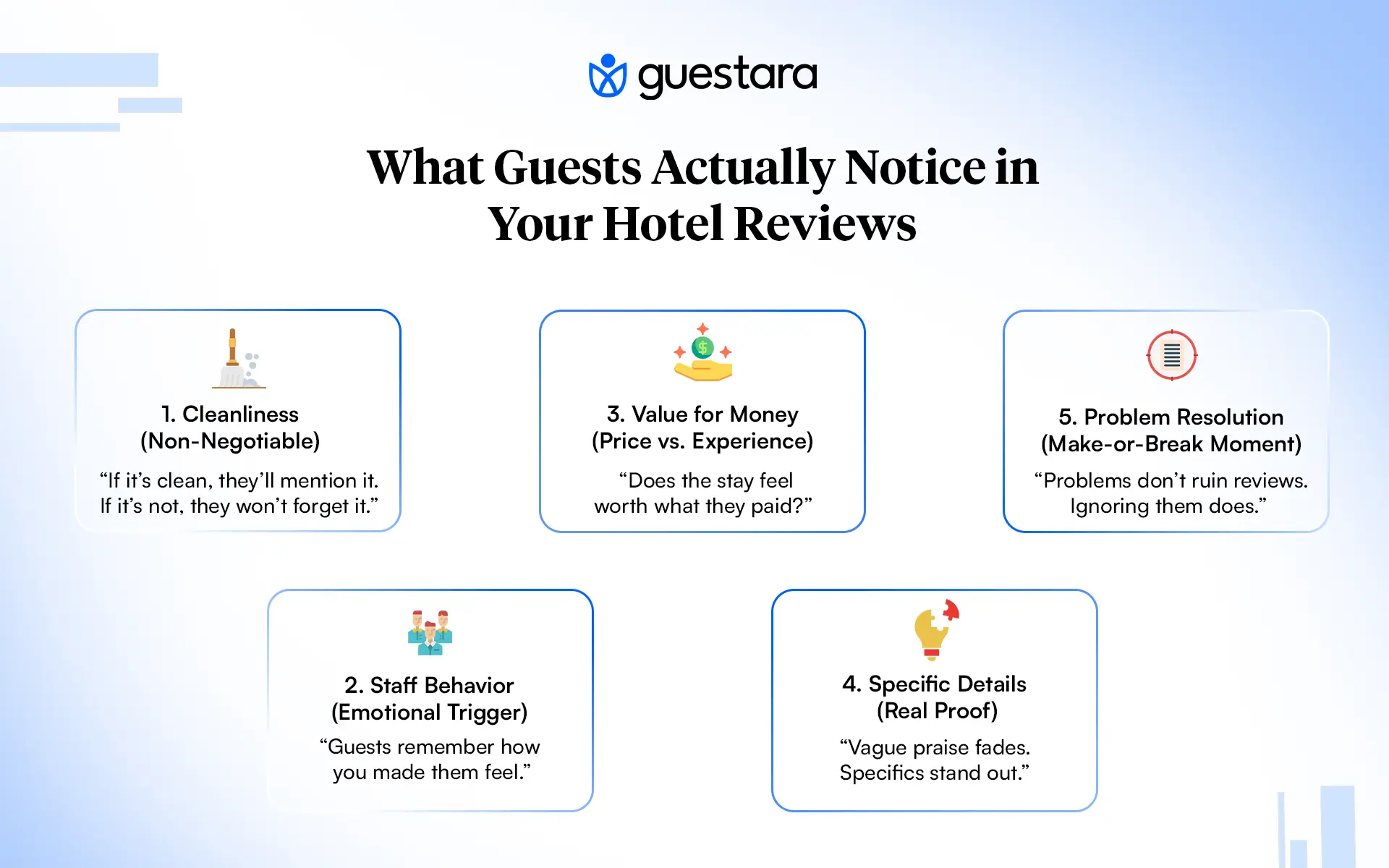
When someone reads a hotel review, they're looking for specific information. Understanding this helps you improve your hotel and encourage better reviews.
Cleanliness is the foundation. Guests mention cleanliness first. Not furniture quality. Not decor. Cleanliness. If your rooms are clean, you'll see it in reviews. If they're not, you'll see that too. This is non-negotiable.
Staff behavior gets remembered. Guests don't just write about rooms. They write about how staff treated them. Was the front desk helpful? Did housekeeping smile? Were they willing to solve problems? Staff interactions create emotional memories that turn into words in reviews.
Value for money matters. Guests compare price to experience. A 150 dollar room that feels worth 150 dollars gets positive reviews. A 150 dollar room that feels like 100 dollars gets negative reviews. Price positioning affects guest expectations and satisfaction.
Specific details carry weight. "Great hotel" gets ignored. "The shower had excellent water pressure and the breakfast had fresh fruit daily" gets read. Specific details in reviews feel authentic and helpful. This is what future guests need to know.
Problem resolution speaks volumes. Something goes wrong during the stay. The guest reports it. How you fix it determines the review tone. Fast solutions turn problems into loyalty. Ignored problems turn into complaints online.
This might sound backwards, but reviews influence guest experience before they even arrive.
Reviews set guest expectations. A guest books your hotel based on reviews. They arrive expecting what those reviews promised. If reviews mentioned excellent breakfast, they expect excellent breakfast. If reviews mentioned basic amenities, they expect basic amenities. You're now responsible for meeting expectations created by past guests.
Reviews guide where guests go in your hotel. A guest reads that your rooftop bar has amazing views. They head to the rooftop bar. They didn't discover this on your website. They learned it from guest reviews. Reviews literally guide guest behavior throughout their stay.
Reviews create pressure to perform. Your staff knows about good reviews. They understand the reputation you've built. This motivates them to maintain standards. Conversely, bad reviews create pressure to improve. Either way, reviews influence how your team operates.
Reviews highlight what matters to your market. You might think your business center is essential. Guest reviews might mention that nobody used it, but they couldn't stop talking about the location near restaurants. Reviews tell you what guests actually value versus what you assumed they'd value.
Hotel guest reviews have become more powerful than traditional advertising. Here's why:
Guests trust other guests more than hotel marketing. You could write a perfect description of your hotel. Guest reviews carry more weight. Research shows that 83% of customers rely on reviews to make accommodation decisions. People booking hotels read reviews before they read your website. They want honest perspectives from real people who stayed there.
Reviews affect your search ranking. Google favors hotels with more reviews and better ratings. Booking.com, Expedia, and other platforms push highly-rated hotels to the top. More visibility means more bookings. It's that simple.
Online reviews build credibility. New hotels without reviews struggle. Hotels with hundreds of positive reviews attract bookings almost effortlessly. The social proof is powerful. Potential guests think: others stayed here and loved it, so it must be good.
Negative reviews hurt more than positive reviews. One bad review can cancel out five good ones in a potential guest's mind. That's reality. Here's the stark number: 94% of travelers have actively avoided booking a hotel due to negative reviews. A single negative review can drive away approximately 30 potential customers. But here's the opportunity: how you respond to negative reviews matters just as much as the review itself.
Numbers tell the story clearly.
Hotels with more reviews get more bookings. That's established fact. But the relationship is more complex than volume alone.
Rating frequency and quality drive conversion. Research shows that hotels with 70% positive reviews maintain an 80% booking rate. This reveals the threshold: you don't need perfection. You need consistency and authentic positive feedback at scale.
First-page visibility depends on reviews. When someone searches for hotels in your area, search algorithms use review signals to rank results. More reviews and higher ratings push you toward the top. Less visibility means fewer clicks. Fewer clicks means fewer bookings.
Review response time affects booking decisions. Potential guests read reviews. They also read how the hotel responded. A fast, professional, empathetic response to a negative review actually increases trust. It shows management cares. Lack of response suggests management doesn't monitor guest feedback. Our detailed guide on how faster review responses boost bookings shows this correlation clearly.
Mixed reviews often perform better than perfect reviews. A hotel with all 5-star reviews looks suspicious to many travelers. Hotels with mostly 4-5 stars but some 3-star reviews feel more authentic. Real guests have varied experiences. Realistic review profiles convert better.
Your response to reviews matters as much as the reviews themselves.
Respond fast. Don't wait weeks. Respond within 48 hours when possible. Speed signals you're actively engaged. Slow responses suggest you're ignoring guests. Research on review response time shows a direct correlation between fast responses and increased booking rates.
Take blame, not excuses. A guest complained about noise. Your response shouldn't explain why the noise happened. Your response should say "we're sorry you experienced this" and explain what you'll do differently. Take responsibility. Guests respect accountability.
Make it personal. Don't use templated responses. Acknowledge specific details the guest mentioned. Use their name if available. "Dear Guest" responses get ignored. Personal responses get noticed.
Offer solutions, not arguments. If a guest complained about missing amenities, offer a solution. Offer a discount on their next stay or offer compensation. Arguing your case online won't help. Solving the problem will.
Public and professional tone. Everyone reads your response, not just the guest who left the review. Keep it professional. Keep it positive. Never get defensive in writing. This applies to negative reviews especially.
Turn complaints into opportunities. A guest complained about breakfast timing. Your response: "We're adjusting breakfast service based on guest feedback. Thank you for helping us improve." Now future guests see you listen and adapt.
For a comprehensive breakdown of how to handle negative reviews and prevent them from happening in the first place, check out our complete guide on responding to bad reviews and preventing them.
80% of travelers read at least ten reviews before finalizing a reservation so quality and volume matter. But how do you get more reviews without being pushy?
Ask at checkout. Staff should mention reviews during checkout. "We'd love to hear about your experience. Could you share feedback on TripAdvisor or Google?" Make it easy by providing links via QR codes on receipts.
Send follow-up emails. After checkout, send an email thanking guests and requesting feedback. Keep it brief. Include direct links to review platforms. One email is perfect. Multiple follow-ups feel like spam.
Make the process simple. Don't ask guests to navigate complex websites. Use QR codes. Send direct links. Let guests review on their preferred platform.
Incentivize appropriately. You can encourage reviews. You can't pay for positive reviews. That's against platform terms and unethical. Ask genuinely. Let guests share honestly.
Target recent guests. Memories fade. Request reviews while experiences are fresh, ideally within 24-48 hours of checkout.
Segment your approach. A guest who seemed satisfied deserves a straightforward review request. A guest who mentioned problems deserves a personal outreach checking if issues were resolved before requesting a review.
Learn from others' mistakes to avoid them yourself.
Ignoring negative reviews. Silence looks like you don't care. Whether or not you respond, potential guests notice your review response rate. Low response rates hurt credibility.
Arguing with guests in responses. Your comment section isn't the place for debate. It's the place for solutions. Save the argument for internal discussions.
Using the same response for every review. Guests notice templates immediately. "Thanks for your feedback" appears hundreds of times. Personal responses stand out.
Focusing only on ratings, not comments. A 4-star review with detailed feedback teaches you more than a 5-star generic "great hotel" review. Read the words. That's where the real insights live.
Not tracking trends. One negative comment about slow WiFi is a guest complaint. Three negative comments about slow WiFi is a business problem. Track what guests mention repeatedly.
Waiting too long to address systemic issues. Reviews reveal problems. If three guests mention cold water in showers, fix the water heater. Don't wait for ten complaints.
Reviews aren't just marketing tools. They're strategic business information.
Identify quick wins. A guest mentioned the lobby chair is uncomfortable. That's fixable. Guests mentioned check-in took 20 minutes. That's fixable. Look for problems you can solve quickly and then confirm the fix in future reviews.
Spot operational gaps. Reviews reveal what your team might not report. If guests keep mentioning late housekeeping, that's a staffing issue. If guests mention staff rudeness, that's a training issue. Internal feedback doesn't always surface what guest reviews do.
Test improvements through follow-up reviews. Made a change based on feedback? Watch the next batch of reviews. Did the issue improve? Reviews become your quality control system.
Involve your team in review analysis. Share guest feedback with relevant staff. Housekeeping sees cleanliness complaints. Front desk sees check-in comments. Let teams own their review-related feedback.
Build review analysis into staff goals. Make review improvement part of performance metrics. This shifts focus from ignoring reviews to actively improving them.
Not all platforms matter equally. Understand where your guests review.
Google Reviews. Appears in search results and Google Maps. Highest impact on discovery. Most important for local SEO. Essential to manage.
Booking.com. Where many bookings happen. Guests expect to see reviews here. High volume but lower SEO impact than Google.
TripAdvisor. Still relevant for travel research. Lower booking impact but maintains brand reputation value.
Expedia. Connected to Booking.com in many ways. Moderate importance. Guests use this for comparison shopping.
Facebook. Building in importance. Appears in local searches. Easier for angry guests to comment publicly.
Industry-specific platforms. Luxury hotels matter on Luxury.com. Business travelers matter on corporate review sites. Know where your specific guest type reviews.
Focus effort where your guests actually go. For most hotels, Google and Booking.com are priorities.
Managing reviews manually becomes impossible as your hotel grows.
Review aggregation platforms collect feedback from multiple sources into one dashboard. You see Google, Booking.com, and TripAdvisor reviews in one place. You don't jump between platforms.
Sentiment analysis tools read reviews and identify patterns. They flag complaints automatically. They highlight what guests love most.
Automated request systems send review requests at the right time with minimal effort. They deliver links guests need without your staff remembering to ask.
Response templates help your team stay consistent while keeping responses personalized. Templates provide structure, but staff add personal details.
Alert systems notify you instantly when new reviews arrive. Speed matters when responding.
Guestara's hospitality review management system lets you collect guest reviews directly, automatically filter them by sentiment, and push positive reviews to your OTA listings. This means good reviews reach Booking.com, Expedia, and other platforms automatically, boosting your visibility where guests actually book. Bad reviews stay internal so your team can address issues before they spread.
Hotels that master guest review management pull ahead of competitors quickly.
You get more bookings. Better reviews and higher visibility means higher booking volume. This is measurable. You see it in your daily reservation numbers.
Your marketing costs drop. When guests recommend you in reviews, you're not paying for that recommendation. That's free marketing. More positive reviews mean more word-of-mouth effect.
You improve operations faster. Guest feedback tells you exactly what to fix. You don't guess. You act on real data from real guests.
Your team becomes more engaged. When staff sees their work reflected in positive reviews, they feel valued. Bad reviews motivate improvement. Either way, reviews create accountability and purpose.
You attract the right guests. Better reviews attract guests aligned with your hotel's strengths. These guests are more satisfied. Satisfied guests spend more and create better reviews. It's a cycle.
Understanding guest reviews is one thing. Acting on that understanding is another.
Start tracking reviews daily. Log into each platform. Read what guests say. Respond to new reviews. Make this non-negotiable routine.
Analyze patterns quarterly. Every three months, read all reviews from that quarter. What complaints appear repeatedly? What do guests love most? What changed from the previous quarter?
Train your team on response protocols. Everyone on staff should understand that reviews matter. Front desk should know how to encourage reviews. Housekeeping should know their work directly affects reviews.
Implement a review request process. Decide when and how you'll ask for reviews. Make it system-driven, not random. Consistency drives volume.
Connect feedback to action. When you identify a problem in reviews, act on it. Then mention that action in future review responses. Show you're listening and improving.
Measure impact on bookings. Track how review improvements correlate with booking increases. This quantifies the value of managing reviews properly.
Hotel reviews shape your guest experience. They shape your reputation. They shape your bookings.
The hotels winning today aren't those with perfect properties. They're the ones listening to guests, responding thoughtfully, and improving based on feedback. They understand that reviews are continuous feedback loops, not final judgments.
Your guests are telling you how to succeed. They're giving you free consulting. They're showing you exactly what to improve.
The question isn't whether you should care about guest reviews. You have to. The question is whether you will respond strategically or ignore the signal that determines your business.
Start today. Read your reviews. Respond with care. Identify one improvement. Implement it. Watch the next batch of reviews confirm the change worked.
That's the competitive advantage that guest reviews provide.
Ready to transform how you manage guest feedback? Explore how Guestara helps hotels centralize reviews, automate responses, and turn guest insights into measurable business results.


Learn how hotel reviews impact guest experience and bookings, why online reviews matter, and key strategies to manage and leverage guest feedback.
How Online Reviews Shape Your Hotel's Guest Experience
A guest checks into your hotel. The room is clean. The staff is friendly. The stay goes well. But here's what actually matters: what they write online afterward.
Your hotel reviews are now your reputation. They sit on Google, TripAdvisor, Booking.com, and dozens of other platforms. Before a potential guest books, they read reviews. Most travelers read at least ten reviews before deciding. That's ten chances for someone to confirm you're worth booking or convince them to go elsewhere.
This isn't about ego. It's about survival in the hotel business today.
Guest reviews shape everything. They influence booking decisions. They determine your search visibility. They tell you exactly what your guests think. They reveal your blind spots. They create opportunities to improve.
The question is: are you using this feedback, or are you ignoring it?
When someone reads a hotel review, they're looking for specific information. Understanding this helps you improve your hotel and encourage better reviews.
Cleanliness is the foundation. Guests mention cleanliness first. Not furniture quality. Not decor. Cleanliness. If your rooms are clean, you'll see it in reviews. If they're not, you'll see that too. This is non-negotiable.
Staff behavior gets remembered. Guests don't just write about rooms. They write about how staff treated them. Was the front desk helpful? Did housekeeping smile? Were they willing to solve problems? Staff interactions create emotional memories that turn into words in reviews.
Value for money matters. Guests compare price to experience. A 150 dollar room that feels worth 150 dollars gets positive reviews. A 150 dollar room that feels like 100 dollars gets negative reviews. Price positioning affects guest expectations and satisfaction.
Specific details carry weight. "Great hotel" gets ignored. "The shower had excellent water pressure and the breakfast had fresh fruit daily" gets read. Specific details in reviews feel authentic and helpful. This is what future guests need to know.
Problem resolution speaks volumes. Something goes wrong during the stay. The guest reports it. How you fix it determines the review tone. Fast solutions turn problems into loyalty. Ignored problems turn into complaints online.
This might sound backwards, but reviews influence guest experience before they even arrive.
Reviews set guest expectations. A guest books your hotel based on reviews. They arrive expecting what those reviews promised. If reviews mentioned excellent breakfast, they expect excellent breakfast. If reviews mentioned basic amenities, they expect basic amenities. You're now responsible for meeting expectations created by past guests.
Reviews guide where guests go in your hotel. A guest reads that your rooftop bar has amazing views. They head to the rooftop bar. They didn't discover this on your website. They learned it from guest reviews. Reviews literally guide guest behavior throughout their stay.
Reviews create pressure to perform. Your staff knows about good reviews. They understand the reputation you've built. This motivates them to maintain standards. Conversely, bad reviews create pressure to improve. Either way, reviews influence how your team operates.
Reviews highlight what matters to your market. You might think your business center is essential. Guest reviews might mention that nobody used it, but they couldn't stop talking about the location near restaurants. Reviews tell you what guests actually value versus what you assumed they'd value.
Hotel guest reviews have become more powerful than traditional advertising. Here's why:
Guests trust other guests more than hotel marketing. You could write a perfect description of your hotel. Guest reviews carry more weight. Research shows that 83% of customers rely on reviews to make accommodation decisions. People booking hotels read reviews before they read your website. They want honest perspectives from real people who stayed there.
Reviews affect your search ranking. Google favors hotels with more reviews and better ratings. Booking.com, Expedia, and other platforms push highly-rated hotels to the top. More visibility means more bookings. It's that simple.
Online reviews build credibility. New hotels without reviews struggle. Hotels with hundreds of positive reviews attract bookings almost effortlessly. The social proof is powerful. Potential guests think: others stayed here and loved it, so it must be good.
Negative reviews hurt more than positive reviews. One bad review can cancel out five good ones in a potential guest's mind. That's reality. Here's the stark number: 94% of travelers have actively avoided booking a hotel due to negative reviews. A single negative review can drive away approximately 30 potential customers. But here's the opportunity: how you respond to negative reviews matters just as much as the review itself.
Numbers tell the story clearly.
Hotels with more reviews get more bookings. That's established fact. But the relationship is more complex than volume alone.
Rating frequency and quality drive conversion. Research shows that hotels with 70% positive reviews maintain an 80% booking rate. This reveals the threshold: you don't need perfection. You need consistency and authentic positive feedback at scale.
First-page visibility depends on reviews. When someone searches for hotels in your area, search algorithms use review signals to rank results. More reviews and higher ratings push you toward the top. Less visibility means fewer clicks. Fewer clicks means fewer bookings.
Review response time affects booking decisions. Potential guests read reviews. They also read how the hotel responded. A fast, professional, empathetic response to a negative review actually increases trust. It shows management cares. Lack of response suggests management doesn't monitor guest feedback. Our detailed guide on how faster review responses boost bookings shows this correlation clearly.
Mixed reviews often perform better than perfect reviews. A hotel with all 5-star reviews looks suspicious to many travelers. Hotels with mostly 4-5 stars but some 3-star reviews feel more authentic. Real guests have varied experiences. Realistic review profiles convert better.
Your response to reviews matters as much as the reviews themselves.
Respond fast. Don't wait weeks. Respond within 48 hours when possible. Speed signals you're actively engaged. Slow responses suggest you're ignoring guests. Research on review response time shows a direct correlation between fast responses and increased booking rates.
Take blame, not excuses. A guest complained about noise. Your response shouldn't explain why the noise happened. Your response should say "we're sorry you experienced this" and explain what you'll do differently. Take responsibility. Guests respect accountability.
Make it personal. Don't use templated responses. Acknowledge specific details the guest mentioned. Use their name if available. "Dear Guest" responses get ignored. Personal responses get noticed.
Offer solutions, not arguments. If a guest complained about missing amenities, offer a solution. Offer a discount on their next stay or offer compensation. Arguing your case online won't help. Solving the problem will.
Public and professional tone. Everyone reads your response, not just the guest who left the review. Keep it professional. Keep it positive. Never get defensive in writing. This applies to negative reviews especially.
Turn complaints into opportunities. A guest complained about breakfast timing. Your response: "We're adjusting breakfast service based on guest feedback. Thank you for helping us improve." Now future guests see you listen and adapt.
For a comprehensive breakdown of how to handle negative reviews and prevent them from happening in the first place, check out our complete guide on responding to bad reviews and preventing them.
80% of travelers read at least ten reviews before finalizing a reservation so quality and volume matter. But how do you get more reviews without being pushy?
Ask at checkout. Staff should mention reviews during checkout. "We'd love to hear about your experience. Could you share feedback on TripAdvisor or Google?" Make it easy by providing links via QR codes on receipts.
Send follow-up emails. After checkout, send an email thanking guests and requesting feedback. Keep it brief. Include direct links to review platforms. One email is perfect. Multiple follow-ups feel like spam.
Make the process simple. Don't ask guests to navigate complex websites. Use QR codes. Send direct links. Let guests review on their preferred platform.
Incentivize appropriately. You can encourage reviews. You can't pay for positive reviews. That's against platform terms and unethical. Ask genuinely. Let guests share honestly.
Target recent guests. Memories fade. Request reviews while experiences are fresh, ideally within 24-48 hours of checkout.
Segment your approach. A guest who seemed satisfied deserves a straightforward review request. A guest who mentioned problems deserves a personal outreach checking if issues were resolved before requesting a review.
Learn from others' mistakes to avoid them yourself.
Ignoring negative reviews. Silence looks like you don't care. Whether or not you respond, potential guests notice your review response rate. Low response rates hurt credibility.
Arguing with guests in responses. Your comment section isn't the place for debate. It's the place for solutions. Save the argument for internal discussions.
Using the same response for every review. Guests notice templates immediately. "Thanks for your feedback" appears hundreds of times. Personal responses stand out.
Focusing only on ratings, not comments. A 4-star review with detailed feedback teaches you more than a 5-star generic "great hotel" review. Read the words. That's where the real insights live.
Not tracking trends. One negative comment about slow WiFi is a guest complaint. Three negative comments about slow WiFi is a business problem. Track what guests mention repeatedly.
Waiting too long to address systemic issues. Reviews reveal problems. If three guests mention cold water in showers, fix the water heater. Don't wait for ten complaints.
Reviews aren't just marketing tools. They're strategic business information.
Identify quick wins. A guest mentioned the lobby chair is uncomfortable. That's fixable. Guests mentioned check-in took 20 minutes. That's fixable. Look for problems you can solve quickly and then confirm the fix in future reviews.
Spot operational gaps. Reviews reveal what your team might not report. If guests keep mentioning late housekeeping, that's a staffing issue. If guests mention staff rudeness, that's a training issue. Internal feedback doesn't always surface what guest reviews do.
Test improvements through follow-up reviews. Made a change based on feedback? Watch the next batch of reviews. Did the issue improve? Reviews become your quality control system.
Involve your team in review analysis. Share guest feedback with relevant staff. Housekeeping sees cleanliness complaints. Front desk sees check-in comments. Let teams own their review-related feedback.
Build review analysis into staff goals. Make review improvement part of performance metrics. This shifts focus from ignoring reviews to actively improving them.
Not all platforms matter equally. Understand where your guests review.
Google Reviews. Appears in search results and Google Maps. Highest impact on discovery. Most important for local SEO. Essential to manage.
Booking.com. Where many bookings happen. Guests expect to see reviews here. High volume but lower SEO impact than Google.
TripAdvisor. Still relevant for travel research. Lower booking impact but maintains brand reputation value.
Expedia. Connected to Booking.com in many ways. Moderate importance. Guests use this for comparison shopping.
Facebook. Building in importance. Appears in local searches. Easier for angry guests to comment publicly.
Industry-specific platforms. Luxury hotels matter on Luxury.com. Business travelers matter on corporate review sites. Know where your specific guest type reviews.
Focus effort where your guests actually go. For most hotels, Google and Booking.com are priorities.
Managing reviews manually becomes impossible as your hotel grows.
Review aggregation platforms collect feedback from multiple sources into one dashboard. You see Google, Booking.com, and TripAdvisor reviews in one place. You don't jump between platforms.
Sentiment analysis tools read reviews and identify patterns. They flag complaints automatically. They highlight what guests love most.
Automated request systems send review requests at the right time with minimal effort. They deliver links guests need without your staff remembering to ask.
Response templates help your team stay consistent while keeping responses personalized. Templates provide structure, but staff add personal details.
Alert systems notify you instantly when new reviews arrive. Speed matters when responding.
Guestara's hospitality review management system lets you collect guest reviews directly, automatically filter them by sentiment, and push positive reviews to your OTA listings. This means good reviews reach Booking.com, Expedia, and other platforms automatically, boosting your visibility where guests actually book. Bad reviews stay internal so your team can address issues before they spread.
Hotels that master guest review management pull ahead of competitors quickly.
You get more bookings. Better reviews and higher visibility means higher booking volume. This is measurable. You see it in your daily reservation numbers.
Your marketing costs drop. When guests recommend you in reviews, you're not paying for that recommendation. That's free marketing. More positive reviews mean more word-of-mouth effect.
You improve operations faster. Guest feedback tells you exactly what to fix. You don't guess. You act on real data from real guests.
Your team becomes more engaged. When staff sees their work reflected in positive reviews, they feel valued. Bad reviews motivate improvement. Either way, reviews create accountability and purpose.
You attract the right guests. Better reviews attract guests aligned with your hotel's strengths. These guests are more satisfied. Satisfied guests spend more and create better reviews. It's a cycle.
Understanding guest reviews is one thing. Acting on that understanding is another.
Start tracking reviews daily. Log into each platform. Read what guests say. Respond to new reviews. Make this non-negotiable routine.
Analyze patterns quarterly. Every three months, read all reviews from that quarter. What complaints appear repeatedly? What do guests love most? What changed from the previous quarter?
Train your team on response protocols. Everyone on staff should understand that reviews matter. Front desk should know how to encourage reviews. Housekeeping should know their work directly affects reviews.
Implement a review request process. Decide when and how you'll ask for reviews. Make it system-driven, not random. Consistency drives volume.
Connect feedback to action. When you identify a problem in reviews, act on it. Then mention that action in future review responses. Show you're listening and improving.
Measure impact on bookings. Track how review improvements correlate with booking increases. This quantifies the value of managing reviews properly.
Hotel reviews shape your guest experience. They shape your reputation. They shape your bookings.
The hotels winning today aren't those with perfect properties. They're the ones listening to guests, responding thoughtfully, and improving based on feedback. They understand that reviews are continuous feedback loops, not final judgments.
Your guests are telling you how to succeed. They're giving you free consulting. They're showing you exactly what to improve.
The question isn't whether you should care about guest reviews. You have to. The question is whether you will respond strategically or ignore the signal that determines your business.
Start today. Read your reviews. Respond with care. Identify one improvement. Implement it. Watch the next batch of reviews confirm the change worked.
That's the competitive advantage that guest reviews provide.
Ready to transform how you manage guest feedback? Explore how Guestara helps hotels centralize reviews, automate responses, and turn guest insights into measurable business results.
Guests prioritize cleanliness, staff behavior, and value for money. They want specific details like "shower had great water pressure" and check how hotels respond to negative reviews. Recent reviews matter more than old ones.
83% of customers rely on reviews to decide. Hotels with 70% positive reviews maintain an 80% booking rate. A single negative review can drive away 30 potential customers.
Fix problems guests mention repeatedly. Request reviews 24-48 hours after checkout via QR codes. Respond to every review within 48 hours, especially negative ones, and involve your team in review analysis.
Respond fast, take responsibility without excuses, and offer solutions not arguments. Keep it professional and personal. A thoughtful response to complaints actually increases trust with potential guests.
Reviews influence bookings more than marketing, guide your operations with real feedback, and affect search rankings. They build credibility and reduce marketing costs through free word-of-mouth.
We work closely with the industry leaders to offer seamless solutions




We’re here to help your whole team stay ahead of the curve as you grow.

Get up and running quickly with a personalized onboarding plan

Connect with real people who really get it, 24/7

Checkout our vast library of free resources, templates and more
There's only so much we can say — so let us show you! Schedule a demo today and reach your business goals.


.png)
%20(1).png)