
NOI is a hotel's income from operations after all operating and fixed costs, but before debt, taxes, and depreciation. It is the ownership-level profit number, and because a hotel's value is calculated as NOI / Cap Rate, it is the figure investors and lenders care about most.
Net Operating Income (NOI) is what a property earns once every operating and fixed operating cost has been paid, but before financing and accounting choices enter the picture. It deliberately excludes debt service, income taxes, depreciation, and amortization, so it reflects what the asset itself produces, independent of how any given owner financed or structured the deal.
That independence is the point. Two buyers could finance the same hotel completely differently, but they would calculate the same NOI, which is why it is the standard basis for valuing and comparing hotel assets.
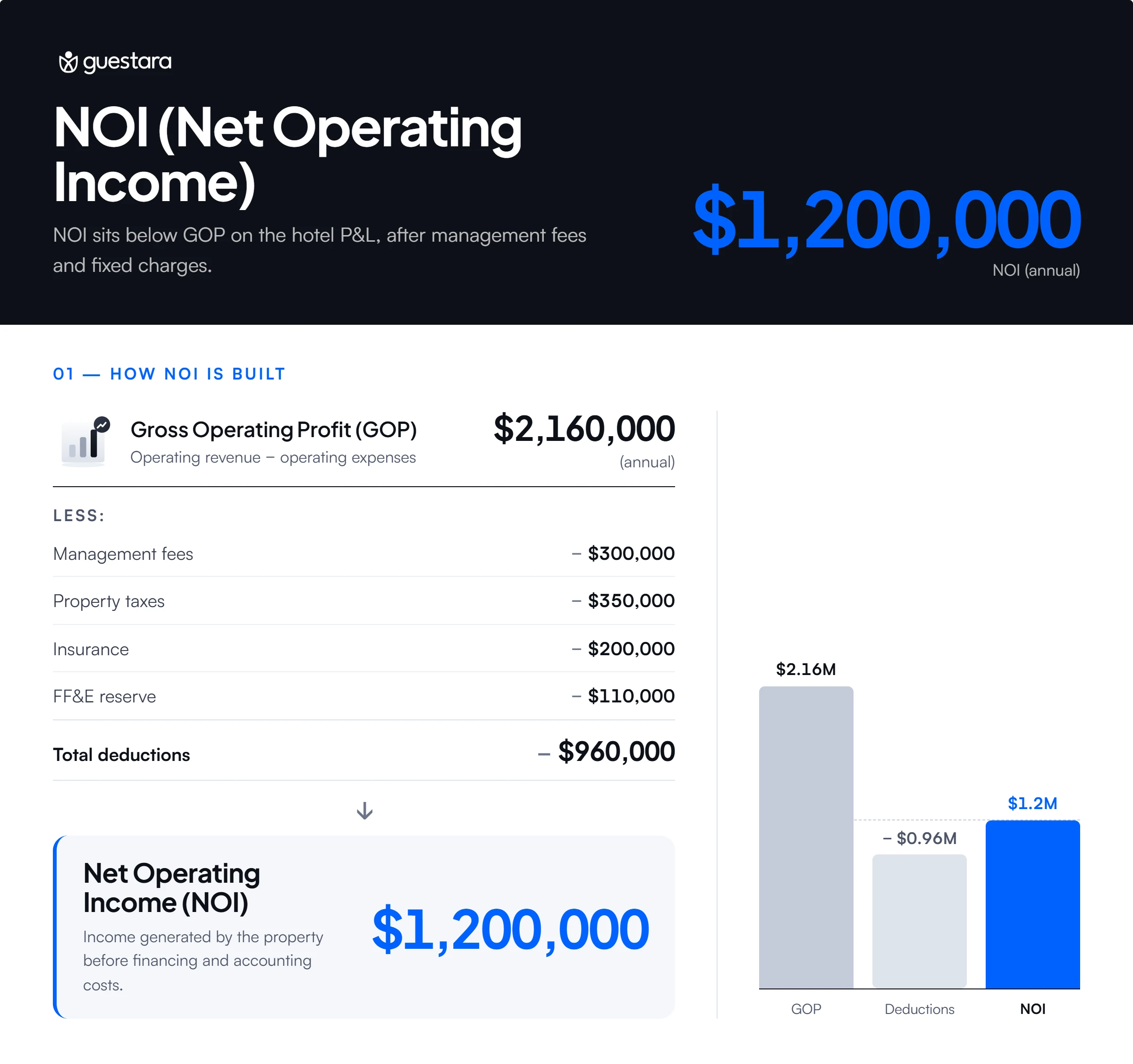
NOI sits several lines below GOP on the hotel P&L. Building down from operations:
Everything above NOI is about running the hotel; everything below it (interest, income tax, depreciation, amortization) is about financing and accounting. NOI is the dividing line.
NOI = Total Operating Revenue - Total Operating Expenses
Here "operating expenses" is the full set: departmental costs, undistributed costs, management fees, and fixed charges such as property taxes and insurance, plus an FF&E reserve in hotel practice. It excludes debt service, income taxes, depreciation, and amortization.
Take the 100-room hotel from across this cluster on an annual basis, where monthly GOP of $180,000 annualizes to about $2,160,000.
NOI = $2,160,000 - $960,000 = $1,200,000
Now value the asset. Hotel value is NOI divided by the market capitalization rate (cap rate):
Value = $1,200,000 / 8% = $15,000,000
That single relationship is why owners obsess over NOI: at an 8% cap rate, every $1 of durable NOI adds about $12.50 of asset value.
NOI is the bridge between operating performance and asset value.
The practical takeaway: because financing and tax items sit below NOI, the only way to move it is through operations and fixed-cost control. Every dollar you add to GOP, whether by lifting revenue or cutting operating cost, flows straight down to NOI, and from there into valuation.
On that last point, Guestara's hotel payments automates collection and reconciliation, helping secure revenue and lower the finance overhead that would otherwise erode operating profit before it ever reaches NOI.
The profit figure that sets what your hotel is actually worth.
NOI is a hotel's income from operations after all operating and fixed costs, but before debt, taxes, and depreciation. It is the ownership-level profit number, and because a hotel's value is calculated as NOI / Cap Rate, it is the figure investors and lenders care about most.
Net Operating Income (NOI) is what a property earns once every operating and fixed operating cost has been paid, but before financing and accounting choices enter the picture. It deliberately excludes debt service, income taxes, depreciation, and amortization, so it reflects what the asset itself produces, independent of how any given owner financed or structured the deal.
That independence is the point. Two buyers could finance the same hotel completely differently, but they would calculate the same NOI, which is why it is the standard basis for valuing and comparing hotel assets.
NOI sits several lines below GOP on the hotel P&L. Building down from operations:
Everything above NOI is about running the hotel; everything below it (interest, income tax, depreciation, amortization) is about financing and accounting. NOI is the dividing line.
NOI = Total Operating Revenue - Total Operating Expenses
Here "operating expenses" is the full set: departmental costs, undistributed costs, management fees, and fixed charges such as property taxes and insurance, plus an FF&E reserve in hotel practice. It excludes debt service, income taxes, depreciation, and amortization.
Take the 100-room hotel from across this cluster on an annual basis, where monthly GOP of $180,000 annualizes to about $2,160,000.
NOI = $2,160,000 - $960,000 = $1,200,000
Now value the asset. Hotel value is NOI divided by the market capitalization rate (cap rate):
Value = $1,200,000 / 8% = $15,000,000
That single relationship is why owners obsess over NOI: at an 8% cap rate, every $1 of durable NOI adds about $12.50 of asset value.
NOI is the bridge between operating performance and asset value.
The practical takeaway: because financing and tax items sit below NOI, the only way to move it is through operations and fixed-cost control. Every dollar you add to GOP, whether by lifting revenue or cutting operating cost, flows straight down to NOI, and from there into valuation.
On that last point, Guestara's hotel payments automates collection and reconciliation, helping secure revenue and lower the finance overhead that would otherwise erode operating profit before it ever reaches NOI.
GOP is measured before management fees and fixed charges, so it reflects operating performance. NOI is measured after those, so it reflects ownership-level profit. GOP is always the higher, earlier line.
They are close, and in hotels sometimes used interchangeably. The usual distinction is that hotel NOI deducts an FF&E reserve while EBITDA does not, making NOI slightly lower. Conventions vary, so define the term explicitly in any deal.
Through the cap rate: Value = NOI / Cap Rate. Divide annual NOI by the market cap rate to estimate the asset's value.
No. NOI is calculated before debt service, which is exactly why it is comparable across owners with different financing.


