.webp)
GOP is the profit a hotel earns from its operations before fixed costs. Formula: GOP = Total Operating Revenue - Total Operating Expenses. It is the profit hotel management directly controls, which is why it sits at the heart of the hotel P&L and underpins metrics like GOPPAR.
Gross Operating Profit (GOP) is what remains after a hotel subtracts all of its operating expenses from all of its operating revenue, but before it accounts for fixed charges such as rent, property taxes, insurance, interest, and depreciation. In other words, GOP isolates the part of profitability that day-to-day management actually influences, separate from decisions made by owners and lenders.
Because it strips out ownership and financing costs, GOP is the fairest way to judge how well a property is run. Two hotels with very different rent or debt loads can still be compared cleanly on GOP.
GOP = Total Operating Revenue - Total Operating Expenses
A simplified hotel profit and loss statement flows like this:
GOP is the line that separates operating performance above it from ownership and capital costs below it.
Using the same 100-room property from across this cluster, over one month:
GOP = $540,000 - $360,000 = $180,000
A useful companion figure is GOP margin, which puts that profit in proportion to revenue:
GOP Margin = $180,000 / $540,000 = 33.3%
Divide that same GOP by available rooms and you get GOPPAR, the per-room view owners use to compare properties of different sizes.
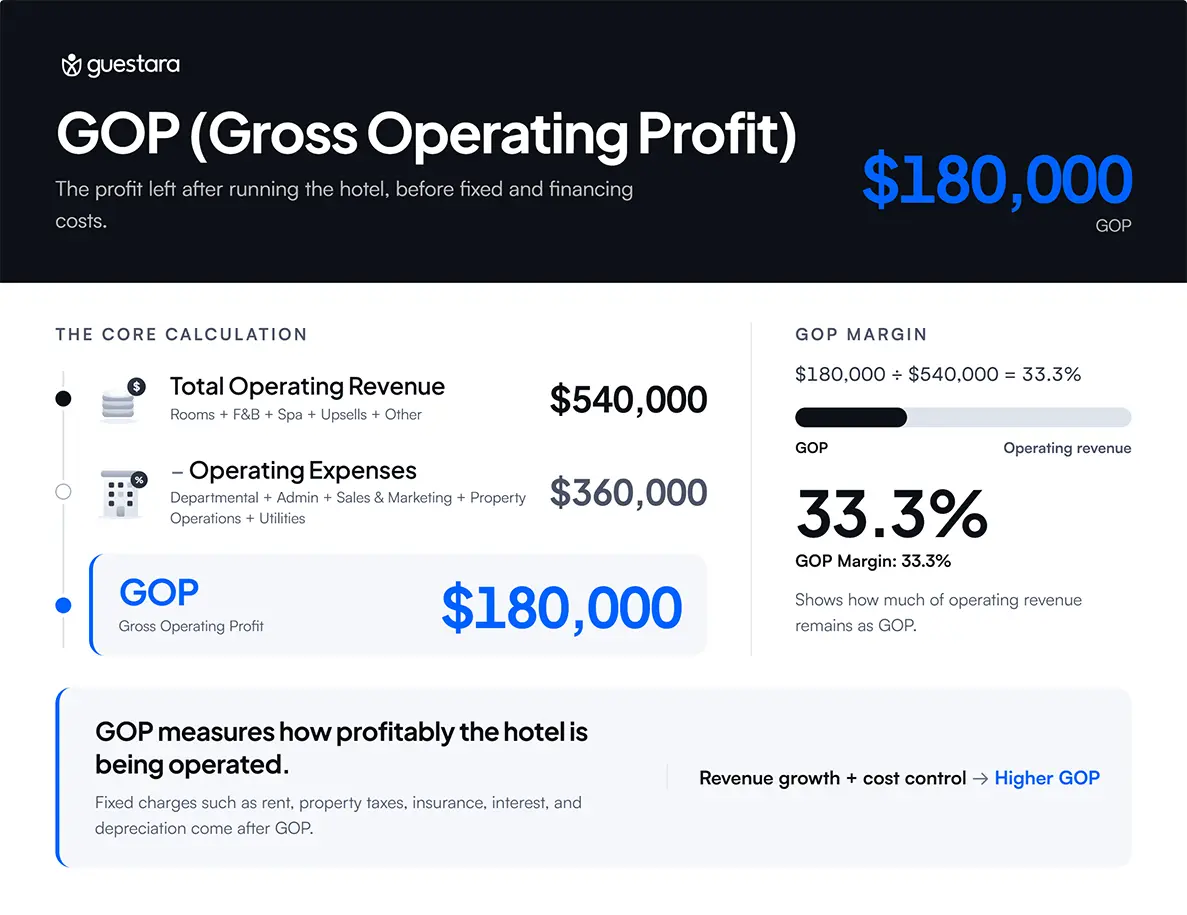
GOP is the clearest single read on operational profitability. It rewards management for growing revenue and controlling cost, without penalizing or crediting them for rent and financing they do not control. That is why it anchors owner reporting, management incentive fees, and cross-property comparison.
GOP margin adds context: a rising GOP is only healthy if the margin holds, since profit that grows more slowly than revenue signals costs creeping up. Margins vary widely by segment, with leaner limited-service hotels often posting higher GOP margins than full-service properties that carry more departments and labor, so benchmark against comparable hotels rather than an absolute target.
GOP responds to the same two dials as any profit measure: grow revenue and contain cost.
Payments are an underrated GOP lever, because both revenue capture and finance overhead flow through them. Guestara's hotel payments automates collection, deposits, and reconciliation, which helps secure revenue and reduce the manual back-office cost that quietly erodes gross operating profit.
The profit your team controls, before rent and financing enter the picture.
GOP is the profit a hotel earns from its operations before fixed costs. Formula: GOP = Total Operating Revenue - Total Operating Expenses. It is the profit hotel management directly controls, which is why it sits at the heart of the hotel P&L and underpins metrics like GOPPAR.
Gross Operating Profit (GOP) is what remains after a hotel subtracts all of its operating expenses from all of its operating revenue, but before it accounts for fixed charges such as rent, property taxes, insurance, interest, and depreciation. In other words, GOP isolates the part of profitability that day-to-day management actually influences, separate from decisions made by owners and lenders.
Because it strips out ownership and financing costs, GOP is the fairest way to judge how well a property is run. Two hotels with very different rent or debt loads can still be compared cleanly on GOP.
GOP = Total Operating Revenue - Total Operating Expenses
A simplified hotel profit and loss statement flows like this:
GOP is the line that separates operating performance above it from ownership and capital costs below it.
Using the same 100-room property from across this cluster, over one month:
GOP = $540,000 - $360,000 = $180,000
A useful companion figure is GOP margin, which puts that profit in proportion to revenue:
GOP Margin = $180,000 / $540,000 = 33.3%
Divide that same GOP by available rooms and you get GOPPAR, the per-room view owners use to compare properties of different sizes.
GOP is the clearest single read on operational profitability. It rewards management for growing revenue and controlling cost, without penalizing or crediting them for rent and financing they do not control. That is why it anchors owner reporting, management incentive fees, and cross-property comparison.
GOP margin adds context: a rising GOP is only healthy if the margin holds, since profit that grows more slowly than revenue signals costs creeping up. Margins vary widely by segment, with leaner limited-service hotels often posting higher GOP margins than full-service properties that carry more departments and labor, so benchmark against comparable hotels rather than an absolute target.
GOP responds to the same two dials as any profit measure: grow revenue and contain cost.
Payments are an underrated GOP lever, because both revenue capture and finance overhead flow through them. Guestara's hotel payments automates collection, deposits, and reconciliation, which helps secure revenue and reduce the manual back-office cost that quietly erodes gross operating profit.
GOP is operating profit before fixed charges, financing, and depreciation. Net profit is what remains after all of those, so GOP is always the higher, earlier line on the P&L.
Departmental expenses plus undistributed operating expenses (admin, sales and marketing, property operations, utilities). Fixed charges like rent, taxes, insurance, interest, and depreciation are excluded.
GOP is a total dollar figure. GOPPAR is that same GOP divided by available rooms, which lets you compare profitability across hotels of different sizes.
It depends on segment. Limited-service hotels often run higher GOP margins than full-service ones. Judge it against comparable properties and your own trailing periods rather than a fixed number.


