
GOPPAR measures a hotel's operating profit, not revenue, per available room. Formula: GOPPAR = Gross Operating Profit / Available Rooms. Because it factors in cost, GOPPAR is the metric owners and investors trust most, and it is far harder to inflate than RevPAR.
Gross Operating Profit per Available Room (GOPPAR) shows how much operating profit a property keeps for each room it has available to sell. It is the profit-side counterpart to RevPAR and TRevPAR: where those metrics stop at revenue, GOPPAR subtracts the operating costs of running the hotel first, then spreads what is left across available rooms.
That shift from revenue to profit is why owners, asset managers, and investors lean on GOPPAR. It reflects not just how much a hotel earns, but how efficiently it turns that earning into profit, which makes it a cleaner read on management performance.
GOPPAR = Gross Operating Profit (GOP) / Total Available Rooms
Where:
GOP = Total Operating Revenue - Total Operating Expenses
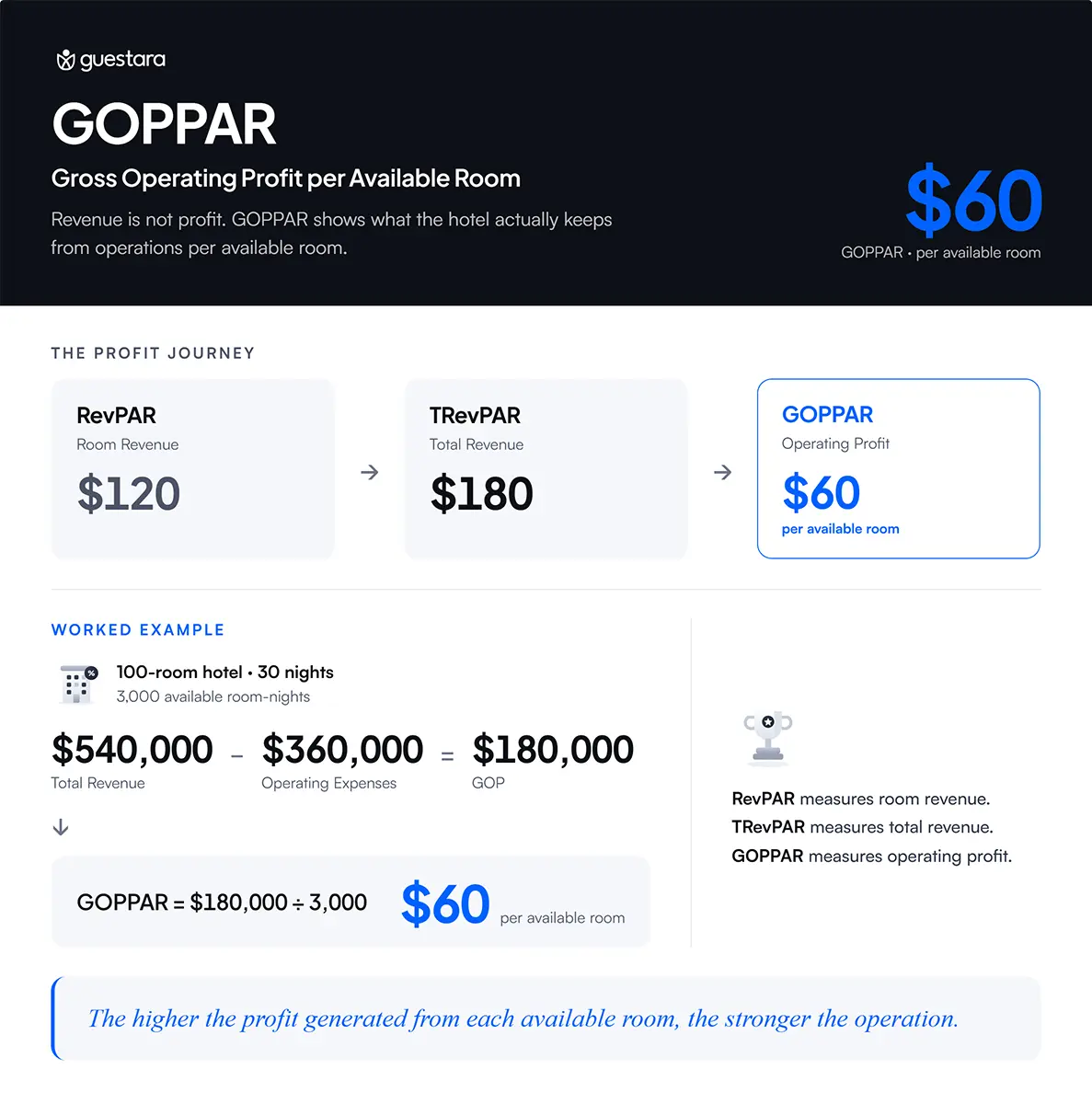
Take the same 100-room hotel over a 30-night month (3,000 available room-nights) used across this metrics cluster:
GOPPAR = $180,000 / 3,000 = $60
Seen together, the three metrics trace one property from top line to profit: RevPAR $120 (room revenue), TRevPAR $180 (all revenue), GOPPAR $60 (operating profit) per available room. Each step tells you something the one before it could not.
Two hotels can post identical RevPAR and still run very different businesses. One might buy its occupancy through high-commission OTA channels and heavy labor; the other might fill rooms directly and run lean. RevPAR treats them the same. GOPPAR does not, because cost is baked into it.
That also makes GOPPAR hard to game. You can pump occupancy, and even RevPAR, by discounting, but discounting rarely improves profit, so it does little for GOPPAR. This resistance to manipulation is exactly why owners and investors treat GOPPAR as the honest scorecard.
One limit to keep in mind: GOPPAR stops at gross operating profit. It sits above fixed charges like rent, management fees, debt service, and depreciation, so it is not the bottom line. For profit after those items, you move to measures like adjusted GOP and NOI.
GOPPAR moves on two dials at once: grow profitable revenue and control cost.
Upselling is a standout GOPPAR lever because it adds high-margin revenue to rooms already sold, with little extra operating cost behind it. Guestara's hotel upsell software automates upgrade and add-on offers across the guest journey, and hotels using it see up to 200% more upsells, revenue that lands close to the profit line.
GOPPAR is the third step in a natural progression. RevPAR captures room revenue per available room. TRevPAR widens that to total revenue per available room. GOPPAR takes total revenue, subtracts operating cost, and shows the profit per available room that is left. Read as a set, they move from how well you price rooms, to how well you monetize the whole property, to how profitably you run it.
Profit per room, not just revenue, and the number owners actually trust.
GOPPAR measures a hotel's operating profit, not revenue, per available room. Formula: GOPPAR = Gross Operating Profit / Available Rooms. Because it factors in cost, GOPPAR is the metric owners and investors trust most, and it is far harder to inflate than RevPAR.
Gross Operating Profit per Available Room (GOPPAR) shows how much operating profit a property keeps for each room it has available to sell. It is the profit-side counterpart to RevPAR and TRevPAR: where those metrics stop at revenue, GOPPAR subtracts the operating costs of running the hotel first, then spreads what is left across available rooms.
That shift from revenue to profit is why owners, asset managers, and investors lean on GOPPAR. It reflects not just how much a hotel earns, but how efficiently it turns that earning into profit, which makes it a cleaner read on management performance.
GOPPAR = Gross Operating Profit (GOP) / Total Available Rooms
Where:
GOP = Total Operating Revenue - Total Operating Expenses
Take the same 100-room hotel over a 30-night month (3,000 available room-nights) used across this metrics cluster:
GOPPAR = $180,000 / 3,000 = $60
Seen together, the three metrics trace one property from top line to profit: RevPAR $120 (room revenue), TRevPAR $180 (all revenue), GOPPAR $60 (operating profit) per available room. Each step tells you something the one before it could not.
Two hotels can post identical RevPAR and still run very different businesses. One might buy its occupancy through high-commission OTA channels and heavy labor; the other might fill rooms directly and run lean. RevPAR treats them the same. GOPPAR does not, because cost is baked into it.
That also makes GOPPAR hard to game. You can pump occupancy, and even RevPAR, by discounting, but discounting rarely improves profit, so it does little for GOPPAR. This resistance to manipulation is exactly why owners and investors treat GOPPAR as the honest scorecard.
One limit to keep in mind: GOPPAR stops at gross operating profit. It sits above fixed charges like rent, management fees, debt service, and depreciation, so it is not the bottom line. For profit after those items, you move to measures like adjusted GOP and NOI.
GOPPAR moves on two dials at once: grow profitable revenue and control cost.
Upselling is a standout GOPPAR lever because it adds high-margin revenue to rooms already sold, with little extra operating cost behind it. Guestara's hotel upsell software automates upgrade and add-on offers across the guest journey, and hotels using it see up to 200% more upsells, revenue that lands close to the profit line.
GOPPAR is the third step in a natural progression. RevPAR captures room revenue per available room. TRevPAR widens that to total revenue per available room. GOPPAR takes total revenue, subtracts operating cost, and shows the profit per available room that is left. Read as a set, they move from how well you price rooms, to how well you monetize the whole property, to how profitably you run it.
RevPAR measures room revenue per available room and ignores cost. GOPPAR measures operating profit per available room, so it reflects both revenue and how efficiently the hotel is run.
All operating revenue minus all operating expenses the property controls, calculated before fixed charges such as rent, property taxes, insurance, interest, and depreciation.
Because it reflects profitability and management effectiveness, and it cannot be inflated by discounting the way occupancy and RevPAR can.
No. GOPPAR stops at gross operating profit, above fixed charges and debt service. For profit after those items, use adjusted GOP or NOI.


