TRevPAR measures a hotel's total revenue, from every source, per available room. Formula: TRevPAR = Total Revenue / Available Rooms. Unlike RevPAR, which counts only room revenue, TRevPAR captures F&B, spa, upsells, and every other stream, so it reflects how well the whole property earns.
Total Revenue per Available Room (TRevPAR) shows how much revenue a property generates across all departments for each room it has available to sell. Where RevPAR looks only at what the rooms themselves bring in, TRevPAR widens the lens to the entire guest wallet: food and beverage, spa, experiences, upsells, parking, and any other ancillary income.
That makes TRevPAR the headline metric of total revenue management, the discipline of optimizing every revenue stream a guest touches, not just the room rate.
TRevPAR = Total Revenue / Total Available Rooms
The denominator is identical to RevPAR. Only the numerator changes, from room revenue to all revenue.
A 100-room hotel over a 30-night month has 3,000 available room-nights.
TRevPAR = $540,000 / 3,000 = $180
The $60 gap between RevPAR ($120) and TRevPAR ($180) is exactly the ancillary revenue this property earns per available room. For a resort or an F&B-heavy hotel, that gap is where a large share of the business actually lives.
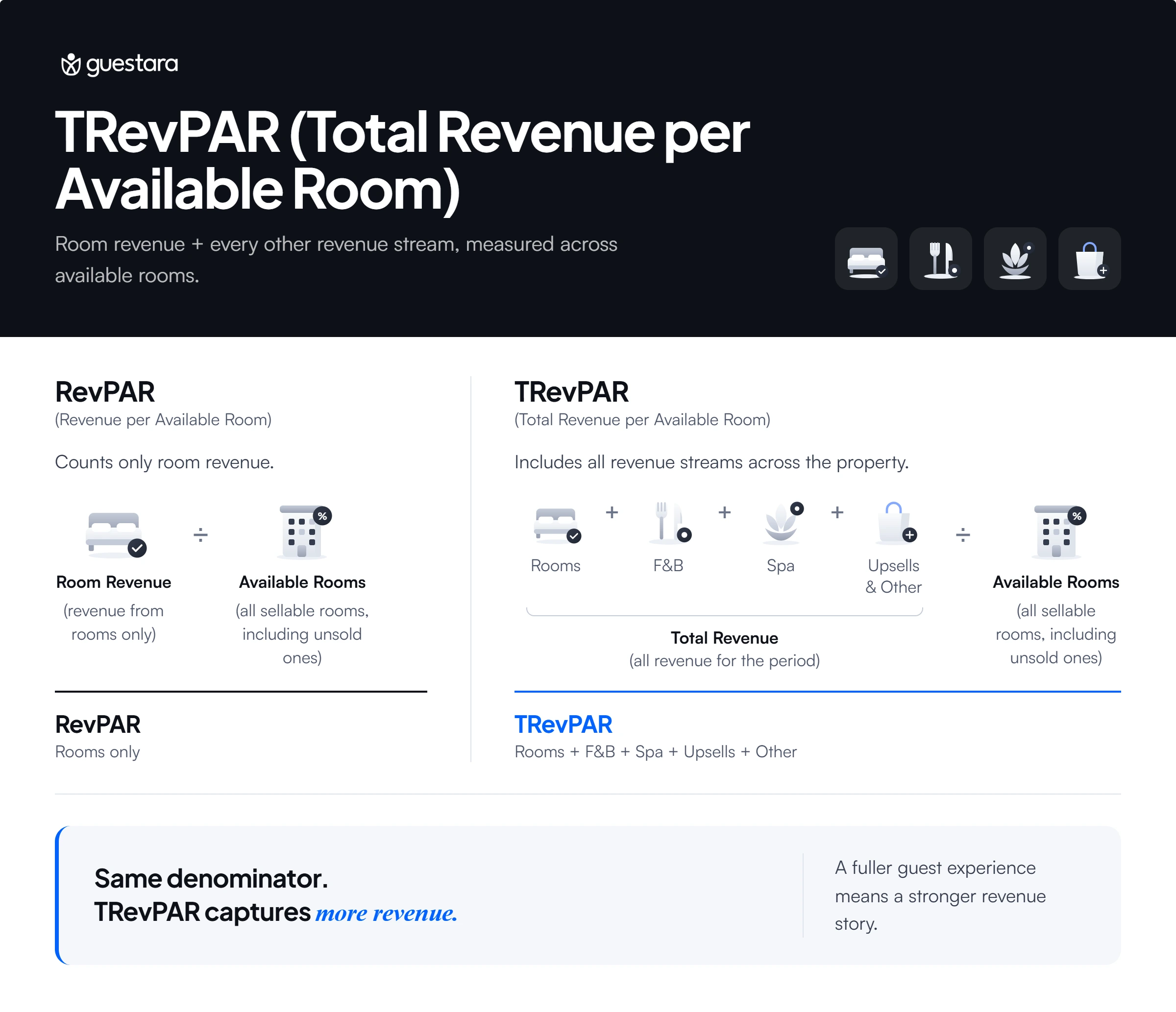
RevPAR can make two hotels look identical while one earns far more from restaurants, upsells, and experiences. TRevPAR surfaces that difference. It rewards properties that turn a stay into more than a room, and it is the right yardstick for full-service hotels and resorts where rooms are only part of the revenue story.
For a rooms-only property with little ancillary income, TRevPAR sits close to RevPAR and adds little. The more revenue streams you run, the more TRevPAR tells you that RevPAR cannot.
One caution: TRevPAR is still a revenue metric, not a profit one. Ancillary streams often carry very different margins than rooms, so a high TRevPAR does not automatically mean high profit. For that, you move on to GOPPAR.
.webp)
TRevPAR grows when you capture more of each guest's spend per available room.
Upselling is the most direct TRevPAR lever because it adds ancillary revenue to rooms already sold. Guestara's hotel upsell software automates upgrade and add-on offers across the guest journey, and hotels using it see up to 200% more upsells, feeding straight into a higher TRevPAR.
TRevPAR is all hotel revenue per room, not just rooms. See the formula, an example, and how it differs from RevPAR.
TRevPAR measures a hotel's total revenue, from every source, per available room. Formula: TRevPAR = Total Revenue / Available Rooms. Unlike RevPAR, which counts only room revenue, TRevPAR captures F&B, spa, upsells, and every other stream, so it reflects how well the whole property earns.
Total Revenue per Available Room (TRevPAR) shows how much revenue a property generates across all departments for each room it has available to sell. Where RevPAR looks only at what the rooms themselves bring in, TRevPAR widens the lens to the entire guest wallet: food and beverage, spa, experiences, upsells, parking, and any other ancillary income.
That makes TRevPAR the headline metric of total revenue management, the discipline of optimizing every revenue stream a guest touches, not just the room rate.
TRevPAR = Total Revenue / Total Available Rooms
The denominator is identical to RevPAR. Only the numerator changes, from room revenue to all revenue.
A 100-room hotel over a 30-night month has 3,000 available room-nights.
TRevPAR = $540,000 / 3,000 = $180
The $60 gap between RevPAR ($120) and TRevPAR ($180) is exactly the ancillary revenue this property earns per available room. For a resort or an F&B-heavy hotel, that gap is where a large share of the business actually lives.
RevPAR can make two hotels look identical while one earns far more from restaurants, upsells, and experiences. TRevPAR surfaces that difference. It rewards properties that turn a stay into more than a room, and it is the right yardstick for full-service hotels and resorts where rooms are only part of the revenue story.
For a rooms-only property with little ancillary income, TRevPAR sits close to RevPAR and adds little. The more revenue streams you run, the more TRevPAR tells you that RevPAR cannot.
One caution: TRevPAR is still a revenue metric, not a profit one. Ancillary streams often carry very different margins than rooms, so a high TRevPAR does not automatically mean high profit. For that, you move on to GOPPAR.
TRevPAR grows when you capture more of each guest's spend per available room.
Upselling is the most direct TRevPAR lever because it adds ancillary revenue to rooms already sold. Guestara's hotel upsell software automates upgrade and add-on offers across the guest journey, and hotels using it see up to 200% more upsells, feeding straight into a higher TRevPAR.
RevPAR counts room revenue only; TRevPAR counts total revenue from every department. Same denominator, broader numerator.
All revenue streams: rooms, food and beverage, spa, experiences, upsells, parking, and any other ancillary income the property earns.
Yes, or equal. Because total revenue is at least room revenue, TRevPAR is greater than or equal to RevPAR, and they match only when a property has no ancillary revenue.
No. It measures total revenue per available room, not profitability. Different streams carry different margins, so use GOPPAR when you need the profit picture.


