In This Article:
Subscribe to our newsletter
Read about our privacy policy.
Thank you! Your submission has been received!
Oops! Something went wrong while submitting the form.
Hotel Operations

How to Start a Boutique Hotel: Steps, Costs, and Tips

How to start a boutique hotel, step by step: define your concept, plan costs, secure funding, design the space, set up tech, and launch with guests in mind. URL SLUG: how-to-start-a-boutique-hotel


Published on:
23/9/2026
Summarise with:
How to Start a Boutique Hotel: Steps, Costs, and Tips Read the complete guide by Guestara
TL;DR — Key Takeaways
  • A boutique hotel is a small, independent, design-led property, usually 10 to 100 rooms, built around a distinct style and personal service.
  • Starting one follows eight steps, from defining your concept to securing funding, designing the space, and launching.
  • Costs vary widely by location and whether you build or convert, so a detailed business plan and funding buffer come first.
  • The global boutique hotel market is growing about 7 percent a year, with India the fastest-growing region, per Grand View Research.
  • Profitability comes from direct bookings, smart rate strategy, upsells, and an experience guests review and return for.

Starting a boutique hotel means building a small, design-led property around a clear identity and personal service, then getting the concept, funding, space, and operations right in the correct order. Do that well and you create a place guests choose on purpose, not by default.

The appeal is obvious. Travelers increasingly want character over cookie-cutter rooms, and a well-run boutique property can command premium rates on a small footprint. The catch is that the same details that make it special, the design, the service, the story, are the hardest to get right. This guide walks you through it step by step.

What is a boutique hotel?

A boutique hotel is a small, independent property, typically between 10 and 100 rooms, defined by a distinctive design, a strong sense of place, and highly personal service. Unlike chain hotels, boutique properties trade scale and standardisation for character and intimacy. The look, the story, and the guest experience are the product as much as the room itself.

There is no strict rulebook, but three traits show up almost every time: a small room count, a design-led identity, and service that feels personal rather than processed. That combination is what lets a boutique hotel charge more per room than a comparable standard hotel.

Key takeaways

  • A boutique hotel is a small, independent, design-led property, usually 10 to 100 rooms.
  • Its character, sense of place, and personal service are the product, not just the room.

How much does it cost to start a boutique hotel?

There is no single figure, because cost depends on location, size, and whether you build from scratch or convert an existing building. Converting a small property is usually cheaper than a ground-up build, though renovation, design, and licensing still add up quickly. Plan for the purchase or lease, the fit-out and design, technology, staffing, licences, and a cash buffer for the first slow months.

In India, a small boutique property typically starts from a few crore rupees, with land, location, and licensing driving most of the difference. Wherever you build, a detailed business plan with realistic costs and a funding buffer is the first real step, not an afterthought.

Key takeaways

  • Boutique hotel startup costs swing widely with location, size, and build versus conversion.
  • Budget for property, design, tech, staff, licences, and a buffer, backed by a realistic business plan.

How to start a boutique hotel step by step

Here is the sequence that works, from idea to opening day. Follow it in order, since each step depends on the one before.

Guestara infographic outlining 8 steps to start a boutique hotel, from defining the concept and writing a business plan to securing funding, choosing a property, getting licences, branding, setting up hotel systems, and launching.
  1. Define your concept and niche. Decide who you serve and what makes your property different, from design theme to location to the type of guest you want.
  2. Write a business plan. Map your costs, revenue, funding needs, and break-even, and use it to pressure-test the idea before you spend.
  3. Secure funding. Line up the capital through savings, investors, or loans, with enough buffer for a slow first season.
  4. Find and secure the property. Choose a location and building that fit your concept, whether a conversion or a new build, and check the zoning.
  5. Handle licences and permits. Register the business and secure the required approvals, which in India include GST, an FSSAI food licence, fire and police clearances, and a trade licence.
  6. Design and brand the space. Turn your concept into interiors, identity, and a story guests feel the moment they arrive.
  7. Set up operations and technology. Put your booking, PMS, check-in, guest messaging, and payment systems in place before you open.
  8. Hire, train, and launch. Recruit a small team that fits your service style, then market the opening across your website, OTAs, and social channels.

Key takeaways

  • Starting a boutique hotel runs in order: concept, plan, funding, property, licences, design, systems, then launch.
  • Each step depends on the last, so skipping ahead, especially past the business plan, is where new owners get burned.

How do you make a boutique hotel profitable?

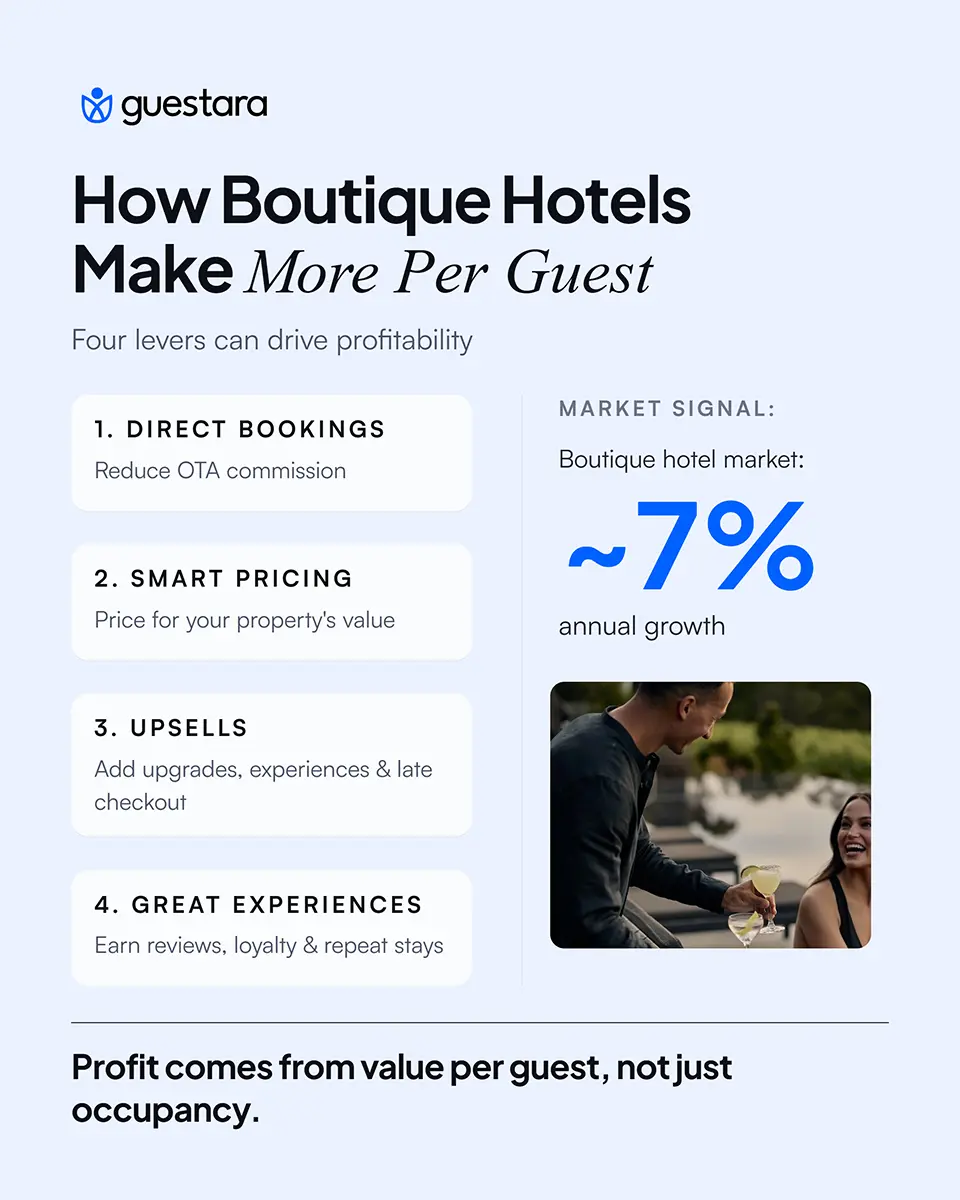
Guestara infographic explaining four ways boutique hotels can increase revenue per guest: direct bookings, smart pricing, upsells such as upgrades and late checkout, and great guest experiences that drive reviews, loyalty, and repeat stays. It also highlights approximately 7% annual boutique hotel market growth.

A boutique hotel turns profitable by earning more per guest on a small room count, not by filling more rooms than its size allows. The market is on your side, with the global boutique hotel sector growing about 7 percent a year and India the fastest-growing region, according to Grand View Research. The job is to capture that demand at a healthy rate.

Four levers do most of the work. Drive direct bookings to cut OTA commission. Price for your value, since a strong boutique property can sit well above the roughly 161 dollar US average nightly rate reported by STR and CoStar. Add revenue per stay through upsells like room upgrades, experiences, and late checkout, using proven upselling ideas and tools such as Guestara's Upsell menu. And protect the experience that earns repeat stays and strong reviews.

Key takeaways

  • Boutique hotels profit by earning more per guest on a small footprint, not by chasing occupancy.
  • Direct bookings, value-based pricing, upsells, and a repeat-driving experience are the four main levers.

Technology and systems a boutique hotel needs

A boutique hotel runs on a small stack of core systems that let a lean team deliver a big-hotel experience. At minimum you need a booking engine and PMS, a fast and low-friction check-in, guest messaging, in-stay ordering and upsells, review collection, and a smooth checkout. The goal is to automate the routine so your team spends its time on the personal touches guests remember.

Modern platforms bundle these so you are not stitching together five separate tools. Guestara covers contactless check-in, a branded guest app, review collection, and smart checkout in one place, which suits a small property running on thin staffing.

Key takeaways

  • A boutique hotel needs booking and PMS, check-in, guest messaging, upsells, reviews, and checkout systems.
  • Automating the routine frees a small team to focus on the personal service that defines the brand.

What mistakes should you avoid when starting a boutique hotel?

The most common mistake is underestimating cost and runway, then running out of cash before the property builds a reputation. Boutique hotels take time to fill, so budget for a slow first season rather than assuming instant occupancy.

Other frequent traps:

  • Chasing a design you love over one your target guest actually wants
  • Skipping or rushing the business plan
  • Leaning on OTAs and paying away your margin instead of building direct bookings
  • Overstaffing or understaffing before you know your real occupancy pattern
  • Neglecting reviews early, when they matter most to a new property

Avoid these and you protect both the experience and the cash flow that keep a new boutique hotel alive.

Key takeaways

  • The biggest risk is underestimating cost and runway before the property builds a reputation.
  • Guarding cash flow and prioritising early reviews matter as much as the design itself.

[[cta:cta-6 | eyebrow=GUEST EXPERIENCE  | heading=See how a small team delivers a big-hotel experience. | btn=Explore More | link=https://www.guestara.com/guest-engagement-for-hospitality ]]

Pratik Bhondve
Marketing Manager
One Platform

Run your entire guest journey from one platform

Automate check-in, messaging, upsells and reviews, all in one place.

Get a demo
Looking for Guest Management guide in 2026?
Book a personalised demo now.
Book a demo
Subscribe to our newsletter
Read about our privacy policy.
Thank you! Your submission has been received!
Oops! Something went wrong while submitting the form.
Hotel Operations

How to Start a Boutique Hotel: Steps, Costs, and Tips

How to start a boutique hotel, step by step: define your concept, plan costs, secure funding, design the space, set up tech, and launch with guests in mind. URL SLUG: how-to-start-a-boutique-hotel

9/23/2026
How to Start a Boutique Hotel: Steps, Costs, and Tips Read the complete guide by Guestara
Summarise with:
TL;DR — Key Takeaways
  • A boutique hotel is a small, independent, design-led property, usually 10 to 100 rooms, built around a distinct style and personal service.
  • Starting one follows eight steps, from defining your concept to securing funding, designing the space, and launching.
  • Costs vary widely by location and whether you build or convert, so a detailed business plan and funding buffer come first.
  • The global boutique hotel market is growing about 7 percent a year, with India the fastest-growing region, per Grand View Research.
  • Profitability comes from direct bookings, smart rate strategy, upsells, and an experience guests review and return for.

Starting a boutique hotel means building a small, design-led property around a clear identity and personal service, then getting the concept, funding, space, and operations right in the correct order. Do that well and you create a place guests choose on purpose, not by default.

The appeal is obvious. Travelers increasingly want character over cookie-cutter rooms, and a well-run boutique property can command premium rates on a small footprint. The catch is that the same details that make it special, the design, the service, the story, are the hardest to get right. This guide walks you through it step by step.

What is a boutique hotel?

A boutique hotel is a small, independent property, typically between 10 and 100 rooms, defined by a distinctive design, a strong sense of place, and highly personal service. Unlike chain hotels, boutique properties trade scale and standardisation for character and intimacy. The look, the story, and the guest experience are the product as much as the room itself.

There is no strict rulebook, but three traits show up almost every time: a small room count, a design-led identity, and service that feels personal rather than processed. That combination is what lets a boutique hotel charge more per room than a comparable standard hotel.

Key takeaways

  • A boutique hotel is a small, independent, design-led property, usually 10 to 100 rooms.
  • Its character, sense of place, and personal service are the product, not just the room.

How much does it cost to start a boutique hotel?

There is no single figure, because cost depends on location, size, and whether you build from scratch or convert an existing building. Converting a small property is usually cheaper than a ground-up build, though renovation, design, and licensing still add up quickly. Plan for the purchase or lease, the fit-out and design, technology, staffing, licences, and a cash buffer for the first slow months.

In India, a small boutique property typically starts from a few crore rupees, with land, location, and licensing driving most of the difference. Wherever you build, a detailed business plan with realistic costs and a funding buffer is the first real step, not an afterthought.

Key takeaways

  • Boutique hotel startup costs swing widely with location, size, and build versus conversion.
  • Budget for property, design, tech, staff, licences, and a buffer, backed by a realistic business plan.

How to start a boutique hotel step by step

Here is the sequence that works, from idea to opening day. Follow it in order, since each step depends on the one before.

Guestara infographic outlining 8 steps to start a boutique hotel, from defining the concept and writing a business plan to securing funding, choosing a property, getting licences, branding, setting up hotel systems, and launching.
  1. Define your concept and niche. Decide who you serve and what makes your property different, from design theme to location to the type of guest you want.
  2. Write a business plan. Map your costs, revenue, funding needs, and break-even, and use it to pressure-test the idea before you spend.
  3. Secure funding. Line up the capital through savings, investors, or loans, with enough buffer for a slow first season.
  4. Find and secure the property. Choose a location and building that fit your concept, whether a conversion or a new build, and check the zoning.
  5. Handle licences and permits. Register the business and secure the required approvals, which in India include GST, an FSSAI food licence, fire and police clearances, and a trade licence.
  6. Design and brand the space. Turn your concept into interiors, identity, and a story guests feel the moment they arrive.
  7. Set up operations and technology. Put your booking, PMS, check-in, guest messaging, and payment systems in place before you open.
  8. Hire, train, and launch. Recruit a small team that fits your service style, then market the opening across your website, OTAs, and social channels.

Key takeaways

  • Starting a boutique hotel runs in order: concept, plan, funding, property, licences, design, systems, then launch.
  • Each step depends on the last, so skipping ahead, especially past the business plan, is where new owners get burned.

How do you make a boutique hotel profitable?

Guestara infographic explaining four ways boutique hotels can increase revenue per guest: direct bookings, smart pricing, upsells such as upgrades and late checkout, and great guest experiences that drive reviews, loyalty, and repeat stays. It also highlights approximately 7% annual boutique hotel market growth.

A boutique hotel turns profitable by earning more per guest on a small room count, not by filling more rooms than its size allows. The market is on your side, with the global boutique hotel sector growing about 7 percent a year and India the fastest-growing region, according to Grand View Research. The job is to capture that demand at a healthy rate.

Four levers do most of the work. Drive direct bookings to cut OTA commission. Price for your value, since a strong boutique property can sit well above the roughly 161 dollar US average nightly rate reported by STR and CoStar. Add revenue per stay through upsells like room upgrades, experiences, and late checkout, using proven upselling ideas and tools such as Guestara's Upsell menu. And protect the experience that earns repeat stays and strong reviews.

Key takeaways

  • Boutique hotels profit by earning more per guest on a small footprint, not by chasing occupancy.
  • Direct bookings, value-based pricing, upsells, and a repeat-driving experience are the four main levers.

Technology and systems a boutique hotel needs

A boutique hotel runs on a small stack of core systems that let a lean team deliver a big-hotel experience. At minimum you need a booking engine and PMS, a fast and low-friction check-in, guest messaging, in-stay ordering and upsells, review collection, and a smooth checkout. The goal is to automate the routine so your team spends its time on the personal touches guests remember.

Modern platforms bundle these so you are not stitching together five separate tools. Guestara covers contactless check-in, a branded guest app, review collection, and smart checkout in one place, which suits a small property running on thin staffing.

Key takeaways

  • A boutique hotel needs booking and PMS, check-in, guest messaging, upsells, reviews, and checkout systems.
  • Automating the routine frees a small team to focus on the personal service that defines the brand.

What mistakes should you avoid when starting a boutique hotel?

The most common mistake is underestimating cost and runway, then running out of cash before the property builds a reputation. Boutique hotels take time to fill, so budget for a slow first season rather than assuming instant occupancy.

Other frequent traps:

  • Chasing a design you love over one your target guest actually wants
  • Skipping or rushing the business plan
  • Leaning on OTAs and paying away your margin instead of building direct bookings
  • Overstaffing or understaffing before you know your real occupancy pattern
  • Neglecting reviews early, when they matter most to a new property

Avoid these and you protect both the experience and the cash flow that keep a new boutique hotel alive.

Key takeaways

  • The biggest risk is underestimating cost and runway before the property builds a reputation.
  • Guarding cash flow and prioritising early reviews matter as much as the design itself.

[[cta:cta-6 | eyebrow=GUEST EXPERIENCE  | heading=See how a small team delivers a big-hotel experience. | btn=Explore More | link=https://www.guestara.com/guest-engagement-for-hospitality ]]

Pratik Bhondve
Marketing Manager
Subscribe to our newsletter
Read about our privacy policy.
Thank you! Your submission has been received!
Oops! Something went wrong while submitting the form.

Frequently Asked Questions

How many rooms does a boutique hotel have?

Most boutique hotels have between 10 and 100 rooms, small enough to keep service personal and the property distinctive. There is no legal limit, but once a property grows much beyond 100 rooms it usually loses the intimate feel that defines the category.

Is a boutique hotel profitable?

A boutique hotel can be very profitable, because a small, design-led property can command premium rates and strong loyalty. Profitability depends on controlling costs, driving direct bookings, adding upsell revenue, and maintaining the experience that earns repeat stays and good reviews.

How long does it take to start a boutique hotel?

From concept to opening typically takes one to three years, depending on whether you convert an existing building or build new, and how long financing and permits take. A conversion in a ready market can move faster, while a ground-up build or a heritage renovation takes longer.

Do you need experience to open a boutique hotel?

Formal hospitality experience helps but is not essential, since many successful owners come from design, business, or other fields. What matters is a clear concept, a solid business plan, the right team, and systems that cover the operational side you may not know well.

Your hospitality tech stack’s best friend

We work closely with the industry leaders to offer seamless solutions

Guestara is already easy to use. But we’re still here for you

We’re here to help your whole team stay ahead of the curve as you grow.

heart handshake icon
Onboarding Services

Get up and running quickly with a personalized onboarding plan

customer support icon
24/7 Support

Connect with real people who really get it, 24/7

book icon
Guides and Templates

Checkout our vast library of free resources, templates and more

See Guestara in action now.

There's only so much we can say — so let us show you! Schedule a demo today and reach your business goals.