Motel vs hotel: a motel is a budget roadside stop with exterior room access, a hotel has interior rooms and more amenities. Compare cost, safety, which to book.




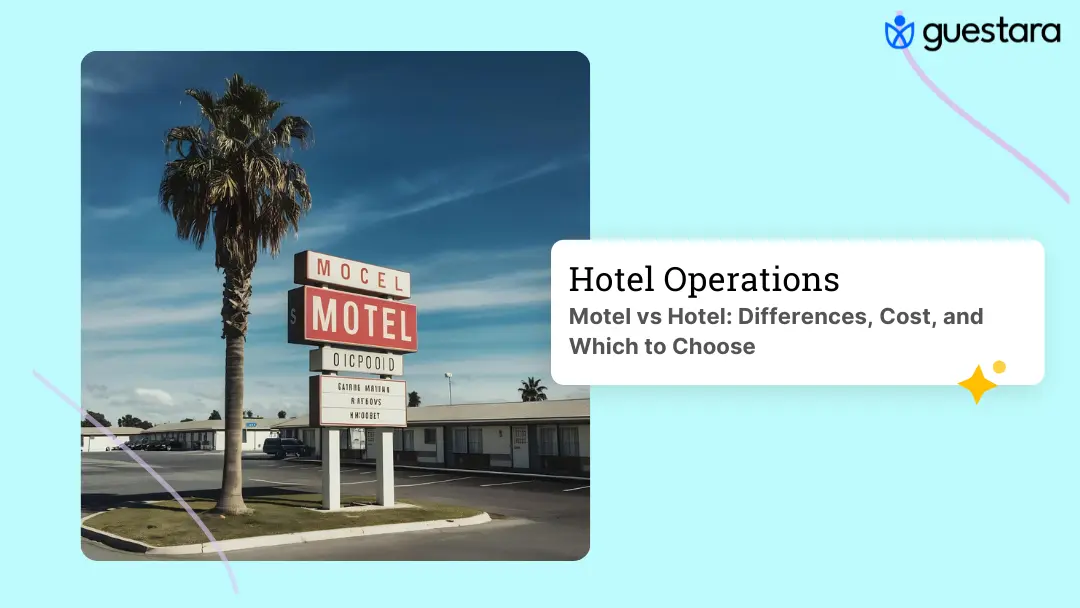
The difference between a motel and a hotel comes down to how you reach your room and why you are staying. A motel puts your door a few steps from your car for a quick overnight stop. A hotel puts your room down an interior hallway, in a building meant for a fuller stay.
You have seen both from the road. The single-storey strip with doors facing the parking lot and a neon vacancy sign is a motel. The multi-floor building with a lobby and a lift is a hotel. Here is exactly how they differ, what each costs, and which one to book.
A motel is a small, budget roadside property, usually one or two storeys, where rooms open directly onto an outdoor parking area, built for short overnight stops. A hotel is a larger, multi-storey property with interior room access, a lobby, and a wider range of services, built for longer or more comfortable stays. The clearest tell is the door: a motel room opens to the car park, a hotel room opens to an inside hallway.
A motel is a roadside lodging built for motorists who need a cheap, convenient place to stop overnight. The word blends motor and hotel, and the format took off in the United States in the 1920s and 1930s as highways spread and car travel boomed. Rooms usually open straight onto the parking lot, so guests can park at the door, unload, and leave early with no lobby to pass through.
Motels keep things simple: a clean room, a bed, a bathroom, free parking, and often little else. That stripped-back model is the point, because it keeps rates low for travelers who only need a few hours of sleep between drives.
A hotel is a commercial property offering rooms accessed from interior hallways, along with a front desk and services that scale with its class. Unlike a motel, a hotel is built around an indoor experience, from the lobby to the corridors to on-site facilities like dining, a gym, or a pool. Hotels sit where guests want to be, in city centres, near airports, or by attractions.
Hotels span a wide range, from budget chains to luxury properties, but they share that interior layout and a fuller service model. This is why a hotel usually costs more than a motel and suits longer or more comfortable stays.
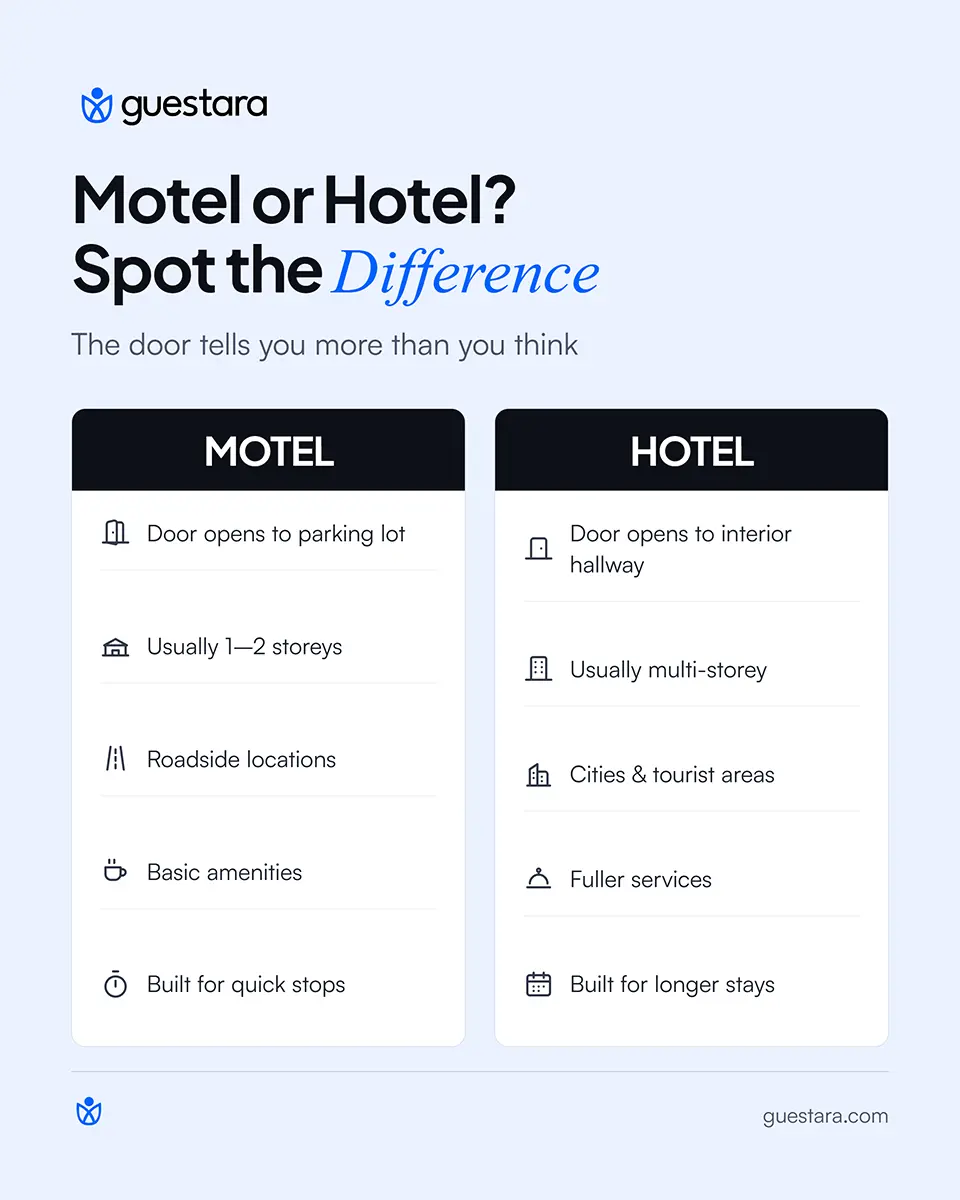
Cost is the biggest practical difference. Motels are built to be cheap and usually price well below the market. The average US hotel rate sat near 161 dollars a night in 2025, according to STR and CoStar data, and motels commonly run around half that or less, since they carry far lower overheads and offer fewer services.
Location and access follow the same logic. Motels cluster along highways and town edges where land is cheaper and drivers pass through, with rooms opening to the parking lot for fast in and out. Hotels take pricier central sites and route guests through a lobby and interior halls, trading quick access for comfort and security.
Choose a motel for a cheap, convenient overnight stop by car, and a hotel for comfort, amenities, or a longer stay. If you are driving cross-country and need a few hours of sleep, a motel does the job for less. If the stay is the point, or you want a pool, room service, and a central location, a hotel is worth the extra.
Use these quick rules:
A common worry is safety. Motels are not inherently less safe than hotels, but exterior room access and roadside locations mean it pays to check recent reviews and pick a well-rated property. Even the dictionary keeps the two separate, defining a motel by its motor-era, park-at-the-door design.
Two modern notes are worth knowing. Retro and boutique motels have made a comeback, with design-led properties turning the roadside format into a stylish, mid-priced stay. And the word itself is largely North American. In India, the same need is met by budget hotels, lodges, and highway hotels near national highways, so travelers there compare budget hotels rather than motels.
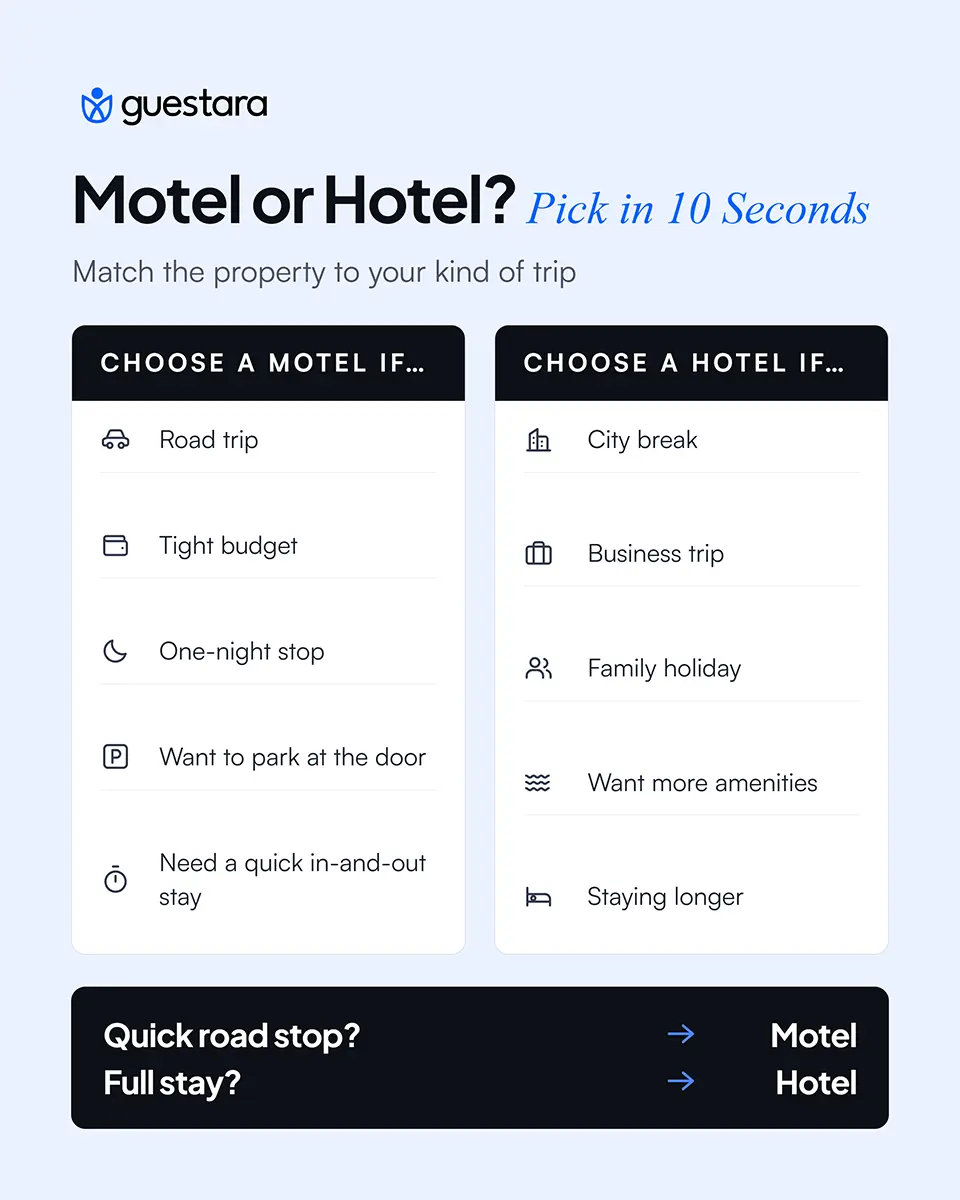
For operators, the motel or hotel label sets guest expectations, the price ceiling, and the kind of stay you are selling. A roadside property that invests in the wrong extras prices itself out of its market, while a hotel that skimps on service underdelivers on its promise. The job is to match the offer to the format.
Budget and roadside properties win on speed and low overhead, which is where lean operations matter most. Guestara's self-service check-in lets a small team turn rooms quickly without a large front desk, so a lean property runs smoothly on thin staffing.
[[cta:cta-5 | eyebrow=SELF SERVICE | heading=See how lean properties check guests in without a front desk. | btn= Explore Self Check-In link=https://www.guestara.com/contactless-checkin-checkout ]]


Motel vs hotel: a motel is a budget roadside stop with exterior room access, a hotel has interior rooms and more amenities. Compare cost, safety, which to book.
The difference between a motel and a hotel comes down to how you reach your room and why you are staying. A motel puts your door a few steps from your car for a quick overnight stop. A hotel puts your room down an interior hallway, in a building meant for a fuller stay.
You have seen both from the road. The single-storey strip with doors facing the parking lot and a neon vacancy sign is a motel. The multi-floor building with a lobby and a lift is a hotel. Here is exactly how they differ, what each costs, and which one to book.
A motel is a small, budget roadside property, usually one or two storeys, where rooms open directly onto an outdoor parking area, built for short overnight stops. A hotel is a larger, multi-storey property with interior room access, a lobby, and a wider range of services, built for longer or more comfortable stays. The clearest tell is the door: a motel room opens to the car park, a hotel room opens to an inside hallway.
A motel is a roadside lodging built for motorists who need a cheap, convenient place to stop overnight. The word blends motor and hotel, and the format took off in the United States in the 1920s and 1930s as highways spread and car travel boomed. Rooms usually open straight onto the parking lot, so guests can park at the door, unload, and leave early with no lobby to pass through.
Motels keep things simple: a clean room, a bed, a bathroom, free parking, and often little else. That stripped-back model is the point, because it keeps rates low for travelers who only need a few hours of sleep between drives.
A hotel is a commercial property offering rooms accessed from interior hallways, along with a front desk and services that scale with its class. Unlike a motel, a hotel is built around an indoor experience, from the lobby to the corridors to on-site facilities like dining, a gym, or a pool. Hotels sit where guests want to be, in city centres, near airports, or by attractions.
Hotels span a wide range, from budget chains to luxury properties, but they share that interior layout and a fuller service model. This is why a hotel usually costs more than a motel and suits longer or more comfortable stays.
Cost is the biggest practical difference. Motels are built to be cheap and usually price well below the market. The average US hotel rate sat near 161 dollars a night in 2025, according to STR and CoStar data, and motels commonly run around half that or less, since they carry far lower overheads and offer fewer services.
Location and access follow the same logic. Motels cluster along highways and town edges where land is cheaper and drivers pass through, with rooms opening to the parking lot for fast in and out. Hotels take pricier central sites and route guests through a lobby and interior halls, trading quick access for comfort and security.
Choose a motel for a cheap, convenient overnight stop by car, and a hotel for comfort, amenities, or a longer stay. If you are driving cross-country and need a few hours of sleep, a motel does the job for less. If the stay is the point, or you want a pool, room service, and a central location, a hotel is worth the extra.
Use these quick rules:
A common worry is safety. Motels are not inherently less safe than hotels, but exterior room access and roadside locations mean it pays to check recent reviews and pick a well-rated property. Even the dictionary keeps the two separate, defining a motel by its motor-era, park-at-the-door design.
Two modern notes are worth knowing. Retro and boutique motels have made a comeback, with design-led properties turning the roadside format into a stylish, mid-priced stay. And the word itself is largely North American. In India, the same need is met by budget hotels, lodges, and highway hotels near national highways, so travelers there compare budget hotels rather than motels.
For operators, the motel or hotel label sets guest expectations, the price ceiling, and the kind of stay you are selling. A roadside property that invests in the wrong extras prices itself out of its market, while a hotel that skimps on service underdelivers on its promise. The job is to match the offer to the format.
Budget and roadside properties win on speed and low overhead, which is where lean operations matter most. Guestara's self-service check-in lets a small team turn rooms quickly without a large front desk, so a lean property runs smoothly on thin staffing.
[[cta:cta-5 | eyebrow=SELF SERVICE | heading=See how lean properties check guests in without a front desk. | btn= Explore Self Check-In link=https://www.guestara.com/contactless-checkin-checkout ]]
Yes, almost always. Motels carry lower overheads and offer fewer services, so they usually price well below hotels, often around half the average hotel rate. The trade-off is fewer amenities and a roadside rather than central location.
A motel is a roadside property built for motorists, with exterior room access and minimal service. An inn is usually smaller and often older, focused on a cosy, personal stay with interior access and sometimes a restaurant or bar. Inns lean toward character and hospitality, motels toward convenience and price.
Motels are not inherently unsafe, but their exterior room access and roadside locations make it worth choosing a well-reviewed property. Check recent guest reviews, look for good lighting and secure locks, and favour motels in reputable chains or with strong ratings.
The word motel combines motor and hotel. It was coined in the United States in the 1920s to describe roadside lodging built for motorists as car travel and the highway network expanded.
We work closely with the industry leaders to offer seamless solutions




We’re here to help your whole team stay ahead of the curve as you grow.

Get up and running quickly with a personalized onboarding plan

Connect with real people who really get it, 24/7

Checkout our vast library of free resources, templates and more
There's only so much we can say — so let us show you! Schedule a demo today and reach your business goals.


.png)