.webp)
EBITDA measures profit before financing, tax, and non-cash accounting charges are removed. On the hotel P&L it sits just below GOP and just above NOI. Because it strips out how a hotel is financed and taxed, it is a clean way to compare operating profitability across properties and a common basis for valuation.
EBITDA stands for Earnings Before Interest, Taxes, Depreciation, and Amortization. It is a profitability measure that deliberately removes four things: interest (a financing choice), taxes (a jurisdiction and structure issue), and depreciation and amortization (non-cash accounting charges). What is left approximates the operating profit the business generates before those decisions distort the picture.
In hospitality, EBITDA is most useful as a comparison and valuation tool. Two hotels with different loans, owners, and tax situations can be compared on EBITDA as if those differences did not exist, which is exactly what buyers, lenders, and asset managers want.
EBITDA falls between two metrics already in this cluster:
So the order runs GOP, then EBITDA, then NOI, each one net of more cost than the last. GOP is greater than or equal to EBITDA, which is greater than or equal to NOI.
There are two equivalent ways to arrive at it.
Built up from net income:
EBITDA = Net Income + Interest + Taxes + Depreciation + Amortization
Built down in hotel terms:
EBITDA = GOP - Management Fees - Fixed Charges (property taxes, insurance), before any FF&E reserve.
Using the same 100-room hotel on an annual basis, where monthly GOP of $180,000 annualizes to about $2,160,000:
The $260,000 gap between EBITDA and NOI is the FF&E reserve, the money set aside to keep the property competitive. That gap is why the two numbers are close but not the same.
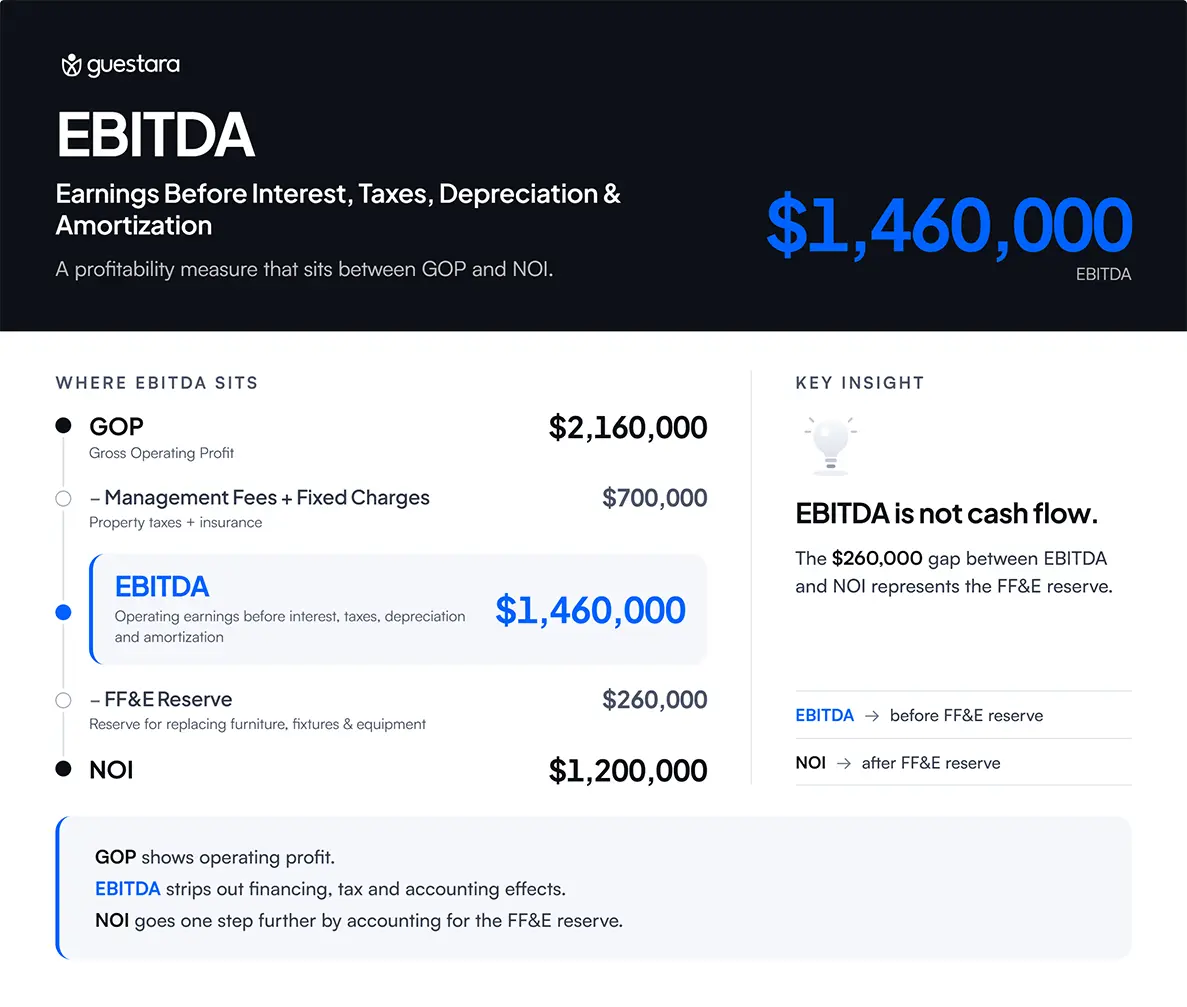
EBITDA is not cash flow, and in hotels that caveat has teeth. Because EBITDA sits before the FF&E reserve, it ignores the very real, recurring cost of replacing furniture, fixtures, and equipment. A hotel that never reinvests will show a healthy EBITDA while quietly declining. This is precisely why hotel valuation usually leans on NOI, which nets out that reserve, rather than EBITDA alone. EBITDA also excludes debt service, working capital, and taxes actually paid, so it should never be read as the money left in the owner's pocket.
Because interest, tax, and depreciation sit below it, EBITDA moves on operating performance and fixed-cost control, the same levers as GOP.
Hotel profit stripped of financing and accounting noise, and why it isn't cash.
EBITDA measures profit before financing, tax, and non-cash accounting charges are removed. On the hotel P&L it sits just below GOP and just above NOI. Because it strips out how a hotel is financed and taxed, it is a clean way to compare operating profitability across properties and a common basis for valuation.
EBITDA stands for Earnings Before Interest, Taxes, Depreciation, and Amortization. It is a profitability measure that deliberately removes four things: interest (a financing choice), taxes (a jurisdiction and structure issue), and depreciation and amortization (non-cash accounting charges). What is left approximates the operating profit the business generates before those decisions distort the picture.
In hospitality, EBITDA is most useful as a comparison and valuation tool. Two hotels with different loans, owners, and tax situations can be compared on EBITDA as if those differences did not exist, which is exactly what buyers, lenders, and asset managers want.
EBITDA falls between two metrics already in this cluster:
So the order runs GOP, then EBITDA, then NOI, each one net of more cost than the last. GOP is greater than or equal to EBITDA, which is greater than or equal to NOI.
There are two equivalent ways to arrive at it.
Built up from net income:
EBITDA = Net Income + Interest + Taxes + Depreciation + Amortization
Built down in hotel terms:
EBITDA = GOP - Management Fees - Fixed Charges (property taxes, insurance), before any FF&E reserve.
Using the same 100-room hotel on an annual basis, where monthly GOP of $180,000 annualizes to about $2,160,000:
The $260,000 gap between EBITDA and NOI is the FF&E reserve, the money set aside to keep the property competitive. That gap is why the two numbers are close but not the same.
EBITDA is not cash flow, and in hotels that caveat has teeth. Because EBITDA sits before the FF&E reserve, it ignores the very real, recurring cost of replacing furniture, fixtures, and equipment. A hotel that never reinvests will show a healthy EBITDA while quietly declining. This is precisely why hotel valuation usually leans on NOI, which nets out that reserve, rather than EBITDA alone. EBITDA also excludes debt service, working capital, and taxes actually paid, so it should never be read as the money left in the owner's pocket.
Because interest, tax, and depreciation sit below it, EBITDA moves on operating performance and fixed-cost control, the same levers as GOP.
Earnings Before Interest, Taxes, Depreciation, and Amortization, a measure of profit before financing and non-cash accounting charges are removed.
They are close. The usual distinction is the FF&E reserve: EBITDA is calculated before it, NOI after it, so EBITDA is slightly higher. Conventions vary, so define the term in any deal.
GOP is measured before management fees and fixed charges; EBITDA is measured after them. GOP is the higher, earlier line on the P&L.
No. EBITDA ignores capital spending (like the FF&E reserve), debt service, working capital, and taxes actually paid, so it overstates the cash a hotel actually keeps.


