
A length-of-stay discount is a reduced nightly rate offered to guests who book longer stays, such as "stay 4 nights, save 15%." Hotels use it to lift average length of stay and cut per-night servicing cost, but it must be used carefully, because a discount deeper than the value of the longer stay simply erodes ADR.
A length-of-stay (LOS) discount is a pricing tactic that rewards guests for staying longer by lowering the nightly rate as the number of nights increases. Instead of one flat price per night, the hotel offers a better per-night rate to bookings that clear a minimum number of nights, or publishes a discounted weekly or monthly rate.
It is a demand-shaping tool. Rather than changing how many guests book, a length-of-stay discount changes the shape of each booking, nudging shorter stays into longer ones.
Length-of-stay discounts are set up as rate rules in the booking engine, PMS, or channel manager, and they usually take one of a few forms:
The discount can be open to everyone or targeted, offered only on specific dates, through the direct channel, or to loyalty members, so the hotel controls exactly where the cheaper rate applies.
The appeal comes down to what longer stays do for the operation:
A length-of-stay discount lowers the rate on every discounted night, so it only pays off when the longer stay and the incremental demand it creates outweigh the rate given up. Discount too deeply, or on nights you would have sold anyway, and you simply trade ADR for nothing, which drags down RevPAR and profit.
A quick illustration: at a $150 nightly rate, a "stay 4 or more nights, save 15%" offer prices those nights at $127.50. If it genuinely converts a 2-night booker into a 5-night stay, you earn 5 nights at $127.50 ($637.50) instead of 2 nights at $150 ($300), a large gain, and cheaper to service per night. But if the guest was always going to stay 5 nights, that same offer just handed back $112.50 in rate. The tactic lives or dies on whether it creates incremental stays.
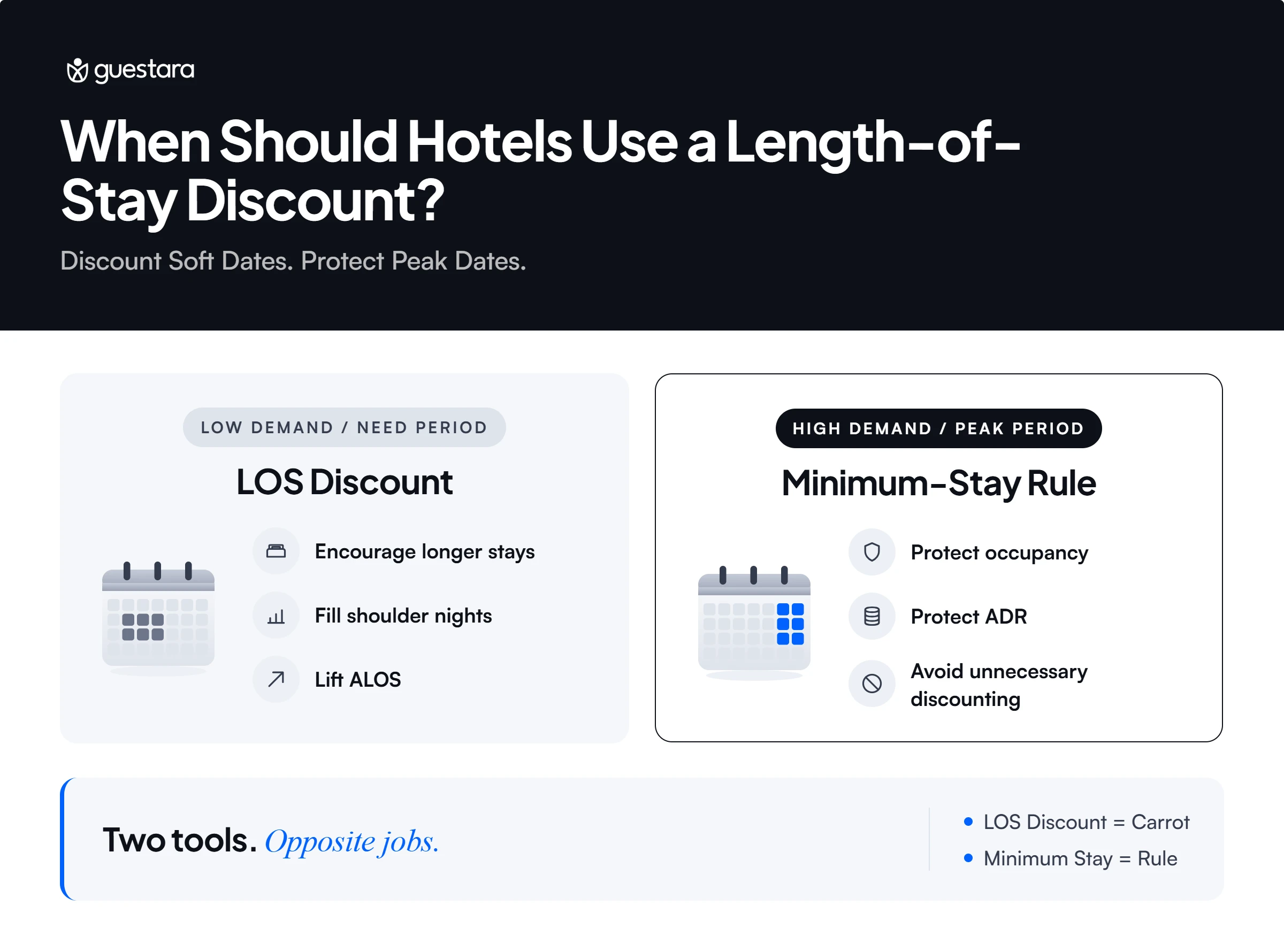
These two are easy to confuse because both act on length of stay, but they work in opposite directions:
Used together, they are complementary. Restrictions protect rate on peak dates you can already fill, while discounts stimulate longer stays during need periods, which is exactly where a length-of-stay discount belongs.
Getting the offer in front of the right guest at the right moment matters as much as the offer itself. Guestara's guest engagement platform surfaces long-stay rates and extend-your-stay prompts across pre-arrival and in-stay messaging, where they actually convert into extra nights.
Reward longer stays without giving away your rate.
A length-of-stay discount is a reduced nightly rate offered to guests who book longer stays, such as "stay 4 nights, save 15%." Hotels use it to lift average length of stay and cut per-night servicing cost, but it must be used carefully, because a discount deeper than the value of the longer stay simply erodes ADR.
A length-of-stay (LOS) discount is a pricing tactic that rewards guests for staying longer by lowering the nightly rate as the number of nights increases. Instead of one flat price per night, the hotel offers a better per-night rate to bookings that clear a minimum number of nights, or publishes a discounted weekly or monthly rate.
It is a demand-shaping tool. Rather than changing how many guests book, a length-of-stay discount changes the shape of each booking, nudging shorter stays into longer ones.
Length-of-stay discounts are set up as rate rules in the booking engine, PMS, or channel manager, and they usually take one of a few forms:
The discount can be open to everyone or targeted, offered only on specific dates, through the direct channel, or to loyalty members, so the hotel controls exactly where the cheaper rate applies.
The appeal comes down to what longer stays do for the operation:
A length-of-stay discount lowers the rate on every discounted night, so it only pays off when the longer stay and the incremental demand it creates outweigh the rate given up. Discount too deeply, or on nights you would have sold anyway, and you simply trade ADR for nothing, which drags down RevPAR and profit.
A quick illustration: at a $150 nightly rate, a "stay 4 or more nights, save 15%" offer prices those nights at $127.50. If it genuinely converts a 2-night booker into a 5-night stay, you earn 5 nights at $127.50 ($637.50) instead of 2 nights at $150 ($300), a large gain, and cheaper to service per night. But if the guest was always going to stay 5 nights, that same offer just handed back $112.50 in rate. The tactic lives or dies on whether it creates incremental stays.
These two are easy to confuse because both act on length of stay, but they work in opposite directions:
Used together, they are complementary. Restrictions protect rate on peak dates you can already fill, while discounts stimulate longer stays during need periods, which is exactly where a length-of-stay discount belongs.
Getting the offer in front of the right guest at the right moment matters as much as the offer itself. Guestara's guest engagement platform surfaces long-stay rates and extend-your-stay prompts across pre-arrival and in-stay messaging, where they actually convert into extra nights.
A reduced nightly rate for guests who book a longer stay, applied as a tier ("save more the longer you stay") or a discounted weekly or monthly rate.
It can. It lowers the rate on discounted nights, so it only pays off when it creates genuinely longer or incremental stays. Used on nights you would have sold anyway, it just dilutes ADR.
On need periods and soft dates, where stimulating longer stays adds occupancy you would not otherwise get. Avoid discounting peak dates; use minimum-stay controls there instead.
A discount incentivizes longer stays with a lower price; a minimum-stay requirement mandates a number of nights. One is a carrot, the other a rule, and they are often used together.


